
5 Minute Math Below is the content of
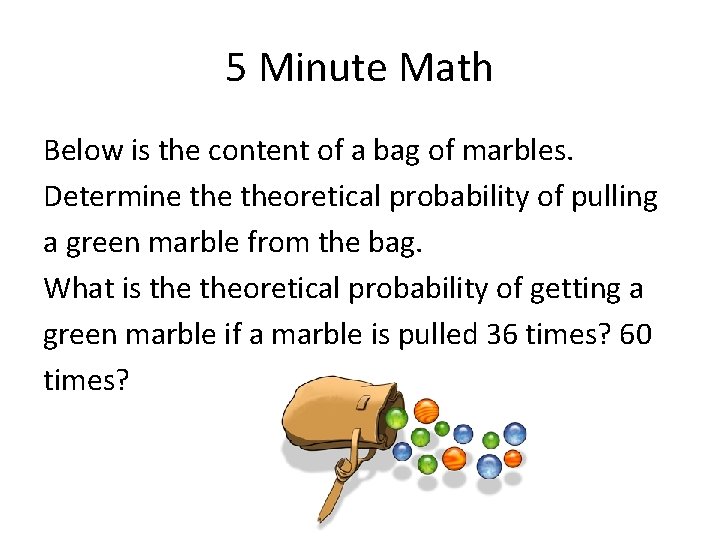
5 Minute Math Below is the content of a bag of marbles. Determine theoretical probability of pulling a green marble from the bag. What is theoretical probability of getting a green marble if a marble is pulled 36 times? 60 times?
Describing and Classifying Prisms & Pyramids Using Faces, Vertices and Edges 6. 3
Learning Goal We will recall our understanding of faces, vertices and edges so that we can identify different types of solids. We’ll know we’ve got it when we can describe and classify prisms and pyramids.
Vocabulary • • Curved bodies Edge Face Polyhedron Prism Pyramid Solid Vertex
Quick Reminder A solid is a 3 -dimensional figure formed by at least one closed surface. There are two categories of solids: curved bodies and polyhedrons.

Types of Solids: Curved Bodies Cylinder Cone Sphere These solids have at least 1 curved surface.
Types of Solids: Polyhedrons • These solids are formed by polygons (plane surfaces, or flat 2 -dimensional surfaces) • They are characterized by the number of faces, vertices and edges they have – Edge: a segment where 2 faces meet – Vertex: an intersecting point of at least 2 edges • There are two types of polyhedrons: prisms and pyramids
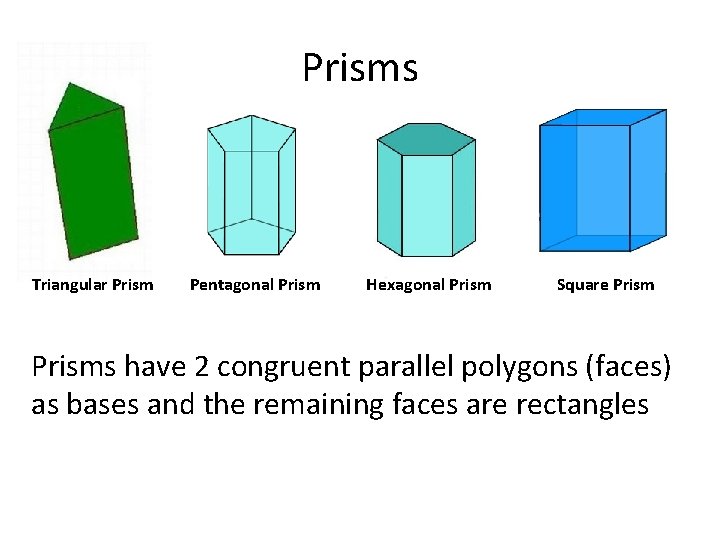
Prisms Triangular Prism Pentagonal Prism Hexagonal Prism Square Prisms have 2 congruent parallel polygons (faces) as bases and the remaining faces are rectangles
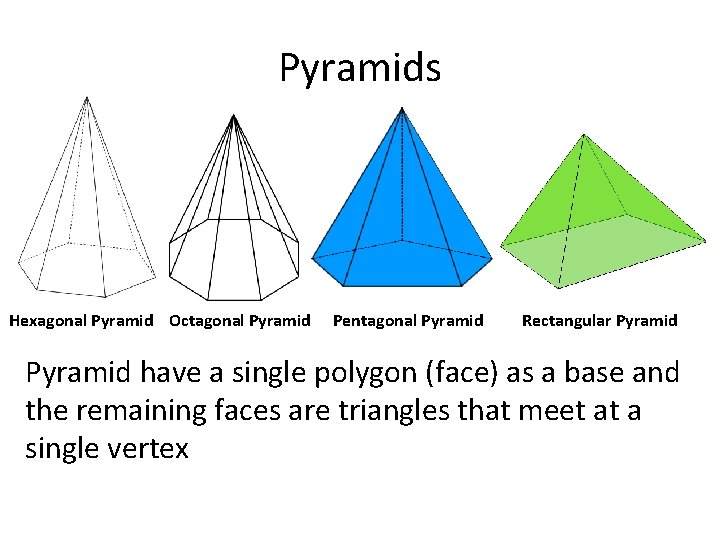
Pyramids Hexagonal Pyramid Octagonal Pyramid Pentagonal Pyramid Rectangular Pyramid have a single polygon (face) as a base and the remaining faces are triangles that meet at a single vertex
Let’s Practice Grade 5 Grade 6 • Page 87 • Page 91 – #1 • Page 88 • Page 92 – – #2 #3 #4 #5 – #2 – #3
- Slides: 10