
5 Life Tables Life table Describe the health


5 Life Tables

Life table Describe the health and longevity of an entire nation Identify the death rates experienced by a population over a given period of time Applications – mortality of a particular population, to make international comparisons, to compute insurance premiums and annuities, and to predict survival Rate – usually a group of 100, 000 persons Table 5. 1 Abridged life table for the total population, U. S. 1992 Abridged means ‘to make shorter’ Chapter 5 p 97
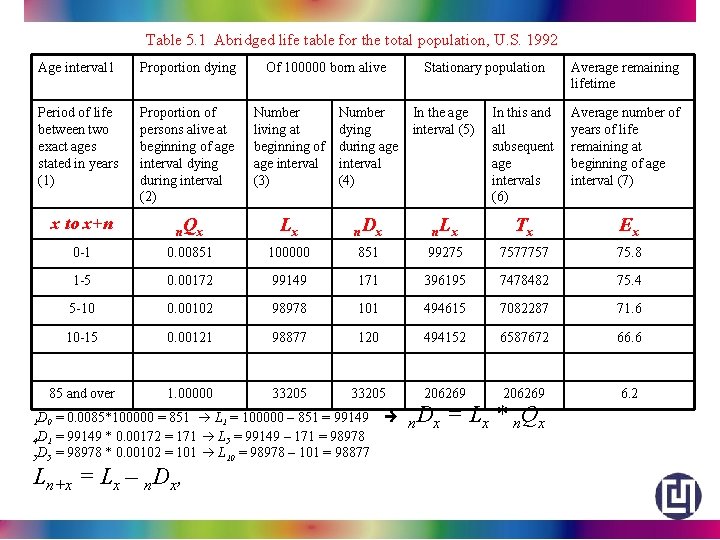
Table 5. 1 Abridged life table for the total population, U. S. 1992 Age interval 1 Proportion dying Of 100000 born alive Stationary population Period of life between two exact ages stated in years (1) Proportion of persons alive at beginning of age interval dying during interval (2) Number living at beginning of age interval (3) Number dying during age interval (4) In the age interval (5) In this and all subsequent age intervals (6) Average number of years of life remaining at beginning of age interval (7) x to x+n n Qx Lx n Dx n Lx Tx Ex 0 -1 0. 00851 100000 851 99275 7577757 75. 8 1 -5 0. 00172 99149 171 396195 7478482 75. 4 5 -10 0. 00102 98978 101 494615 7082287 71. 6 10 -15 0. 00121 98877 120 494152 6587672 66. 6 85 and over 1. 00000 33205 206269 6. 2 = 0. 0085*100000 = 851 L 1 = 100000 – 851 = 99149 n 4 D 1 = 99149 * 0. 00172 = 171 L 5 = 99149 – 171 = 98978 5 D 5 = 98978 * 0. 00102 = 101 L 10 = 98978 – 101 = 98877 1 D 0 Ln+x = Lx – n. Dx, D x = L x * n. Q x Average remaining lifetime
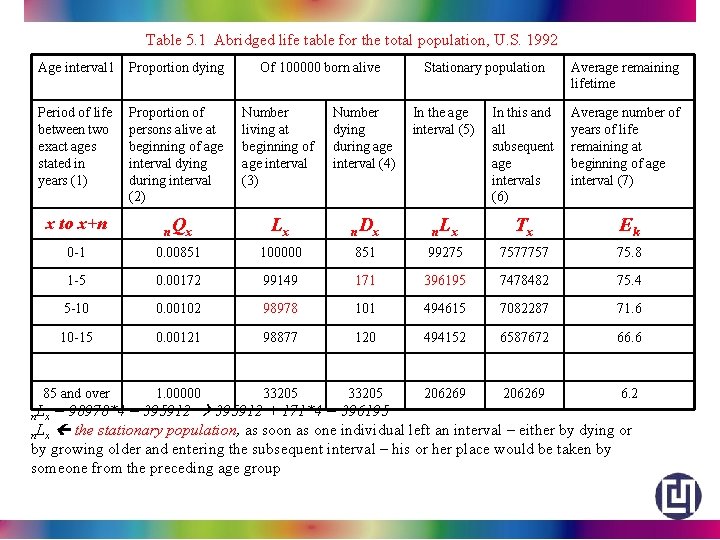
Table 5. 1 Abridged life table for the total population, U. S. 1992 Age interval 1 Proportion dying Of 100000 born alive Stationary population Average remaining lifetime Period of life between two exact ages stated in years (1) Proportion of persons alive at beginning of age interval dying during interval (2) Number living at beginning of age interval (3) Number dying during age interval (4) In the age interval (5) In this and all subsequent age intervals (6) Average number of years of life remaining at beginning of age interval (7) x to x+n n Qx Lx n Dx n Lx Tx Ek 0 -1 0. 00851 100000 851 99275 7577757 75. 8 1 -5 0. 00172 99149 171 396195 7478482 75. 4 5 -10 0. 00102 98978 101 494615 7082287 71. 6 10 -15 0. 00121 98877 120 494152 6587672 66. 6 85 and over 1. 00000 33205 206269 6. 2 = 98978*4 = 395912 + 171*4 = 396195 n. Lx the stationary population, as soon as one individual left an interval – either by dying or by growing older and entering the subsequent interval – his or her place would be taken by someone from the preceding age group n. Lx
Chapter 5 p 100
Chapter 5 p 102
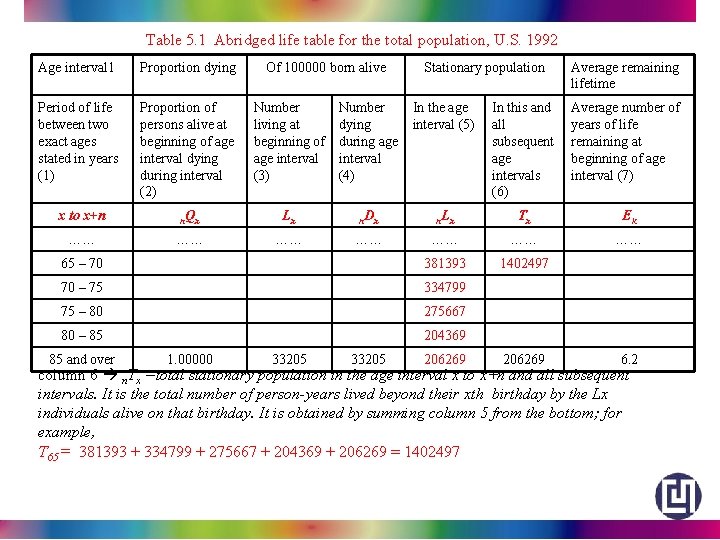
Table 5. 1 Abridged life table for the total population, U. S. 1992 Age interval 1 Proportion dying Period of life between two exact ages stated in years (1) Proportion of persons alive at beginning of age interval dying during interval (2) Number living at beginning of age interval (3) Number dying during age interval (4) In the age interval (5) In this and all subsequent age intervals (6) Average number of years of life remaining at beginning of age interval (7) x to x+n n. Qx Lx n. Dx n. Lx Tx Ek …… …… 65 – 70 381393 1402497 70 – 75 334799 75 – 80 275667 80 – 85 204369 85 and over 1. 00000 Of 100000 born alive 33205 Stationary population 206269 Average remaining lifetime 6. 2 column 6 n. Tx =total stationary population in the age interval x to x+n and all subsequent intervals. It is the total number of person-years lived beyond their xth birthday by the Lx individuals alive on that birthday. It is obtained by summing column 5 from the bottom; for example, T 65 = 381393 + 334799 + 275667 + 204369 + 206269 = 1402497
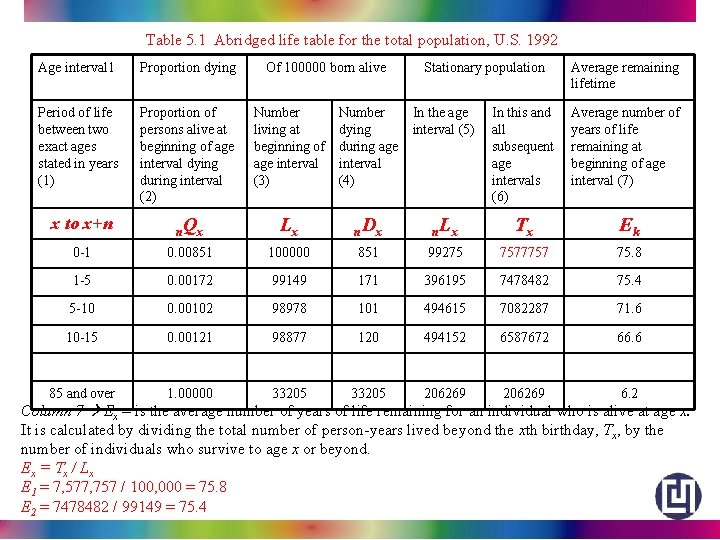
Table 5. 1 Abridged life table for the total population, U. S. 1992 Age interval 1 Proportion dying Of 100000 born alive Stationary population Average remaining lifetime Period of life between two exact ages stated in years (1) Proportion of persons alive at beginning of age interval dying during interval (2) Number living at beginning of age interval (3) Number dying during age interval (4) In the age interval (5) In this and all subsequent age intervals (6) Average number of years of life remaining at beginning of age interval (7) x to x+n n Qx Lx n Dx n Lx Tx Ek 0 -1 0. 00851 100000 851 99275 7577757 75. 8 1 -5 0. 00172 99149 171 396195 7478482 75. 4 5 -10 0. 00102 98978 101 494615 7082287 71. 6 10 -15 0. 00121 98877 120 494152 6587672 66. 6 85 and over 1. 00000 33205 206269 6. 2 Column 7 Ex = is the average number of years of life remaining for an individual who is alive at age x. It is calculated by dividing the total number of person-years lived beyond the xth birthday, Tx, by the number of individuals who survive to age x or beyond. E x = Tx / Lx E 1 = 7, 577, 757 / 100, 000 = 75. 8 E 2 = 7478482 / 99149 = 75. 4
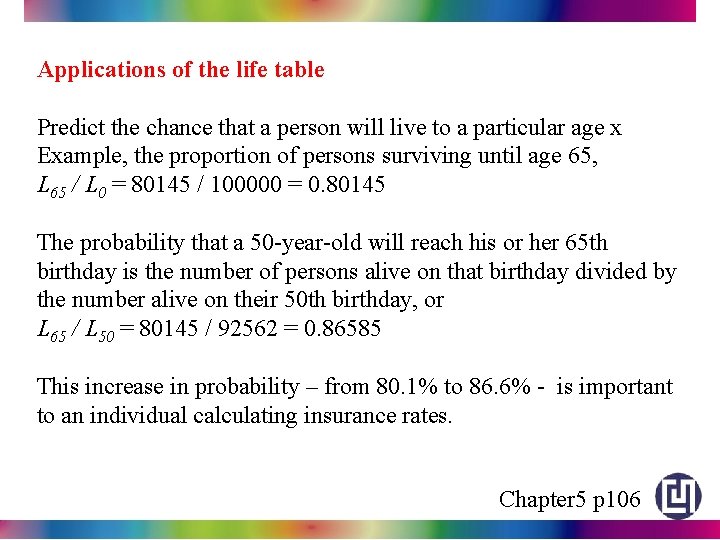
Applications of the life table Predict the chance that a person will live to a particular age x Example, the proportion of persons surviving until age 65, L 65 / L 0 = 80145 / 100000 = 0. 80145 The probability that a 50 -year-old will reach his or her 65 th birthday is the number of persons alive on that birthday divided by the number alive on their 50 th birthday, or L 65 / L 50 = 80145 / 92562 = 0. 86585 This increase in probability – from 80. 1% to 86. 6% - is important to an individual calculating insurance rates. Chapter 5 p 106
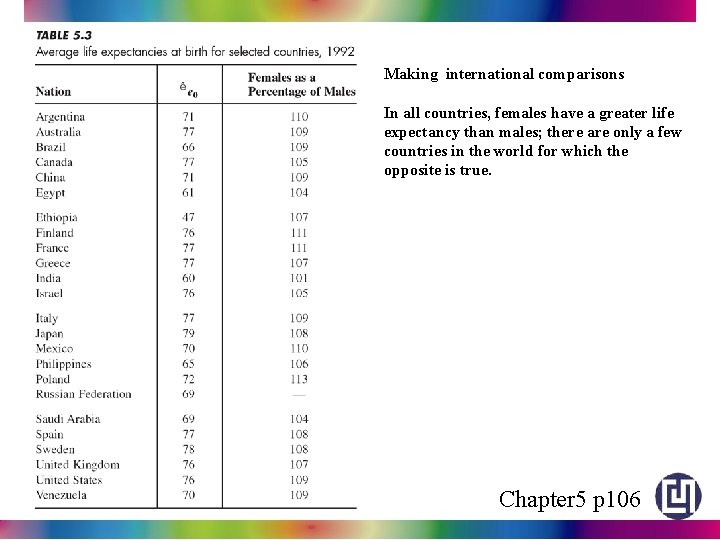
Making international comparisons In all countries, females have a greater life expectancy than males; there are only a few countries in the world for which the opposite is true. Chapter 5 p 106

Chapter 5 p 97
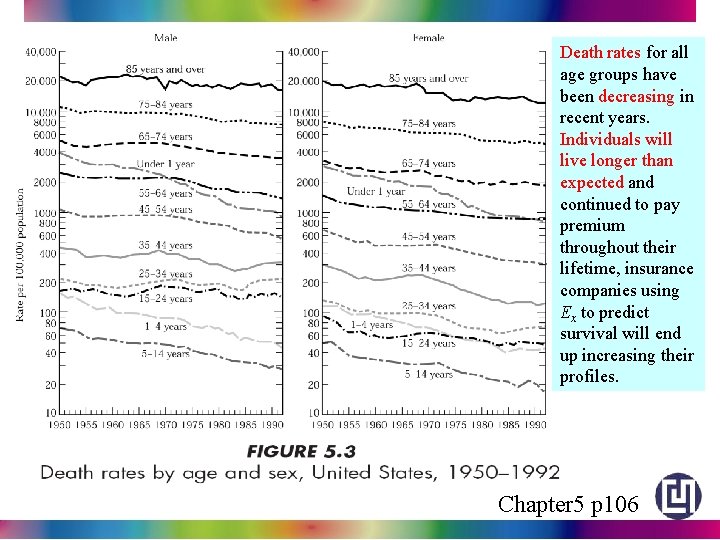
Death rates for all age groups have been decreasing in recent years. Individuals will live longer than expected and continued to pay premium throughout their lifetime, insurance companies using Ex to predict survival will end up increasing their profiles. Chapter 5 p 106
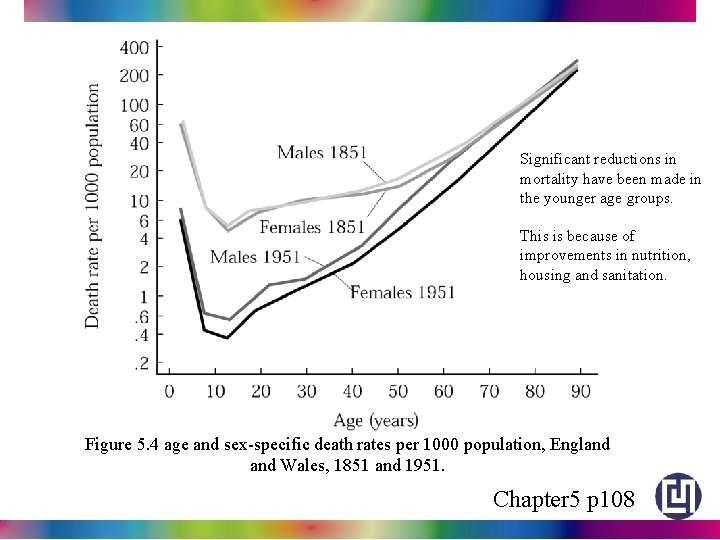
Significant reductions in mortality have been made in the younger age groups. This is because of improvements in nutrition, housing and sanitation. Figure 5. 4 age and sex-specific death rates per 1000 population, England Wales, 1851 and 1951. Chapter 5 p 108
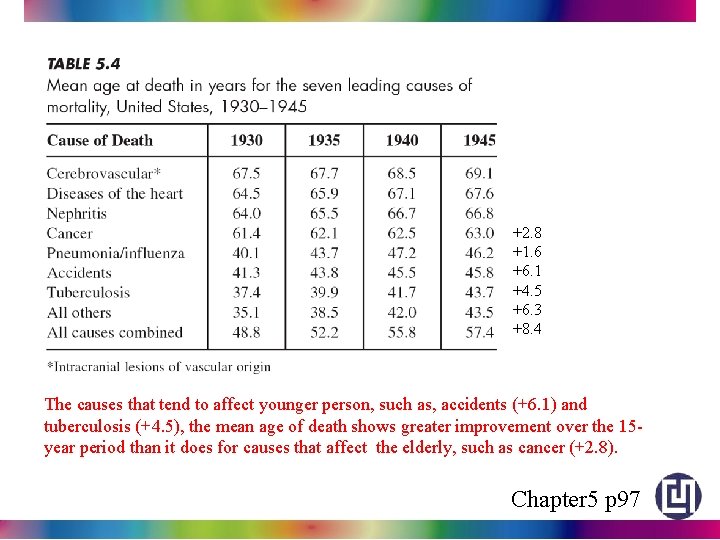
+2. 8 +1. 6 +6. 1 +4. 5 +6. 3 +8. 4 The causes that tend to affect younger person, such as, accidents (+6. 1) and tuberculosis (+4. 5), the mean age of death shows greater improvement over the 15 year period than it does for causes that affect the elderly, such as cancer (+2. 8). Chapter 5 p 97
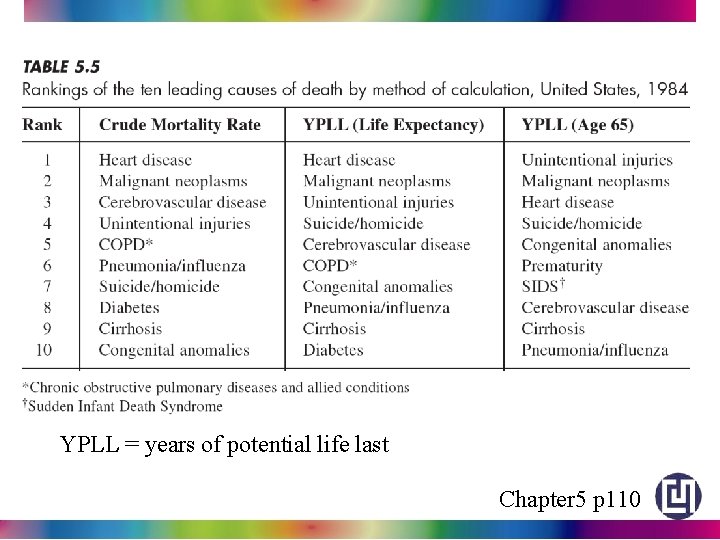
YPLL = years of potential life last Chapter 5 p 110

Chapter 5 p 97
- Slides: 17