
5 Introduction to software change Software change SC
- Slides: 29
5 Introduction to software change • Software change (SC) is the process of adding new functionality to existing code • Foundation of software evolution, servicing © 2012 Václav Rajlich Software Engineering: The Current Practice Ch. 5 1
Characteristics of SC • Lientz and Swanson – perfective ~66% – adaptive – corrective – protective © 2012 Václav Rajlich Software Engineering: The Current Practice Ch. 5 2
Functionality • Incremental – adding new functionality • Contraction – removing obsolete functionality • Replacement – replacing existing functionality • Refactoring – changing software structure without changing behavior © 2012 Václav Rajlich Software Engineering: The Current Practice Ch. 5 3
Impact • Local impact • Significant impact • Massive impact • Change strategy – improves structure – quick fix © 2012 Václav Rajlich Software Engineering: The Current Practice Ch. 5 4
Form of changing code • Source code – most common • Code after compilation – object form – executable form © 2012 Václav Rajlich Software Engineering: The Current Practice Ch. 5 5
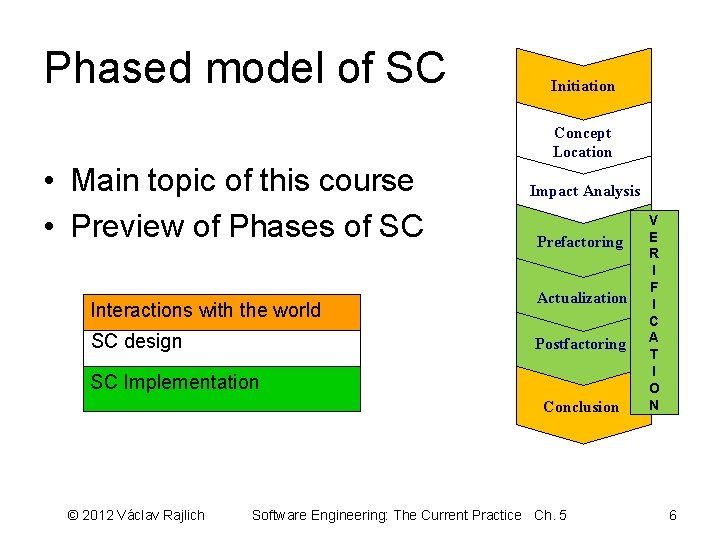
Phased model of SC Initiation Concept Location • Main topic of this course • Preview of Phases of SC Interactions with the world SC design Impact Analysis Prefactoring Actualization Postfactoring SC Implementation Conclusion © 2012 Václav Rajlich Software Engineering: The Current Practice Ch. 5 V E R I F I C A T I O N 6
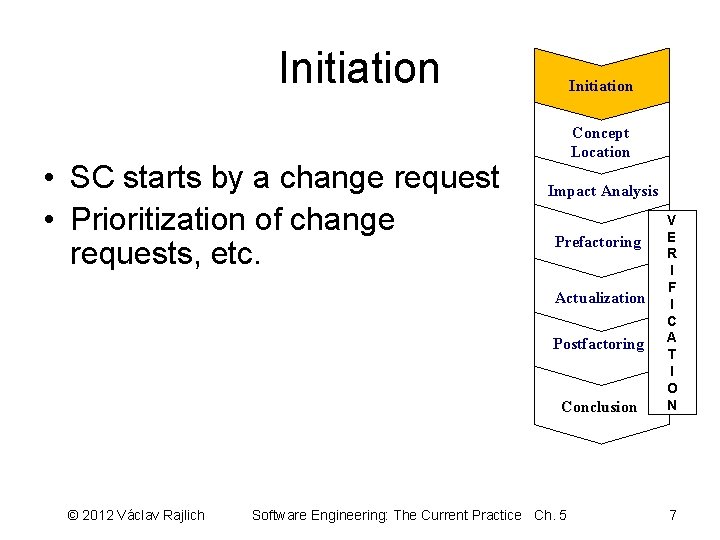
Initiation • SC starts by a change request • Prioritization of change requests, etc. Initiation Concept Location Impact Analysis Prefactoring Actualization Postfactoring Conclusion © 2012 Václav Rajlich Software Engineering: The Current Practice Ch. 5 V E R I F I C A T I O N 7
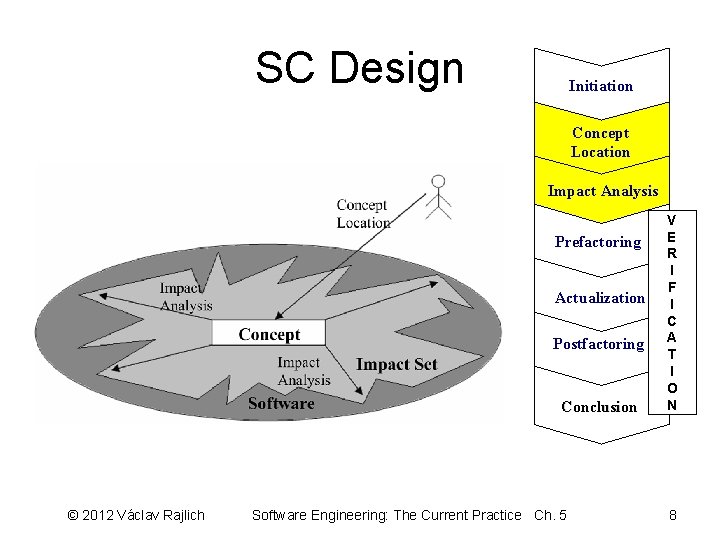
SC Design Initiation Concept Location Impact Analysis Prefactoring Actualization Postfactoring Conclusion © 2012 Václav Rajlich Software Engineering: The Current Practice Ch. 5 V E R I F I C A T I O N 8
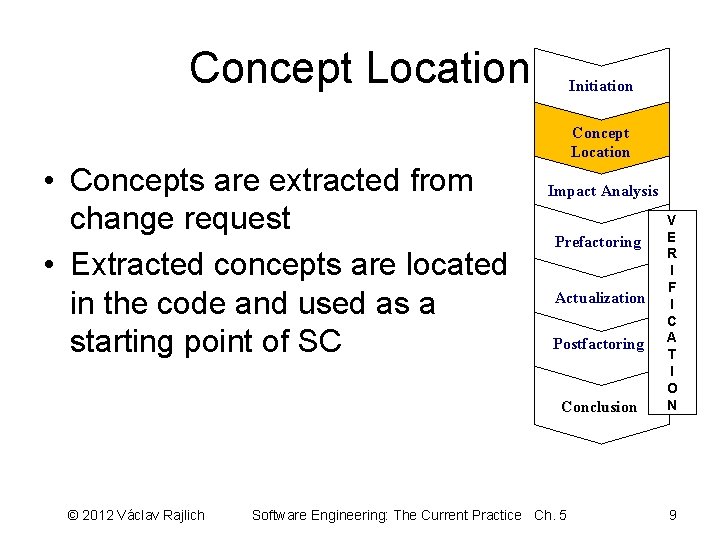
Concept Location Initiation Concept Location • Concepts are extracted from change request • Extracted concepts are located in the code and used as a starting point of SC Impact Analysis Prefactoring Actualization Postfactoring Conclusion © 2012 Václav Rajlich Software Engineering: The Current Practice Ch. 5 V E R I F I C A T I O N 9
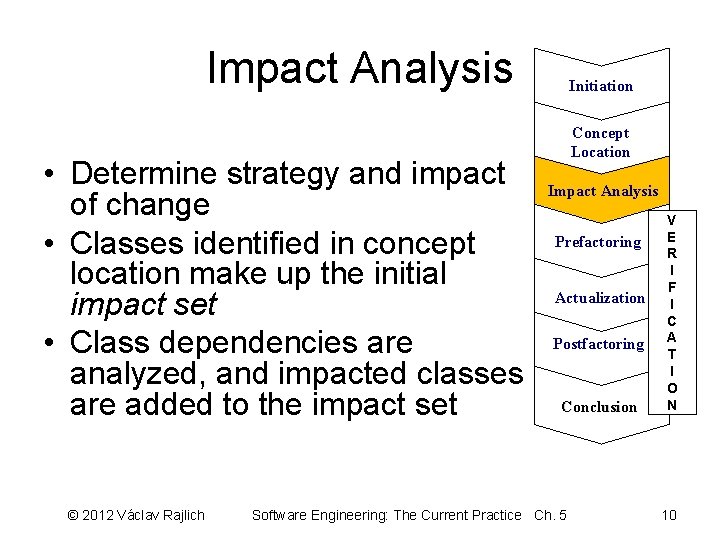
Impact Analysis • Determine strategy and impact of change • Classes identified in concept location make up the initial impact set • Class dependencies are analyzed, and impacted classes are added to the impact set © 2012 Václav Rajlich Initiation Concept Location Impact Analysis Prefactoring Actualization Postfactoring Conclusion Software Engineering: The Current Practice Ch. 5 V E R I F I C A T I O N 10
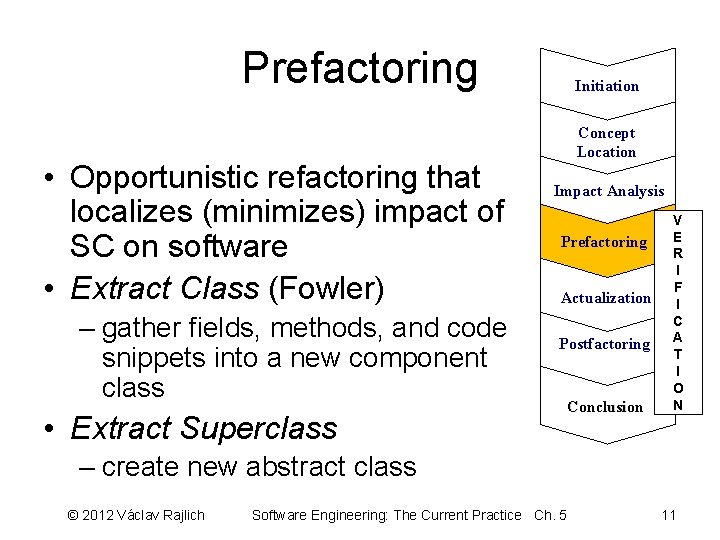
Prefactoring • Opportunistic refactoring that localizes (minimizes) impact of SC on software • Extract Class (Fowler) – gather fields, methods, and code snippets into a new component class • Extract Superclass Initiation Concept Location Impact Analysis Prefactoring Actualization Postfactoring Conclusion V E R I F I C A T I O N – create new abstract class © 2012 Václav Rajlich Software Engineering: The Current Practice Ch. 5 11
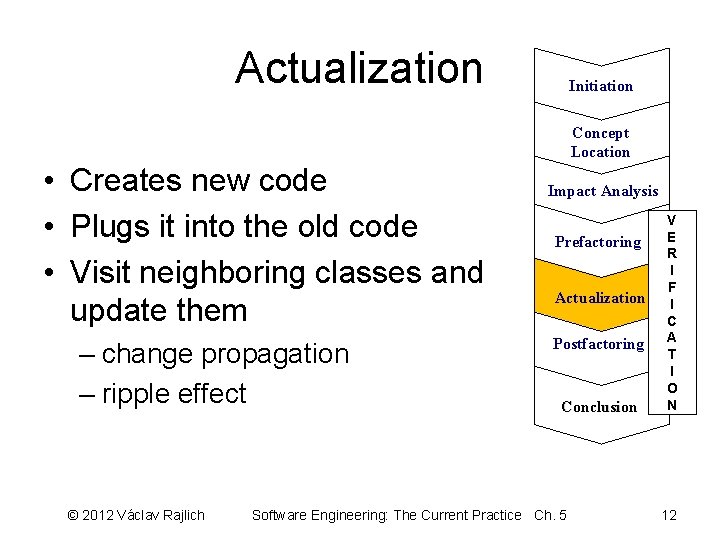
Actualization Initiation Concept Location • Creates new code • Plugs it into the old code • Visit neighboring classes and update them – change propagation – ripple effect © 2012 Václav Rajlich Impact Analysis Prefactoring Actualization Postfactoring Conclusion Software Engineering: The Current Practice Ch. 5 V E R I F I C A T I O N 12
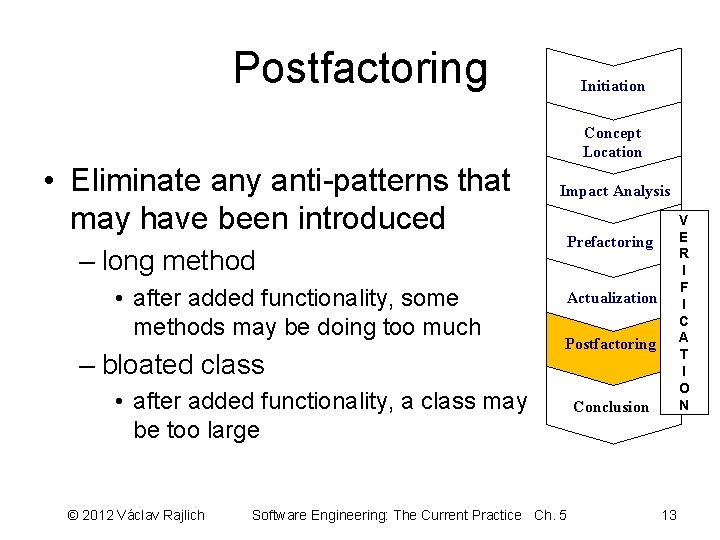
Postfactoring Initiation Concept Location • Eliminate any anti-patterns that may have been introduced – long method • after added functionality, some methods may be doing too much – bloated class Impact Analysis Prefactoring Actualization Postfactoring • after added functionality, a class may be too large © 2012 Václav Rajlich V E R I F I C A T I O N Software Engineering: The Current Practice Ch. 5 Conclusion 13
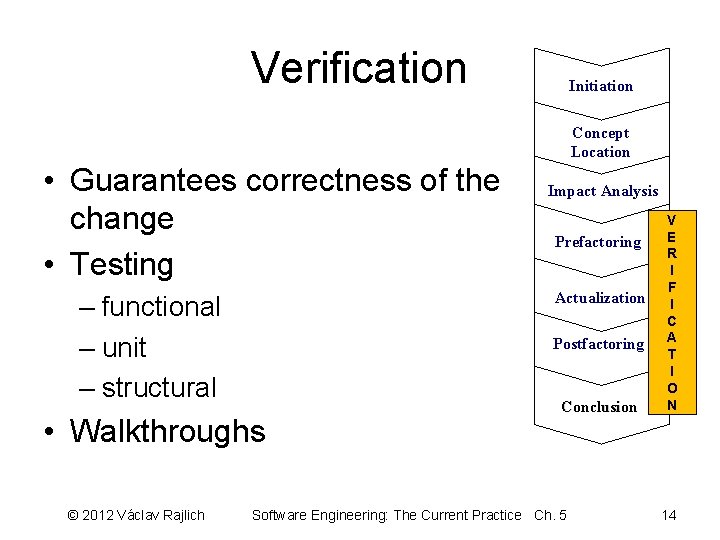
Verification Initiation Concept Location • Guarantees correctness of the change • Testing Prefactoring Actualization – functional – unit – structural Postfactoring • Walkthroughs © 2012 Václav Rajlich Impact Analysis Conclusion Software Engineering: The Current Practice Ch. 5 V E R I F I C A T I O N 14
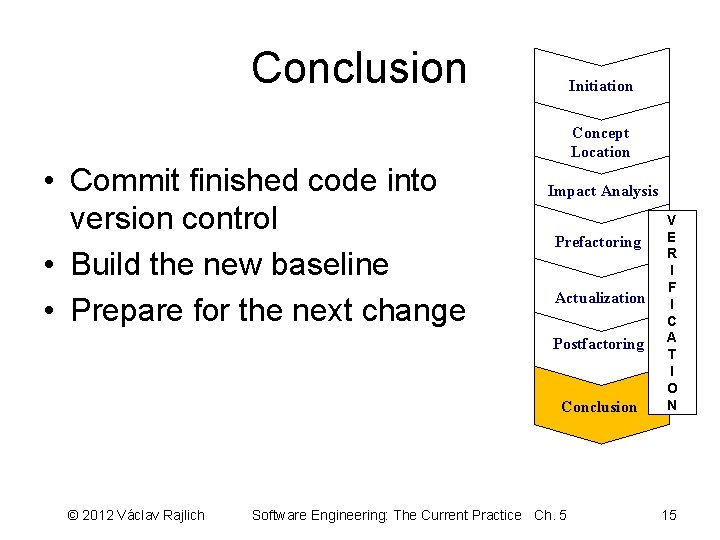
Conclusion Initiation Concept Location • Commit finished code into version control • Build the new baseline • Prepare for the next change Impact Analysis Prefactoring Actualization Postfactoring Conclusion © 2012 Václav Rajlich Software Engineering: The Current Practice Ch. 5 V E R I F I C A T I O N 15
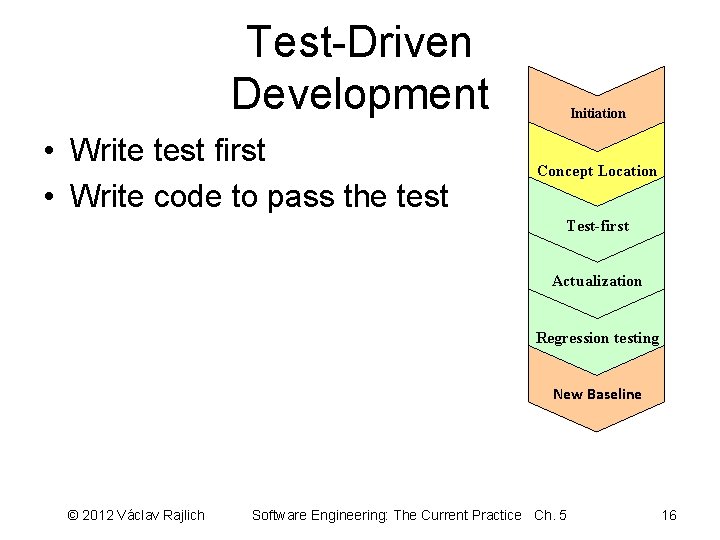
Test-Driven Development • Write test first • Write code to pass the test Initiation Concept Location Test-first Actualization Regression testing New Baseline © 2012 Václav Rajlich Software Engineering: The Current Practice Ch. 5 16
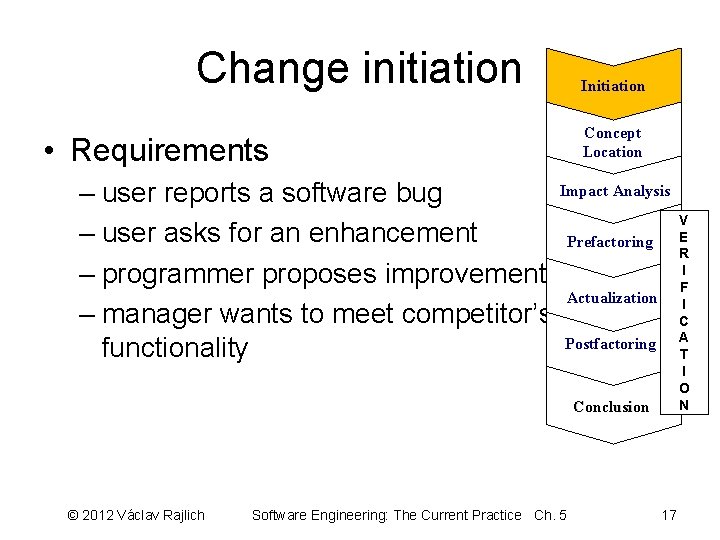
Change initiation • Requirements Initiation Concept Location Impact Analysis – user reports a software bug – user asks for an enhancement Prefactoring – programmer proposes improvement Actualization – manager wants to meet competitor’s Postfactoring functionality Conclusion © 2012 Václav Rajlich Software Engineering: The Current Practice Ch. 5 17 V E R I F I C A T I O N
Requirements form • Sentence or paragraph • Bug report • User story – limit the complexity of the story and potential for misunderstanding – user story fits on a 3” x 5” card – if a new functionality cannot fit, it has to be divided into several user stories © 2012 Václav Rajlich Software Engineering: The Current Practice Ch. 5 18
Sample User Stories • As a book shopper, I want to read reviews of a selected book to help me decide whether to buy it. • As an author, I want the spell checker to ignore words with numbers so that only truly misspelled words are indicated. © 2012 Václav Rajlich Software Engineering: The Current Practice Ch. 5 19
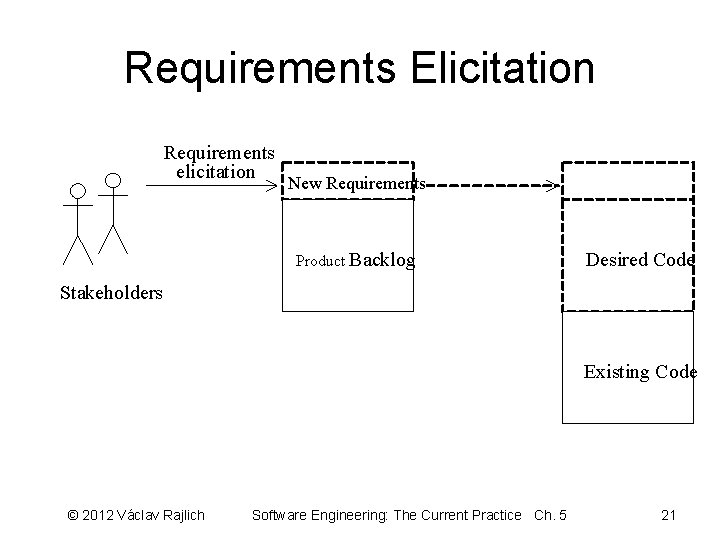
Product backlog • Database of requirements (“Wish list”) – Tools like Bugzilla/Jira • Add/delete/modify/reprioritize change requests – additional knowledge is acquired by the users – additional clarification is needed by the developers © 2012 Václav Rajlich Software Engineering: The Current Practice Ch. 5 20
Requirements Elicitation Requirements elicitation New Requirements Product Backlog Desired Code Stakeholders Existing Code © 2012 Václav Rajlich Software Engineering: The Current Practice Ch. 5 21
Requirements analysis • Inconsistencies – Contradictions • ex. different formula for the same thing – Inadequacy • ex. requirements are too terse -> developers have to guess © 2012 Václav Rajlich Software Engineering: The Current Practice Ch. 5 22
Inconsistencies (2) • Noise • ex. irrelevant requirements (delete them) • Unfeasibility • ex. project team or technology barriers • Ambiguity • ex. interpreting a requirement in more than one way © 2012 Václav Rajlich Software Engineering: The Current Practice Ch. 5 23
Prioritization - bugs • 1. Fatal application error • 2. Application is severely impaired – no workaround can be found • 3. Some functionality is impaired – workaround can be found • 4. Minor problem – not involving primary functionality © 2012 Václav Rajlich Software Engineering: The Current Practice Ch. 5 24
Business value • 1. An essential functionality without which the application is useless • 2. An important functionality that users rely on • 3. A functionality that users need but can be without • 4. A minor enhancement © 2012 Václav Rajlich Software Engineering: The Current Practice Ch. 5 25
Risk reduction • 1. A serious threat, the so-called “showstopper” – if unresolved, the project is in serious trouble • 2. An important threat that cannot be ignored • 3. A distant threat that still merits attention • 4. A minor inconveniences © 2012 Václav Rajlich Software Engineering: The Current Practice Ch. 5 26
Process needs • 1. Key requirement – if not implemented in advance, practically all code will have to be redone • 2. An important requirement – if postponed, will lead to large rework • 3. A nontrivial rework will be required if this requirement is postponed • 4. A minor rework will be triggered © 2012 Václav Rajlich Software Engineering: The Current Practice Ch. 5 27
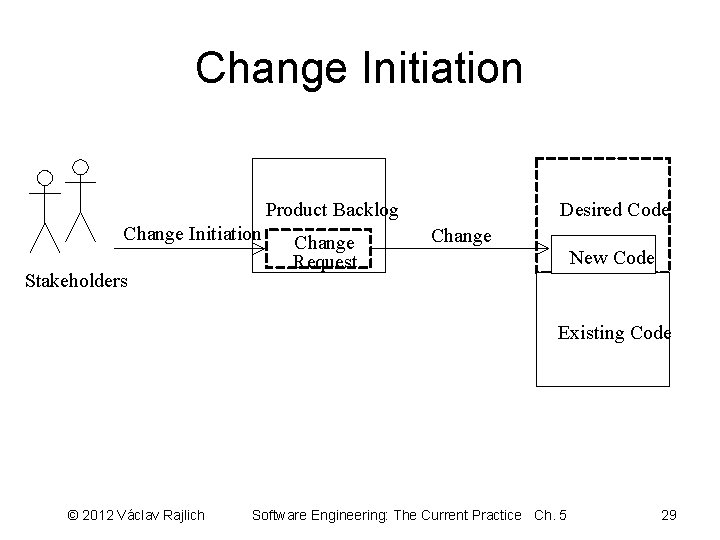
Change Initiation process • Select a set of the highest priority requirements • Analyze these requirements • After this analysis, select the highest priority requirement as the next change request © 2012 Václav Rajlich Software Engineering: The Current Practice Ch. 5 28
Change Initiation Product Backlog Change Initiation Stakeholders Change Request Desired Code Change New Code Existing Code © 2012 Václav Rajlich Software Engineering: The Current Practice Ch. 5 29