
5 Heisenbergs uncertainty principle One of the most
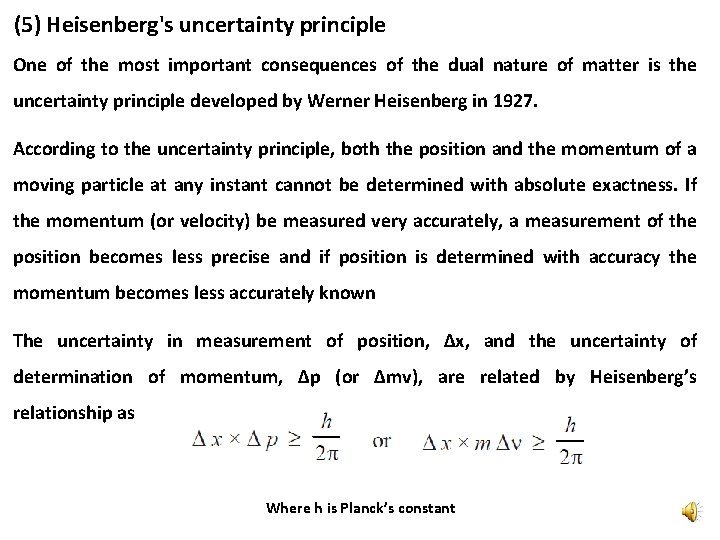
(5) Heisenberg's uncertainty principle One of the most important consequences of the dual nature of matter is the uncertainty principle developed by Werner Heisenberg in 1927. According to the uncertainty principle, both the position and the momentum of a moving particle at any instant cannot be determined with absolute exactness. If the momentum (or velocity) be measured very accurately, a measurement of the position becomes less precise and if position is determined with accuracy the momentum becomes less accurately known The uncertainty in measurement of position, Δx, and the uncertainty of determination of momentum, Δp (or Δmv), are related by Heisenberg’s relationship as Where h is Planck’s constant
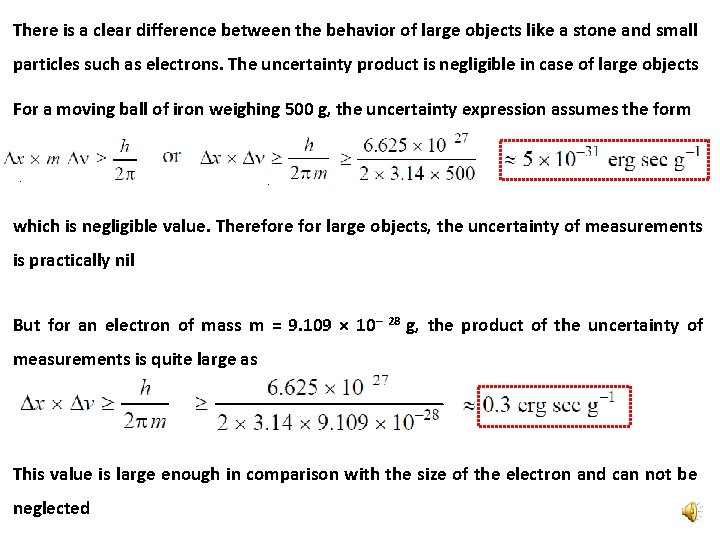
There is a clear difference between the behavior of large objects like a stone and small particles such as electrons. The uncertainty product is negligible in case of large objects For a moving ball of iron weighing 500 g, the uncertainty expression assumes the form which is negligible value. Therefore for large objects, the uncertainty of measurements is practically nil But for an electron of mass m = 9. 109 × 10– 28 g, the product of the uncertainty of measurements is quite large as This value is large enough in comparison with the size of the electron and can not be neglected

Q 5: Calculate the uncertainty in position of an electron if the uncertainty in velocity is 5. 7 × 10⁵ m sec– 1. Solution According to Heisenberg’s uncertainty principle On substitution we get:
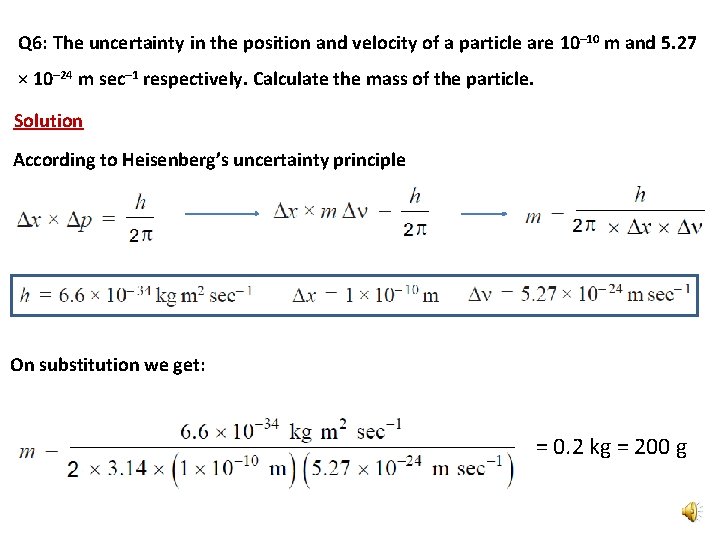
Q 6: The uncertainty in the position and velocity of a particle are 10– 10 m and 5. 27 × 10– 24 m sec– 1 respectively. Calculate the mass of the particle. Solution According to Heisenberg’s uncertainty principle On substitution we get: = 0. 2 kg = 200 g
- Slides: 4