
5 Habits of Highly INeffective Programmers 1 Design
5 Habits of Highly INeffective Programmers 1. Design with less than total focus 2. Disorganized code – Style, comments, design 3. Bite off more than you can chew – During implementation 4. Debug in a random walk 5. Program/debug in zombie mode – a. k. a. Don’t start early enough, don’t pace

7 Habits of Highly Effective People (Covey) 1. Be Proactive: Take initiative, seek new ideas 2. Begin with the end in mind: Have a goal 3. Put first things first: Prioritize, organize 4. Think win/win: Seek mutual benefits 5. Seek first to understand, then to be understood: Learn first, be adaptable 6. Synergize: Make the whole greater than the parts 7. Renewal: Physical, mental, spiritual, emotional
Problem-solving in the Large • In-the-small – There is an answer, the problem is to find it • In-the-large – Many possible solutions – More complex problems -> more alternative solutions – The goal is to pick the best solution
Problem-solving Process • • • Define the problem Generate solutions Analysis for deciding the course of action Implement the solution Evaluation
Problem Definition • • The first step is to define the “right problem” The “real problem” is often disguised Symptoms vs. root problem Example 1: – – Store had a rain forest health food mix It didn’t sell Perceived problem: overpriced Real problem: badly displayed
Example 2: Oil Recovery • Oil company had underperforming oil field • Perceived problem: “Find ways to improve the oil recovery” • After years of effort, still no improvement • Eventually discovered that the estimates of oil in field were wrong • Real problem: “Learn why the well was not producing well”
Example 3: Flow Meter • Flow meters in a chemical plant were being corroded and would leak • Perceived problem: “Find materials to make meter from that will not corrode” • After much effort, no such materials were found • Real problem: “Keep the flow meter from leaking” • Solution: Regularly replace (cheap) flow meters
Example 4: Gas from Coal • A coal-to-gas process was generating tar-like substances in pipes • Perceived problem: “Improve the solvents used to dissolve the coal to avoid the tar” • No solvent was found that worked • Real problem (generalize): “Determine why tar deposits are forming, and avoid them” • Solution: Increase velocity in pipes gives coal and solvent less time to react and scours pipes clean
First Four Steps: Problem Definition 1. Collect and analyze information and data – – List every relevent thing you can think of. Fill in missing gaps 2. Talk with people familiar with the problem – – Look past the obvious get clarifications when you don’t understand 3. If at all possible, view the problem first hand 4. Confirm all findings.
Examples • Hotel needs new elevators: – New shafts would cut rooms, etc – Doorman suggested adding elevator to outside of building • Plastics factory: – New factory generated defective plastic – Extensive analysis of design and materials detected no flaw – Eventually an engineer decided to look at the plant – A valve was set wrong, and no coolant reached the equipment
Problem Statement • Check out the problem statement: 1. Where did the problem originate? 2. Who posed the problem statement? Your boss? Their boss? Colleague? Client? 3. Can that person explain their reasoning? 4. Are the reasoning and assumptions valid? 5. Has that person considered different viewpoints? 6. Have you used steps 1 -4 to gather information? Always check the problem statement.
Present State vs. Desired State • • Define the present state Define the desired state Make sure both are precise Make sure they match
Example • Situation: Too many bombers in WWII shot down. Many come back with bullet holes in similar spots • Perceived problem: – Reinforced damaged areas with thicker armor plating • Mismatch: – Present: Many bullets penetrating aircraft – Desired: Fewer planes being shot down • Not a match because surviving planes have bullet holes
Example (cont) • New statements: – Present: Many bullets penetrating critical and noncritical areas – Desired: Fewer bullets penetrating critical areas • These statements match • This focuses on the real problem • The original solution “fixed” something that wasn’t causing the real problem – Planes with holes in non-critical areas were not the ones shot down
Dunker Diagram • Trees in two dimensions 1. Steps: • Goal • What to do • How to do it 2. Desired state vs. Make present state OK • Example: Find a better job 1. Find a better job 2. Make present job OK
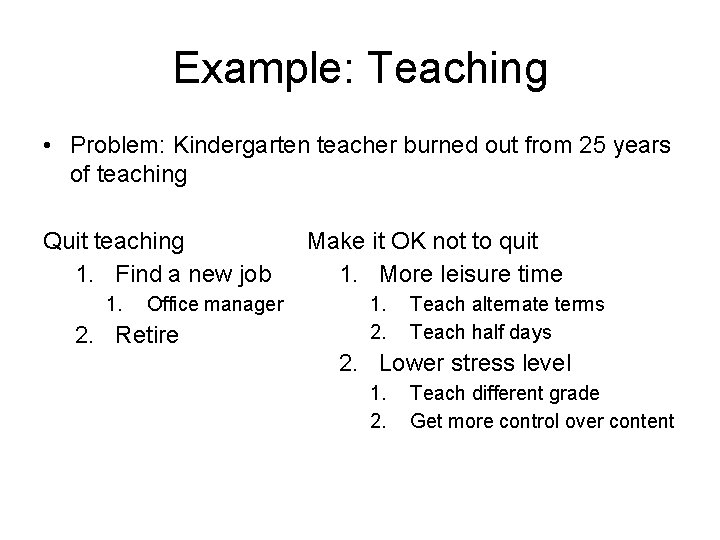
Example: Teaching • Problem: Kindergarten teacher burned out from 25 years of teaching Quit teaching 1. Find a new job 1. Office manager 2. Retire Make it OK not to quit 1. More leisure time 1. 2. Teach alternate terms Teach half days 2. Lower stress level 1. 2. Teach different grade Get more control over content
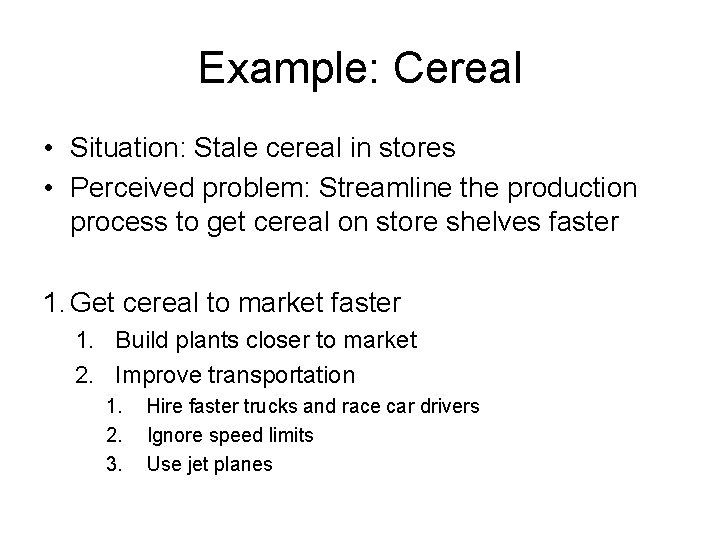
Example: Cereal • Situation: Stale cereal in stores • Perceived problem: Streamline the production process to get cereal on store shelves faster 1. Get cereal to market faster 1. Build plants closer to market 2. Improve transportation 1. 2. 3. Hire faster trucks and race car drivers Ignore speed limits Use jet planes
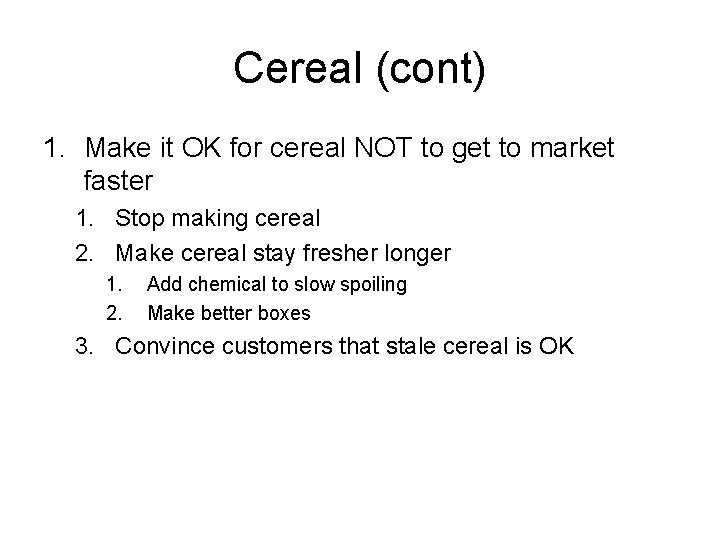
Cereal (cont) 1. Make it OK for cereal NOT to get to market faster 1. Stop making cereal 2. Make cereal stay fresher longer 1. 2. Add chemical to slow spoiling Make better boxes 3. Convince customers that stale cereal is OK
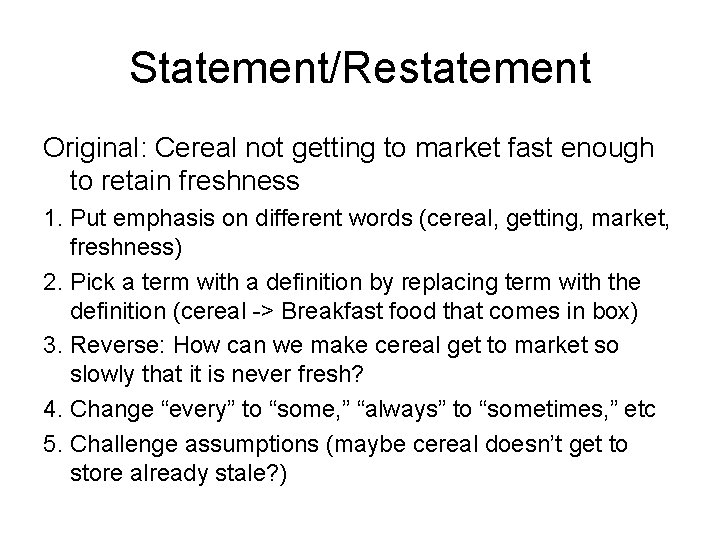
Statement/Restatement Original: Cereal not getting to market fast enough to retain freshness 1. Put emphasis on different words (cereal, getting, market, freshness) 2. Pick a term with a definition by replacing term with the definition (cereal -> Breakfast food that comes in box) 3. Reverse: How can we make cereal get to market so slowly that it is never fresh? 4. Change “every” to “some, ” “always” to “sometimes, ” etc 5. Challenge assumptions (maybe cereal doesn’t get to store already stale? )
- Slides: 19