
5 Grammar cohesion part II Cohesion and coherence

- Slides: 19
5_ Grammar cohesion (part II)
Cohesion and coherence
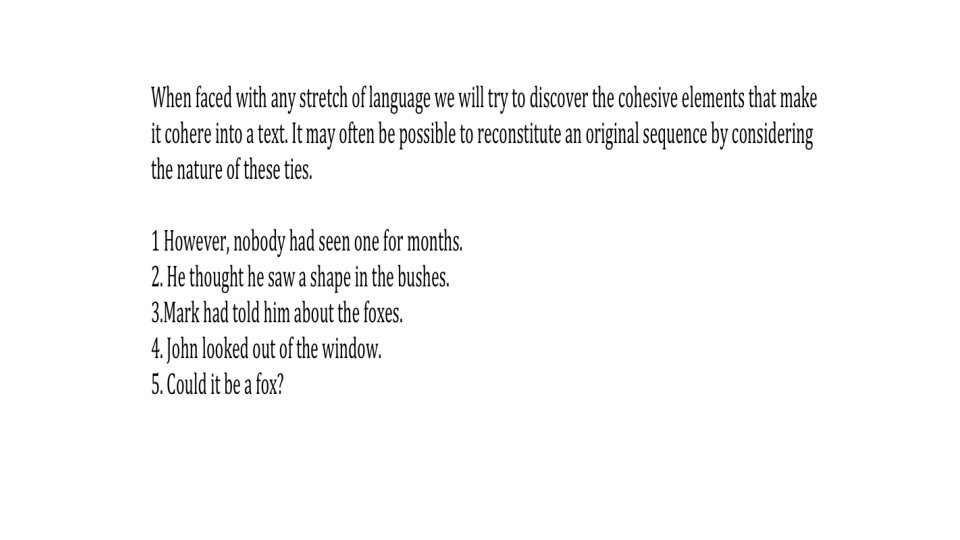
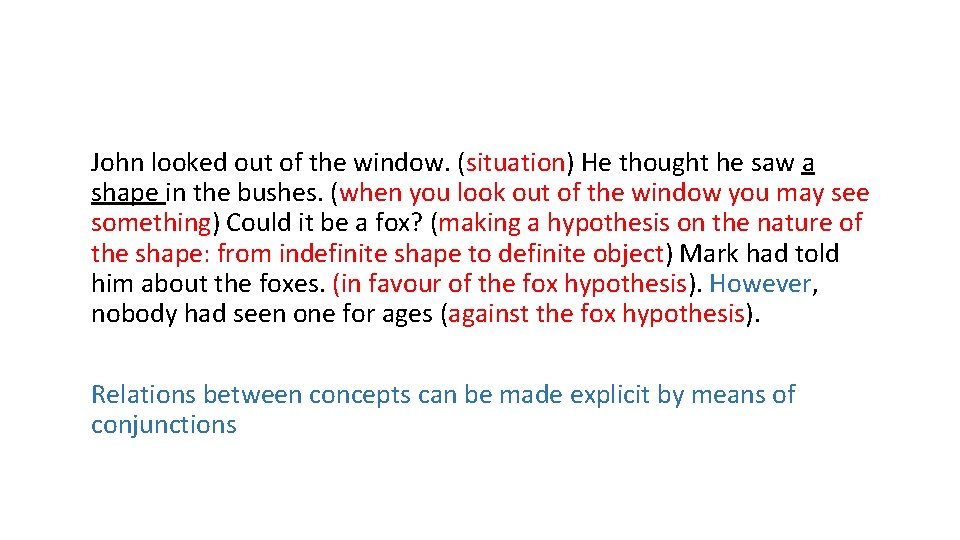
John looked out of the window. (situation) He thought he saw a shape in the bushes. (when you look out of the window you may see something) Could it be a fox? (making a hypothesis on the nature of the shape: from indefinite shape to definite object) Mark had told him about the foxes. (in favour of the fox hypothesis). However, nobody had seen one for ages (against the fox hypothesis). Relations between concepts can be made explicit by means of conjunctions
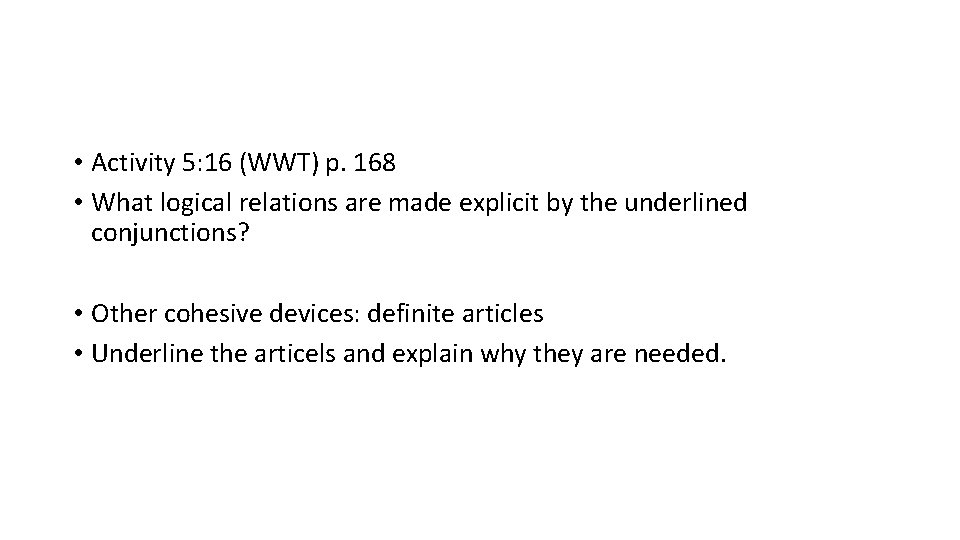
• Activity 5: 16 (WWT) p. 168 • What logical relations are made explicit by the underlined conjunctions? • Other cohesive devices: definite articles • Underline the articels and explain why they are needed.
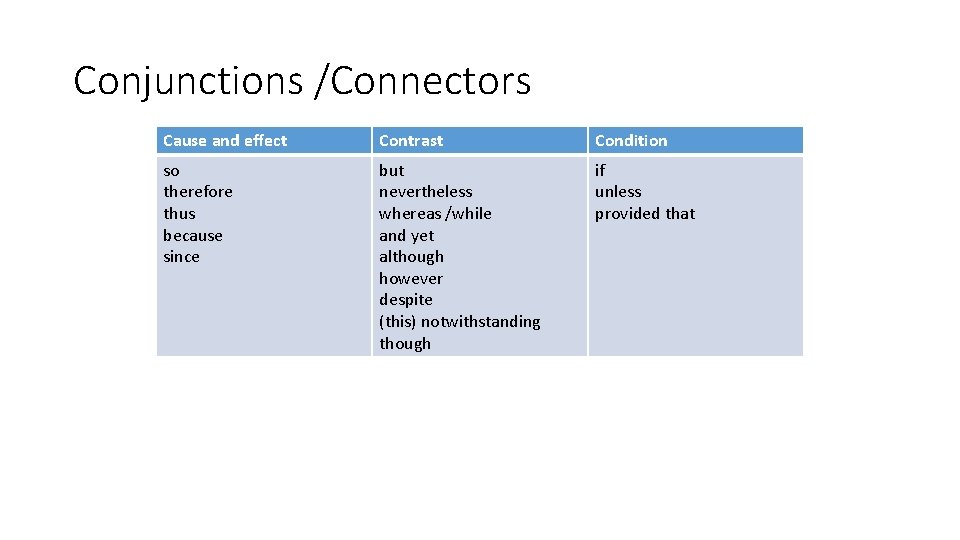
Conjunctions /Connectors Cause and effect Contrast Condition so therefore thus because since but nevertheless whereas /while and yet although however despite (this) notwithstanding though if unless provided that
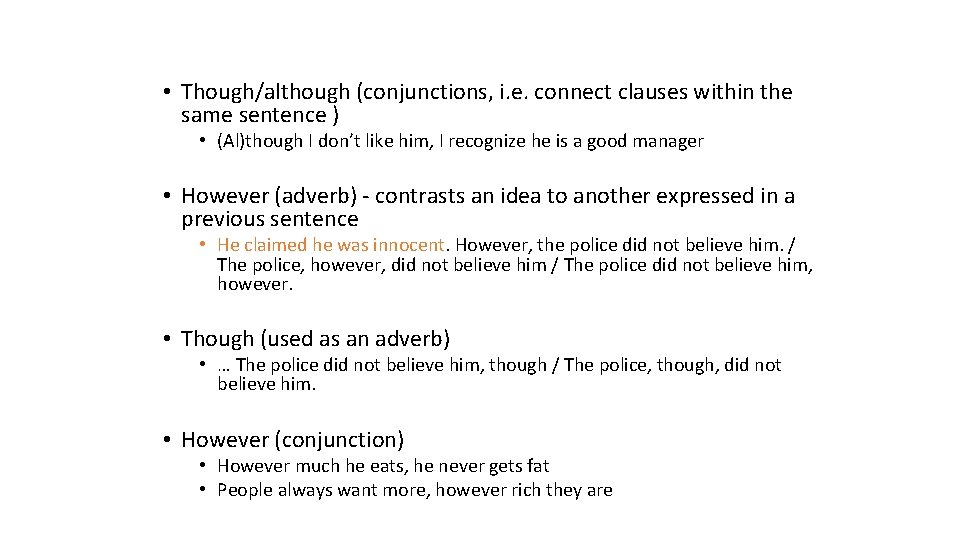
• Though/although (conjunctions, i. e. connect clauses within the same sentence ) • (Al)though I don’t like him, I recognize he is a good manager • However (adverb) - contrasts an idea to another expressed in a previous sentence • He claimed he was innocent. However, the police did not believe him. / The police, however, did not believe him / The police did not believe him, however. • Though (used as an adverb) • … The police did not believe him, though / The police, though, did not believe him. • However (conjunction) • However much he eats, he never gets fat • People always want more, however rich they are
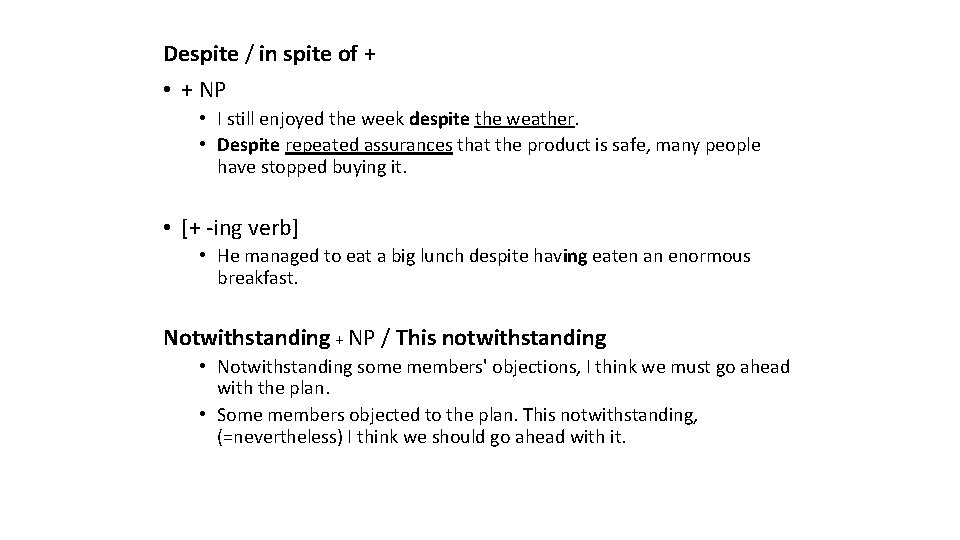
Despite / in spite of + • + NP • I still enjoyed the week despite the weather. • Despite repeated assurances that the product is safe, many people have stopped buying it. • [+ -ing verb] • He managed to eat a big lunch despite having eaten an enormous breakfast. Notwithstanding + NP / This notwithstanding • Notwithstanding some members' objections, I think we must go ahead with the plan. • Some members objected to the plan. This notwithstanding, (=nevertheless) I think we should go ahead with it.
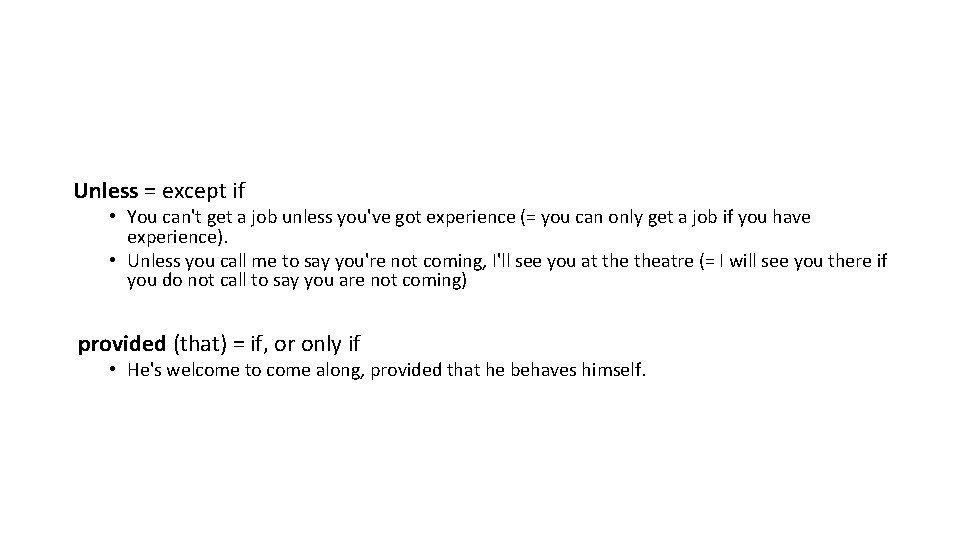
Unless = except if • You can't get a job unless you've got experience (= you can only get a job if you have experience). • Unless you call me to say you're not coming, I'll see you at theatre (= I will see you there if you do not call to say you are not coming) provided (that) = if, or only if • He's welcome to come along, provided that he behaves himself.
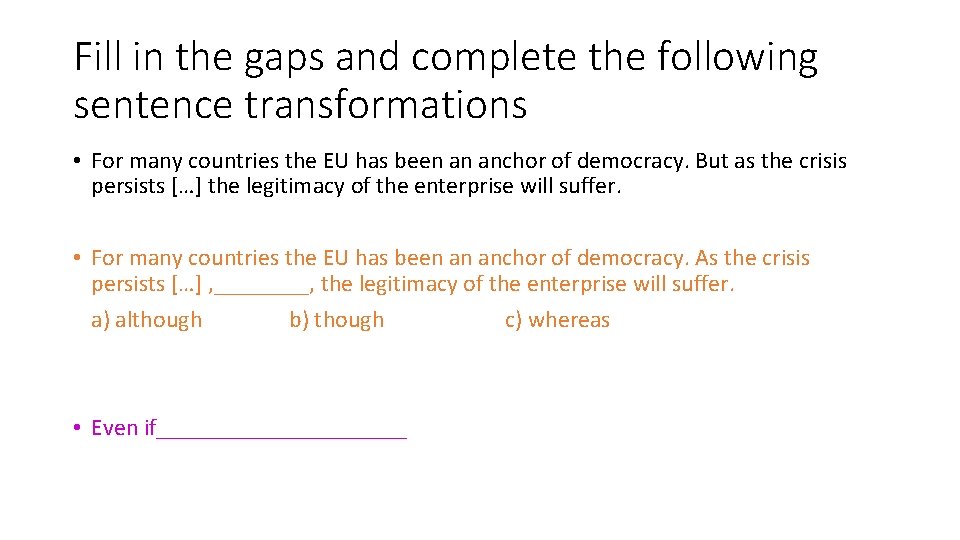
Fill in the gaps and complete the following sentence transformations • For many countries the EU has been an anchor of democracy. But as the crisis persists […] the legitimacy of the enterprise will suffer. • For many countries the EU has been an anchor of democracy. As the crisis persists […] , ____, the legitimacy of the enterprise will suffer. a) although b) though c) whereas • Even if___________
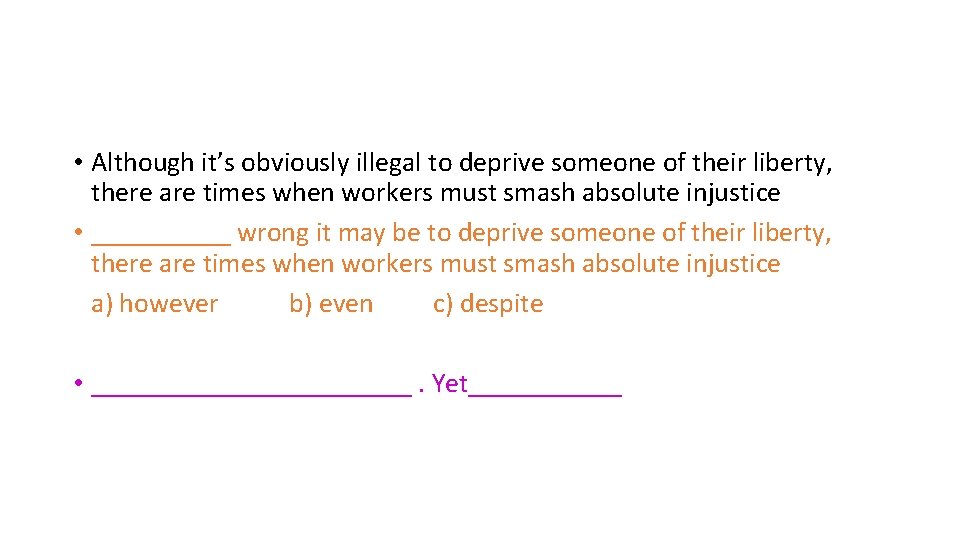
• Although it’s obviously illegal to deprive someone of their liberty, there are times when workers must smash absolute injustice • _____ wrong it may be to deprive someone of their liberty, there are times when workers must smash absolute injustice a) however b) even c) despite • ____________. Yet______
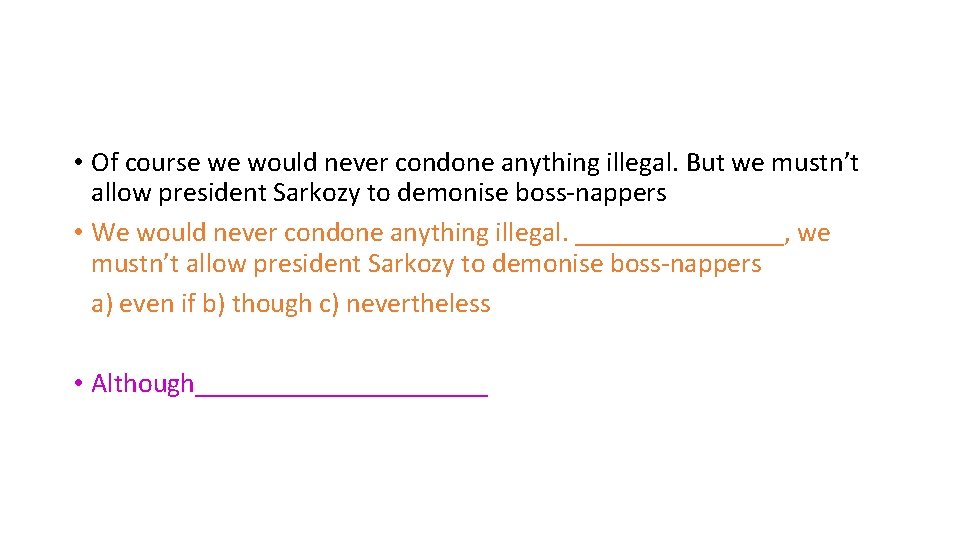
• Of course we would never condone anything illegal. But we mustn’t allow president Sarkozy to demonise boss-nappers • We would never condone anything illegal. ________, we mustn’t allow president Sarkozy to demonise boss-nappers a) even if b) though c) nevertheless • Although___________
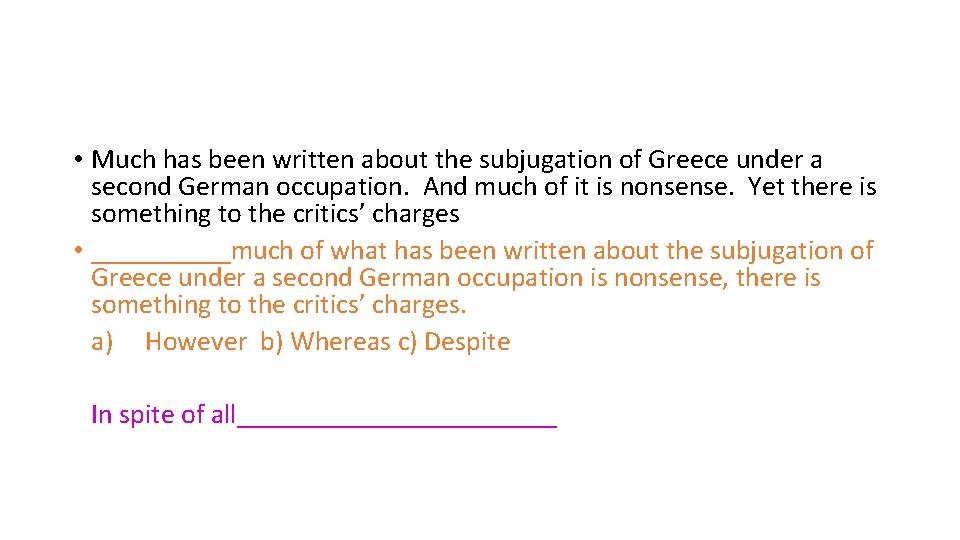
• Much has been written about the subjugation of Greece under a second German occupation. And much of it is nonsense. Yet there is something to the critics’ charges • _____much of what has been written about the subjugation of Greece under a second German occupation is nonsense, there is something to the critics’ charges. a) However b) Whereas c) Despite In spite of all____________
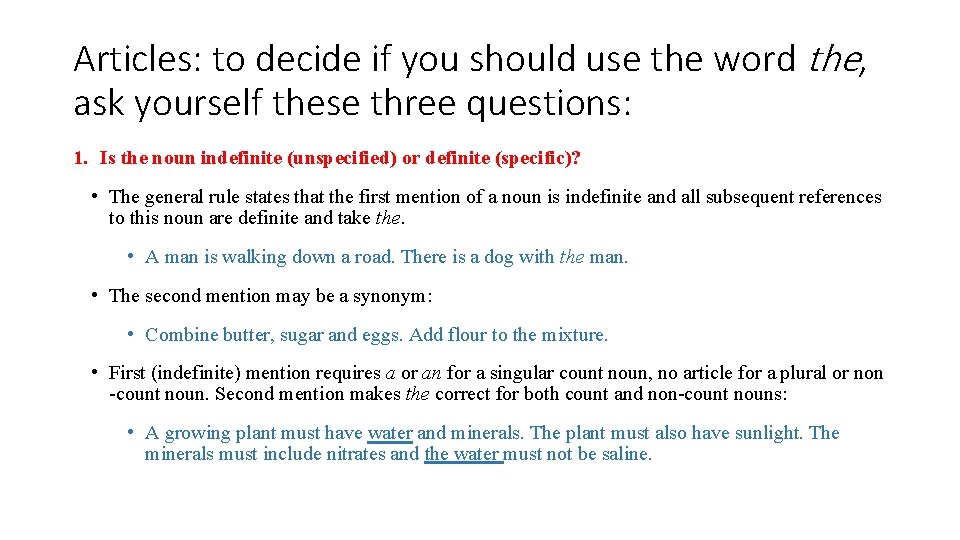
Articles: to decide if you should use the word the, ask yourself these three questions: 1. Is the noun indefinite (unspecified) or definite (specific)? • The general rule states that the first mention of a noun is indefinite and all subsequent references to this noun are definite and take the. • A man is walking down a road. There is a dog with the man. • The second mention may be a synonym: • Combine butter, sugar and eggs. Add flour to the mixture. • First (indefinite) mention requires a or an for a singular count noun, no article for a plural or non -count noun. Second mention makes the correct for both count and non-count nouns: • A growing plant must have water and minerals. The plant must also have sunlight. The minerals must include nitrates and the water must not be saline.
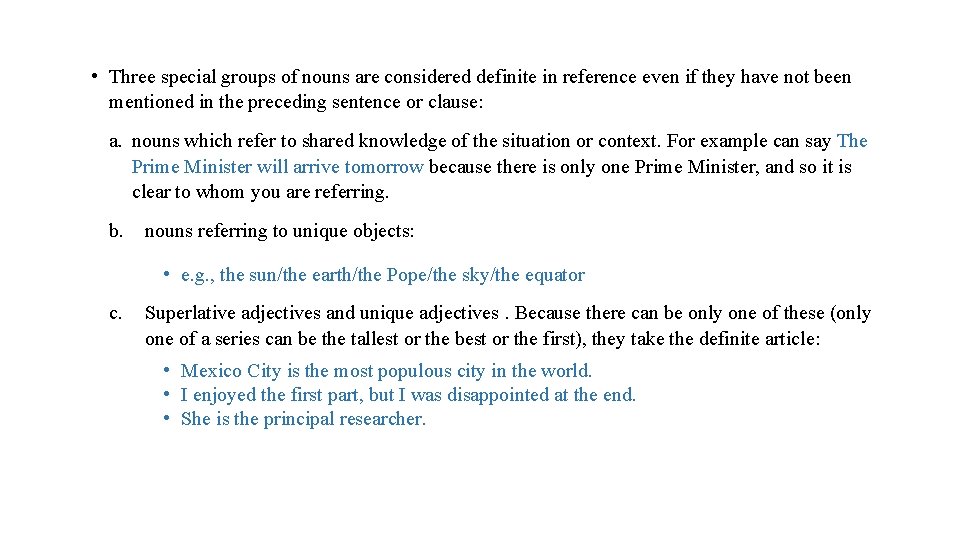
• Three special groups of nouns are considered definite in reference even if they have not been mentioned in the preceding sentence or clause: a. nouns which refer to shared knowledge of the situation or context. For example can say The Prime Minister will arrive tomorrow because there is only one Prime Minister, and so it is clear to whom you are referring. b. nouns referring to unique objects: • e. g. , the sun/the earth/the Pope/the sky/the equator c. Superlative adjectives and unique adjectives. Because there can be only one of these (only one of a series can be the tallest or the best or the first), they take the definite article: • Mexico City is the most populous city in the world. • I enjoyed the first part, but I was disappointed at the end. • She is the principal researcher.
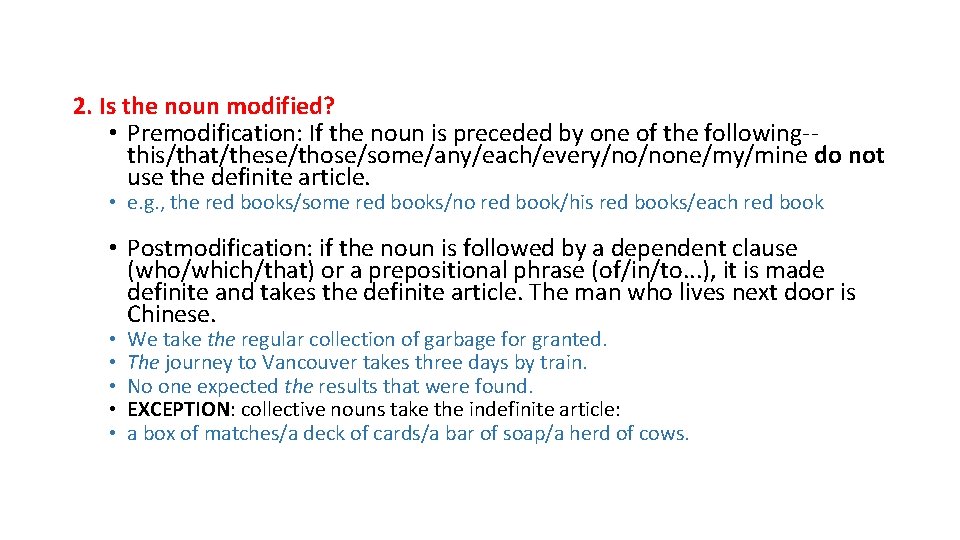
2. Is the noun modified? • Premodification: If the noun is preceded by one of the following-this/that/these/those/some/any/each/every/no/none/my/mine do not use the definite article. • e. g. , the red books/some red books/no red book/his red books/each red book • Postmodification: if the noun is followed by a dependent clause (who/which/that) or a prepositional phrase (of/in/to. . . ), it is made definite and takes the definite article. The man who lives next door is Chinese. • • • We take the regular collection of garbage for granted. The journey to Vancouver takes three days by train. No one expected the results that were found. EXCEPTION: collective nouns take the indefinite article: a box of matches/a deck of cards/a bar of soap/a herd of cows.
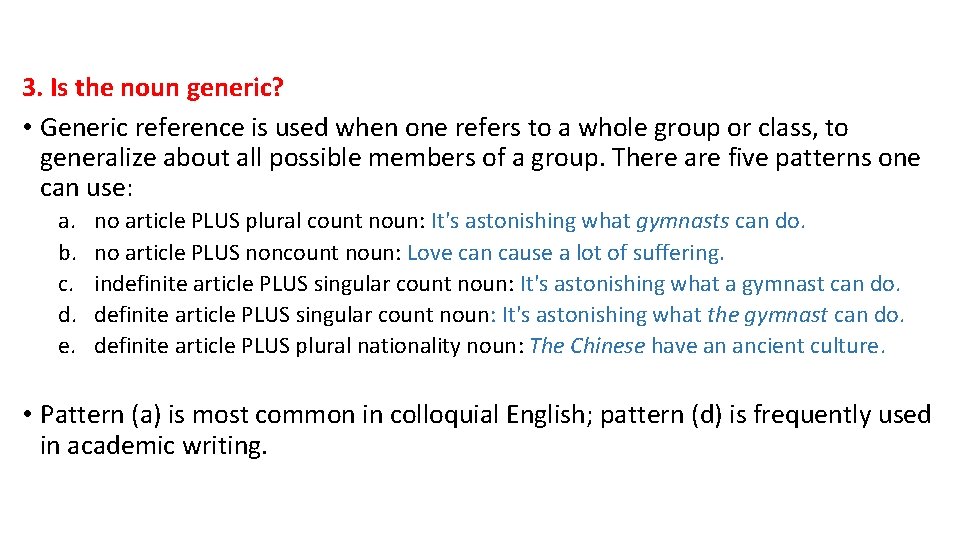
3. Is the noun generic? • Generic reference is used when one refers to a whole group or class, to generalize about all possible members of a group. There are five patterns one can use: a. b. c. d. e. no article PLUS plural count noun: It's astonishing what gymnasts can do. no article PLUS noncount noun: Love can cause a lot of suffering. indefinite article PLUS singular count noun: It's astonishing what a gymnast can do. definite article PLUS singular count noun: It's astonishing what the gymnast can do. definite article PLUS plural nationality noun: The Chinese have an ancient culture. • Pattern (a) is most common in colloquial English; pattern (d) is frequently used in academic writing.
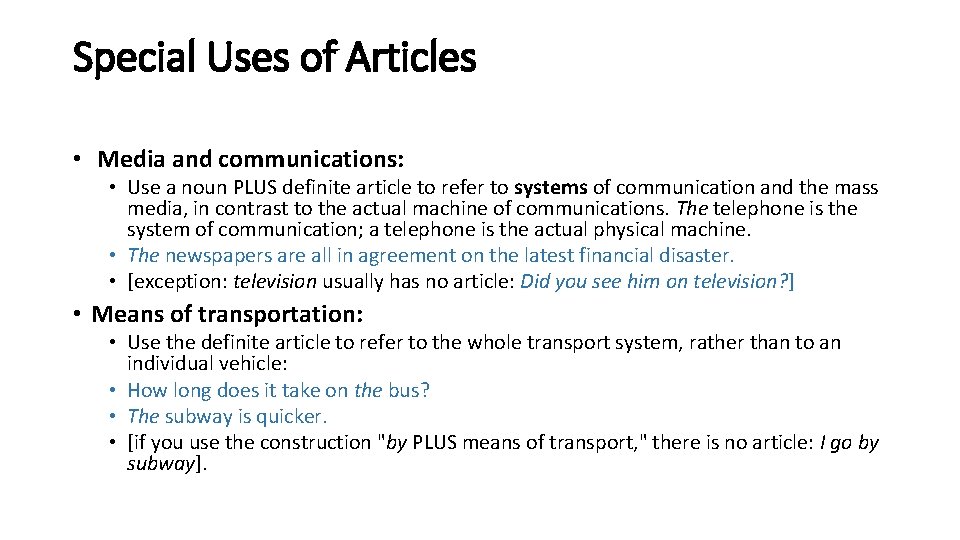
Special Uses of Articles • Media and communications: • Use a noun PLUS definite article to refer to systems of communication and the mass media, in contrast to the actual machine of communications. The telephone is the system of communication; a telephone is the actual physical machine. • The newspapers are all in agreement on the latest financial disaster. • [exception: television usually has no article: Did you see him on television? ] • Means of transportation: • Use the definite article to refer to the whole transport system, rather than to an individual vehicle: • How long does it take on the bus? • The subway is quicker. • [if you use the construction "by PLUS means of transport, " there is no article: I go by subway].
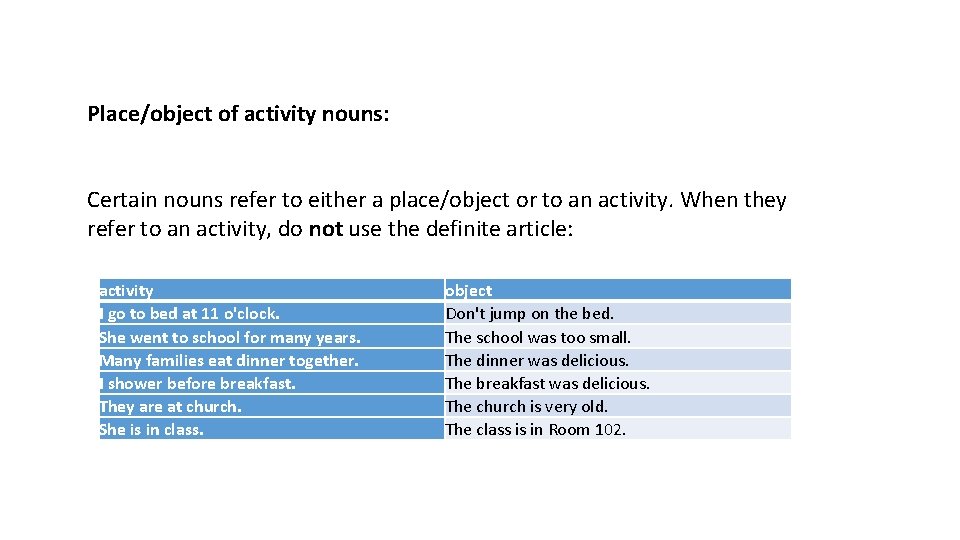
Place/object of activity nouns: Certain nouns refer to either a place/object or to an activity. When they refer to an activity, do not use the definite article: activity I go to bed at 11 o'clock. She went to school for many years. Many families eat dinner together. I shower before breakfast. They are at church. She is in class. object Don't jump on the bed. The school was too small. The dinner was delicious. The breakfast was delicious. The church is very old. The class is in Room 102.