
5 Functions of a Random Variable Functions of
5. Functions of a Random Variable
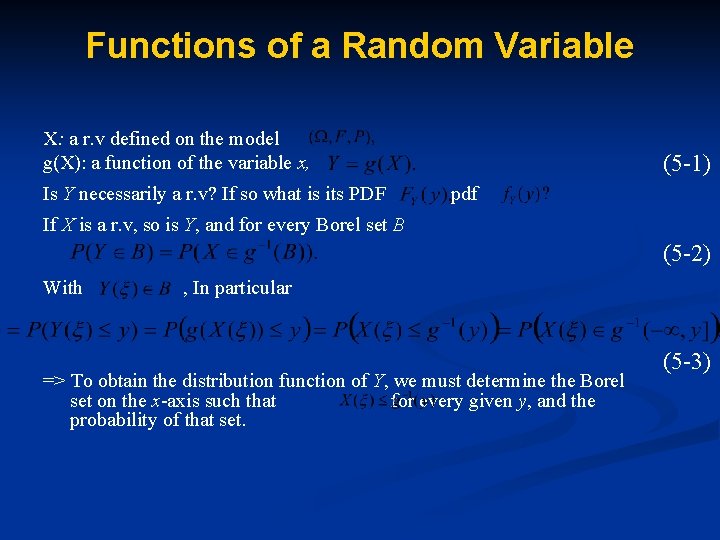
Functions of a Random Variable X: a r. v defined on the model g(X): a function of the variable x, Is Y necessarily a r. v? If so what is its PDF (5 -1) pdf If X is a r. v, so is Y, and for every Borel set B (5 -2) With , In particular => To obtain the distribution function of Y, we must determine the Borel set on the x-axis such that for every given y, and the probability of that set. (5 -3)
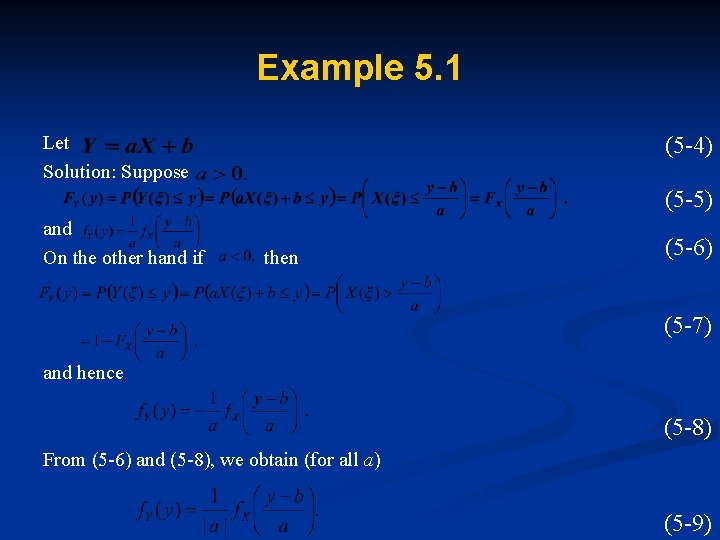
Example 5. 1 Let Solution: Suppose (5 -4) (5 -5) and On the other hand if then (5 -6) (5 -7) and hence (5 -8) From (5 -6) and (5 -8), we obtain (for all a) (5 -9)
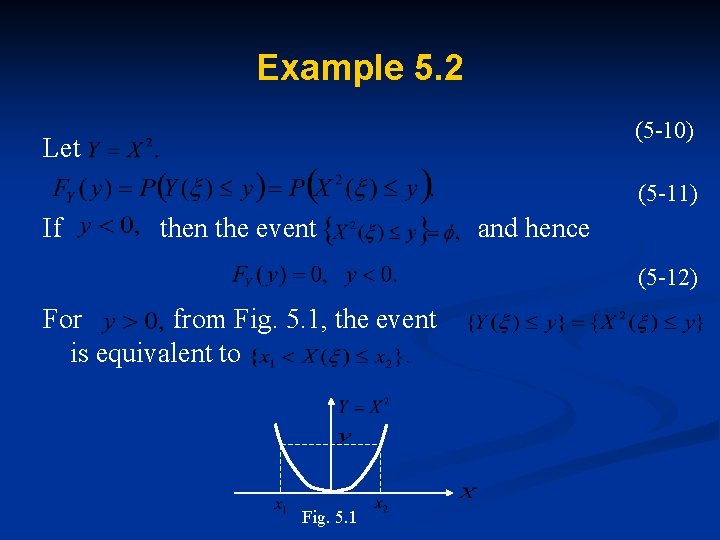
Example 5. 2 (5 -10) Let (5 -11) If then the event and hence (5 -12) For from Fig. 5. 1, the event is equivalent to Fig. 5. 1
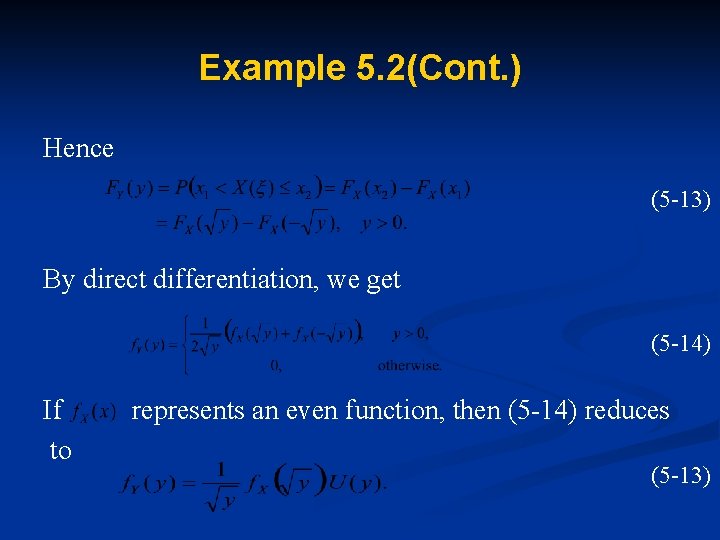
Example 5. 2(Cont. ) Hence (5 -13) By direct differentiation, we get (5 -14) If to represents an even function, then (5 -14) reduces (5 -13)
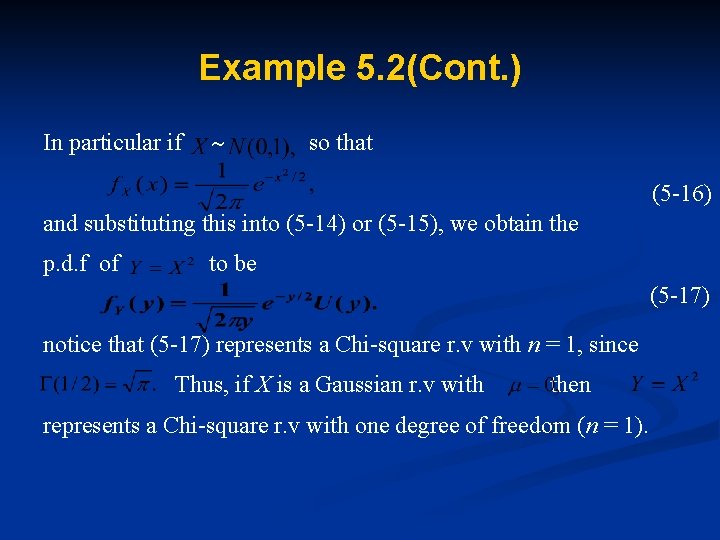
Example 5. 2(Cont. ) In particular if so that (5 -16) and substituting this into (5 -14) or (5 -15), we obtain the p. d. f of to be (5 -17) notice that (5 -17) represents a Chi-square r. v with n = 1, since Thus, if X is a Gaussian r. v with then represents a Chi-square r. v with one degree of freedom (n = 1).
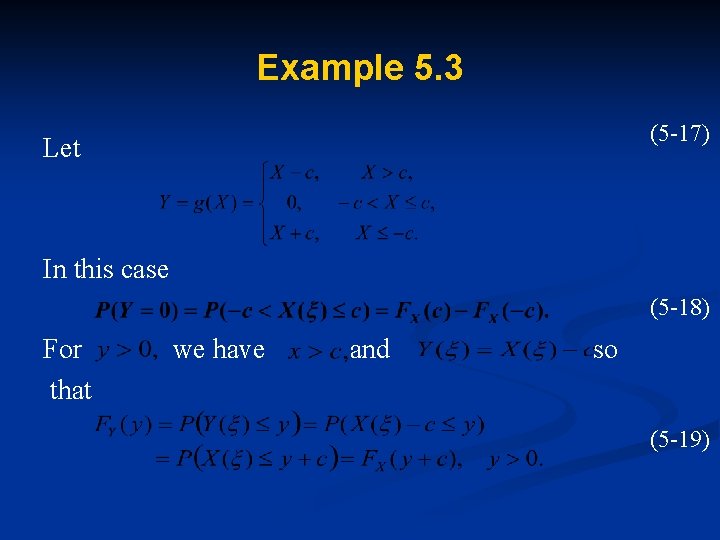
Example 5. 3 (5 -17) Let In this case (5 -18) For that we have and so (5 -19)
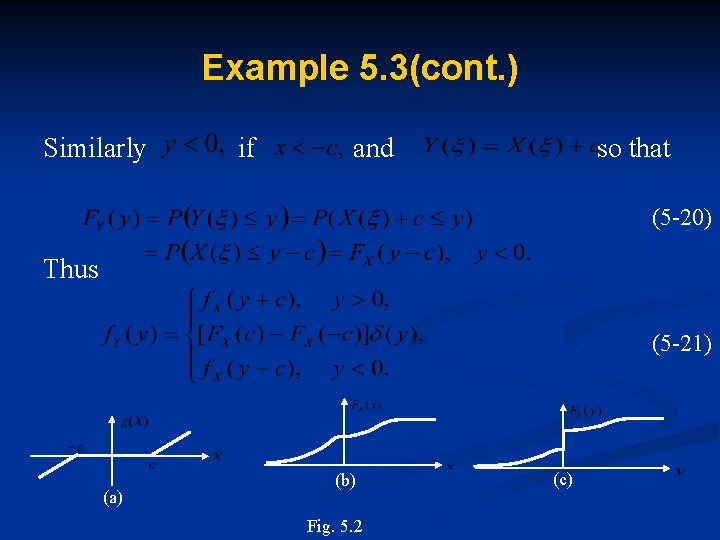
Example 5. 3(cont. ) Similarly if and so that (5 -20) Thus (5 -21) (a) (b) Fig. 5. 2 (c)
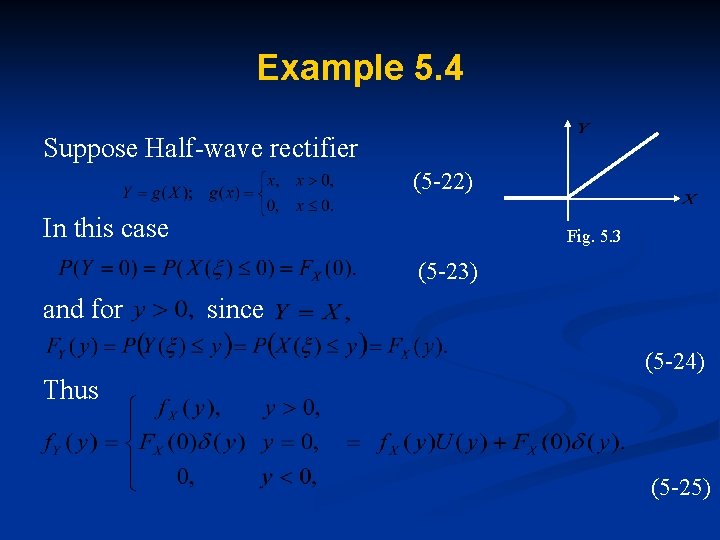
Example 5. 4 Suppose Half-wave rectifier (5 -22) In this case Fig. 5. 3 (5 -23) and for Thus since (5 -24) (5 -25)
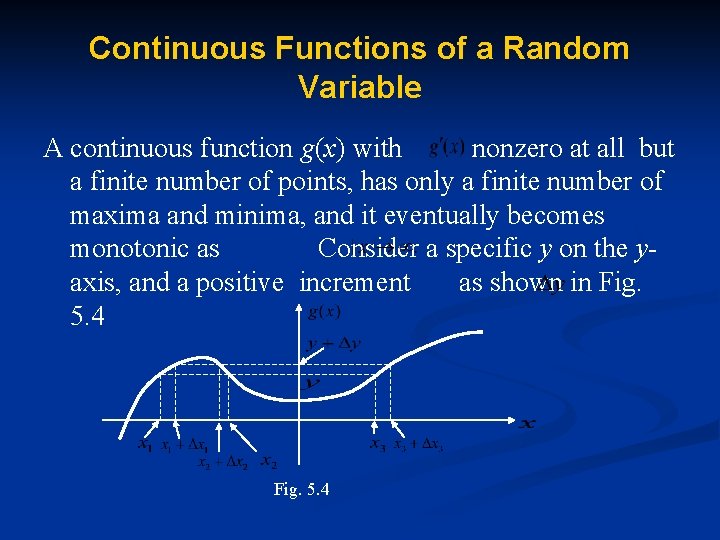
Continuous Functions of a Random Variable A continuous function g(x) with nonzero at all but a finite number of points, has only a finite number of maxima and minima, and it eventually becomes monotonic as Consider a specific y on the yaxis, and a positive increment as shown in Fig. 5. 4
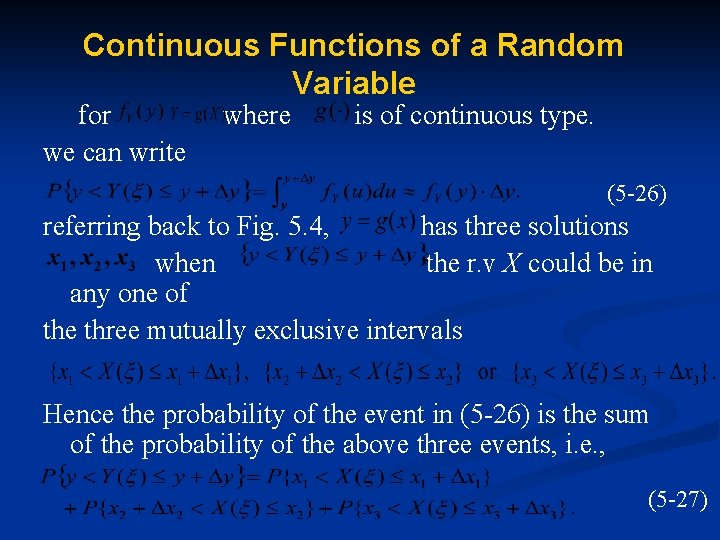
Continuous Functions of a Random Variable for we can write where is of continuous type. (5 -26) referring back to Fig. 5. 4, has three solutions when the r. v X could be in any one of the three mutually exclusive intervals Hence the probability of the event in (5 -26) is the sum of the probability of the above three events, i. e. , (5 -27)
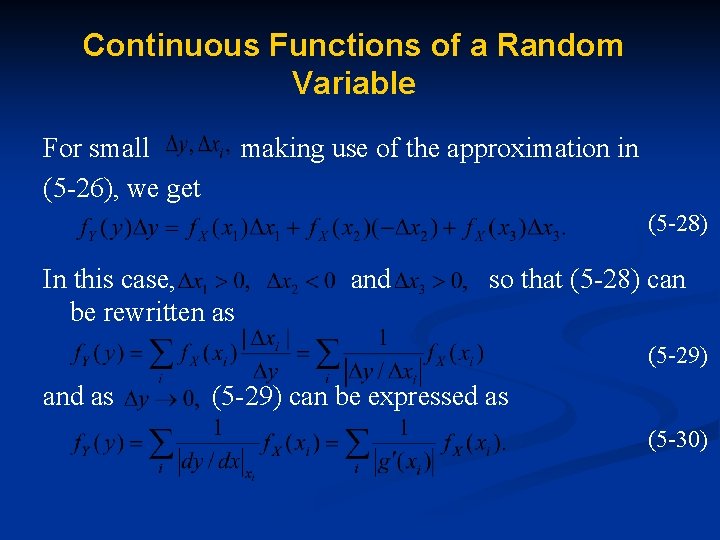
Continuous Functions of a Random Variable For small (5 -26), we get making use of the approximation in (5 -28) In this case, be rewritten as and so that (5 -28) can (5 -29) and as (5 -29) can be expressed as (5 -30)
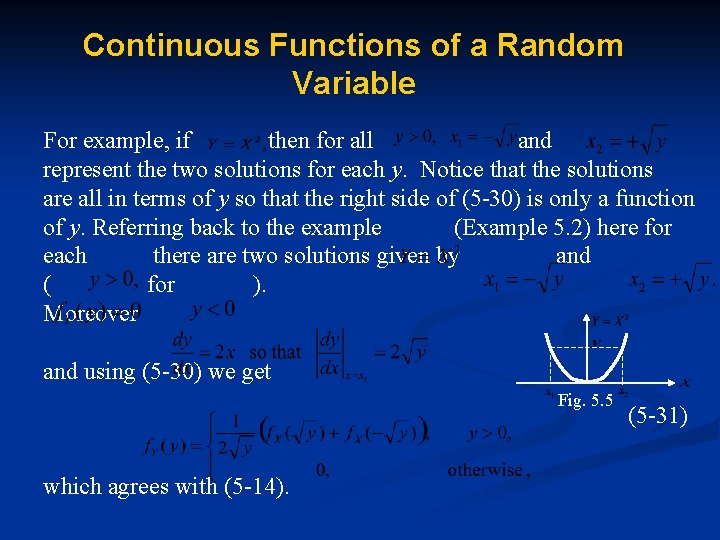
Continuous Functions of a Random Variable For example, if then for all and represent the two solutions for each y. Notice that the solutions are all in terms of y so that the right side of (5 -30) is only a function of y. Referring back to the example (Example 5. 2) here for each there are two solutions given by and ( for ). Moreover and using (5 -30) we get Fig. 5. 5 which agrees with (5 -14). (5 -31)
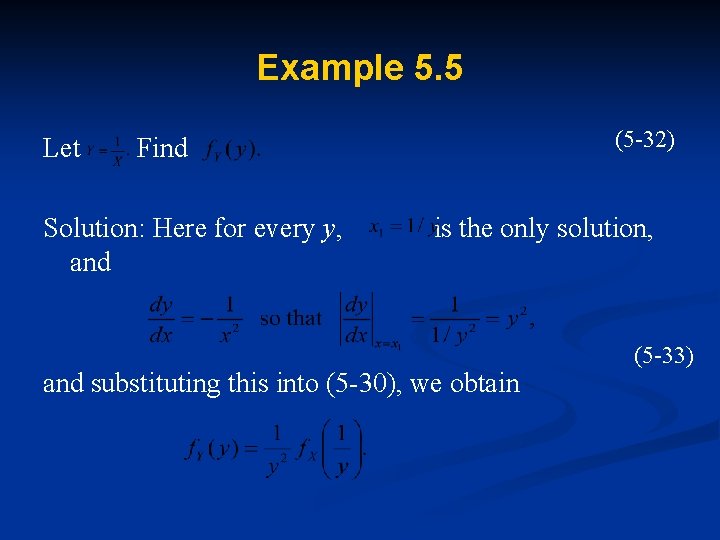
Example 5. 5 Let (5 -32) Find Solution: Here for every y, and is the only solution, and substituting this into (5 -30), we obtain (5 -33)
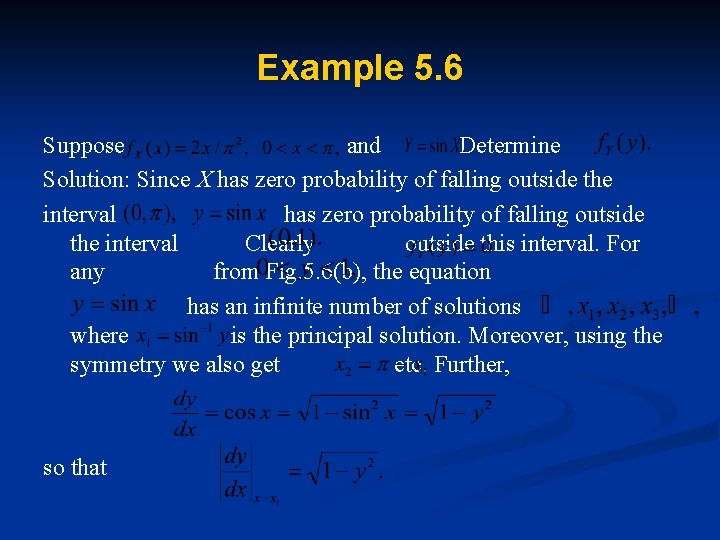
Example 5. 6 Suppose and Determine Solution: Since X has zero probability of falling outside the interval Clearly outside this interval. For any from Fig. 5. 6(b), the equation has an infinite number of solutions where is the principal solution. Moreover, using the symmetry we also get etc. Further, so that
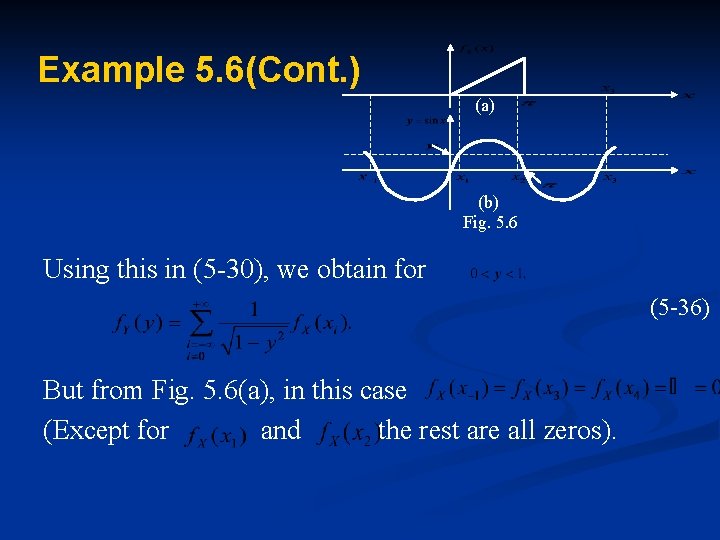
Example 5. 6(Cont. ) (a) (b) Fig. 5. 6 Using this in (5 -30), we obtain for (5 -36) But from Fig. 5. 6(a), in this case (Except for and the rest are all zeros).
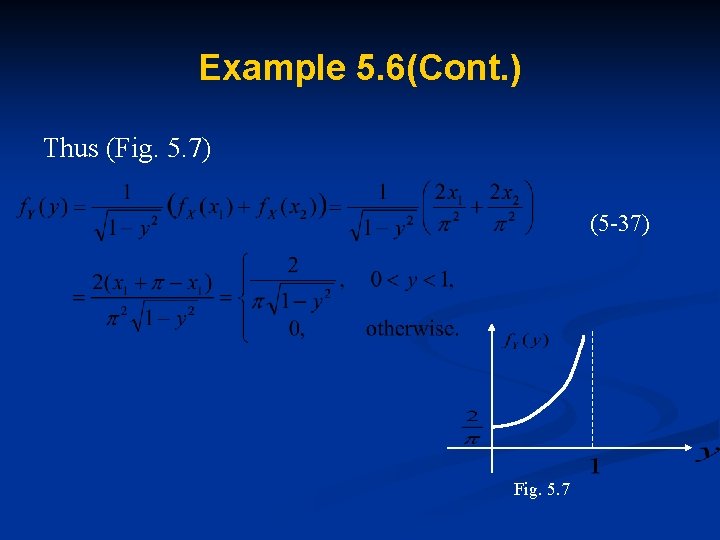
Example 5. 6(Cont. ) Thus (Fig. 5. 7) (5 -37) Fig. 5. 7
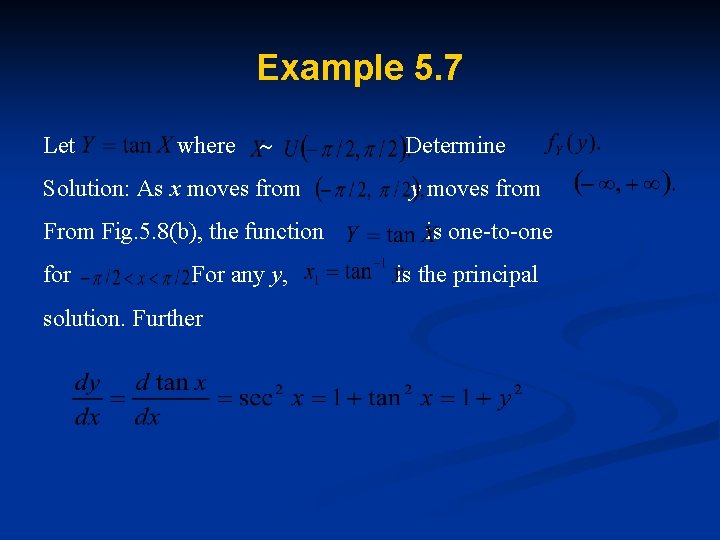
Example 5. 7 Let where Solution: As x moves from Fig. 5. 8(b), the function for For any y, solution. Further Determine y moves from is one-to-one is the principal
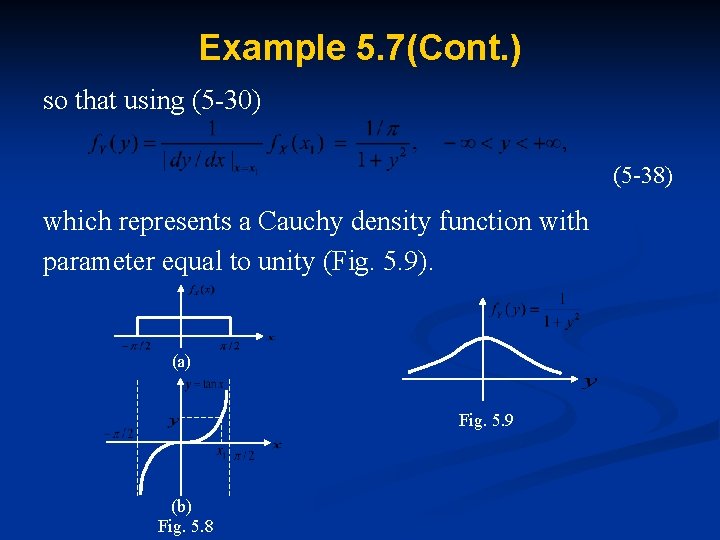
Example 5. 7(Cont. ) so that using (5 -30) (5 -38) which represents a Cauchy density function with parameter equal to unity (Fig. 5. 9). (a) Fig. 5. 9 (b) Fig. 5. 8
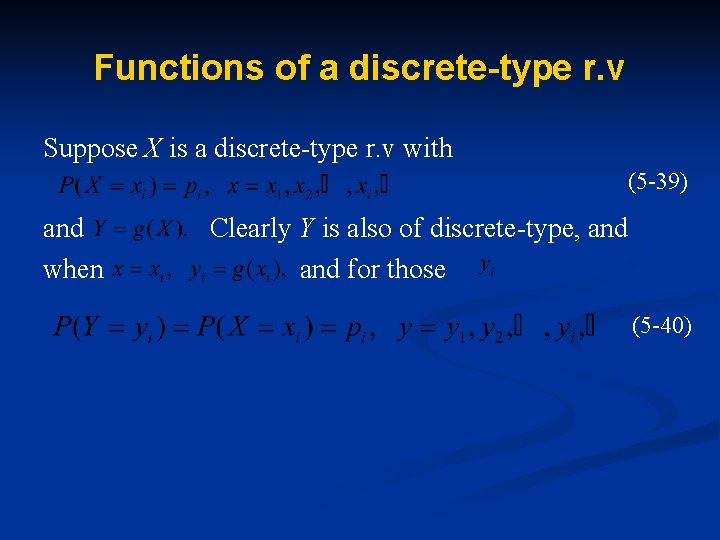
Functions of a discrete-type r. v Suppose X is a discrete-type r. v with (5 -39) and when Clearly Y is also of discrete-type, and for those (5 -40)
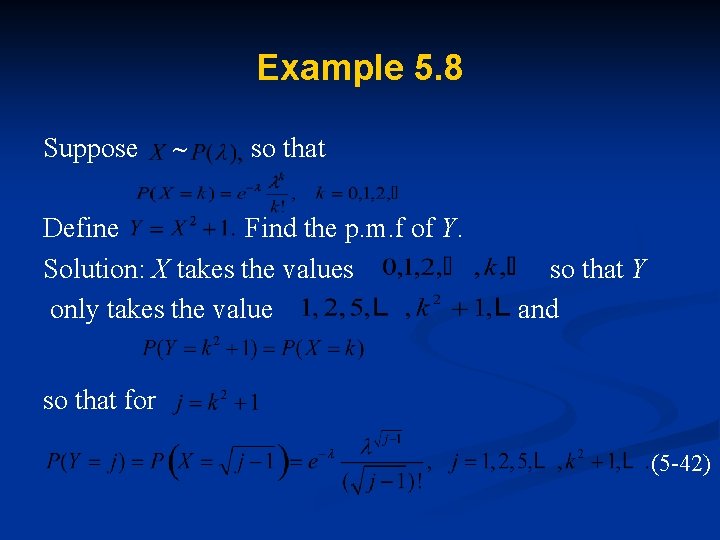
Example 5. 8 Suppose so that Define Find the p. m. f of Y. Solution: X takes the values only takes the value so that Y and so that for (5 -42)
- Slides: 21