
5 Flow Rate and Capacity Analysis 1 v

- Slides: 30
5. Flow Rate and Capacity Analysis 1 v Throughput v Resources and Resource Pools v Theoretical v Bottleneck v Capacity v Product and Capacity capacity resources utilization mix and its effect on theoretical capacity and profitability v Capacity Improvement
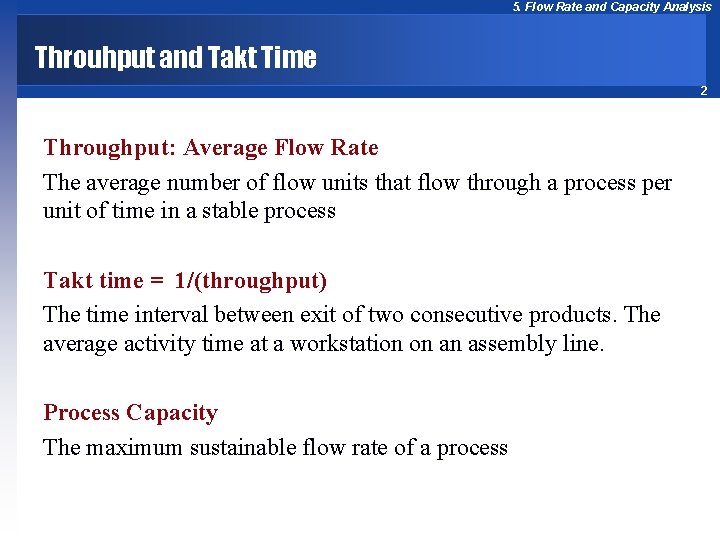
5. Flow Rate and Capacity Analysis Throuhput and Takt Time 2 Throughput: Average Flow Rate The average number of flow units that flow through a process per unit of time in a stable process Takt time = 1/(throughput) The time interval between exit of two consecutive products. The average activity time at a workstation on an assembly line. Process Capacity The maximum sustainable flow rate of a process
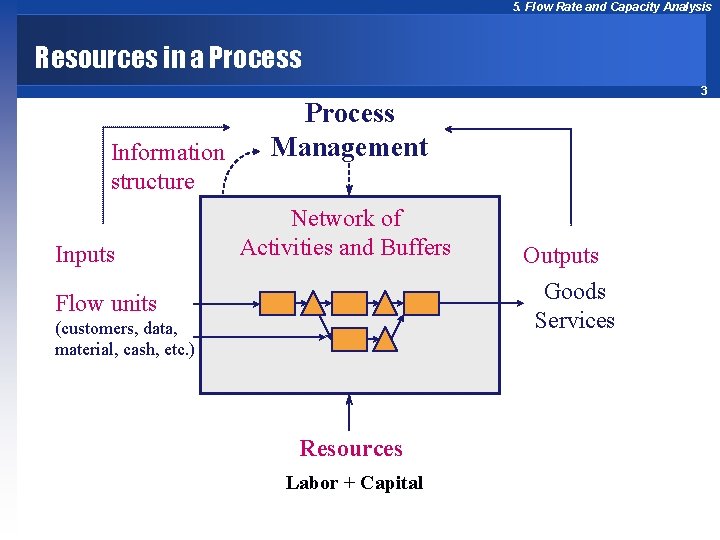
5. Flow Rate and Capacity Analysis Resources in a Process Information structure Inputs 3 Process Management Network of Activities and Buffers Flow units (customers, data, material, cash, etc. ) Resources Labor + Capital Outputs Goods Services
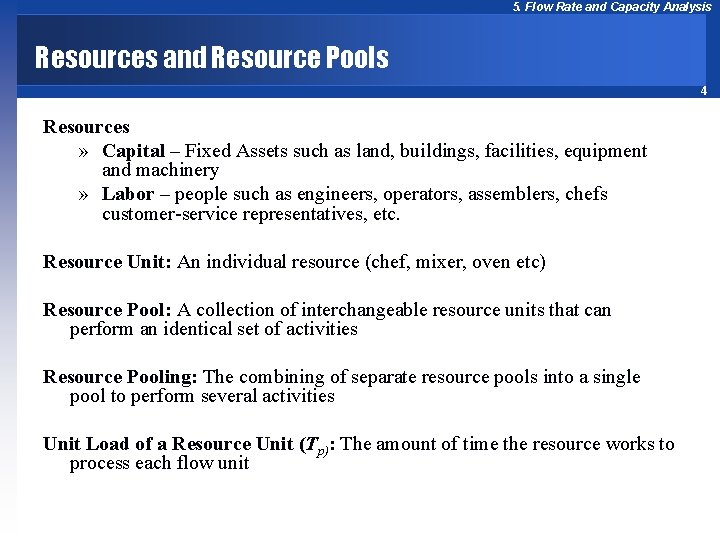
5. Flow Rate and Capacity Analysis Resources and Resource Pools 4 Resources » Capital – Fixed Assets such as land, buildings, facilities, equipment and machinery » Labor – people such as engineers, operators, assemblers, chefs customer-service representatives, etc. Resource Unit: An individual resource (chef, mixer, oven etc) Resource Pool: A collection of interchangeable resource units that can perform an identical set of activities Resource Pooling: The combining of separate resource pools into a single pool to perform several activities Unit Load of a Resource Unit (Tp): The amount of time the resource works to process each flow unit
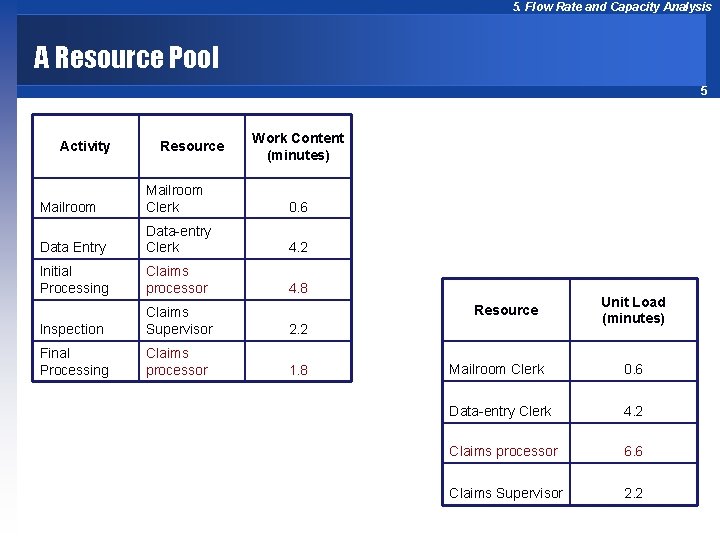
5. Flow Rate and Capacity Analysis A Resource Pool 5 Activity Resource Work Content (minutes) Mailroom Clerk 0. 6 Data Entry Data-entry Clerk 4. 2 Initial Processing Claims processor 4. 8 Inspection Claims Supervisor 2. 2 Final Processing Claims processor 1. 8 Resource Unit Load (minutes) Mailroom Clerk 0. 6 Data-entry Clerk 4. 2 Claims processor 6. 6 Claims Supervisor 2. 2
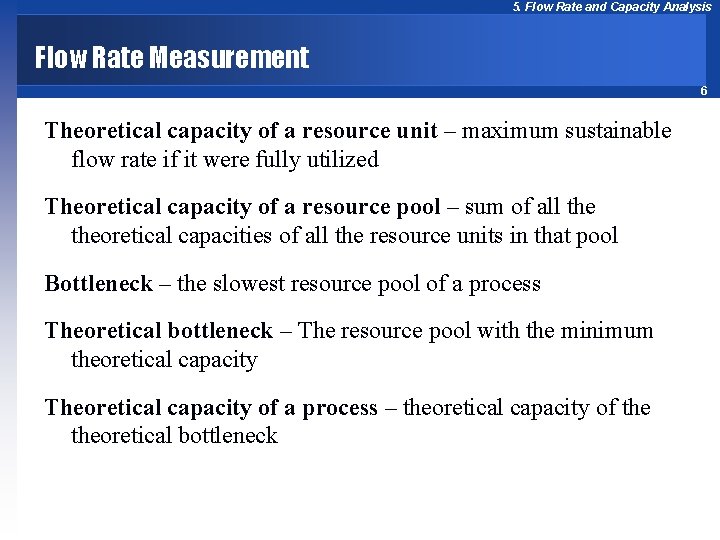
5. Flow Rate and Capacity Analysis Flow Rate Measurement 6 Theoretical capacity of a resource unit – maximum sustainable flow rate if it were fully utilized Theoretical capacity of a resource pool – sum of all theoretical capacities of all the resource units in that pool Bottleneck – the slowest resource pool of a process Theoretical bottleneck – The resource pool with the minimum theoretical capacity Theoretical capacity of a process – theoretical capacity of theoretical bottleneck
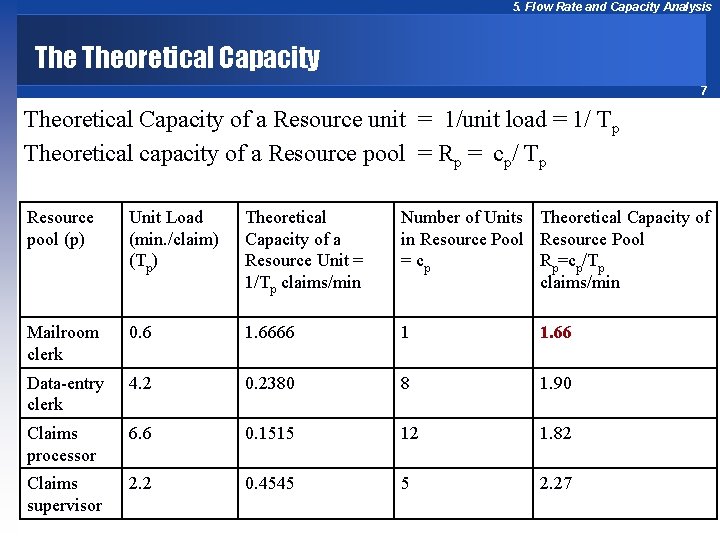
5. Flow Rate and Capacity Analysis Theoretical Capacity 7 Theoretical Capacity of a Resource unit = 1/unit load = 1/ Tp Theoretical capacity of a Resource pool = Rp = cp/ Tp Resource pool (p) Unit Load (min. /claim) (Tp) Theoretical Capacity of a Resource Unit = 1/Tp claims/min Number of Units Theoretical Capacity of in Resource Pool = cp Rp=cp/Tp claims/min Mailroom clerk 0. 6 1. 6666 1 1. 66 Data-entry clerk 4. 2 0. 2380 8 1. 90 Claims processor 6. 6 0. 1515 12 1. 82 Claims supervisor 2. 2 0. 4545 5 2. 27
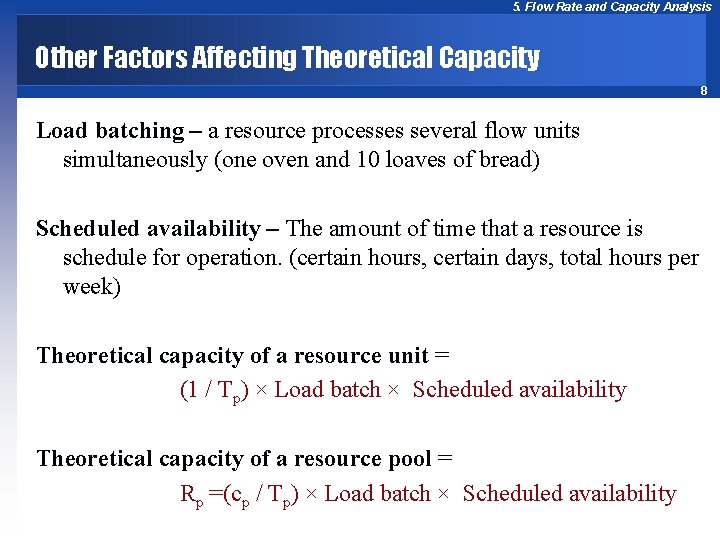
5. Flow Rate and Capacity Analysis Other Factors Affecting Theoretical Capacity 8 Load batching – a resource processes several flow units simultaneously (one oven and 10 loaves of bread) Scheduled availability – The amount of time that a resource is schedule for operation. (certain hours, certain days, total hours per week) Theoretical capacity of a resource unit = (1 / Tp) × Load batch × Scheduled availability Theoretical capacity of a resource pool = Rp =(cp / Tp) × Load batch × Scheduled availability
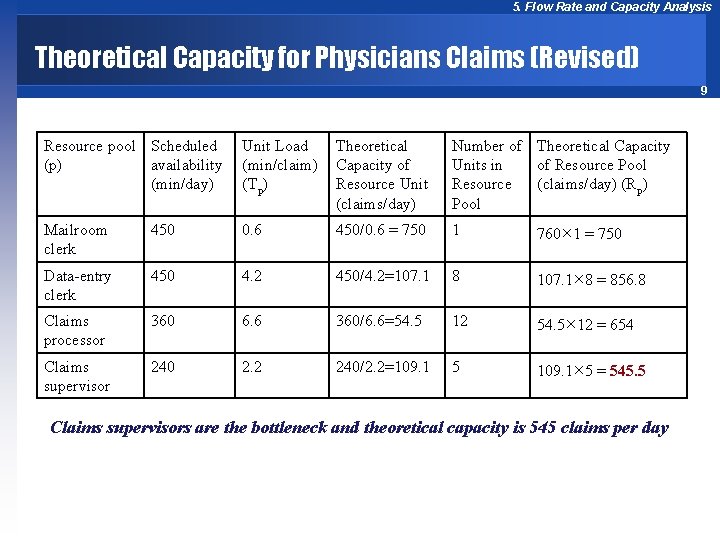
5. Flow Rate and Capacity Analysis Theoretical Capacity for Physicians Claims (Revised) 9 Resource pool Scheduled (p) availability (min/day) Unit Load (min/claim) (Tp) Theoretical Capacity of Resource Unit (claims/day) Number of Theoretical Capacity Units in of Resource Pool Resource (claims/day) (Rp) Pool Mailroom clerk 450 0. 6 450/0. 6 = 750 1 760× 1 = 750 Data-entry clerk 450 4. 2 450/4. 2=107. 1 8 107. 1× 8 = 856. 8 Claims processor 360 6. 6 360/6. 6=54. 5 12 54. 5× 12 = 654 Claims supervisor 240 2. 2 240/2. 2=109. 1 5 109. 1× 5 = 545. 5 Claims supervisors are the bottleneck and theoretical capacity is 545 claims per day
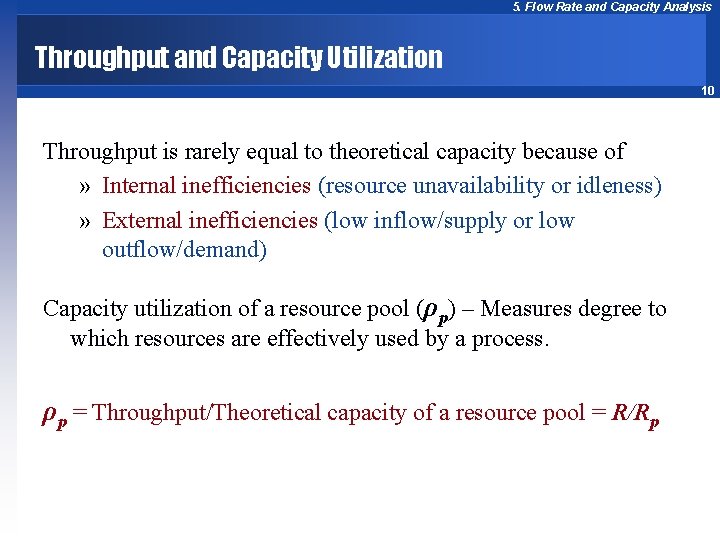
5. Flow Rate and Capacity Analysis Throughput and Capacity Utilization 10 Throughput is rarely equal to theoretical capacity because of » Internal inefficiencies (resource unavailability or idleness) » External inefficiencies (low inflow/supply or low outflow/demand) Capacity utilization of a resource pool (ρp) – Measures degree to which resources are effectively used by a process. ρp = Throughput/Theoretical capacity of a resource pool = R/Rp
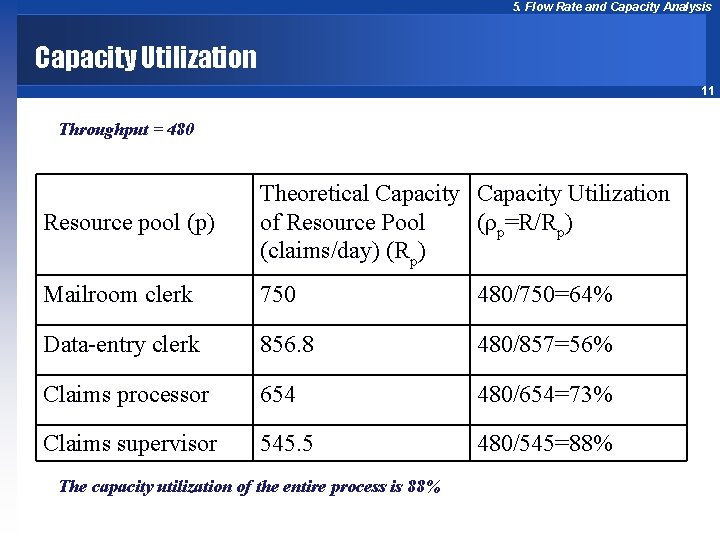
5. Flow Rate and Capacity Analysis Capacity Utilization 11 Throughput = 480 Resource pool (p) Theoretical Capacity Utilization of Resource Pool (ρp=R/Rp) (claims/day) (Rp) Mailroom clerk 750 480/750=64% Data-entry clerk 856. 8 480/857=56% Claims processor 654 480/654=73% Claims supervisor 545. 5 480/545=88% The capacity utilization of the entire process is 88%
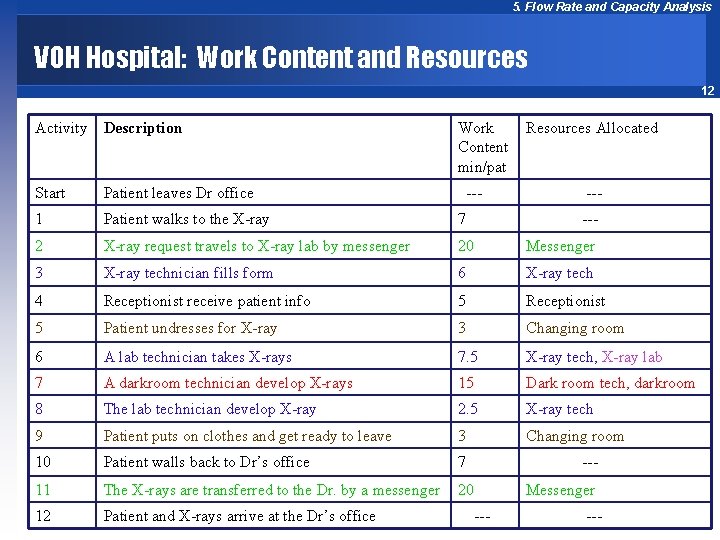
5. Flow Rate and Capacity Analysis VOH Hospital: Work Content and Resources 12 Activity Description Work Content min/pat --- Resources Allocated Start Patient leaves Dr office --- 1 Patient walks to the X-ray 7 2 X-ray request travels to X-ray lab by messenger 20 Messenger 3 X-ray technician fills form 6 X-ray tech 4 Receptionist receive patient info 5 Receptionist 5 Patient undresses for X-ray 3 Changing room 6 A lab technician takes X-rays 7. 5 X-ray tech, X-ray lab 7 A darkroom technician develop X-rays 15 Dark room tech, darkroom 8 The lab technician develop X-ray 2. 5 X-ray tech 9 Patient puts on clothes and get ready to leave 3 Changing room 10 Patient walls back to Dr’s office 7 11 The X-rays are transferred to the Dr. by a messenger 20 12 Patient and X-rays arrive at the Dr’s office --- --Messenger ---
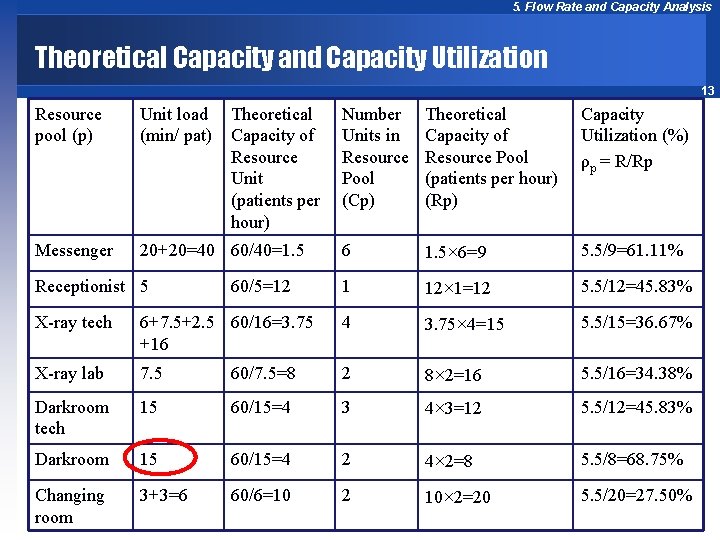
5. Flow Rate and Capacity Analysis Theoretical Capacity and Capacity Utilization 13 Resource pool (p) Unit load (min/ pat) Messenger 20+20=40 60/40=1. 5 Receptionist 5 Theoretical Capacity of Resource Unit (patients per hour) 60/5=12 Number Units in Resource Pool (Cp) Theoretical Capacity of Resource Pool (patients per hour) (Rp) Capacity Utilization (%) ρp = R/Rp 6 1. 5× 6=9 5. 5/9=61. 11% 1 12× 1=12 5. 5/12=45. 83% X-ray tech 6+7. 5+2. 5 60/16=3. 75 +16 4 3. 75× 4=15 5. 5/15=36. 67% X-ray lab 7. 5 60/7. 5=8 2 8× 2=16 5. 5/16=34. 38% Darkroom tech 15 60/15=4 3 4× 3=12 5. 5/12=45. 83% Darkroom 15 60/15=4 2 4× 2=8 5. 5/8=68. 75% Changing room 3+3=6 60/6=10 2 10× 2=20 5. 5/20=27. 50%
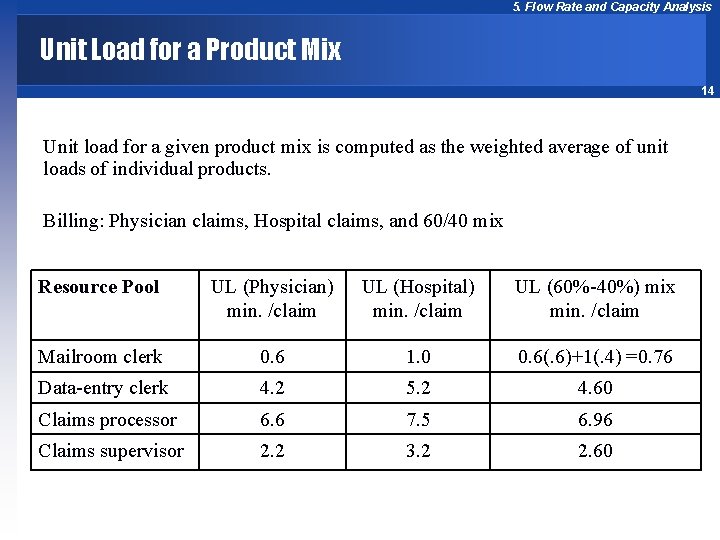
5. Flow Rate and Capacity Analysis Unit Load for a Product Mix 14 Unit load for a given product mix is computed as the weighted average of unit loads of individual products. Billing: Physician claims, Hospital claims, and 60/40 mix Resource Pool UL (Physician) min. /claim UL (Hospital) min. /claim UL (60%-40%) mix min. /claim Mailroom clerk 0. 6 1. 0 0. 6(. 6)+1(. 4) =0. 76 Data-entry clerk 4. 2 5. 2 4. 60 Claims processor 6. 6 7. 5 6. 96 Claims supervisor 2. 2 3. 2 2. 60
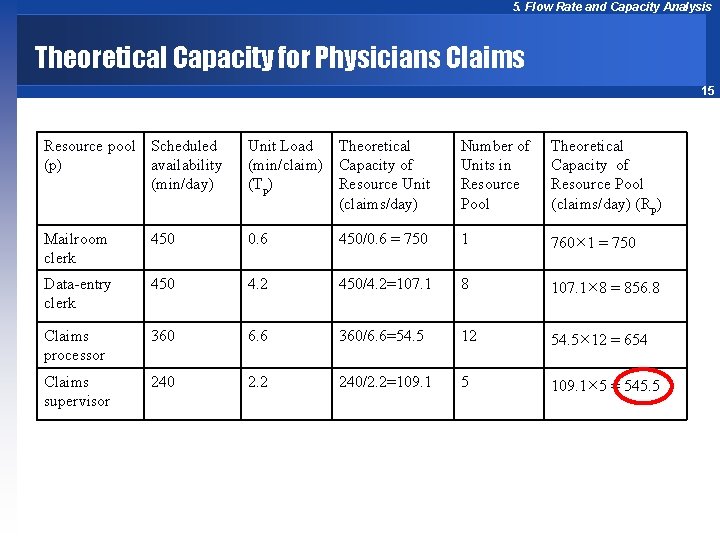
5. Flow Rate and Capacity Analysis Theoretical Capacity for Physicians Claims 15 Resource pool Scheduled (p) availability (min/day) Unit Load Theoretical (min/claim) Capacity of (Tp) Resource Unit (claims/day) Number of Units in Resource Pool Theoretical Capacity of Resource Pool (claims/day) (Rp) Mailroom clerk 450 0. 6 450/0. 6 = 750 1 760× 1 = 750 Data-entry clerk 450 4. 2 450/4. 2=107. 1 8 107. 1× 8 = 856. 8 Claims processor 360 6. 6 360/6. 6=54. 5 12 54. 5× 12 = 654 Claims supervisor 240 2. 2 240/2. 2=109. 1 5 109. 1× 5 = 545. 5
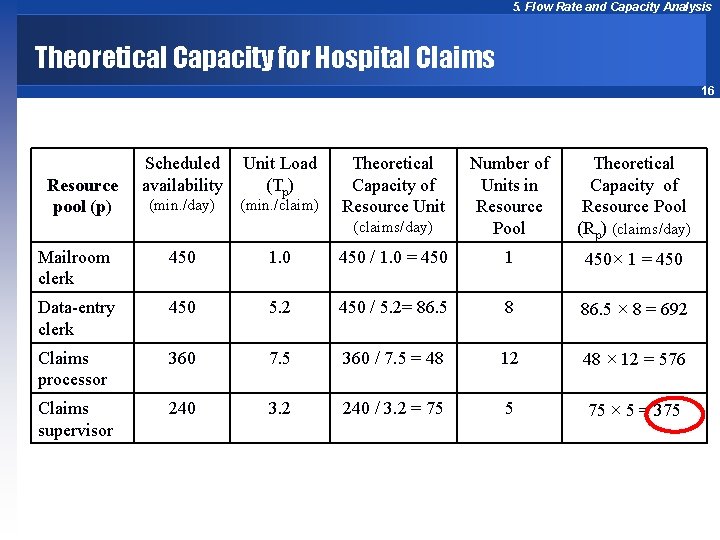
5. Flow Rate and Capacity Analysis Theoretical Capacity for Hospital Claims 16 Resource pool (p) Scheduled availability (min. /day) Unit Load (Tp) (min. /claim) Theoretical Capacity of Resource Unit (claims/day) Number of Units in Resource Pool Theoretical Capacity of Resource Pool (Rp) (claims/day) Mailroom clerk 450 1. 0 450 / 1. 0 = 450 1 450× 1 = 450 Data-entry clerk 450 5. 2 450 / 5. 2= 86. 5 8 86. 5 × 8 = 692 Claims processor 360 7. 5 360 / 7. 5 = 48 12 48 × 12 = 576 Claims supervisor 240 3. 2 240 / 3. 2 = 75 5 75 × 5 = 375
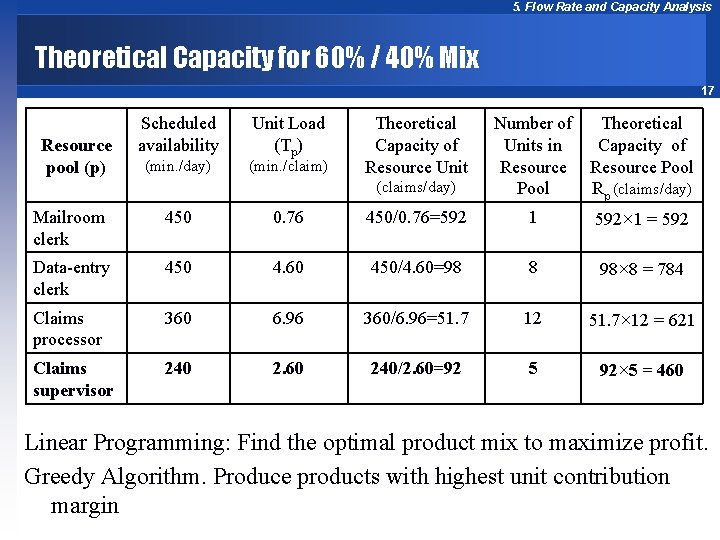
5. Flow Rate and Capacity Analysis Theoretical Capacity for 60% / 40% Mix 17 Resource pool (p) Scheduled availability (min. /day) Unit Load (Tp) (min. /claim) Theoretical Capacity of Resource Unit (claims/day) Number of Theoretical Units in Capacity of Resource Pool Rp (claims/day) Mailroom clerk 450 0. 76 450/0. 76=592 1 592× 1 = 592 Data-entry clerk 450 4. 60 450/4. 60=98 8 98× 8 = 784 Claims processor 360 6. 96 360/6. 96=51. 7 12 51. 7× 12 = 621 Claims supervisor 240 2. 60 240/2. 60=92 5 92× 5 = 460 Linear Programming: Find the optimal product mix to maximize profit. Greedy Algorithm. Produce products with highest unit contribution margin
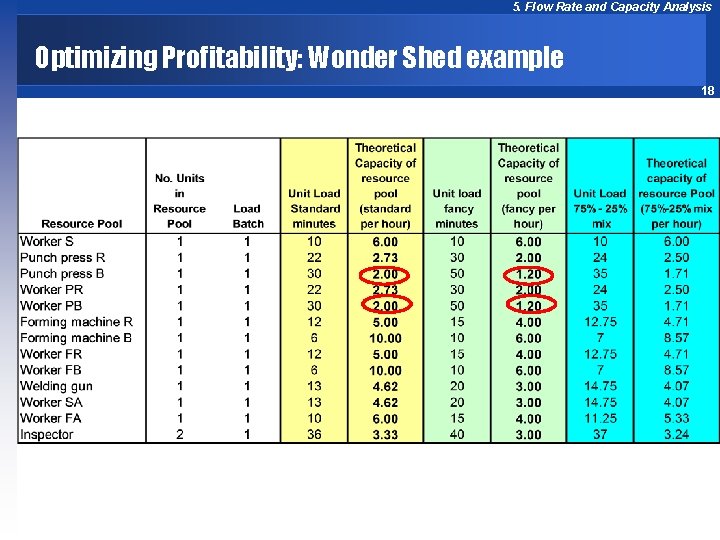
5. Flow Rate and Capacity Analysis Optimizing Profitability: Wonder Shed example 18
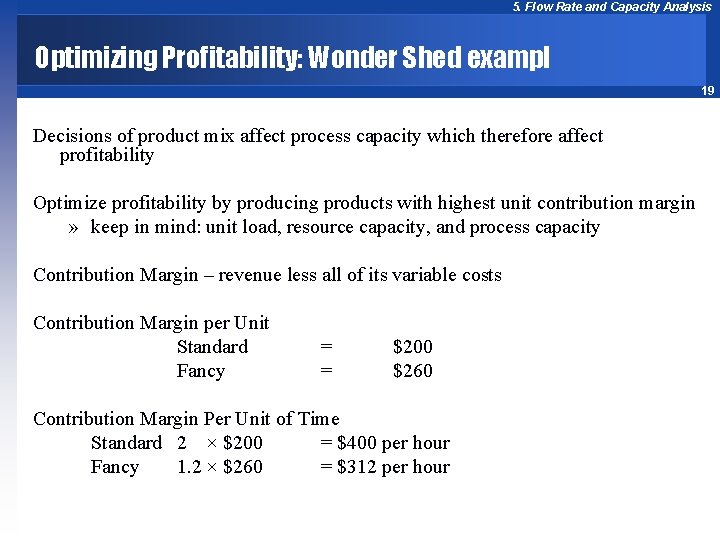
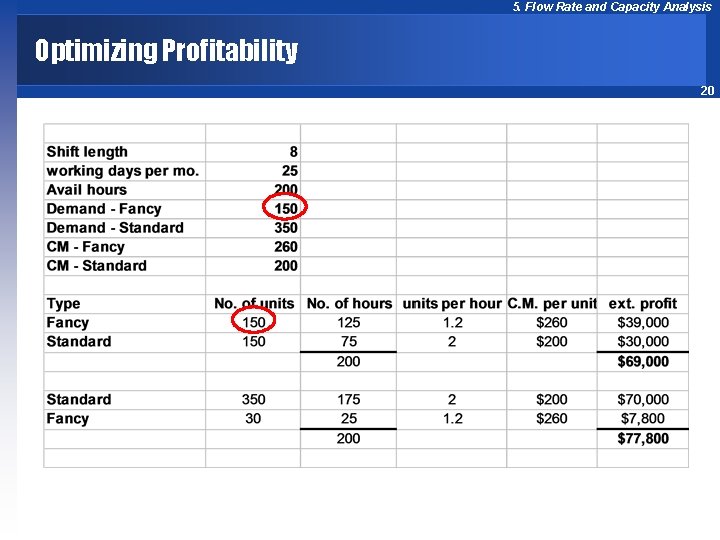
5. Flow Rate and Capacity Analysis Optimizing Profitability: Wonder Shed exampl 19 Decisions of product mix affect process capacity which therefore affect profitability Optimize profitability by producing products with highest unit contribution margin » keep in mind: unit load, resource capacity, and process capacity Contribution Margin – revenue less all of its variable costs Contribution Margin per Unit Standard Fancy = = $200 $260 Contribution Margin Per Unit of Time Standard 2 × $200 = $400 per hour Fancy 1. 2 × $260 = $312 per hour
5. Flow Rate and Capacity Analysis Optimizing Profitability 20
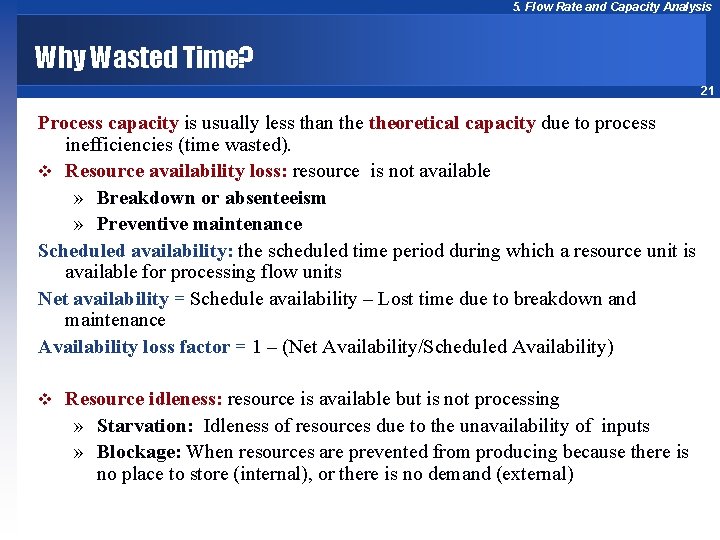
5. Flow Rate and Capacity Analysis Why Wasted Time? 21 Process capacity is usually less than theoretical capacity due to process inefficiencies (time wasted). v Resource availability loss: resource is not available » Breakdown or absenteeism » Preventive maintenance Scheduled availability: the scheduled time period during which a resource unit is available for processing flow units Net availability = Schedule availability – Lost time due to breakdown and maintenance Availability loss factor = 1 – (Net Availability/Scheduled Availability) v Resource idleness: resource is available but is not processing » Starvation: Idleness of resources due to the unavailability of inputs » Blockage: When resources are prevented from producing because there is no place to store (internal), or there is no demand (external)
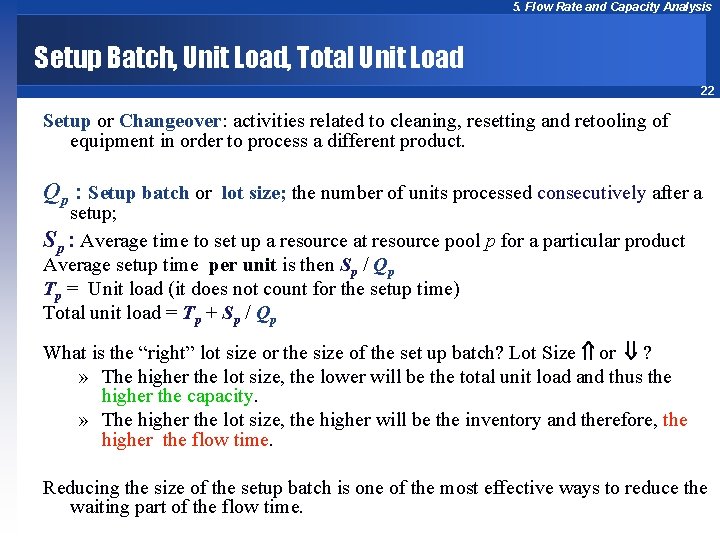
5. Flow Rate and Capacity Analysis Setup Batch, Unit Load, Total Unit Load 22 Setup or Changeover: activities related to cleaning, resetting and retooling of equipment in order to process a different product. Qp : Setup batch or lot size; the number of units processed consecutively after a setup; Sp : Average time to set up a resource at resource pool p for a particular product Average setup time per unit is then Sp / Qp Tp = Unit load (it does not count for the setup time) Total unit load = Tp + Sp / Qp What is the “right” lot size or the size of the set up batch? Lot Size or ? » The higher the lot size, the lower will be the total unit load and thus the higher the capacity. » The higher the lot size, the higher will be the inventory and therefore, the higher the flow time. Reducing the size of the setup batch is one of the most effective ways to reduce the waiting part of the flow time.
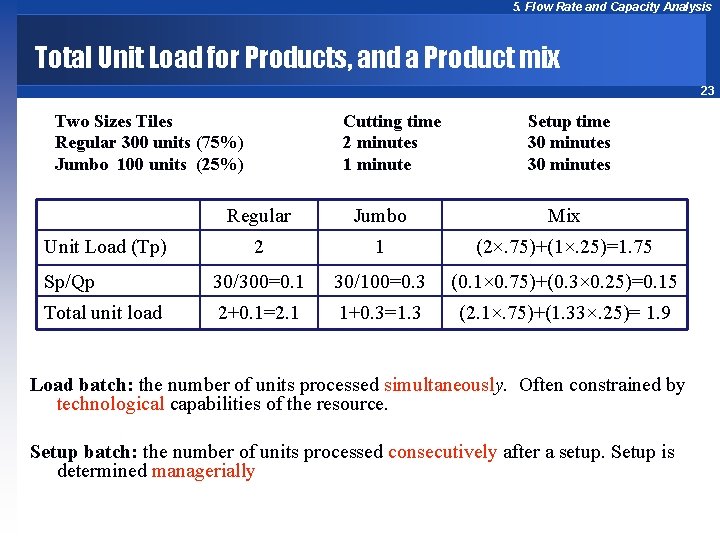
5. Flow Rate and Capacity Analysis Total Unit Load for Products, and a Product mix 23 Two Sizes Tiles Regular 300 units (75%) Jumbo 100 units (25%) Cutting time 2 minutes 1 minute Setup time 30 minutes Regular Jumbo Mix 2 1 (2×. 75)+(1×. 25)=1. 75 Sp/Qp 30/300=0. 1 30/100=0. 3 (0. 1× 0. 75)+(0. 3× 0. 25)=0. 15 Total unit load 2+0. 1=2. 1 1+0. 3=1. 3 (2. 1×. 75)+(1. 33×. 25)= 1. 9 Unit Load (Tp) Load batch: the number of units processed simultaneously. Often constrained by technological capabilities of the resource. Setup batch: the number of units processed consecutively after a setup. Setup is determined managerially
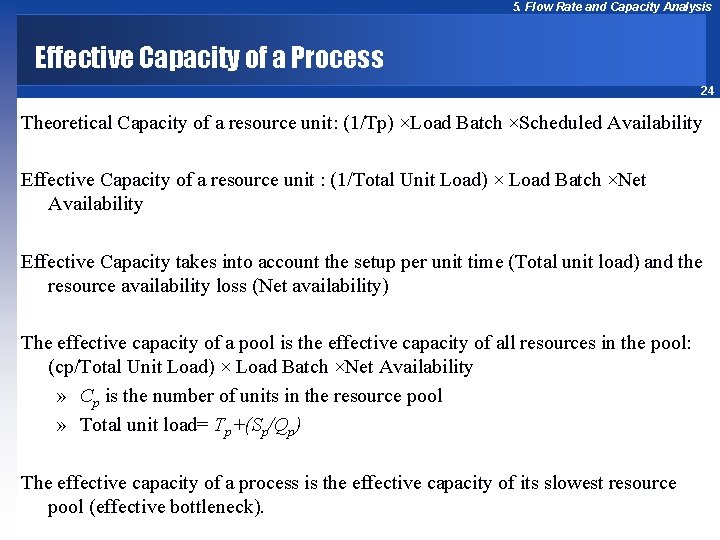
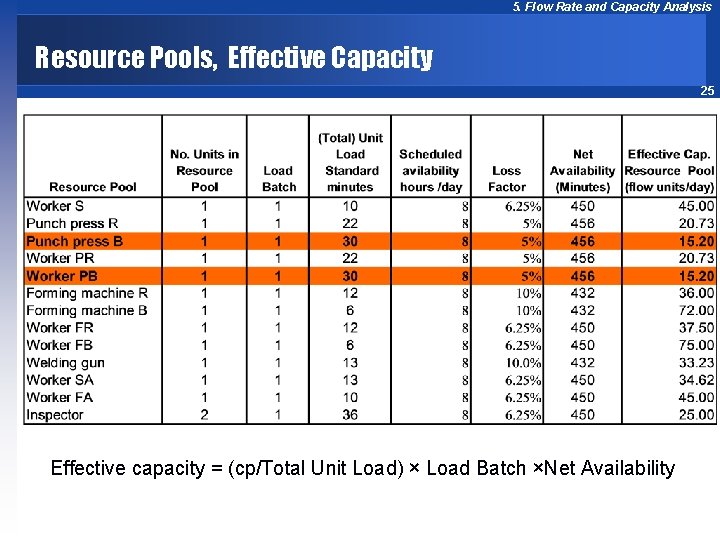
5. Flow Rate and Capacity Analysis Effective Capacity of a Process 24 Theoretical Capacity of a resource unit: (1/Tp) ×Load Batch ×Scheduled Availability Effective Capacity of a resource unit : (1/Total Unit Load) × Load Batch ×Net Availability Effective Capacity takes into account the setup per unit time (Total unit load) and the resource availability loss (Net availability) The effective capacity of a pool is the effective capacity of all resources in the pool: (cp/Total Unit Load) × Load Batch ×Net Availability » Cp is the number of units in the resource pool » Total unit load= Tp+(Sp/Qp) The effective capacity of a process is the effective capacity of its slowest resource pool (effective bottleneck).
5. Flow Rate and Capacity Analysis Resource Pools, Effective Capacity 25 Effective capacity = (cp/Total Unit Load) × Load Batch ×Net Availability
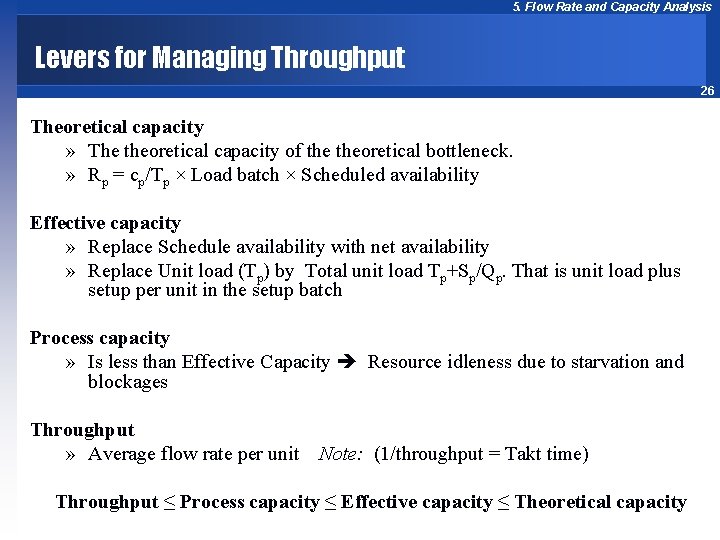
5. Flow Rate and Capacity Analysis Levers for Managing Throughput 26 Theoretical capacity » The theoretical capacity of theoretical bottleneck. » Rp = cp/Tp × Load batch × Scheduled availability Effective capacity » Replace Schedule availability with net availability » Replace Unit load (Tp) by Total unit load Tp+Sp/Qp. That is unit load plus setup per unit in the setup batch Process capacity » Is less than Effective Capacity Resource idleness due to starvation and blockages Throughput » Average flow rate per unit Note: (1/throughput = Takt time) Throughput ≤ Process capacity ≤ Effective capacity ≤ Theoretical capacity
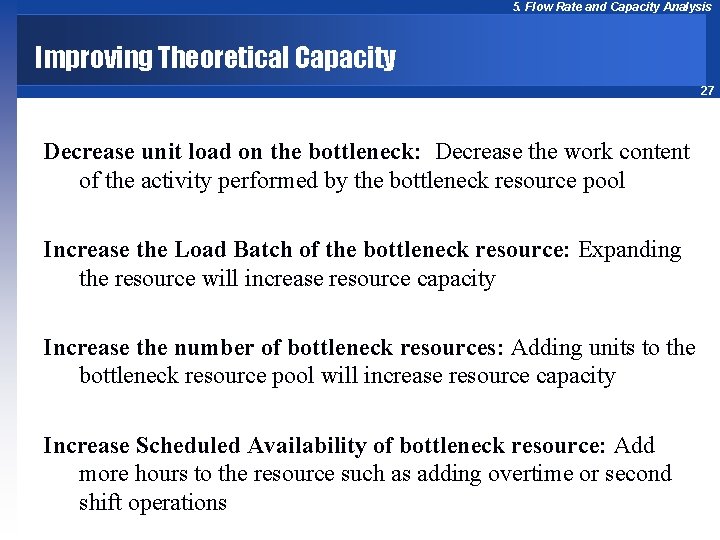
5. Flow Rate and Capacity Analysis Improving Theoretical Capacity 27 Decrease unit load on the bottleneck: Decrease the work content of the activity performed by the bottleneck resource pool Increase the Load Batch of the bottleneck resource: Expanding the resource will increase resource capacity Increase the number of bottleneck resources: Adding units to the bottleneck resource pool will increase resource capacity Increase Scheduled Availability of bottleneck resource: Add more hours to the resource such as adding overtime or second shift operations
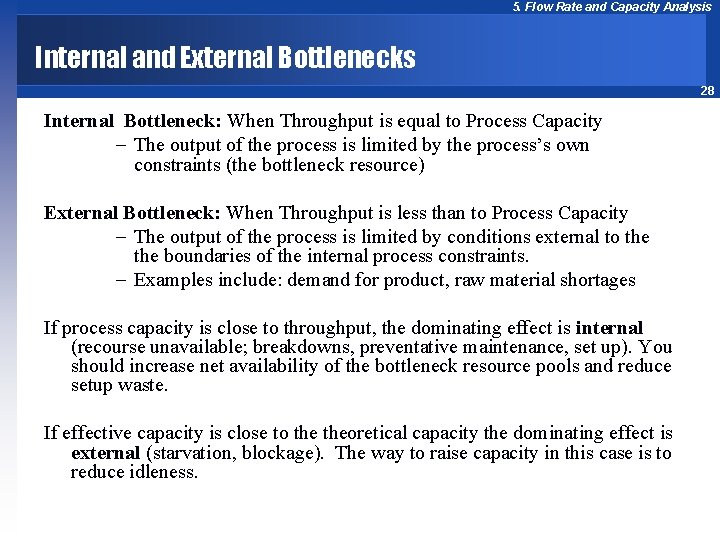
5. Flow Rate and Capacity Analysis Internal and External Bottlenecks 28 Internal Bottleneck: When Throughput is equal to Process Capacity - The output of the process is limited by the process’s own constraints (the bottleneck resource) External Bottleneck: When Throughput is less than to Process Capacity - The output of the process is limited by conditions external to the boundaries of the internal process constraints. - Examples include: demand for product, raw material shortages If process capacity is close to throughput, the dominating effect is internal (recourse unavailable; breakdowns, preventative maintenance, set up). You should increase net availability of the bottleneck resource pools and reduce setup waste. If effective capacity is close to theoretical capacity the dominating effect is external (starvation, blockage). The way to raise capacity in this case is to reduce idleness.
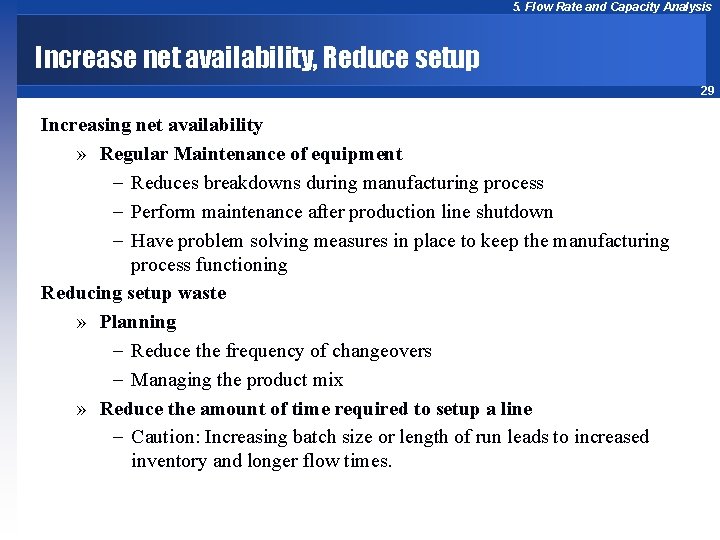
5. Flow Rate and Capacity Analysis Increase net availability, Reduce setup 29 Increasing net availability » Regular Maintenance of equipment - Reduces breakdowns during manufacturing process - Perform maintenance after production line shutdown - Have problem solving measures in place to keep the manufacturing process functioning Reducing setup waste » Planning - Reduce the frequency of changeovers - Managing the product mix » Reduce the amount of time required to setup a line - Caution: Increasing batch size or length of run leads to increased inventory and longer flow times.
5. Flow Rate and Capacity Analysis Decrease resource idleness 30 Decreasing resource idleness » Starvation and Blockage are the problems. - If we have two raw material for a process and one is unavailable we have a starvation condition - If the buffer is not big enough upstream and there is no place for the product to go we have a blockage condition » Techniques to avoid Starvation and Blockage - Proper buffer size - Process flow synchronization Internal bottle neck will require increasing the capacity of the bottle neck to a capacity where a new bottleneck will appear. Once the old bottleneck does not have the lowest capacity do not continue to increase capacity. It will not increase overall capacity any further.