
5 Establishment of Companies Content 1 Establishment of

5 Establishment of Companies
Content 1. Establishment of LLCs 2. Establishment of JSCs 3. Promoter’s liabilities 4. Pre-incorporation contract
1. Establishment of LLCs * Characteristics of LLCs - small or medium size - trust, confidence and understanding between shareholders - private, less disclosure requirement
CCL 2013, s 23: The establishment of a limited liability company shall satisfy the following conditions: (1) The number of shareholders accords with the quorum; (2) (The amount of capital contributions paid by the shareholders reaches the statutory minimum amount of the registered capital; ) There is an amount of capital contributions subscribed to by all the shareholders according with the articles of association; (3) The articles of association are worked out jointly by shareholders; (4) The company has a name and its organizational structure complies with that of a limited liability company; and (5) The company has a domicile.
(1) LLCs’ establishment conditions (a) number of shareholders conforms to the statutory number * Who can be and can not be shareholders?
* Can a company become the shareholder of a partnership enterprise? CCL 2013, s 15: A company may invest in other enterprises. However, it shall not become a capital contributor that shall bear the joint liabilities for the debts of the enterprises it invests in, unless it is otherwise provided for by any law.
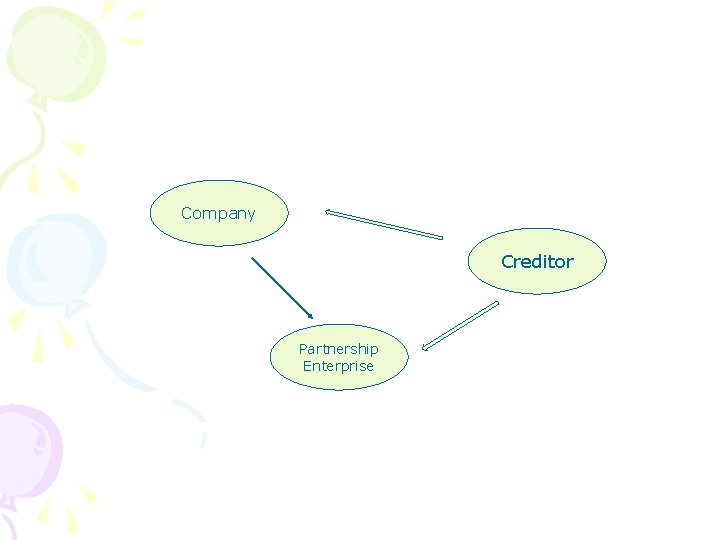
Company Creditor Partnership Enterprise
Partnership Enterprise Law 2006, s 3: No wholly state-owned company, state-owned enterprise, listed company, public-welfare-oriented public institution or social organization may become a general partner. - wholly stated-owned company - stated-owned enterprise
(b) Capital contributions of shareholders must reach the statutory minimum amount - minimum share capital - forms of share capital - asset evaluation - payment method
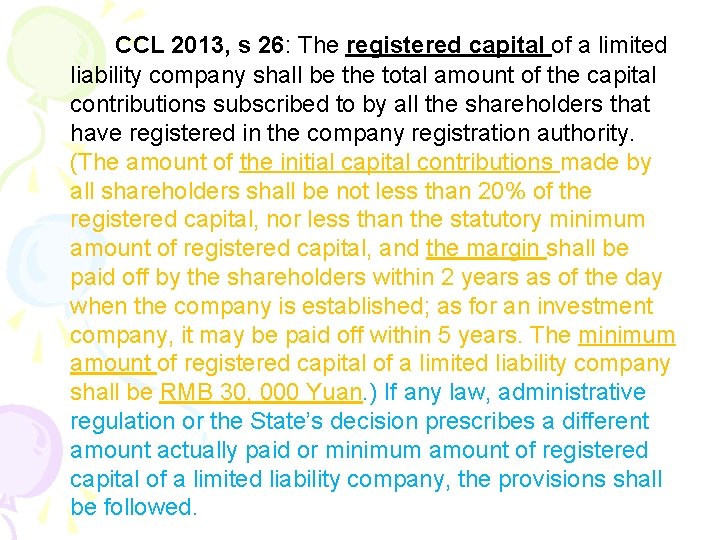
CCL 2013, s 26: The registered capital of a limited liability company shall be the total amount of the capital contributions subscribed to by all the shareholders that have registered in the company registration authority. (The amount of the initial capital contributions made by all shareholders shall be not less than 20% of the registered capital, nor less than the statutory minimum amount of registered capital, and the margin shall be paid off by the shareholders within 2 years as of the day when the company is established; as for an investment company, it may be paid off within 5 years. The minimum amount of registered capital of a limited liability company shall be RMB 30, 000 Yuan. ) If any law, administrative regulation or the State’s decision prescribes a different amount actually paid or minimum amount of registered capital of a limited liability company, the provisions shall be followed.
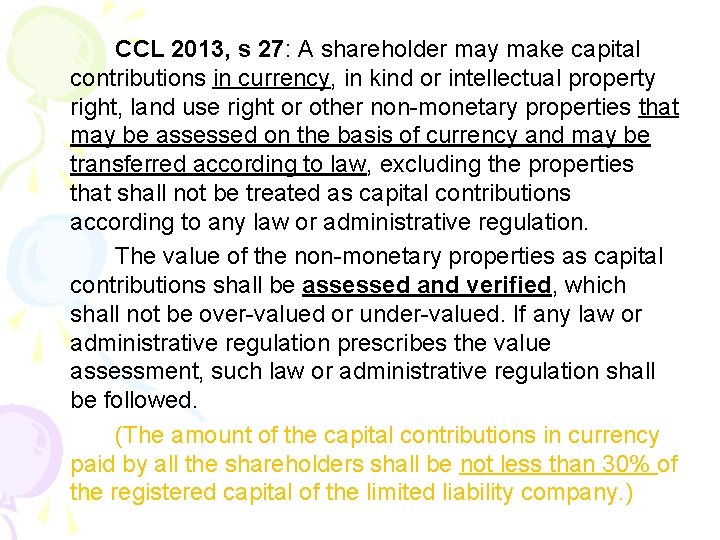
CCL 2013, s 27: A shareholder may make capital contributions in currency, in kind or intellectual property right, land use right or other non-monetary properties that may be assessed on the basis of currency and may be transferred according to law, excluding the properties that shall not be treated as capital contributions according to any law or administrative regulation. The value of the non-monetary properties as capital contributions shall be assessed and verified, which shall not be over-valued or under-valued. If any law or administrative regulation prescribes the value assessment, such law or administrative regulation shall be followed. (The amount of the capital contributions in currency paid by all the shareholders shall be not less than 30% of the registered capital of the limited liability company. )
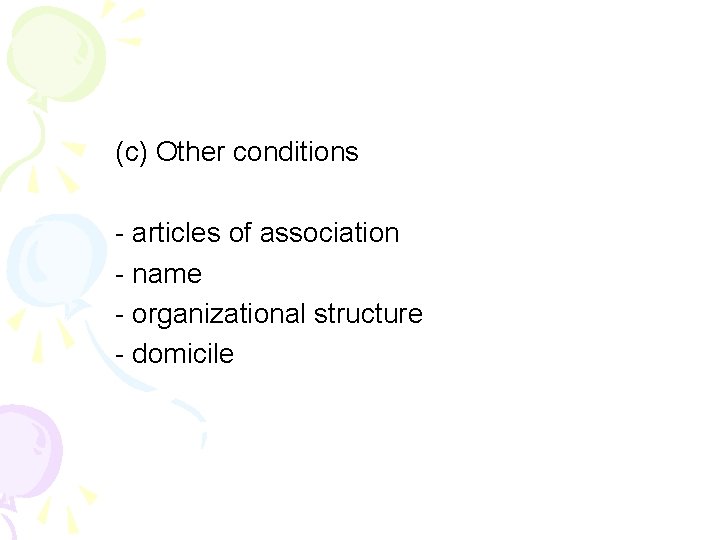
(c) Other conditions - articles of association - name - organizational structure - domicile
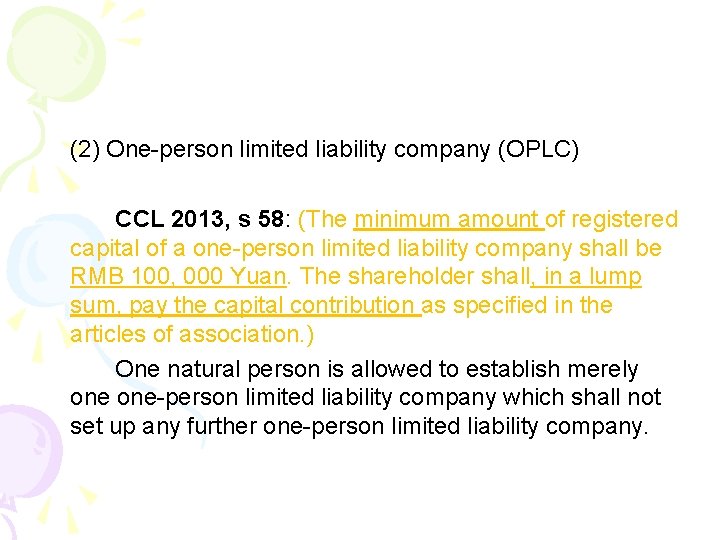
(2) One-person limited liability company (OPLC) CCL 2013, s 58: (The minimum amount of registered capital of a one-person limited liability company shall be RMB 100, 000 Yuan. The shareholder shall, in a lump sum, pay the capital contribution as specified in the articles of association. ) One natural person is allowed to establish merely one-person limited liability company which shall not set up any further one-person limited liability company.
* OPLC may not set up the board of shareholders (shareholders’ meeting). * Piercing the corporate veil: burden of proof CCL 2013, s 63: If the shareholder of a one-person limited liability company is unable to prove that the property of the one-person limited liability company is independent from his own property, he shall bear joint liabilities for the debts of the company.
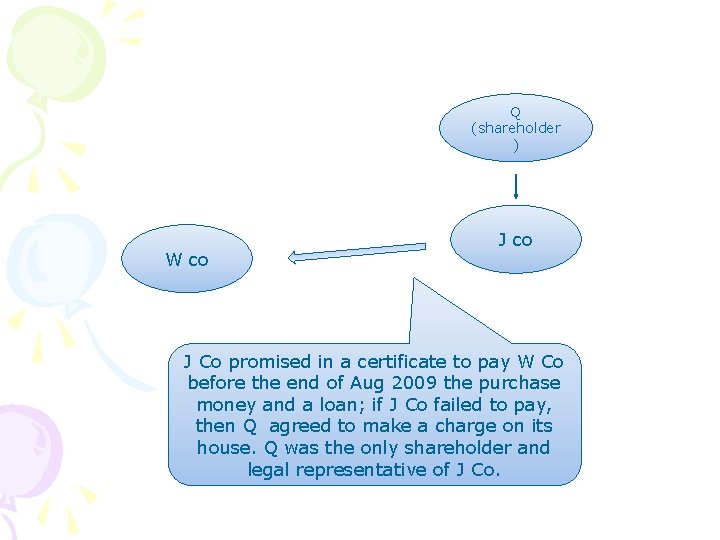
Q (shareholder ) W co J Co promised in a certificate to pay W Co before the end of Aug 2009 the purchase money and a loan; if J Co failed to pay, then Q agreed to make a charge on its house. Q was the only shareholder and legal representative of J Co.
(3) Wholly state-owned company (WSC) * Features of WSCs - one shareholder: State Assets Regulatory & Management Institution (SARMI) - only special enterprises may be qualified - establishment must be approved

- no shareholder’ meeting - special board of directors (which should have workers’ representatives), and non-worker directors be appointed by SARMI - one manager - a board of supervisors, which have at least 5 members and at least 1/3 should be workers’ representatives
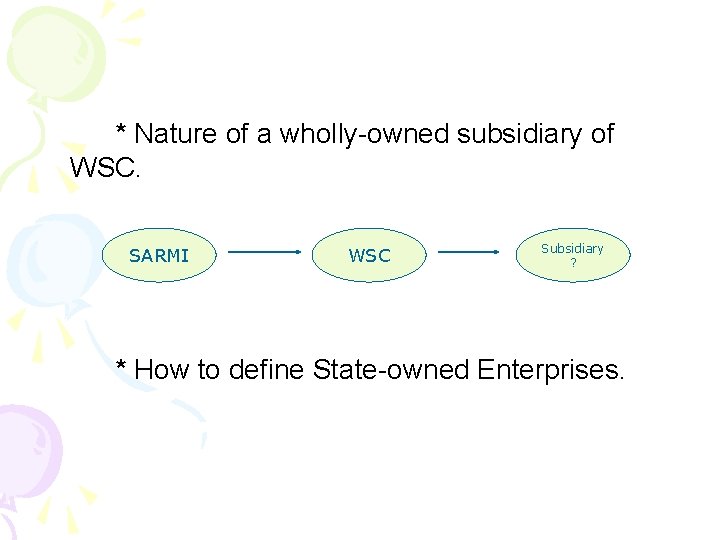
* Nature of a wholly-owned subsidiary of WSC. SARMI WSC Subsidiary ? * How to define State-owned Enterprises.
2. Establishment of JSCs * Features of JSCs - large size - combination of capital, rather than individual’s trust or understanding - public, strict disclosure requirement

CCL 2013, s 76: The establishment of a joint stock limited company shall meet the following conditions: (1) The number of promoters meets the quorum; (2) (The capital stock subscribed for and raised by the promoters reaches the minimum amount of the statutory capital; ) There is an amount of capital stock subscribed for or actually raised by the promoters according with the articles of associations; (3) The issuance of shares and the preparatory work accord with the provisions of the law; (4) The articles of association are formulated by the promoters, and are adopted at the establishment meeting if the company is to be launched by stock floatation; (5) The company has a name, and its organizational structure accords with that of a joint stock limited company (6) The company has a domicile.

(1) Articles of association - mandatory matters: CCL 2013, s 81 (2) Capital contributions - CCL 2013, ss 80, 82, 83, 84 (3) Establishment meeting - CCL 2013, ss 89, 90, 91 (4) Registration - CCL 2013, s 92
CCL 2013, s 80: Where a joint stock limited company is established by promotion, its registered capital shall be the total capital stock subscribed for by all the promoters as registered in the company registration authority. (The minimum amount of initial capital contributions to be made by all promoters shall be not less than 20% of the total registered capital, and the remaining amount shall be paid off by the promoters within 2 years as of the day when the company is established, while for an investment company, the remaining amount may be paid off within 5 years. ) Before the registered capital is paid off, no stock may be offered to others for subscription. Where a joint stock limited company is established by stock floatation, its registered capital shall be the total actually paid capital stock as registered in the company registration authority. (The minimum amount of the registered capital of a joint stock limited company shall be RMB 5 million Yuan. ) If any law, administrative regulation or the State’s decision prescribes a different amount actually paid or minimum amount of registered capital, such provision shall be followed.

CCL 2013, s 83: When establishing a joint stock limited company by promotion, the promoters shall subscribe, in writing, for the full amount of shares prescribed in the articles of association, and shall make the payment accirding to the articles of association. (In the case of paying the capital contributions at one time, the promoters shall make the payment in a lump sum; in the case of paying the capital contributions by installments, the promoters shall make the down payment immediately. ) In the case of making capital contributions in non-monetary properties, the promoters shall go through the procedures for the transfer of property rights according to law. If any of the promoters fails to make capital contributions by following the provisions of the preceding paragraph, it shall bear the liabilities for breach of contract according to the stipulations in the promoters agreement. After the promoters (have made their down payment) have subscribed their payment, they should elect the board of directors and the board of supervisors. The board of directors shall file a registration application with the company registration authority and submit thereto the articles of association, (the capital verification certification as issued by a lawfully established capital verification institution, ) as well as other documents as stimulated by the laws and administrative regulations.
CCL 2013, s 84: For a joint stock limited company established by stock flotation, the shares subscribed for by the promoters shall not be less than 35 % of the total shares. However, if it is otherwise provided for by any law or administrative regulation, such law or administrative regulation shall prevail. CCL 2013, s 85: When raising shares in the public, the promoters shall publish a prospectus and prepare share subscription forms. The share subscription form shall involve the items listed in Article 87, and a subscriber shall fill in the number and amount of shares he subscribes for and his domicile, and shall affix his signature or seal thereto. The subscriber shall pay the shares pursuant to the number of shares he has subscribed for.

By promotion Establishment By stock flotation
3. Promoter’s liabilities (1) Who is a promoter? - a person who takes the initiative in developing and organizing a new business venture - often an aggressive, imaginative entrepreneur - need to handle all preparatory matters - usually exist before the establishment of a company
* Under Chinese law, the promoters: - usually possess full capacity to conduct civil activities - usually have their domiciles in China - may be natural person or legal person - may be foreign investors

(2) Duties of promoters - to prepare for the Ao. A - to subscribe all shares issued if the shares are issued by promotion - to subscribe at least 35%of total shares if the shares are issued by stock floatation - to prepare the prospectus, sign an underwriting agreement and sign a agreement with bank if the shares are issued by stock floatation - to call for and preside over an establishment meeting after the shares are paid
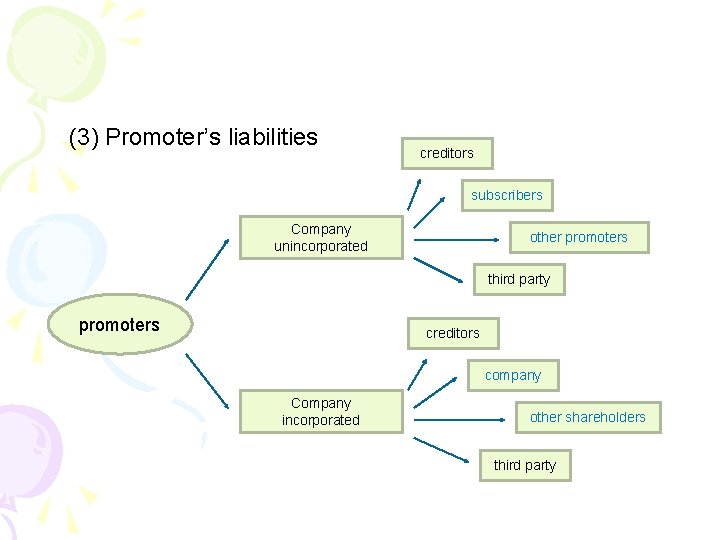
(3) Promoter’s liabilities creditors subscribers Company unincorporated other promoters third party promoters creditors company Company incorporated other shareholders third party
* If company fails to be established - promoter’s unlimited liability - promoter’s liabilities to creditors, subscribers: CCL 2013, s 94 - promoter’s liabilities to third parties: CCL JI 3, s 5
* If company is established - promoter’s liabilities to company: make capital contribution - promoter’s liabilities to other shareholders: contractual - promoter’s liabilities to creditors: CCL JI 3, ss 13, 14 - promoter’s liabilities to third parties: CCL JI 3, s 5
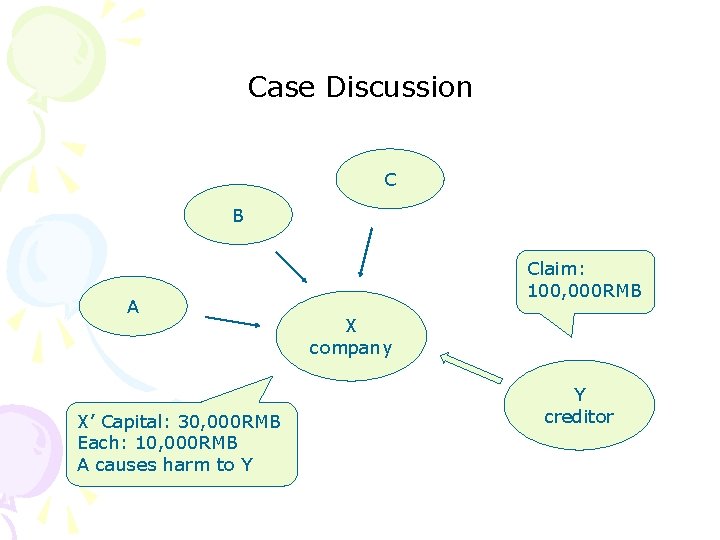
CCL JI 3, s 5: Where a promoter causes any harm to anyone else due to performance of the duty of establishing the company, if, after the establishment of the company, the victim claims that the company shall bear the compensation liability for tort, the people’s court shall support such claim If the company fails to be established, and the victim claims that all the promoters shall bear joint and several liabilities, the people’s court shall support such claim. The company or the promoters not in fault may, after making compensations, recourse against the promoters in fault.
Case Discussion C B A X’ Capital: 30, 000 RMB Each: 10, 000 RMB A causes harm to Y Claim: 100, 000 RMB X company Y creditor
4. Pre-incorporation contract (1) Under common law, three cases:
(a) Case 1: contracts executed in the name of the promoter Wow, My Show stage, cool…… I would like to sign this contract… Do you have any interest in competing on My Show stage? I can send you to that stage, but first you need to sign a contract with me……
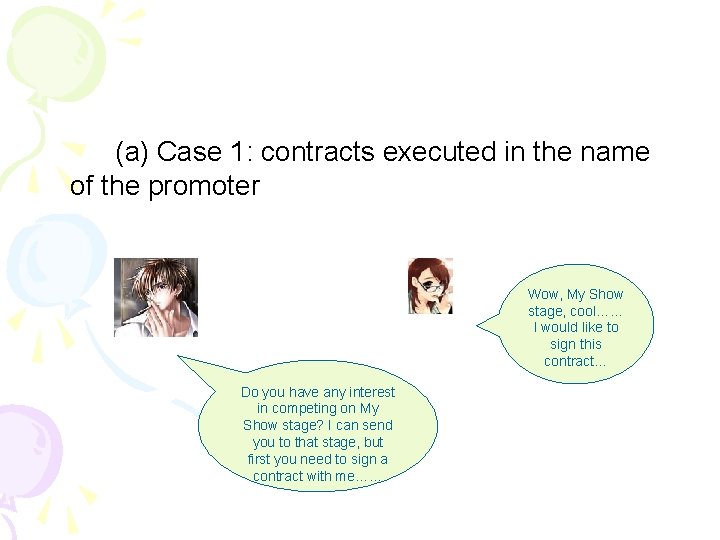
Result (1) Personal liable for the contract, Unless there is a Novation
What is a Novation? Novation is a contract principle by which a third party takes over the rights and duties of a party to a contract, such party thereby being released from obligations under the contract. A novation requires the consent of the other party to the contract, but that consent may be implied from the circumstances.
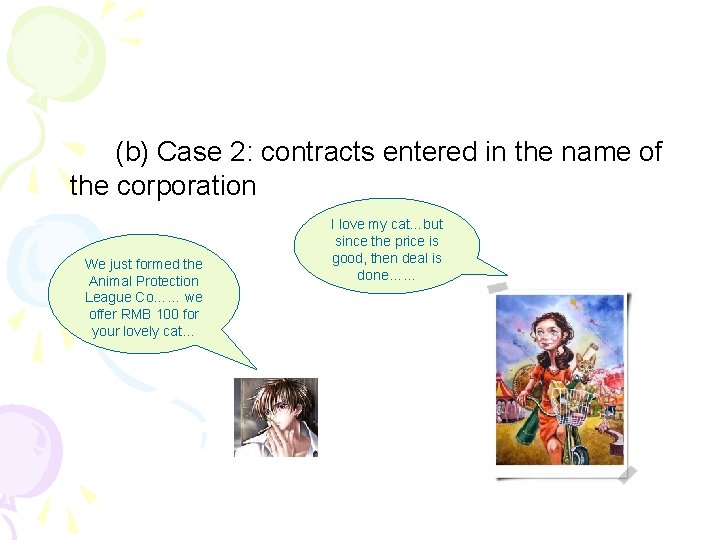
(b) Case 2: contracts entered in the name of the corporation We just formed the Animal Protection League Co…… we offer RMB 100 for your lovely cat… I love my cat…but since the price is good, then deal is done……
Result (2) Personal liable for the contract, but the subsequent adoption of the contract by the corporation may release the promoter
* Summary: If the promoter enters into a contract with a third person in the name of the corporation without disclosing that it is not in existence, the promoter is personally liable on the contract. If the corporation is thereafter created and takes over the contract, the promoter has a chance of being relived of liability but there is a substantial chance that a court will conclude that no novation was intended and the promoter remains liable.
(c) Case 3: contracts referring to the fact the corporation is not yet formed So the corporation is not yet formed… whatever, I need this contract…… I sign this contract on behalf of ABC Co, a corporation to be formed……
Result (3) Personal liable for the contract if the corporation is not formed, but not liable if the corporation is formed and adopts the contracts
(2) Under Chinese law * General rule - the credits and debts of preincorporated company are certainly adopted by the company incorporated - the debts of pre-incorporated company are different from those of promoters
(a) Case 1 - promoters take the liabilities personally - company shall take the liabilities if (i) it confirms that contract, or (ii) it has actually enjoyed the contractual rights, or (iii) it has actually performed the contractual duties (b) Case 2 - CCL 2013, s 210: administrative liabilities - civil liabilities: not clear under CCL
CCL JI 3, s 2: Where a promoter concludes a contract with anyone else in his own name for the purpose of establishing a company, if that person claims that the promoter shall bear contractual liabilities, the people’s court shall support such claim. Where the contract as prescribed in the preceding paragraph is confirmed after the company is established, or the contractual rights have been actually enjoyed or the contractual obligations have been actually performed, if the other party to the contract claims that the company shall bear contractual liabilities, the people’s court shall support such claim.
(c) Case 3 - company shall take the liabilities - company will not take the liabilities if it has the evidence to prove that the promoter makes that contract for his own benefit, but it still shall take the liabilities if another party to that contact is in good faith
CCL JI 3, s 3: Where a promoter concludes a contract with anyone else in the name of a company being established, if, after the company is established, the other party to the contract claims that the company shall bear contractual liabilities, the people’s court shall support such claim. Where, after a company is established, there is evidence to prove that the promoter has concluded a contract with anyone else in the name of the company being established for his own interest, if the company claims on this ground that it shall not bear contractual liabilities, the people’s court shall support such claim except that the other party concluded the contract for good faith.
- Slides: 47