
5 Elasticity and its Application Economics N Gregory




- Slides: 27
5 Elasticity and its Application Economics N. Gregory Mankiw PRINCIPLES OF N. Gregory Mankiw Premium Power. Point Slides by Ron Cronovich
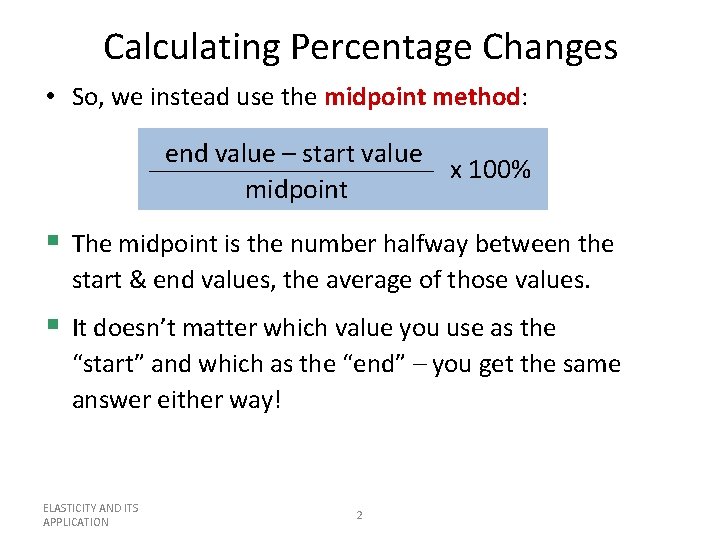
Calculating Percentage Changes • So, we instead use the midpoint method: end value – start value x 100% midpoint § The midpoint is the number halfway between the start & end values, the average of those values. § It doesn’t matter which value you use as the “start” and which as the “end” – you get the same answer either way! ELASTICITY AND ITS APPLICATION 2
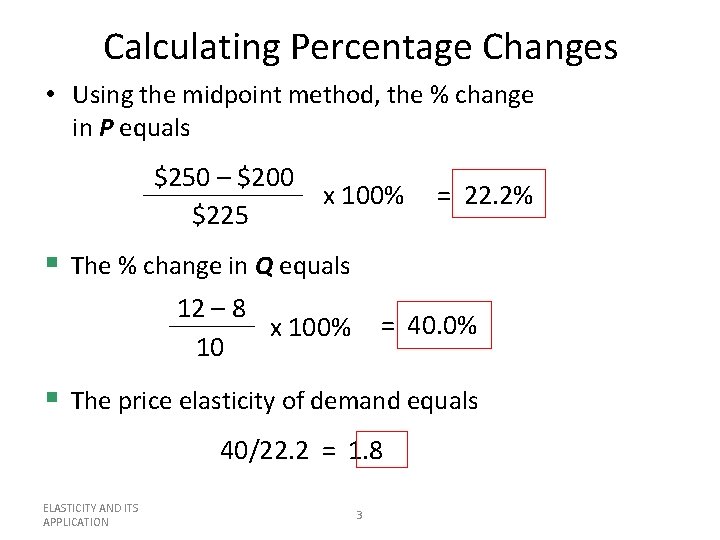
Calculating Percentage Changes • Using the midpoint method, the % change in P equals $250 – $200 $225 x 100% = 22. 2% § The % change in Q equals 12 – 8 x 100% 10 = 40. 0% § The price elasticity of demand equals 40/22. 2 = 1. 8 ELASTICITY AND ITS APPLICATION 3
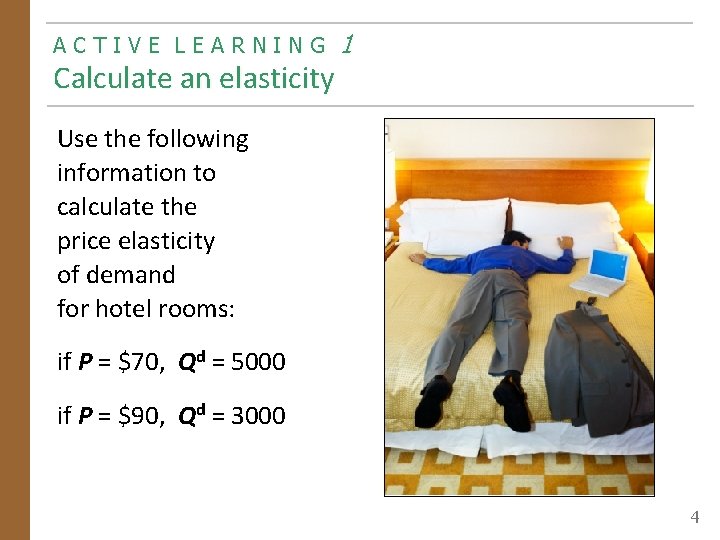
ACTIVE LEARNING Calculate an elasticity 1 Use the following information to calculate the price elasticity of demand for hotel rooms: if P = $70, Qd = 5000 if P = $90, Qd = 3000 4
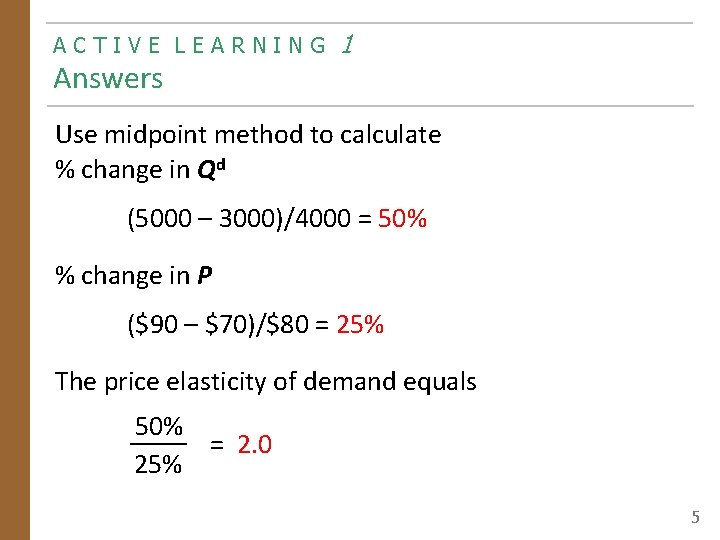
ACTIVE LEARNING Answers 1 Use midpoint method to calculate % change in Qd (5000 – 3000)/4000 = 50% % change in P ($90 – $70)/$80 = 25% The price elasticity of demand equals 50% = 2. 0 25% 5
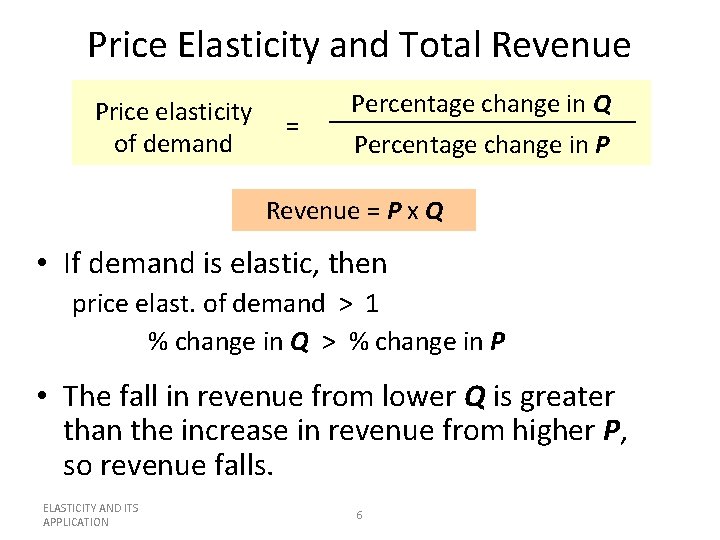
Price Elasticity and Total Revenue Price elasticity of demand = Percentage change in Q Percentage change in P Revenue = P x Q • If demand is elastic, then price elast. of demand > 1 % change in Q > % change in P • The fall in revenue from lower Q is greater than the increase in revenue from higher P, so revenue falls. ELASTICITY AND ITS APPLICATION 6
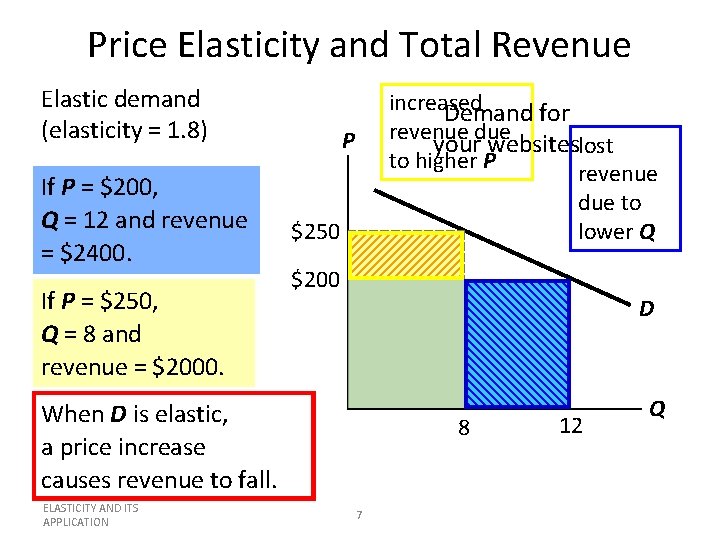
Price Elasticity and Total Revenue Elastic demand (elasticity = 1. 8) If P = $200, Q = 12 and revenue = $2400. If P = $250, Q = 8 and revenue = $2000. increased Demand for revenue due your websiteslost to higher P revenue due to lower Q P $250 $200 D When D is elastic, a price increase causes revenue to fall. ELASTICITY AND ITS APPLICATION 8 7 12 Q
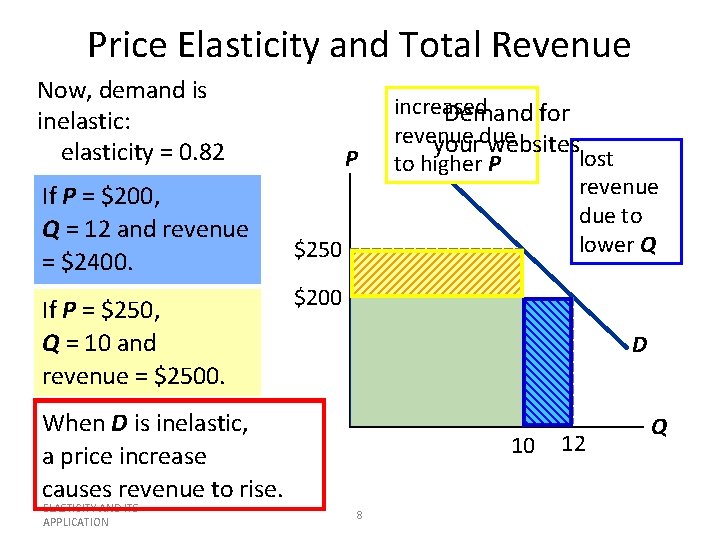
Price Elasticity and Total Revenue Now, demand is inelastic: elasticity = 0. 82 If P = $200, Q = 12 and revenue = $2400. If P = $250, Q = 10 and revenue = $2500. P $250 $200 D When D is inelastic, a price increase causes revenue to rise. ELASTICITY AND ITS APPLICATION increased Demand for revenue yourdue websites lost to higher P revenue due to lower Q 10 8 12 Q
6 Supply, Demand, and Government Policies Economics N. Gregory Mankiw PRINCIPLES OF N. Gregory Mankiw Premium Power. Point Slides by Ron Cronovich
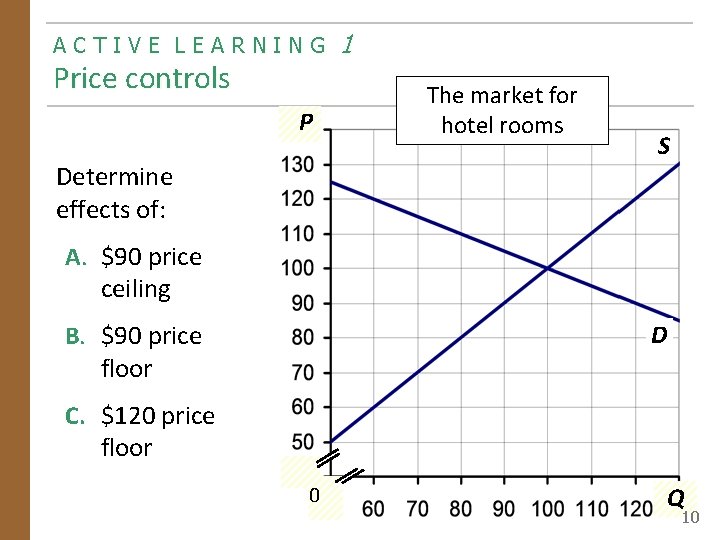
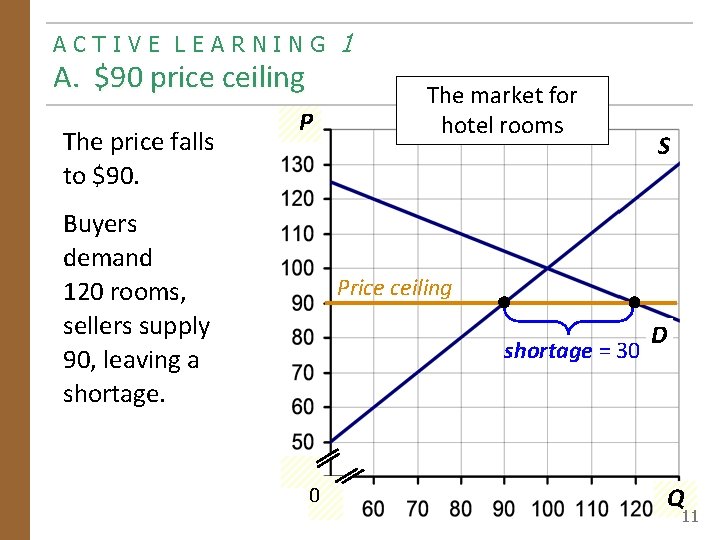
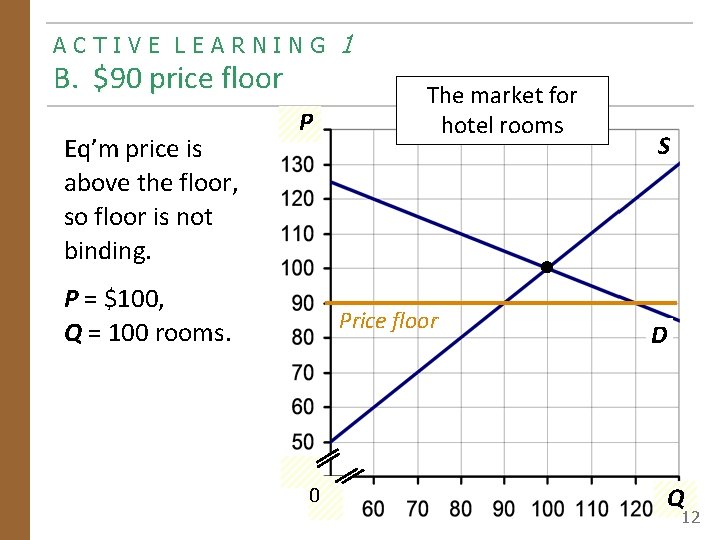
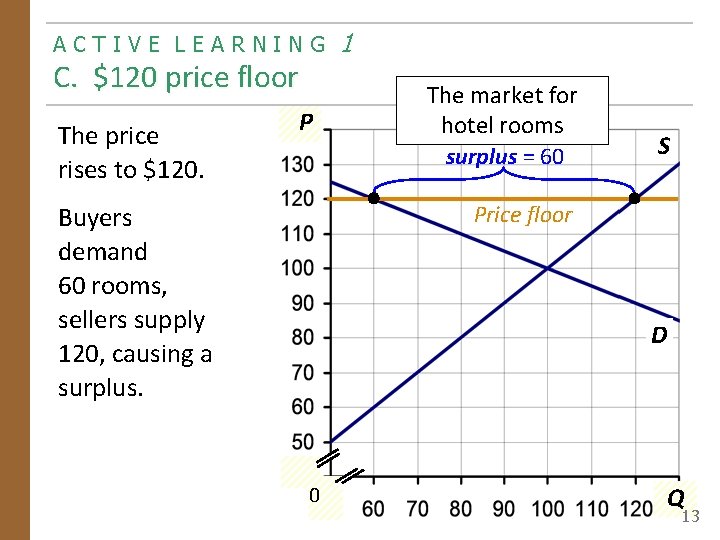
ACTIVE LEARNING Price controls P Determine effects of: 1 The market for hotel rooms S A. $90 price ceiling D B. $90 price floor C. $120 price floor 0 Q 10
ACTIVE LEARNING A. $90 price ceiling The price falls to $90. P Buyers demand 120 rooms, sellers supply 90, leaving a shortage. 1 The market for hotel rooms S Price ceiling shortage = 30 0 D Q 11
ACTIVE LEARNING B. $90 price floor Eq’m price is above the floor, so floor is not binding. P P = $100, Q = 100 rooms. 1 The market for hotel rooms Price floor 0 S D Q 12
ACTIVE LEARNING C. $120 price floor The price rises to $120. P 1 The market for hotel rooms surplus = 60 S Price floor Buyers demand 60 rooms, sellers supply 120, causing a surplus. D 0 Q 13
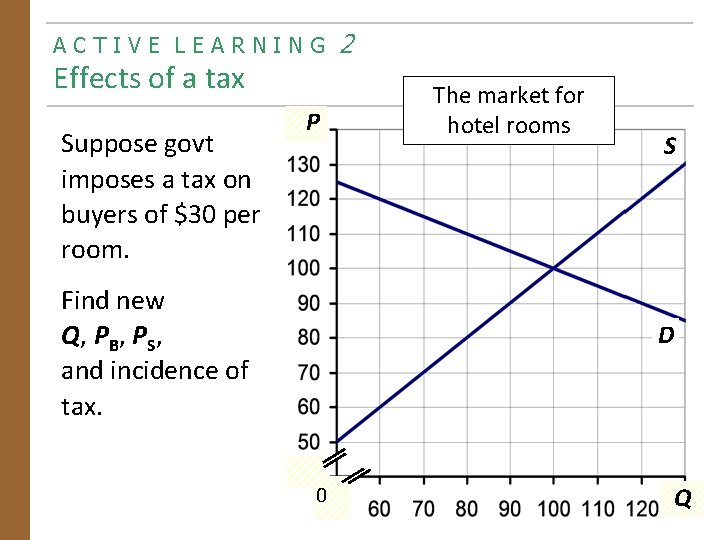
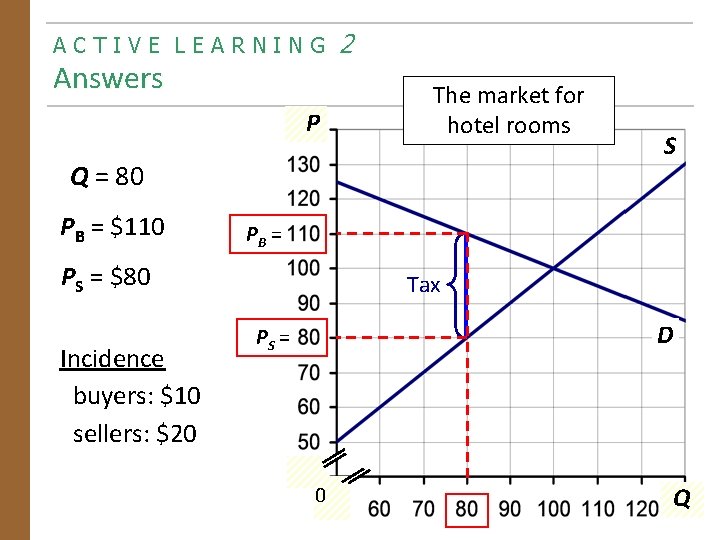
ACTIVE LEARNING Effects of a tax Suppose govt imposes a tax on buyers of $30 per room. P Find new Q, PB, PS, and incidence of tax. 2 The market for hotel rooms S D 0 Q
ACTIVE LEARNING Answers P 2 The market for hotel rooms Q = 80 PB = $110 PB = PS = $80 Incidence buyers: $10 sellers: $20 S Tax D PS = 0 Q
7 Consumers, Producers, and the Efficiency of Markets Economics N. Gregory Mankiw PRINCIPLES OF N. Gregory Mankiw Premium Power. Point Slides by Ron Cronovich
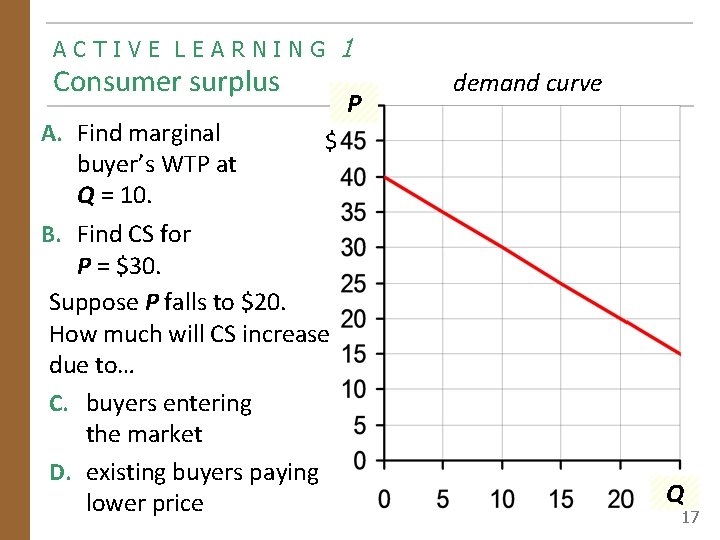
ACTIVE LEARNING Consumer surplus A. Find marginal buyer’s WTP at Q = 10. 1 P demand curve $ B. Find CS for P = $30. Suppose P falls to $20. How much will CS increase due to… C. buyers entering the market D. existing buyers paying lower price Q 17
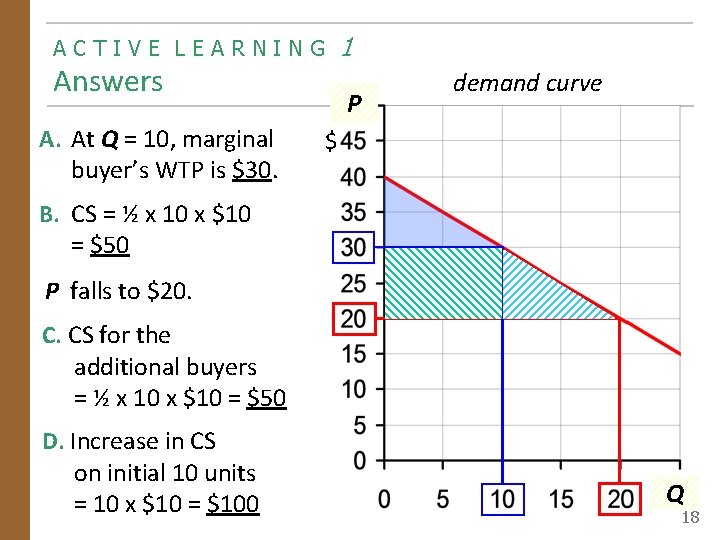
ACTIVE LEARNING Answers A. At Q = 10, marginal buyer’s WTP is $30. 1 P demand curve $ B. CS = ½ x 10 x $10 = $50 P falls to $20. C. CS for the additional buyers = ½ x 10 x $10 = $50 D. Increase in CS on initial 10 units = 10 x $10 = $100 Q 18
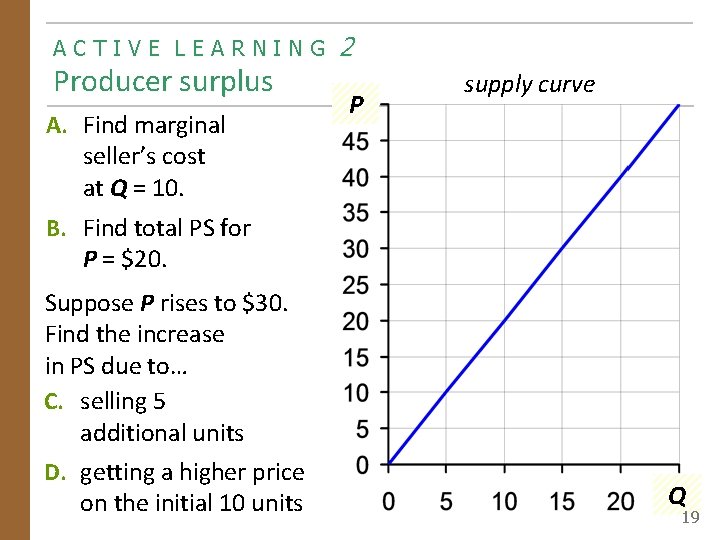
ACTIVE LEARNING Producer surplus A. Find marginal seller’s cost at Q = 10. 2 P supply curve B. Find total PS for P = $20. Suppose P rises to $30. Find the increase in PS due to… C. selling 5 additional units D. getting a higher price on the initial 10 units Q 19
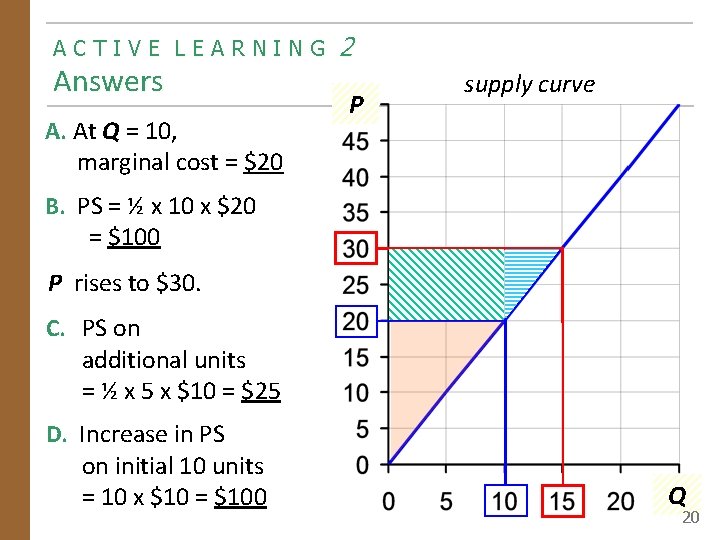
ACTIVE LEARNING Answers A. At Q = 10, marginal cost = $20 2 P supply curve B. PS = ½ x 10 x $20 = $100 P rises to $30. C. PS on additional units = ½ x 5 x $10 = $25 D. Increase in PS on initial 10 units = 10 x $10 = $100 Q 20
8 Application: The Costs of Taxation Economics N. Gregory Mankiw PRINCIPLES OF N. Gregory Mankiw Premium Power. Point Slides by Ron Cronovich
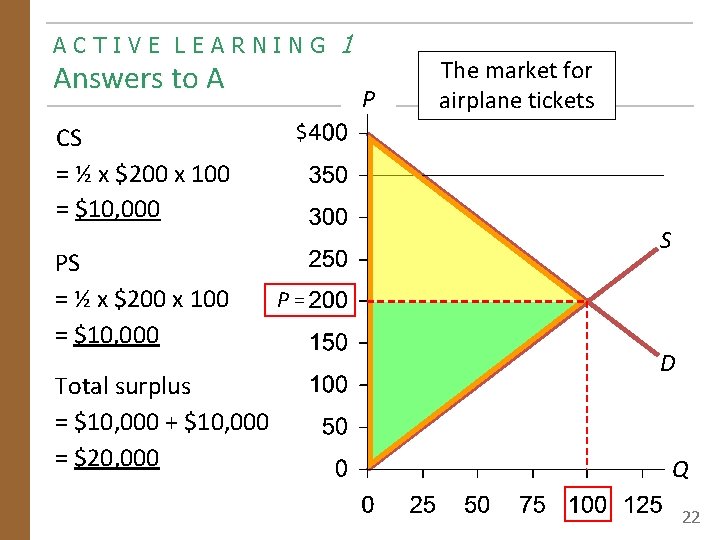
ACTIVE LEARNING Answers to A CS = ½ x $200 x 100 = $10, 000 PS = ½ x $200 x 100 = $10, 000 Total surplus = $10, 000 + $10, 000 = $20, 000 1 P The market for airplane tickets $ S P= D Q 22
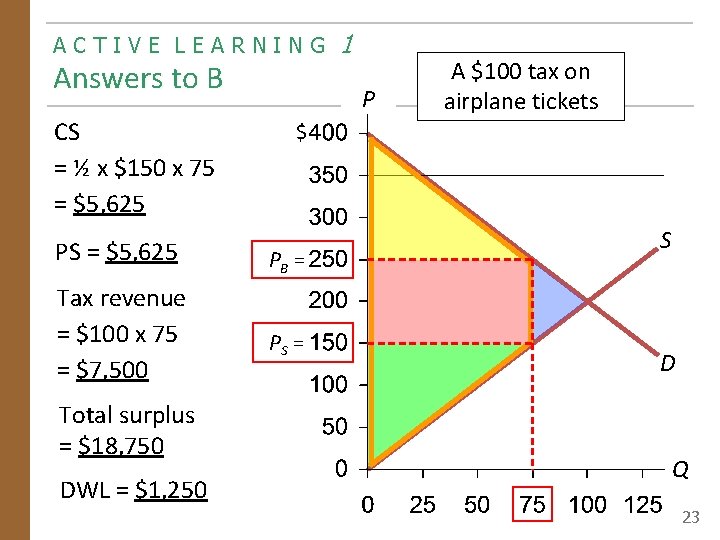
ACTIVE LEARNING Answers to B CS = ½ x $150 x 75 = $5, 625 P PB = Tax revenue = $100 x 75 = $7, 500 PS = DWL = $1, 250 A $100 tax on airplane tickets $ PS = $5, 625 Total surplus = $18, 750 1 S D Q 23
9 Application: International Trade Economics N. Gregory Mankiw PRINCIPLES OF N. Gregory Mankiw Premium Power. Point Slides by Ron Cronovich
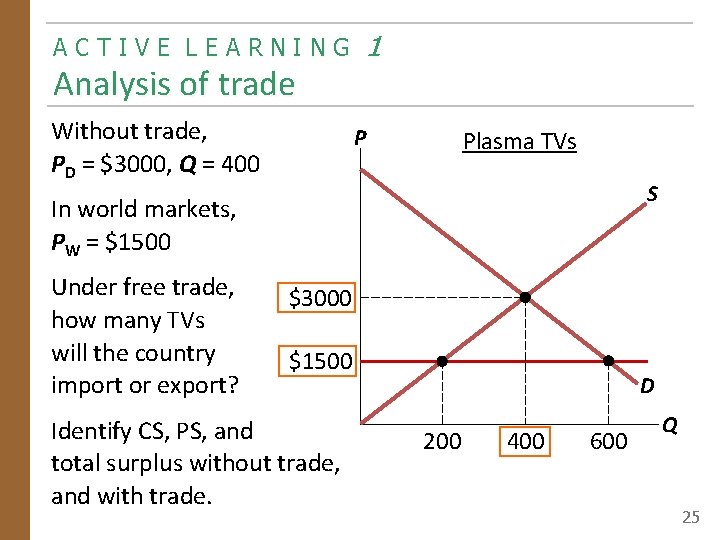
ACTIVE LEARNING Analysis of trade Without trade, PD = $3000, Q = 400 1 P Plasma TVs S In world markets, PW = $1500 Under free trade, how many TVs will the country import or export? $3000 $1500 Identify CS, PS, and total surplus without trade, and with trade. D 200 400 600 Q 25
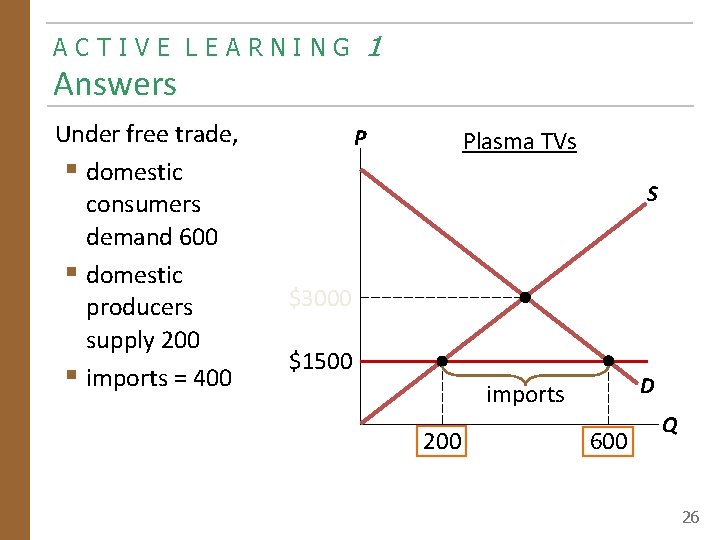
ACTIVE LEARNING Answers Under free trade, § domestic consumers demand 600 § domestic producers supply 200 § imports = 400 1 P Plasma TVs S $3000 $1500 D imports 200 600 Q 26
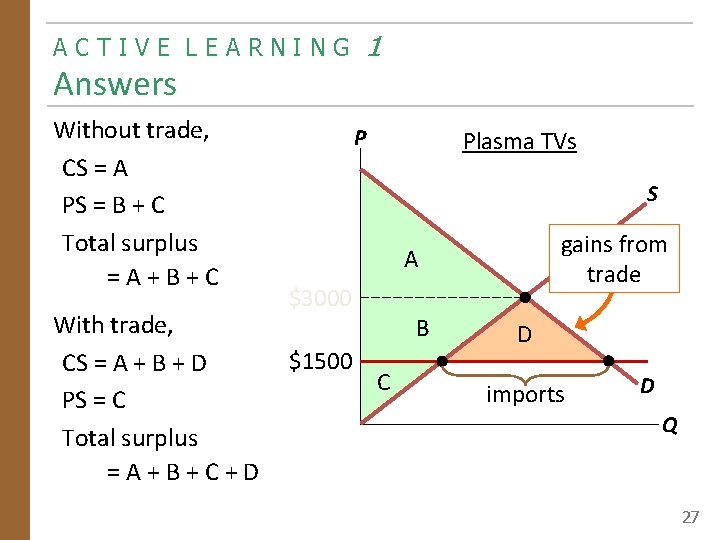
ACTIVE LEARNING Answers Without trade, CS = A PS = B + C Total surplus =A+B+C With trade, CS = A + B + D PS = C Total surplus =A+B+C+D 1 P Plasma TVs S gains from trade A $3000 $1500 B C D imports D Q 27