
5 e Ethics in Information Technology Chapter 6
- Slides: 29
5 e Ethics in Information Technology Chapter 6 Intellectual Property George W. Reynolds © 2015 Cengage Learning. All Rights Reserved. May not be scanned, copied or duplicated, or posted to a publicly accessible website, in whole or in part.
Learning Objectives § What does the term intellectual property encompass, and why are organizations so concerned about protecting intellectual property? § What are the strengths and limitations of using copyrights, patents, and trade secret laws to protect intellectual property? § What is plagiarism, and what can be done to combat it? © 2015 Cengage Learning. All Rights Reserved. May not be scanned, copied or duplicated, or posted to a publicly accessible website, in whole or in part. 2
Learning Objectives § What is reverse engineering, and what issues are associated with applying it to create a lookalike of a competitor’s software program? § What is open source code, and what is the fundamental premise behind its use? § What is the essential difference between competitive intelligence and industrial espionage, and how is competitive intelligence gathered? § What is cybersquatting, and what strategy should be used to protect an organization from it? © 2015 Cengage Learning. All Rights Reserved. May not be scanned, copied or duplicated, or posted to a publicly accessible website, in whole or in part. 3
Intellectual Property § Describes works of the mind that are distinct and owned or created by a single person or group § Protected through § Copyright § Patent § Trade secret laws § Owner controls and receive compensations for the use of their intellectual property © 2015 Cengage Learning. All Rights Reserved. May not be scanned, copied or duplicated, or posted to a publicly accessible website, in whole or in part. 4
Copyright § Exclusive right to distribute, display, perform, reproduce an original work in copies or prepare derivative works based on the work § Copyright infringement: Violation of the rights secured by the owner of a copyright § Sonny Bono Copyright Term Extension Act § Establishes time limits for copy right protected work © 2015 Cengage Learning. All Rights Reserved. May not be scanned, copied or duplicated, or posted to a publicly accessible website, in whole or in part. 5
Copyright § Eligibility criteria § Work should be original and must fall within one of the categories described in Title 17 of the U. S. Code § Fair use doctrine § Allows portions of copyrighted materials to be used without permission § Depends on purpose, character, nature, relation, and effect of the copyrighted work § Software copyright protection § Proving infringement requires showing resemblance that could be explained only by copying © 2015 Cengage Learning. All Rights Reserved. May not be scanned, copied or duplicated, or posted to a publicly accessible website, in whole or in part. 6
Measures for Protection of Intellectual Property Prioritizing Resources and Organization for Intellectual Property (PRO-IP) Act of 2008 • Increased trademark and copyright enforcement and substantially increased penalties for infringement General Agreement on Tariffs and Trade (GATT) • Multilateral agreement governing international trade WTO and the WTO TRIPS Agreement (1994) • Agreement on Trade-Related Aspects of Intellectual Property Rights (TRIPS) • Establishes minimum levels of protection that each government must provide to the intellectual property of all WTO members © 2015 Cengage Learning. All Rights Reserved. May not be scanned, copied or duplicated, or posted to a publicly accessible website, in whole or in part. 7
Measures for Protection of Intellectual Property World Intellectual Property Organization (WIPO) Copyright Treaty (1996) • Encourages use of intellectual property as a means to stimulate innovation and creativity Digital Millennium Copyright Act (DMCA) • Implements the WIPO Copyright Treaty and the WIPO Performances © 2015 Cengage Learning. All Rights Reserved. May not be scanned, copied or duplicated, or posted to a publicly accessible website, in whole or in part. 8
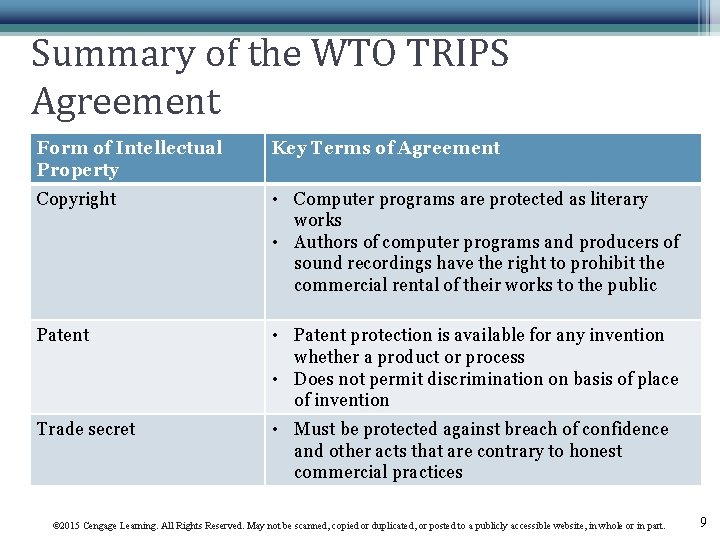
Summary of the WTO TRIPS Agreement Form of Intellectual Property Key Terms of Agreement Copyright • Computer programs are protected as literary works • Authors of computer programs and producers of sound recordings have the right to prohibit the commercial rental of their works to the public Patent • Patent protection is available for any invention whether a product or process • Does not permit discrimination on basis of place of invention Trade secret • Must be protected against breach of confidence and other acts that are contrary to honest commercial practices © 2015 Cengage Learning. All Rights Reserved. May not be scanned, copied or duplicated, or posted to a publicly accessible website, in whole or in part. 9
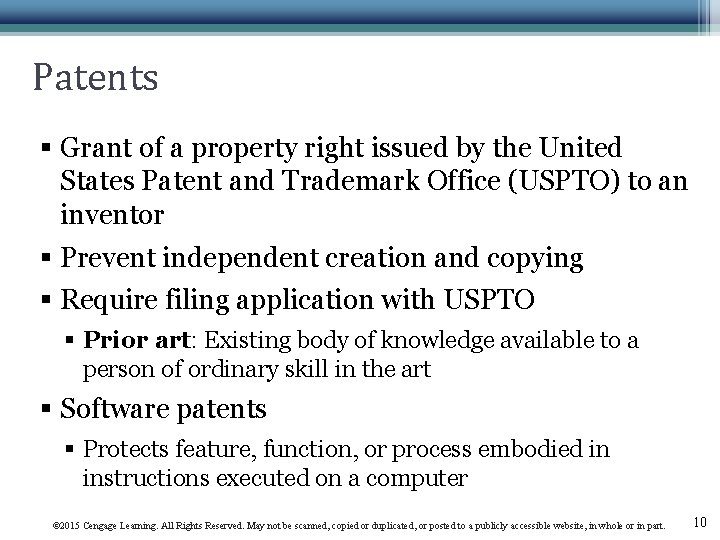
Patents § Grant of a property right issued by the United States Patent and Trademark Office (USPTO) to an inventor § Prevent independent creation and copying § Require filing application with USPTO § Prior art: Existing body of knowledge available to a person of ordinary skill in the art § Software patents § Protects feature, function, or process embodied in instructions executed on a computer © 2015 Cengage Learning. All Rights Reserved. May not be scanned, copied or duplicated, or posted to a publicly accessible website, in whole or in part. 10
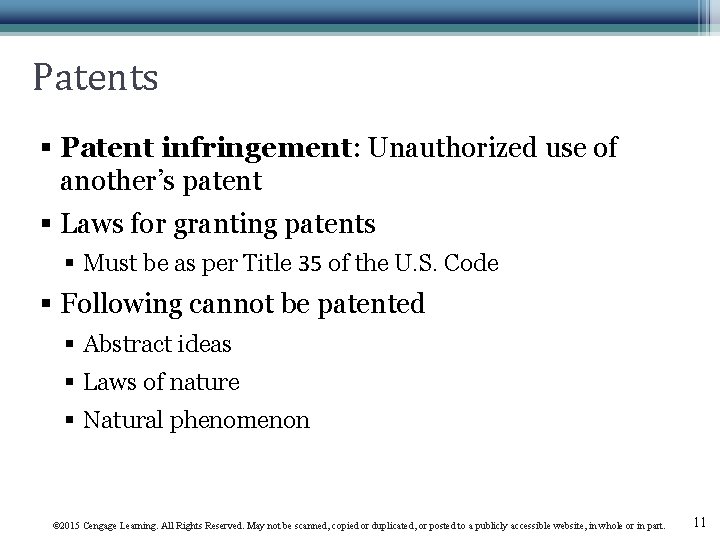
Patents § Patent infringement: Unauthorized use of another’s patent § Laws for granting patents § Must be as per Title 35 of the U. S. Code § Following cannot be patented § Abstract ideas § Laws of nature § Natural phenomenon © 2015 Cengage Learning. All Rights Reserved. May not be scanned, copied or duplicated, or posted to a publicly accessible website, in whole or in part. 11
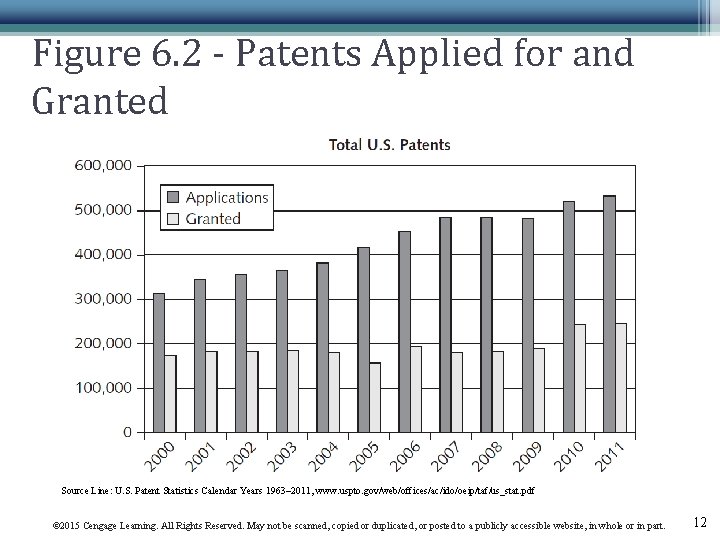
Figure 6. 2 - Patents Applied for and Granted Source Line: U. S. Patent Statistics Calendar Years 1963– 2011, www. uspto. gov/web/offices/ac/ido/oeip/taf/us_stat. pdf © 2015 Cengage Learning. All Rights Reserved. May not be scanned, copied or duplicated, or posted to a publicly accessible website, in whole or in part. 12
Leahy-Smith America Invents Act (2011) § Changed the patent system from a first-to-invent to first-inventor-to-file § Expanded the definition of prior art used to determine the novelty of an invention and whether it can be patented © 2015 Cengage Learning. All Rights Reserved. May not be scanned, copied or duplicated, or posted to a publicly accessible website, in whole or in part. 13
Cross-Licensing Agreements § Each party agrees not to sue the other over patent infringements § Small businesses must pay an additional cost from which many larger companies are exempt § Usually settles and licenses its patents to the large company © 2015 Cengage Learning. All Rights Reserved. May not be scanned, copied or duplicated, or posted to a publicly accessible website, in whole or in part. 14
Trade Secrets § Business information that: § Represents something of economic value § Has required effort or cost to develop § Has some degree of uniqueness or novelty § Is generally unknown to the public § Is kept confidential © 2015 Cengage Learning. All Rights Reserved. May not be scanned, copied or duplicated, or posted to a publicly accessible website, in whole or in part. 15
Advantages of Trade Secret Laws § No time limitations on the protection of trade secrets § No need to file an application, make disclosures to any person or agency, or disclose a trade secret to outsiders to gain protection § Trade secrets cannot be ruled invalid by the courts © 2015 Cengage Learning. All Rights Reserved. May not be scanned, copied or duplicated, or posted to a publicly accessible website, in whole or in part. 16
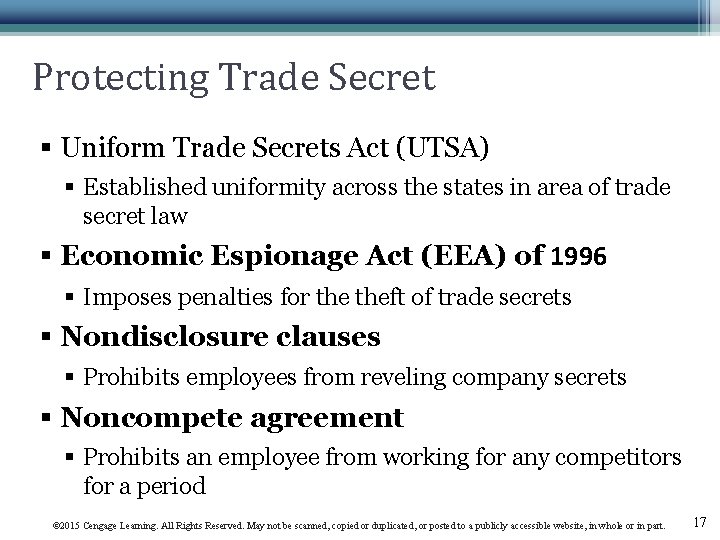
Protecting Trade Secret § Uniform Trade Secrets Act (UTSA) § Established uniformity across the states in area of trade secret law § Economic Espionage Act (EEA) of 1996 § Imposes penalties for theft of trade secrets § Nondisclosure clauses § Prohibits employees from reveling company secrets § Noncompete agreement § Prohibits an employee from working for any competitors for a period © 2015 Cengage Learning. All Rights Reserved. May not be scanned, copied or duplicated, or posted to a publicly accessible website, in whole or in part. 17
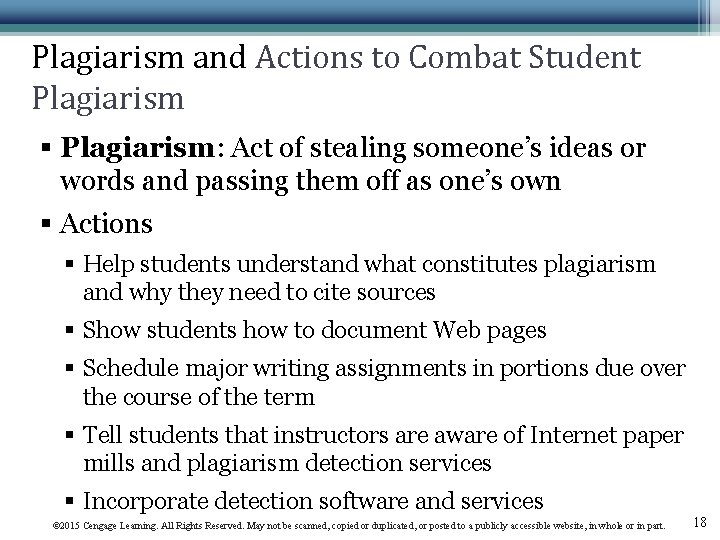
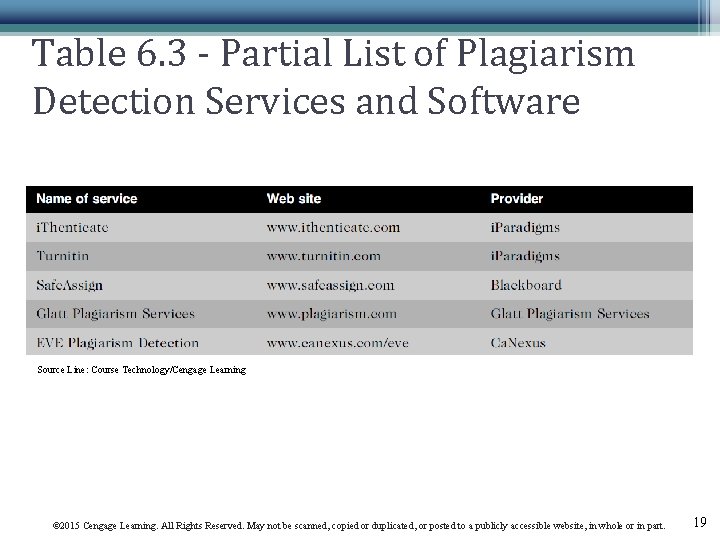
Plagiarism and Actions to Combat Student Plagiarism § Plagiarism: Act of stealing someone’s ideas or words and passing them off as one’s own § Actions § Help students understand what constitutes plagiarism and why they need to cite sources § Show students how to document Web pages § Schedule major writing assignments in portions due over the course of the term § Tell students that instructors are aware of Internet paper mills and plagiarism detection services § Incorporate detection software and services © 2015 Cengage Learning. All Rights Reserved. May not be scanned, copied or duplicated, or posted to a publicly accessible website, in whole or in part. 18
Table 6. 3 - Partial List of Plagiarism Detection Services and Software Source Line: Course Technology/Cengage Learning © 2015 Cengage Learning. All Rights Reserved. May not be scanned, copied or duplicated, or posted to a publicly accessible website, in whole or in part. 19
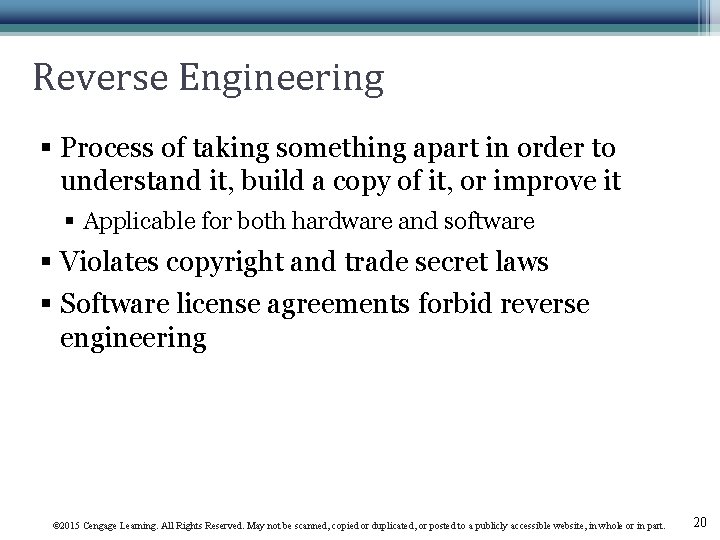
Reverse Engineering § Process of taking something apart in order to understand it, build a copy of it, or improve it § Applicable for both hardware and software § Violates copyright and trade secret laws § Software license agreements forbid reverse engineering © 2015 Cengage Learning. All Rights Reserved. May not be scanned, copied or duplicated, or posted to a publicly accessible website, in whole or in part. 20
Open Source Code § Program whose source code is made available for use or modification, as users or other developers see fit § Produces better software than the traditional closed model § Reasons for developing open source code § Respect § Reputation § Recovering maintenance cost § Hassle of license and marketing © 2015 Cengage Learning. All Rights Reserved. May not be scanned, copied or duplicated, or posted to a publicly accessible website, in whole or in part. 21
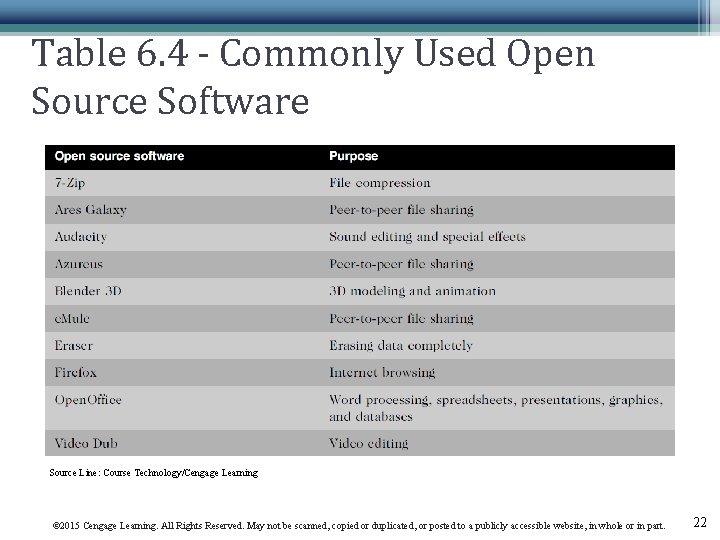
Table 6. 4 - Commonly Used Open Source Software Source Line: Course Technology/Cengage Learning © 2015 Cengage Learning. All Rights Reserved. May not be scanned, copied or duplicated, or posted to a publicly accessible website, in whole or in part. 22
Competitive Intelligence § Legally obtained information that is gathered to help a company gain an advantage over its rivals § Integrated into a company’s strategic plans and decision making § Not same as industrial espionage § Industrial espionage: Use of illegal means to obtain business information not available to the general public § Sources of data § Rapportive, Crunchbase, CORI, Thomas. Net. com, Who. Got. Funded. com © 2015 Cengage Learning. All Rights Reserved. May not be scanned, copied or duplicated, or posted to a publicly accessible website, in whole or in part. 23
Trademark Infringement § Trademark § Logo, package design, phrase, sound, or word that enables a consumer to differentiate one company’s products from another’s § Can be renewed forever, so long as a mark is in use § Lanham Act of 1946 - Defines the use of a trademark as process for obtaining a trademark from the Patent and Trademark Office § Outlines penalties associated with trademark infringement © 2015 Cengage Learning. All Rights Reserved. May not be scanned, copied or duplicated, or posted to a publicly accessible website, in whole or in part. 24
Trademark Infringement § Nominative fair use - Defense employed by the defendant in trademark infringement case, requires proving following § Plaintiff’s product or service cannot be readily identifiable without using the plaintiff’s mark § It uses only as much of the plaintiff’s mark as necessary to identify the defendant’s product or service § Defendant does nothing with the plaintiff’s mark that suggests endorsement or sponsorship by the plaintiff © 2015 Cengage Learning. All Rights Reserved. May not be scanned, copied or duplicated, or posted to a publicly accessible website, in whole or in part. 25
Cybersquatting § Cybersquatters: Register domain names for famous trademarks or company names to which they had no connection § Hope that the trademark’s owner would eventually buy the domain name for a large sum of money § Tactics to circumvent cybersquatting - Register all possible domain names §. com, . edu, . gov, . int, . mil, . net, . org, arpa, . aero, . biz, . coop, . info, . museum, . name, . pro, . asia, . cat, . mobi, . tel, . travel, and. xxx © 2015 Cengage Learning. All Rights Reserved. May not be scanned, copied or duplicated, or posted to a publicly accessible website, in whole or in part. 26
Internet Corporation for Assigned Names and Numbers (ICANN) § Nonprofit corporation responsible for managing the internet’s domain name system § Current trademark holders are given time to assert their rights in the new top-level domains before registrations are opened to the general public § Has a Uniform Domain Name Dispute Resolution Policy § Anticybersquatting Consumer Protection Act allows trademark owners to challenge foreign cybersquatters © 2015 Cengage Learning. All Rights Reserved. May not be scanned, copied or duplicated, or posted to a publicly accessible website, in whole or in part. 27
Summary § Intellectual property is protected by laws for: § Copyrights § Patents § Trademarks § Trade secrets § Plagiarism is stealing and passing off the ideas and words of another as one’s own § Reverse engineering § Process of breaking something down in order to understand, build a copy of, or improve it © 2015 Cengage Learning. All Rights Reserved. May not be scanned, copied or duplicated, or posted to a publicly accessible website, in whole or in part. 28
Summary § Open source code § Made available for use or modification as users or other developers see fit § Competitive intelligence § Uses legal means and public information § Trademark infringement § Use of other’s trademark in a Web site can lead to issues § Cybersquatting § Registration of a domain name by an unaffiliated party © 2015 Cengage Learning. All Rights Reserved. May not be scanned, copied or duplicated, or posted to a publicly accessible website, in whole or in part. 29