
5 Do you have 5 Minutes Using Brief

5 Do you have 5 Minutes? Using Brief Educational Interventions in the Professional Development Setting to Promote Retention of Learned Concepts KELLEY A. SEARS, BSN, RN, CPN
5 Educational Content: Background § EDUCATIONAL PROGRAM ON THE FIRST FIVE MINUTES OF PEDIATRIC CARDIAC ARREST § HIGH LEVEL OF STAFF ENGAGEMENT § IMPROVEMENT IN § § Knowledge (p < 0. 0001) § Skill (p< 0. 0001) § Self-Efficacy (p< 0. 0001) HOW DO WE SUSTAIN THESE OUTCOMES?
5 RETENTION OF CPR CURRICULUM § Low volume, high risk events § Literature reveals poor retention of CPR knowledge, skills, and priorities in nurses KNOWLES’ THEORY OF ADULT LEARNING Teaching Strategy: Background § Learner-centered § Curriculum developed on learner’s needs and self-identified gaps in knowledge and skill § Curriculum is meaningful and relevant FORMAL ASSESSMENT OF LEARNER SELFIDENTIFIED GAPS § Focus groups § Review of Mental Model Framework (Billings & Halstead 2016; Curran, 2014; Sullivan, 2015)
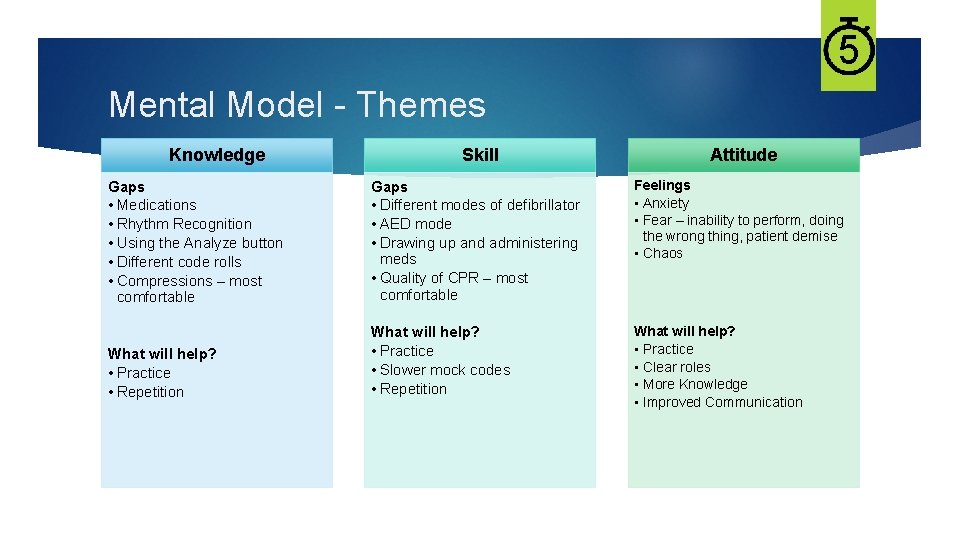
5 Mental Model - Themes Knowledge Skill Attitude Gaps • Medications • Rhythm Recognition • Using the Analyze button • Different code rolls • Compressions – most comfortable Gaps • Different modes of defibrillator • AED mode • Drawing up and administering meds • Quality of CPR – most comfortable Feelings • Anxiety • Fear – inability to perform, doing the wrong thing, patient demise • Chaos What will help? • Practice • Repetition What will help? • Practice • Slower mock codes • Repetition What will help? • Practice • Clear roles • More Knowledge • Improved Communication
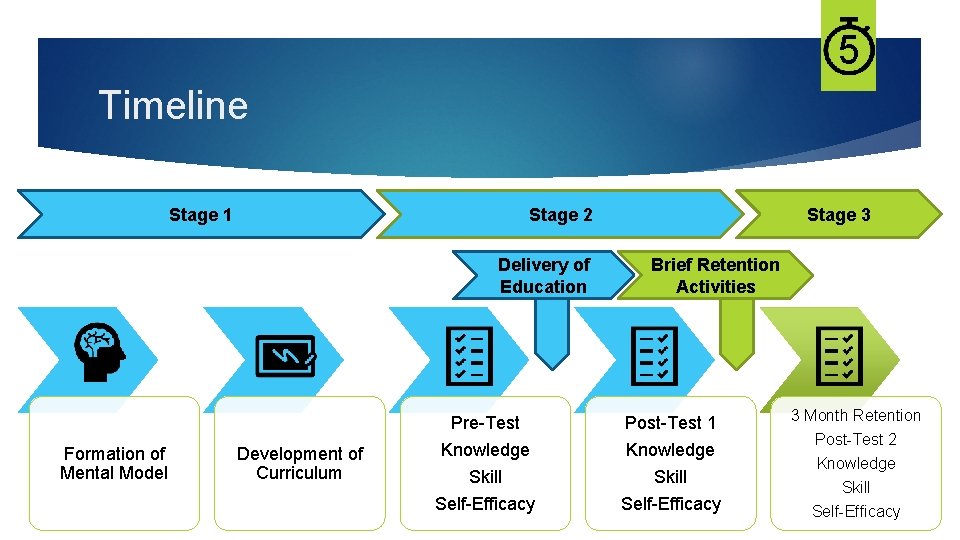
5 Timeline Stage 1 Stage 2 Delivery of Education Formation of Mental Model Development of Curriculum Stage 3 Brief Retention Activities Pre-Test Post-Test 1 Knowledge Skill Self-Efficacy 3 Month Retention Post-Test 2 Knowledge Skill Self-Efficacy
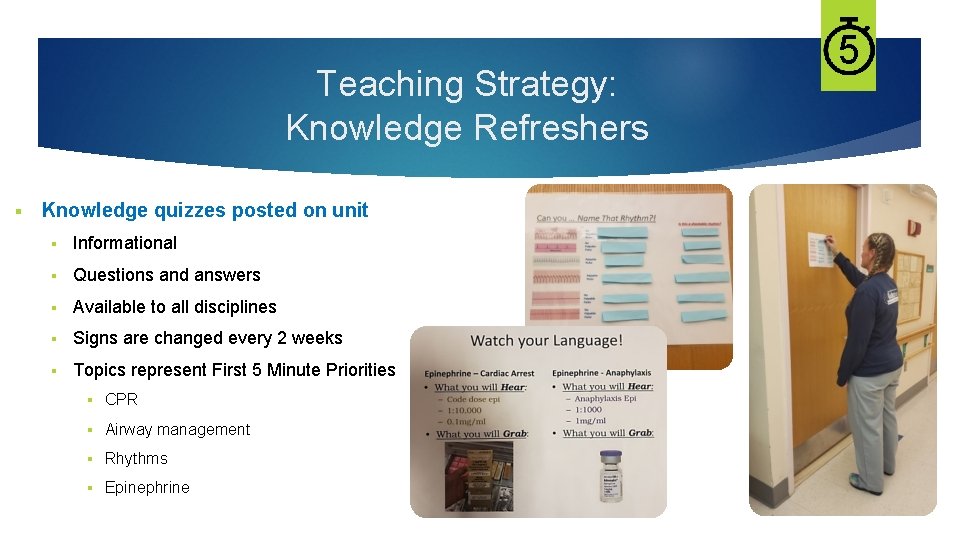
Teaching Strategy: Knowledge Refreshers § Knowledge quizzes posted on unit § Informational § Questions and answers § Available to all disciplines § Signs are changed every 2 weeks § Topics represent First 5 Minute Priorities § CPR § Airway management § Rhythms § Epinephrine 5
Teaching Strategy: 5 Minute Skill Refreshers Use of low fidelity simulation & hands-on partial task trainers • • • Retain and improve skills learned in previous instruction Improve clinical competence Learner-driven management errors Gain self-confidence and knowledge Reinforce learning with constructive feedback 5 Use of deliberate practice sessions Evidence supports improvement of skill performance and retention of CPR priorities Use of peer tuition in group scenarios • Participants within the group teach others what they know • Instructor acts as a facilitator of group and content expert (Billings & Halstead, 2016; Bradshaw & Hultquist, 2017; Hamilton, 2005; Sullivan, 2015)
Teaching Strategy: 5 Minute Nursing Mock Code In-situ Medium-fidelity Simulation • Retain and improve knowledge and skills learned in previous instruction • Demonstration of the application of learning • Improve clinical competence, gain selfconfidence • Learner-driven management errors • Evidence suggests brief, frequent simulation sessions improve retention of CPR priorities 5 Debriefing • When most of the learning occurs • Reinforces theory, allows students to share experiences, reinforces solidarity • Learning occurs through reflection • Instructor is a facilitator – stimulates student thinking and reflection • Discussion of application of learned concepts into practice (Billings & Halstead, 2016; Bradshaw & Hultquist, 2017; Hamilton, 2005; Sullivan, 2015)
5 Kirkpatrick Evaluation Model § Model can be used to achieve and evaluate desired learner outcomes § Evaluation model has been used for simulation education/training § Literature supports use of Kirkpatrick Model for evaluation of CPR training in nurses § Comprehensive model that incorporates all relevant stakeholders § Students § Instructors § Employers (Billings & Halstead, 2016; Dorri, Akbari, & Sedeh, 2016; Paull, Whitsed, & Girardi, 2016; Rouse, 2011)
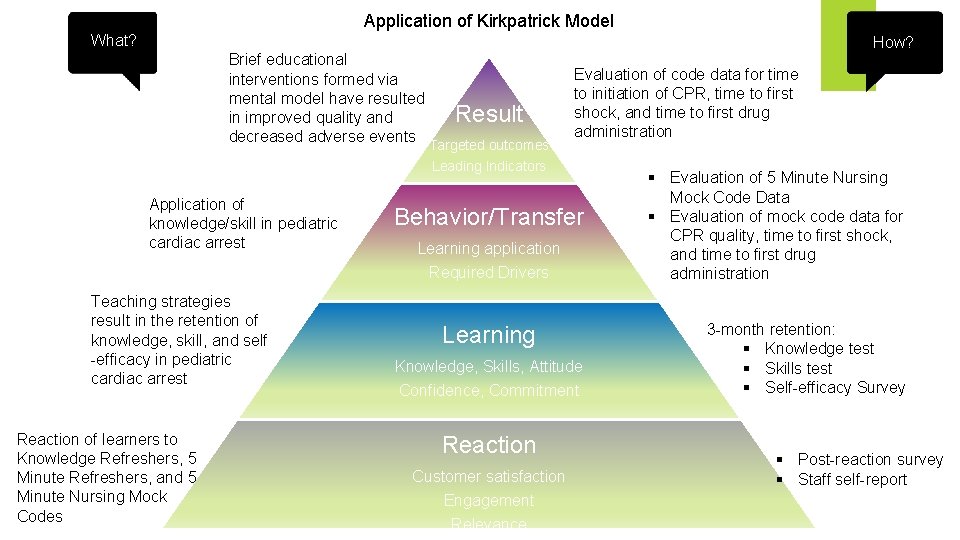
Application of Kirkpatrick Model What? Brief educational interventions formed via mental model have resulted Result in improved quality and decreased adverse events Targeted outcomes How? Evaluation of code data for time to initiation of CPR, time to first shock, and time to first drug administration Leading Indicators Application of knowledge/skill in pediatric cardiac arrest Teaching strategies result in the retention of knowledge, skill, and self -efficacy in pediatric cardiac arrest Reaction of learners to Knowledge Refreshers, 5 Minute Refreshers, and 5 Minute Nursing Mock Codes Behavior/Transfer Learning application Required Drivers Learning Knowledge, Skills, Attitude Confidence, Commitment Reaction Customer satisfaction Engagement Relevance § Evaluation of 5 Minute Nursing Mock Code Data § Evaluation of mock code data for CPR quality, time to first shock, and time to first drug administration 3 -month retention: § Knowledge test § Skills test § Self-efficacy Survey § Post-reaction survey § Staff self-report
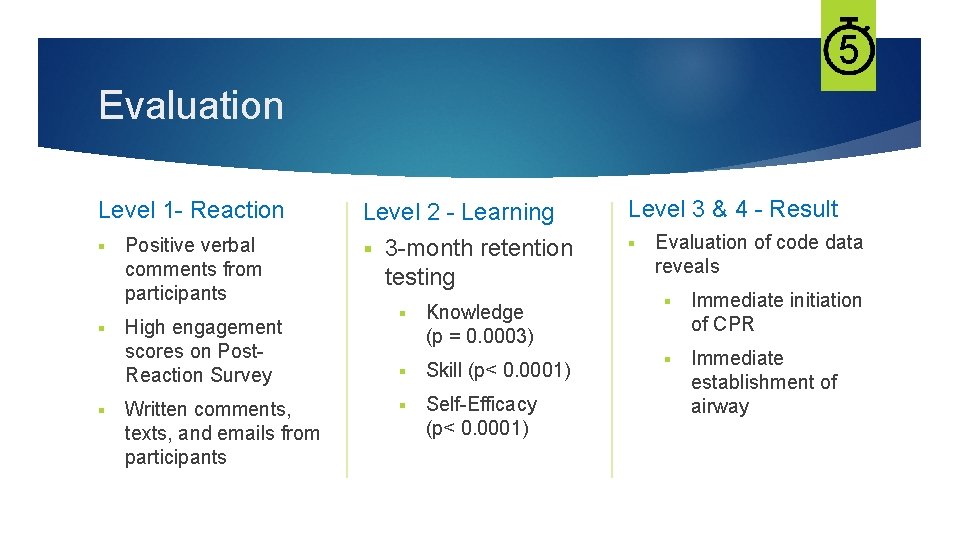
5 Evaluation Level 1 - Reaction § § § Positive verbal comments from participants High engagement scores on Post. Reaction Survey Written comments, texts, and emails from participants Level 2 - Learning § 3 -month retention testing § Knowledge (p = 0. 0003) § Skill (p< 0. 0001) § Self-Efficacy (p< 0. 0001) Level 3 & 4 - Result § Evaluation of code data reveals § Immediate initiation of CPR § Immediate establishment of airway
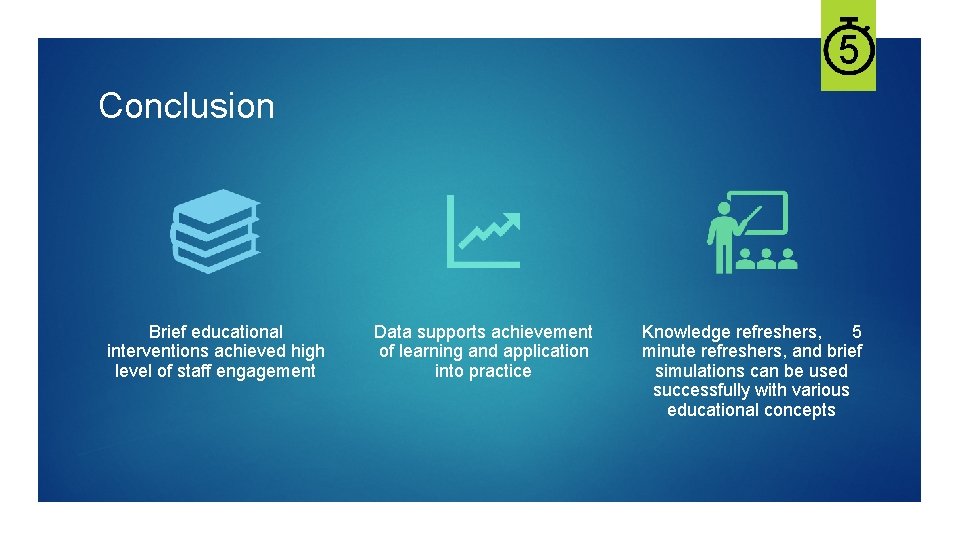
5 Conclusion Brief educational interventions achieved high level of staff engagement Data supports achievement of learning and application into practice Knowledge refreshers, 5 minute refreshers, and brief simulations can be used successfully with various educational concepts
5 References § Billings, D. M. , & Halstead, J. A. (2016). Teaching in nursing: A guide for faculty. (5 th ed. ). St. Louis, MO: Elsevier. § Bradshaw, M. , & Hultquist, B. L. (2017). Innovative teaching strategies in nursing and related health professions. (7 th ed. ). Burlington, MA: Jones & Bartlett Learning. § Curran, M. K. (2014). Examination of the teaching styles of nursing professional development specialists, part I: Best practices in adult learning theory, curriculum development, and knowledge transfer. The Journal of Continuing Education in Nursing, 45(5), 233 -240. § Dorri, S. , Akbari, M. , & Sedeh, M. D. (2016). Kirkpatrick evaluation model for in-service training on cardiopulmonary resuscitation. Iranian Journal of Nursing and Midwifery Research, 21(5), 493 -497. § Hamilton, R. (2005). Nurses’ knowledge and skill retention following cardiopulmonary resuscitation training: A review of the literature. Journal of Advanced Nursing, 51(3), 288 -297. § Paull, M. , Whitsed, C. , & Girardi, A. (2016). Applying the Kirkpatrick model: Evaluating an Interaction for Learning Framework curriculum intervention. Issues in Educational Research, 26(3), 490 -507. § Rouse, D. N. (2011). Employing Kirkpatrick’s evaluation framework to determine effectiveness of health information management courses and programs. Perspectives in Health Information Management, 8. Retrieved from https: //www. ncbi. nlm. nih. gov/pmc/articles/PMC 3070232 § Sullivan, N. (2015). An integrative review: Instructional strategies to improve nurses’ retention of cardiopulmonary resuscitation priorities. International Journal of Nursing Education and Scholarship, 12(1), 1 -7.
- Slides: 13