
5 DIFFERENT TYPES OF FOOD IN FRANCE By

5 DIFFERENT TYPES OF FOOD IN FRANCE By: Ellis
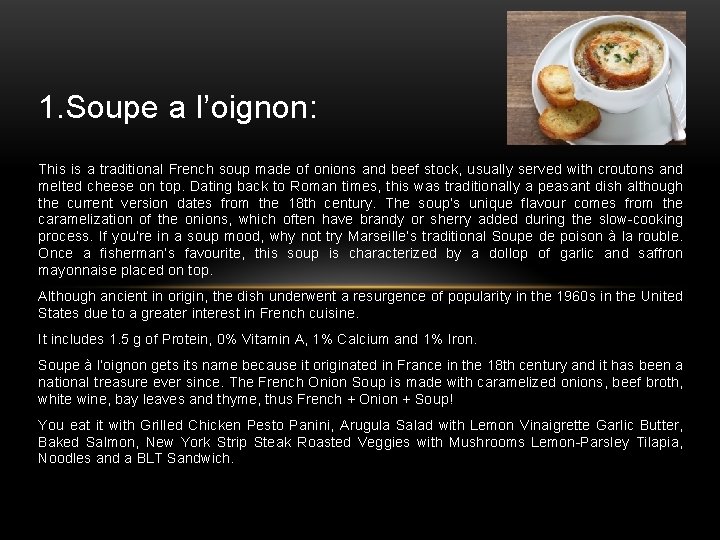
1. Soupe a l’oignon: This is a traditional French soup made of onions and beef stock, usually served with croutons and melted cheese on top. Dating back to Roman times, this was traditionally a peasant dish although the current version dates from the 18 th century. The soup’s unique flavour comes from the caramelization of the onions, which often have brandy or sherry added during the slow-cooking process. If you’re in a soup mood, why not try Marseille’s traditional Soupe de poison à la rouble. Once a fisherman’s favourite, this soup is characterized by a dollop of garlic and saffron mayonnaise placed on top. Although ancient in origin, the dish underwent a resurgence of popularity in the 1960 s in the United States due to a greater interest in French cuisine. It includes 1. 5 g of Protein, 0% Vitamin A, 1% Calcium and 1% Iron. Soupe à l’oignon gets its name because it originated in France in the 18 th century and it has been a national treasure ever since. The French Onion Soup is made with caramelized onions, beef broth, white wine, bay leaves and thyme, thus French + Onion + Soup! You eat it with Grilled Chicken Pesto Panini, Arugula Salad with Lemon Vinaigrette Garlic Butter, Baked Salmon, New York Strip Steak Roasted Veggies with Mushrooms Lemon-Parsley Tilapia, Noodles and a BLT Sandwich.
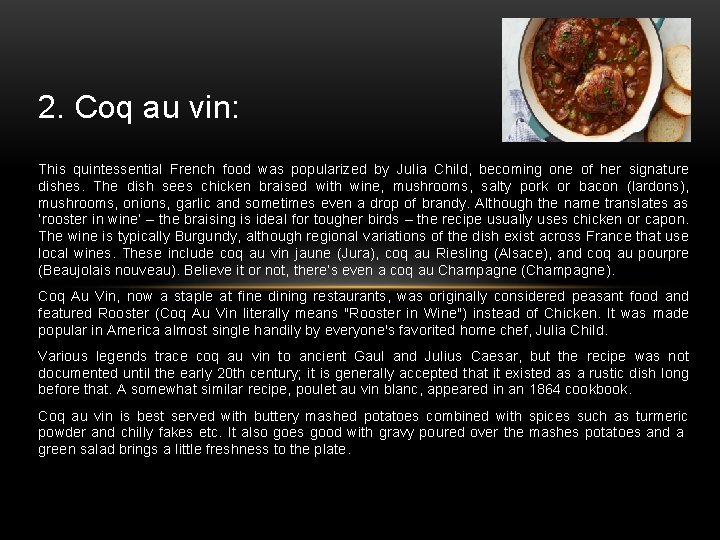
2. Coq au vin: This quintessential French food was popularized by Julia Child, becoming one of her signature dishes. The dish sees chicken braised with wine, mushrooms, salty pork or bacon (lardons), mushrooms, onions, garlic and sometimes even a drop of brandy. Although the name translates as ‘rooster in wine’ – the braising is ideal for tougher birds – the recipe usually uses chicken or capon. The wine is typically Burgundy, although regional variations of the dish exist across France that use local wines. These include coq au vin jaune (Jura), coq au Riesling (Alsace), and coq au pourpre (Beaujolais nouveau). Believe it or not, there’s even a coq au Champagne (Champagne). Coq Au Vin, now a staple at fine dining restaurants, was originally considered peasant food and featured Rooster (Coq Au Vin literally means "Rooster in Wine") instead of Chicken. It was made popular in America almost single handily by everyone's favorited home chef, Julia Child. Various legends trace coq au vin to ancient Gaul and Julius Caesar, but the recipe was not documented until the early 20 th century; it is generally accepted that it existed as a rustic dish long before that. A somewhat similar recipe, poulet au vin blanc, appeared in an 1864 cookbook. Coq au vin is best served with buttery mashed potatoes combined with spices such as turmeric powder and chilly fakes etc. It also goes good with gravy poured over the mashes potatoes and a green salad brings a little freshness to the plate.
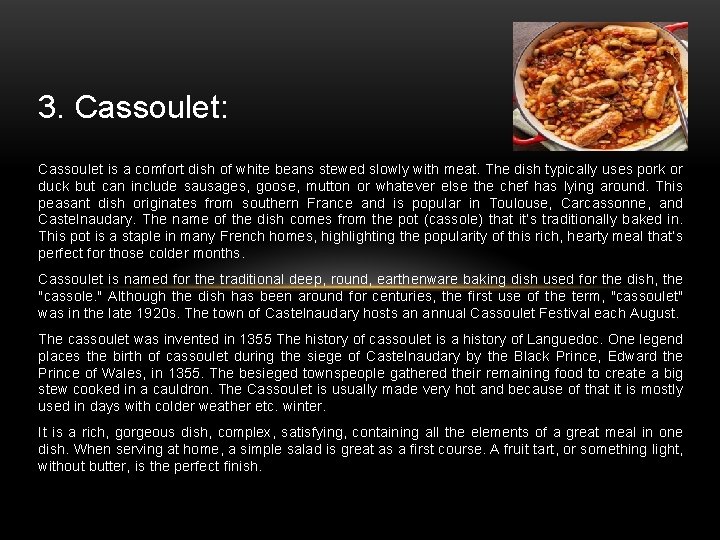
3. Cassoulet: Cassoulet is a comfort dish of white beans stewed slowly with meat. The dish typically uses pork or duck but can include sausages, goose, mutton or whatever else the chef has lying around. This peasant dish originates from southern France and is popular in Toulouse, Carcassonne, and Castelnaudary. The name of the dish comes from the pot (cassole) that it’s traditionally baked in. This pot is a staple in many French homes, highlighting the popularity of this rich, hearty meal that’s perfect for those colder months. Cassoulet is named for the traditional deep, round, earthenware baking dish used for the dish, the "cassole. " Although the dish has been around for centuries, the first use of the term, "cassoulet" was in the late 1920 s. The town of Castelnaudary hosts an annual Cassoulet Festival each August. The cassoulet was invented in 1355 The history of cassoulet is a history of Languedoc. One legend places the birth of cassoulet during the siege of Castelnaudary by the Black Prince, Edward the Prince of Wales, in 1355. The besieged townspeople gathered their remaining food to create a big stew cooked in a cauldron. The Cassoulet is usually made very hot and because of that it is mostly used in days with colder weather etc. winter. It is a rich, gorgeous dish, complex, satisfying, containing all the elements of a great meal in one dish. When serving at home, a simple salad is great as a first course. A fruit tart, or something light, without butter, is the perfect finish.
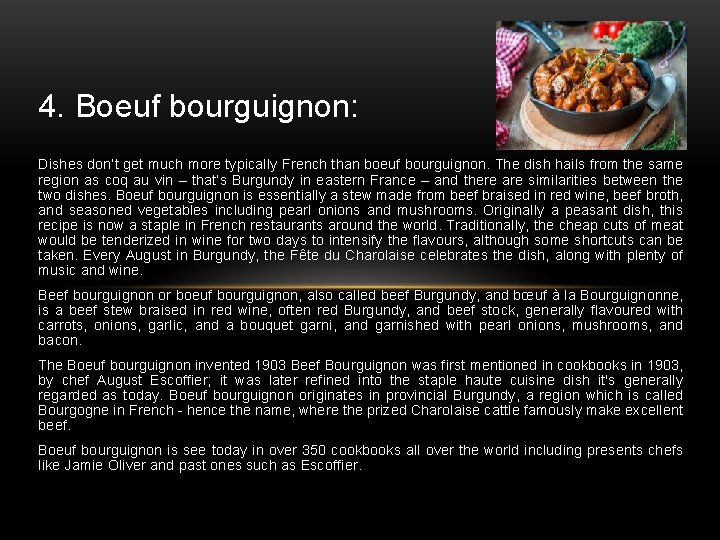
4. Boeuf bourguignon: Dishes don’t get much more typically French than boeuf bourguignon. The dish hails from the same region as coq au vin – that’s Burgundy in eastern France – and there are similarities between the two dishes. Boeuf bourguignon is essentially a stew made from beef braised in red wine, beef broth, and seasoned vegetables including pearl onions and mushrooms. Originally a peasant dish, this recipe is now a staple in French restaurants around the world. Traditionally, the cheap cuts of meat would be tenderized in wine for two days to intensify the flavours, although some shortcuts can be taken. Every August in Burgundy, the Fête du Charolaise celebrates the dish, along with plenty of music and wine. Beef bourguignon or boeuf bourguignon, also called beef Burgundy, and bœuf à la Bourguignonne, is a beef stew braised in red wine, often red Burgundy, and beef stock, generally flavoured with carrots, onions, garlic, and a bouquet garni, and garnished with pearl onions, mushrooms, and bacon. The Boeuf bourguignon invented 1903 Beef Bourguignon was first mentioned in cookbooks in 1903, by chef August Escoffier; it was later refined into the staple haute cuisine dish it's generally regarded as today. Boeuf bourguignon originates in provincial Burgundy, a region which is called Bourgogne in French - hence the name, where the prized Charolaise cattle famously make excellent beef. Boeuf bourguignon is see today in over 350 cookbooks all over the world including presents chefs like Jamie Oliver and past ones such as Escoffier.
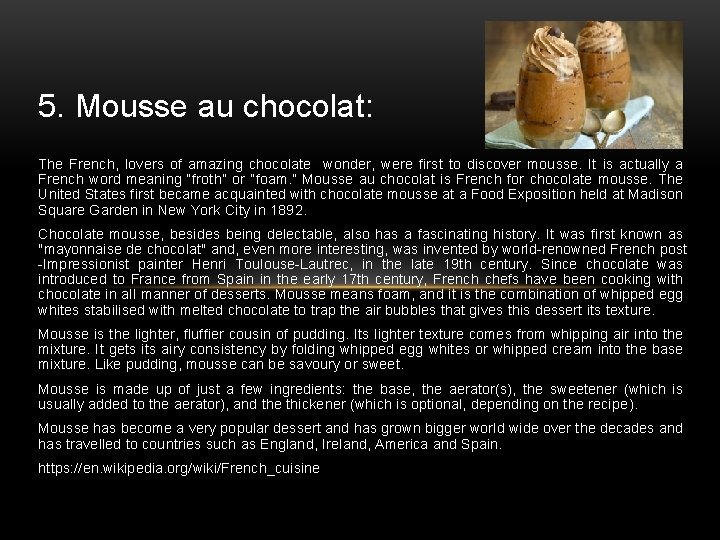
5. Mousse au chocolat: The French, lovers of amazing chocolate wonder, were first to discover mousse. It is actually a French word meaning “froth” or “foam. ” Mousse au chocolat is French for chocolate mousse. The United States first became acquainted with chocolate mousse at a Food Exposition held at Madison Square Garden in New York City in 1892. Chocolate mousse, besides being delectable, also has a fascinating history. It was first known as "mayonnaise de chocolat" and, even more interesting, was invented by world-renowned French post -Impressionist painter Henri Toulouse-Lautrec, in the late 19 th century. Since chocolate was introduced to France from Spain in the early 17 th century, French chefs have been cooking with chocolate in all manner of desserts. Mousse means foam, and it is the combination of whipped egg whites stabilised with melted chocolate to trap the air bubbles that gives this dessert its texture. Mousse is the lighter, fluffier cousin of pudding. Its lighter texture comes from whipping air into the mixture. It gets its airy consistency by folding whipped egg whites or whipped cream into the base mixture. Like pudding, mousse can be savoury or sweet. Mousse is made up of just a few ingredients: the base, the aerator(s), the sweetener (which is usually added to the aerator), and the thickener (which is optional, depending on the recipe). Mousse has become a very popular dessert and has grown bigger world wide over the decades and has travelled to countries such as England, Ireland, America and Spain. https: //en. wikipedia. org/wiki/French_cuisine
- Slides: 6