
5 Diameter of Cells Each white blood cell
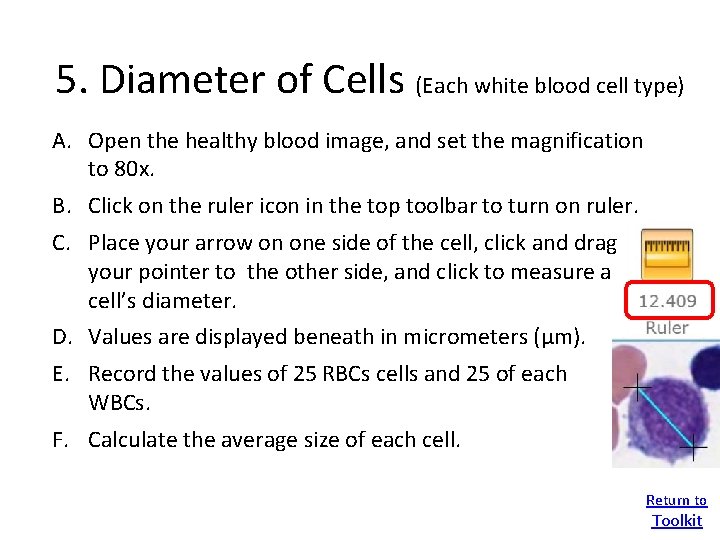
5. Diameter of Cells (Each white blood cell type) A. Open the healthy blood image, and set the magnification to 80 x. B. Click on the ruler icon in the top toolbar to turn on ruler. C. Place your arrow on one side of the cell, click and drag your pointer to the other side, and click to measure a cell’s diameter. D. Values are displayed beneath in micrometers (µm). E. Record the values of 25 RBCs cells and 25 of each WBCs. F. Calculate the average size of each cell. Return to Toolkit

White blood cells 5. Diameter of Cells • To turn off the ruler tool, click the ruler icon again. • You must turn off the ruler to change magnification or move to a different area. • Some white blood cells are rare, try to find and measure at least five eosinophils, basophils, and monocytes. Return to Toolkit

5. Diameter of Cells Example Data Healthy Blood RBC 7. 0 7. 5 8. 3 7. 1 6. 6 …. . . 7. 1 Average Size 7. 36 Neutrophil 8. 78 9. 76 10. 12 9. 89 10. 06 …. . . 8. 58 9. 38 Measured in micrometers (µm). Lymphocyte Monocyte 8. 3 7. 94 6. 8 6. 99 7. 09 …. . . 6. 85 10. 62 10. 64 11. 09 11. 65 10. 42 …. . . 12. 59 Eosinophil 9. 03 10. 1 9. 83 10. 49 9. 92 …. . . 9. 25 7. 31 10. 51 9. 64 Basophil 10. 85 9. 71 10. 06 7. 95 11. 31 …. . . 7. 89 9. 63 Conclusion: Blood cells vary in size (diameters) with the monocyte being largest with RBCs and lymphocytes being smallest.
- Slides: 3