
5 Cost Allocation and ActivityBased Costing Systems 2007
5 Cost Allocation and Activity-Based Costing Systems © 2007 Pearson Education Canada Slide 5 -1
Cost Allocation • Cost allocation attempts to identify some cost or group of costs with one or more cost objectives • Cost objectives may be products, departments or divisions • Ideally, the cost-allocation base or cost driver should link the cost to the cost objective that caused it • Cost pool is a group of individual costs that are allocated to cost objectives using a single cost driver • • • Why allocate costs? Allocate to obtain desired motivation Allocate to compute income and asset valuations Allocate to justify costs and obtain reimbursement Difficult to achieve all three purposes at once Cost allocations often cause discontent and confusion for managers © 2007 Pearson Education Canada Slide 5 -2
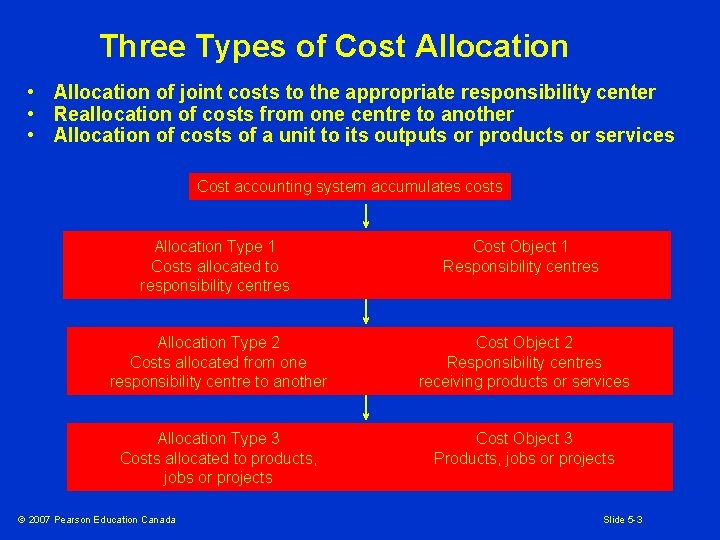
Three Types of Cost Allocation • Allocation of joint costs to the appropriate responsibility center • Reallocation of costs from one centre to another • Allocation of costs of a unit to its outputs or products or services Cost accounting system accumulates costs Allocation Type 1 Costs allocated to responsibility centres Cost Object 1 Responsibility centres Allocation Type 2 Costs allocated from one responsibility centre to another Cost Object 2 Responsibility centres receiving products or services Allocation Type 3 Costs allocated to products, jobs or projects Cost Object 3 Products, jobs or projects © 2007 Pearson Education Canada Slide 5 -3
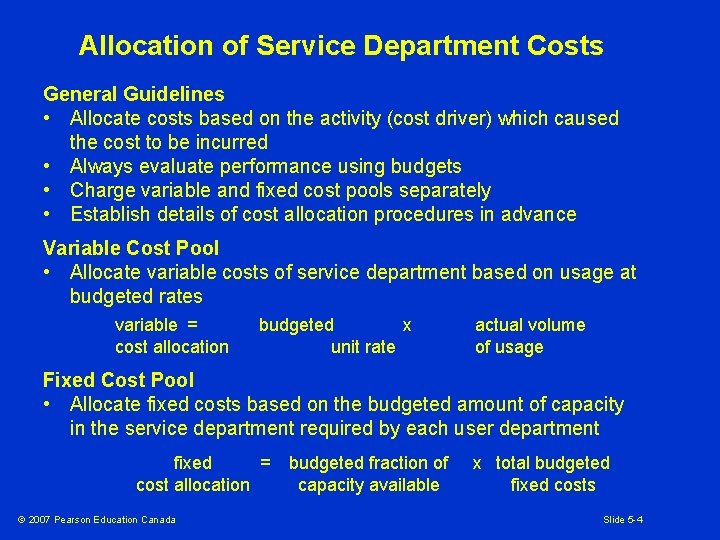
Allocation of Service Department Costs General Guidelines • Allocate costs based on the activity (cost driver) which caused the cost to be incurred • Always evaluate performance using budgets • Charge variable and fixed cost pools separately • Establish details of cost allocation procedures in advance Variable Cost Pool • Allocate variable costs of service department based on usage at budgeted rates variable = cost allocation budgeted x unit rate actual volume of usage Fixed Cost Pool • Allocate fixed costs based on the budgeted amount of capacity in the service department required by each user department fixed = cost allocation © 2007 Pearson Education Canada budgeted fraction of capacity available x total budgeted fixed costs Slide 5 -4

Allocating Service Costs – Direct Method • Allocate service department costs directly to production departments only Service Departments Facilities Direct costs Step 1: Facilities Production Departments Personnel Restaurants $126, 000 $24, 000 (126, 000) Step 2: Personnel Totals © 2007 Pearson Education Canada $100, 000 (24, 000) $0 $0 $209, 800 Accom. Total $160, 000 $410, 000 105, 000 21, 000 4, 800 19, 200 $200, 200 $410, 000 Slide 5 -5
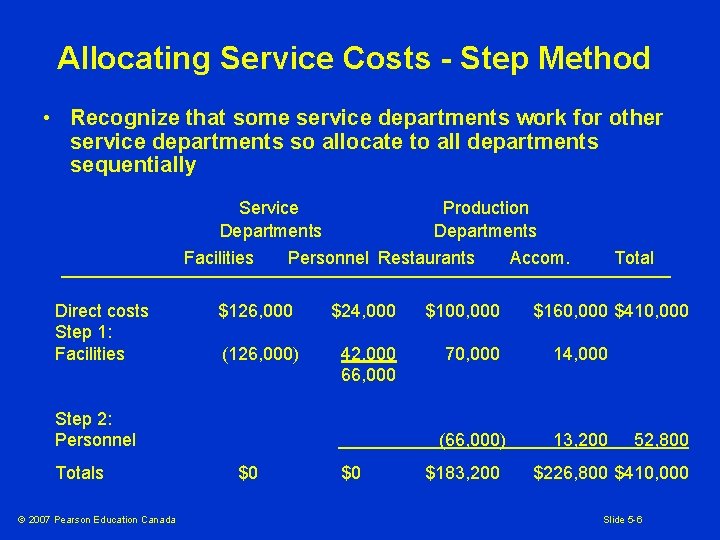
Allocating Service Costs - Step Method • Recognize that some service departments work for other service departments so allocate to all departments sequentially Service Departments Facilities Direct costs Step 1: Facilities Production Departments Personnel Restaurants © 2007 Pearson Education Canada Total $126, 000 $24, 000 $100, 000 (126, 000) 42, 000 66, 000 70, 000 14, 000 (66, 000) 13, 200 Step 2: Personnel Totals Accom. $0 $0 $183, 200 $160, 000 $410, 000 52, 800 $226, 800 $410, 000 Slide 5 -6
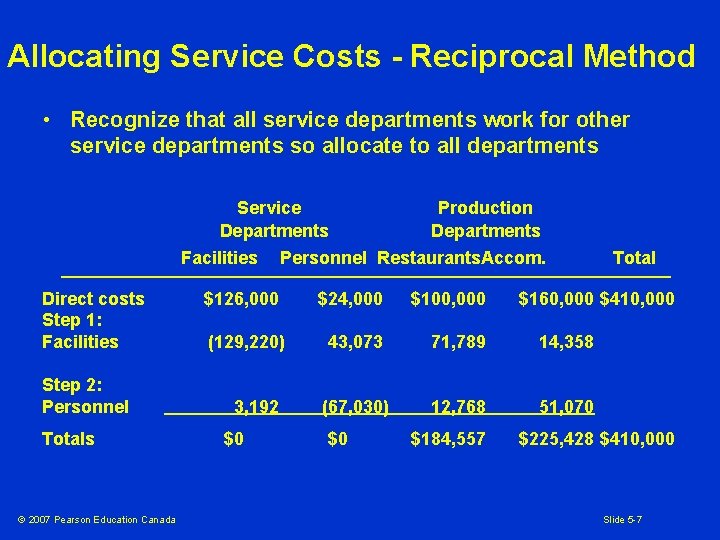
Allocating Service Costs - Reciprocal Method • Recognize that all service departments work for other service departments so allocate to all departments Service Departments Facilities Direct costs Step 1: Facilities Step 2: Personnel Totals © 2007 Pearson Education Canada Production Departments Personnel Restaurants. Accom. $126, 000 $24, 000 $100, 000 (129, 220) 43, 073 71, 789 14, 358 (67, 030) 12, 768 51, 070 3, 192 $0 $0 $184, 557 Total $160, 000 $410, 000 $225, 428 $410, 000 Slide 5 -7
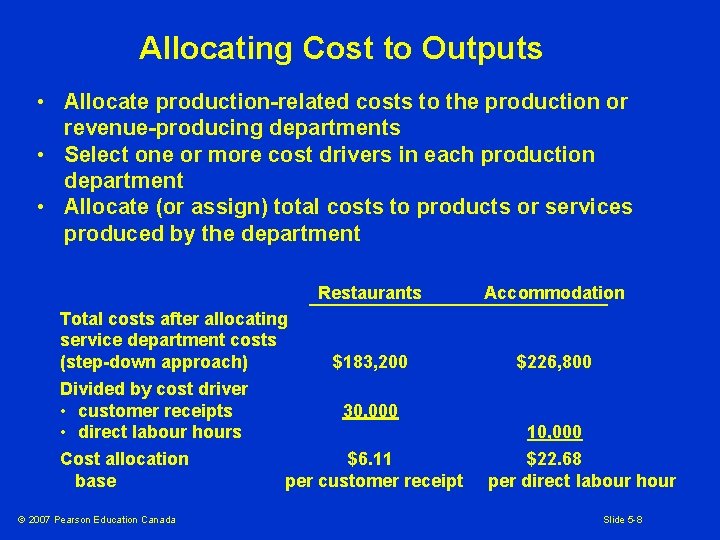
Allocating Cost to Outputs • Allocate production-related costs to the production or revenue-producing departments • Select one or more cost drivers in each production department • Allocate (or assign) total costs to products or services produced by the department Total costs after allocating service department costs (step-down approach) Divided by cost driver • customer receipts • direct labour hours Cost allocation base © 2007 Pearson Education Canada Restaurants Accommodation $183, 200 $226, 800 30, 000 $6. 11 per customer receipt 10, 000 $22. 68 per direct labour hour Slide 5 -8
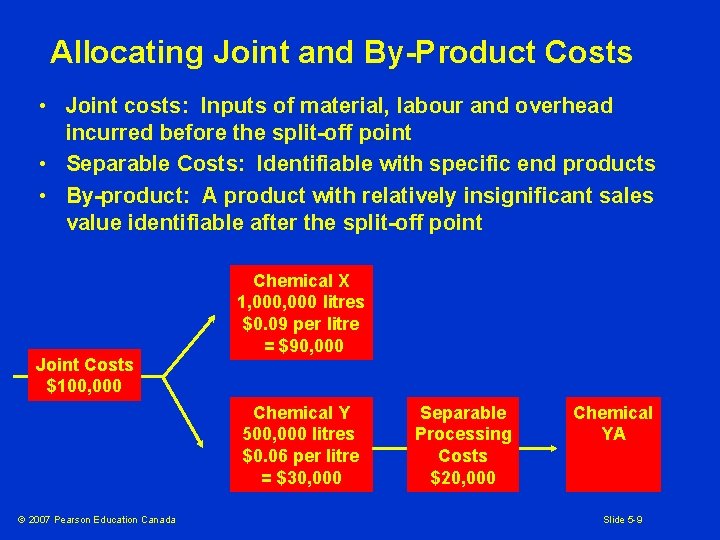
Allocating Joint and By-Product Costs • Joint costs: Inputs of material, labour and overhead incurred before the split-off point • Separable Costs: Identifiable with specific end products • By-product: A product with relatively insignificant sales value identifiable after the split-off point Joint Costs $100, 000 Chemical X 1, 000 litres $0. 09 per litre = $90, 000 Chemical Y 500, 000 litres $0. 06 per litre = $30, 000 © 2007 Pearson Education Canada Separable Processing Costs $20, 000 Chemical YA Slide 5 -9
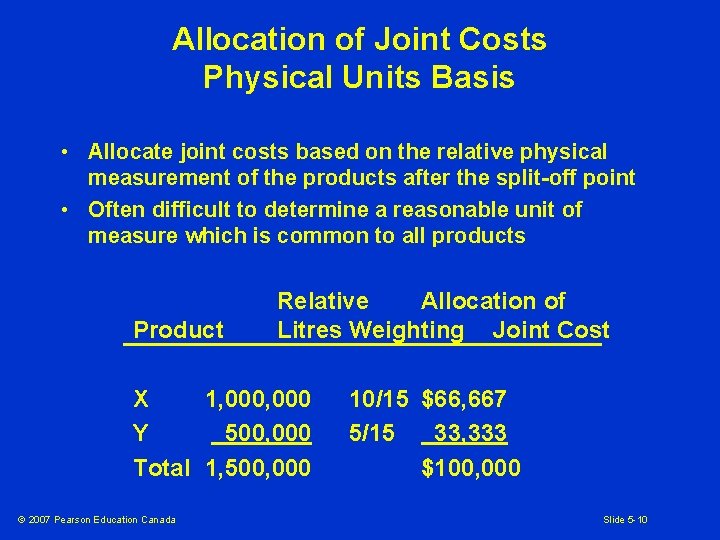
Allocation of Joint Costs Physical Units Basis • Allocate joint costs based on the relative physical measurement of the products after the split-off point • Often difficult to determine a reasonable unit of measure which is common to all products Product Relative Allocation of Litres Weighting Joint Cost X 1, 000 Y 500, 000 Total 1, 500, 000 © 2007 Pearson Education Canada 10/15 $66, 667 5/15 33, 333 $100, 000 Slide 5 -10
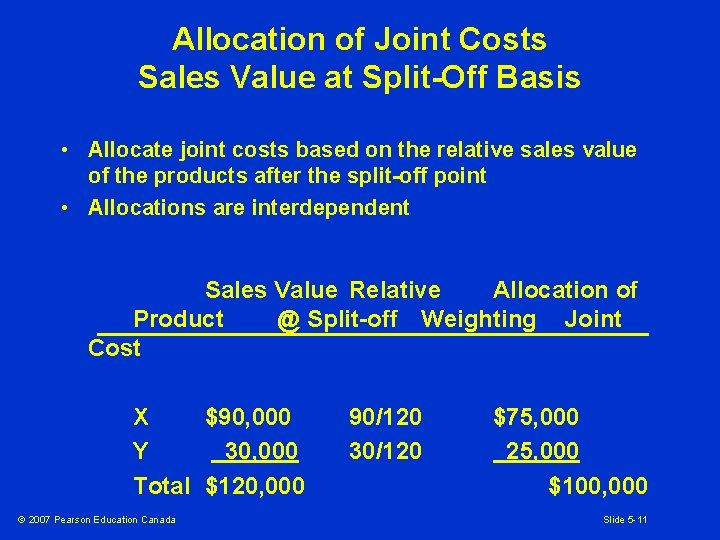
Allocation of Joint Costs Sales Value at Split-Off Basis • Allocate joint costs based on the relative sales value of the products after the split-off point • Allocations are interdependent Sales Value Relative Allocation of Product @ Split-off Weighting Joint Cost X $90, 000 Y 30, 000 Total $120, 000 © 2007 Pearson Education Canada 90/120 30/120 $75, 000 25, 000 $100, 000 Slide 5 -11
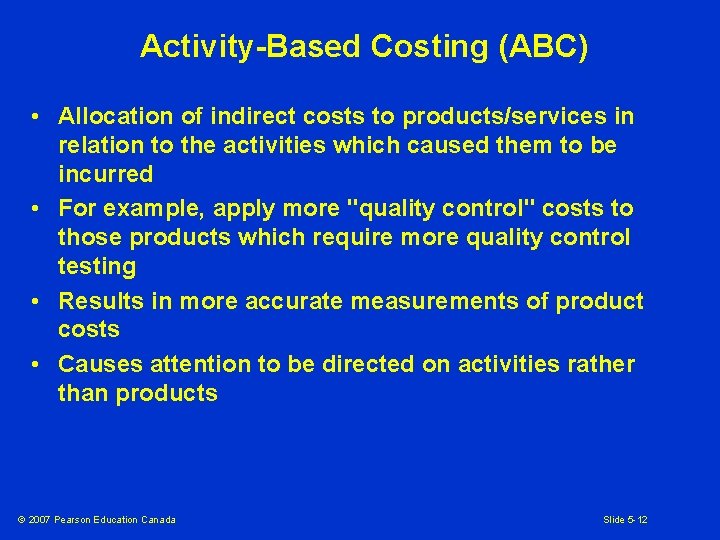
Activity-Based Costing (ABC) • Allocation of indirect costs to products/services in relation to the activities which caused them to be incurred • For example, apply more "quality control" costs to those products which require more quality control testing • Results in more accurate measurements of product costs • Causes attention to be directed on activities rather than products © 2007 Pearson Education Canada Slide 5 -12
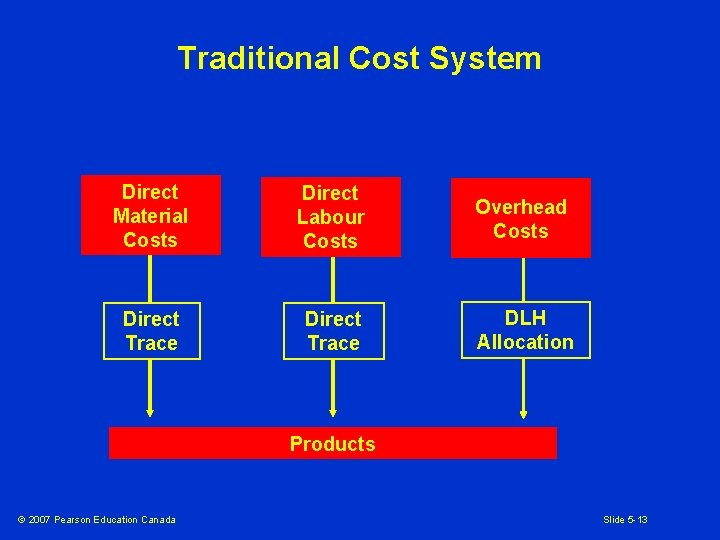
Traditional Cost System Direct Material Costs Direct Labour Costs Overhead Costs Direct Trace DLH Allocation Products © 2007 Pearson Education Canada Slide 5 -13
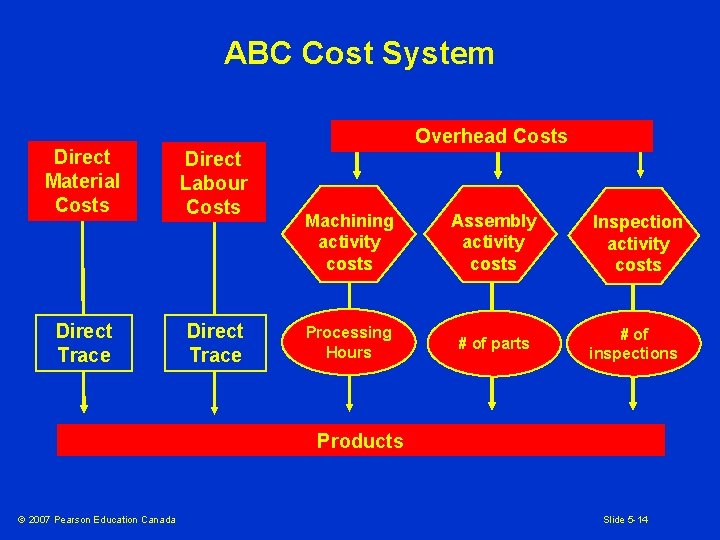
ABC Cost System Overhead Costs Direct Material Costs Direct Labour Costs Direct Trace Machining activity costs Assembly activity costs Inspection activity costs Processing Hours # of parts # of inspections Products © 2007 Pearson Education Canada Slide 5 -14
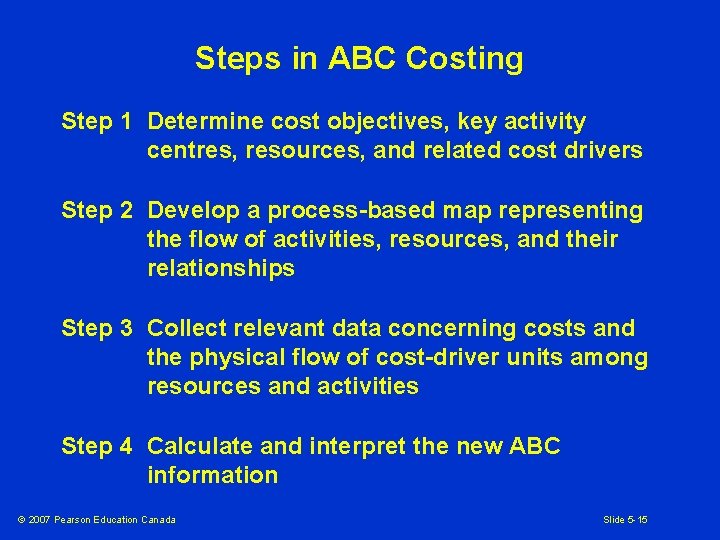
Steps in ABC Costing Step 1 Determine cost objectives, key activity centres, resources, and related cost drivers Step 2 Develop a process-based map representing the flow of activities, resources, and their relationships Step 3 Collect relevant data concerning costs and the physical flow of cost-driver units among resources and activities Step 4 Calculate and interpret the new ABC information © 2007 Pearson Education Canada Slide 5 -15
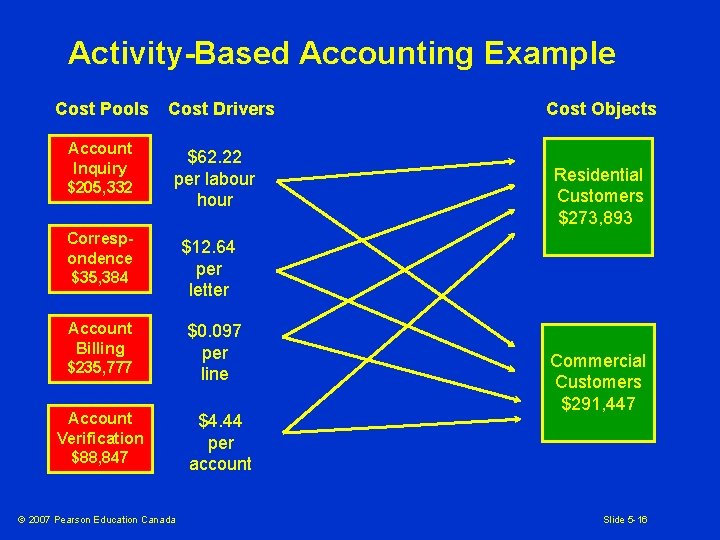
Activity-Based Accounting Example Cost Pools Account Inquiry $205, 332 Cost Drivers $62. 22 per labour hour Correspondence $35, 384 Account Billing $235, 777 Account Verification $88, 847 © 2007 Pearson Education Canada Cost Objects Residential Customers $273, 893 $12. 64 per letter $0. 097 per line $4. 44 per account Commercial Customers $291, 447 Slide 5 -16
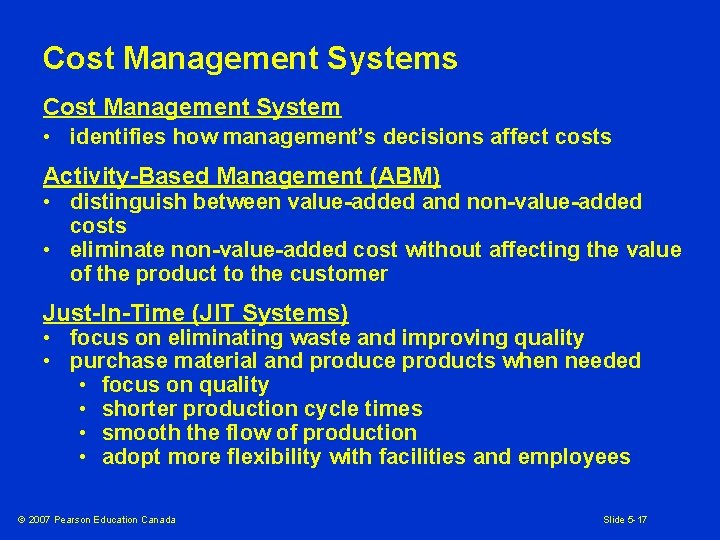
Cost Management Systems Cost Management System • identifies how management’s decisions affect costs Activity-Based Management (ABM) • distinguish between value-added and non-value-added costs • eliminate non-value-added cost without affecting the value of the product to the customer Just-In-Time (JIT Systems) • focus on eliminating waste and improving quality • purchase material and produce products when needed • focus on quality • shorter production cycle times • smooth the flow of production • adopt more flexibility with facilities and employees © 2007 Pearson Education Canada Slide 5 -17
- Slides: 17