
5 Components of Social Studies 5 Components of

- Slides: 18
5 Components of Social Studies
5 Components of Social Studies 1. Geography 2. History 3. Culture and Society 4. Civics and Government 5. Economics
1. Geography • What are the five themes? a. Location b. Human-Environment Interactions c. Place d. Regions e. Movement
1. Geography • The location of places in the world • Physical features such as landforms, bodies of water, etc. • Climate Examples: mountains, valleys, rivers, the desert
Component 1: Geography THEME 1: LOCATION • Relative location – tells where a place is in relation to other places • Absolute location – the exact location of a place
Component 1: Geography THEME 2: HUMANENVIRONMENT INTERACTIONS • Modify – to change your surroundings • Adapt – to change to fit your surroundings
Component 1: Geography THEME 3: PLACE • Physical features – landforms, bodies of water, climate, animal life • Human features – buildings, roads
Component 1: Geography THEME 4: REGIONS • Regions – areas on Earth that differ from each other because of their features
Component 1: Geography THEME 5: MOVEMENT • Cause – an action that makes something happen • Effect – what happens as a result of that action
Component 2: History -The Past -Famous (and well-known) people -Events Examples: Abraham Lincoln, the Civil War, the Declaration of Independence
Component 2: HISTORY VOCABULARY • History – what happened in the past • Chronology – time order in which events take place in history • Oral history – a story told aloud by a person who did not write down what happened • Perspectives – different points of view • Historical empathy – the ability to understand people of the past in their own frame of reference
Component 3: Culture and Society • Traditions of a group of people • Beliefs/values • Behaviors Examples: Clothing, type of music, ways of greeting someone
Component 3: CULTURE VOCABULARY • Culture – ways of acting, speaking, and believing • Society – human group • Heritage – the wealth of ideas that have been passed down through their history
Component 4: Civics and Government • Who leads a country • How the country is run • Laws Examples: President, King or Queen, democracy, the Constitution
Component 4: GOVERNMENT VOCABULARY • Government – a system of leaders and laws that helps people live safely together • Civic participation – being concerned and involved in issues related to your community
Component 5: Economics • Money! • How money is spent • Things that help a country make money Examples: finances, taxes, salaries, industries, unemployment
Component 5: ECONOMICS VOCABULARY • Economy – a system of using resources to meet needs • Economics – the study of the way that goods and wealth are produced, distributed, and used in the world
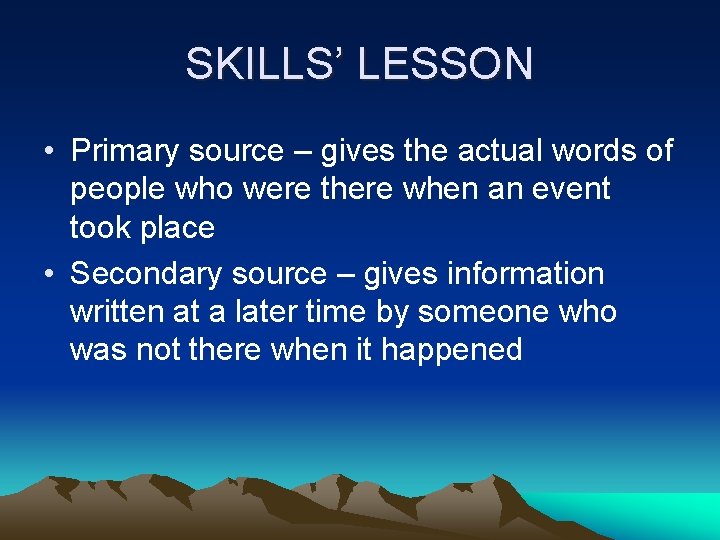
SKILLS’ LESSON • Primary source – gives the actual words of people who were there when an event took place • Secondary source – gives information written at a later time by someone who was not there when it happened