
5 CHAPTER Problems and Solutions in Modern Policing

5 CHAPTER Problems and Solutions in Modern Policing
Police Organizations and Field Operations § Police Organizations are based on bureaucracy § A hierarchically structured administrative organization that carries out specific functions § § § Formal rules Goal is to reach maximum efficiency Best service with limited resources § § Staff Budget
The Structure of the Police Department § Organization influenced by environment: § § Jurisdiction size Types of crime Population demographics Chain of command § § § Clear rank structure and strict accountability “Top down” chain of command Delegation of authority § Personnel take orders from and are responsible to those in positions of power directly above them § Organizing by area and time § Law enforcement in the field § Efficient organization of field services § Patrol, investigations, and special operations
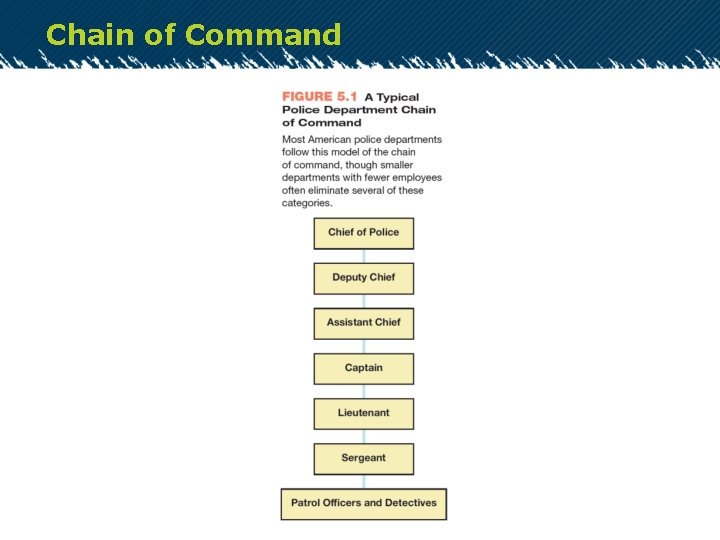
Chain of Command
Police on Patrol: The Backbone of the Department § Patrol is one of the main functions of police § Every department has a patrol unit § Usually the largest division of the department § Purpose of Patrol: § § § Deter crime by maintaining a visible presence Maintenance of public order and a sense of security Twenty-four-hour provision of services that are not crime-related
Patrol Activities § Four categories: § Preventive patrol § § Calls for service § § Responding to calls (25% of patrol time) Administrative duties § § Maintain presence in community (40% of patrol time) Paperwork (20% of patrol time) Officer-initiated activities § Officer-initiated interactions with citizens (15% of patrol time)
Police Investigations § Investigation is the second main function of police § § Investigative work is reactive Detective § § Primary police investigator of crimes Promoted from patrol officer Not quite as glamorous as portrayed by the media Spend most of their time investigating property crimes
Aggressive Investigative Strategies § Undercover operations § § Agent assumes false identity Commonly used to infiltrate large-scale narcotics operations or organized crime Most dangerous and controversial Often use a confidential informant § § Person involved with criminal activity and provides information to police Used when an agency doesn’t want to risk officer to undercover work or when outsider can’t infiltrate an organized crime network
Discussion Question #1 § In Hawaii there is a exemption in state law that allows undercover officers to have sex with prostitutes during investigations. § § Discuss the reasons to support this exemption in the law. Discuss the reasons to oppose this exemption in the law.
Clearance Rates and Cold Cases § Goal of law enforcement is to clear cases which means secure the arrest and prosecution of the offenders § Clearance Rates § Comparison of the number of crimes cleared by arrest and prosecution with the number of crime reported during any given time period § § § In 2012, 47% of violent crimes were solved In 2012, 19% of property crimes were solved Low clearance rates cause cold cases § § Criminal investigation has not been solved after a certain amount of time Even with new technology only 1 in 20 cold cases result in arrest
Forensic Investigations and DNA § Officers rely on experts in forensics to help solve cases § Forensic experts determine: § § § Cause of death Time of death Type of weapon used Identity of the crime victim Identity of the offender
Forensic Investigations and DNA § Crime Scene Forensics § Very important to secure and protect trace evidence from contamination § § Trace evidence is evidence such as a fingerprint, blood, or hair found in small amounts at a crime scene Ballistics is the study of firearms, including the firing of the weapon and the flight of the bullet
The DNA Revolution § § § Databases and cold hits § § DNA Fingerprinting (Emerged in the mid-1990 s) Identifying a person based on a sample of his or her DNA Labs can create a DNA profile of the suspect and test it against suspects A match can be as conclusive as 30 billion to one DNA greatly increases the chances that a crime will be solved When law enforcement finds a suspect “out of nowhere” by comparing DNA evidence from a crime scene against the DNA database New developments § § CODIS Touch DNA Familial searches Genetic witnesses
Discussion Question #2 § All states collect DNA from offenders convicted of a felony. § Some states collect DNA from offenders who have been arrested for a violent crime but not yet convicted of that crime. § § Discuss the reasons to support allowing the police to take DNA from arrestees. Discuss the reasons to oppose allowing the police to take DNA from arrestees.
Police Strategies: What Works § Calls for Service § Operational basis of police work is incident-driven § § Response time and efficiency § § Reactive approach that emphasizes a speedy response to calls for service Time elapsed between the call for service and when the police arrive Improving response time efficiency § § § Response time is not as critical as response time for the most important calls Introduction of 311 nonemergency call system Differential response § § Answering calls that are the most serious most quickly Next generation 911 § Better technology
Police Strategies: What Works § Random Patrol § § Relies on police officers monitoring a certain area with the goal of detecting crimes in progress or preventing crime due to their presence Testing Random Patrol § § Kansas City Preventive Patrol Experiment in the 1970 s found that preventive patrol had no impact Random patrols are important for maintaining community relations § § Reduce fear of crime Directed Patrol § Focus on specific type of criminal activity at a specific time
Police Strategies: What Works § Predictive Policing and Crime Mapping § Finding “Hot Spots” § § § The Rise of Compstat § § Hot spots are concentrated areas of high criminal activity that draw a directed police response Crime mapping is technology that allows crime analysts to identify trends and patterns of criminal behavior within a given area Computerized mapping launched in New York Meetings are held to evaluate the data Provides police with information about patterns of crime and gives them the ability to dispatch needed officers to the hot spots

Police Strategies: What Works § Arrest Strategies § § § Reactive arrests are those made by the police who observe a criminal act or respond to a call for service Proactive arrests occur when police take the initiative to target a particular type of criminal or behavior Quality of Life Crimes § § § Broken windows theory believes that a neighborhood in disrepair signals that criminal activity is tolerated in the area By cracking down on quality of life crimes police can reclaim the neighborhood The Broken Windows Effect § Continues to influence police strategy

Community Policing § Community policing is a philosophy that emphasizes community support for and cooperation with the police in preventing crime § Return to the Community § § Promotes community partnerships Proactive problem solving Community engagement The Quiet Revolution § § Nearly 2/3 of police departments mention community policing in their mission statements Popular among law enforcement officers
Problem Oriented Policing § Problem-Oriented Policing: § § Philosophy that requires police to identify potential criminal activity and develop strategies to prevent or respond to that activity Attempt to control or even solve the root causes of criminal behavior Encourages police officers to stop looking at their work as day-to-day proposition Additional police action should be taken to prevent future crime
‘Us Versus Them”: Issues in Modern Policing § Police Subculture § § The values and perceptions that are shared by members of a police department These values permeate agencies and are taught to new officers through a process of socialization Socialization is the process through which officers are taught the values and expected behavior of the police subculture The core values of police subculture § Danger, stress, boredom, and violence

Police Subculture § Rituals to a police officer’s acceptance § § § § Attending a police academy Working with a senior officer Making the initial felony arrest Using force for the first time Using or witnessing deadly force for the first time Witnessing major traumatic incident for the first time Blue curtain § Used to refer to the value placed on secrecy and the general mistrust of the outside world shared by many police officers

‘Us Versus Them”: Issues in Modern Policing § The Physical Dangers of Police Work § Police come into contact with people 40 million times per year § § Have relatively low death rates and injury rates Stress and Mental Dangers of Police Work § Police Stressors § § Aspects of police work and life that lead to feelings of stress The Consequences of Police Stress § § Burnout – mental state that occurs when a person suffers from exhaustion and has difficulty functioning normally as a result of overwork and stress PTSD
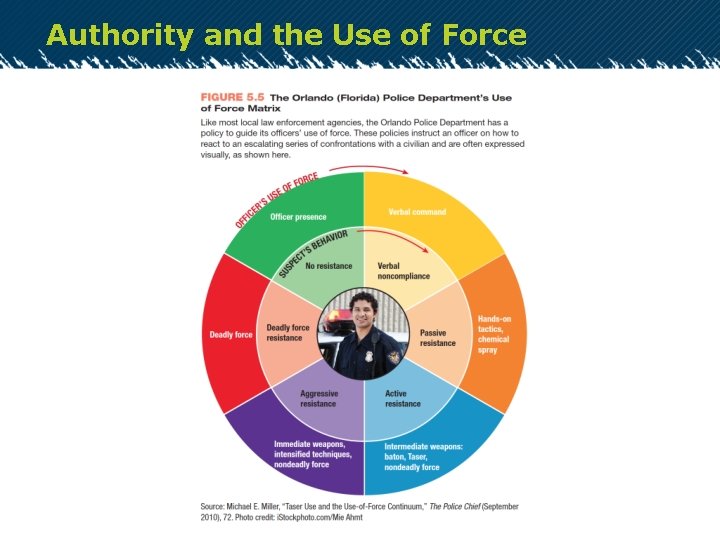
Authority and the Use of Force § Use of Force in law Enforcement § § The use of force is rare Occurs in only 1. 4% of police-public encounters Use of force matrix prevents officers with the proper force options for different levels of contact Types of force § Reasonable force § § The degree of force that is appropriate to protect the police officer or other citizens and is not excessive Deadly force § Force applied by a police officer that is likely or intended to cause death
Authority and the Use of Force
Authority and the Use of Force § The United States Supreme Court and Use of Force: § § Tennessee v. Garner (1985) Graham v. Conner (1989)
Discussion Question #3 § You are a police officer and are responding to a domestic violence call. § § You find Max and Jenny standing in the front yard of a residence, drinking beer, and yelling at each other. Jenny has a bloody, swollen lip and claims that Max is her live-in boyfriend and is the person who hit her. Max begins yelling and becomes increasingly aggressive towards Jenny, pointing his finger in her face and balling his fist. Jenny yells back at him and slaps his hand away. Jenny then throws her can of beer at Max and begins to walk towards the front door of the residence in an attempt to go inside. What are the factors in this scenario that you must consider?

Police Misconduct and Ethics § The courts generally allow for police officers to decide what to enforce, how much to enforce it, against whom, and on what occasions § Judicial support of police discretion is based on a few factors: § § Police officers are generally considered trustworthy Experience and training give officers the ability to determine whether certain activity poses a threat to society and to take reasonable action Due to the nature of their jobs, officers are knowledgeable about humans and behavior Police officers find themselves in danger of harm and must be allowed to protect themselves
Police Misconduct and Ethics § Police Corruption § The abuse of authority by a law enforcement officer for personal gain § § Bribery Shakedowns Mooching Police Accountability § Internal Investigations § § Citizen oversight § § Division in police department that receives and investigates complaints of wrongdoing by police officers The process by which citizens review complaints brought against officers or departments Surveillance and police misconduct
Ethics in Law Enforcement § Ethical dilemmas are defined as a situation in which law enforcement officers: § § Do not know the right course of action Have difficulty doing what they consider to be right; and/or Find the wrong choice very tempting Elements of Ethics § Noble Cause Corruption § Knowing misconduct by a police officer with the goal of attaining what the officer believes is a “just” result § Four categories of ethical dilemmas: 1. Discretion 2. Duty – moral or legal obligation 3. Honesty 4. Loyalty
Discussion Question #4 § You are investigating a kidnapping in your jurisdiction. § Through a reliable source you obtain the name of a suspect in the case. § You and your partner apprehend the suspect, Bob. § You and your partner are interrogating Bob and he admits to kidnapping the little girl and burying her alive. § Bob refuses to tell you where the little girl is buried and there is a possibility that she is still alive. § What is the ethical dilemma in this case? § How would you handle this situation?
- Slides: 31