
5 Chapter 5 Normalization of Database Tables Database
5 Chapter 5 Normalization of Database Tables Database Systems: Design, Implementation, and Management, Sixth Edition, Rob and Coronel Database Systems: Design, Implementation, & Management, 6 th Edition, Rob & Coronel
5 In this chapter, you will learn: • What normalization is and what role it plays in the database design process • About the normal forms 1 NF, 2 NF, 3 NF, BCNF, and 4 NF • How normal forms can be transformed from lower normal forms to higher normal forms • That normalization and ER modeling are used concurrently to produce a good database design • That some situations require denormalization to generate information efficiently Database Systems: Design, Implementation, & Management, 6 th Edition, Rob & Coronel 2

5 Database Tables and Normalization • Normalization – Process for evaluating and correcting table structures to minimize data redundancies • helps eliminate data anomalies – Works through a series of stages called normal forms: • Normal form (1 NF) • Second normal form (2 NF) • Third normal form (3 NF) Database Systems: Design, Implementation, & Management, 6 th Edition, Rob & Coronel 3
5 Database Tables and Normalization (continued) – 2 NF is better than 1 NF; 3 NF is better than 2 NF – For most business database design purposes, 3 NF is highest we need to go in the normalization process – Highest level of normalization is not always most desirable Database Systems: Design, Implementation, & Management, 6 th Edition, Rob & Coronel 4

5 The Need for Normalization • Example: company that manages building projects – Charges its clients by billing hours spent on each contract – Hourly billing rate is dependent on employee’s position – Periodically, a report is generated that contains information displayed in Table 5. 1 Database Systems: Design, Implementation, & Management, 6 th Edition, Rob & Coronel 5
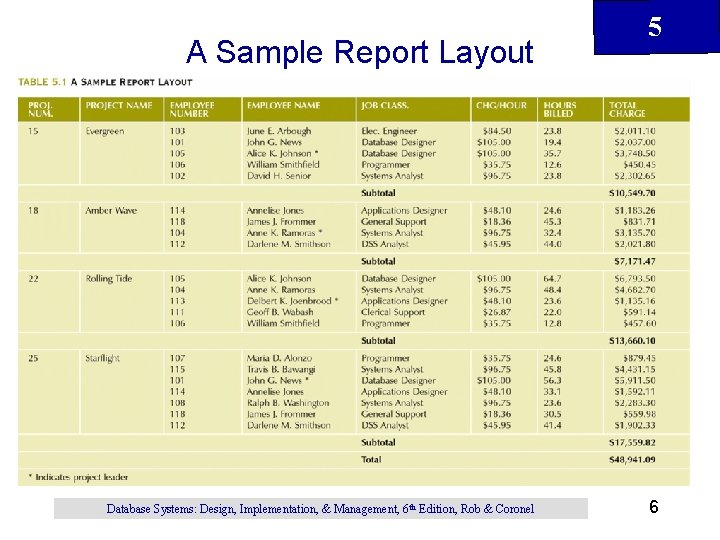
A Sample Report Layout Database Systems: Design, Implementation, & Management, 6 th Edition, Rob & Coronel 5 6
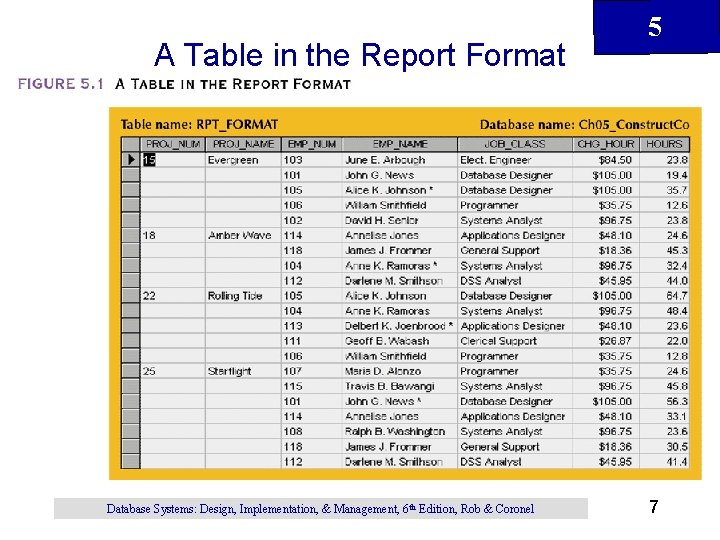
A Table in the Report Format Database Systems: Design, Implementation, & Management, 6 th Edition, Rob & Coronel 5 7
5 The Need for Normalization (continued) • Structure of data set in Figure 5. 1 does not handle data very well • The table structure appears to work; report is generated with ease • Unfortunately, the report may yield different results, depending on what data anomaly has occurred Database Systems: Design, Implementation, & Management, 6 th Edition, Rob & Coronel 8
5 Conversion to First Normal Form • Repeating group – Derives its name from the fact that a group of multiple (related) entries can exist for any single key attribute occurrence • Relational table must not contain repeating groups • Normalizing the table structure will reduce these data redundancies • Normalization is three-step procedure Database Systems: Design, Implementation, & Management, 6 th Edition, Rob & Coronel 9
5 Step 1: Eliminate the Repeating Groups • Present data in a tabular format, where each cell has a single value and there are no repeating groups • Eliminate repeating groups by eliminating nulls, making sure that each repeating group attribute contains an appropriate data value Database Systems: Design, Implementation, & Management, 6 th Edition, Rob & Coronel 10
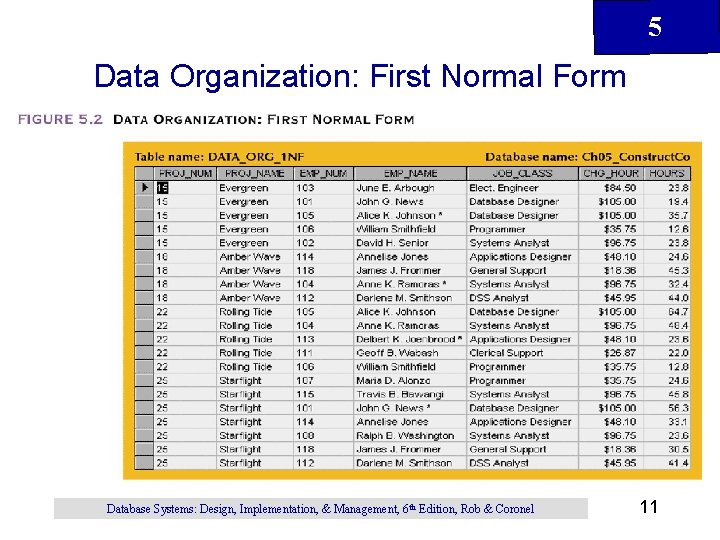
5 Data Organization: First Normal Form Database Systems: Design, Implementation, & Management, 6 th Edition, Rob & Coronel 11

5 Step 2: Identify the Primary Key • Primary key must uniquely identify attribute value • New key must be composed, in this example, of a combination of PROJ_NUM and EMP_NUM Database Systems: Design, Implementation, & Management, 6 th Edition, Rob & Coronel 12
5 Step 3: Identify all Dependencies • Dependencies can be depicted with the help of a diagram • Dependency diagram: – Depicts all dependencies found within a given table structure – Helpful in getting bird’s-eye view of all relationships among a table’s attributes – Their Use makes it much less likely that an important dependency will be overlooked Database Systems: Design, Implementation, & Management, 6 th Edition, Rob & Coronel 13
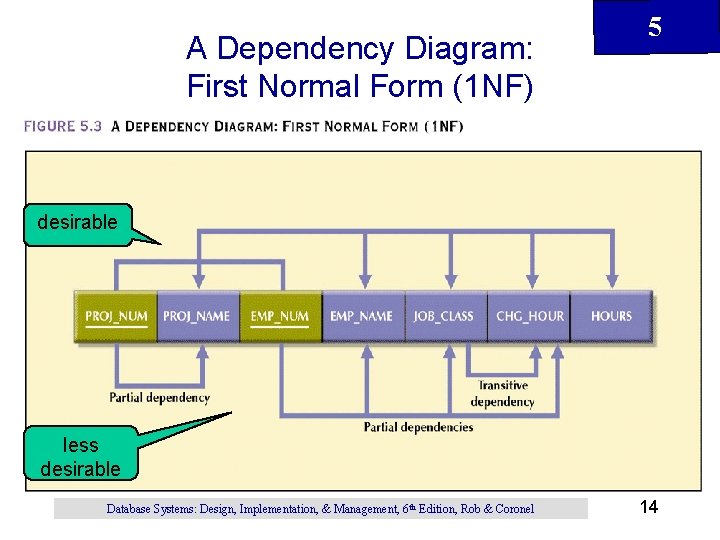
A Dependency Diagram: First Normal Form (1 NF) 5 desirable less desirable Database Systems: Design, Implementation, & Management, 6 th Edition, Rob & Coronel 14
First Normal Form 5 • Tabular format in which: – All key attributes are defined – There are no repeating groups in the table – All attributes are dependent on primary key • All relational tables satisfy 1 NF requirements • Some tables contain partial dependencies – Dependencies based on only part of the primary key – Sometimes used for performance reasons, but should be used with caution – Still subject to data redundancies • Every row entry requires duplication of data Database Systems: Design, Implementation, & Management, 6 th Edition, Rob & Coronel 15
5 Conversion to Second Normal Form • Relational database design can be improved by converting the database into second normal form (2 NF) • Two steps Database Systems: Design, Implementation, & Management, 6 th Edition, Rob & Coronel 16
5 Step 1: Identify All Key Components • Write each key component on separate line, and then write the original (composite) key on the last line • Each component will become the key in a new table Database Systems: Design, Implementation, & Management, 6 th Edition, Rob & Coronel 17
5 Step 2: Identify the Dependent Attributes • Determine which attributes are dependent on which other attributes • At this point, most anomalies have been eliminated Database Systems: Design, Implementation, & Management, 6 th Edition, Rob & Coronel 18
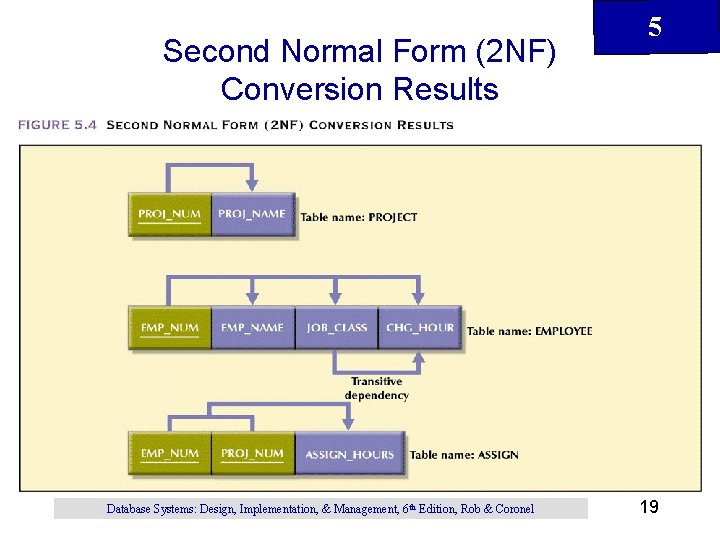
Second Normal Form (2 NF) Conversion Results Database Systems: Design, Implementation, & Management, 6 th Edition, Rob & Coronel 5 19
5 Second Normal Form • Table is in second normal form (2 NF) if: – It is in 1 NF and – It includes no partial dependencies: • No attribute is dependent on only a portion of the primary key Database Systems: Design, Implementation, & Management, 6 th Edition, Rob & Coronel 20
5 Conversion to Third Normal Form • Data anomalies created are easily eliminated by completing three steps Database Systems: Design, Implementation, & Management, 6 th Edition, Rob & Coronel 21
5 Step 1: Identify Each New Determinant • For every transitive dependency, write its determinant as a PK for a new table – Determinant • Any attribute whose value determines other values within a row Database Systems: Design, Implementation, & Management, 6 th Edition, Rob & Coronel 22
5 Step 2: Identify the Dependent Attributes • Identify the attributes dependent on each determinant identified in Step 1 and identify the dependency • Name the table to reflect its contents and function Database Systems: Design, Implementation, & Management, 6 th Edition, Rob & Coronel 23
5 Step 3: Remove the Dependent Attributes from Transitive Dependencies • Eliminate all dependent attributes in transitive relationship(s) from each table that has such a transitive relationship • Draw a new dependency diagram to show all tables defined in Steps 1– 3 • Check new tables and modified tables from Step 3 to make sure that each has a determinant and does not contain inappropriate dependencies Database Systems: Design, Implementation, & Management, 6 th Edition, Rob & Coronel 24
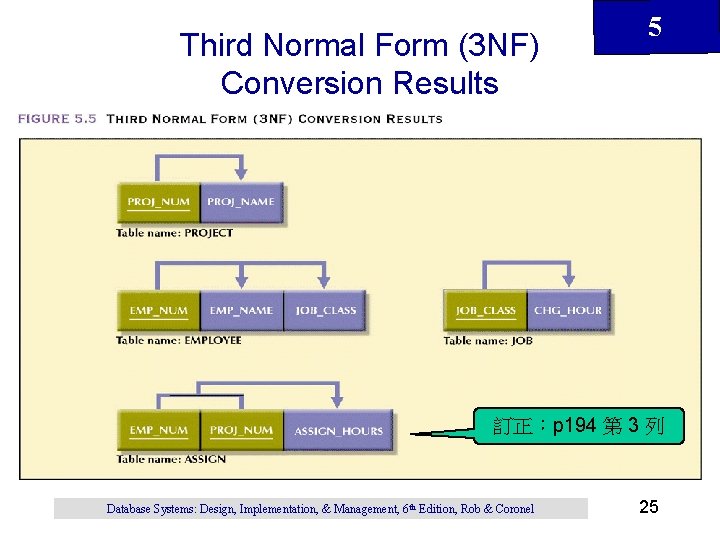
Third Normal Form (3 NF) Conversion Results 5 訂正:p 194 第 3 列 Database Systems: Design, Implementation, & Management, 6 th Edition, Rob & Coronel 25
5 Third Normal Form • A table is in third normal form (3 NF) if: – It is in 2 NF and – It contains no transitive dependencies Database Systems: Design, Implementation, & Management, 6 th Edition, Rob & Coronel 26
5 Improving the Design • Table structures are cleaned up to eliminate the troublesome initial partial and transitive dependencies • Normalization cannot, by itself, be relied on to make good designs • It is valuable because its use helps eliminate data redundancies Database Systems: Design, Implementation, & Management, 6 th Edition, Rob & Coronel 27
5 Improving the Design (continued) • The following changes were made: – PK assignment • Add JOB_CODE to avoid referential integrity violation – Naming conventions • Change JOB_HOURS to ASSIGN_HOURS – Attribute atomicity • Divide EMP_NAME – Adding attributes • EMP_HIREDATE Database Systems: Design, Implementation, & Management, 6 th Edition, Rob & Coronel 28

5 Improving the Design (continued) – Adding relationships • Information about each project’s manager – Refining PKs • Add ASSIGN_NUM for greater flexibilty – Maintaining historical accuracy • ASSIGN_CHG_HOUR, JOB_CHG_HOUR – Using derived attributes • ASSIGN_CHARGE Database Systems: Design, Implementation, & Management, 6 th Edition, Rob & Coronel 29
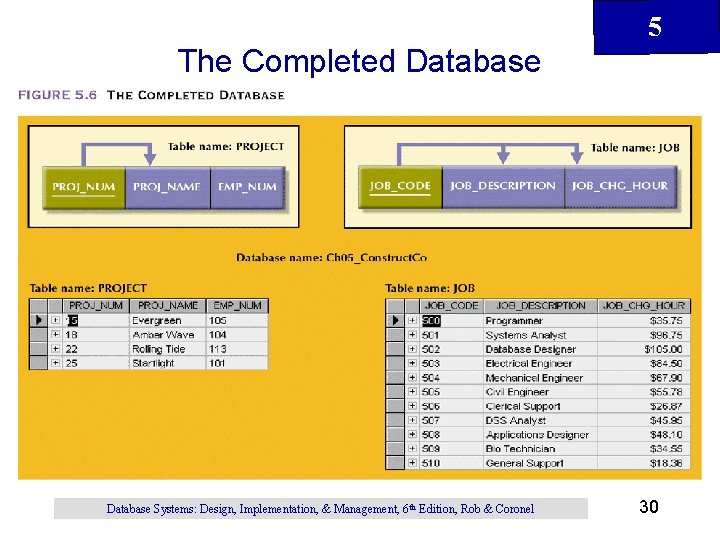
5 The Completed Database Systems: Design, Implementation, & Management, 6 th Edition, Rob & Coronel 30
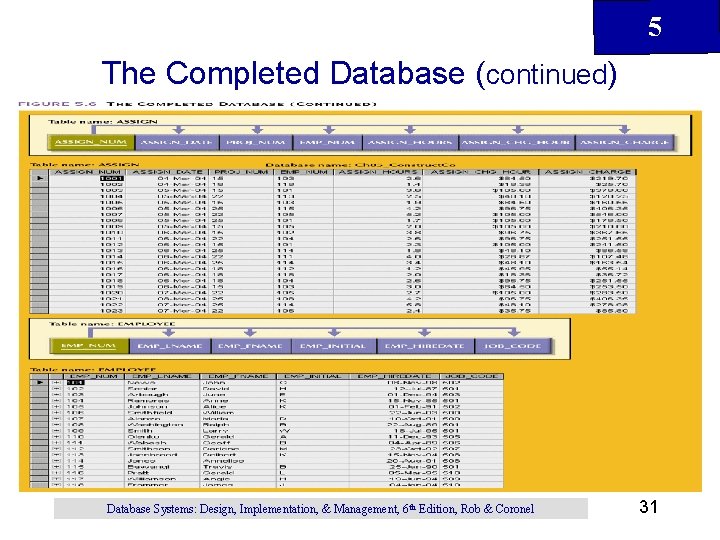
5 The Completed Database (continued) Database Systems: Design, Implementation, & Management, 6 th Edition, Rob & Coronel 31

5 Limitations on System-Assigned Keys • System-assigned primary key may not prevent confusing entries • Data entries in Table 5. 2 are inappropriate because they duplicate existing records – Yet there has been no violation of either entity integrity or referential integrity Database Systems: Design, Implementation, & Management, 6 th Edition, Rob & Coronel 32
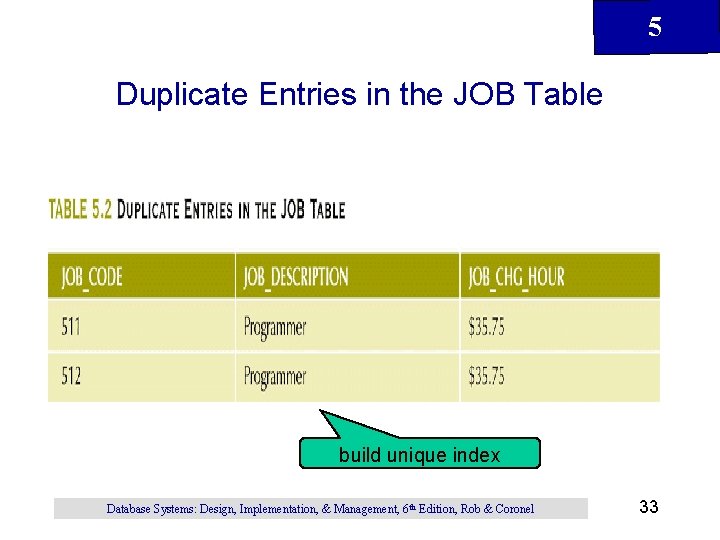
5 Duplicate Entries in the JOB Table build unique index Database Systems: Design, Implementation, & Management, 6 th Edition, Rob & Coronel 33
5 The Boyce-Codd Normal Form (BCNF) • Every determinant in the table is a candidate key – Has same characteristics as primary key, but for some reason, not chosen to be primary key • If a table contains only one candidate key, the 3 NF and the BCNF are equivalent • BCNF can be violated only if the table contains more than one candidate key Database Systems: Design, Implementation, & Management, 6 th Edition, Rob & Coronel 34
5 The Boyce-Codd Normal Form (BCNF) (continued) • Most designers consider the Boyce-Codd normal form (BCNF) as a special case of 3 NF • A table is in 3 NF if it is in 2 NF and there are no transitive dependencies • A table can be in 3 NF and not be in BCNF – A nonkey attribute is the determinant of a key attribute • Note that a transitive dependency exists when one nonprime attribute is dependent on another nonprime attribute Database Systems: Design, Implementation, & Management, 6 th Edition, Rob & Coronel 35
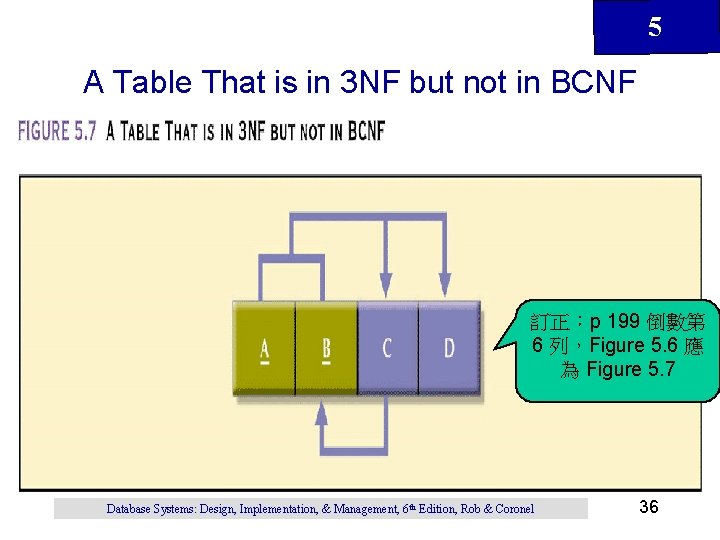
5 A Table That is in 3 NF but not in BCNF 訂正:p 199 倒數第 6 列,Figure 5. 6 應 為 Figure 5. 7 Database Systems: Design, Implementation, & Management, 6 th Edition, Rob & Coronel 36
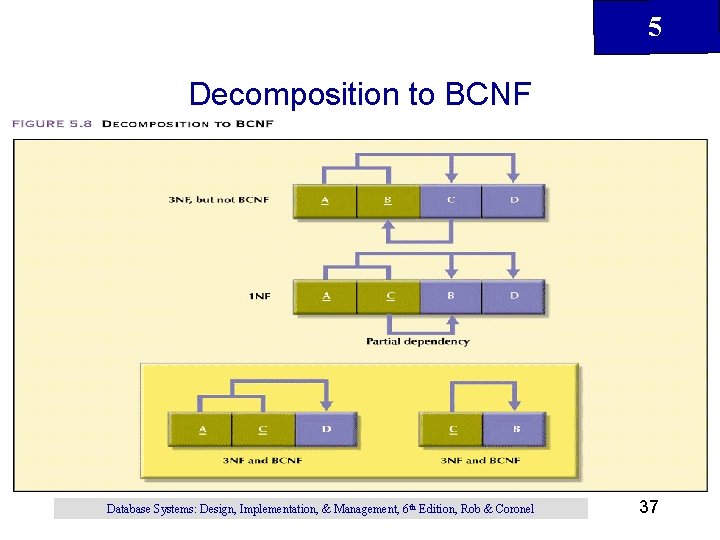
5 Decomposition to BCNF Database Systems: Design, Implementation, & Management, 6 th Edition, Rob & Coronel 37
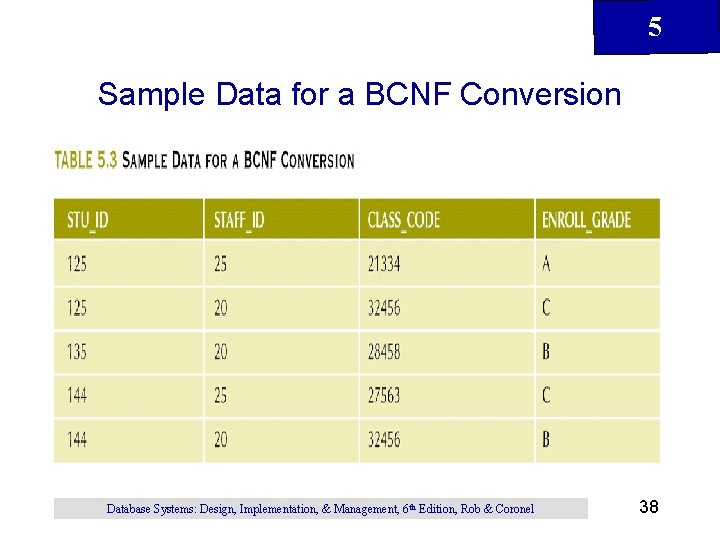
5 Sample Data for a BCNF Conversion Database Systems: Design, Implementation, & Management, 6 th Edition, Rob & Coronel 38
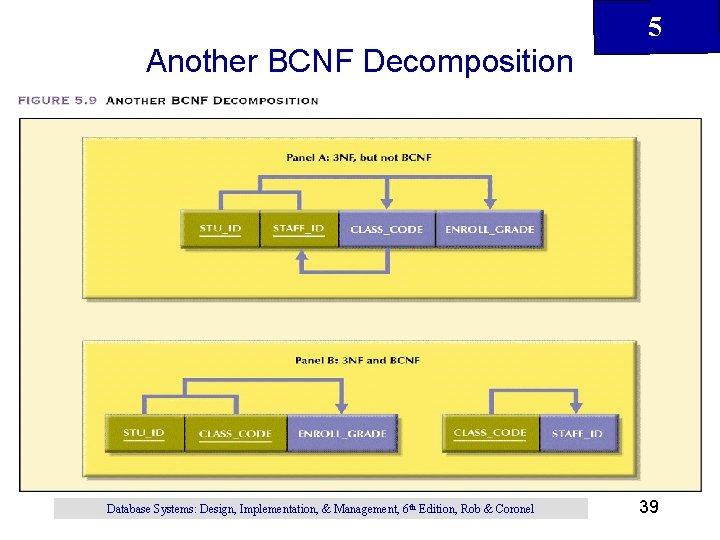
5 Another BCNF Decomposition Database Systems: Design, Implementation, & Management, 6 th Edition, Rob & Coronel 39
5 Normalization and Database Design • Normalization should be part of design process • Make sure that proposed entities meet required normal form before table structures are created • Many real-world databases have been improperly designed or burdened with anomalies if improperly modified during course of time • You may be asked to redesign and modify existing databases Database Systems: Design, Implementation, & Management, 6 th Edition, Rob & Coronel 40
5 Normalization and Database Design (continued) • ER diagram – Provides the big picture, or macro view, of an organization’s data requirements and operations – Created through an iterative process • Identifying relevant entities, their attributes and their relationship • Use results to identify additional entities and attributes Database Systems: Design, Implementation, & Management, 6 th Edition, Rob & Coronel 41
5 Normalization and Database Design (continued) • Normalization procedures – Focus on the characteristics of specific entities – A micro view of the entities within the ER diagram • Difficult to separate normalization process from ER modeling process • Two techniques should be used concurrently Database Systems: Design, Implementation, & Management, 6 th Edition, Rob & Coronel 42
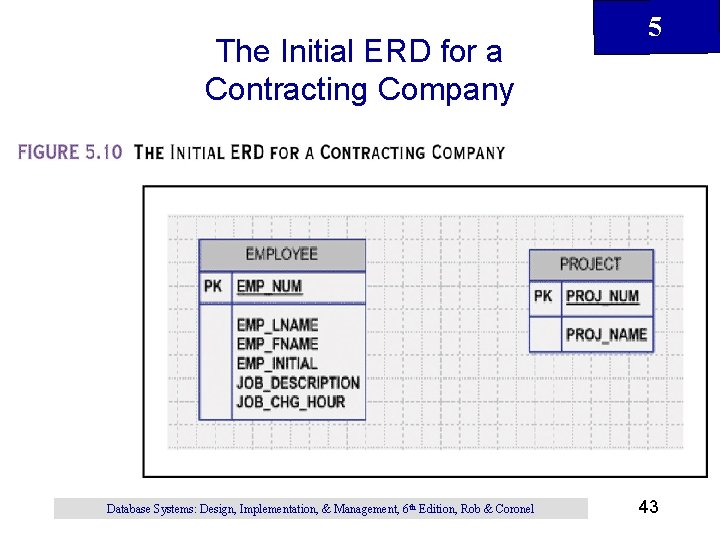
The Initial ERD for a Contracting Company Database Systems: Design, Implementation, & Management, 6 th Edition, Rob & Coronel 5 43
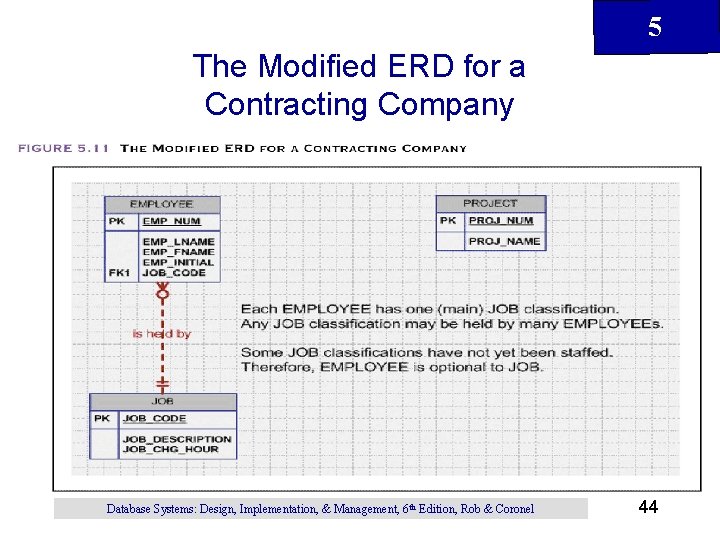
5 The Modified ERD for a Contracting Company Database Systems: Design, Implementation, & Management, 6 th Edition, Rob & Coronel 44
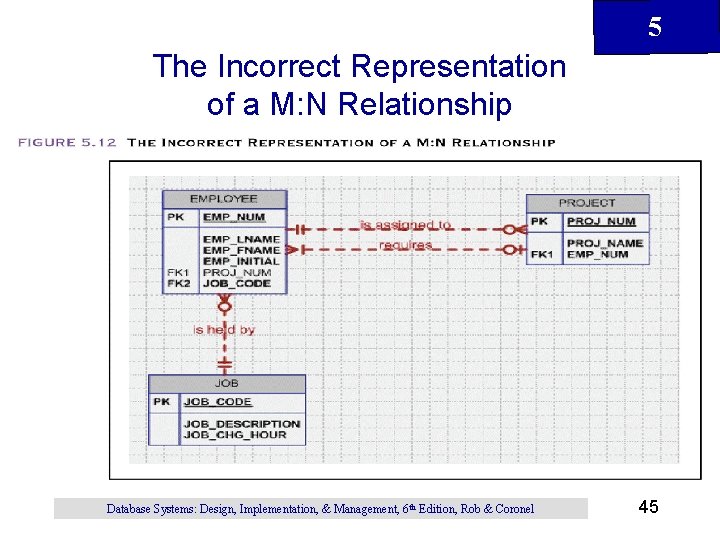
5 The Incorrect Representation of a M: N Relationship Database Systems: Design, Implementation, & Management, 6 th Edition, Rob & Coronel 45
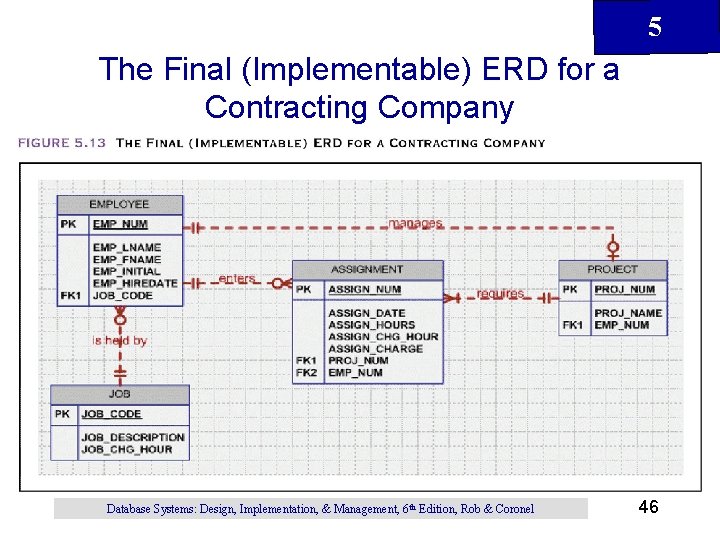
5 The Final (Implementable) ERD for a Contracting Company Database Systems: Design, Implementation, & Management, 6 th Edition, Rob & Coronel 46

5 The Implemented Database for the Contracting Company Database Systems: Design, Implementation, & Management, 6 th Edition, Rob & Coronel 47
5 Higher-Level Normal Forms • In some databases, multiple multivalued attributes exist Database Systems: Design, Implementation, & Management, 6 th Edition, Rob & Coronel 48
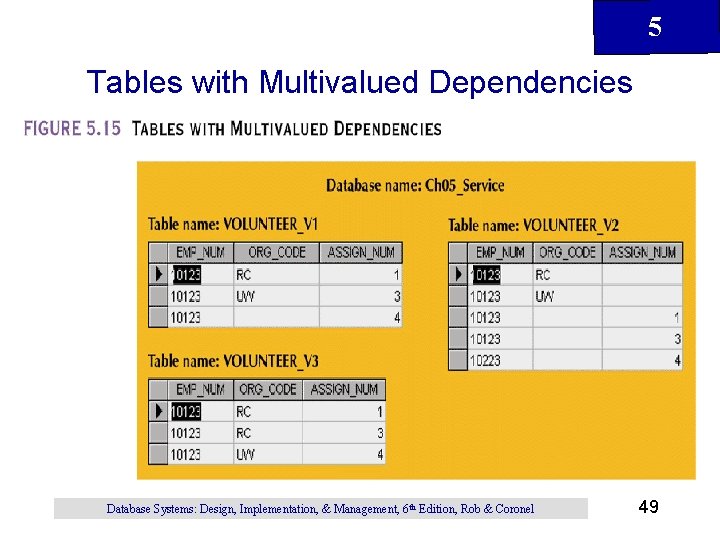
5 Tables with Multivalued Dependencies Database Systems: Design, Implementation, & Management, 6 th Edition, Rob & Coronel 49
5 Fourth Normal Form • Table is in fourth normal form (4 NF) if – It is in 3 NF – Has no multiple sets of multivalued dependencies • 4 NF is largely academic if tables conform to the following two rules: – All attributes are dependent on primary key but independent of each other – No row contains two or more multivalued facts about an entity Database Systems: Design, Implementation, & Management, 6 th Edition, Rob & Coronel 50
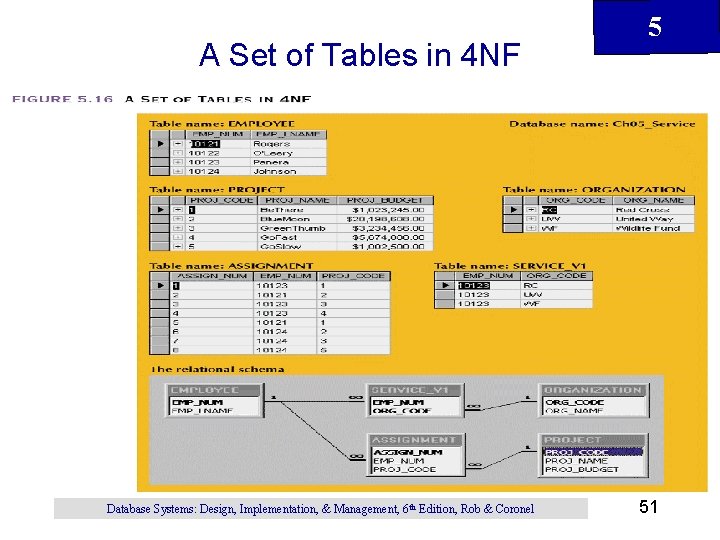
A Set of Tables in 4 NF Database Systems: Design, Implementation, & Management, 6 th Edition, Rob & Coronel 5 51
5 Denormalization • Creation of normalized relations is important database design goal • Processing requirements should also be a goal • If tables decomposed to conform to normalization requirements – Number of database tables expands Database Systems: Design, Implementation, & Management, 6 th Edition, Rob & Coronel 52

5 Denormalization (continued) • Joining larger number of tables takes additional disk input/output (I/O) operations and processing logic – Reduces system speed • Conflicts among design efficiency, information requirements, and processing speed are often resolved through compromises that may include denormalization Database Systems: Design, Implementation, & Management, 6 th Edition, Rob & Coronel 53
5 Denormalization (continued) • Unnormalized tables in a production database tend to have these defects: – Data updates are less efficient because programs that read and update tables must deal with larger tables – Indexing is much more cumbersome – Unnormalized tables yield no simple strategies for creating virtual tables known as views Database Systems: Design, Implementation, & Management, 6 th Edition, Rob & Coronel 54

5 Denormalization (continued) • Use denormalization cautiously • Understand why—under some circumstances —unnormalized tables are a better choice Database Systems: Design, Implementation, & Management, 6 th Edition, Rob & Coronel 55
5 Summary • Normalization is a table design technique aimed at minimizing data redundancies • First three normal forms (1 NF, 2 NF, and 3 NF) are most commonly encountered • Normalization is an important part—but only a part—of the design process • Continue the iterative ER process until all entities and their attributes are defined and all equivalent tables are in 3 NF Database Systems: Design, Implementation, & Management, 6 th Edition, Rob & Coronel 56
5 Summary (continued) • A table in 3 NF may contain multivalued dependencies that produce either numerous null values or redundant data • It may be necessary to convert a 3 NF table to the fourth normal form (4 NF) by – splitting such a table to remove multivalued dependencies • Tables are sometimes denormalized to yield less I/O which increases processing speed Database Systems: Design, Implementation, & Management, 6 th Edition, Rob & Coronel 57
- Slides: 57