
5 Capacity and Waiting Dr Ron Lembke Operations
5. Capacity and Waiting Dr. Ron Lembke Operations Management
How much do we have? n Design capacity: max output designed for ¨ Everything n goes right, enough support staff Effective Capacity ¨ Routine maintenance ¨ Affected by resources allocated ¨ We can only sustain so much effort. ¨ Output level process designed for ¨ Lowest cost per unit
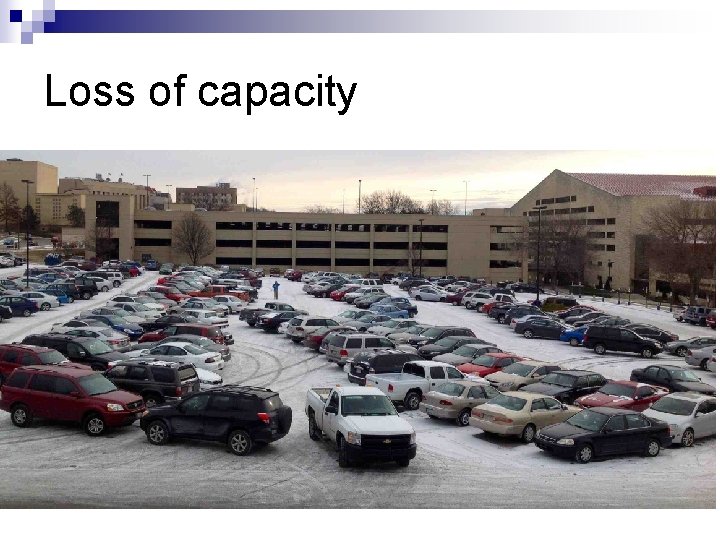
Loss of capacity
Utilization and Efficiency n Capacity utilization = actual output design capacity n Efficiency = actual output effective capacity n Efficiency can be > 1. 0 but not for long
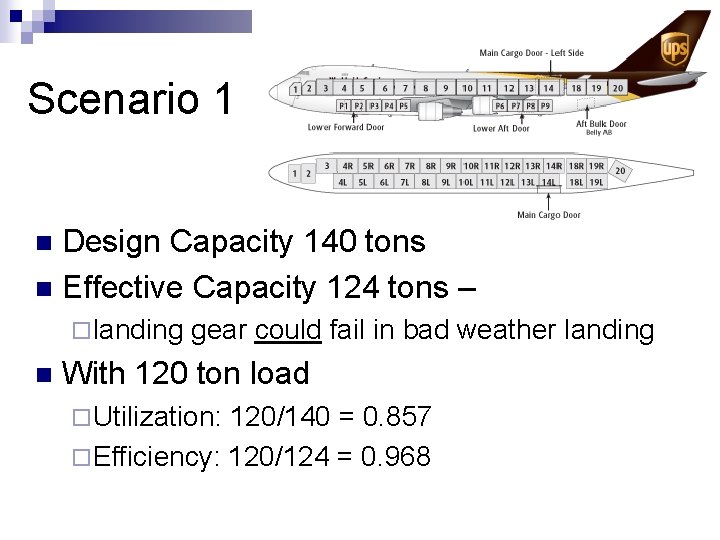
Scenario 1 Design Capacity 140 tons n Effective Capacity 124 tons – n ¨ landing n gear could fail in bad weather landing With 120 ton load ¨ Utilization: 120/140 = 0. 857 ¨ Efficiency: 120/124 = 0. 968
Economies of Scale Cost per unit cheaper, the more you make n Fixed costs spread over more units n
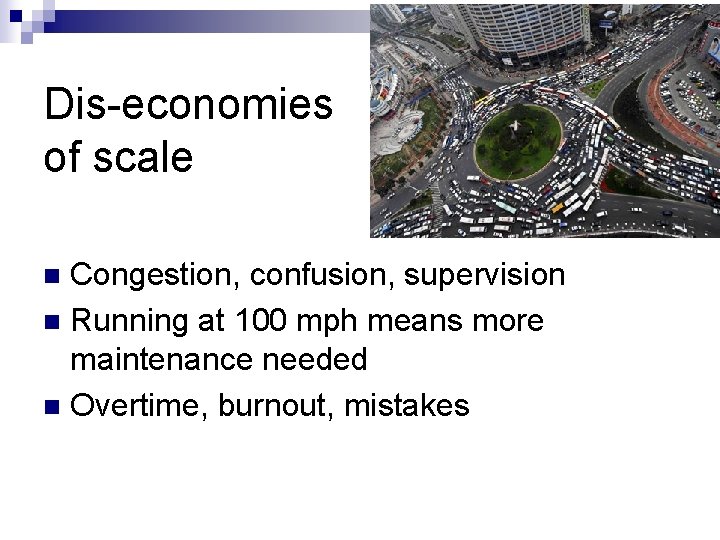
Dis-economies of scale Congestion, confusion, supervision n Running at 100 mph means more maintenance needed n Overtime, burnout, mistakes n
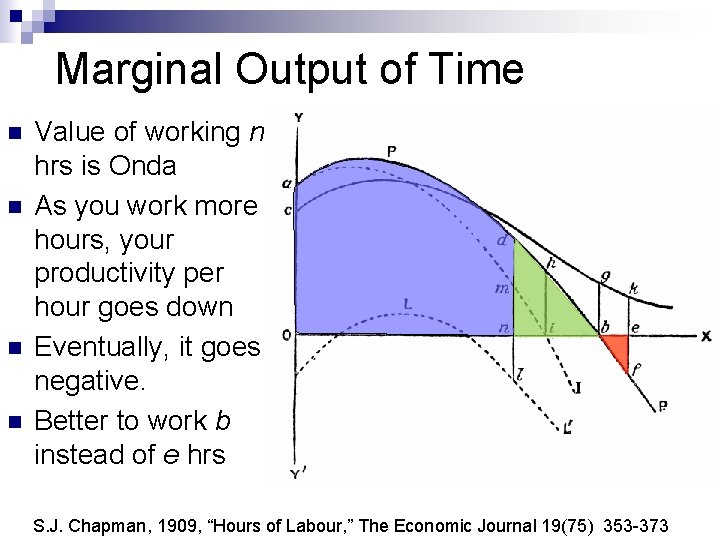
Marginal Output of Time n n Value of working n hrs is Onda As you work more hours, your productivity per hour goes down Eventually, it goes negative. Better to work b instead of e hrs S. J. Chapman, 1909, “Hours of Labour, ” The Economic Journal 19(75) 353 -373
Learning Curves n time/unit goes down consistently ¨ First 1 takes 15 min, 2 nd takes 5, 3 rd takes 3 Down 10% (for example) as output doubles n We can use Logarithms to approximate this n ¨ cost n per unit after 10, 000 units? If you ever need this, email me, and we can talk as much as you want
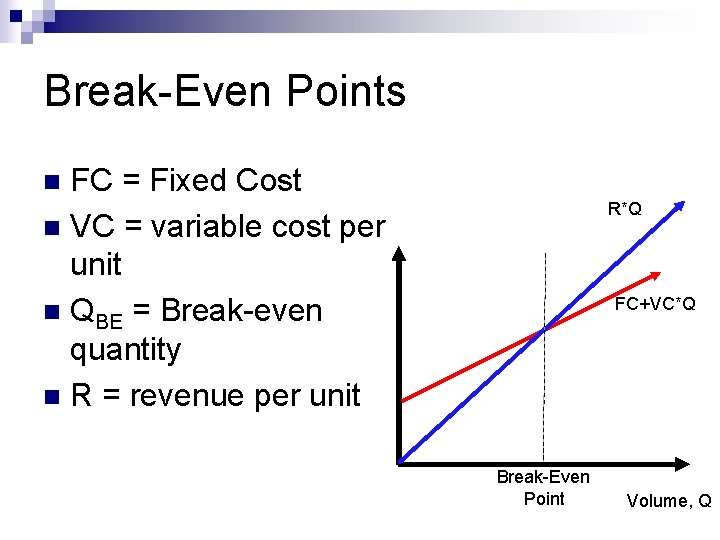
Break-Even Points FC = Fixed Cost n VC = variable cost per unit n QBE = Break-even quantity n R = revenue per unit n R*Q FC+VC*Q Break-Even Point Volume, Q
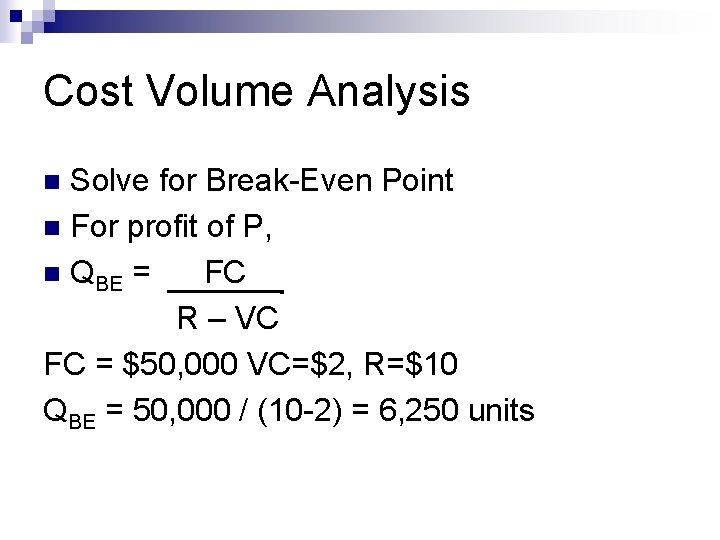
Cost Volume Analysis Solve for Break-Even Point n For profit of P, n QBE = FC R – VC FC = $50, 000 VC=$2, R=$10 QBE = 50, 000 / (10 -2) = 6, 250 units n
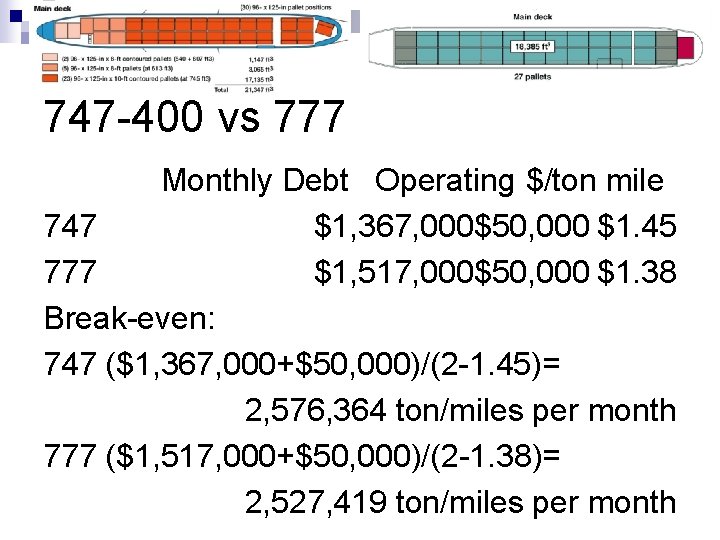
747 -400 vs 777 Monthly Debt Operating $/ton mile 747 $1, 367, 000$50, 000 $1. 45 777 $1, 517, 000$50, 000 $1. 38 Break-even: 747 ($1, 367, 000+$50, 000)/(2 -1. 45)= 2, 576, 364 ton/miles per month 777 ($1, 517, 000+$50, 000)/(2 -1. 38)= 2, 527, 419 ton/miles per month
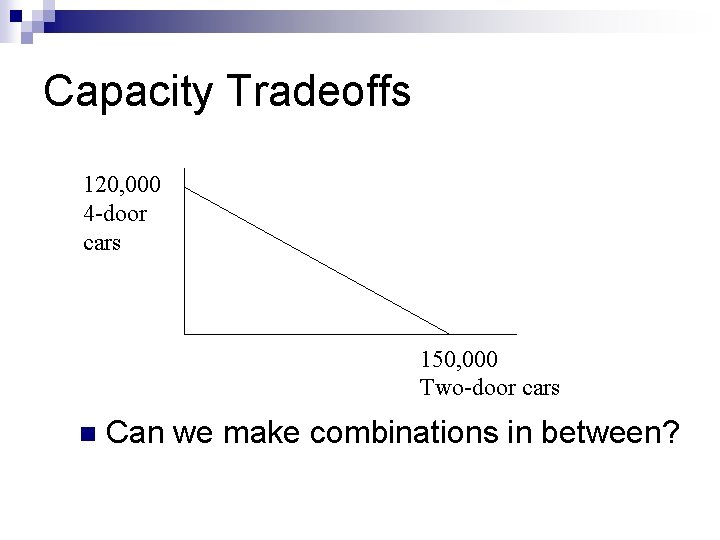
Capacity Tradeoffs 120, 000 4 -door cars 150, 000 Two-door cars n Can we make combinations in between?
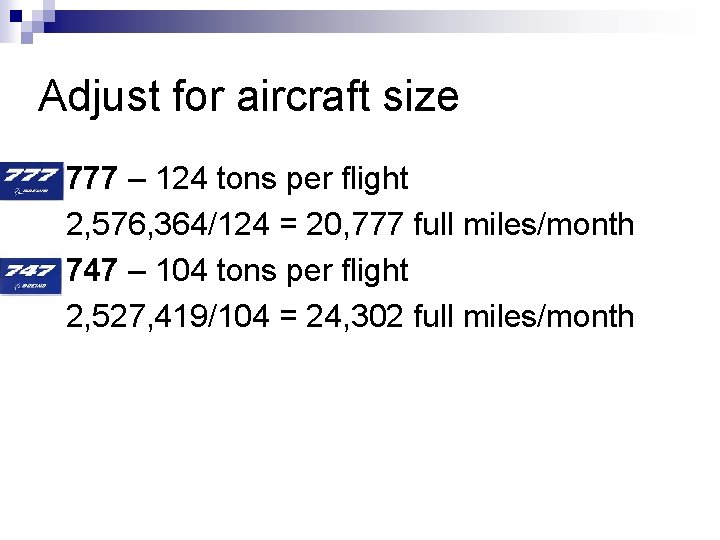
Adjust for aircraft size 777 – 124 tons per flight 2, 576, 364/124 = 20, 777 full miles/month 747 – 104 tons per flight 2, 527, 419/104 = 24, 302 full miles/month
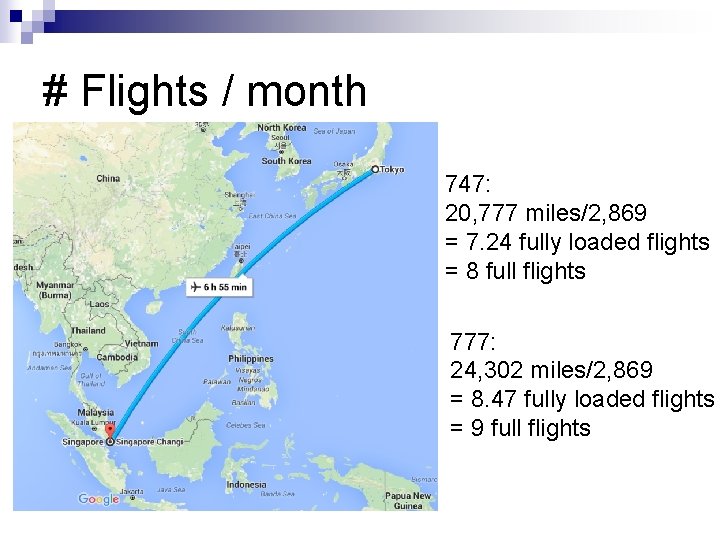
# Flights / month 747: 20, 777 miles/2, 869 = 7. 24 fully loaded flights = 8 full flights 777: 24, 302 miles/2, 869 = 8. 47 fully loaded flights = 9 full flights
Time Horizons Long-Range: over a year – acquiring, disposing of production resources n Intermediate Range: Monthly or quarterly plans, hiring, firing, layoffs n Short Range – less than a month, daily or weekly scheduling process, overtime, worker scheduling, etc. n
Adding Capacity Expensive to add capacity n A few large expansions are cheaper (per unit) than many small additions n Large expansions allow of “clean sheet of paper” thinking, re-design of processes n ¨ Carry unused overhead for a long time ¨ May never be needed
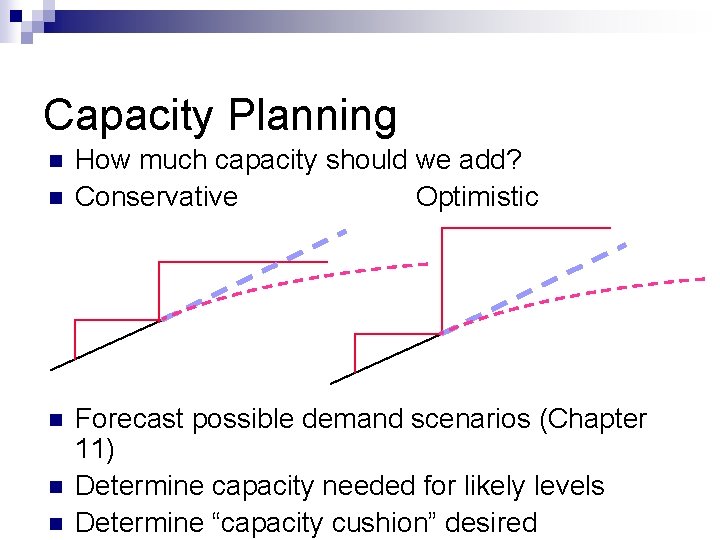
Capacity Planning n n n How much capacity should we add? Conservative Optimistic Forecast possible demand scenarios (Chapter 11) Determine capacity needed for likely levels Determine “capacity cushion” desired
Capacity Sources n In addition to expanding facilities: ¨ Two or three shifts ¨ Outsourcing non-core activities ¨ Training or acquisition of faster equipment
What Would Henry Say? n n Ford introduced the $5 (per day) wage in 1914 He introduced the 40 hour work week “so people would have more time to buy” It also meant more output: 3*8 > 2*10 ¨ “Now we know from our experience in changing from six to five days and back again that we can get at least as great production in five days as we can in six, and we shall probably get a greater, for the pressure will bring better methods. ¨ Crowther, World’s Work, 1926
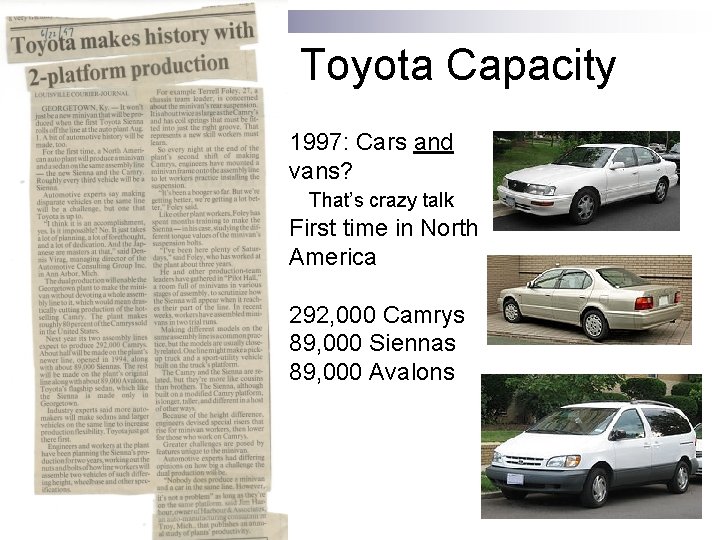
Toyota Capacity 1997: Cars and vans? That’s crazy talk First time in North America 292, 000 Camrys 89, 000 Siennas 89, 000 Avalons
Decision Trees Consider different possible decisions, and different possible outcomes n Compute expected profits of each decision n Choose decision with highest expected profits, work your way back up the tree. n
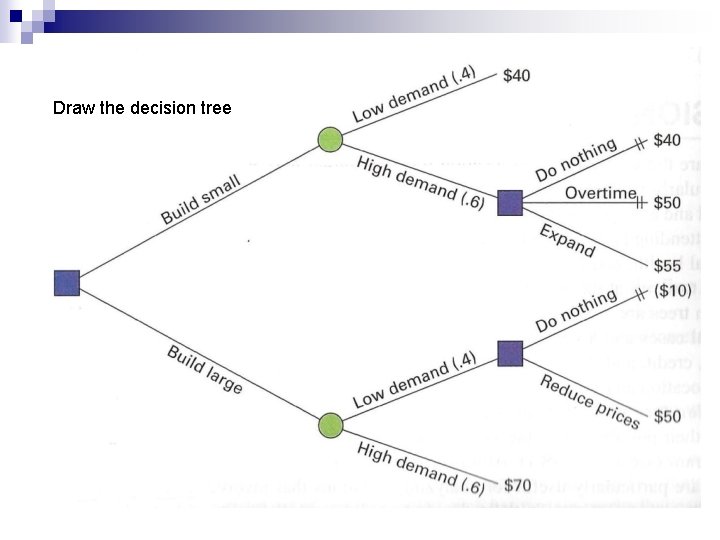
Draw the decision tree
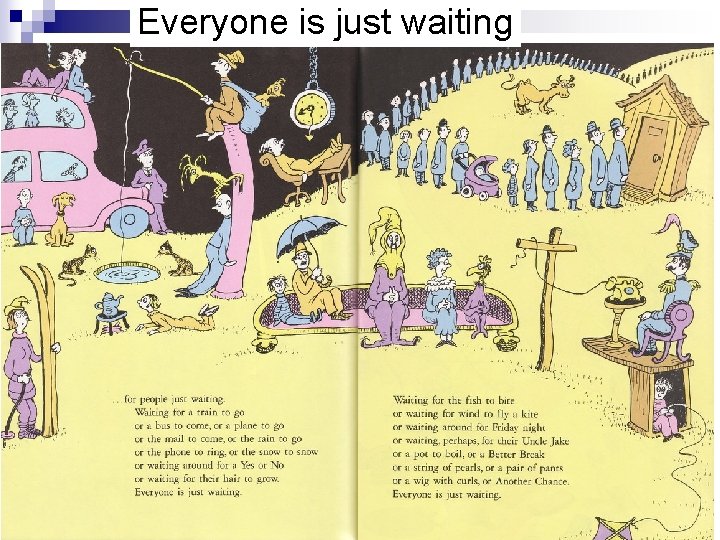
Everyone is just waiting Everyone is Just Waiting
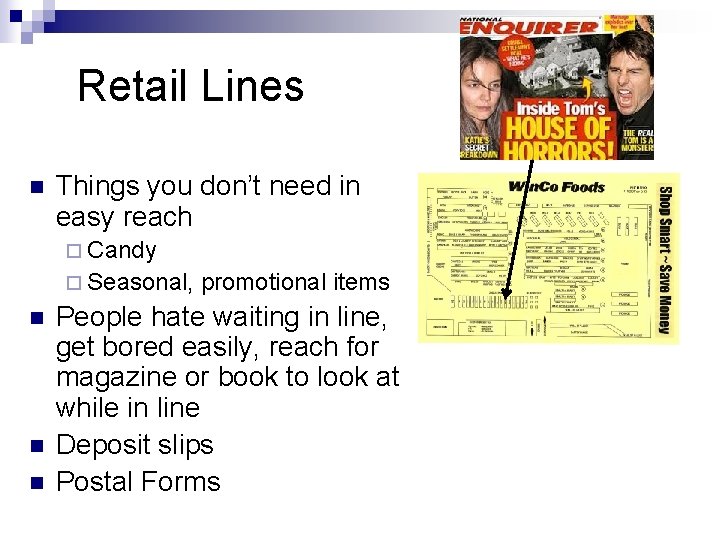
Retail Lines n Things you don’t need in easy reach ¨ Candy ¨ Seasonal, n n n promotional items People hate waiting in line, get bored easily, reach for magazine or book to look at while in line Deposit slips Postal Forms
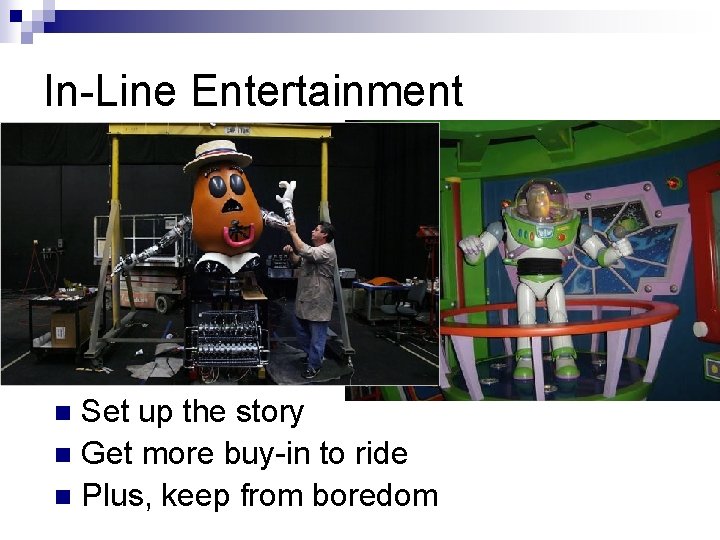
In-Line Entertainment Set up the story n Get more buy-in to ride n Plus, keep from boredom n
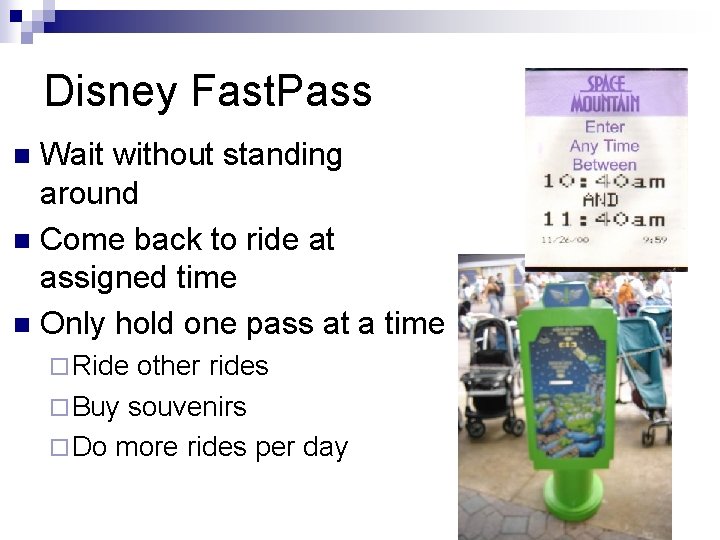
Disney Fast. Pass Wait without standing around n Come back to ride at assigned time n Only hold one pass at a time n ¨ Ride other rides ¨ Buy souvenirs ¨ Do more rides per day
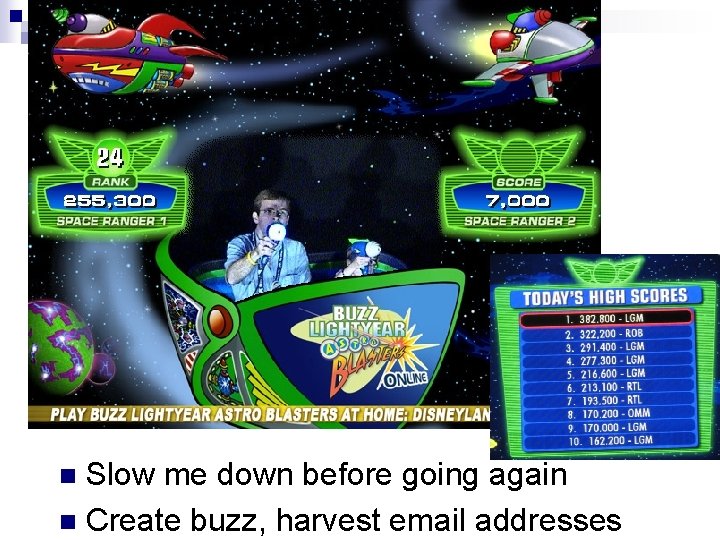
Benefits of Interactivity Slow me down before going again n Create buzz, harvest email addresses n
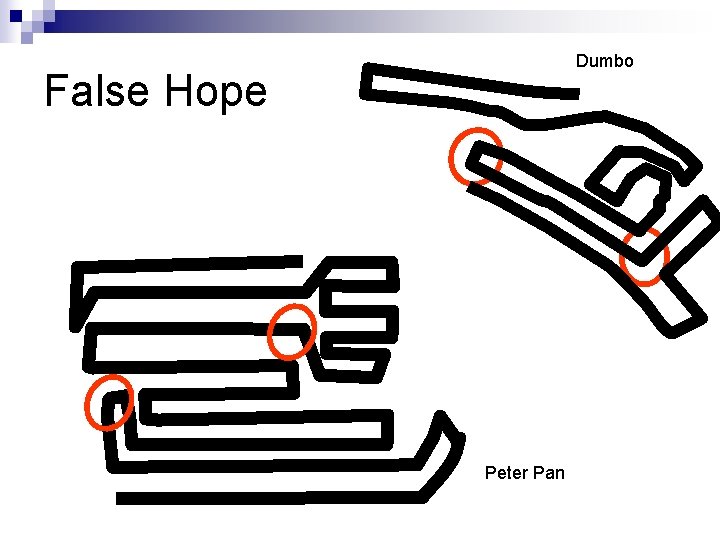
Dumbo False Hope Peter Pan
Queues In England, they don’t ‘wait in line, ’ they ‘wait on queue. ’ n So the study of lines is called queueing theory. n
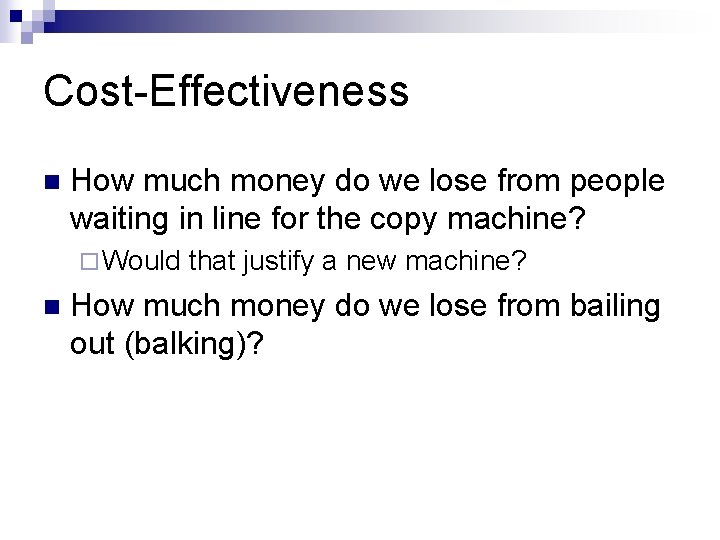
Cost-Effectiveness n How much money do we lose from people waiting in line for the copy machine? ¨ Would n that justify a new machine? How much money do we lose from bailing out (balking)?
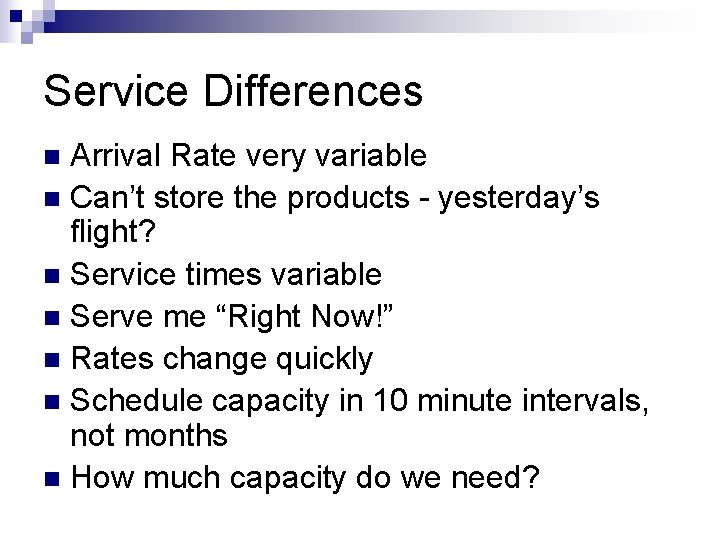
Service Differences Arrival Rate very variable n Can’t store the products - yesterday’s flight? n Service times variable n Serve me “Right Now!” n Rates change quickly n Schedule capacity in 10 minute intervals, not months n How much capacity do we need? n
We are the problem n n n Customers arrive randomly. Time between arrivals is called the “interarrival time” Interarrival times often have the “memoryless property”: ¨ On average, interarrival time is 60 sec. ¨ the last person came in 30 sec. ago, expected time until next person: 60 sec. ¨ 5 minutes since last person: still 60 sec. n Variability in flow means excess capacity is needed
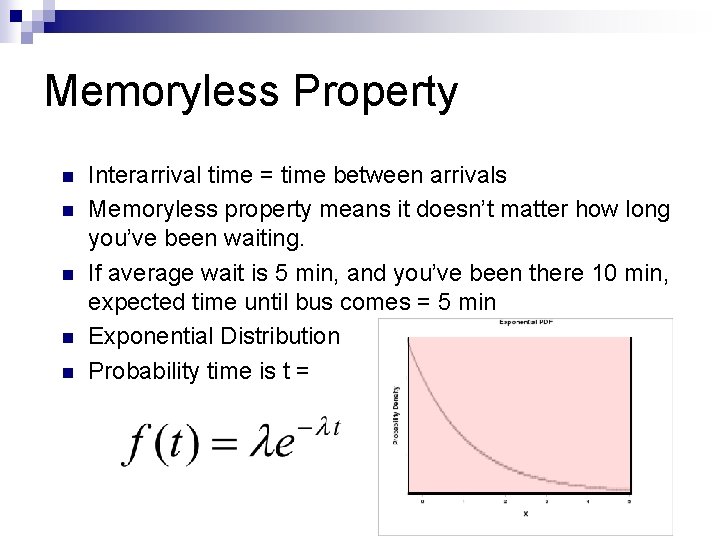
Memoryless Property n n n Interarrival time = time between arrivals Memoryless property means it doesn’t matter how long you’ve been waiting. If average wait is 5 min, and you’ve been there 10 min, expected time until bus comes = 5 min Exponential Distribution Probability time is t =
Poisson Distribution Assumes interarrival times are exponential n Tells the probability of a given number of arrivals during some time period T. n
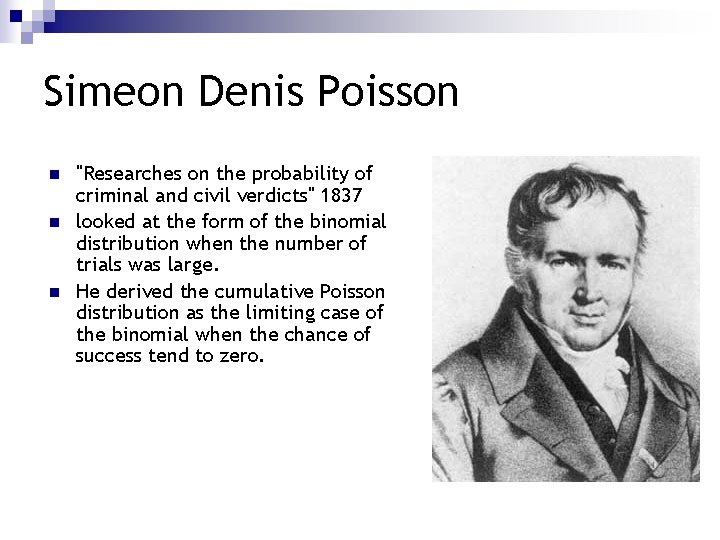
Simeon Denis Poisson n "Researches on the probability of criminal and civil verdicts" 1837 looked at the form of the binomial distribution when the number of trials was large. He derived the cumulative Poisson distribution as the limiting case of the binomial when the chance of success tend to zero.
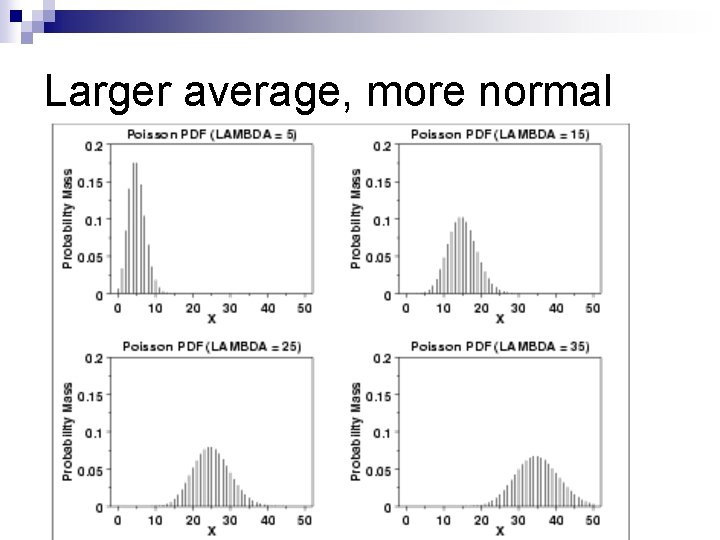
Larger average, more normal
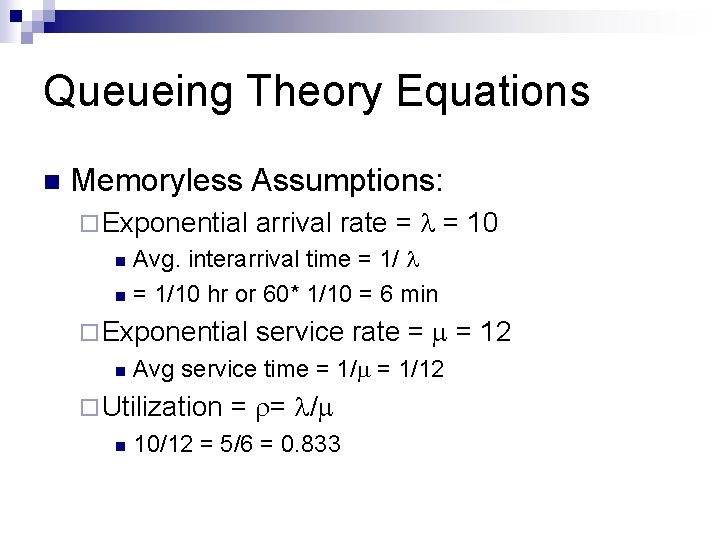
Queueing Theory Equations n Memoryless Assumptions: ¨ Exponential arrival rate = = 10 Avg. interarrival time = 1/ n = 1/10 hr or 60* 1/10 = 6 min n ¨ Exponential n Avg service time = 1/12 ¨ Utilization n service rate = = 12 = = / 10/12 = 5/6 = 0. 833
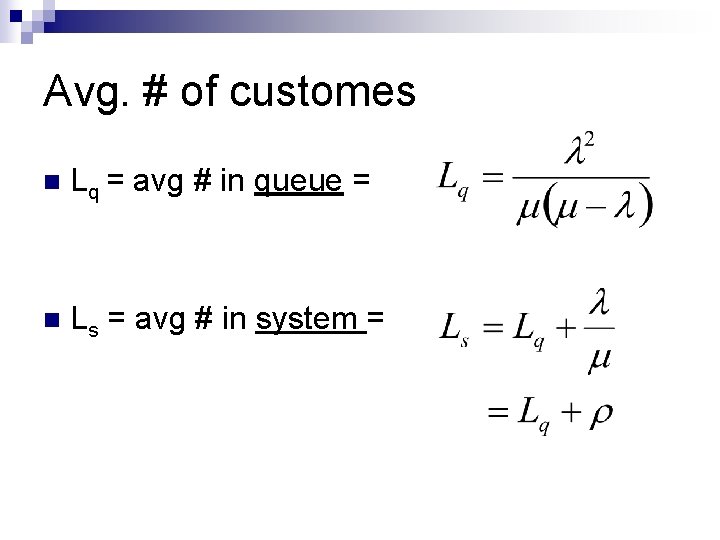
Avg. # of customes n Lq = avg # in queue = n Ls = avg # in system =
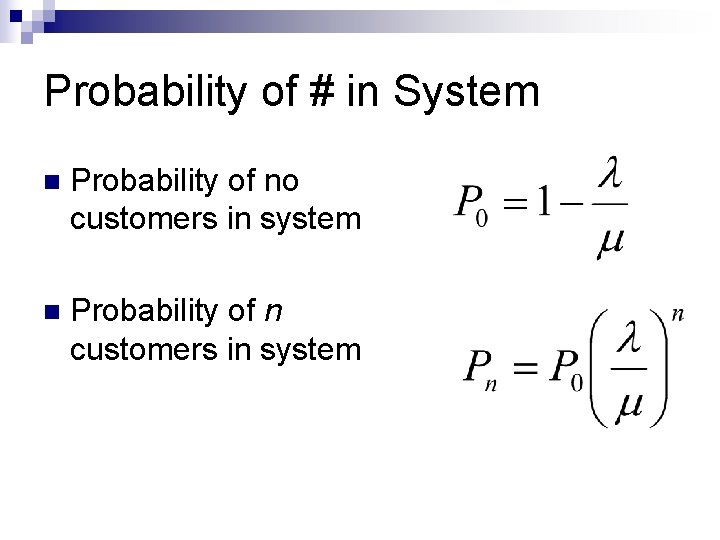
Probability of # in System n Probability of no customers in system n Probability of n customers in system
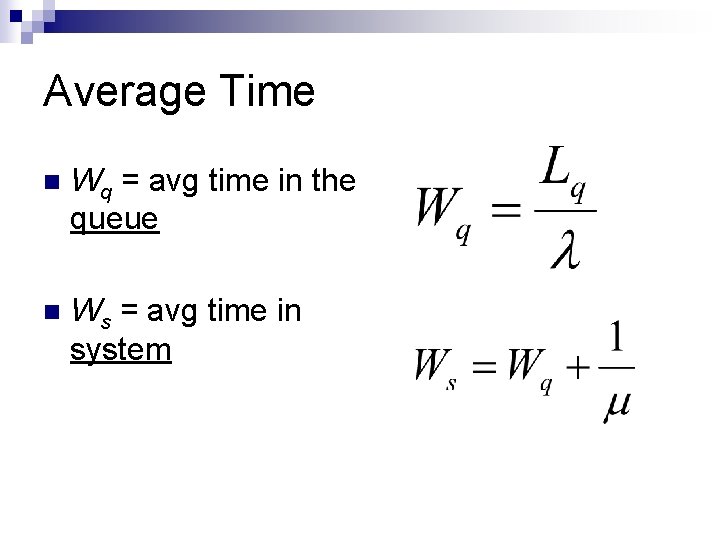
Average Time n Wq = avg time in the queue n Ws = avg time in system
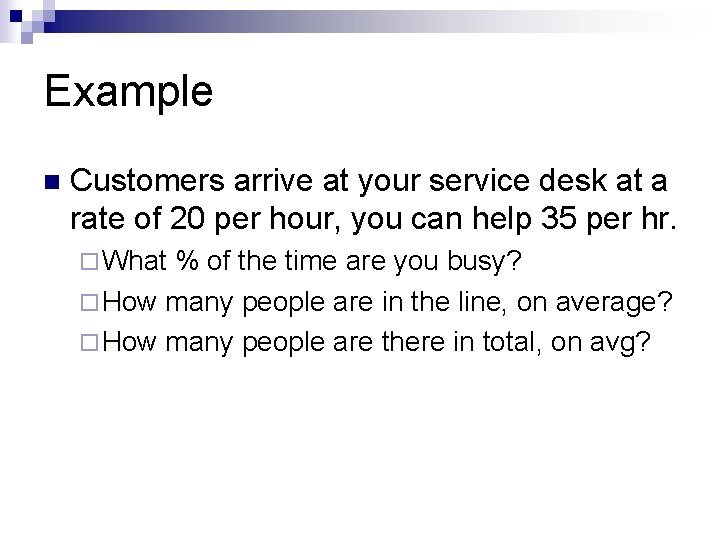
Example n Customers arrive at your service desk at a rate of 20 per hour, you can help 35 per hr. ¨ What % of the time are you busy? ¨ How many people are in the line, on average? ¨ How many people are there in total, on avg?
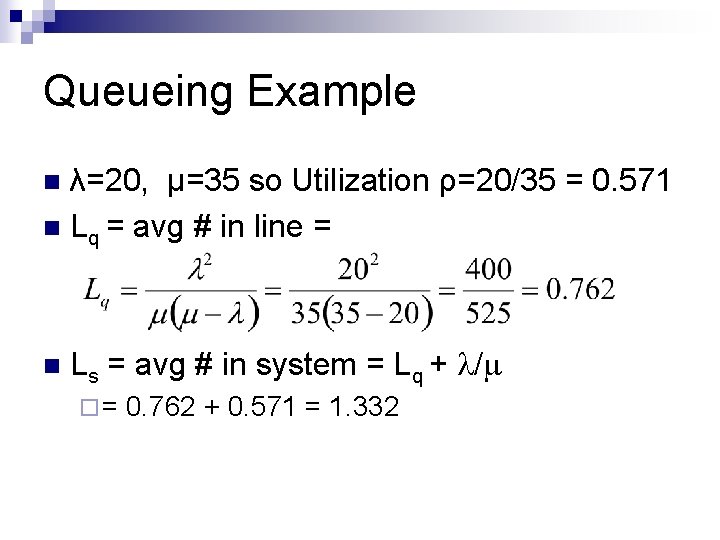
Queueing Example λ=20, μ=35 so Utilization ρ=20/35 = 0. 571 n Lq = avg # in line = n n Ls = avg # in system = Lq + / ¨= 0. 762 + 0. 571 = 1. 332
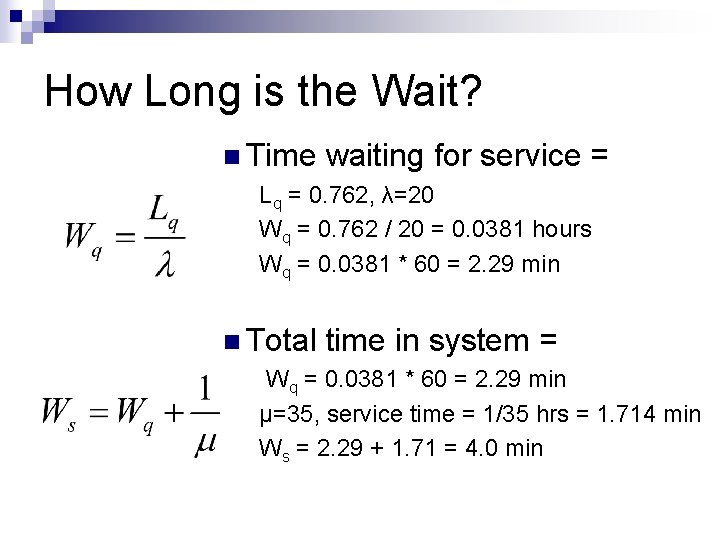
How Long is the Wait? n Time waiting for service = Lq = 0. 762, λ=20 Wq = 0. 762 / 20 = 0. 0381 hours Wq = 0. 0381 * 60 = 2. 29 min n Total time in system = Wq = 0. 0381 * 60 = 2. 29 min μ=35, service time = 1/35 hrs = 1. 714 min Ws = 2. 29 + 1. 71 = 4. 0 min
What did we learn? Memoryless property means exponential distribution, Poisson arrivals n Results hold for simple systems: one line, one server n ¨ Average length of time in line, and system ¨ Average number of people in line and in system ¨ Probability of n people in the system
- Slides: 45