
5 Balance Sheet and Statement of Cash Flows
5 Balance Sheet and Statement of Cash Flows Intermediate Accounting 5 -1 Kieso, Weygandt, and Warfield
Balance Sheet, also referred to as the statement of financial position: 1. Reports assets, liabilities, and equity at a specific date. 2. Provides information about resources, obligations to creditors, and equity in net resources. 3. Helps in predicting amounts, timing, and uncertainty of future cash flows. 5 -2 LO 1 Explain the uses and limitations of a balance sheet.
Balance Sheet Usefulness of the Balance Sheet 5 -3 u Computing rates of return. u Evaluating the capital structure. u Assess risk and future cash flows. u Analyze the company’s: ► Liquidity, ► Solvency, and ► Financial flexibility. LO 1 Explain the uses and limitations of a balance sheet.
Balance Sheet Limitations of the Balance Sheet 5 -4 u Most assets and liabilities are reported at historical cost. u Use of judgments and estimates. u Many items of financial value are omitted. LO 1 Explain the uses and limitations of a balance sheet.
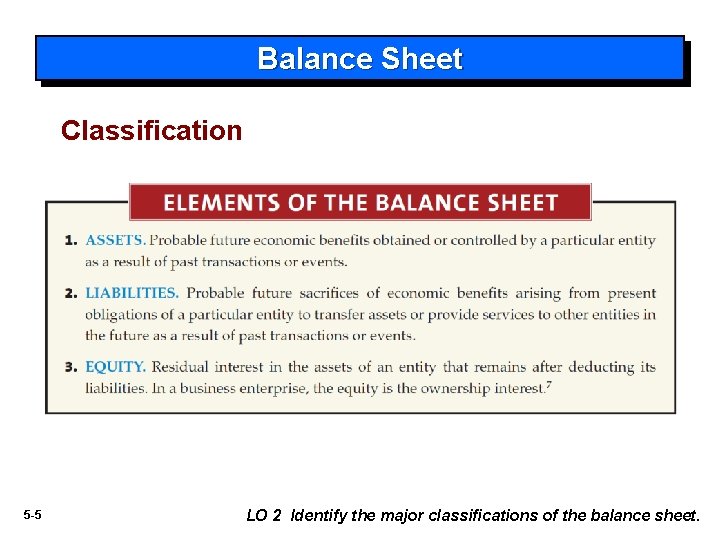
Balance Sheet Classification 5 -5 LO 2 Identify the major classifications of the balance sheet.
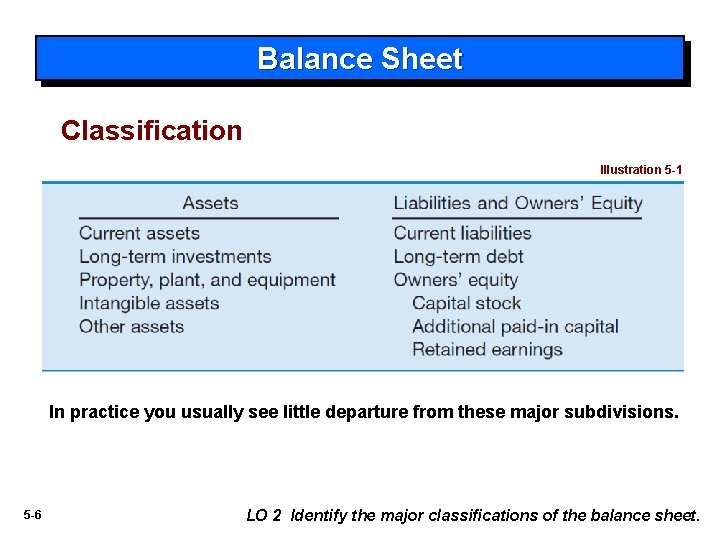
Balance Sheet Classification Illustration 5 -1 In practice you usually see little departure from these major subdivisions. 5 -6 LO 2 Identify the major classifications of the balance sheet.
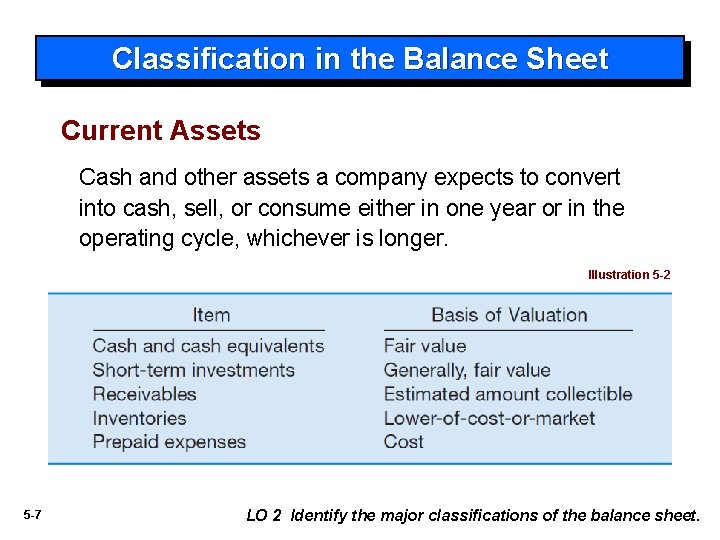
Classification in the Balance Sheet Current Assets Cash and other assets a company expects to convert into cash, sell, or consume either in one year or in the operating cycle, whichever is longer. Illustration 5 -2 5 -7 LO 2 Identify the major classifications of the balance sheet.
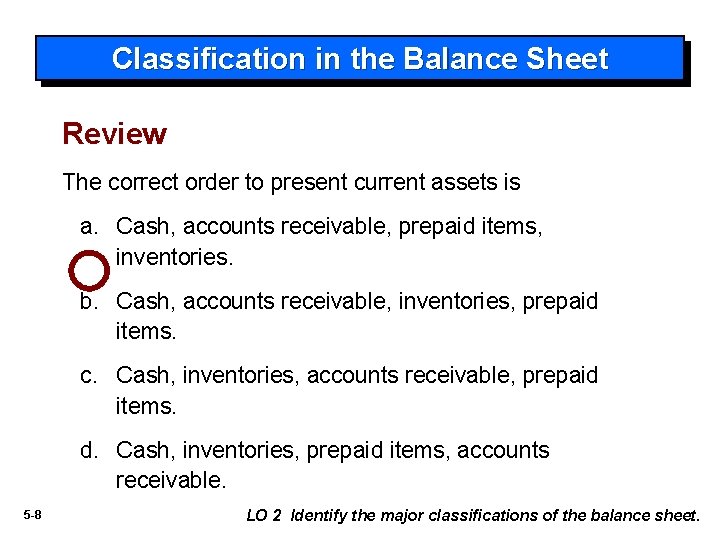
Classification in the Balance Sheet Review The correct order to present current assets is a. Cash, accounts receivable, prepaid items, inventories. b. Cash, accounts receivable, inventories, prepaid items. c. Cash, inventories, accounts receivable, prepaid items. d. Cash, inventories, prepaid items, accounts receivable. 5 -8 LO 2 Identify the major classifications of the balance sheet.
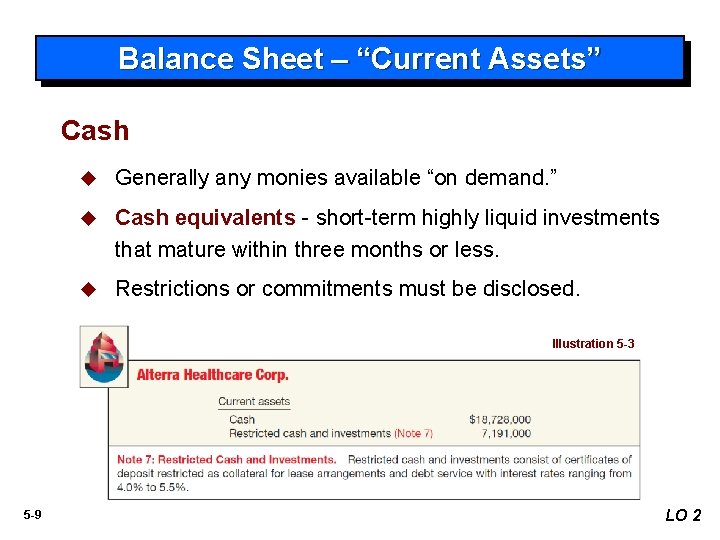
Balance Sheet – “Current Assets” Cash u Generally any monies available “on demand. ” u Cash equivalents - short-term highly liquid investments that mature within three months or less. u Restrictions or commitments must be disclosed. Illustration 5 -3 5 -9 LO 2
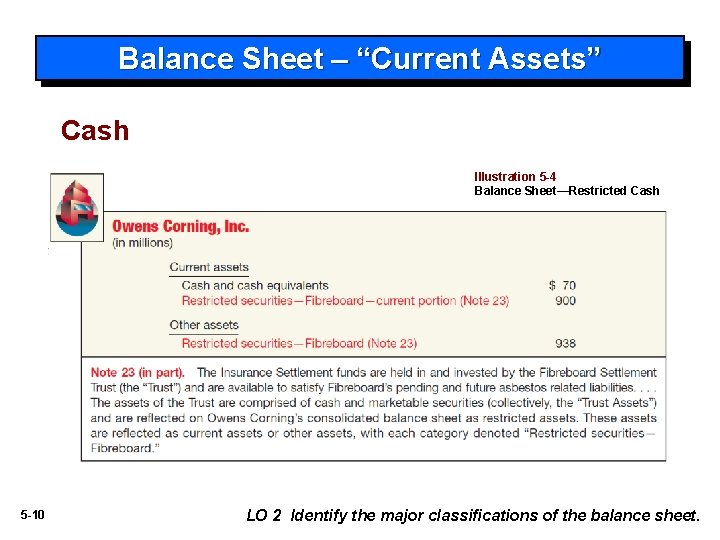
Balance Sheet – “Current Assets” Cash Illustration 5 -4 Balance Sheet—Restricted Cash 5 -10 LO 2 Identify the major classifications of the balance sheet.
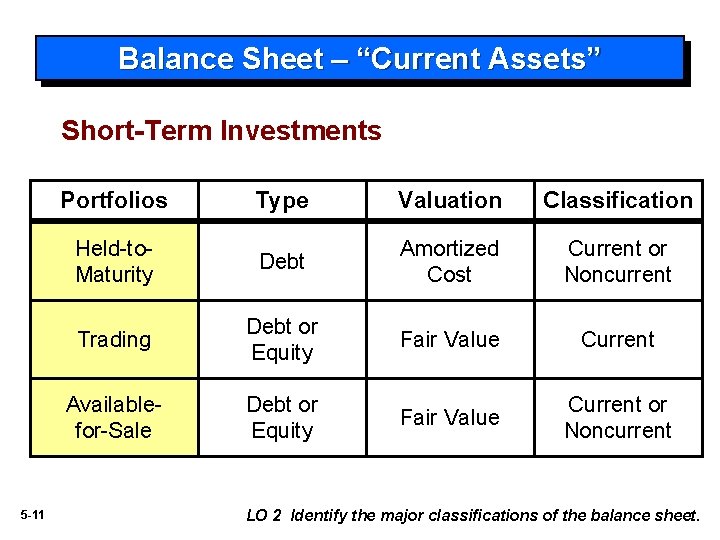
Balance Sheet – “Current Assets” Short-Term Investments Portfolios 5 -11 Type Valuation Classification Held-to. Maturity Debt Amortized Cost Current or Noncurrent Trading Debt or Equity Fair Value Current Availablefor-Sale Debt or Equity Fair Value Current or Noncurrent LO 2 Identify the major classifications of the balance sheet.
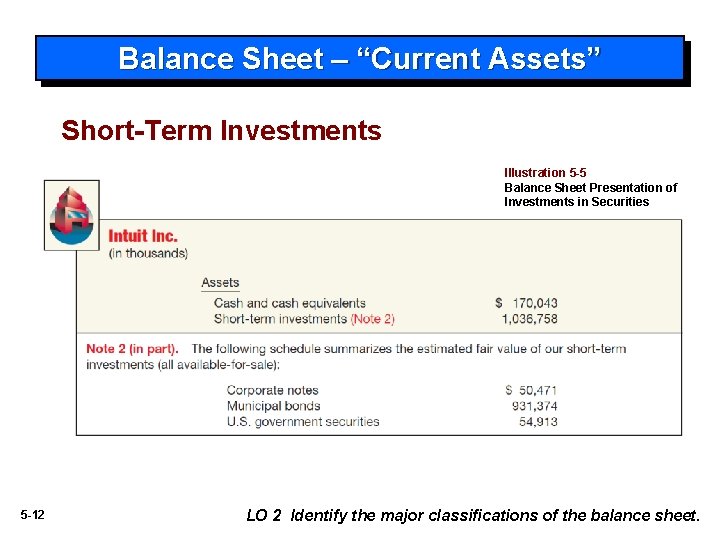
Balance Sheet – “Current Assets” Short-Term Investments Illustration 5 -5 Balance Sheet Presentation of Investments in Securities 5 -12 LO 2 Identify the major classifications of the balance sheet.
Balance Sheet – “Current Assets” Receivables Major categories of receivables should be shown in the balance sheet or the related notes. A company should clearly identify 5 -13 u Anticipated loss due to uncollectibles. u Amount and nature of any nontrade receivables. u Receivables used as collateral. LO 2 Identify the major classifications of the balance sheet.
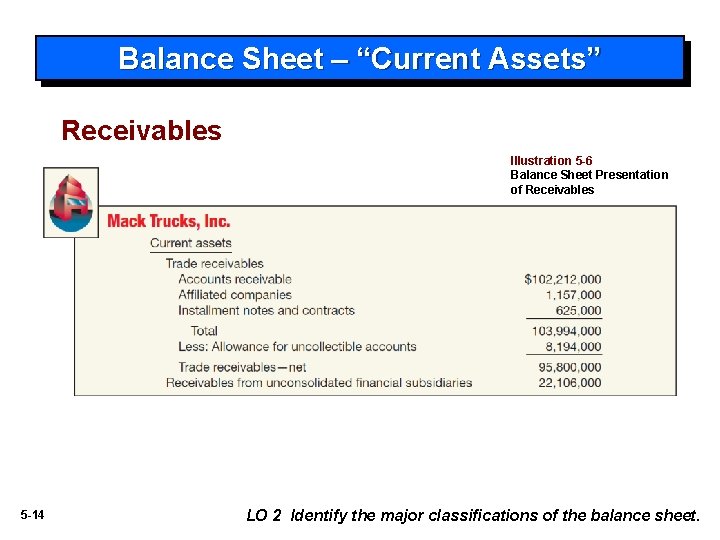
Balance Sheet – “Current Assets” Receivables Illustration 5 -6 Balance Sheet Presentation of Receivables 5 -14 LO 2 Identify the major classifications of the balance sheet.
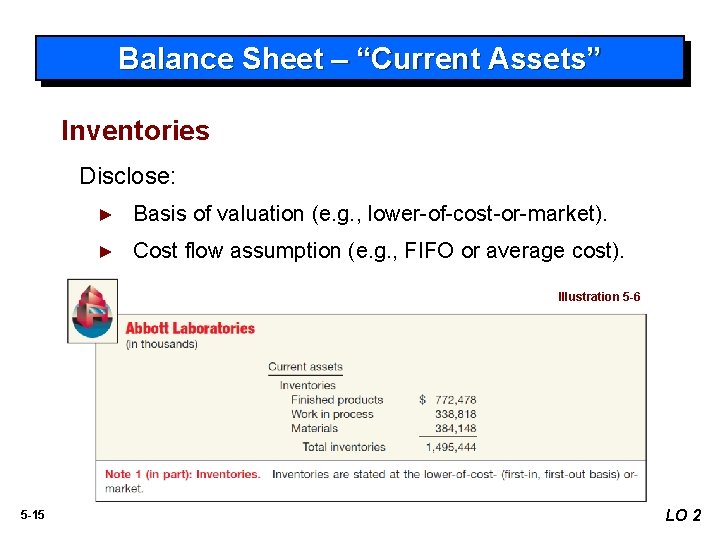
Balance Sheet – “Current Assets” Inventories Disclose: ► Basis of valuation (e. g. , lower-of-cost-or-market). ► Cost flow assumption (e. g. , FIFO or average cost). Illustration 5 -6 5 -15 LO 2
Balance Sheet – “Current Assets” Prepaid Expenses Payment of cash, that is recorded as an asset because service or benefit will be received in the future. Cash Payment BEFORE Expense Recorded Prepayments often occur in regard to: 5 -16 u insurance u rent u supplies u taxes u advertising LO 2 Identify the major classifications of the balance sheet.
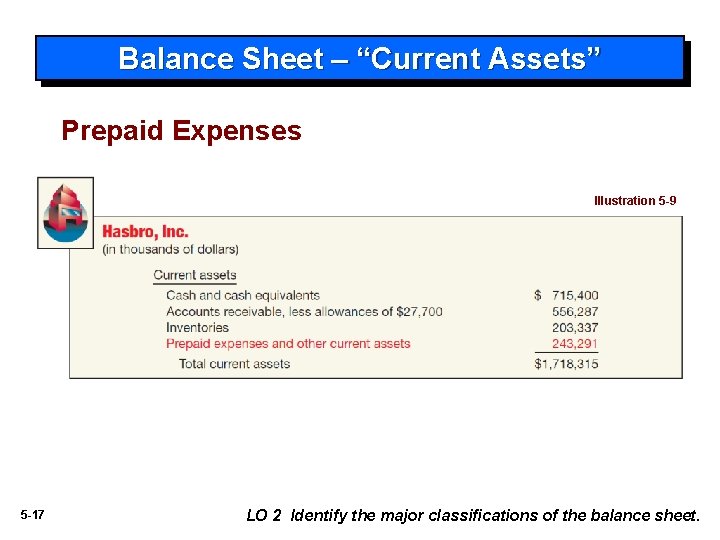
Balance Sheet – “Current Assets” Prepaid Expenses Illustration 5 -9 5 -17 LO 2 Identify the major classifications of the balance sheet.
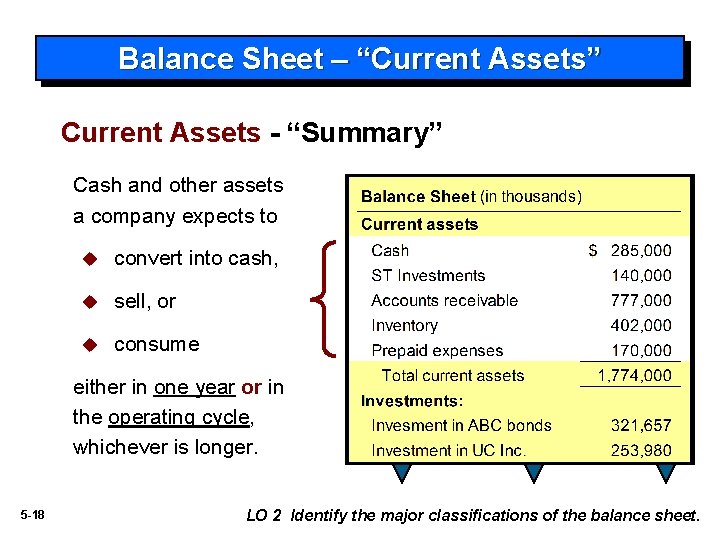
Balance Sheet – “Current Assets” Current Assets - “Summary” Cash and other assets a company expects to u convert into cash, u sell, or u consume either in one year or in the operating cycle, whichever is longer. 5 -18 LO 2 Identify the major classifications of the balance sheet.
Classification in the Balance Sheet Non-Current Assets Long-term Investments 1. Securities (bonds, common stock, or long-term notes). 2. Tangible fixed assets not currently used in operations (land held for speculation). 3. Special funds (sinking fund, pension fund, or plant expansion fund. 4. Non-consolidated subsidiaries or affilated companies. 5 -19 LO 2 Identify the major classifications of the balance sheet.
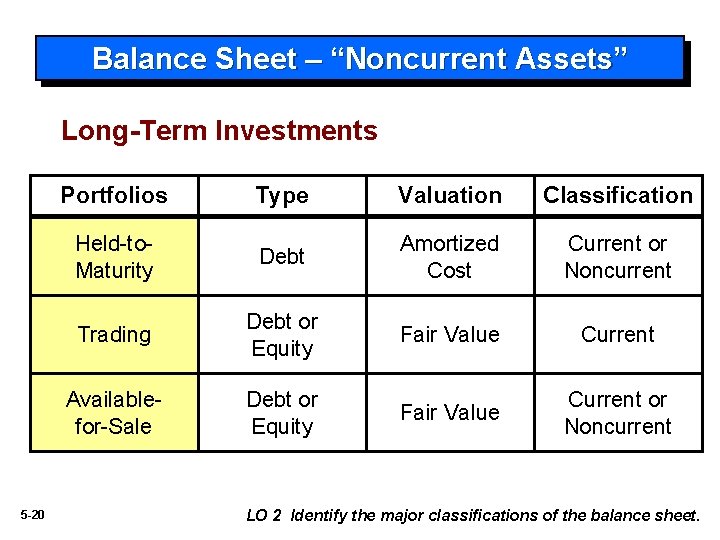
Balance Sheet – “Noncurrent Assets” Long-Term Investments Portfolios 5 -20 Type Valuation Classification Held-to. Maturity Debt Amortized Cost Current or Noncurrent Trading Debt or Equity Fair Value Current Availablefor-Sale Debt or Equity Fair Value Current or Noncurrent LO 2 Identify the major classifications of the balance sheet.
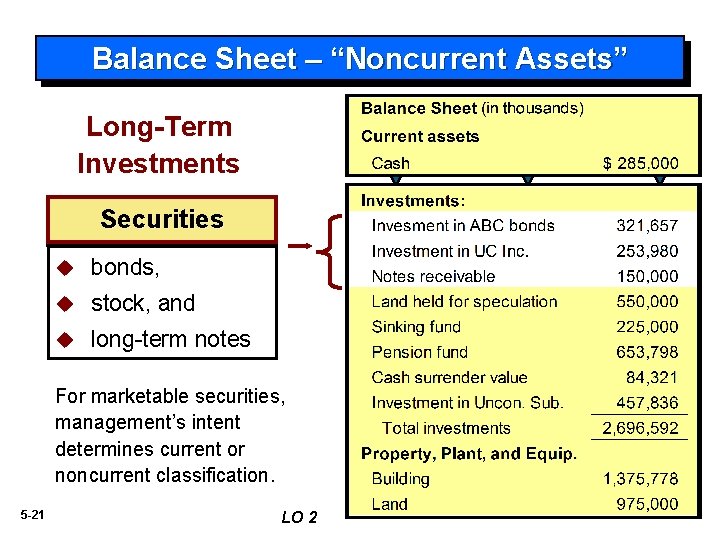
Balance Sheet – “Noncurrent Assets” Long-Term Investments Securities u bonds, u stock, and u long-term notes For marketable securities, management’s intent determines current or noncurrent classification. 5 -21 LO 2
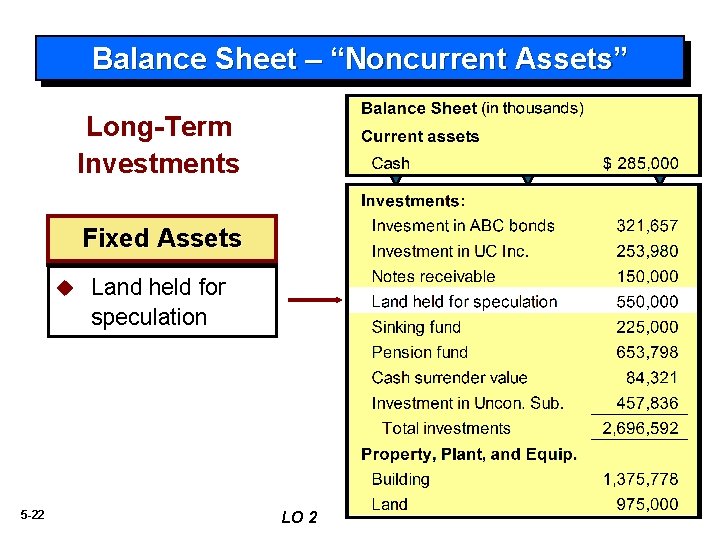
Balance Sheet – “Noncurrent Assets” Long-Term Investments Fixed Assets u 5 -22 Land held for speculation LO 2
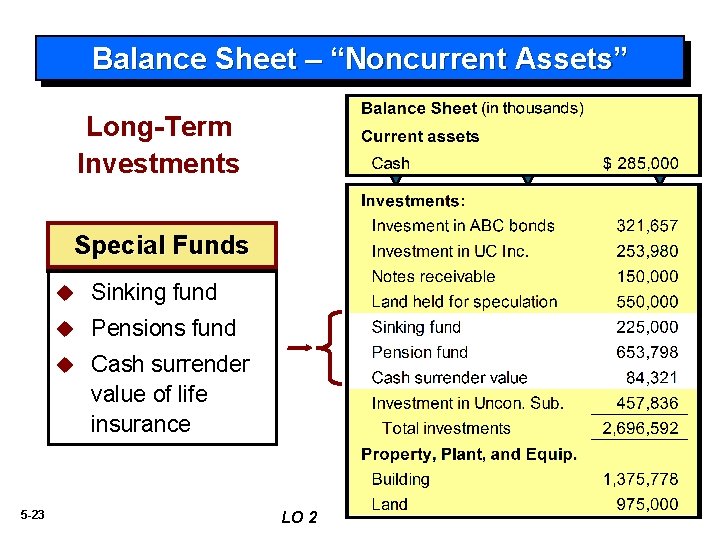
Balance Sheet – “Noncurrent Assets” Long-Term Investments Special Funds 5 -23 u Sinking fund u Pensions fund u Cash surrender value of life insurance LO 2
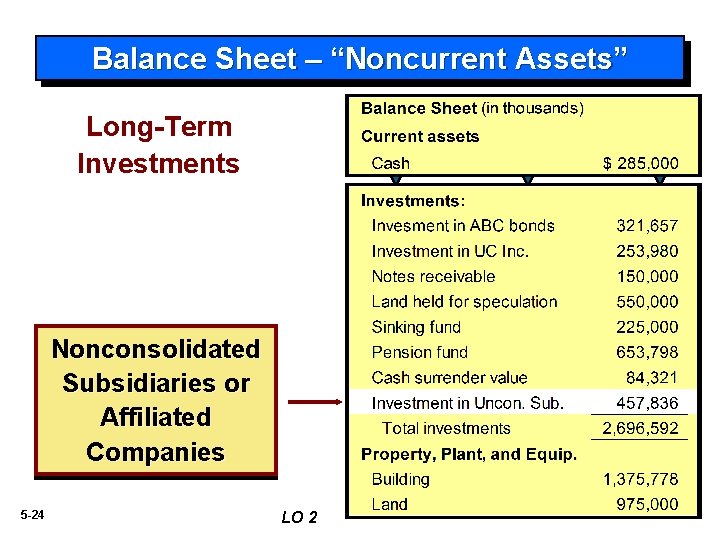
Balance Sheet – “Noncurrent Assets” Long-Term Investments Nonconsolidated Subsidiaries or Affiliated Companies 5 -24 LO 2
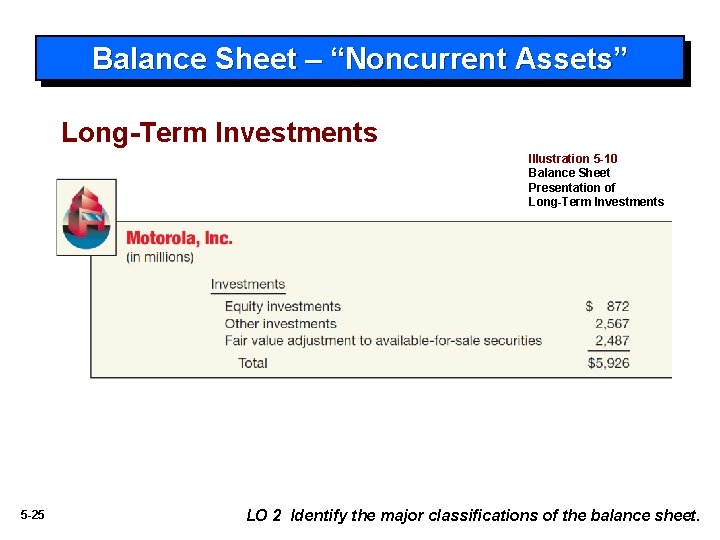
Balance Sheet – “Noncurrent Assets” Long-Term Investments Illustration 5 -10 Balance Sheet Presentation of Long-Term Investments 5 -25 LO 2 Identify the major classifications of the balance sheet.
Balance Sheet – “Noncurrent Assets” Property, Plant, and Equipment Tangible long-lived assets used in the regular operations of the business. u Physical property such as land, buildings, machinery, furniture, tools, and wasting resources (minerals). u With the exception of land, a company either depreciates (e. g. , buildings) or depletes (e. g. , oil reserves) these assets. 5 -26 LO 2 Identify the major classifications of the balance sheet.
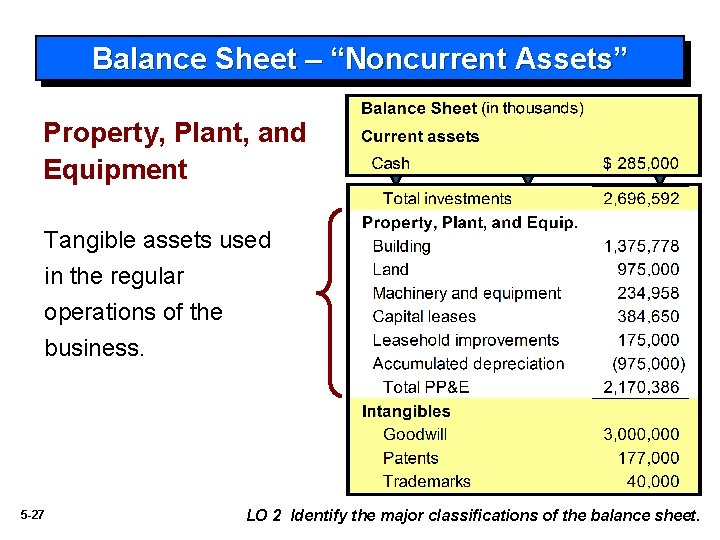
Balance Sheet – “Noncurrent Assets” Property, Plant, and Equipment Tangible assets used in the regular operations of the business. 5 -27 LO 2 Identify the major classifications of the balance sheet.
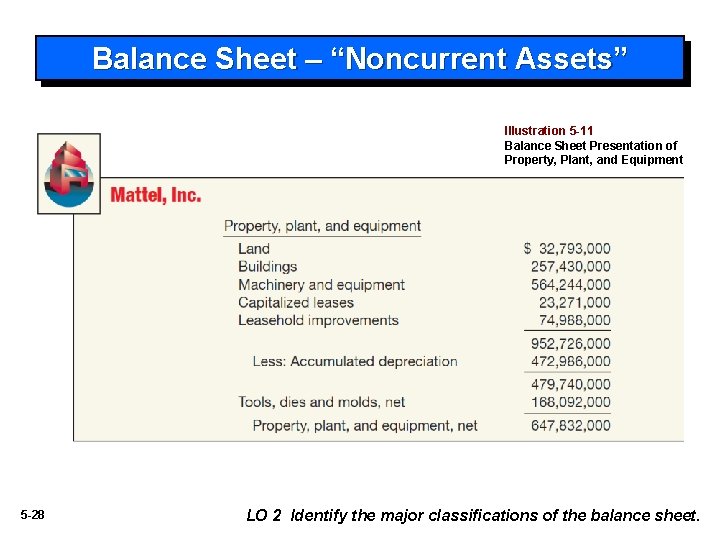
Balance Sheet – “Noncurrent Assets” Illustration 5 -11 Balance Sheet Presentation of Property, Plant, and Equipment 5 -28 LO 2 Identify the major classifications of the balance sheet.
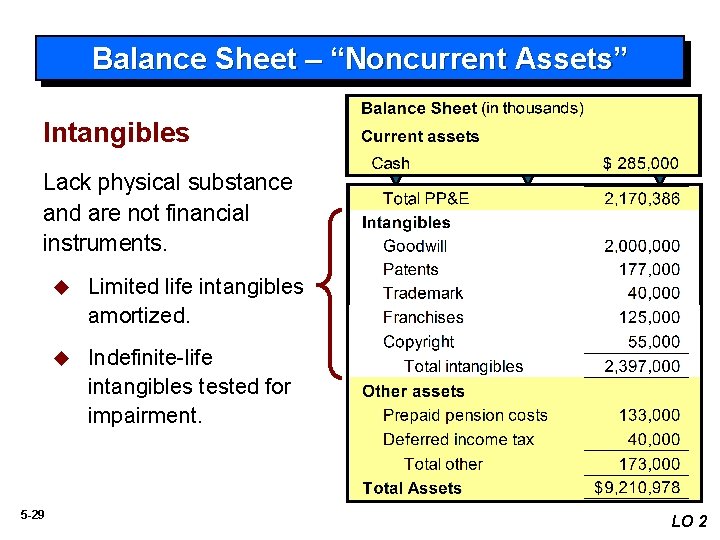
Balance Sheet – “Noncurrent Assets” Intangibles Lack physical substance and are not financial instruments. 5 -29 u Limited life intangibles amortized. u Indefinite-life intangibles tested for impairment. LO 2
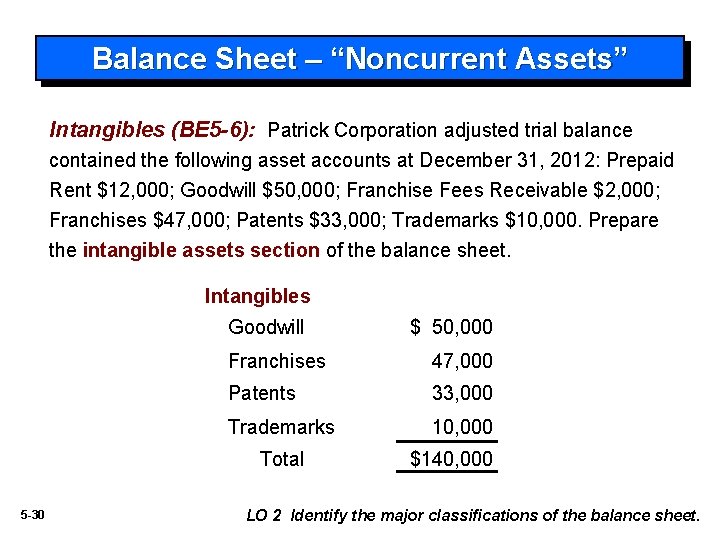
Balance Sheet – “Noncurrent Assets” Intangibles (BE 5 -6): Patrick Corporation adjusted trial balance contained the following asset accounts at December 31, 2012: Prepaid Rent $12, 000; Goodwill $50, 000; Franchise Fees Receivable $2, 000; Franchises $47, 000; Patents $33, 000; Trademarks $10, 000. Prepare the intangible assets section of the balance sheet. Intangibles Goodwill Franchises 47, 000 Patents 33, 000 Trademarks 10, 000 Total 5 -30 $ 50, 000 $140, 000 LO 2 Identify the major classifications of the balance sheet.
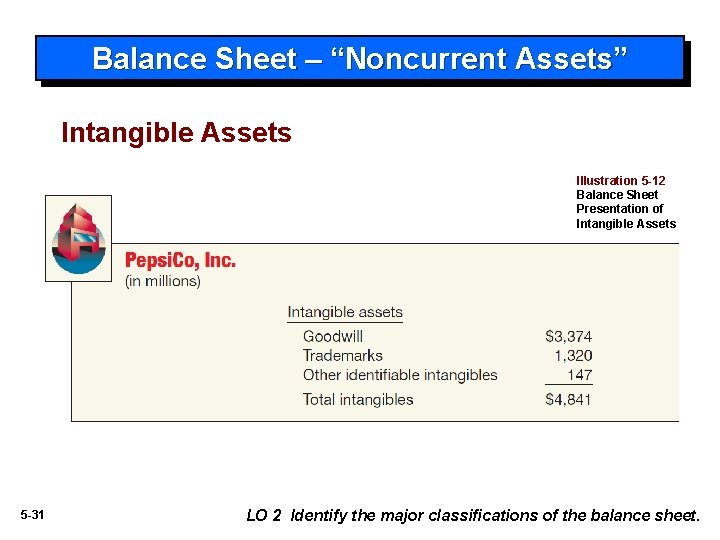
Balance Sheet – “Noncurrent Assets” Intangible Assets Illustration 5 -12 Balance Sheet Presentation of Intangible Assets 5 -31 LO 2 Identify the major classifications of the balance sheet.
Balance Sheet – “Noncurrent Assets” Other Assets Items vary in practice. Can include: 5 -32 u Long-term prepaid expenses u Non-current receivables u Assets in special funds u Property held for sale u Restricted cash or securities LO 2 Identify the major classifications of the balance sheet.
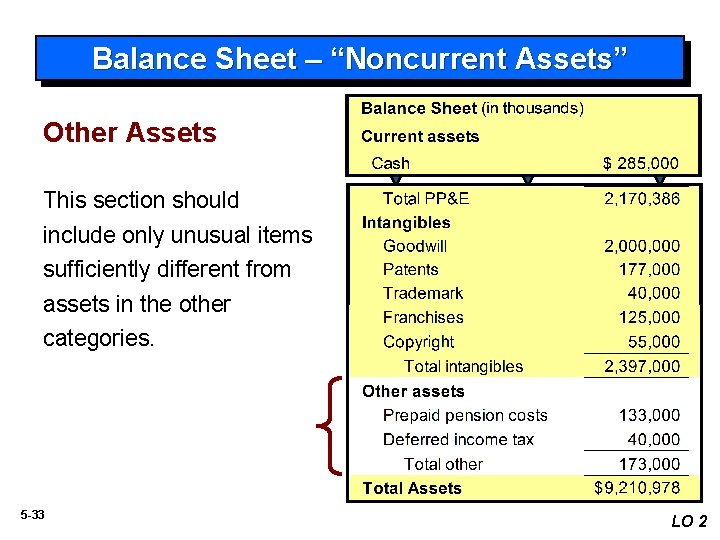
Balance Sheet – “Noncurrent Assets” Other Assets This section should include only unusual items sufficiently different from assets in the other categories. 5 -33 LO 2
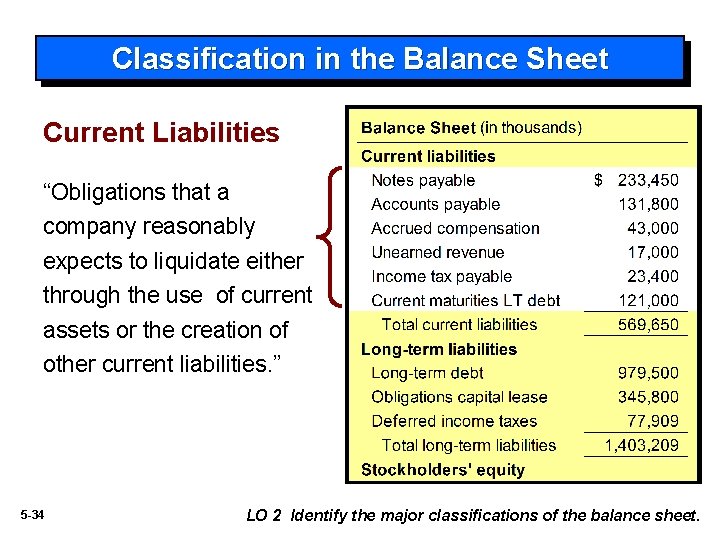
Classification in the Balance Sheet Current Liabilities “Obligations that a company reasonably expects to liquidate either through the use of current assets or the creation of other current liabilities. ” 5 -34 LO 2 Identify the major classifications of the balance sheet.
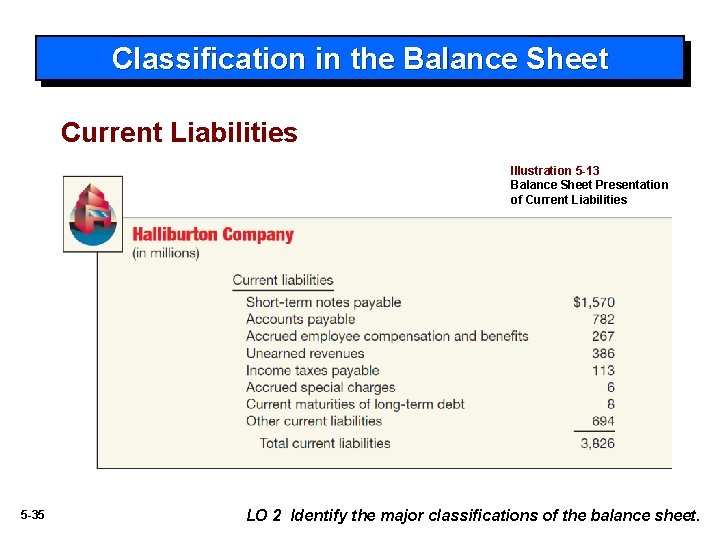
Classification in the Balance Sheet Current Liabilities Illustration 5 -13 Balance Sheet Presentation of Current Liabilities 5 -35 LO 2 Identify the major classifications of the balance sheet.
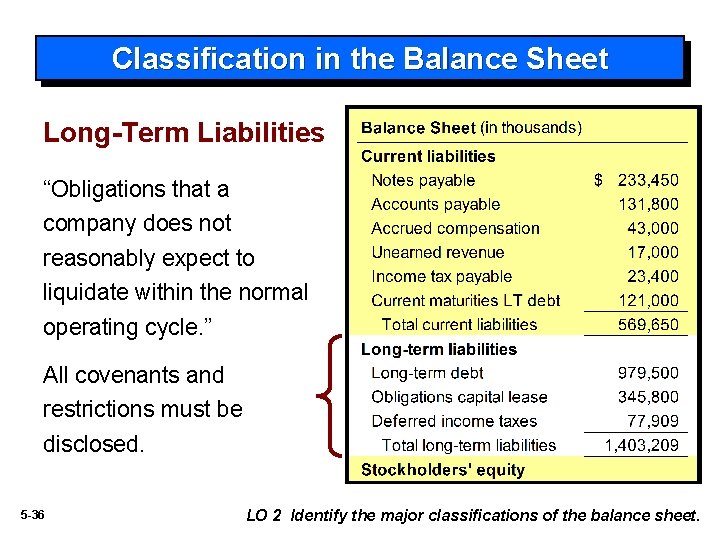
Classification in the Balance Sheet Long-Term Liabilities “Obligations that a company does not reasonably expect to liquidate within the normal operating cycle. ” All covenants and restrictions must be disclosed. 5 -36 LO 2 Identify the major classifications of the balance sheet.
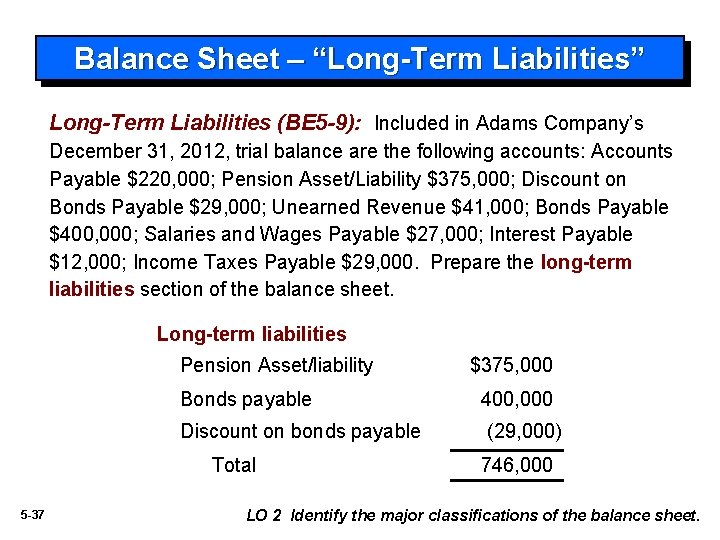
Balance Sheet – “Long-Term Liabilities” Long-Term Liabilities (BE 5 -9): Included in Adams Company’s December 31, 2012, trial balance are the following accounts: Accounts Payable $220, 000; Pension Asset/Liability $375, 000; Discount on Bonds Payable $29, 000; Unearned Revenue $41, 000; Bonds Payable $400, 000; Salaries and Wages Payable $27, 000; Interest Payable $12, 000; Income Taxes Payable $29, 000. Prepare the long-term liabilities section of the balance sheet. Long-term liabilities Pension Asset/liability Bonds payable Discount on bonds payable Total 5 -37 $375, 000 400, 000 (29, 000) 746, 000 LO 2 Identify the major classifications of the balance sheet.
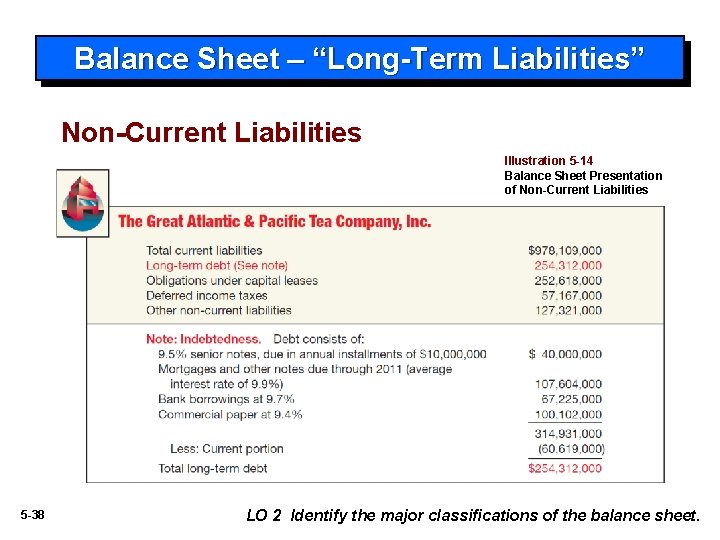
Balance Sheet – “Long-Term Liabilities” Non-Current Liabilities Illustration 5 -14 Balance Sheet Presentation of Non-Current Liabilities 5 -38 LO 2 Identify the major classifications of the balance sheet.
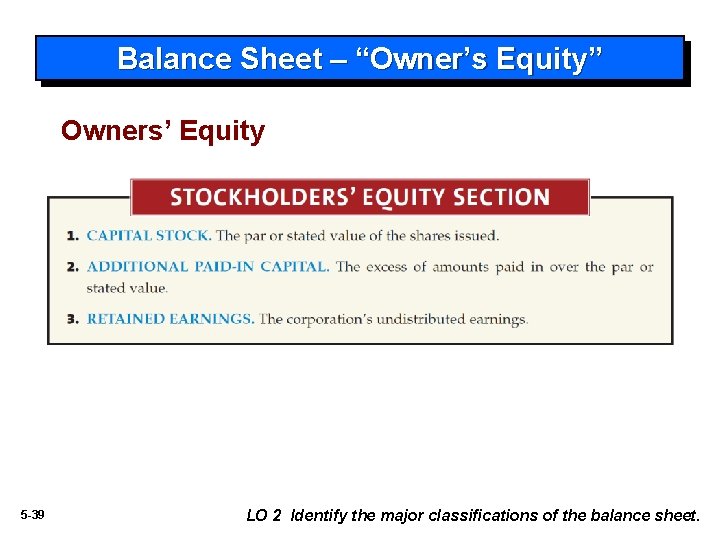
Balance Sheet – “Owner’s Equity” Owners’ Equity 5 -39 LO 2 Identify the major classifications of the balance sheet.
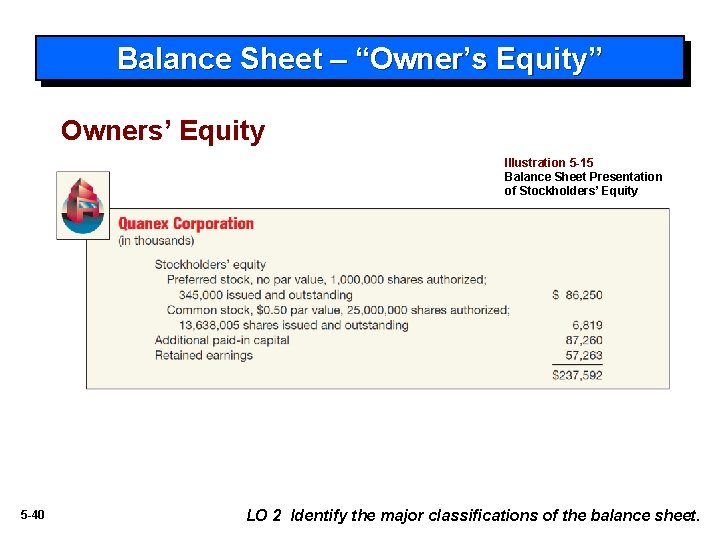
Balance Sheet – “Owner’s Equity” Owners’ Equity Illustration 5 -15 Balance Sheet Presentation of Stockholders’ Equity 5 -40 LO 2 Identify the major classifications of the balance sheet.
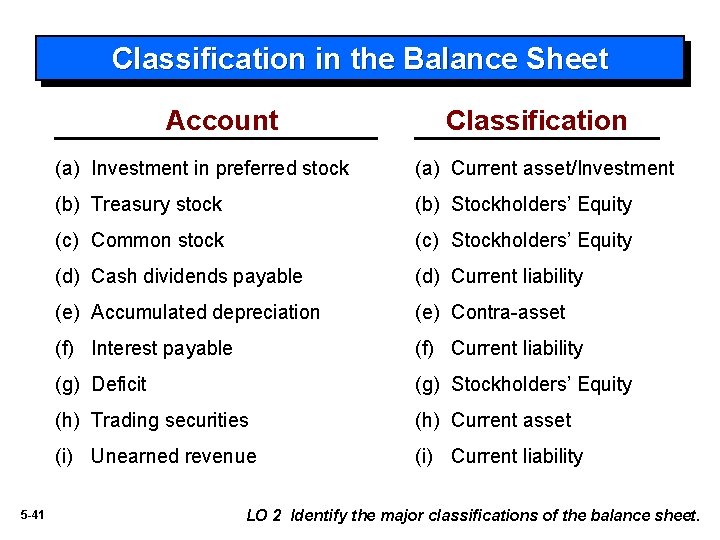
Classification in the Balance Sheet Account 5 -41 Classification (a) Investment in preferred stock (a) Current asset/Investment (b) Treasury stock (b) Stockholders’ Equity (c) Common stock (c) Stockholders’ Equity (d) Cash dividends payable (d) Current liability (e) Accumulated depreciation (e) Contra-asset (f) Interest payable (f) Current liability (g) Deficit (g) Stockholders’ Equity (h) Trading securities (h) Current asset (i) Unearned revenue (i) Current liability LO 2 Identify the major classifications of the balance sheet.
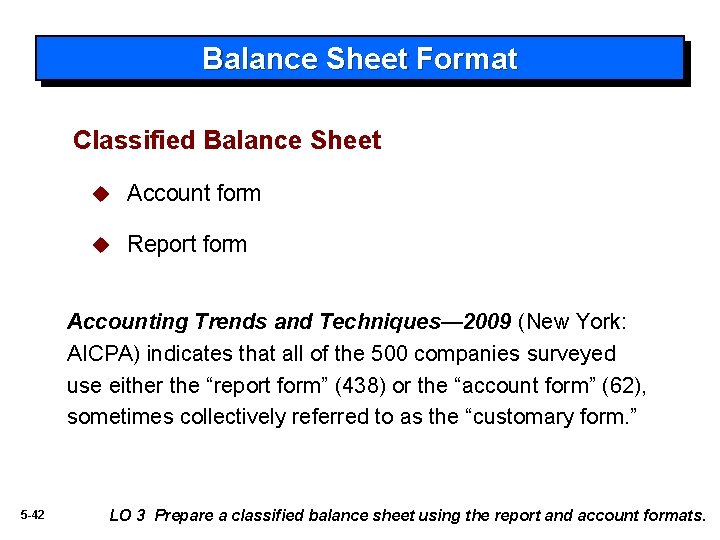
Balance Sheet Format Classified Balance Sheet u Account form u Report form Accounting Trends and Techniques— 2009 (New York: AICPA) indicates that all of the 500 companies surveyed use either the “report form” (438) or the “account form” (62), sometimes collectively referred to as the “customary form. ” 5 -42 LO 3 Prepare a classified balance sheet using the report and account formats.
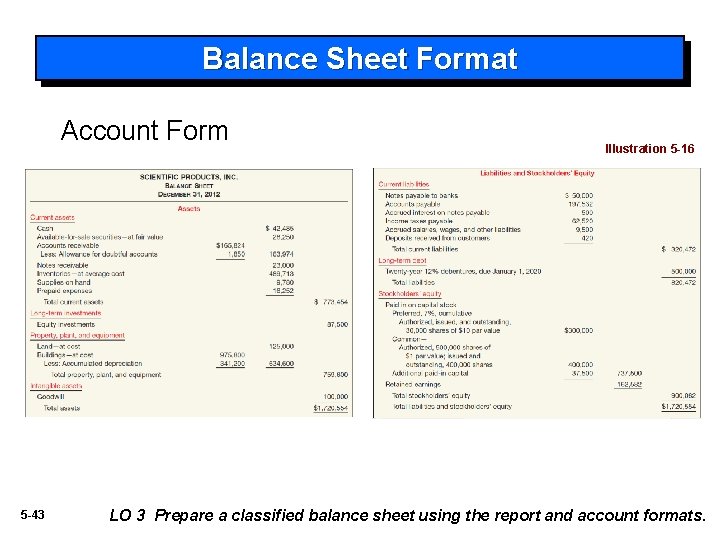
Balance Sheet Format Account Form 5 -43 Illustration 5 -16 LO 3 Prepare a classified balance sheet using the report and account formats.
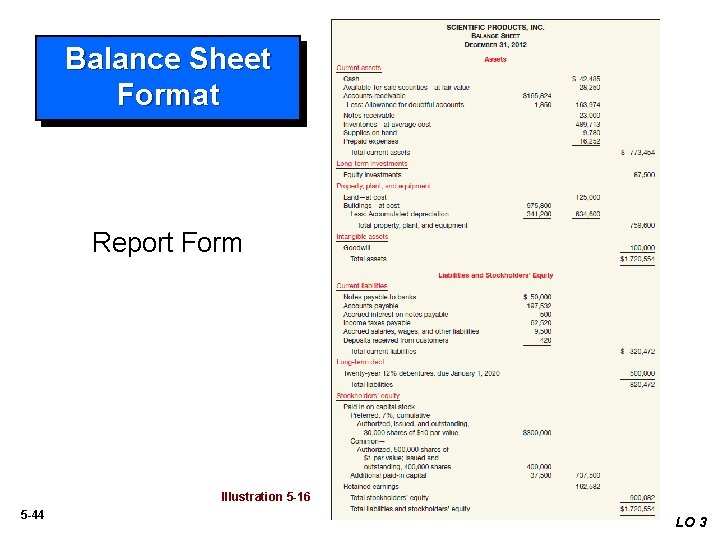
Balance Sheet Format Report Form Illustration 5 -16 5 -44 LO 3
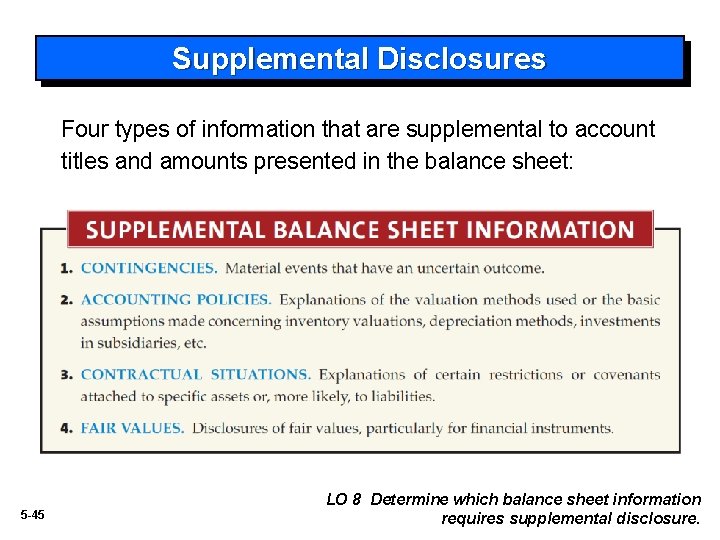
Supplemental Disclosures Four types of information that are supplemental to account titles and amounts presented in the balance sheet: 5 -45 LO 8 Determine which balance sheet information requires supplemental disclosure.
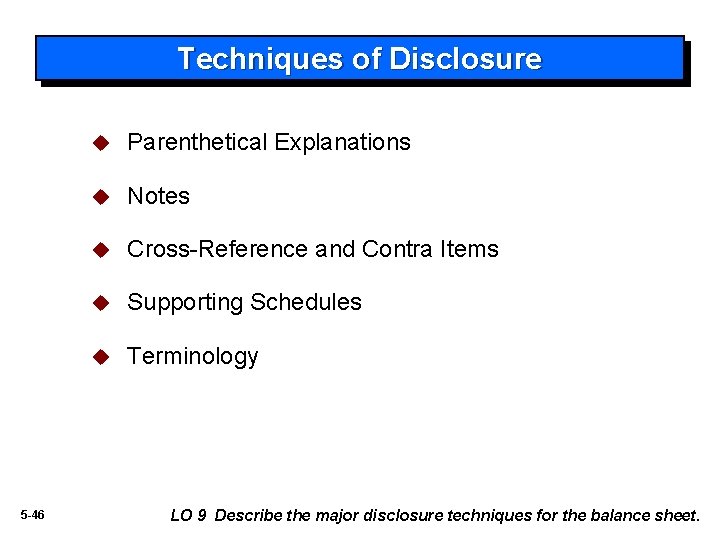
Techniques of Disclosure 5 -46 u Parenthetical Explanations u Notes u Cross-Reference and Contra Items u Supporting Schedules u Terminology LO 9 Describe the major disclosure techniques for the balance sheet.
RELEVANT FACTS 5 -47 u IFRS recommends but does not require the use of the title “statement of financial position” rather than balance sheet. u IFRS requires a classified statement of financial position except in very limited situations. IFRS follows the same guidelines as this textbook for distinguishing between current and noncurrent assets and liabilities. However under GAAP, public companies must follow SEC regulations, which require specific line items. In addition, specific GAAP standards mandate certain forms of reporting this information. u Under IFRS, current assets are usually listed in the reverse order of liquidity. For example, under GAAP cash is listed first, but under IFRS it is listed last.
RELEVANT FACTS 5 -48 u IFRS has many differences in terminology that you will notice in this textbook. u Both IFRS and GAAP require disclosures about (1) accounting policies followed, (2) judgments that management has made in the process of applying the entity’s accounting policies, and (3) the key assumptions and estimation uncertainty that could result in a material adjustment to the carrying amounts of assets and liabilities within the next financial year. Comparative prior period information must be presented and financial statements must be prepared annually. u Use of the term “reserve” is discouraged in GAAP, but there is no such prohibition in IFRS.
IFRS SELF-TEST QUESTION Current assets under IFRS are listed generally: a. by importance. b. in the reverse order of their expected conversion to cash. c. by longevity. d. alphabetically. 5 -49
IFRS SELF-TEST QUESTION Companies that use IFRS: a. may report all their assets on the statement of financial position at fair value. b. are not allowed to net assets (assets 2 liabilities) on their statement of financial positions. c. may report noncurrent assets before current assets on the statement of financial position. d. do not have any guidelines as to what should be reported on the statement of financial position. 5 -50
IFRS SELF-TEST QUESTION A company has purchased a tract of land expects to build a production plant on the land in approximately 5 years. During the 5 years before construction, the land will be idle. Under IFRS, the land should be reported as: a. land expense. b. property, plant, and equipment. c. an intangible asset. d. a long-term investment. 5 -51
- Slides: 51