
5 b Positive Externalities Public Goods and Tragedy
5 b – Positive Externalities, Public Goods, and Tragedy of the Commons This web quiz may appear as two pages on tablets and laptops. I recommend that you view it as one page by clicking on the open book icon at the bottom of the page.
5 b – Market Failures - continued Positive Externalities, Public Goods, and Tragedy of the Commons Market Failures (continued) • Positive Externalities • Public Goods • Tragedy of the Commons
Markets fail to Achieve Alloc. Efficiency when: • They lack competition (lessons 10 b, 11 a, 11 b) • There are effective price ceilings and price floors • Negative Externalities exist (5 a) • Positive Externalities exist (5 b) • There are Public Goods (5 b) • There is a Tragedy of the Commons (5 b) 5 b – Market Failures - continued Positive Externalities, Public Goods, and Tragedy of the Commons
Markets fail to achieve alloc. efficiency when: • They lack competition (10 b, 11 a, 11 b ) • There are effective price ceilings and price floors (5 a) • Negative Externalities exist (5 a) • Positive Externalities exist (5 b) • There are Public Goods (5 b) • There is a Tragedy of the Commons (5 b) 5 b – Market Failures - continued Positive Externalities, Public Goods, and Tragedy of the Commons
For each Market Failure: • Define • Give examples • How they affect Allocative Efficiency - too much produced? (MSB<MSC) - too little produced? (MSB>MSC) • What can the government do? 5 b – Market Failures - continued Positive Externalities, Public Goods, and Tragedy of the Commons
5 b – Outcomes / Must Know (1) Market Failure: Positive Externalities • define positive externalities (external benefits or spillover benefits) • give examples of positive externalities • use the MSB=MSC model to show the effects on allocative efficiency of positive externalities • what can the government do to correct the market failure caused by positive externalities and show the effects of these policies on the MSB=MSC model • Demand is usually equal to MSB, but when there are positive externalities the demand curve is to the left of the MSB curve. Why? • Are positive externalities (spillover benefits) good or bad for society? Why or why not? • Comment on: Econ. Movies 7: Anchorman (Efficiency and Market Failures) (5: 21) [ http: //www. youtube. com/watch? v=FBj. FDt. H-i. ZM ]
5 b Outcomes / Must Know (2) Market Failure: Public Goods • define "public goods (public goods are non-exclusive and non-rival)" • give examples of public goods and explain why they are public goods • define private (exclusive) goods" and give examples • define "rival goods" and give examples • what is the "free rider problem"? • explain how to derive the demand curve for public goods • what effect do public goods have on allocative efficiency? • what can the government do to correct for the market failure of public goods? • Why are public schools, public parks, and public libraries NOT "public goods"? If they are not public goods then why does the government produce them?
5 b Outcomes / Must Know (3) Market Failure: Tragedy of the Commons • what is the Tragedy of the Commons (common access resources are non-exclusive, but rival) • how does the tragedy of the commons affect allocative efficiency? • what can be done to better achieve allocative efficiency when there is a tragedy of the commons? 5 b – Market Failures - continued Positive Externalities, Public Goods, and Tragedy of the Commons
KEY TERMS: positive externalities (external benefits /spillover benefits), private goods, public goods, rivalry (rival goods, nonrival goods) excludability (exclusion principle, nonexcludability, exclusive goods, nonexclusive goods), free-rider problem, marginal-cost-marginal-benefit rule (MB=MC), tragedy of the commons, common access resources 5 b – Market Failures - continued Positive Externalities, Public Goods, and Tragedy of the Commons
1. A positive externality (external benefit or spillover benefit) occurs when: (YP 80) 1. Product differentiation increases the variety of products available 2. The benefits associated with a product exceed those that the buyers receive 3. A firm does not pay all of the costs of producing a good 4. Firms earn positive economic profits
1. A positive externality (external benefit or spillover benefit) occurs when: (YP 80) 1. Product differentiation increases the variety of products available 2. The benefits associated with a product exceed those that the buyers receive 3. A firm does not pay all of the costs of producing a good 4. Firms earn positive economic profits
2. Which is the BEST example of an activity with a positive externality? YP 80 1. 2. 3. 4. Smoking in a restaurant Eating a hamburger Planting a flower garden along a street Selling a candy bar
2. Which is the BEST example of an activity with a positive externality? YP 80 1. 2. 3. 4. Smoking in a restaurant Eating a hamburger Planting a flower garden along a street Selling a candy bar
Examples of Products with Positive Externalities • • • Education Vaccinations Parks Libraries Ski Areas
3. When positive externalities are in a market for a good, the market: (YP 80) 1. Succeeds, because it is producing the socially optimal (alloc. eff. ) output 2. Fails, because it overproduces the good 3. Succeeds, because it overproduces the good 4. Fails, because it underproduces the good
3. When positive externalities are in a market for a good, the market: (YP 80) 1. Succeeds, because it is producing the socially optimal (alloc. eff. ) output 2. Fails, because it overproduces the good 3. Succeeds, because it overproduces the good 4. Fails, because it underproduces the good
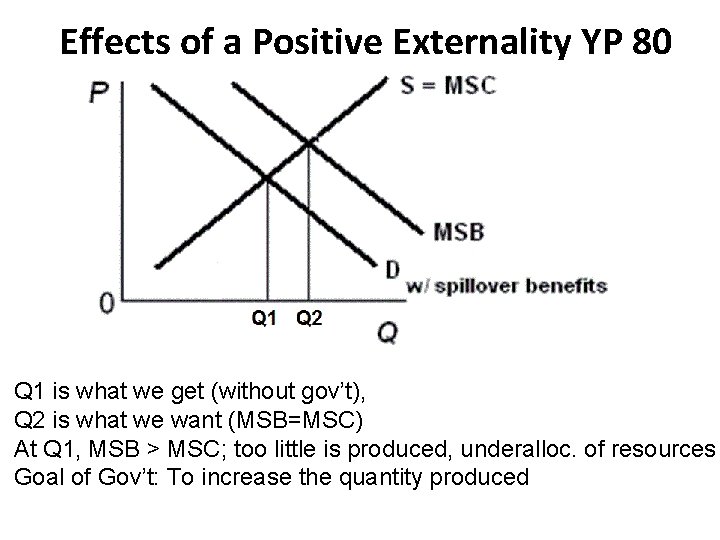
Effects of a Positive Externality YP 80 Q 1 is what we get (without gov’t), Q 2 is what we want (MSB=MSC) At Q 1, MSB > MSC; too little is produced, underalloc. of resources Goal of Gov’t: To increase the quantity produced
4. Which of the following would be done to correct for (internalize) a positive externality? YP 80 1. 2. 3. 4. Government regulations on production Excise tax Privatization Subsidy
4. Which of the following would be done to correct for (internalize) a positive externality? YP 80 1. 2. 3. 4. Government regulations on production Excise tax Privatization Subsidy
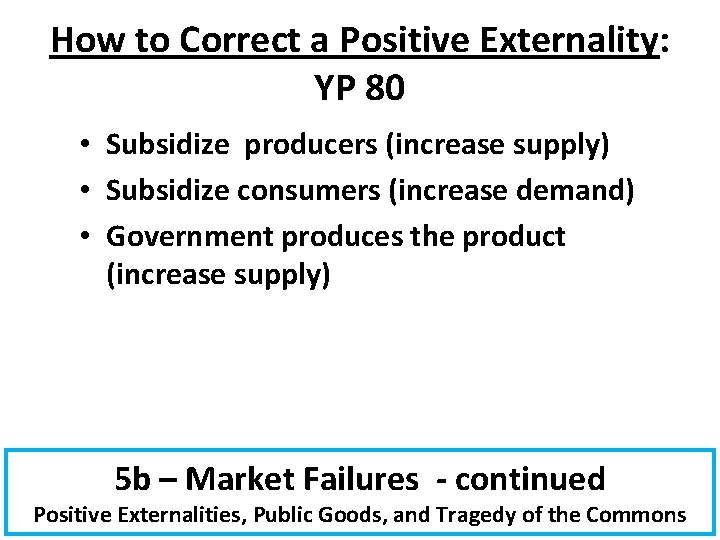
How to Correct a Positive Externality: YP 80 • Subsidize producers (increase supply) • Subsidize consumers (increase demand) • Government produces the product (increase supply) 5 b – Market Failures - continued Positive Externalities, Public Goods, and Tragedy of the Commons
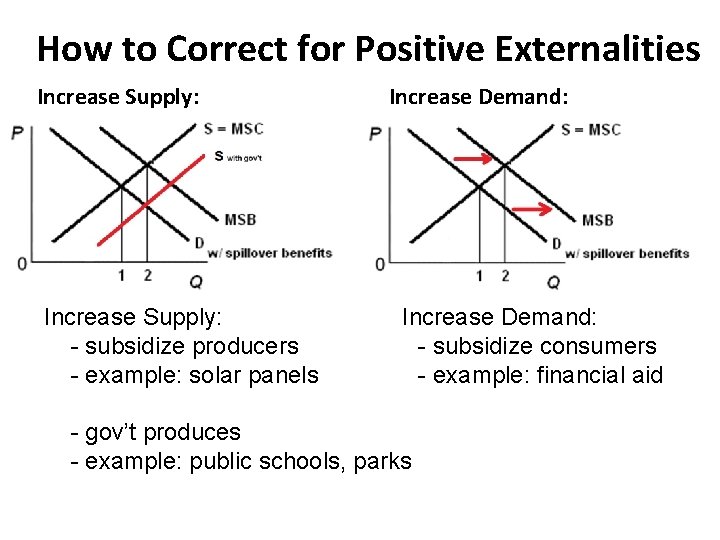
How to Correct for Positive Externalities Increase Supply: - subsidize producers - example: solar panels Increase Demand: - subsidize consumers - example: financial aid - gov’t produces - example: public schools, parks
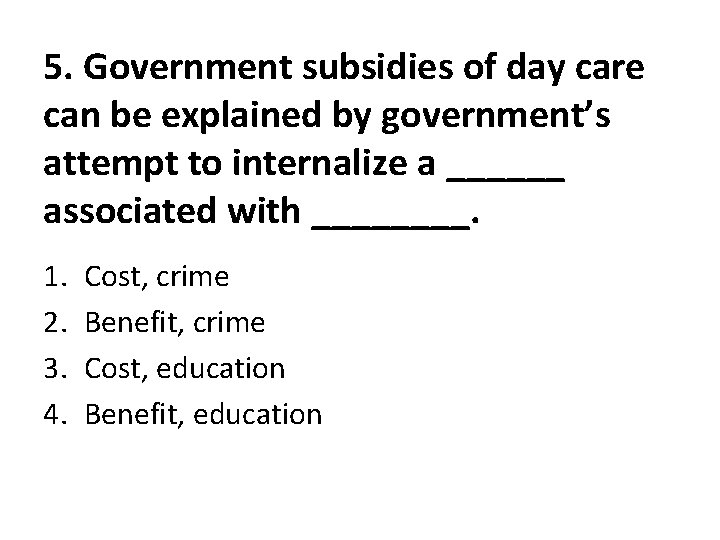
5. Government subsidies of day care can be explained by government’s attempt to internalize a ______ associated with ____. 1. 2. 3. 4. Cost, crime Benefit, crime Cost, education Benefit, education
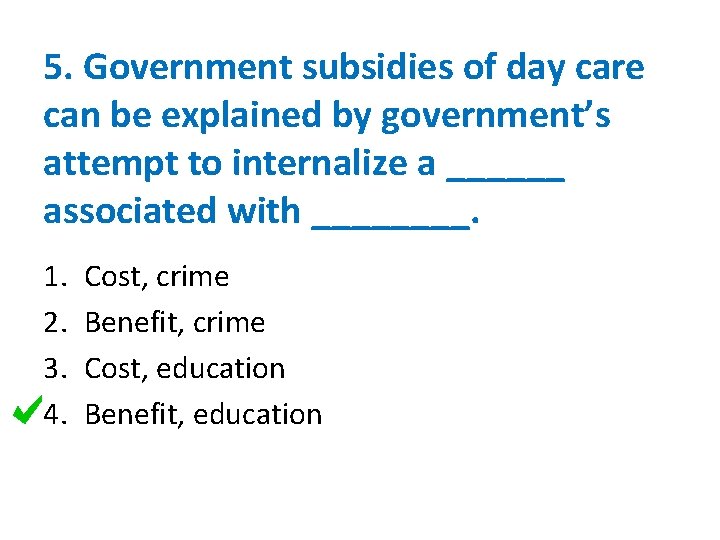
5. Government subsidies of day care can be explained by government’s attempt to internalize a ______ associated with ____. 1. 2. 3. 4. Cost, crime Benefit, crime Cost, education Benefit, education
6. A public good: 1. 2. 3. 4. YP 81 Is a rival, exclusive good Is a non-rival, non-exclusive good Does not have the free rider problem
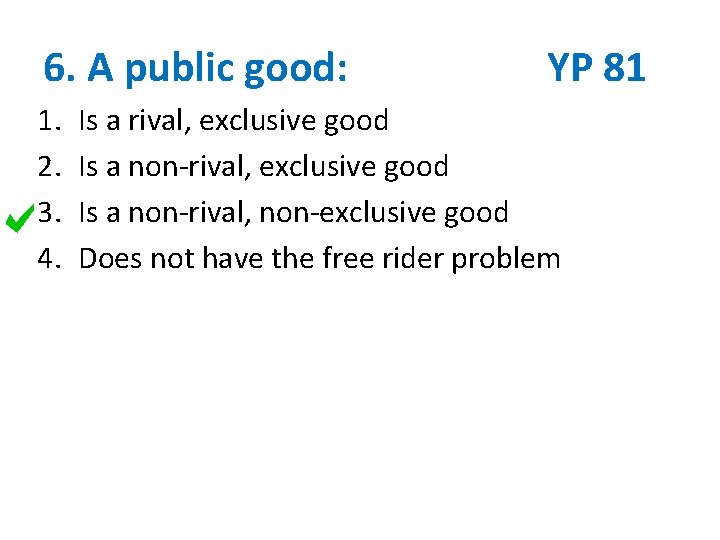
6. A public good: 1. 2. 3. 4. YP 81 Is a rival, exclusive good Is a non-rival, non-exclusive good Does not have the free rider problem
7. Which of the following is the best example of a public good? YP 81 1. 2. 3. 4. A hamburger A music download A public park Light from a streetlight
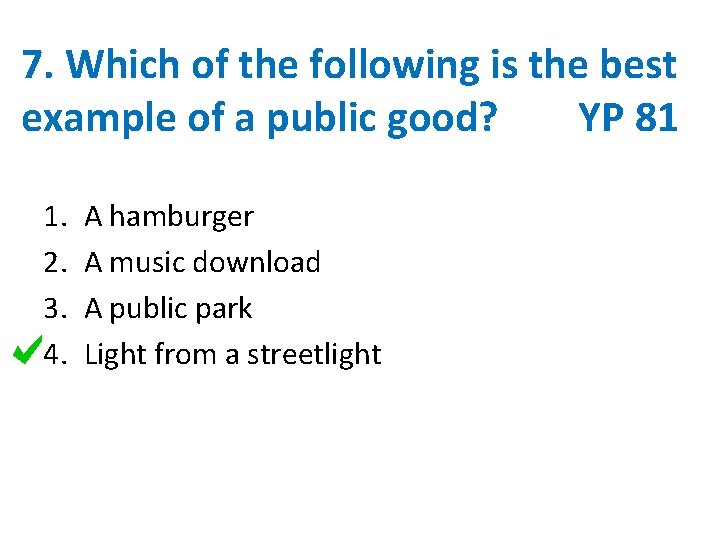
7. Which of the following is the best example of a public good? YP 81 1. 2. 3. 4. A hamburger A music download A public park Light from a streetlight
Examples of Public Goods YP 81 • • • streetlights national defense lighthouse fireworks flood control 5 b – Market Failures - continued Positive Externalities, Public Goods, and Tragedy of the Commons
8. If the consumption of a good by one person reduces the amount of the good that can be consumed by others, the good is: 1. 2. 3. 4. Exclusive Non-exclusive Rival Non-rival
8. If the consumption of a good by one person reduces the amount of the good that can be consumed by others, the good is: 1. 2. 3. 4. Exclusive Non-exclusive Rival Non-rival
9. The market failure associated with public goods is that: YP 81 1. Too many will be produced without the government 2. None will be produced without the government 3. The government cannot produce them 4. Private businesses make very high profits producing them
9. The market failure associated with public goods is that: YP 81 1. Too many will be produced without the government 2. None will be produced without the government 3. The government cannot produce them 4. Private businesses make very high profits producing them
10. The role of government concerning public goods is to: YP 81 1. 2. 3. 4. Tax the product Regulate the product Produce the product Apply the Coase theorem
10. The role of government concerning public goods is to: YP 81 1. 2. 3. 4. Tax the product Regulate the product Produce the product Apply the Coase theorem
11. Are the following Public Goods? - public parks - public schools - public libraries 1. yes 2. no
11. Are the following Public Goods? - public parks - public schools - public libraries 1. yes 2. no
Public parks, public libraries, and public schools are NOT non-rival, and they are NOT non-exclusive, so they are NOT public goods. Why does the gov’t have them? 5 b – Market Failures - continued Positive Externalities, Public Goods, and Tragedy of the Commons
Markets fail to Achieve Alloc. Efficiency when: • They lack competition (lessons 10 b, 11 a, 11 b) • There are effective price ceilings and price floors • Negative Externalities exist (5 a) • Positive Externalities exist (5 b) • There are Public Goods (5 b) • There is a Tragedy of the Commons (5 b) 5 b – Market Failures - continued Positive Externalities, Public Goods, and Tragedy of the Commons
12. Which of the following is associated with the Tragedy of the commons? YP 82 1. 2. 3. 4. Nonrival Spillover Benefits Common Access Resources Private goods
12. Which of the following is associated with the Tragedy of the commons? YP 82 1. 2. 3. 4. Nonrival Spillover Benefits Common Access Resources Private goods
Tragedy of the Commons - YP 82 Common Access Resources • natural resources over which there is no private ownership established and no system for managing the allocation of these resources Tragedy of the Commons • individuals will have an incentive to consume as many common access resources as possible so that the competition does not use them first • private individuals will exploit common access resources unsustainably out of self-interest, ultimately leading to the depletion of the resource
13. Which of the following is NOT an example of the Tragedy of the Commons? YP 82 1. 2. 3. 4. 5. Fishing the oceans Common pastures Atmosphere Forests Public Schools
13. Which of the following is NOT an example of the Tragedy of the Commons? YP 82 1. 2. 3. 4. 5. Fishing the oceans Common pastures Atmosphere Forests Public Schools
14. Which of the following is NOT a role for government concerning the Tragedy of the Commons? YP 82 1. Assign property rights 2. Produce the product itself 3. Manage the property
14. Which of the following is NOT a role for government concerning the Tragedy of the Commons? YP 82 1. Assign property rights 2. Produce the product itself 3. Manage the property
- Slides: 45