
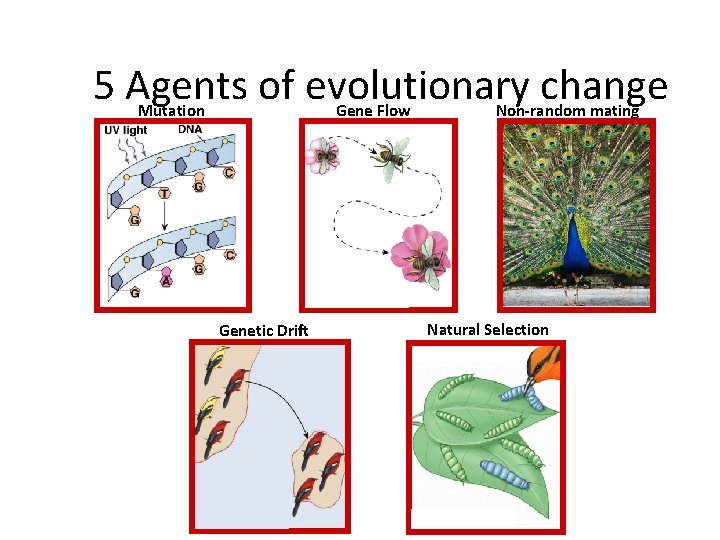
5 Agents of evolutionary change Mutation Gene Flow
- Slides: 36
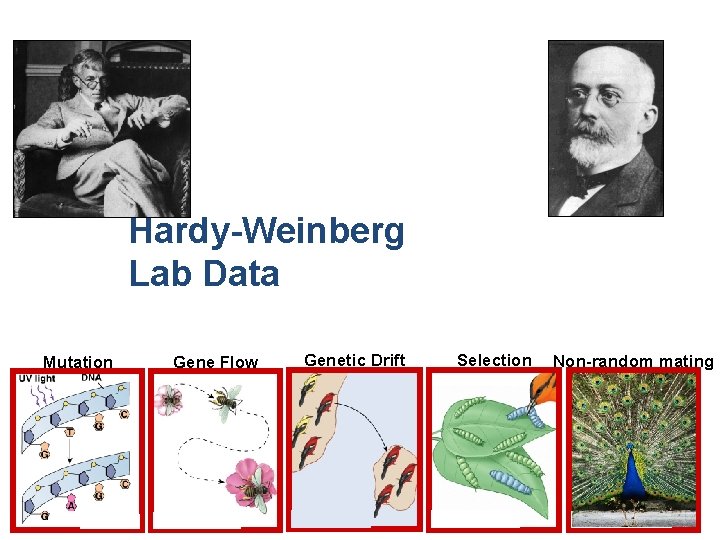
5 Agents of evolutionary change Mutation Gene Flow Genetic Drift Non-random mating Natural Selection
Stnd: 7 e C-Notes: Hardy-Weinberg Equilibrium Objective: 3/19/2014 SWBAT interpret the Hardy. Weinberg equation in order to predict allele trends in populations.
What is the Hardy. Weinberg Equilibrium Model? • The Hardy-Weinberg law examines changes in gene pools and explains how evolution can select for certain genes – If a population is in Hardy-Weinberg equilibrium and its members continue to mate randomly generation after generation, allele and genotype frequencies would remain inherently stable (constant), if certain assumptions are met (5 Conditions).
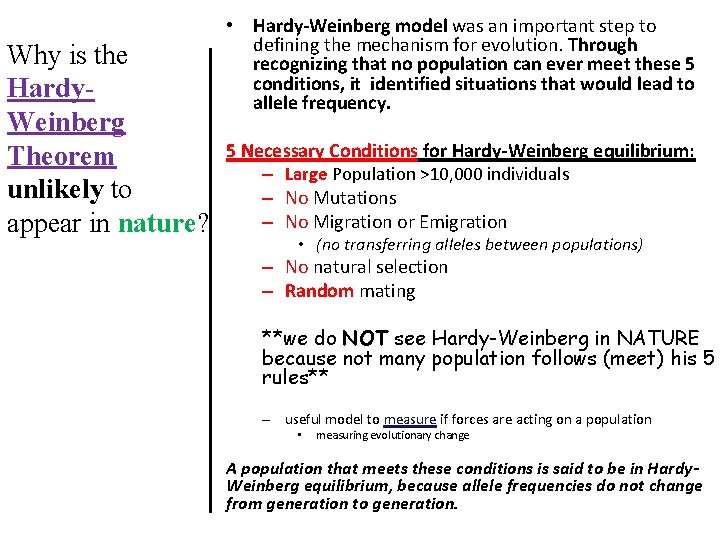
Why is the Hardy. Weinberg Theorem unlikely to appear in nature? • Hardy-Weinberg model was an important step to defining the mechanism for evolution. Through recognizing that no population can ever meet these 5 conditions, it identified situations that would lead to allele frequency. 5 Necessary Conditions for Hardy-Weinberg equilibrium: – Large Population >10, 000 individuals – No Mutations – No Migration or Emigration • (no transferring alleles between populations) – No natural selection – Random mating **we do NOT see Hardy-Weinberg in NATURE because not many population follows (meet) his 5 rules** – useful model to measure if forces are acting on a population • measuring evolutionary change A population that meets these conditions is said to be in Hardy. Weinberg equilibrium, because allele frequencies do not change from generation to generation.
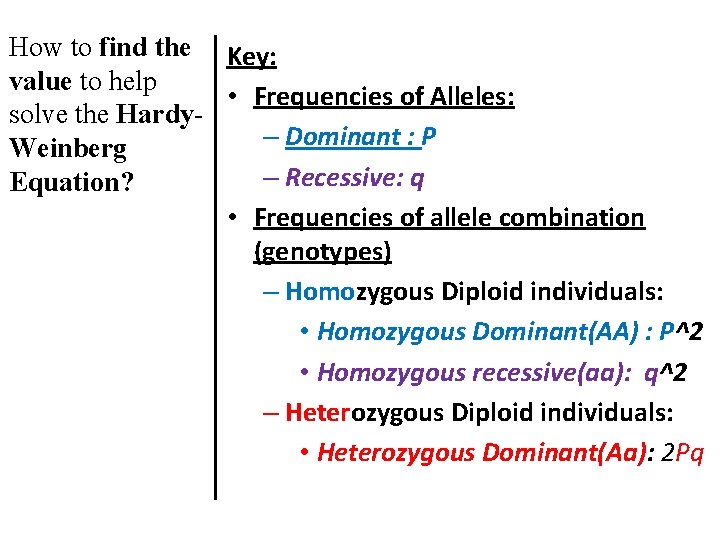
How to find the Key: value to help • Frequencies of Alleles: solve the Hardy– Dominant : P Weinberg – Recessive: q Equation? • Frequencies of allele combination (genotypes) – Homozygous Diploid individuals: • Homozygous Dominant(AA) : P^2 • Homozygous recessive(aa): q^2 – Heterozygous Diploid individuals: • Heterozygous Dominant(Aa): 2 Pq
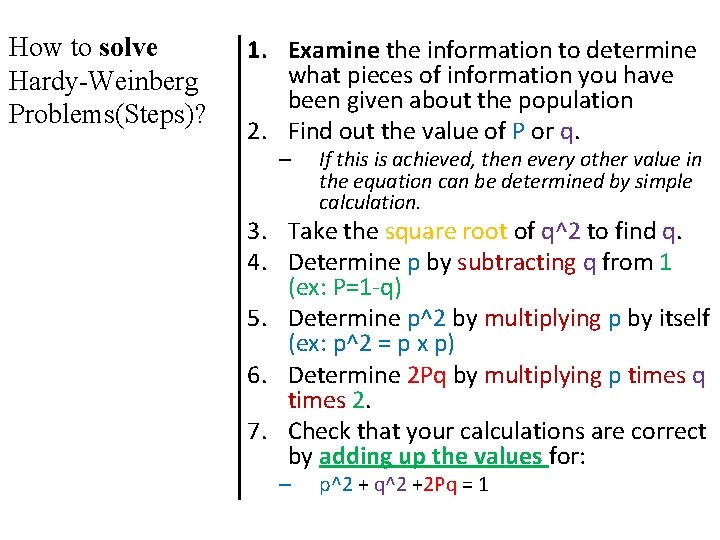
How to solve Hardy-Weinberg Problems(Steps)? 1. Examine the information to determine what pieces of information you have been given about the population 2. Find out the value of P or q. – If this is achieved, then every other value in the equation can be determined by simple calculation. 3. Take the square root of q^2 to find q. 4. Determine p by subtracting q from 1 (ex: P=1 -q) 5. Determine p^2 by multiplying p by itself (ex: p^2 = p x p) 6. Determine 2 Pq by multiplying p times q times 2. 7. Check that your calculations are correct by adding up the values for: – p^2 + q^2 +2 Pq = 1
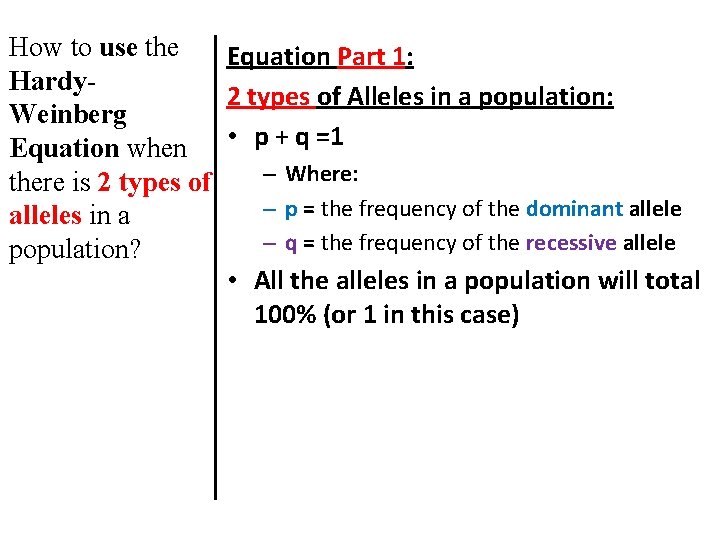
How to use the Equation Part 1: Hardy 2 types of Alleles in a population: Weinberg Equation when • p + q =1 – Where: there is 2 types of – p = the frequency of the dominant alleles in a – q = the frequency of the recessive allele population? • All the alleles in a population will total 100% (or 1 in this case)
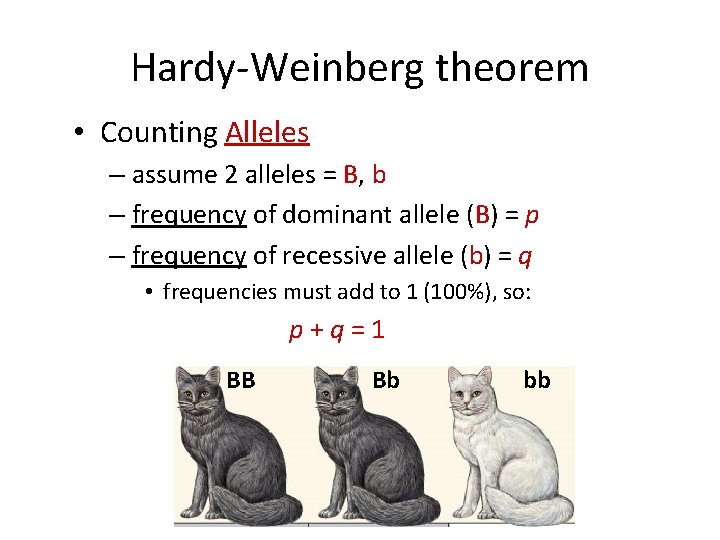
Hardy-Weinberg theorem • Counting Alleles – assume 2 alleles = B, b – frequency of dominant allele (B) = p – frequency of recessive allele (b) = q • frequencies must add to 1 (100%), so: p+q=1 BB Bb bb
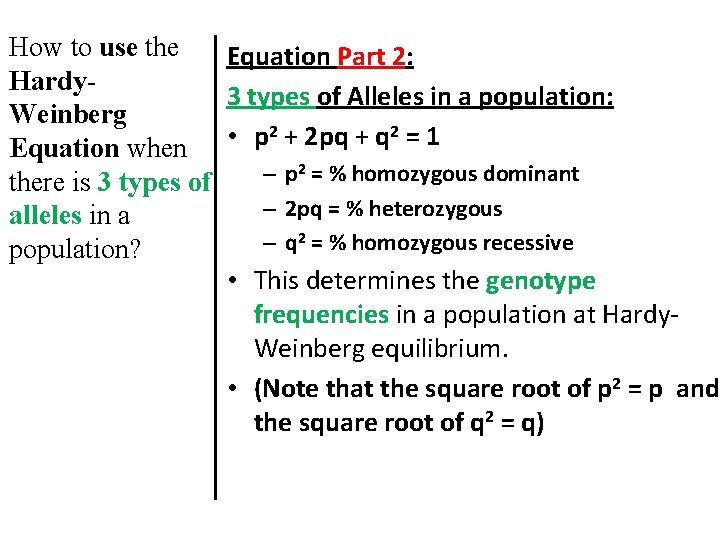
How to use the Equation Part 2: Hardy 3 types of Alleles in a population: Weinberg 2 + 2 pq + q 2 = 1 • p Equation when 2 = % homozygous dominant – p there is 3 types of – 2 pq = % heterozygous alleles in a 2 = % homozygous recessive – q population? • This determines the genotype frequencies in a population at Hardy. Weinberg equilibrium. • (Note that the square root of p 2 = p and the square root of q 2 = q)
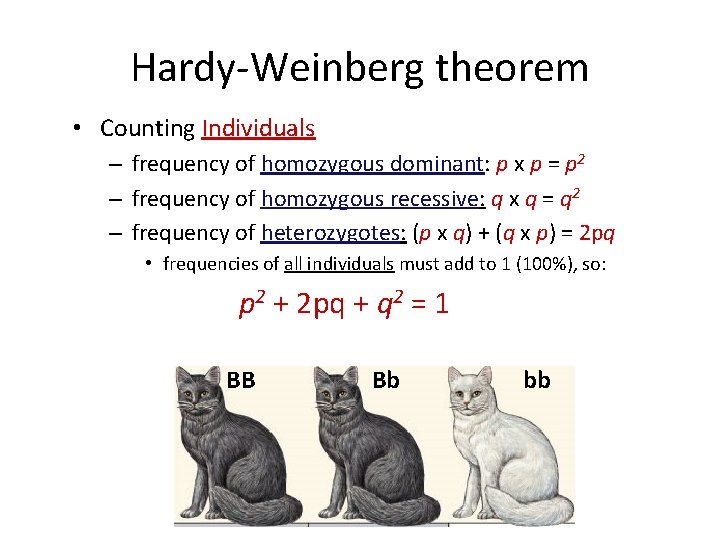
Hardy-Weinberg theorem • Counting Individuals – frequency of homozygous dominant: p x p = p 2 – frequency of homozygous recessive: q x q = q 2 – frequency of heterozygotes: (p x q) + (q x p) = 2 pq • frequencies of all individuals must add to 1 (100%), so: p 2 + 2 pq + q 2 = 1 BB Bb bb
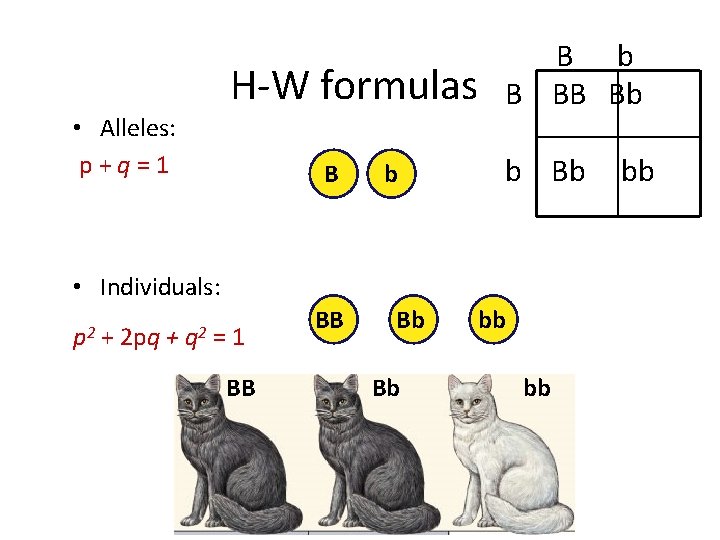
H-W formulas • Alleles: p+q=1 B b B BB Bb b Bb • Individuals: p 2 + 2 pq + q 2 =1 BB BB Bb Bb bb bb bb
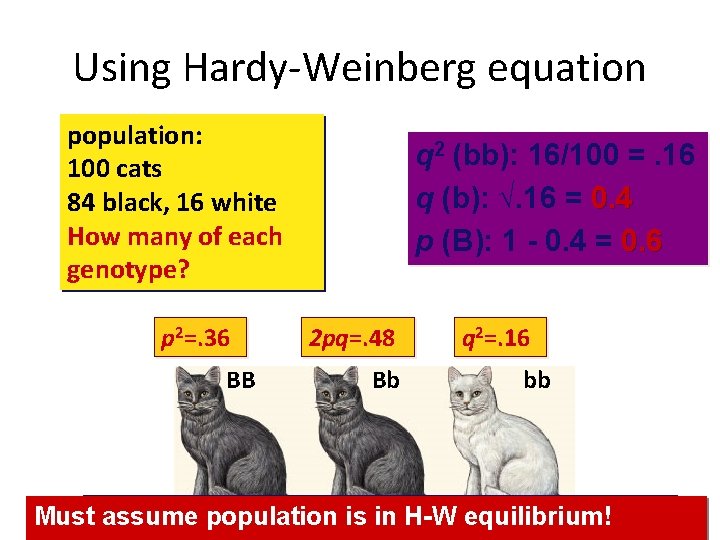
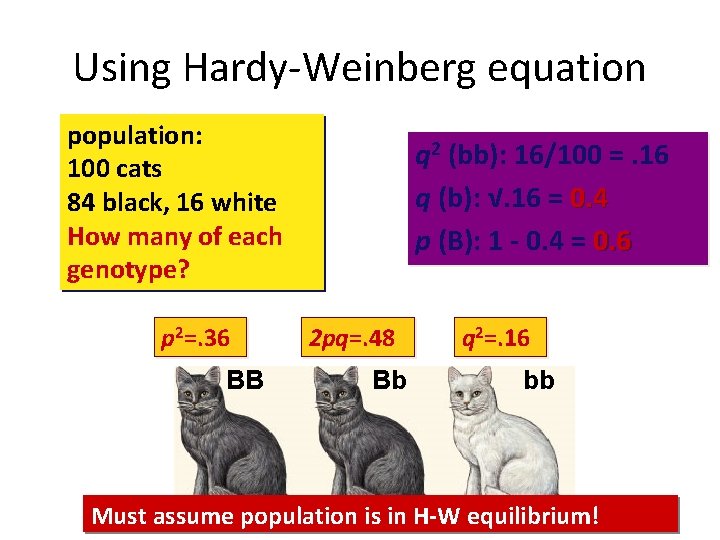
Using Hardy-Weinberg equation population: 100 cats 84 black, 16 white How many of each genotype? p 2=. 36 BB q 2 (bb): 16/100 =. 16 q (b): √. 16 = 0. 4 p (B): 1 - 0. 4 = 0. 6 2 pq=. 48 Bb q 2=. 16 bb are population the genotype frequencies? Must. What assume is in H-W equilibrium!
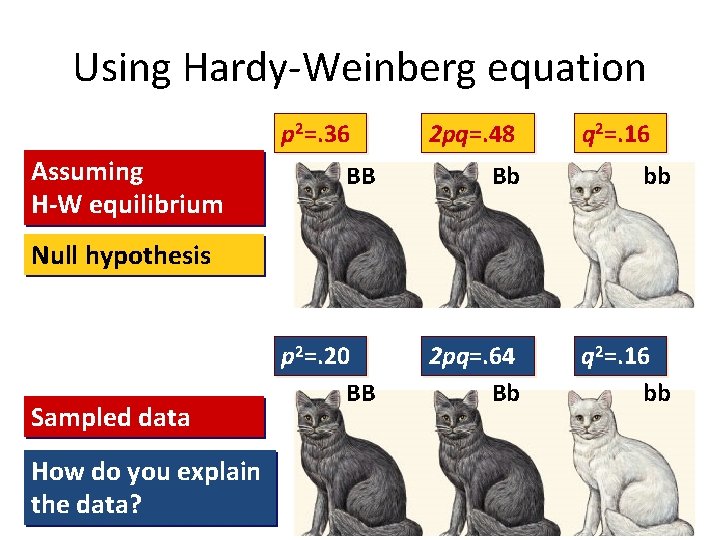
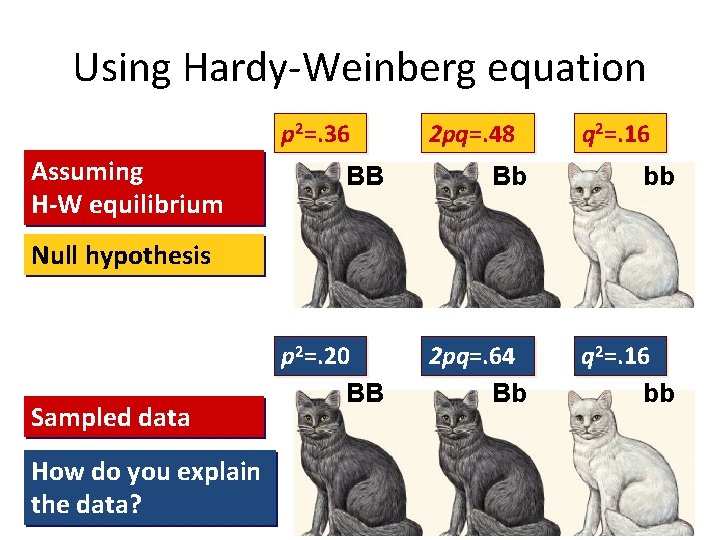
Using Hardy-Weinberg equation p 2=. 36 Assuming H-W equilibrium 2 pq=. 48 q 2=. 16 BB Bb bb p 2=. 20 =. 74 BB 2 pq=. 64 2 pq=. 10 Bb q 2=. 16 bb Null hypothesis Sampled data How do you explain the data?
Using Hardy-Weinberg equation population: 100 cats 84 black, 16 white How many of each genotype? p 2=. 36 BB q 2 (bb): 16/100 =. 16 q (b): √. 16 = 0. 4 p (B): 1 - 0. 4 = 0. 6 2 pq=. 48 Bb q 2=. 16 bb What assume Must are the genotype populationfrequencies? is in H-W equilibrium!
Using Hardy-Weinberg equation p 2=. 36 Assuming H-W equilibrium 2 pq=. 48 q 2=. 16 BB Bb bb p 2=. 20 =. 74 BB 2 pq=. 64 2 pq=. 10 Bb q 2=. 16 bb Null hypothesis Sampled data How do you explain the data?
Hardy-Weinberg Lab Data Mutation 2006 -2007 Gene Flow Genetic Drift Selection Non-random mating
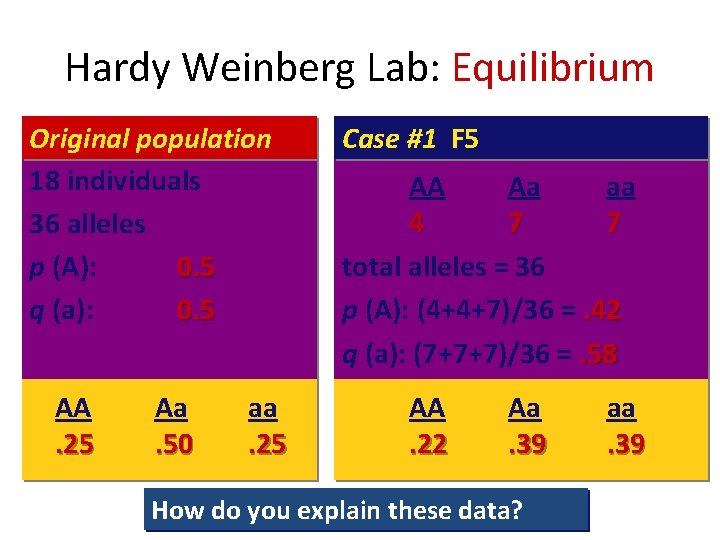
Hardy Weinberg Lab: Equilibrium Original population 18 individuals 36 alleles p (A): 0. 5 q (a): 0. 5 AA. 25 Aa. 50 aa. 25 Case #1 F 5 AA Aa aa 4 7 7 total alleles = 36 p (A): (4+4+7)/36 =. 42 q (a): (7+7+7)/36 =. 58 AA. 22 Aa. 39 How do you explain these data? aa. 39
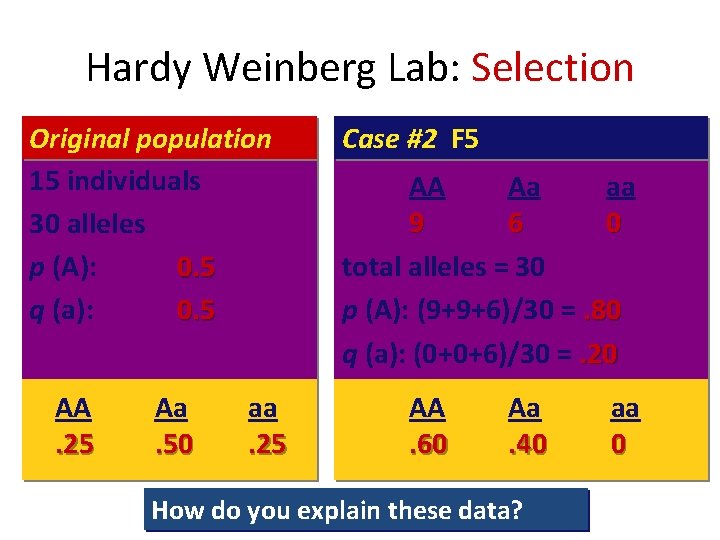
Hardy Weinberg Lab: Selection Original population 15 individuals 30 alleles p (A): 0. 5 q (a): 0. 5 AA. 25 Aa. 50 aa. 25 Case #2 F 5 AA Aa aa 9 6 0 total alleles = 30 p (A): (9+9+6)/30 =. 80 q (a): (0+0+6)/30 =. 20 AA. 60 Aa. 40 How do you explain these data? aa 0
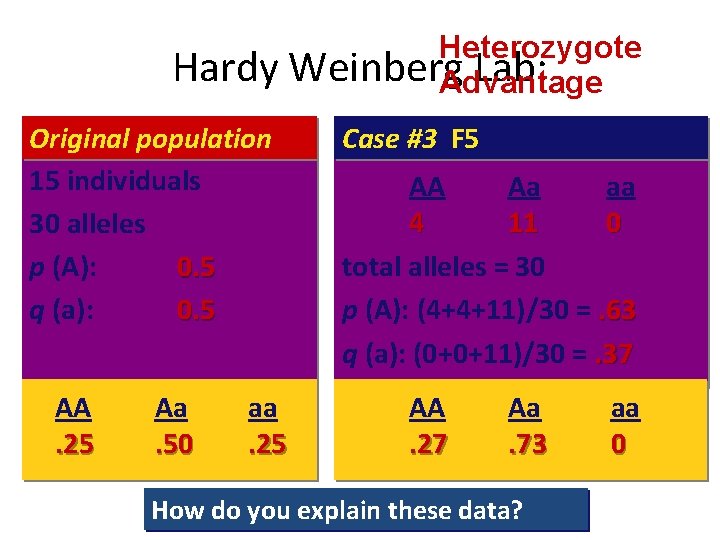
Hardy Original population 15 individuals 30 alleles p (A): 0. 5 q (a): 0. 5 AA. 25 Aa. 50 aa. 25 Heterozygote Weinberg Lab: Advantage Case #3 F 5 AA Aa aa 4 11 0 total alleles = 30 p (A): (4+4+11)/30 =. 63 q (a): (0+0+11)/30 =. 37 AA. 27 Aa. 73 How do you explain these data? aa 0
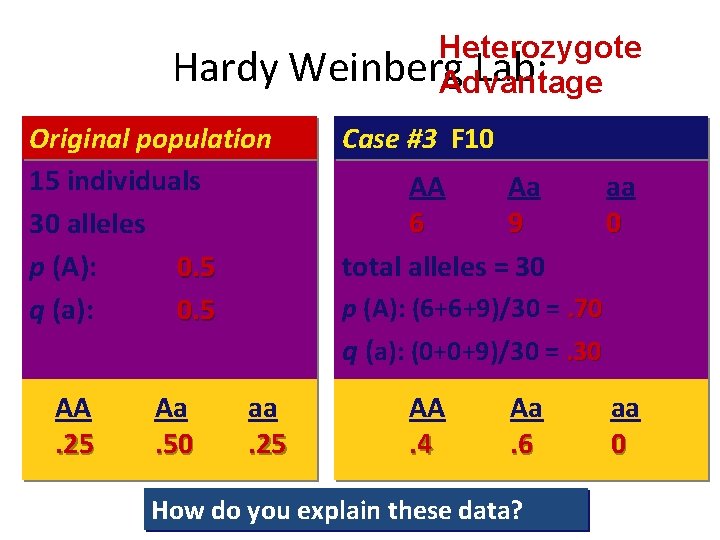
Hardy Original population 15 individuals 30 alleles p (A): 0. 5 q (a): 0. 5 Heterozygote Weinberg Lab: Advantage Case #3 F 10 AA Aa 6 9 total alleles = 30 aa 0 p (A): (6+6+9)/30 =. 70 q (a): (0+0+9)/30 =. 30 AA. 25 Aa. 50 aa. 25 AA. 4 Aa. 6 How do you explain these data? aa 0
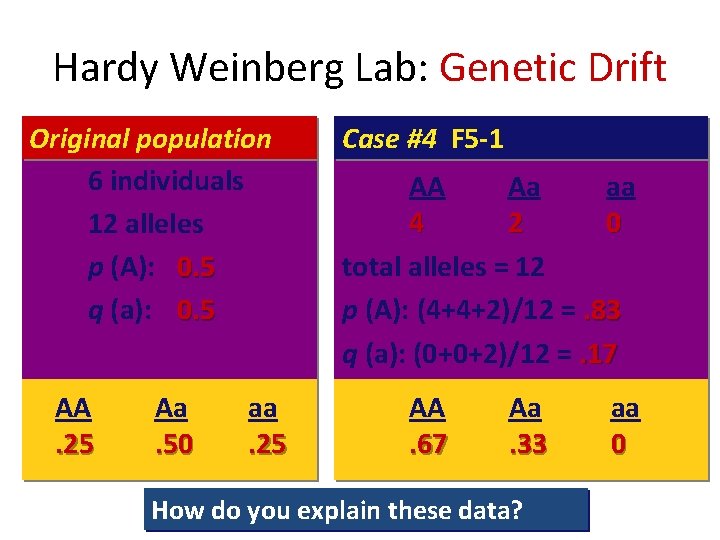
Hardy Weinberg Lab: Genetic Drift Original population 6 individuals 12 alleles p (A): 0. 5 q (a): 0. 5 AA. 25 Aa. 50 aa. 25 Case #4 F 5 -1 AA Aa aa 4 2 0 total alleles = 12 p (A): (4+4+2)/12 =. 83 q (a): (0+0+2)/12 =. 17 AA. 67 Aa. 33 How do you explain these data? aa 0
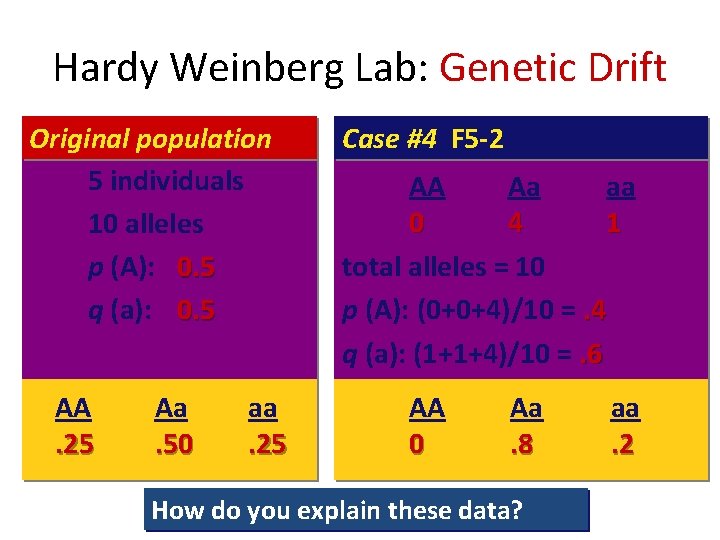
Hardy Weinberg Lab: Genetic Drift Original population 5 individuals 10 alleles p (A): 0. 5 q (a): 0. 5 AA. 25 Aa. 50 aa. 25 Case #4 F 5 -2 AA Aa aa 0 4 1 total alleles = 10 p (A): (0+0+4)/10 =. 4 q (a): (1+1+4)/10 =. 6 AA 0 Aa. 8 How do you explain these data? aa. 2
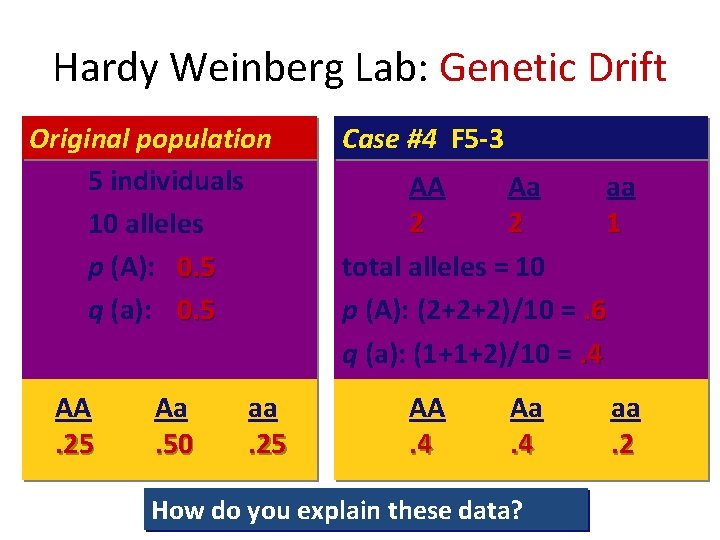
Hardy Weinberg Lab: Genetic Drift Original population 5 individuals 10 alleles p (A): 0. 5 q (a): 0. 5 AA. 25 Aa. 50 aa. 25 Case #4 F 5 -3 AA Aa aa 2 2 1 total alleles = 10 p (A): (2+2+2)/10 =. 6 q (a): (1+1+2)/10 =. 4 AA. 4 Aa. 4 How do you explain these data? aa. 2
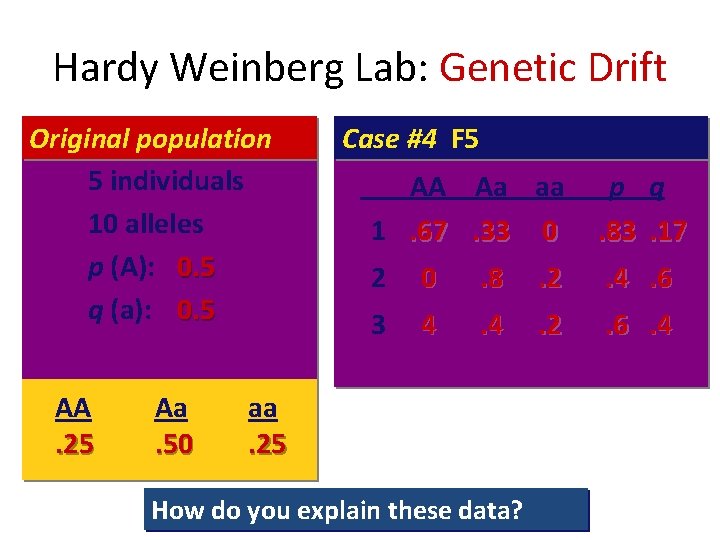
Hardy Weinberg Lab: Genetic Drift Original population 5 individuals 10 alleles p (A): 0. 5 q (a): 0. 5 AA. 25 Aa. 50 Case #4 F 5 AA Aa aa 1. 67. 33 0 p q. 83. 17 2 0 . 8 . 2 . 4. 6 3 4 . 2 . 6. 4 aa. 25 How do you explain these data?
Any Questions? ? 2007 -2008
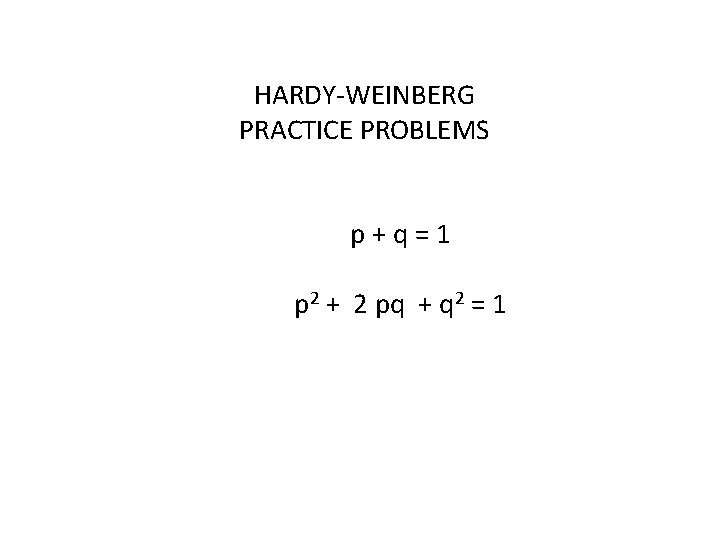
HARDY-WEINBERG PRACTICE PROBLEMS p+q=1 p 2 + 2 pq + q 2 = 1
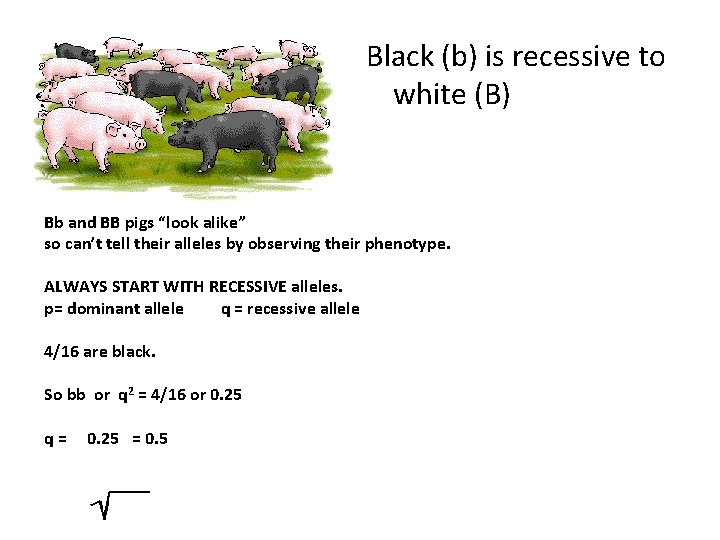
Black (b) is recessive to white (B) Bb and BB pigs “look alike” so can’t tell their alleles by observing their phenotype. ALWAYS START WITH RECESSIVE alleles. p= dominant allele q = recessive allele 4/16 are black. So bb or q 2 = 4/16 or 0. 25 q= 0. 25 = 0. 5
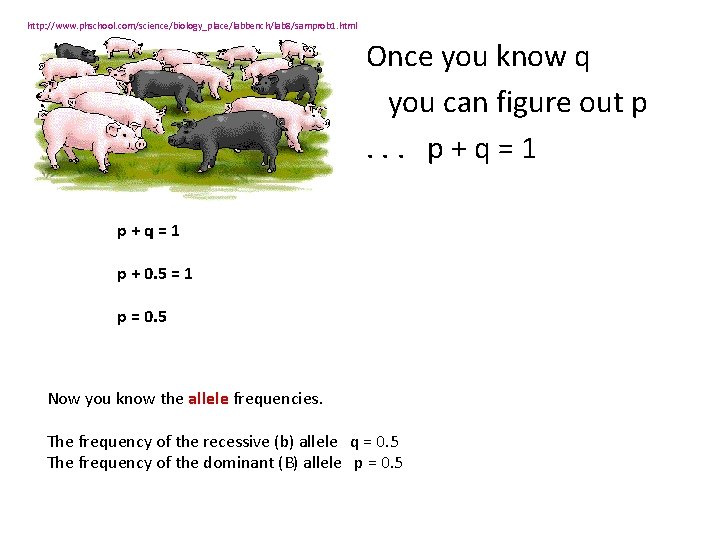
http: //www. phschool. com/science/biology_place/labbench/lab 8/samprob 1. html Once you know q you can figure out p. . . p+q=1 p + 0. 5 = 1 p = 0. 5 Now you know the allele frequencies. The frequency of the recessive (b) allele q = 0. 5 The frequency of the dominant (B) allele p = 0. 5
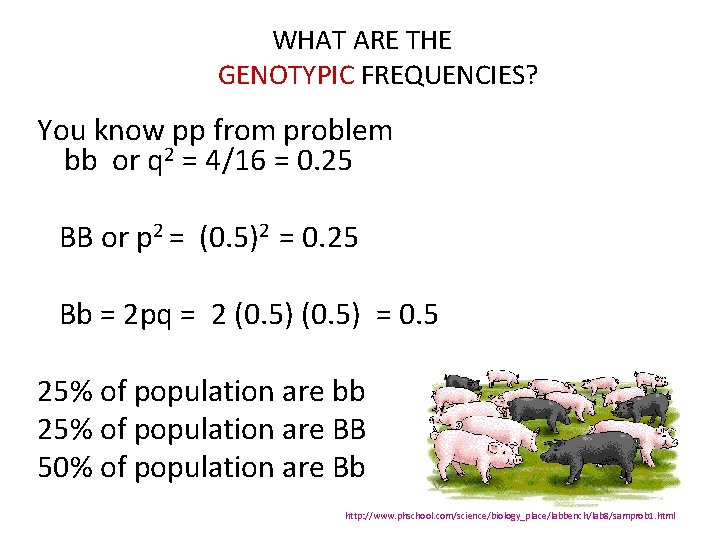
WHAT ARE THE GENOTYPIC FREQUENCIES? You know pp from problem bb or q 2 = 4/16 = 0. 25 BB or p 2 = (0. 5)2 = 0. 25 Bb = 2 pq = 2 (0. 5) = 0. 5 25% of population are bb 25% of population are BB 50% of population are Bb http: //www. phschool. com/science/biology_place/labbench/lab 8/samprob 1. html
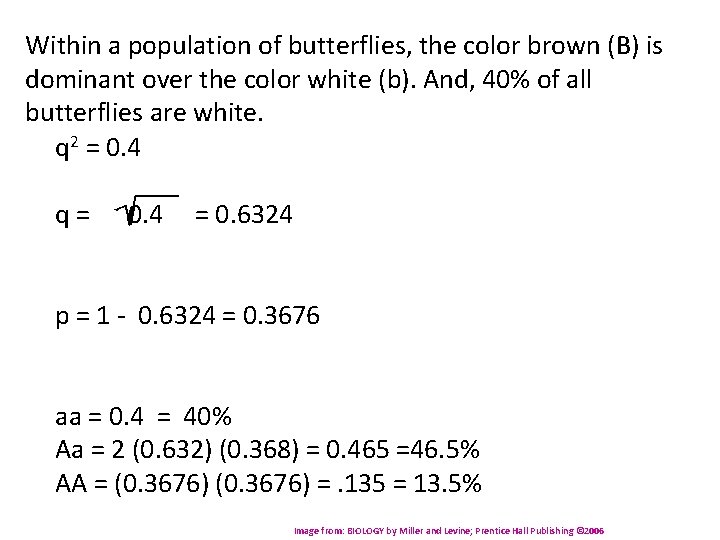
Within a population of butterflies, the color brown (B) is dominant over the color white (b). And, 40% of all butterflies are white. q 2 = 0. 4 q= 0. 4 = 0. 6324 p = 1 - 0. 6324 = 0. 3676 aa = 0. 4 = 40% Aa = 2 (0. 632) (0. 368) = 0. 465 =46. 5% AA = (0. 3676) =. 135 = 13. 5% Image from: BIOLOGY by Miller and Levine; Prentice Hall Publishing © 2006
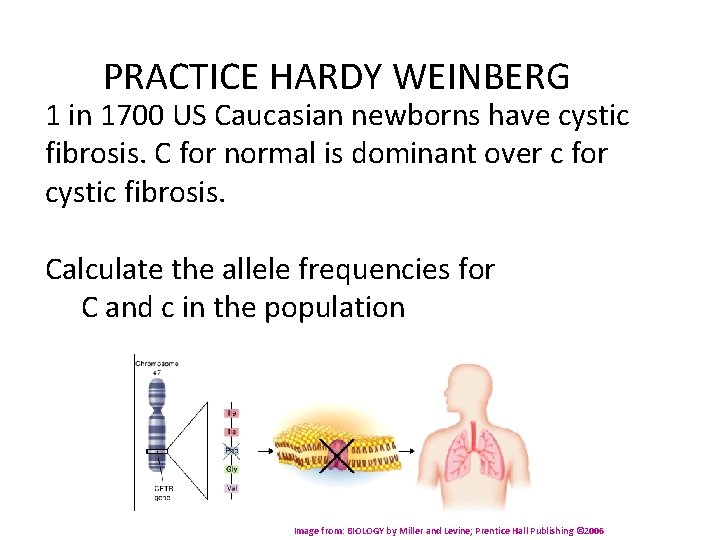
PRACTICE HARDY WEINBERG 1 in 1700 US Caucasian newborns have cystic fibrosis. C for normal is dominant over c for cystic fibrosis. Calculate the allele frequencies for C and c in the population Image from: BIOLOGY by Miller and Levine; Prentice Hall Publishing © 2006
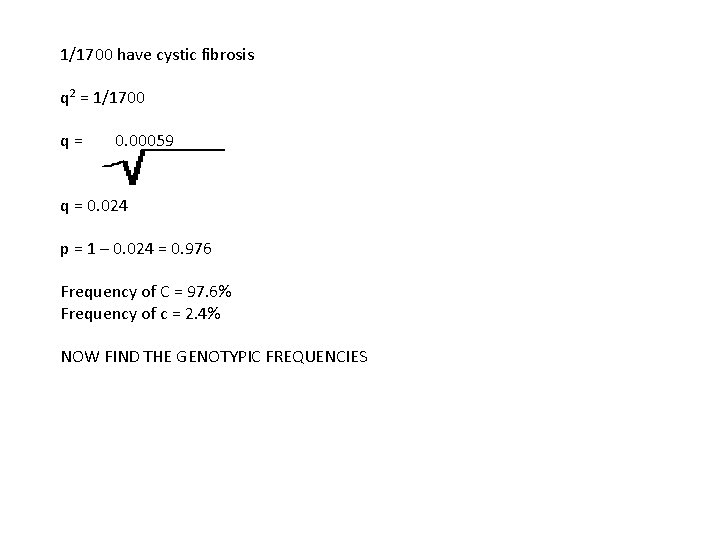
1/1700 have cystic fibrosis q 2 = 1/1700 q= 0. 00059 q = 0. 024 p = 1 – 0. 024 = 0. 976 Frequency of C = 97. 6% Frequency of c = 2. 4% NOW FIND THE GENOTYPIC FREQUENCIES
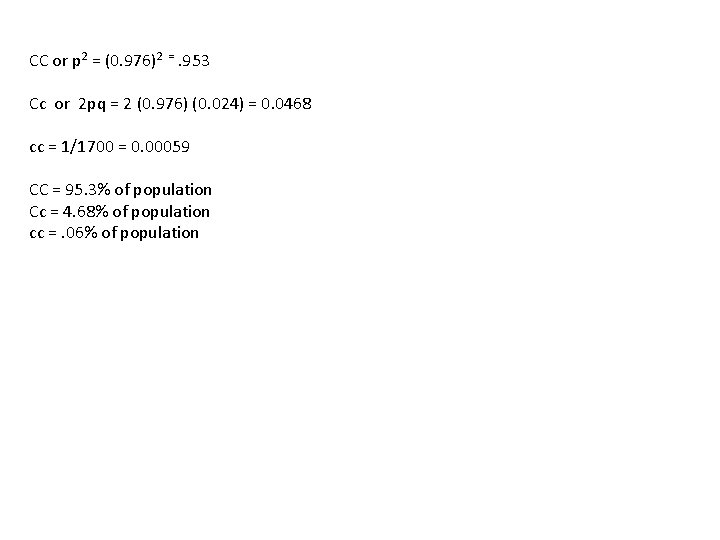
CC or p 2 = (0. 976)2 =. 953 Cc or 2 pq = 2 (0. 976) (0. 024) = 0. 0468 cc = 1/1700 = 0. 00059 CC = 95. 3% of population Cc = 4. 68% of population cc =. 06% of population
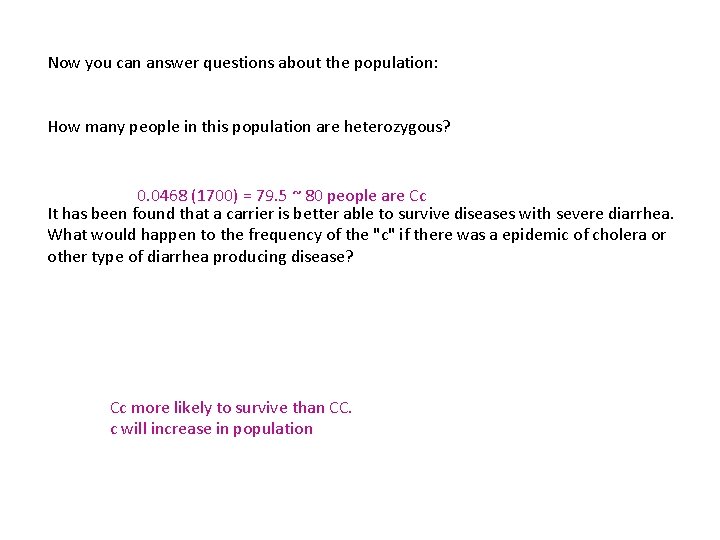
Now you can answer questions about the population: How many people in this population are heterozygous? 0. 0468 (1700) = 79. 5 ~ 80 people are Cc It has been found that a carrier is better able to survive diseases with severe diarrhea. What would happen to the frequency of the "c" if there was a epidemic of cholera or other type of diarrhea producing disease? Cc more likely to survive than CC. c will increase in population
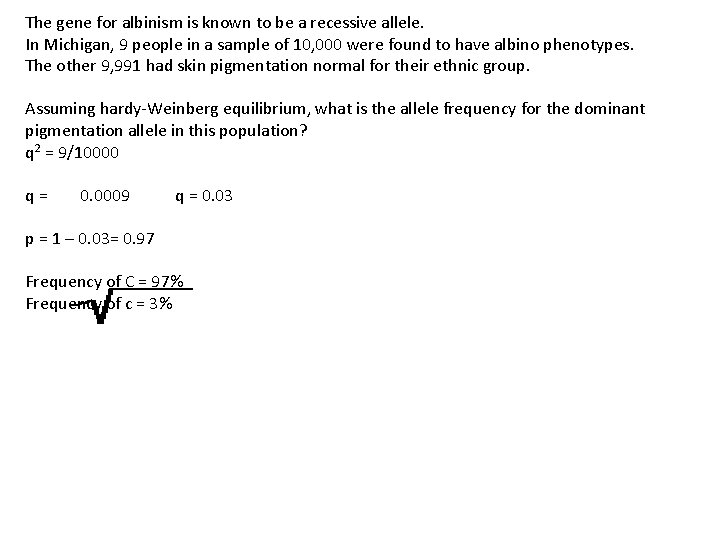
The gene for albinism is known to be a recessive allele. In Michigan, 9 people in a sample of 10, 000 were found to have albino phenotypes. The other 9, 991 had skin pigmentation normal for their ethnic group. Assuming hardy-Weinberg equilibrium, what is the allele frequency for the dominant pigmentation allele in this population? q 2 = 9/10000 q= 0. 0009 q = 0. 03 p = 1 – 0. 03= 0. 97 Frequency of C = 97% Frequency of c = 3%
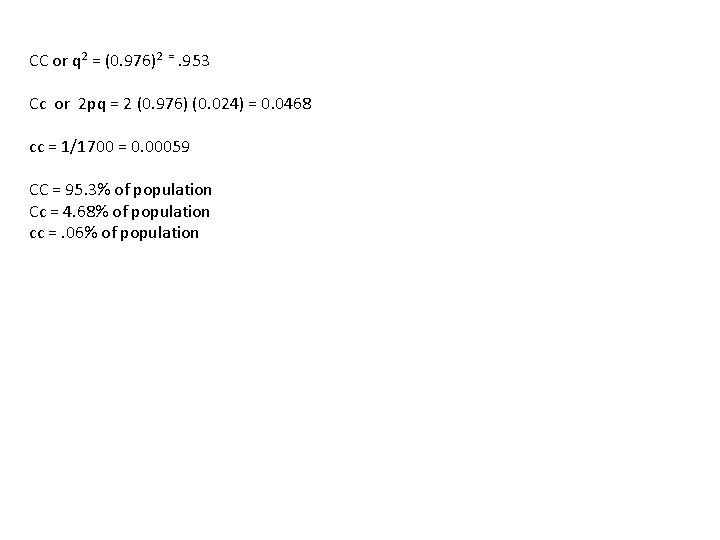
CC or q 2 = (0. 976)2 =. 953 Cc or 2 pq = 2 (0. 976) (0. 024) = 0. 0468 cc = 1/1700 = 0. 00059 CC = 95. 3% of population Cc = 4. 68% of population cc =. 06% of population