
5 Acidbase reactions 5 7 Polyprotic acids Polyprotic
5. Acid-base reactions 5. 7: Polyprotic acids

Polyprotic acids: acids with more than one proton, or hydrogen to donate Phosphoric acid, H 3 PO 4, has three hydrogens to donate, each with its own p. Ka. Weaker acid / less stable conjugate base Each acid is weaker because it has more negative charge and fewer atoms means remaining to delocalize the negative charges. • Stability decreases along with acid strength.
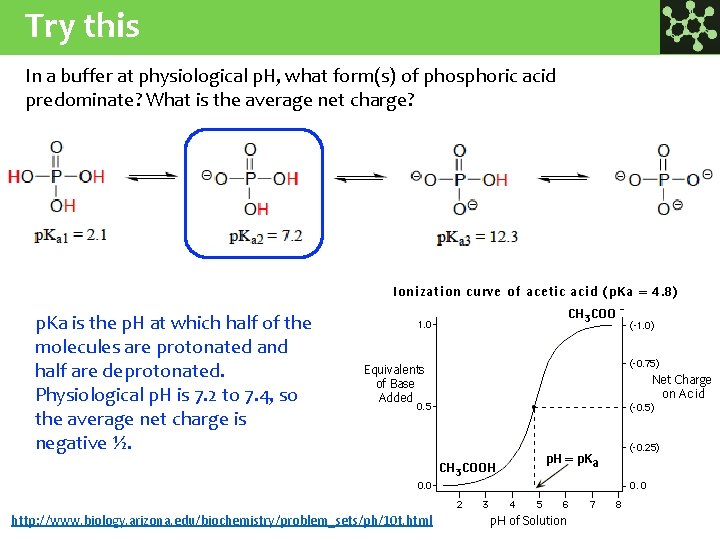
Try this In a buffer at physiological p. H, what form(s) of phosphoric acid predominate? What is the average net charge? p. Ka is the p. H at which half of the molecules are protonated and half are deprotonated. Physiological p. H is 7. 2 to 7. 4, so the average net charge is negative ½. http: //www. biology. arizona. edu/biochemistry/problem_sets/ph/10 t. html

Free amino acids are polyprotic Free (unpolymerized) amino acids have at least two functional groups with acid -base potential: amino group and carboxylic acid group [zwitterion] Alanine p. H 0. 5 p. H 12 Zwitterion: an ion that has both a positive and a negative charge Some amino acids have a third p. Ka because of their side chains: arginine, lysine, aspartate, glutamate, tyrosine, and histidine. Some organic acids also have multiple p. Ka values. • Citric acid: 3. 1, 4. 8, 6. 4

Can you? (1) Define the term ‘polyprotic acid’? (2) Explain why polyprotic acids become weaker as fewer acidic hydrogen atoms remain? How does the stability of the conjugate anion change? (3) Describe how p. Ka relates to the protonation state of molecules? (4) Explain how one molecule can have multiple p. Ka values? (5) Describe how the concept of p. Ka relates to zwitterions?
- Slides: 5