
5 Acidbase reactions 5 3 A Periodic trends
5. Acid-base reactions 5. 3 A: Periodic trends on acidity and basicity
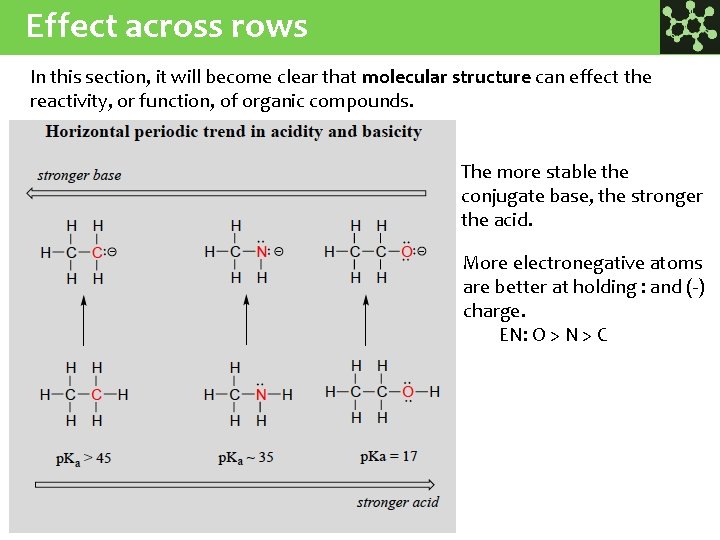
Effect across rows In this section, it will become clear that molecular structure can effect the reactivity, or function, of organic compounds. The more stable the conjugate base, the stronger the acid. More electronegative atoms are better at holding : and (-) charge. EN: O > N > C
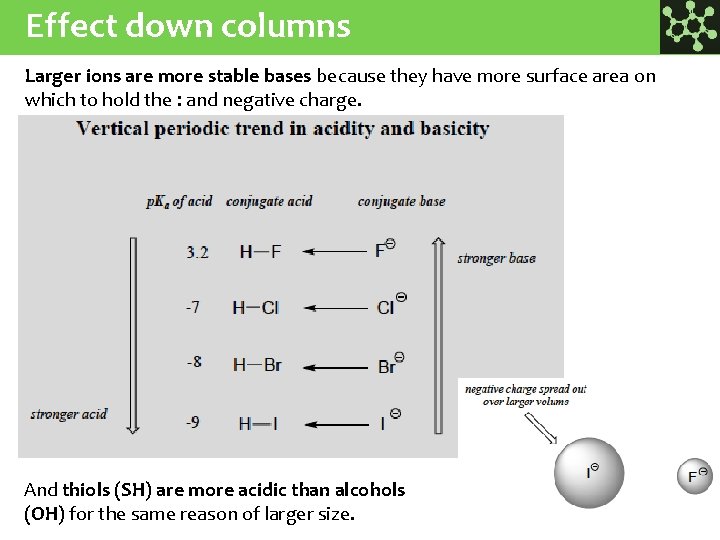
Effect down columns Larger ions are more stable bases because they have more surface area on which to hold the : and negative charge. And thiols (SH) are more acidic than alcohols (OH) for the same reason of larger size.
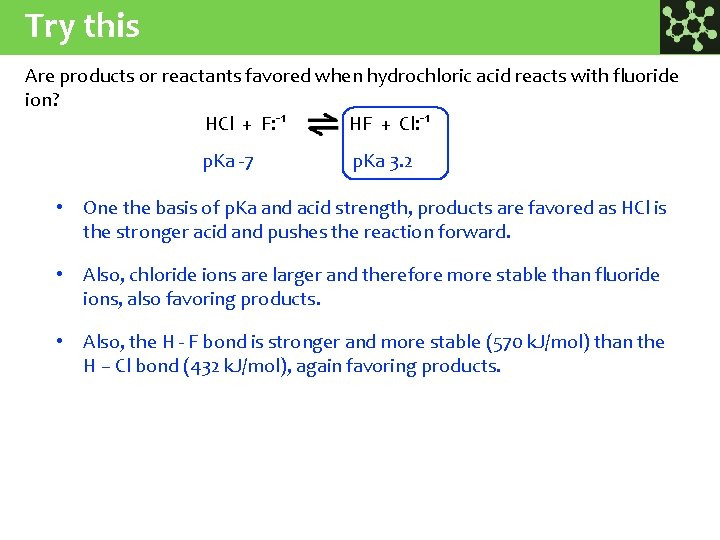
Try this Are products or reactants favored when hydrochloric acid reacts with fluoride ion? HCl + F: -1 HF + Cl: -1 p. Ka -7 p. Ka 3. 2 • One the basis of p. Ka and acid strength, products are favored as HCl is the stronger acid and pushes the reaction forward. • Also, chloride ions are larger and therefore more stable than fluoride ions, also favoring products. • Also, the H - F bond is stronger and more stable (570 k. J/mol) than the H – Cl bond (432 k. J/mol), again favoring products.
5. Acid-base reactions 5. 3 B: Resonance effects on acidity and basicity
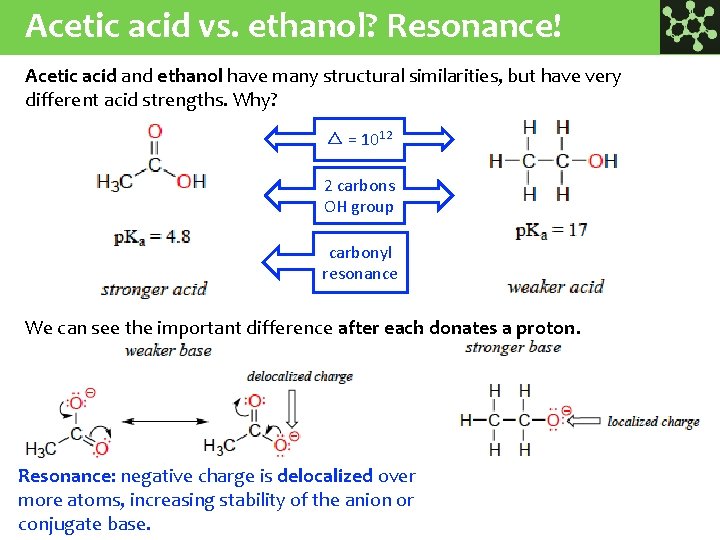
Acetic acid vs. ethanol? Resonance! Acetic acid and ethanol have many structural similarities, but have very different acid strengths. Why? △ = 1012 2 carbons OH group carbonyl resonance We can see the important difference after each donates a proton. Resonance: negative charge is delocalized over more atoms, increasing stability of the anion or conjugate base.
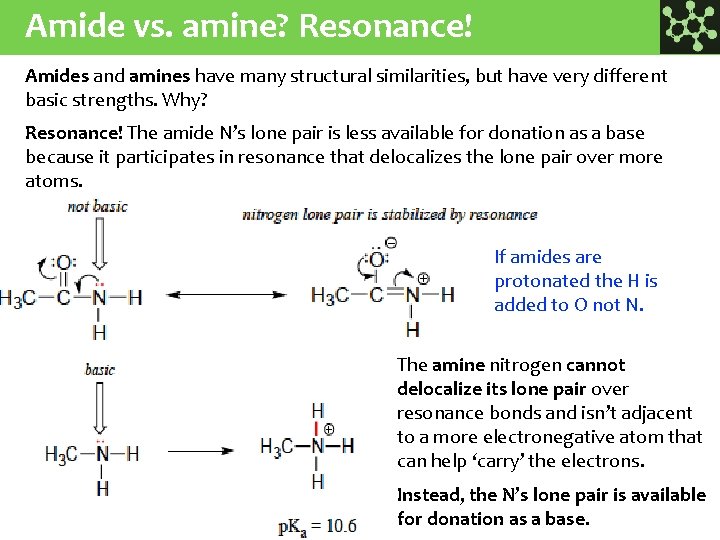
Amide vs. amine? Resonance! Amides and amines have many structural similarities, but have very different basic strengths. Why? Resonance! The amide N’s lone pair is less available for donation as a base because it participates in resonance that delocalizes the lone pair over more atoms. If amides are protonated the H is added to O not N. The amine nitrogen cannot delocalize its lone pair over resonance bonds and isn’t adjacent to a more electronegative atom that can help ‘carry’ the electrons. Instead, the N’s lone pair is available for donation as a base.
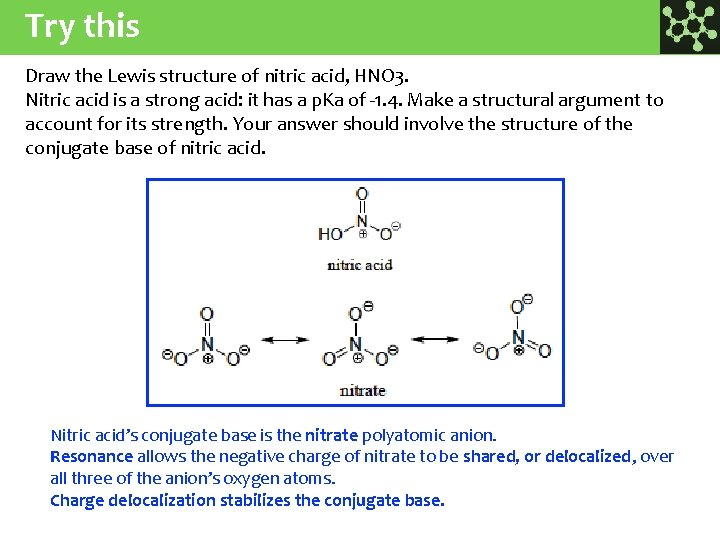
Try this Draw the Lewis structure of nitric acid, HNO 3. Nitric acid is a strong acid: it has a p. Ka of -1. 4. Make a structural argument to account for its strength. Your answer should involve the structure of the conjugate base of nitric acid. Nitric acid’s conjugate base is the nitrate polyatomic anion. Resonance allows the negative charge of nitrate to be shared, or delocalized, over all three of the anion’s oxygen atoms. Charge delocalization stabilizes the conjugate base.
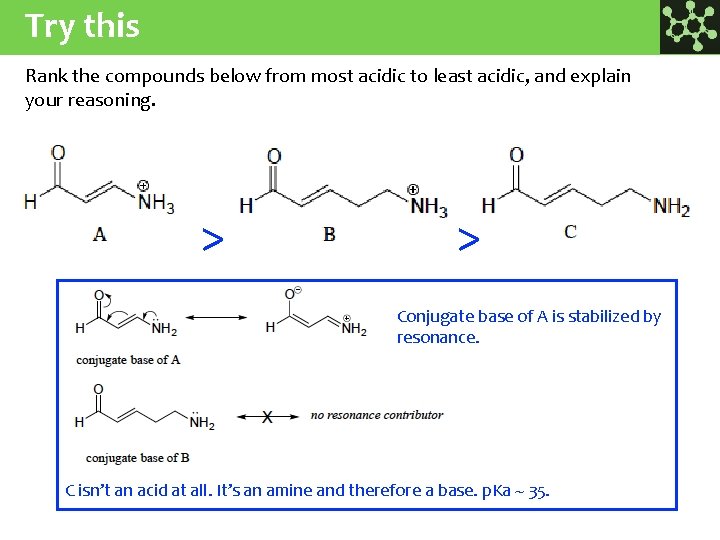
Try this Rank the compounds below from most acidic to least acidic, and explain your reasoning. > > Conjugate base of A is stabilized by resonance. C isn’t an acid at all. It’s an amine and therefore a base. p. Ka ~ 35.
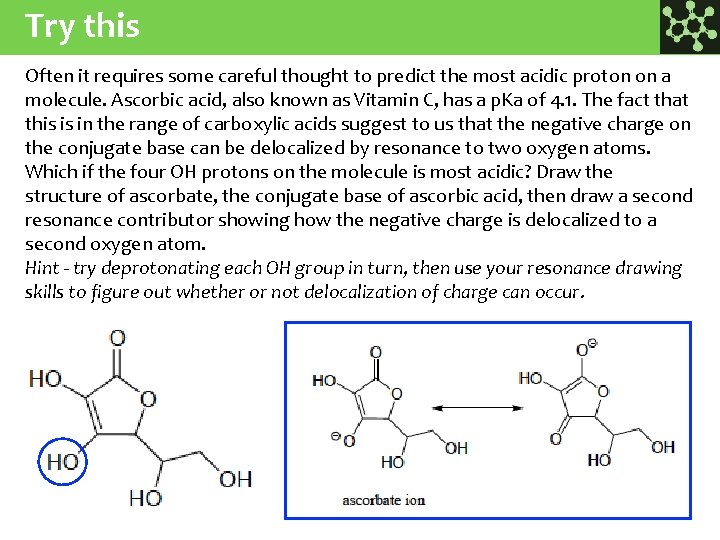
Try this Often it requires some careful thought to predict the most acidic proton on a molecule. Ascorbic acid, also known as Vitamin C, has a p. Ka of 4. 1. The fact that this is in the range of carboxylic acids suggest to us that the negative charge on the conjugate base can be delocalized by resonance to two oxygen atoms. Which if the four OH protons on the molecule is most acidic? Draw the structure of ascorbate, the conjugate base of ascorbic acid, then draw a second resonance contributor showing how the negative charge is delocalized to a second oxygen atom. Hint - try deprotonating each OH group in turn, then use your resonance drawing skills to figure out whether or not delocalization of charge can occur.
5. Acid-base reactions 5. 3 C: Inductive effects on acidity and basicity
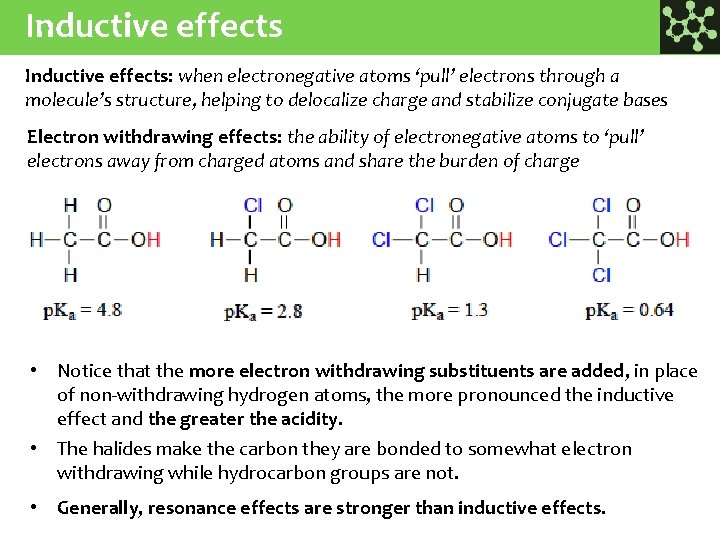
Inductive effects: when electronegative atoms ‘pull’ electrons through a molecule’s structure, helping to delocalize charge and stabilize conjugate bases Electron withdrawing effects: the ability of electronegative atoms to ‘pull’ electrons away from charged atoms and share the burden of charge • Notice that the more electron withdrawing substituents are added, in place of non-withdrawing hydrogen atoms, the more pronounced the inductive effect and the greater the acidity. • The halides make the carbon they are bonded to somewhat electron withdrawing while hydrocarbon groups are not. • Generally, resonance effects are stronger than inductive effects.
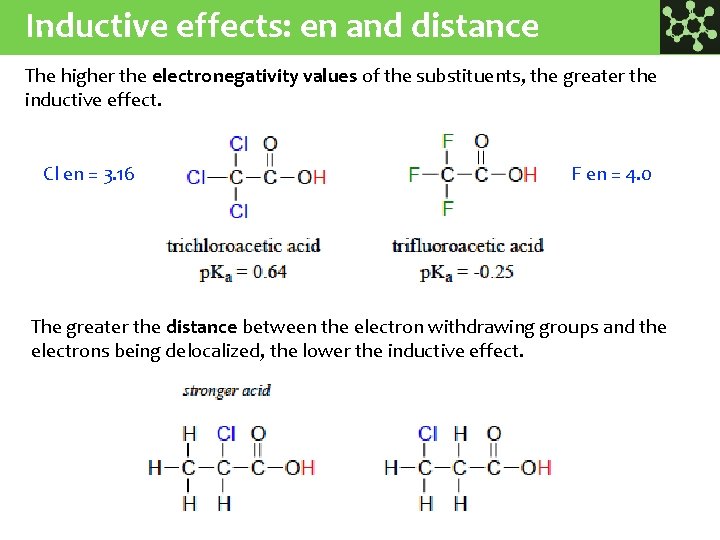
Inductive effects: en and distance The higher the electronegativity values of the substituents, the greater the inductive effect. Cl en = 3. 16 F en = 4. 0 The greater the distance between the electron withdrawing groups and the electrons being delocalized, the lower the inductive effect.
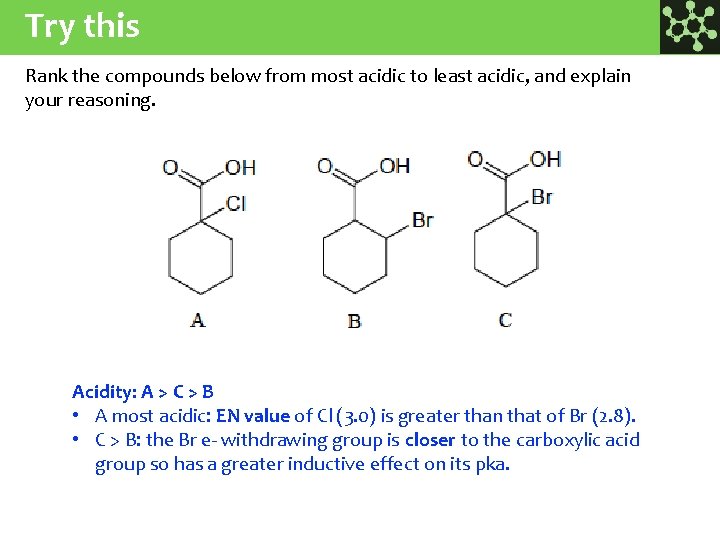
Try this Rank the compounds below from most acidic to least acidic, and explain your reasoning. Acidity: A > C > B • A most acidic: EN value of Cl (3. 0) is greater than that of Br (2. 8). • C > B: the Br e- withdrawing group is closer to the carboxylic acid group so has a greater inductive effect on its pka.
Can you? (1) Explain how and why acidity varies across rows (with increasing electronegativity) and down columns (with increasing size)? (2) Explain how resonance increases acidity by stabilizing the conjugate base? (3) Explain that resonance stabilization of the N’s : in amides prevents them from acting as bases, while the lack of resonance makes amines effective bases? (4) Describe how inductive effects can stabilize conjugate bases and strengthen acids? And that distance matters? (5) Explain how electron withdrawing groups can polarize O-H bonds, increasing acidity? (6) Be aware that resonance usually trumps inductive effects?
- Slides: 15