
5 7 The Pythagorean Theorem Objectives Use the
5 -7 The Pythagorean Theorem Objectives Use the Pythagorean Theorem and its converse to solve problems. Use Pythagorean inequalities to classify triangles. Holt Geometry
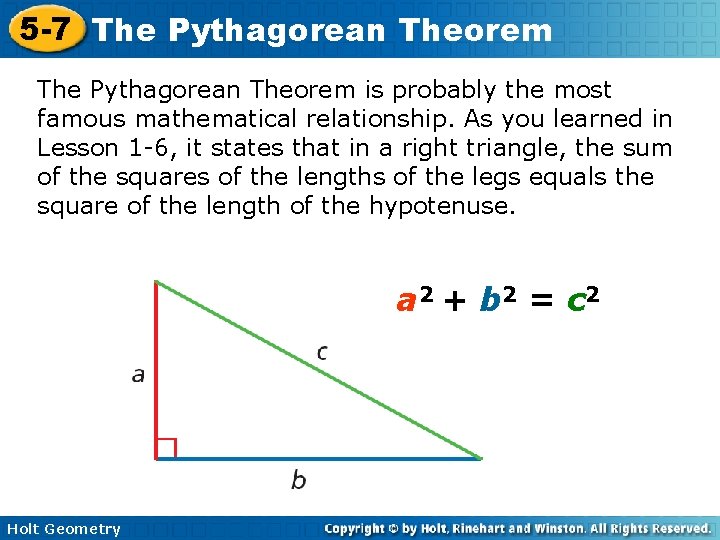
5 -7 The Pythagorean Theorem is probably the most famous mathematical relationship. As you learned in Lesson 1 -6, it states that in a right triangle, the sum of the squares of the lengths of the legs equals the square of the length of the hypotenuse. a 2 + b 2 = c 2 Holt Geometry
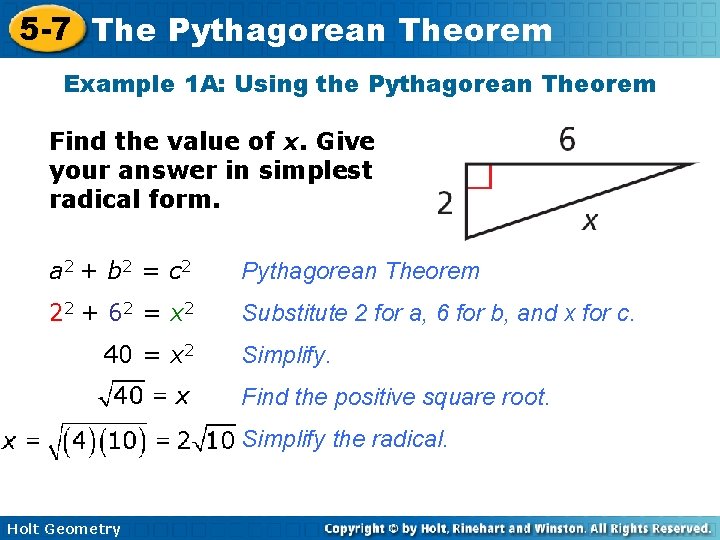
5 -7 The Pythagorean Theorem Example 1 A: Using the Pythagorean Theorem Find the value of x. Give your answer in simplest radical form. a 2 + b 2 = c 2 Pythagorean Theorem 22 + 62 = x 2 Substitute 2 for a, 6 for b, and x for c. 40 = x 2 Simplify. Find the positive square root. Simplify the radical. Holt Geometry
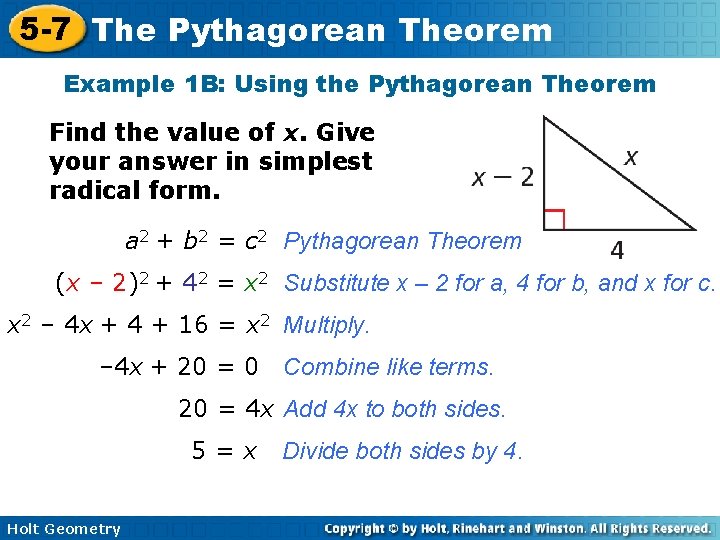
5 -7 The Pythagorean Theorem Example 1 B: Using the Pythagorean Theorem Find the value of x. Give your answer in simplest radical form. a 2 + b 2 = c 2 Pythagorean Theorem (x – 2)2 + 42 = x 2 Substitute x – 2 for a, 4 for b, and x for c. x 2 – 4 x + 4 + 16 = x 2 Multiply. – 4 x + 20 = 0 Combine like terms. 20 = 4 x Add 4 x to both sides. 5=x Holt Geometry Divide both sides by 4.
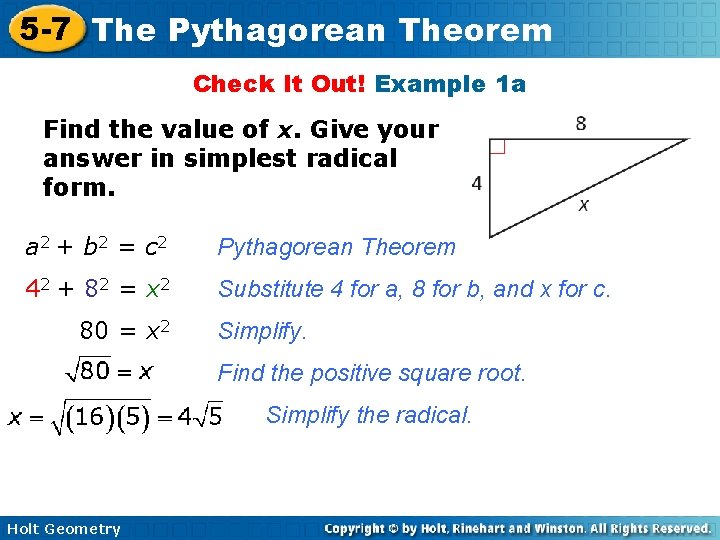
5 -7 The Pythagorean Theorem Check It Out! Example 1 a Find the value of x. Give your answer in simplest radical form. a 2 + b 2 = c 2 Pythagorean Theorem 42 + 82 = x 2 Substitute 4 for a, 8 for b, and x for c. 80 = x 2 Simplify. Find the positive square root. Simplify the radical. Holt Geometry
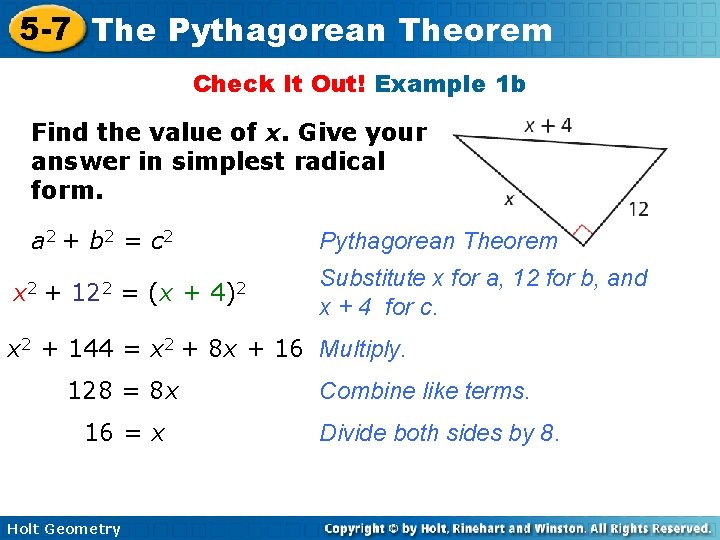
5 -7 The Pythagorean Theorem Check It Out! Example 1 b Find the value of x. Give your answer in simplest radical form. a 2 + b 2 = c 2 x 2 + 122 = (x + Pythagorean Theorem 4)2 Substitute x for a, 12 for b, and x + 4 for c. x 2 + 144 = x 2 + 8 x + 16 Multiply. 128 = 8 x 16 = x Holt Geometry Combine like terms. Divide both sides by 8.
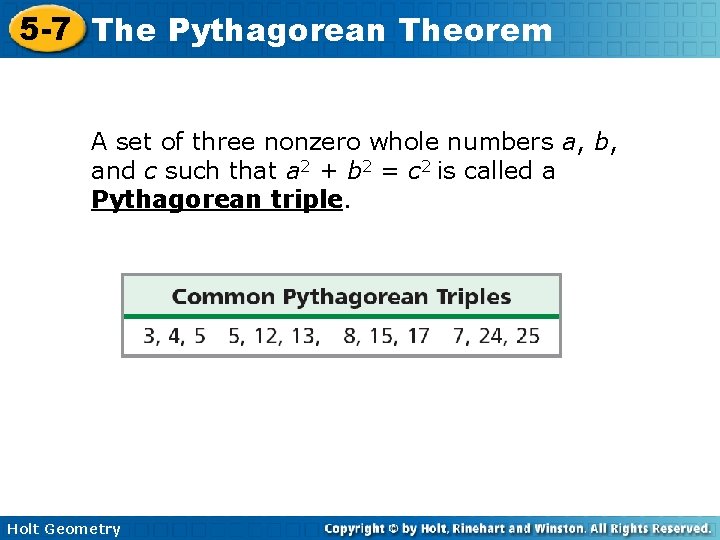
5 -7 The Pythagorean Theorem A set of three nonzero whole numbers a, b, and c such that a 2 + b 2 = c 2 is called a Pythagorean triple. Holt Geometry

5 -7 The Pythagorean Theorem Example 3 A: Identifying Pythagorean Triples Find the missing side length. Tell if the side lengths form a Pythagorean triple. Explain. a 2 + b 2 = c 2 Pythagorean Theorem 142 + 482 = c 2 Substitute 14 for a and 48 for b. 2500 = c 2 Multiply and add. 50 = c Find the positive square root. The side lengths are nonzero whole numbers that satisfy the equation a 2 + b 2 = c 2, so they form a Pythagorean triple. Holt Geometry
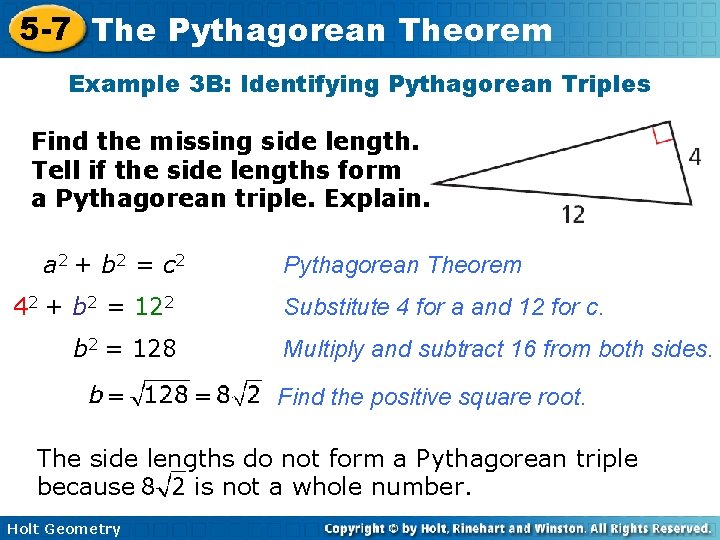
5 -7 The Pythagorean Theorem Example 3 B: Identifying Pythagorean Triples Find the missing side length. Tell if the side lengths form a Pythagorean triple. Explain. a 2 + b 2 = c 2 42 + b 2 = 122 b 2 = 128 Pythagorean Theorem Substitute 4 for a and 12 for c. Multiply and subtract 16 from both sides. Find the positive square root. The side lengths do not form a Pythagorean triple because is not a whole number. Holt Geometry
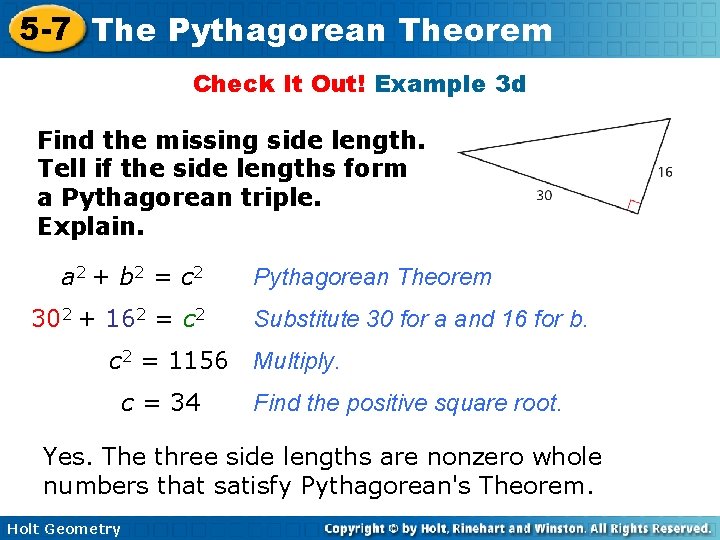
5 -7 The Pythagorean Theorem Check It Out! Example 3 d Find the missing side length. Tell if the side lengths form a Pythagorean triple. Explain. a 2 + b 2 = c 2 302 + 162 = c 2 Pythagorean Theorem Substitute 30 for a and 16 for b. c 2 = 1156 Multiply. c = 34 Find the positive square root. Yes. The three side lengths are nonzero whole numbers that satisfy Pythagorean's Theorem. Holt Geometry
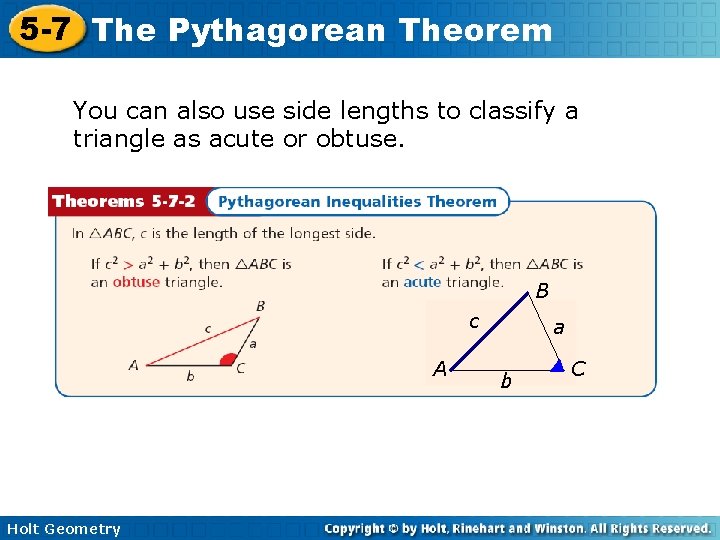
5 -7 The Pythagorean Theorem You can also use side lengths to classify a triangle as acute or obtuse. B c A Holt Geometry a b C
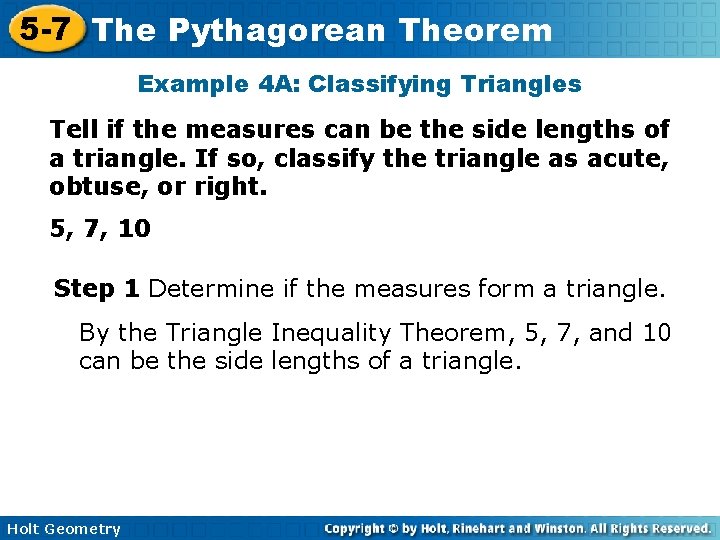
5 -7 The Pythagorean Theorem Example 4 A: Classifying Triangles Tell if the measures can be the side lengths of a triangle. If so, classify the triangle as acute, obtuse, or right. 5, 7, 10 Step 1 Determine if the measures form a triangle. By the Triangle Inequality Theorem, 5, 7, and 10 can be the side lengths of a triangle. Holt Geometry
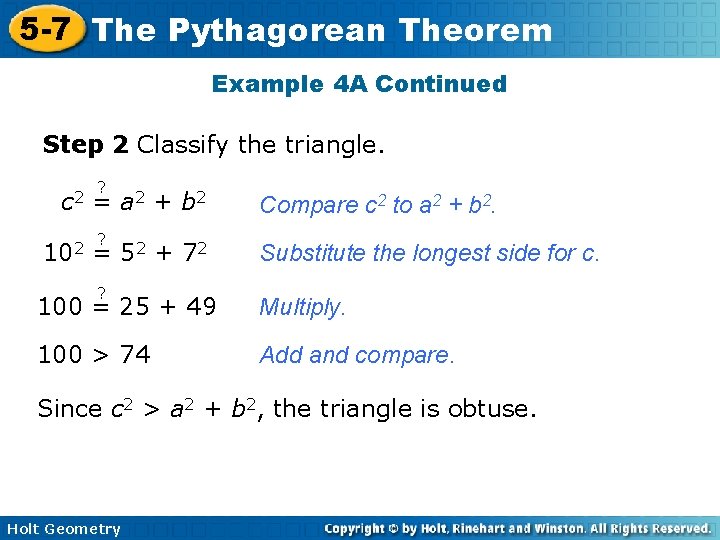
5 -7 The Pythagorean Theorem Example 4 A Continued Step 2 Classify the triangle. c 2 102 ? = a 2 + b 2 ? = 52 + 72 ? Compare c 2 to a 2 + b 2. Substitute the longest side for c. 100 = 25 + 49 Multiply. 100 > 74 Add and compare. Since c 2 > a 2 + b 2, the triangle is obtuse. Holt Geometry
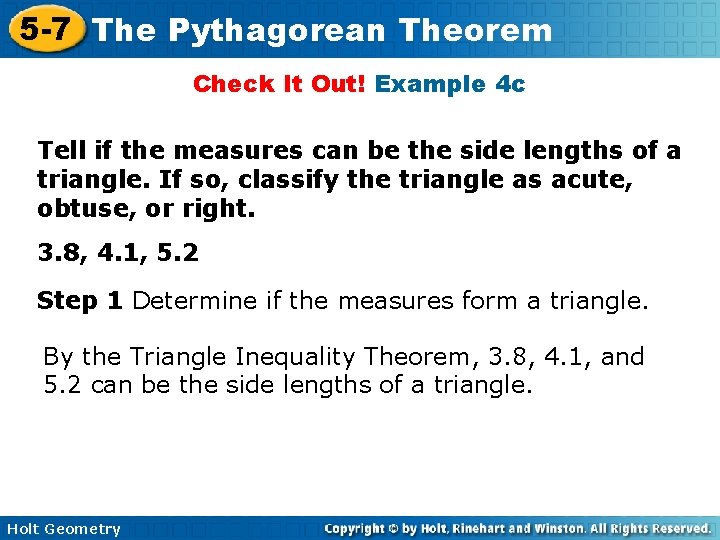
5 -7 The Pythagorean Theorem Check It Out! Example 4 c Tell if the measures can be the side lengths of a triangle. If so, classify the triangle as acute, obtuse, or right. 3. 8, 4. 1, 5. 2 Step 1 Determine if the measures form a triangle. By the Triangle Inequality Theorem, 3. 8, 4. 1, and 5. 2 can be the side lengths of a triangle. Holt Geometry
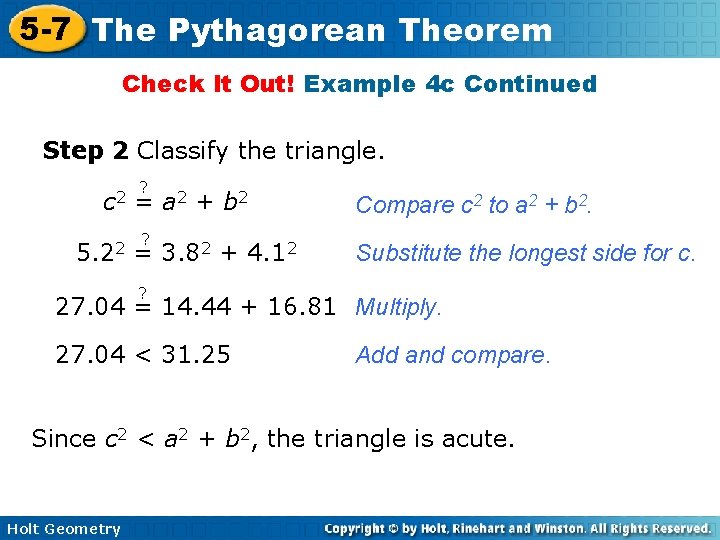
5 -7 The Pythagorean Theorem Check It Out! Example 4 c Continued Step 2 Classify the triangle. c 2 5. 22 ? = a 2 + b 2 ? = 3. 82 + 4. 12 Compare c 2 to a 2 + b 2. Substitute the longest side for c. ? 27. 04 = 14. 44 + 16. 81 Multiply. 27. 04 < 31. 25 Add and compare. Since c 2 < a 2 + b 2, the triangle is acute. Holt Geometry
- Slides: 15