
5 7 Inequalities in Two Triangles WE WILL

- Slides: 9
5. 7 Inequalities in Two Triangles WE WILL APPLY INEQUALITIES IN TWO TRIANGLES.
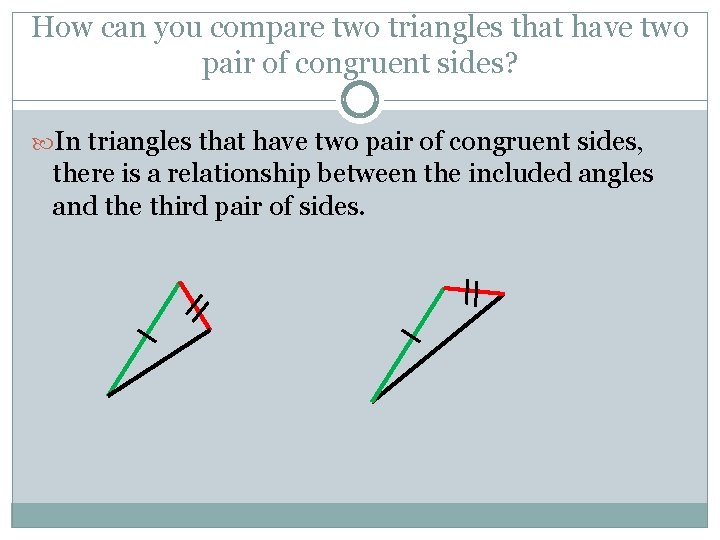
How can you compare two triangles that have two pair of congruent sides? In triangles that have two pair of congruent sides, there is a relationship between the included angles and the third pair of sides.
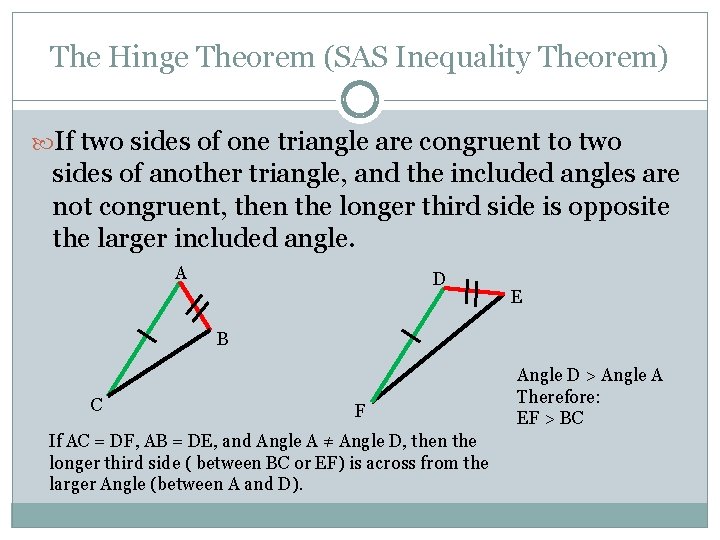
The Hinge Theorem (SAS Inequality Theorem) If two sides of one triangle are congruent to two sides of another triangle, and the included angles are not congruent, then the longer third side is opposite the larger included angle. A D E B C F If AC = DF, AB = DE, and Angle A ≠ Angle D, then the longer third side ( between BC or EF) is across from the larger Angle (between A and D). Angle D > Angle A Therefore: EF > BC
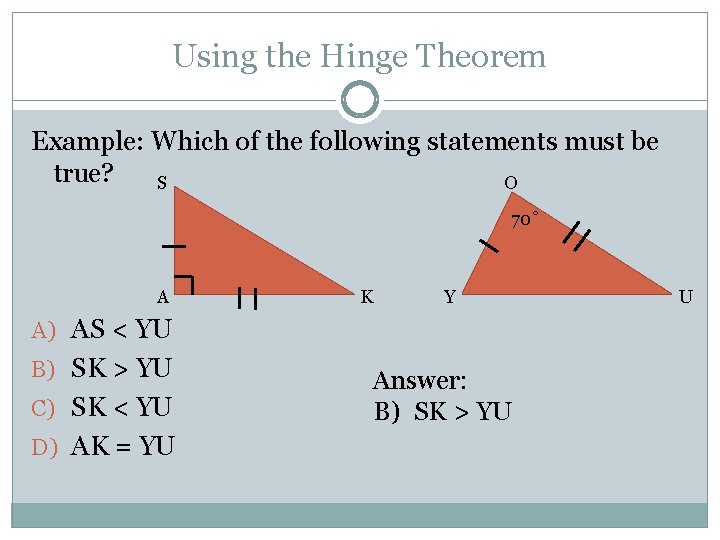
Using the Hinge Theorem Example: Which of the following statements must be true? S O 70˚ A K Y A) AS < YU B) SK > YU C) SK < YU D) AK = YU Answer: B) SK > YU U
Using the Hinge Theorem You Try: What inequality relates LN and OQ in the figure below? 4 M 125˚ 7 O N 4 78˚ L Q Answer: LN > OQ 7 P
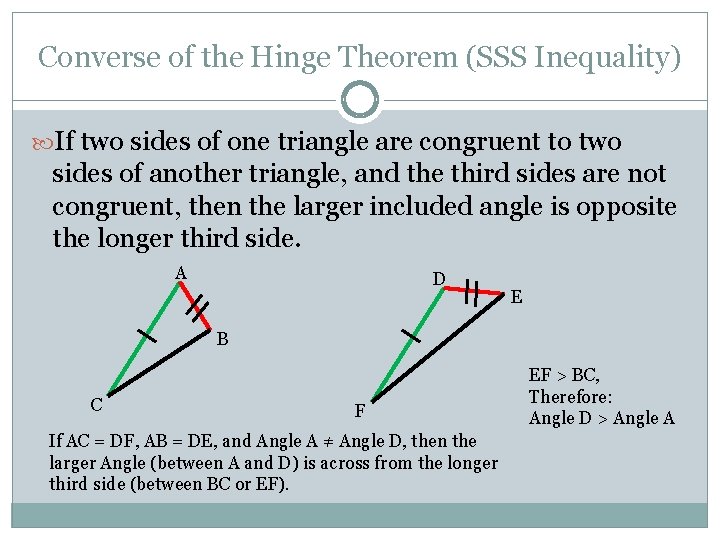
Converse of the Hinge Theorem (SSS Inequality) If two sides of one triangle are congruent to two sides of another triangle, and the third sides are not congruent, then the larger included angle is opposite the longer third side. A D E B C F If AC = DF, AB = DE, and Angle A ≠ Angle D, then the larger Angle (between A and D) is across from the longer third side (between BC or EF). EF > BC, Therefore: Angle D > Angle A
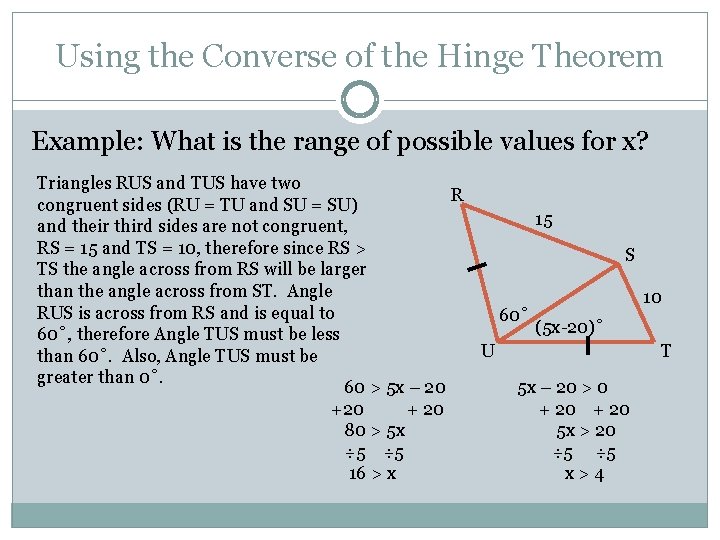
Using the Converse of the Hinge Theorem Example: What is the range of possible values for x? Triangles RUS and TUS have two R congruent sides (RU = TU and SU = SU) 15 and their third sides are not congruent, RS = 15 and TS = 10, therefore since RS > S TS the angle across from RS will be larger than the angle across from ST. Angle 10 RUS is across from RS and is equal to 60˚ (5 x-20)˚ 60˚, therefore Angle TUS must be less U T than 60˚. Also, Angle TUS must be greater than 0˚. 60 > 5 x – 20 > 0 +20 + 20 80 > 5 x 5 x > 20 ÷ 5 ÷ 5 16 > x x>4
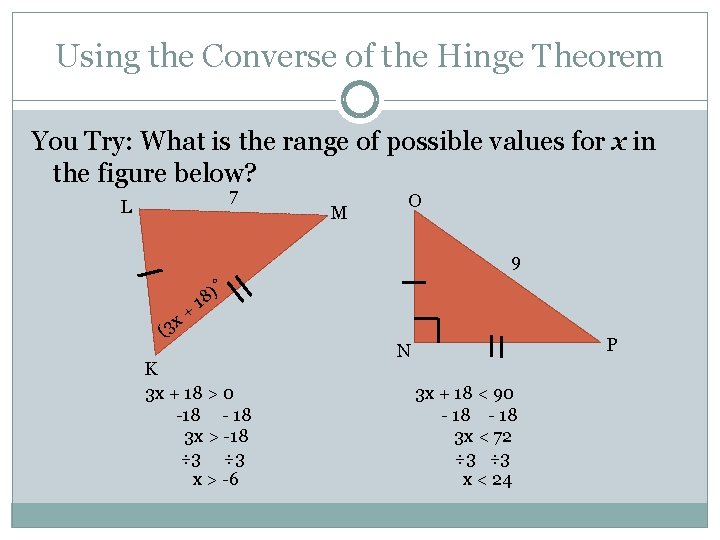
Using the Converse of the Hinge Theorem You Try: What is the range of possible values for x in the figure below? 7 L M O 9 + x 3 ) 18 ˚ ( K 3 x + 18 > 0 -18 - 18 3 x > -18 ÷ 3 x > -6 P N 3 x + 18 < 90 - 18 3 x < 72 ÷ 3 x < 24
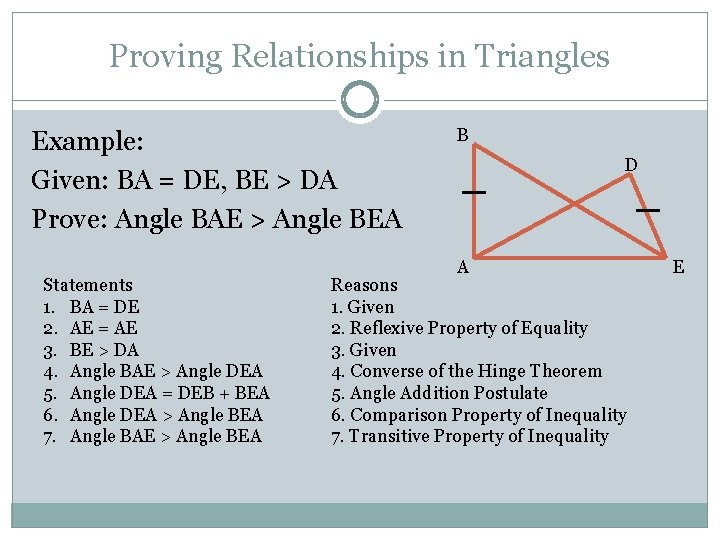
Proving Relationships in Triangles Example: Given: BA = DE, BE > DA Prove: Angle BAE > Angle BEA Statements 1. BA = DE 2. AE = AE 3. BE > DA 4. Angle BAE > Angle DEA 5. Angle DEA = DEB + BEA 6. Angle DEA > Angle BEA 7. Angle BAE > Angle BEA B D A Reasons 1. Given 2. Reflexive Property of Equality 3. Given 4. Converse of the Hinge Theorem 5. Angle Addition Postulate 6. Comparison Property of Inequality 7. Transitive Property of Inequality E