
5 5 Indirect Reasoning Indirect Reasoning All possibilities
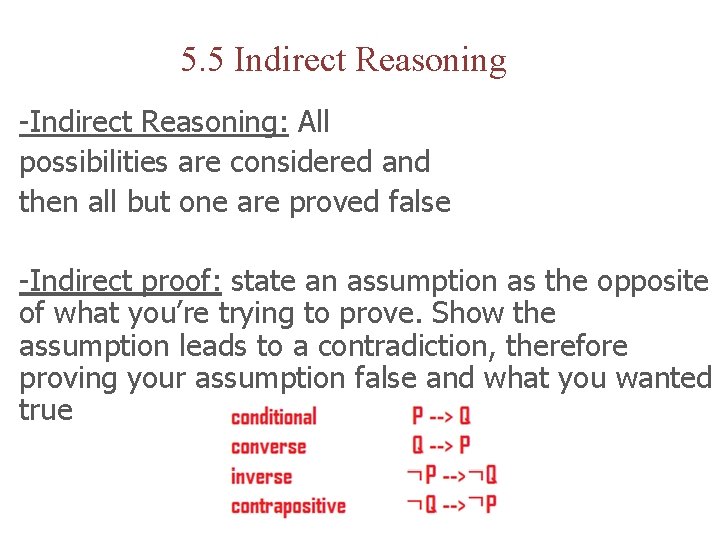
5. 5 Indirect Reasoning -Indirect Reasoning: All possibilities are considered and then all but one are proved false -Indirect proof: state an assumption as the opposite of what you’re trying to prove. Show the assumption leads to a contradiction, therefore proving your assumption false and what you wanted true
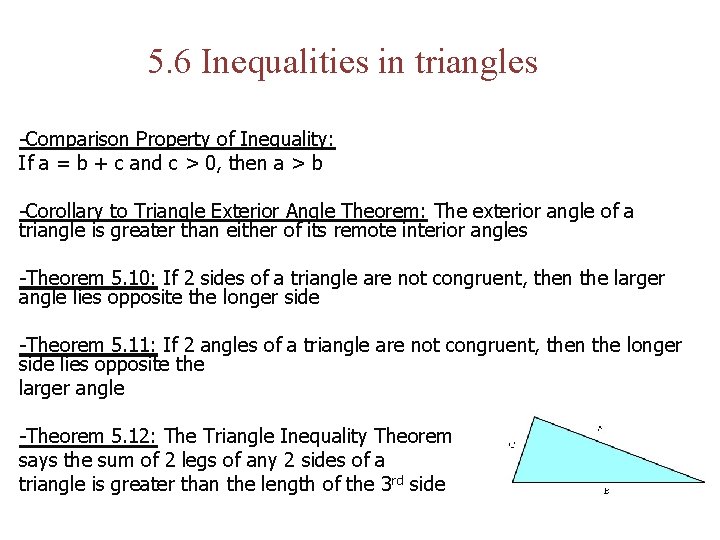
5. 6 Inequalities in triangles -Comparison Property of Inequality: If a = b + c and c > 0, then a > b -Corollary to Triangle Exterior Angle Theorem: The exterior angle of a triangle is greater than either of its remote interior angles -Theorem 5. 10: If 2 sides of a triangle are not congruent, then the larger angle lies opposite the longer side -Theorem 5. 11: If 2 angles of a triangle are not congruent, then the longer side lies opposite the larger angle -Theorem 5. 12: The Triangle Inequality Theorem says the sum of 2 legs of any 2 sides of a triangle is greater than the length of the 3 rd side
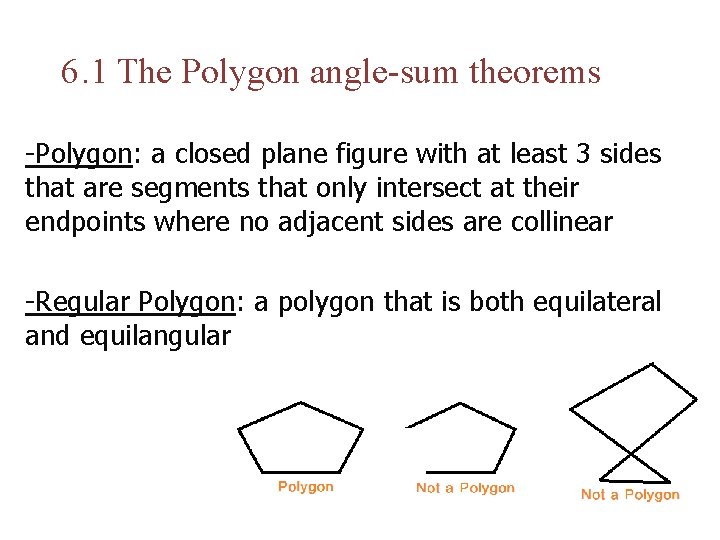
6. 1 The Polygon angle-sum theorems -Polygon: a closed plane figure with at least 3 sides that are segments that only intersect at their endpoints where no adjacent sides are collinear -Regular Polygon: a polygon that is both equilateral and equilangular
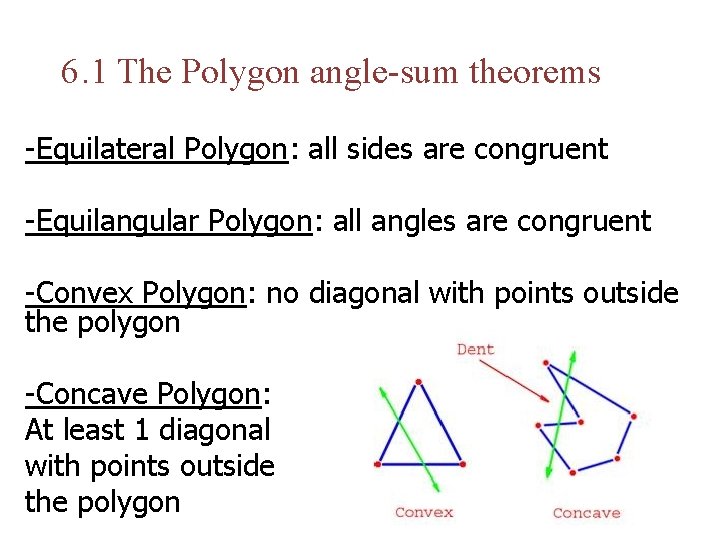
6. 1 The Polygon angle-sum theorems -Equilateral Polygon: all sides are congruent -Equilangular Polygon: all angles are congruent -Convex Polygon: no diagonal with points outside the polygon -Concave Polygon: At least 1 diagonal with points outside the polygon
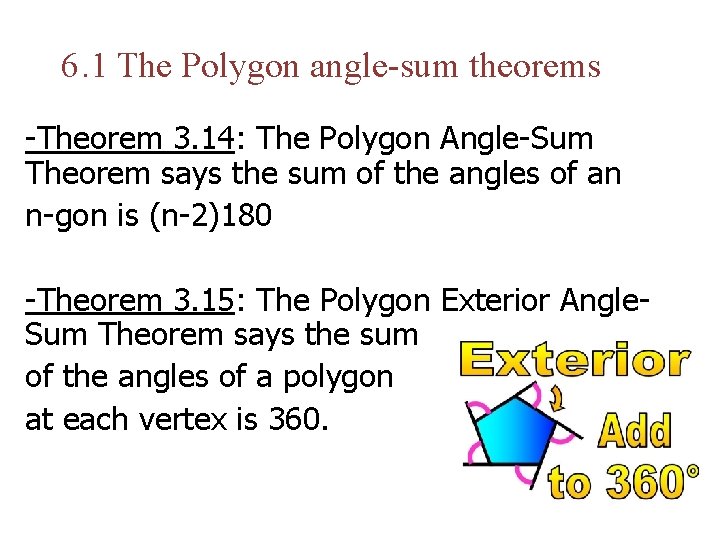
6. 1 The Polygon angle-sum theorems -Theorem 3. 14: The Polygon Angle-Sum Theorem says the sum of the angles of an n-gon is (n-2)180 -Theorem 3. 15: The Polygon Exterior Angle. Sum Theorem says the sum of the angles of a polygon at each vertex is 360.
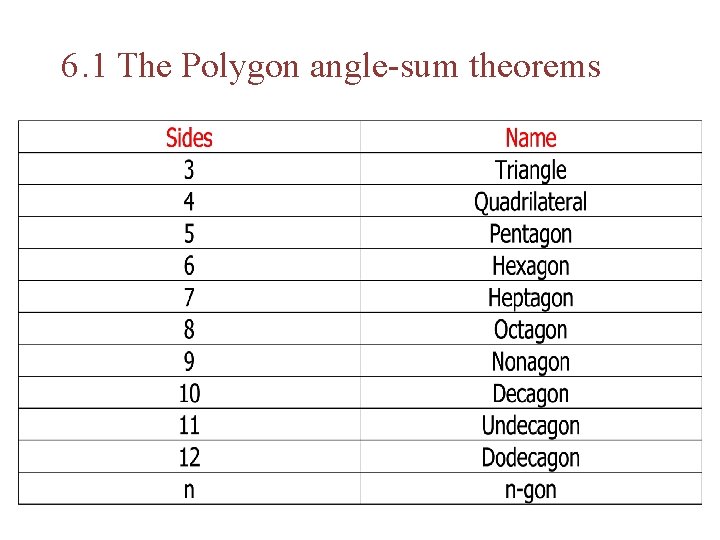
6. 1 The Polygon angle-sum theorems
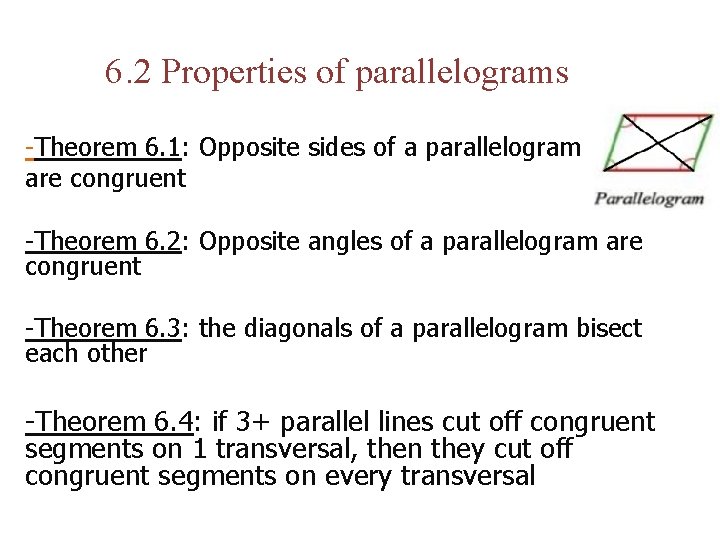
6. 2 Properties of parallelograms -Theorem 6. 1: Opposite sides of a parallelogram are congruent -Theorem 6. 2: Opposite angles of a parallelogram are congruent -Theorem 6. 3: the diagonals of a parallelogram bisect each other -Theorem 6. 4: if 3+ parallel lines cut off congruent segments on 1 transversal, then they cut off congruent segments on every transversal
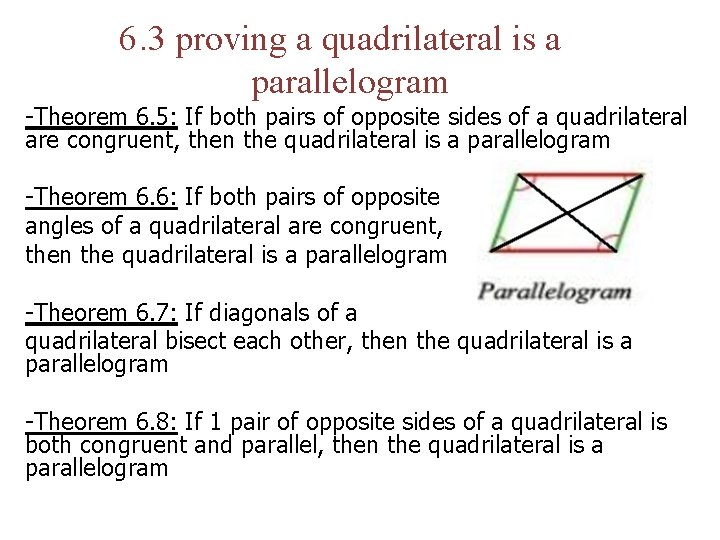
6. 3 proving a quadrilateral is a parallelogram -Theorem 6. 5: If both pairs of opposite sides of a quadrilateral are congruent, then the quadrilateral is a parallelogram -Theorem 6. 6: If both pairs of opposite angles of a quadrilateral are congruent, then the quadrilateral is a parallelogram -Theorem 6. 7: If diagonals of a quadrilateral bisect each other, then the quadrilateral is a parallelogram -Theorem 6. 8: If 1 pair of opposite sides of a quadrilateral is both congruent and parallel, then the quadrilateral is a parallelogram
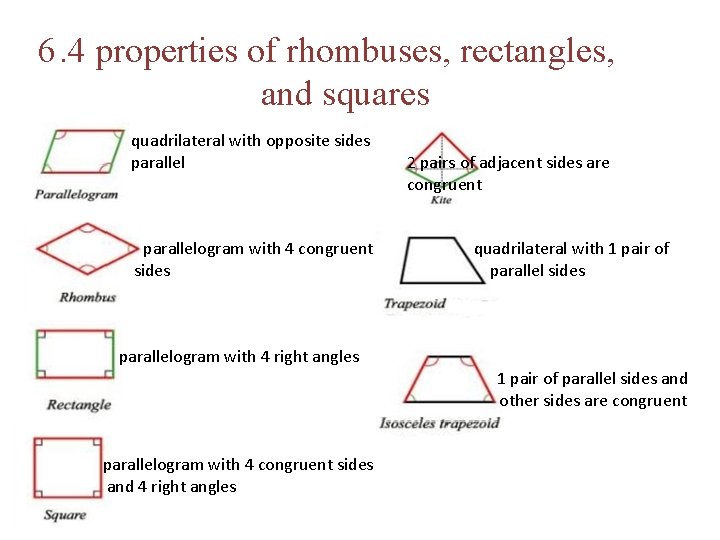
6. 4 properties of rhombuses, rectangles, and squares quadrilateral with opposite sides parallelogram with 4 congruent sides parallelogram with 4 right angles parallelogram with 4 congruent sides and 4 right angles 2 pairs of adjacent sides are congruent quadrilateral with 1 pair of parallel sides and other sides are congruent
6. 5 conditions of rhombuses, rectangles, and squares -Theorem 6. 9: Each diagonal of a rhombus bisects 2 angles of the rhombus -Theorem 6. 10: The diagonals of a rhombus are perpendicular -Theorem 6. 11: The diagonals of a rectangle are congruent -Theorem 6. 12: If 1 diagonal of a parallelogram bisects 2 angles of the parallelogram, then the parallelogram is a rhombus -Theorem 6. 13: If the diagonals of a parallelogram are perpendicular, then the parallelogram is a rhombus -Theorem 6. 14: If the diagonals of a parallelogram are congruent, then the parallelogram is a rectangle
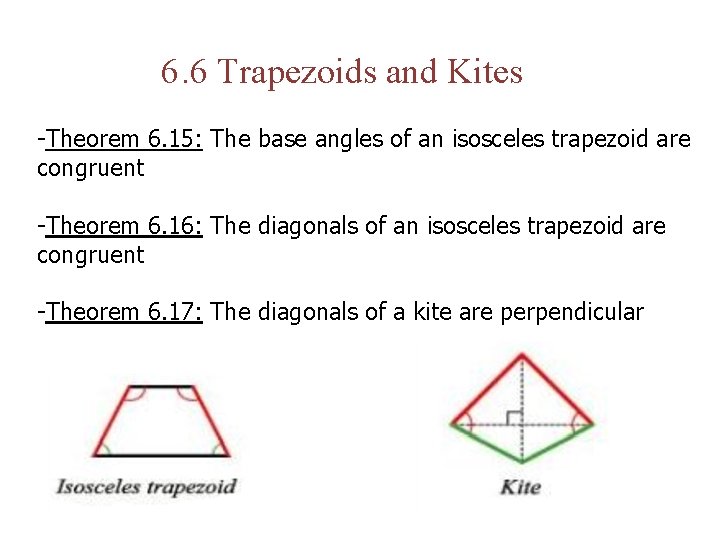
6. 6 Trapezoids and Kites -Theorem 6. 15: The base angles of an isosceles trapezoid are congruent -Theorem 6. 16: The diagonals of an isosceles trapezoid are congruent -Theorem 6. 17: The diagonals of a kite are perpendicular
- Slides: 11