
5 5 Graphing Linear Functions Warm Up Problem
5 -5 Graphing Linear Functions Warm Up Problem of the Day Lesson Presentation Lesson Quizzes

5 -5 Graphing Linear Functions Warm Up Interpret the graph. Rocket Speed A rocket is fired into the air. y x Time The rocket’s speed increases until gravity gradually slows the rocket and causes it to fall to the ground.

5 -5 Graphing Linear Functions Problem of the Day The mean of a, 31, 42, 65, and b is 51. The greatest number is 67 more than the least number. What are the missing numbers? 25 and 92
5 -5 Graphing Linear Functions Learn to identify and graph linear equations.
5 -5 Graphing Linear Functions Vocabulary linear equation linear function
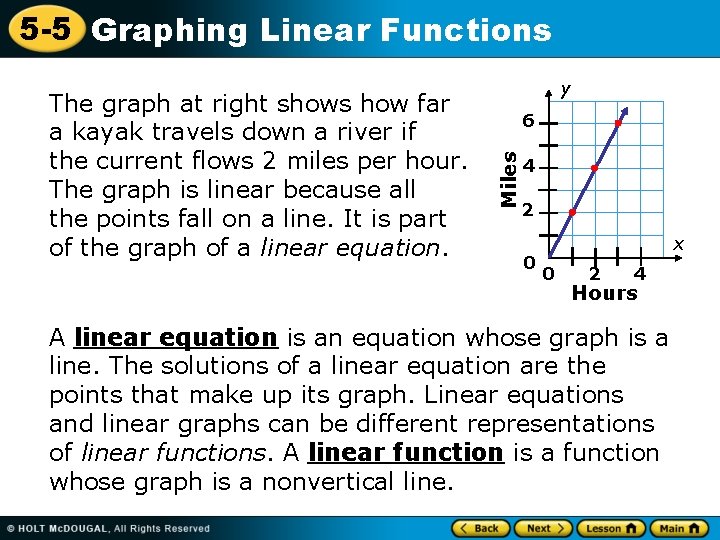
5 -5 Graphing Linear Functions 6 Miles The graph at right shows how far a kayak travels down a river if the current flows 2 miles per hour. The graph is linear because all the points fall on a line. It is part of the graph of a linear equation. y 4 2 0 x 0 2 4 Hours A linear equation is an equation whose graph is a line. The solutions of a linear equation are the points that make up its graph. Linear equations and linear graphs can be different representations of linear functions. A linear function is a function whose graph is a nonvertical line.
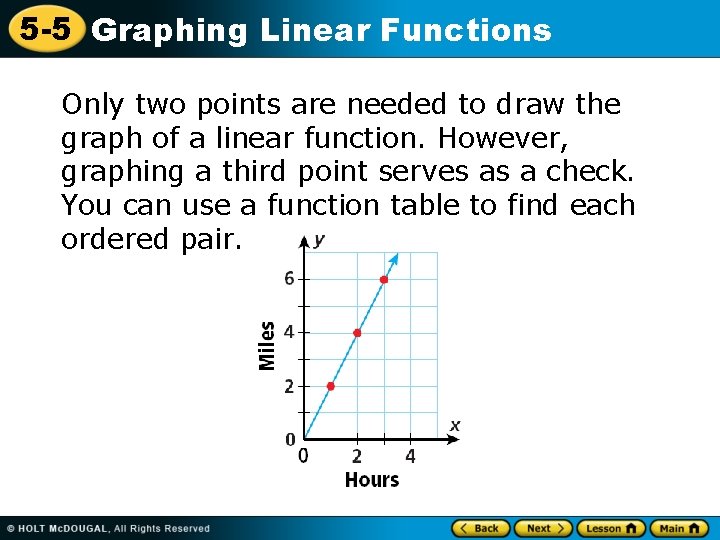
5 -5 Graphing Linear Functions Only two points are needed to draw the graph of a linear function. However, graphing a third point serves as a check. You can use a function table to find each ordered pair.
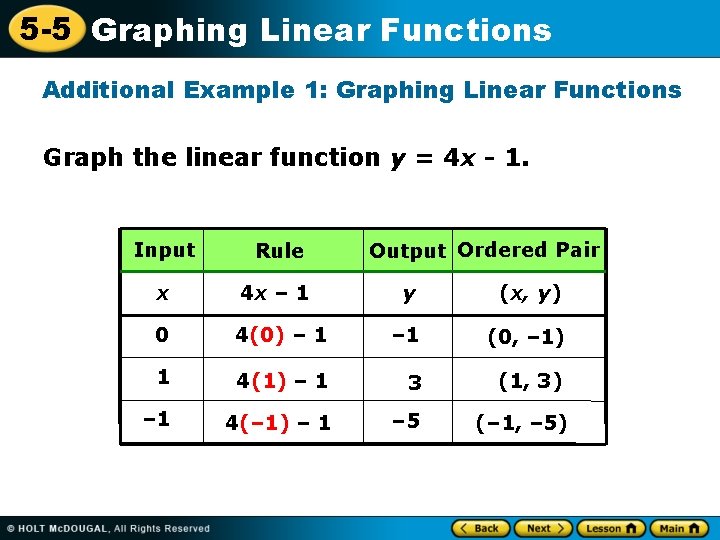
5 -5 Graphing Linear Functions Additional Example 1: Graphing Linear Functions Graph the linear function y = 4 x - 1. Input Rule x 4 x – 1 0 Output Ordered Pair y (x, y) 4(0) – 1 (0, – 1) 1 4(1) – 1 3 (1, 3) – 1 4(– 1) – 1 – 5 (– 1, – 5)
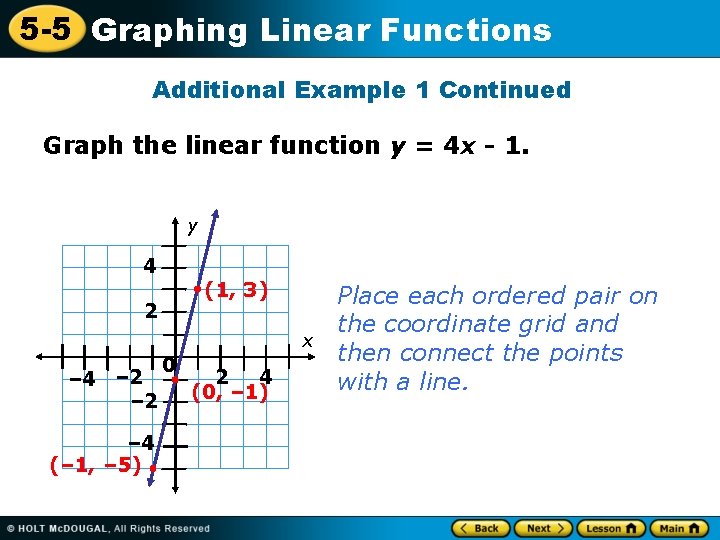
5 -5 Graphing Linear Functions Additional Example 1 Continued Graph the linear function y = 4 x - 1. y 4 (1, 3) 2 x – 4 – 2 – 4 (– 1, – 5) 0 2 4 (0, – 1) Place each ordered pair on the coordinate grid and then connect the points with a line.
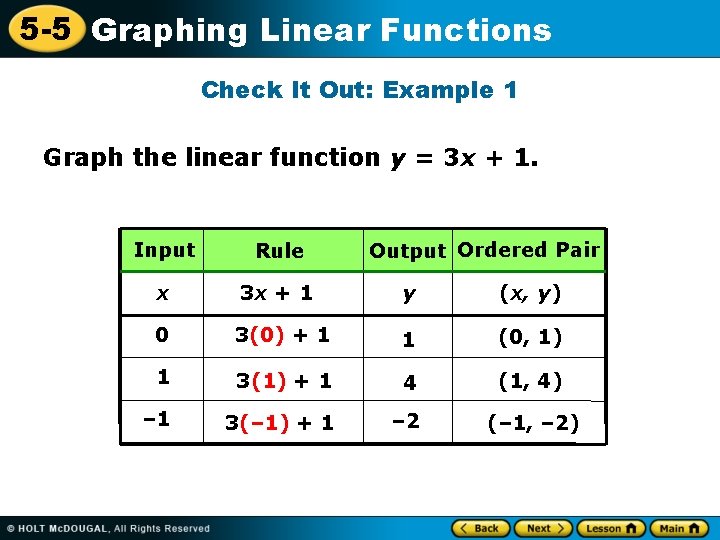
5 -5 Graphing Linear Functions Check It Out: Example 1 Graph the linear function y = 3 x + 1. Input Rule x 3 x + 1 y (x, y) 0 3(0) + 1 1 (0, 1) 1 3(1) + 1 4 (1, 4) – 1 3(– 1) + 1 – 2 (– 1, – 2) Output Ordered Pair
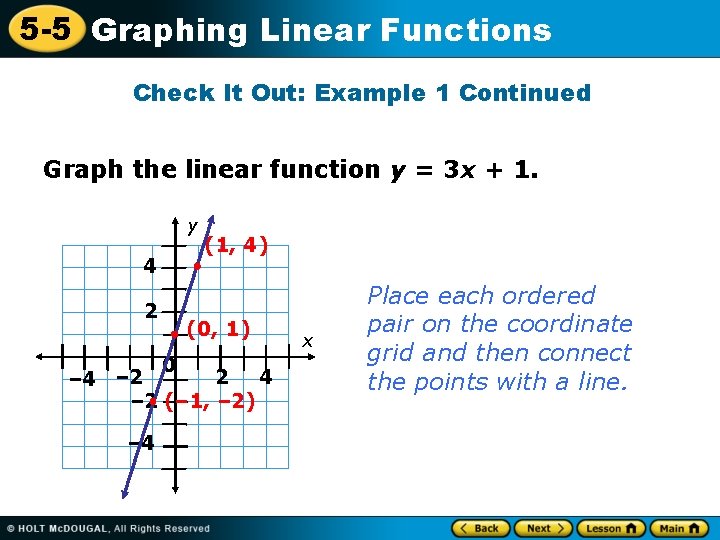
5 -5 Graphing Linear Functions Check It Out: Example 1 Continued Graph the linear function y = 3 x + 1. y 4 2 (1, 4) (0, 1) 0 2 4 – 2 – 2 (– 1, – 2) – 4 x Place each ordered pair on the coordinate grid and then connect the points with a line.
5 -5 Graphing Linear Functions Additional Example 2: Earth Science Application The fastest-moving tectonic plates on Earth move apart at a rate of 15 centimeters per year. Scientists began studying two parts of these plates when they were 30 centimeters apart. Write a linear function that describes the movement of the plates over time. Then make a graph to show the movement over 4 years. Begin by making a function table. Include a column for the rule.
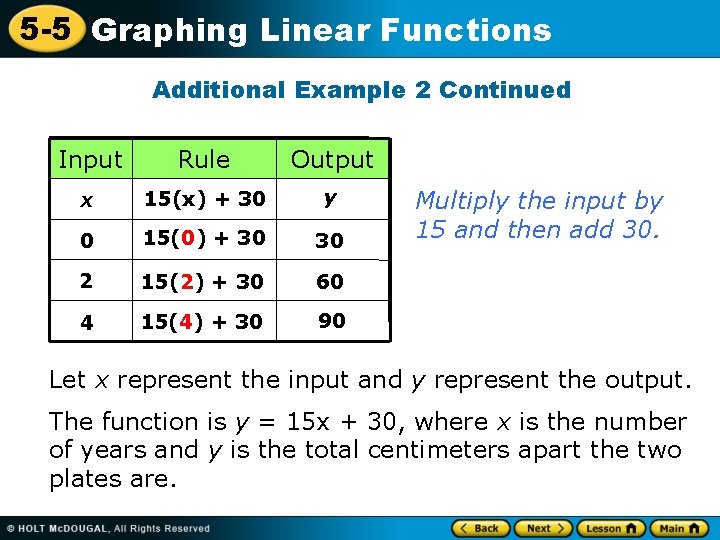
5 -5 Graphing Linear Functions Additional Example 2 Continued Input Rule Output x 15(x) + 30 y 0 15(0) + 30 30 2 15(2) + 30 60 4 15(4) + 30 90 Multiply the input by 15 and then add 30. Let x represent the input and y represent the output. The function is y = 15 x + 30, where x is the number of years and y is the total centimeters apart the two plates are.
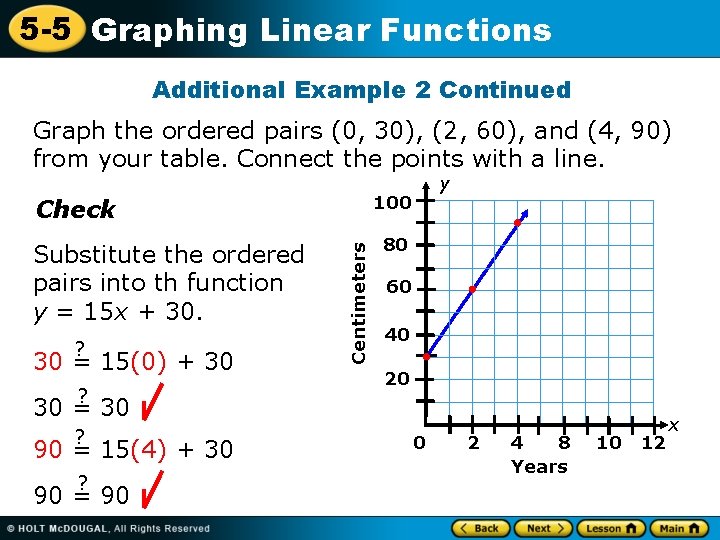
5 -5 Graphing Linear Functions Additional Example 2 Continued Graph the ordered pairs (0, 30), (2, 60), and (4, 90) from your table. Connect the points with a line. 100 ? 30 = 15(0) + 30 ? Centimeters Check Substitute the ordered pairs into th function y = 15 x + 30. y 80 60 40 20 30 = 30 ? 90 = 15(4) + 30 ? 90 = 90 0 2 4 8 Years 10 12 x
5 -5 Graphing Linear Functions Check It Out: Example 2 Dogs are considered to age 7 years for each human year. If a dog is 3 years old today, how old in human years will it be in 4 more years? Write a linear equation which would show this relationship. Then make a graph to show the dog will age in human years over the next 4 years. Begin by making a function table. Include a column for the rule.
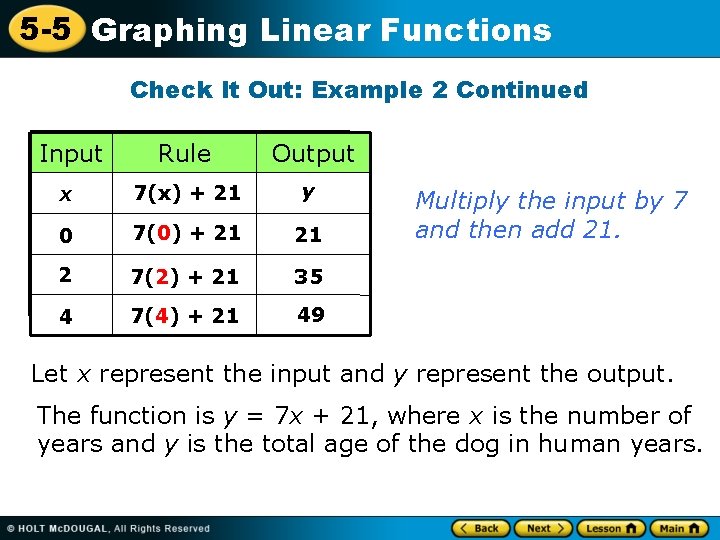
5 -5 Graphing Linear Functions Check It Out: Example 2 Continued Input Rule Output x 7(x) + 21 y 0 7(0) + 21 21 2 7(2) + 21 35 4 7(4) + 21 49 Multiply the input by 7 and then add 21. Let x represent the input and y represent the output. The function is y = 7 x + 21, where x is the number of years and y is the total age of the dog in human years.
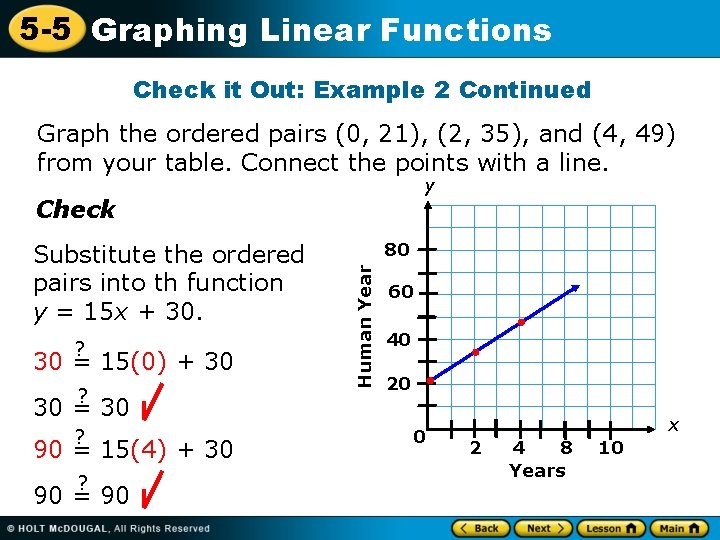
5 -5 Graphing Linear Functions Check it Out: Example 2 Continued Graph the ordered pairs (0, 21), (2, 35), and (4, 49) from your table. Connect the points with a line. y Check ? 30 = 15(0) + 30 ? 30 = 30 ? 90 = 15(4) + 30 ? 90 = 90 80 Human Year Substitute the ordered pairs into th function y = 15 x + 30. 60 40 20 0 x 2 4 8 Years 10

5 -5 Graphing Linear Functions Lesson Quizzes Standard Lesson Quiz for Student Response Systems
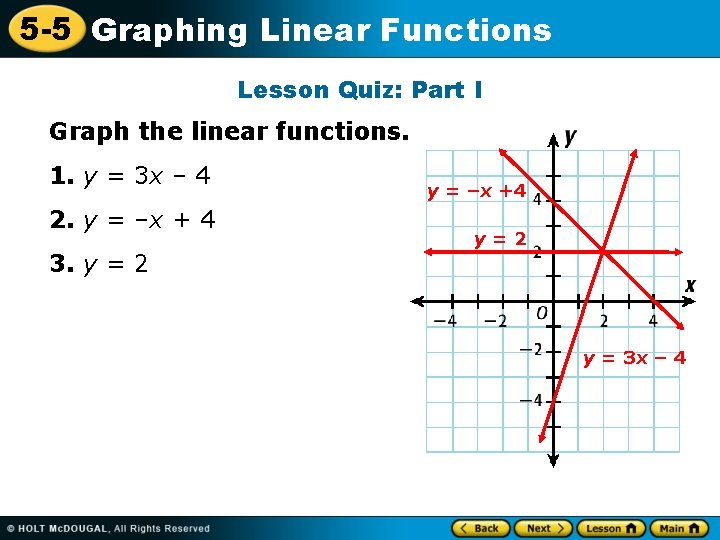
5 -5 Graphing Linear Functions Lesson Quiz: Part I Graph the linear functions. 1. y = 3 x – 4 2. y = –x + 4 3. y = 2 y = –x +4 y=2 y = 3 x – 4
5 -5 Graphing Linear Functions Lesson Quiz: Part II 4. The temperature of a liquid is decreasing at a rate of 12°F per hour. Susan begins measuring the liquid at 200°F. Write a linear function that describes the change in temperature over time. Then make a graph to show the temperature over 5 hours. y = 200 – 12 x
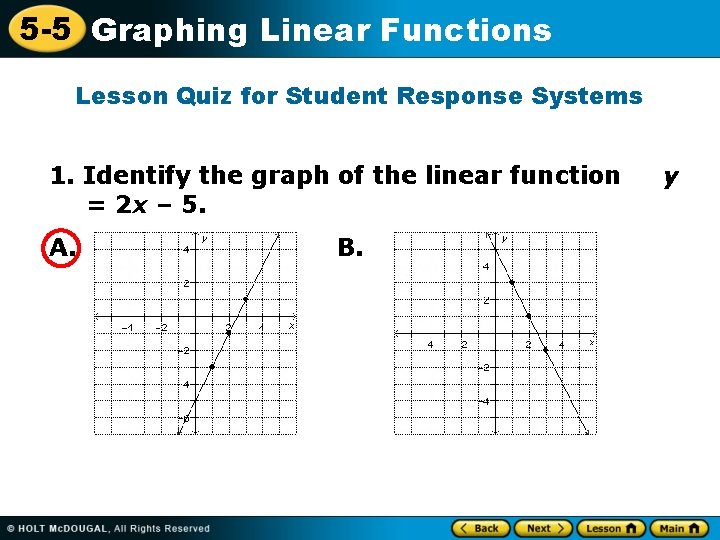
5 -5 Graphing Linear Functions Lesson Quiz for Student Response Systems 1. Identify the graph of the linear function = 2 x – 5. A. B. y
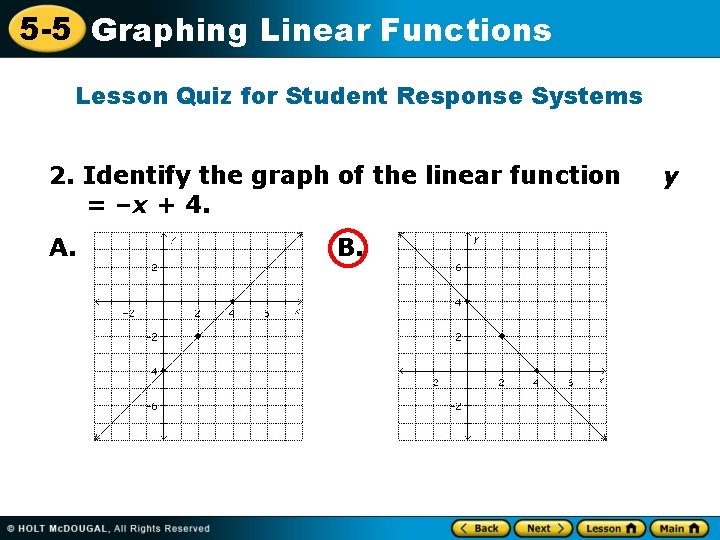
5 -5 Graphing Linear Functions Lesson Quiz for Student Response Systems 2. Identify the graph of the linear function = –x + 4. A. B. y
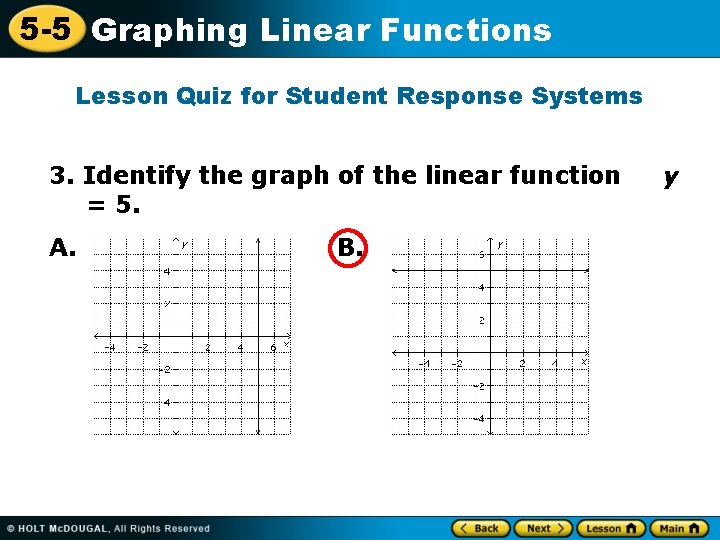
5 -5 Graphing Linear Functions Lesson Quiz for Student Response Systems 3. Identify the graph of the linear function = 5. A. B. y
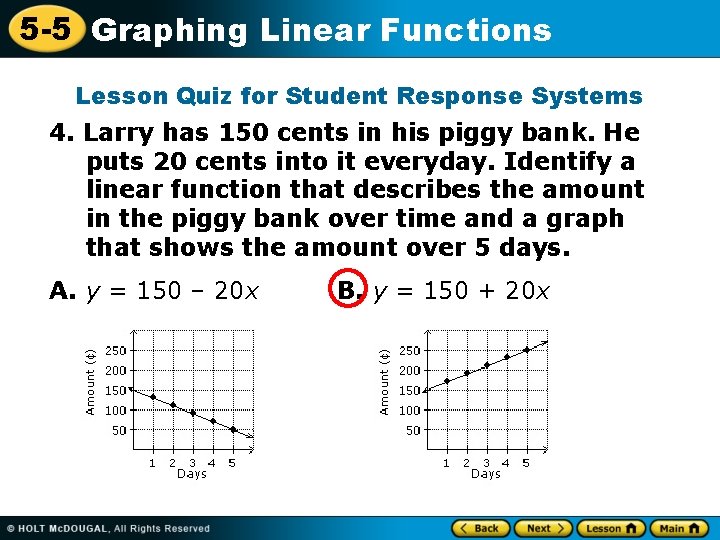
5 -5 Graphing Linear Functions Lesson Quiz for Student Response Systems 4. Larry has 150 cents in his piggy bank. He puts 20 cents into it everyday. Identify a linear function that describes the amount in the piggy bank over time and a graph that shows the amount over 5 days. A. y = 150 – 20 x B. y = 150 + 20 x
- Slides: 24