
5 4 The Spread of Greek Culture What


- Slides: 13
5. 4 The Spread of Greek Culture
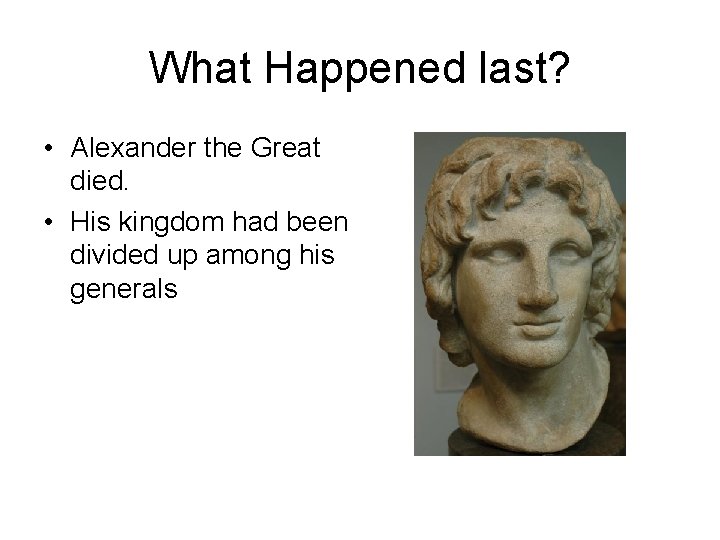
What Happened last? • Alexander the Great died. • His kingdom had been divided up among his generals
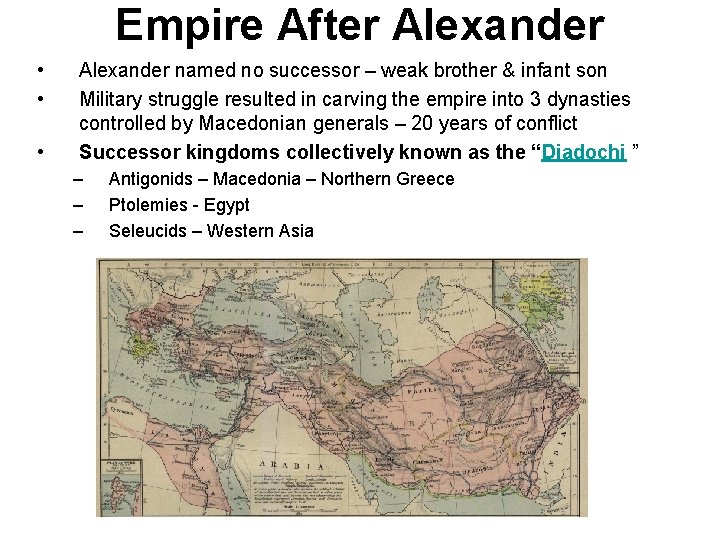
Empire After Alexander • • • Alexander named no successor – weak brother & infant son Military struggle resulted in carving the empire into 3 dynasties controlled by Macedonian generals – 20 years of conflict Successor kingdoms collectively known as the “Diadochi ” – – – Antigonids – Macedonia – Northern Greece Ptolemies - Egypt Seleucids – Western Asia
Significance of the Hellenistic Era • Spread of Greek culture throughout the eastern Mediterranean & Near East • Shift from a culture dominated by ethnic Greeks to a culture dominated by Greek-speakers of various ethnicities • Blending of Greek culture with Near Eastern influences • Shift from the political dominance of the city-state to that of larger monarchies • Cultural centers shifted away from mainland Greece to cosmopolitan cities • New religious, philosophical and
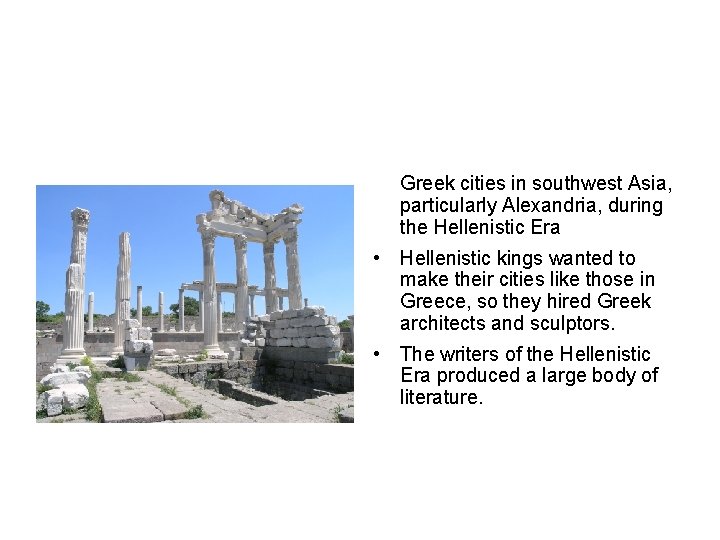
• Philosophers, poets, scientists, and writers moved to the new Greek cities in southwest Asia, particularly Alexandria, during the Hellenistic Era • Hellenistic kings wanted to make their cities like those in Greece, so they hired Greek architects and sculptors. • The writers of the Hellenistic Era produced a large body of literature.
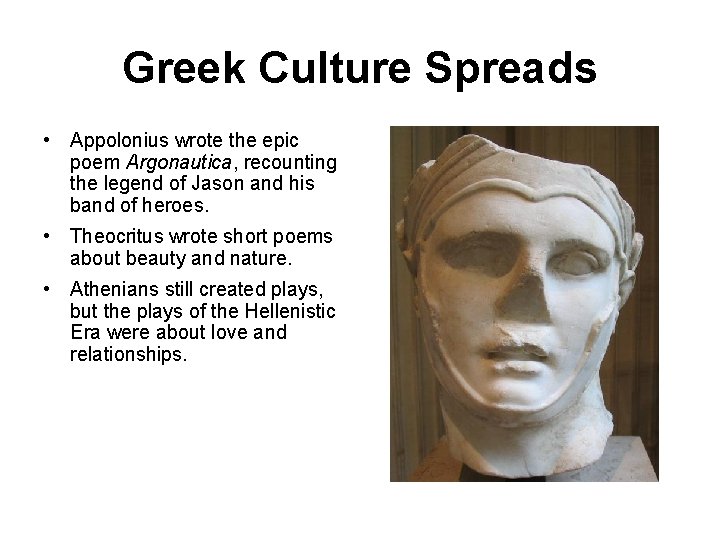
Greek Culture Spreads • Appolonius wrote the epic poem Argonautica, recounting the legend of Jason and his band of heroes. • Theocritus wrote short poems about beauty and nature. • Athenians still created plays, but the plays of the Hellenistic Era were about love and relationships.
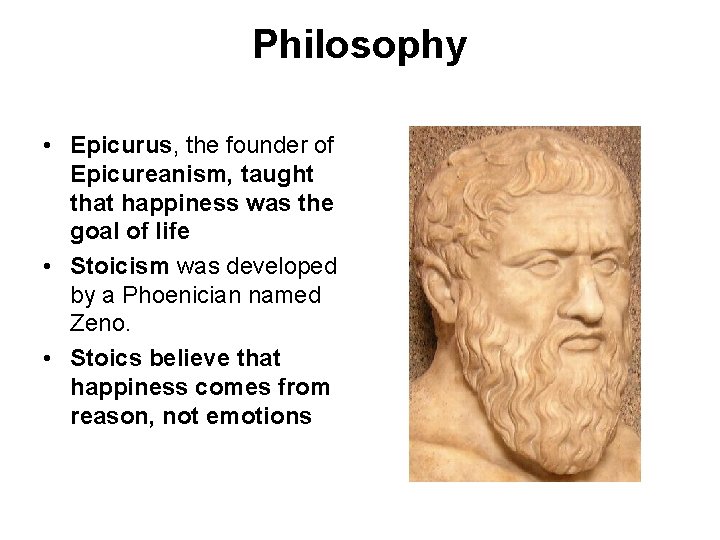
Philosophy • Epicurus, the founder of Epicureanism, taught that happiness was the goal of life • Stoicism was developed by a Phoenician named Zeno. • Stoics believe that happiness comes from reason, not emotions
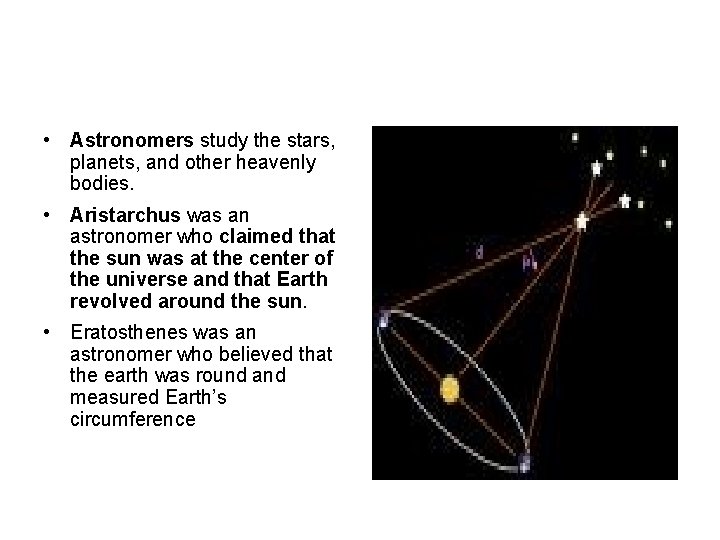
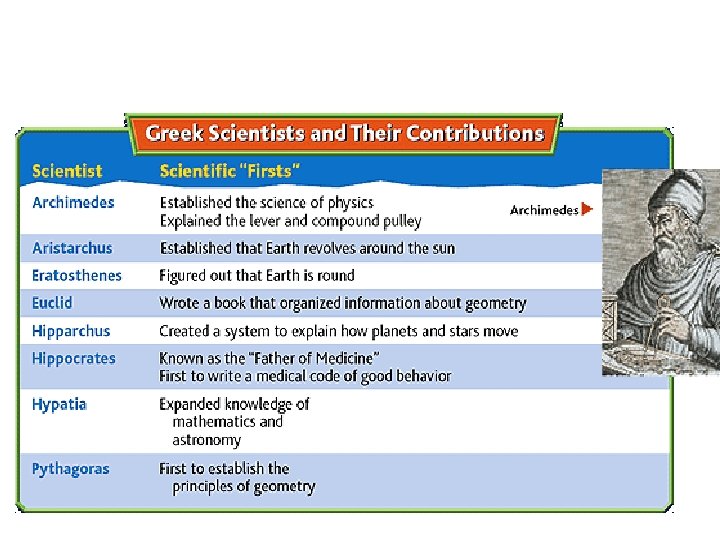
• Astronomers study the stars, planets, and other heavenly bodies. • Aristarchus was an astronomer who claimed that the sun was at the center of the universe and that Earth revolved around the sun. • Eratosthenes was an astronomer who believed that the earth was round and measured Earth’s circumference.
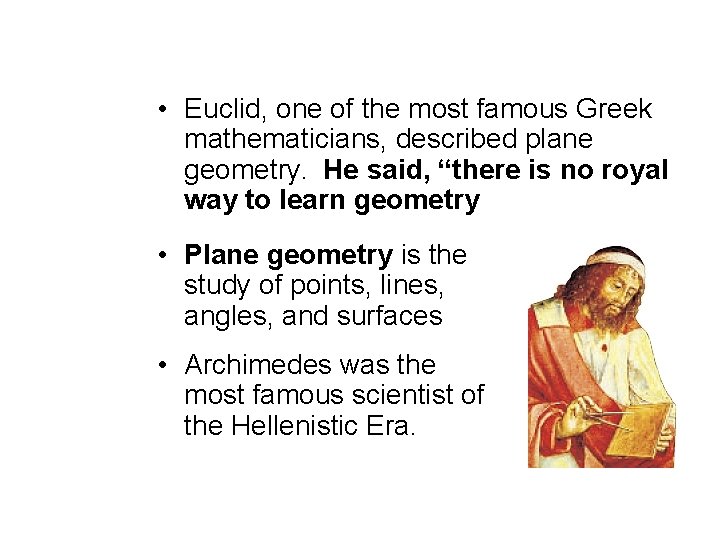
• Euclid, one of the most famous Greek mathematicians, described plane geometry. He said, “there is no royal way to learn geometry. ” • Plane geometry is the study of points, lines, angles, and surfaces. • Archimedes was the most famous scientist of the Hellenistic Era.
The Spread of Greek Culture Greek Science and Math • He worked on solid geometry—the study of spheres and cylinders. • He also determined the value of pi, a number used to measure the area of circles. • Archimedes invented the catapult, among other weapons.
• Archimedes said, “Give me a lever and a place to stand on and I will move the earth. ”
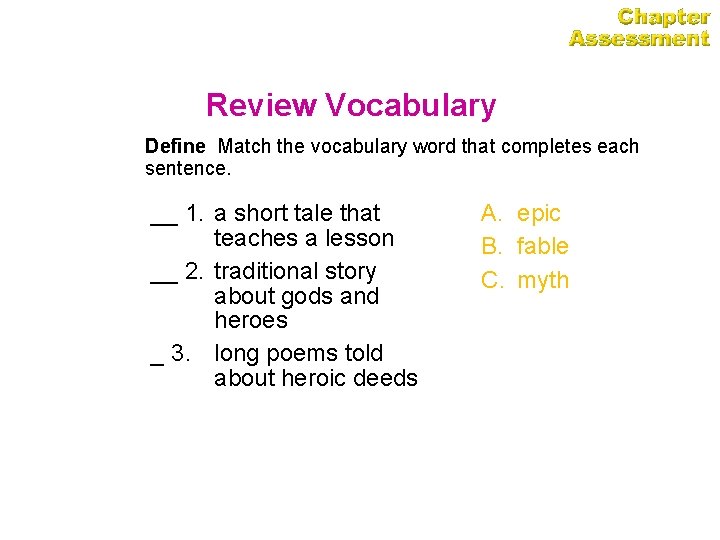
Greek Civilization Review Vocabulary Define Match the vocabulary word that completes each sentence. __ 1. a short tale that teaches a lesson __ 2. traditional story about gods and heroes _ 3. long poems told about heroic deeds A. epic B. fable C. myth