
5 4 Asexual Reproduction KEY CONCEPT Many organisms


- Slides: 14
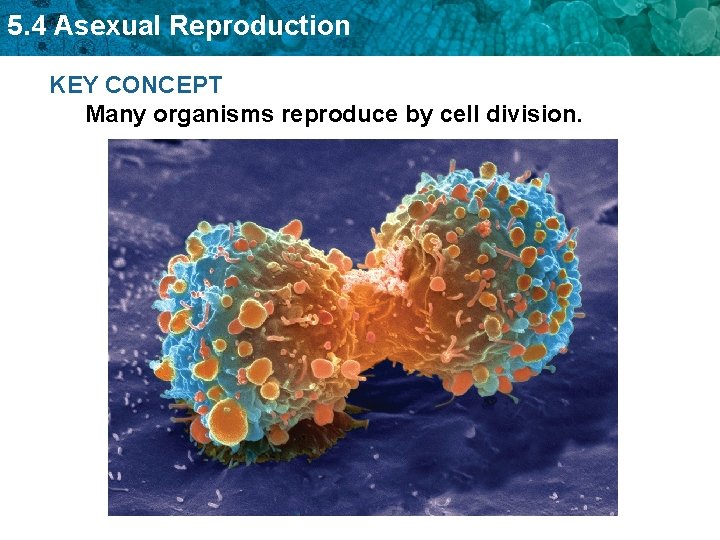
5. 4 Asexual Reproduction KEY CONCEPT Many organisms reproduce by cell division.
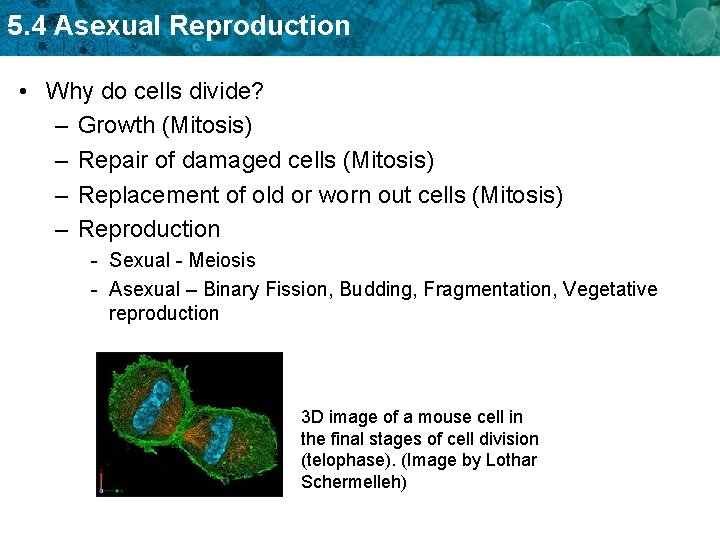
5. 4 Asexual Reproduction • Why do cells divide? – Growth (Mitosis) – Repair of damaged cells (Mitosis) – Replacement of old or worn out cells (Mitosis) – Reproduction - Sexual - Meiosis - Asexual – Binary Fission, Budding, Fragmentation, Vegetative reproduction 3 D image of a mouse cell in the final stages of cell division (telophase). (Image by Lothar Schermelleh)
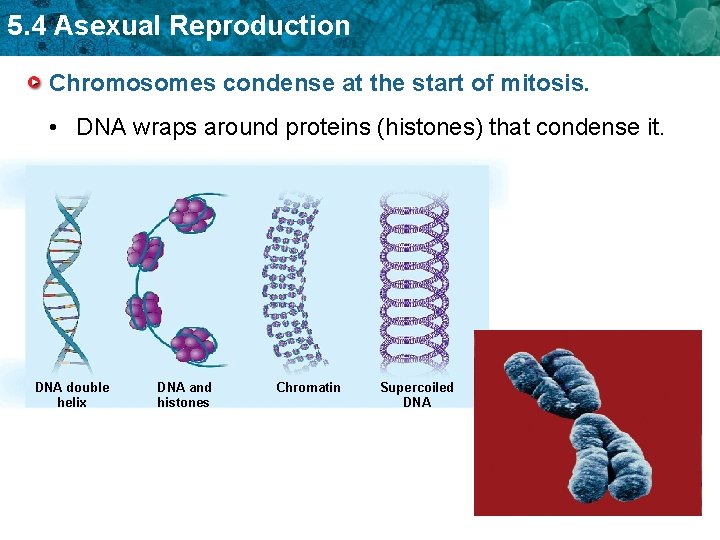
5. 4 Asexual Reproduction Chromosomes condense at the start of mitosis. • DNA wraps around proteins (histones) that condense it. DNA double helix DNA and histones Chromatin Supercoiled DNA
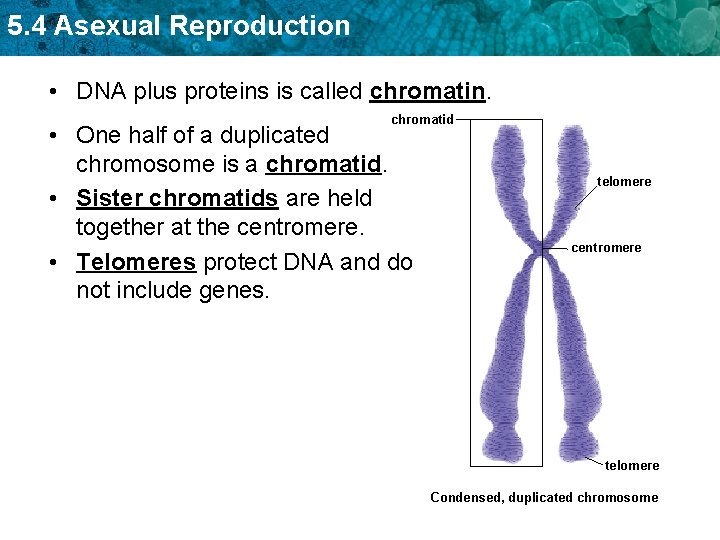
5. 4 Asexual Reproduction • DNA plus proteins is called chromatin. chromatid • One half of a duplicated chromosome is a chromatid. • Sister chromatids are held together at the centromere. • Telomeres protect DNA and do not include genes. telomere centromere telomere Condensed, duplicated chromosome
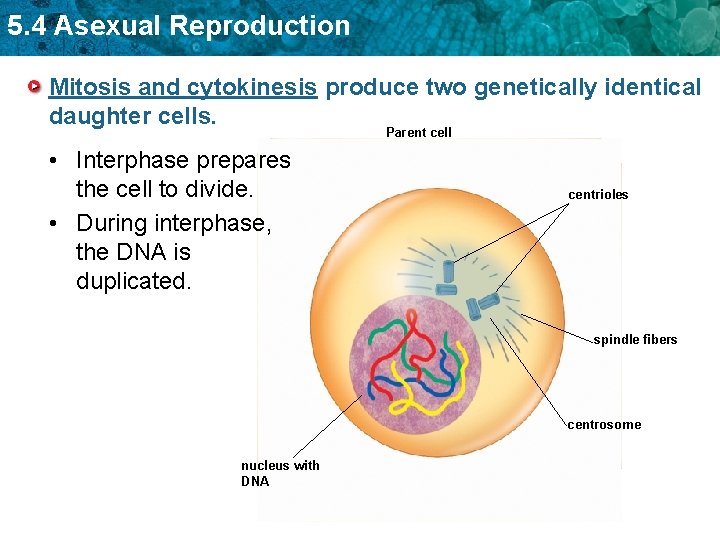
5. 4 Asexual Reproduction Mitosis and cytokinesis produce two genetically identical daughter cells. Parent cell • Interphase prepares the cell to divide. • During interphase, the DNA is duplicated. centrioles spindle fibers centrosome nucleus with DNA
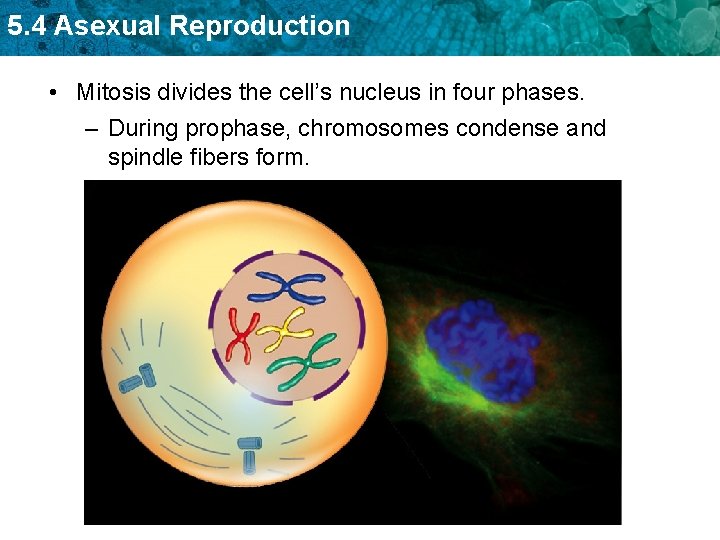
5. 4 Asexual Reproduction • Mitosis divides the cell’s nucleus in four phases. – During prophase, chromosomes condense and spindle fibers form.
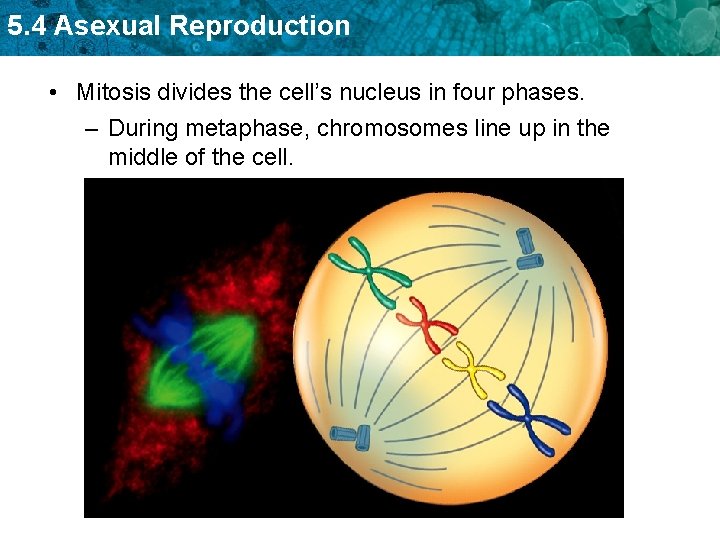
5. 4 Asexual Reproduction • Mitosis divides the cell’s nucleus in four phases. – During metaphase, chromosomes line up in the middle of the cell.
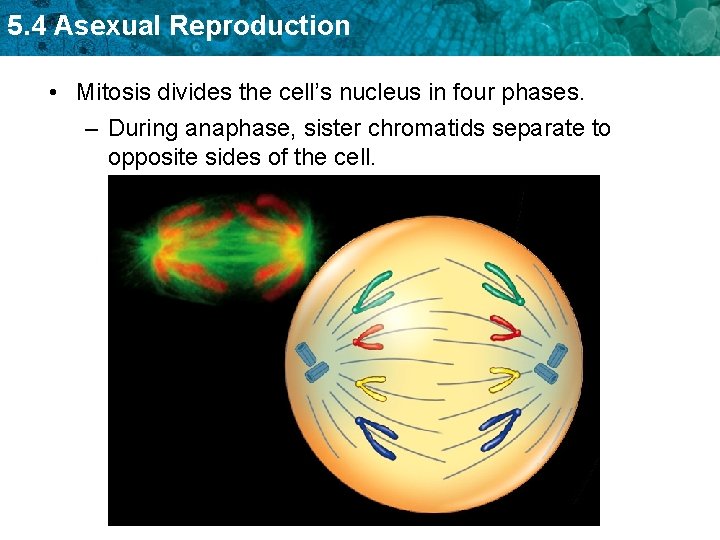
5. 4 Asexual Reproduction • Mitosis divides the cell’s nucleus in four phases. – During anaphase, sister chromatids separate to opposite sides of the cell.
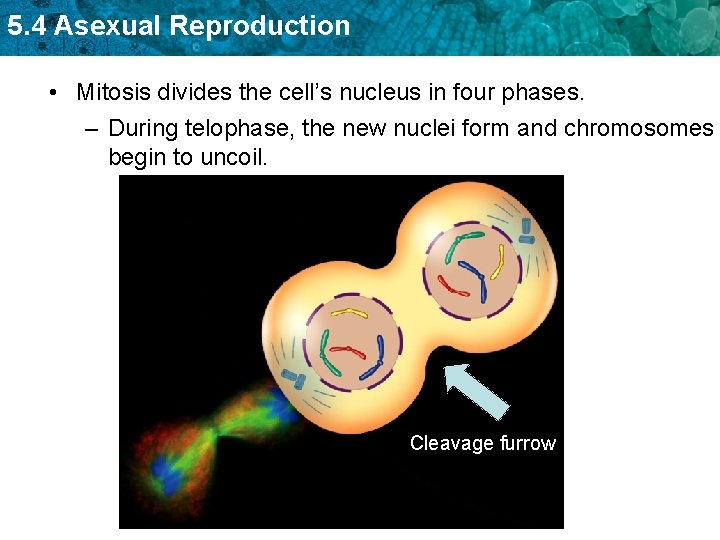
5. 4 Asexual Reproduction • Mitosis divides the cell’s nucleus in four phases. – During telophase, the new nuclei form and chromosomes begin to uncoil. Cleavage furrow
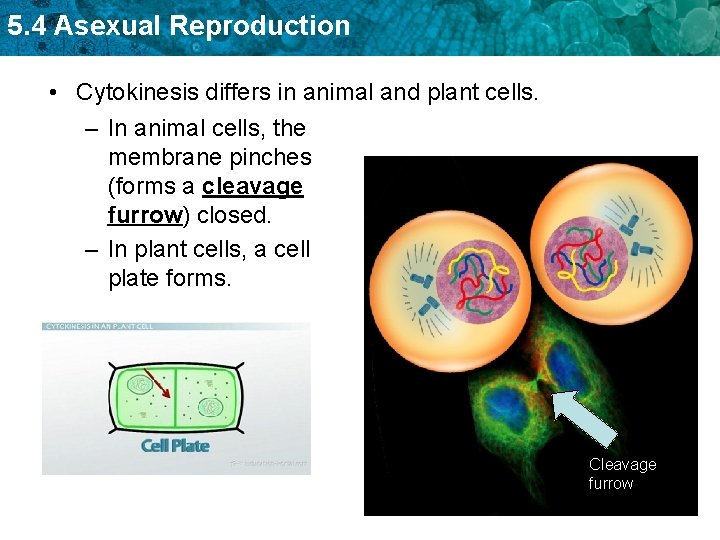
5. 4 Asexual Reproduction • Cytokinesis differs in animal and plant cells. – In animal cells, the membrane pinches (forms a cleavage furrow) closed. – In plant cells, a cell plate forms. Cleavage furrow
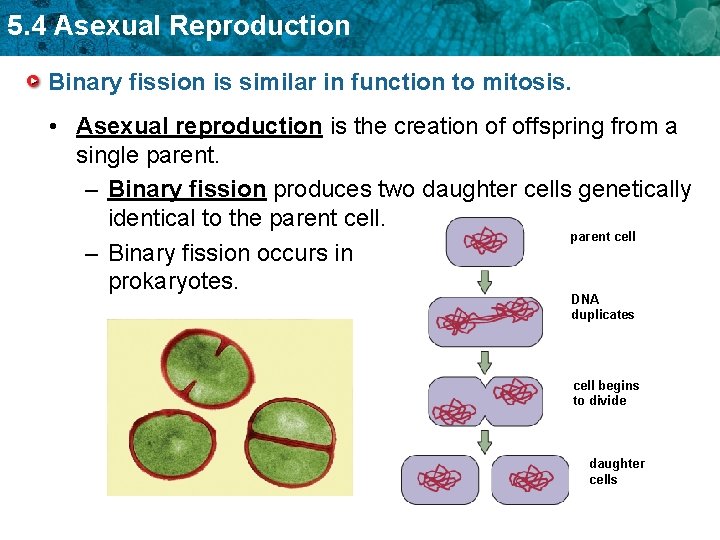
5. 4 Asexual Reproduction Binary fission is similar in function to mitosis. • Asexual reproduction is the creation of offspring from a single parent. – Binary fission produces two daughter cells genetically identical to the parent cell – Binary fission occurs in prokaryotes. DNA duplicates cell begins to divide daughter cells
5. 4 Asexual Reproduction • Environment determines what form of reproduction is most advantageous. – Asexual reproduction is an advantage in consistently favorable conditions. – Sexual reproduction is an advantage in changing conditions.
5. 4 Asexual Reproduction Some eukaryotes reproduce through mitosis. • Budding forms a new organism from a small projection growing on the surface of the parent. Hydra bud Yeast
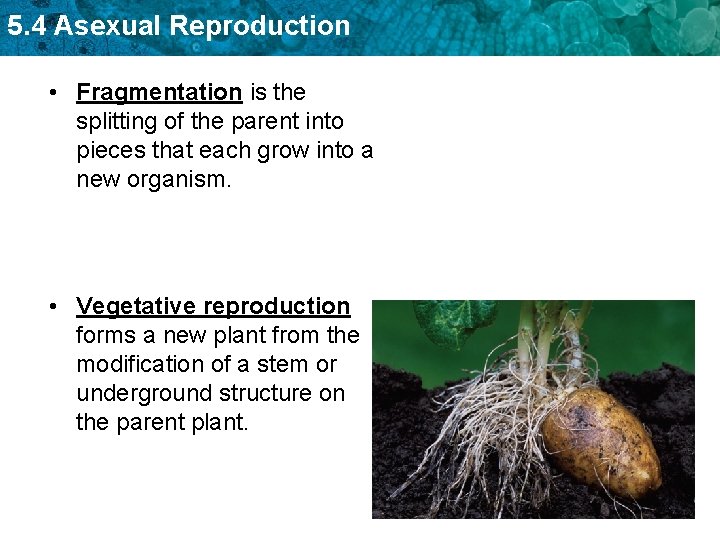
5. 4 Asexual Reproduction • Fragmentation is the splitting of the parent into pieces that each grow into a new organism. • Vegetative reproduction forms a new plant from the modification of a stem or underground structure on the parent plant.