
5 3 Notes Continued Objectives Identify the role
5. 3 Notes Continued… • Objectives – Identify the role of fermentation in the second stage of cellular respiration. – Evaluate the importance of oxygen in aerobic respiration. Chapter menu Resources Copyright © by Holt, Rinehart and Winston. All rights reserved.
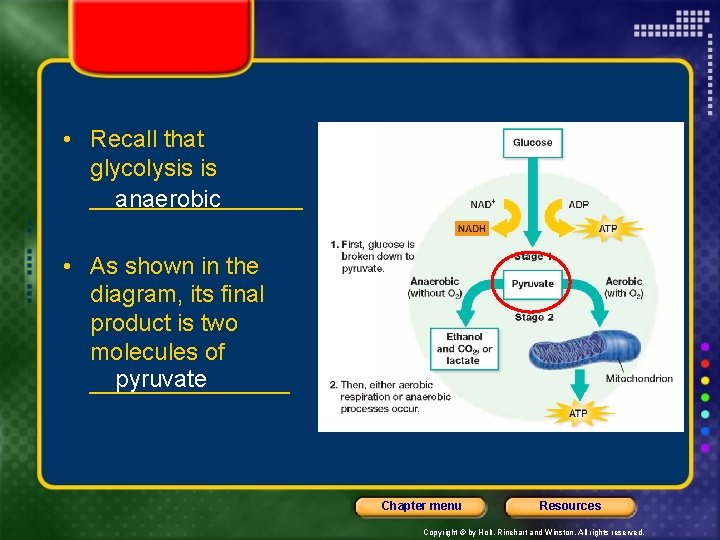
• Recall that glycolysis is ________ anaerobic • As shown in the diagram, its final product is two molecules of pyruvate ________ Chapter menu Resources Copyright © by Holt, Rinehart and Winston. All rights reserved.
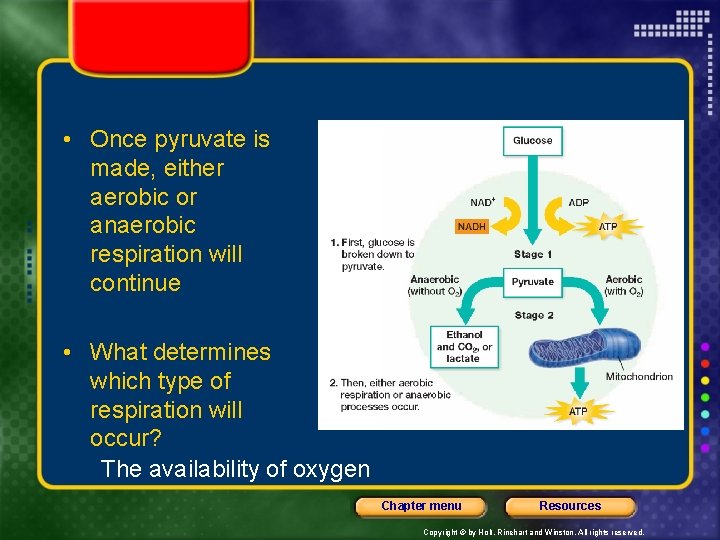
• Once pyruvate is made, either aerobic or anaerobic respiration will continue • What determines which type of respiration will occur? The availability of oxygen Chapter menu Resources Copyright © by Holt, Rinehart and Winston. All rights reserved.
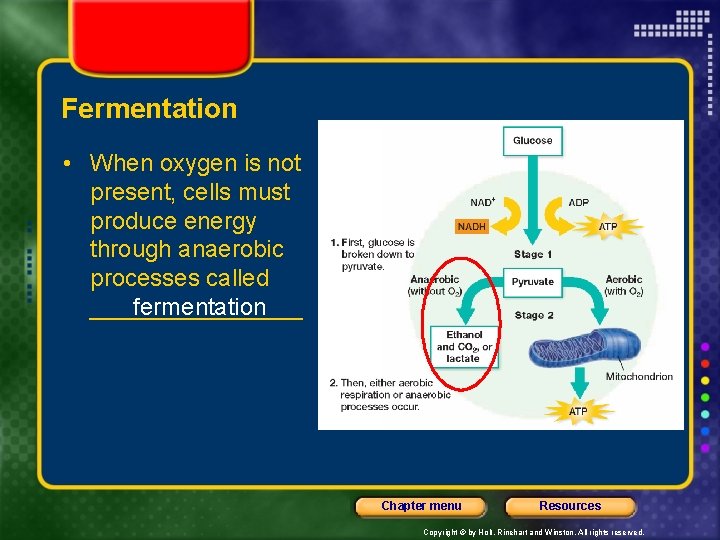
Fermentation • When oxygen is not present, cells must produce energy through anaerobic processes called fermentation ________ Chapter menu Resources Copyright © by Holt, Rinehart and Winston. All rights reserved.
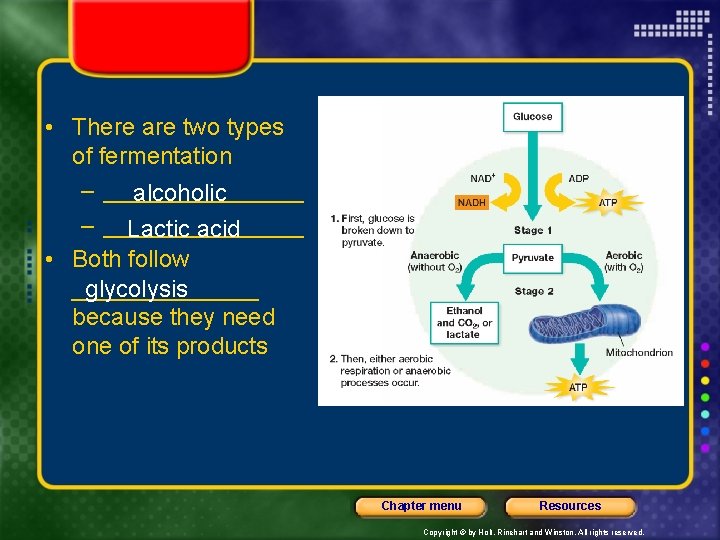
• There are two types of fermentation – ________ alcoholic – ________ Lactic acid • Both follow _______ glycolysis because they need one of its products Chapter menu Resources Copyright © by Holt, Rinehart and Winston. All rights reserved.
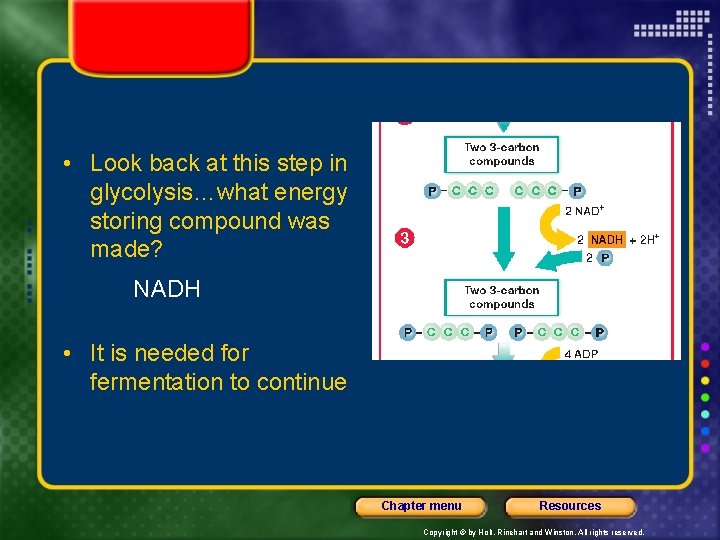
• Look back at this step in glycolysis…what energy storing compound was made? NADH • It is needed for fermentation to continue Chapter menu Resources Copyright © by Holt, Rinehart and Winston. All rights reserved.
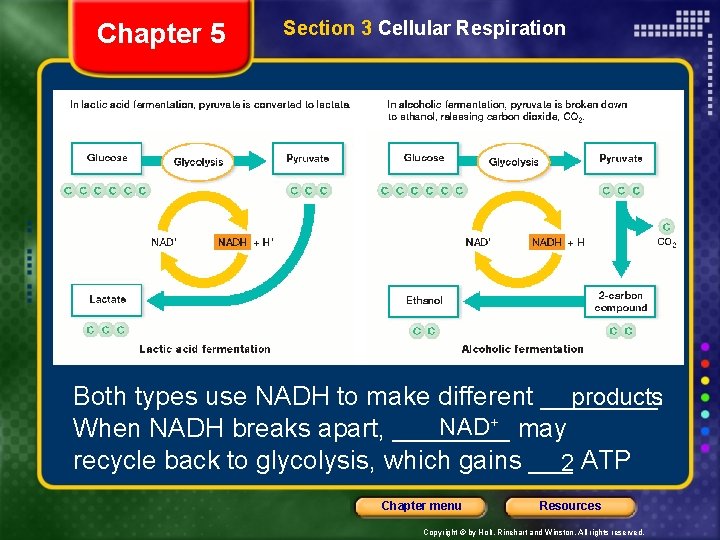
Chapter 5 Section 3 Cellular Respiration products Both types use NADH to make different ____. NAD+ may When NADH breaks apart, ____ recycle back to glycolysis, which gains ___2 ATP Chapter menu Resources Copyright © by Holt, Rinehart and Winston. All rights reserved.
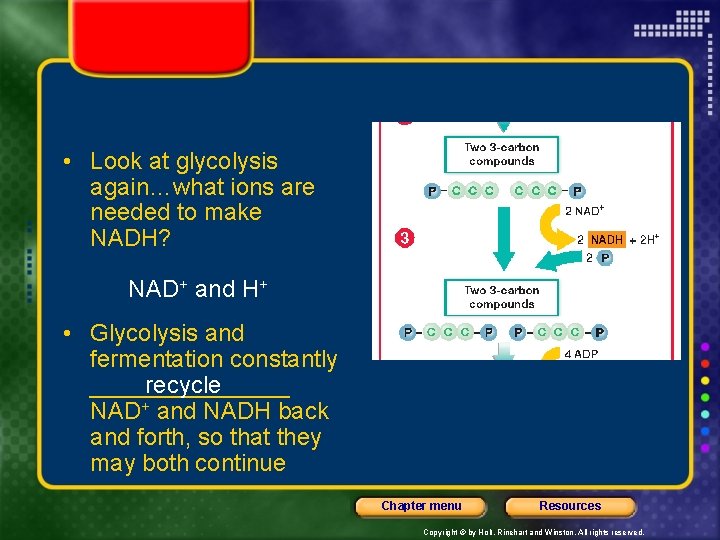
• Look at glycolysis again…what ions are needed to make NADH? NAD+ and H+ • Glycolysis and fermentation constantly recycle ________ NAD+ and NADH back and forth, so that they may both continue Chapter menu Resources Copyright © by Holt, Rinehart and Winston. All rights reserved.
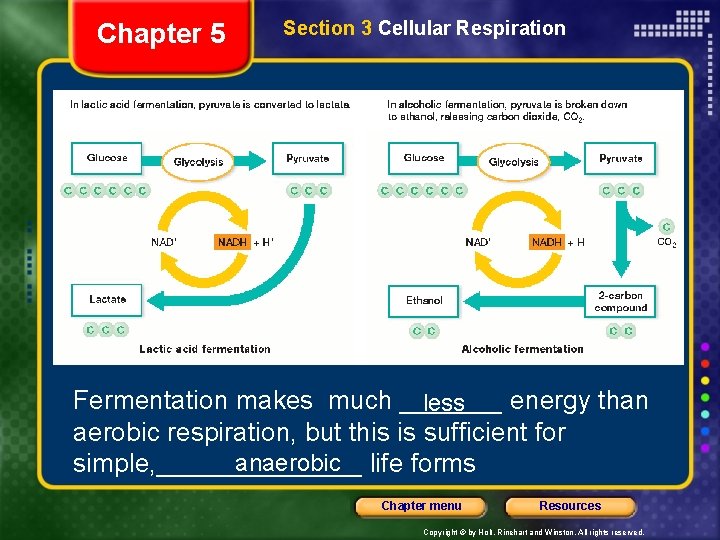
Chapter 5 Section 3 Cellular Respiration Fermentation makes much _______ energy than less aerobic respiration, but this is sufficient for anaerobic life forms simple, _______ Chapter menu Resources Copyright © by Holt, Rinehart and Winston. All rights reserved.
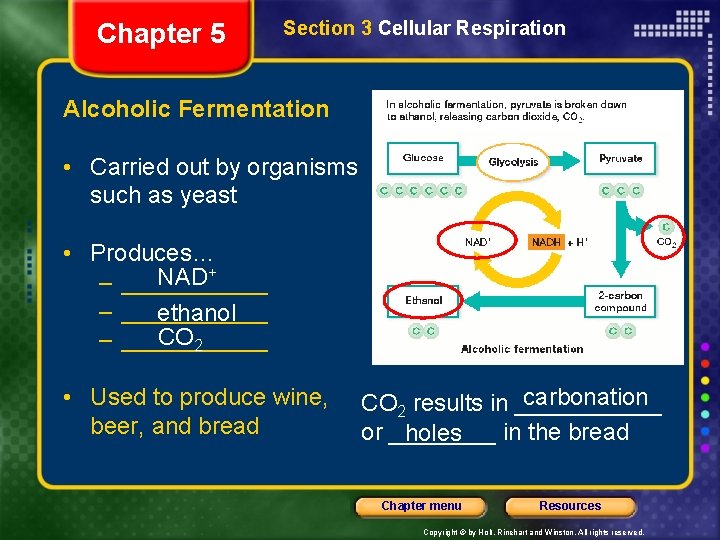
Chapter 5 Section 3 Cellular Respiration Alcoholic Fermentation • Carried out by organisms such as yeast • Produces… NAD+ – ___________ ethanol CO 2 – ______ • Used to produce wine, beer, and bread carbonation CO 2 results in ______ or ____ in the bread holes Chapter menu Resources Copyright © by Holt, Rinehart and Winston. All rights reserved.
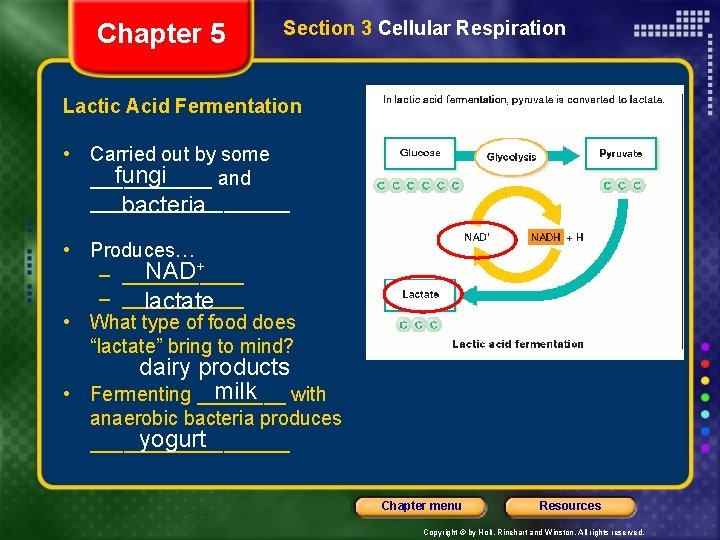
Chapter 5 Section 3 Cellular Respiration Lactic Acid Fermentation • Carried out by some fungi ______ and _________ bacteria • Produces… NAD+ – ___________ lactate • What type of food does “lactate” bring to mind? dairy products milk with • Fermenting ____ anaerobic bacteria produces yogurt _________ Chapter menu Resources Copyright © by Holt, Rinehart and Winston. All rights reserved.
Chapter 5 Section 3 Cellular Respiration Lactic Acid Fermentation • Lactic acid may also build up in ______ muscle cells • When the average person is exercising and they start to cramp, what do they do? stop • This allows your body to take in more ______, oxygen aerobic respiration and resume Chapter menu Resources Copyright © by Holt, Rinehart and Winston. All rights reserved.
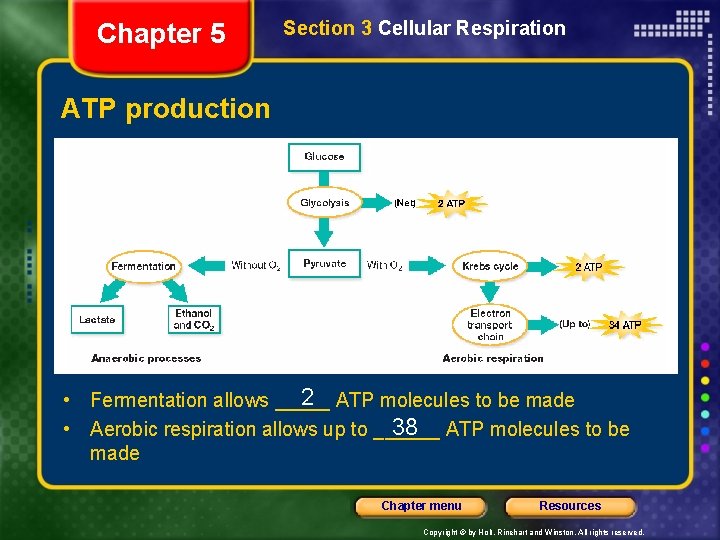
Chapter 5 Section 3 Cellular Respiration ATP production Production of ATP 2 ATP molecules to be made • Fermentation allows _____ 38 ATP molecules to be • Aerobic respiration allows up to ______ made Chapter menu Resources Copyright © by Holt, Rinehart and Winston. All rights reserved.
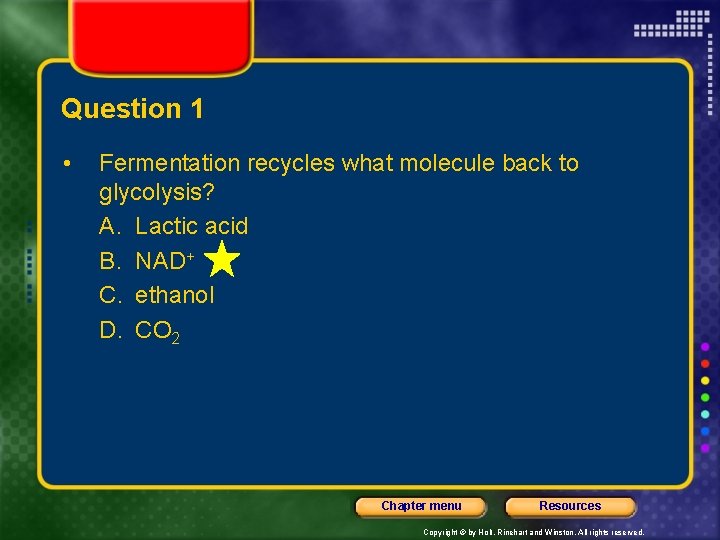
Question 1 • Fermentation recycles what molecule back to glycolysis? A. Lactic acid B. NAD+ C. ethanol D. CO 2 Chapter menu Resources Copyright © by Holt, Rinehart and Winston. All rights reserved.
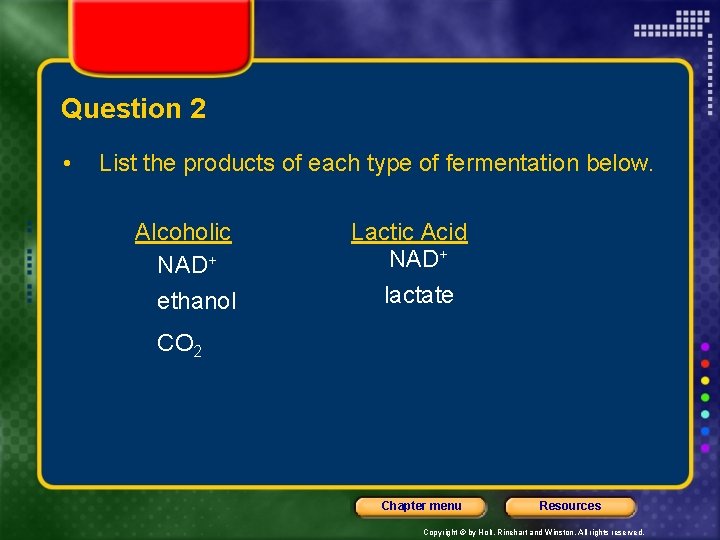
Question 2 • List the products of each type of fermentation below. Alcoholic NAD+ ethanol Lactic Acid NAD+ lactate CO 2 Chapter menu Resources Copyright © by Holt, Rinehart and Winston. All rights reserved.
- Slides: 15