
5 3 Electric cells Primary cell Designed to




- Slides: 19
5. 3 Electric cells
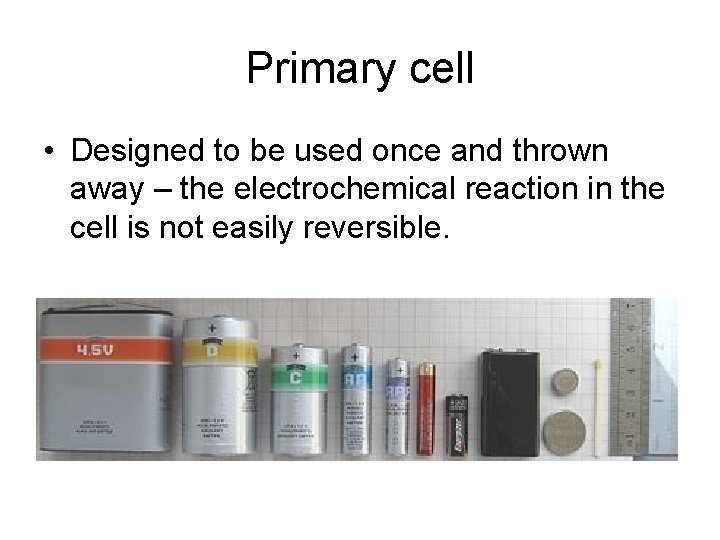
Primary cell • Designed to be used once and thrown away – the electrochemical reaction in the cell is not easily reversible.
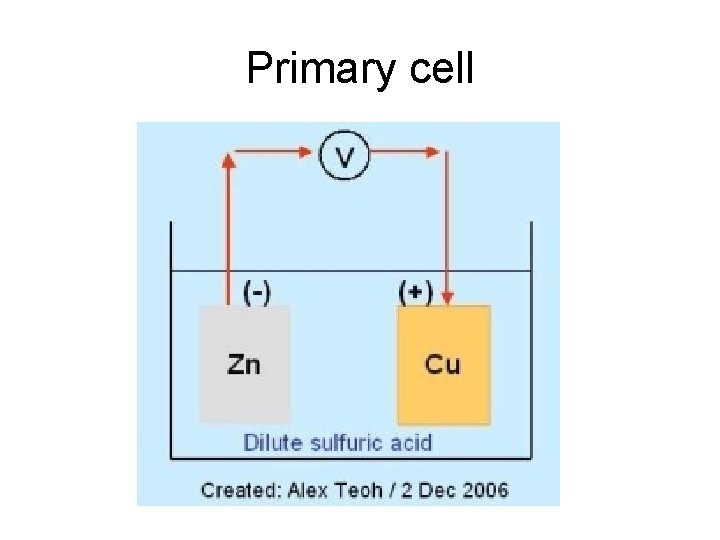
Primary cell
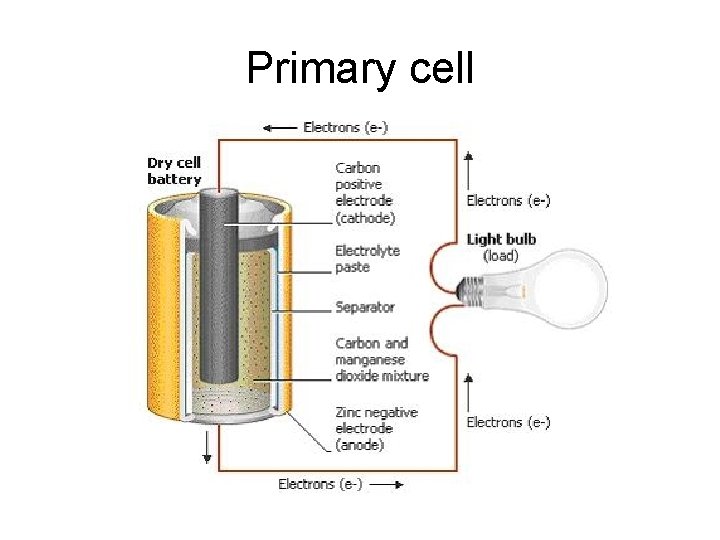
Primary cell
5. 3 Discharge characteristics.
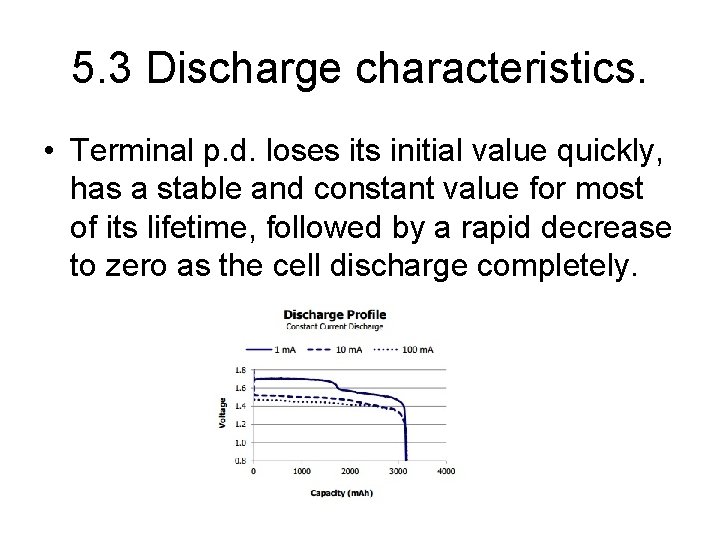
5. 3 Discharge characteristics. • Terminal p. d. loses its initial value quickly, has a stable and constant value for most of its lifetime, followed by a rapid decrease to zero as the cell discharge completely.
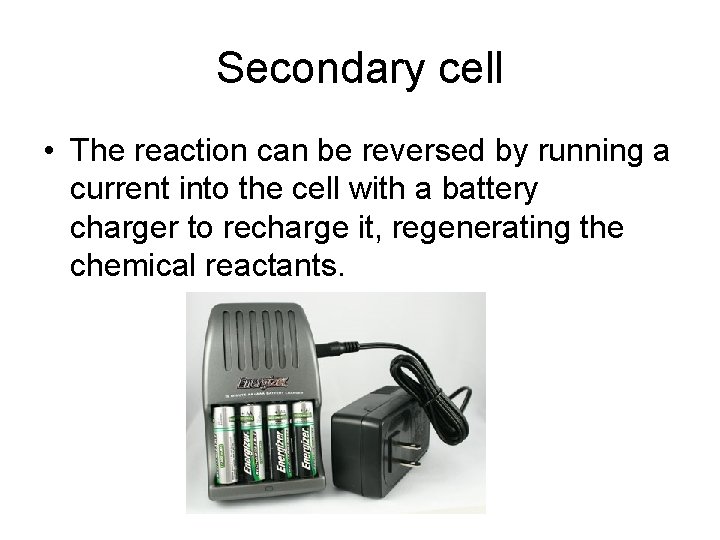
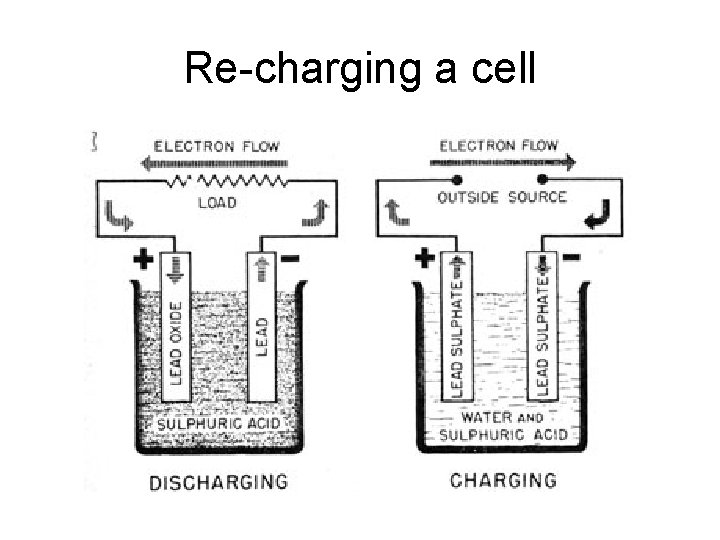
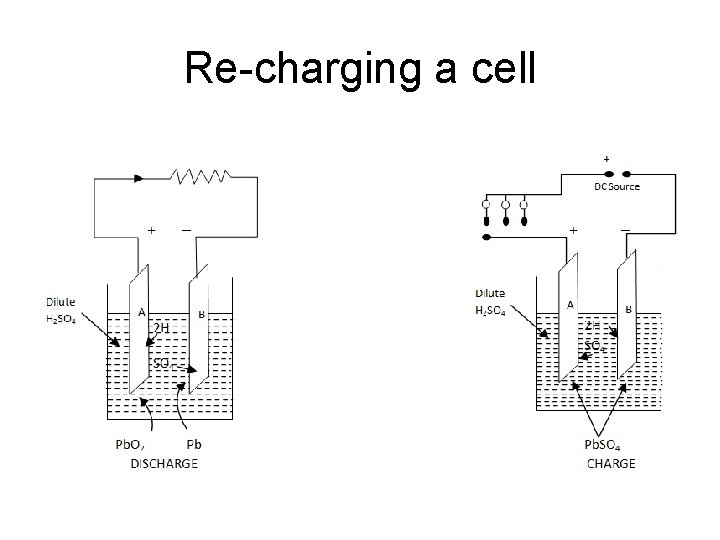
Secondary cell • The reaction can be reversed by running a current into the cell with a battery charger to recharge it, regenerating the chemical reactants.
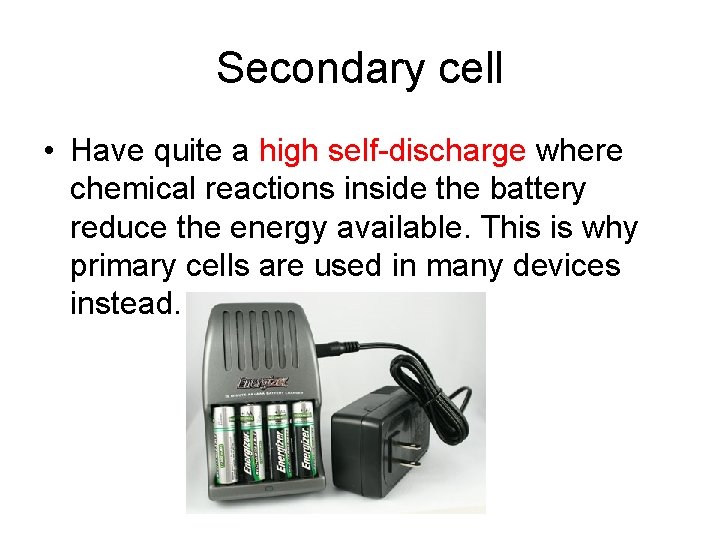
Secondary cell • Have quite a high self-discharge where chemical reactions inside the battery reduce the energy available. This is why primary cells are used in many devices instead.
Re-charging a cell
Re-charging a cell
Internal resistance
Internal resistance • We have assumed so far that the power source has no resistance……. not a good assumption!
Internal resistance • In actuality the p. d. across a cell is less than the EMF due to energy lost in the INTERNAL RESISTANCE
Internal resistance • To help us visualize this, a cell is represented as a “perfect” cell of emf ε attached in series to the internal resistance, given the symbol r.
Internal resistance • Using Kirchoff’s 2 nd law, the emf (ε) of the “perfect” cell is equal to the sum of the p. d. s around the circuit. ε = IR + Ir ε = I(R + r)
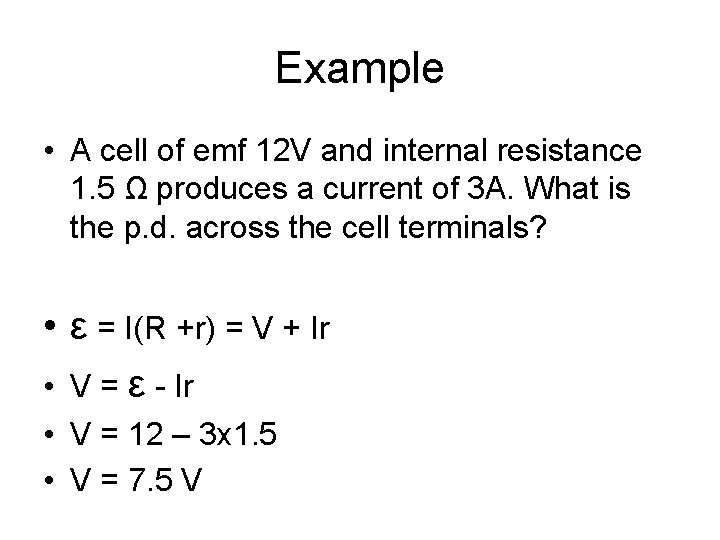
Example • A cell of emf 12 V and internal resistance 1. 5 Ω produces a current of 3 A. What is the p. d. across the cell terminals? • ε = I(R +r) = V + Ir • V = ε - Ir • V = 12 – 3 x 1. 5 • V = 7. 5 V
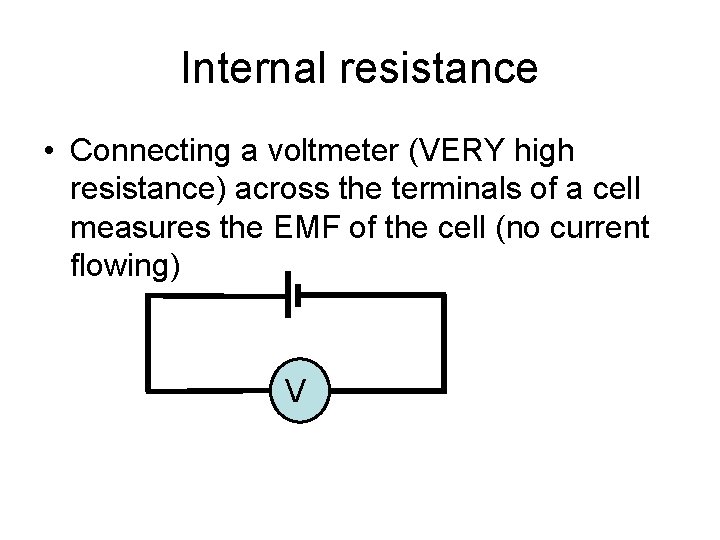
Internal resistance • Connecting a voltmeter (VERY high resistance) across the terminals of a cell measures the EMF of the cell (no current flowing) V
5. 3 Measuring internal resistance
5. 3 Internal resistance questions