
5 2 THE DEFINITE INTEGRAL AREAS USING LIMITS
- Slides: 19
5. 2 THE DEFINITE INTEGRAL AREAS USING LIMITS
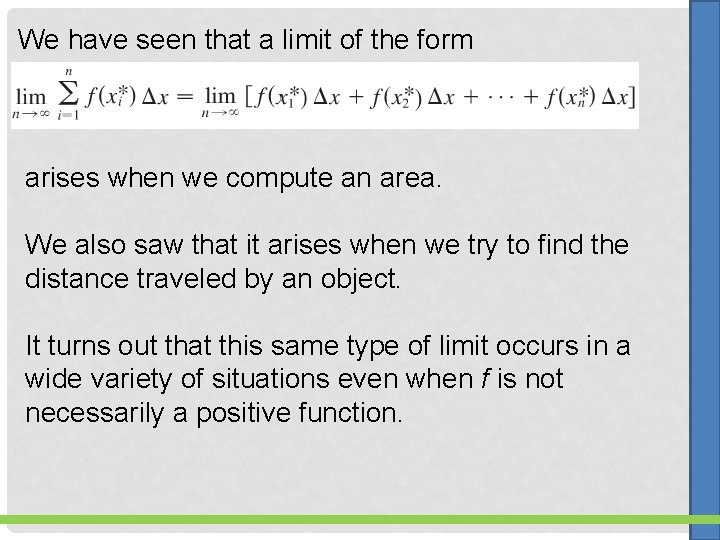
We have seen that a limit of the form arises when we compute an area. We also saw that it arises when we try to find the distance traveled by an object. It turns out that this same type of limit occurs in a wide variety of situations even when f is not necessarily a positive function.
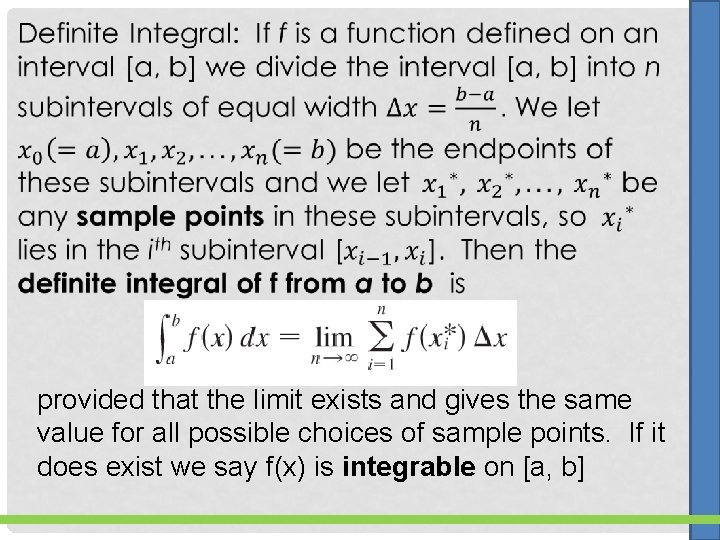
provided that the limit exists and gives the same value for all possible choices of sample points. If it does exist we say f(x) is integrable on [a, b]
The symbol was introduced by Leibniz and is called an integral sign. It is an elongated S and was chosen because an integral is a limit of sums. f(x) is called the integrand (the function inside the integral symbol, a and b are the limits of integration (lower and upper, respectively) and the dx refers to what variable you are integrating with respect to. The procedure of calculating an integral is called integration.
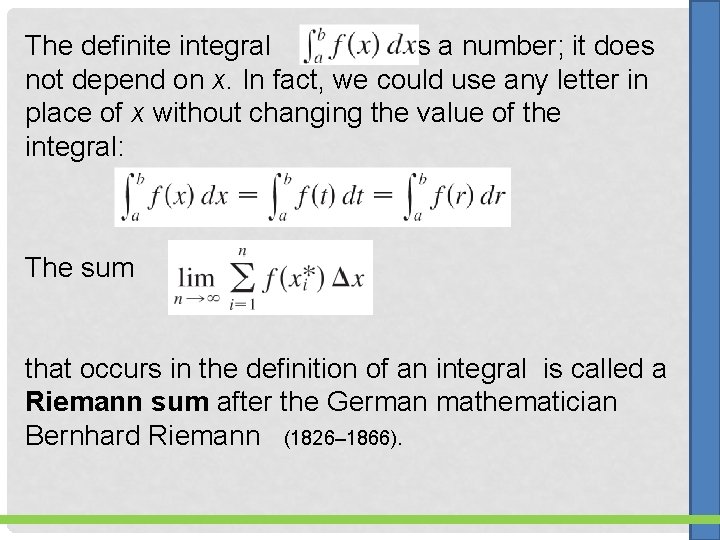
The definite integral is a number; it does not depend on x. In fact, we could use any letter in place of x without changing the value of the integral: The sum that occurs in the definition of an integral is called a Riemann sum after the German mathematician Bernhard Riemann (1826– 1866).
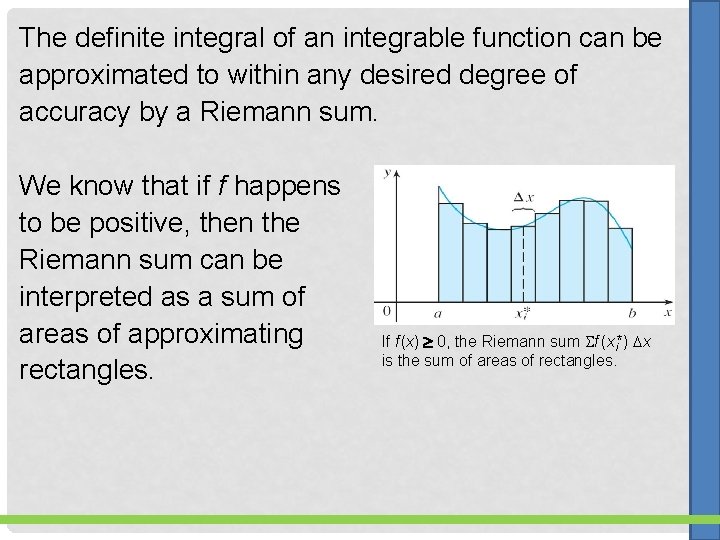
The definite integral of an integrable function can be approximated to within any desired degree of accuracy by a Riemann sum. We know that if f happens to be positive, then the Riemann sum can be interpreted as a sum of areas of approximating rectangles. If f (x) 0, the Riemann sum f (xi*) x is the sum of areas of rectangles.
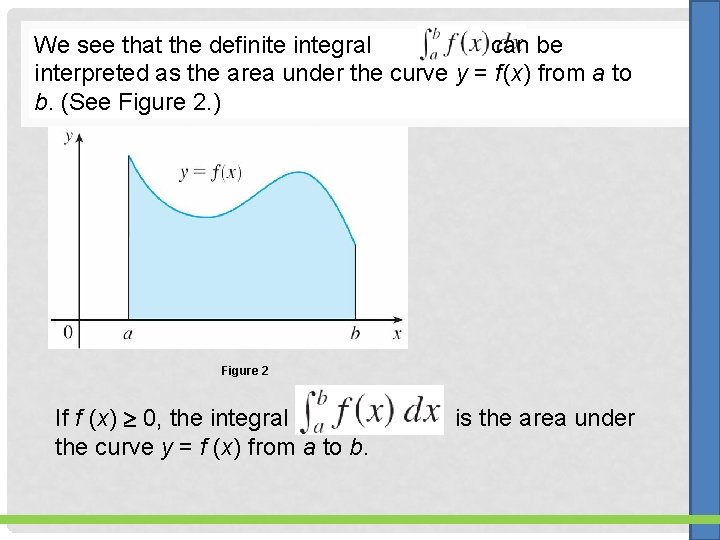
We see that the definite integral can be interpreted as the area under the curve y = f (x) from a to b. (See Figure 2. ) Figure 2 If f (x) 0, the integral the curve y = f (x) from a to b. is the area under
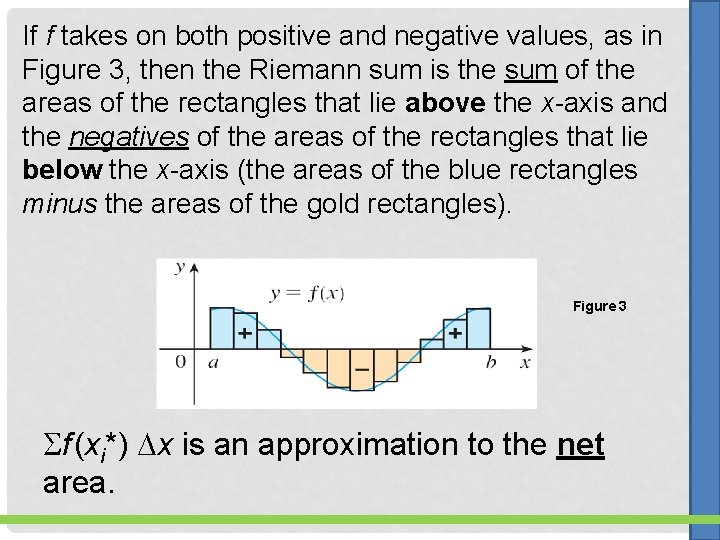
If f takes on both positive and negative values, as in Figure 3, then the Riemann sum is the sum of the areas of the rectangles that lie above the x-axis and the negatives of the areas of the rectangles that lie below the x-axis (the areas of the blue rectangles minus the areas of the gold rectangles). Figure 3 f (xi*) x is an approximation to the net area.
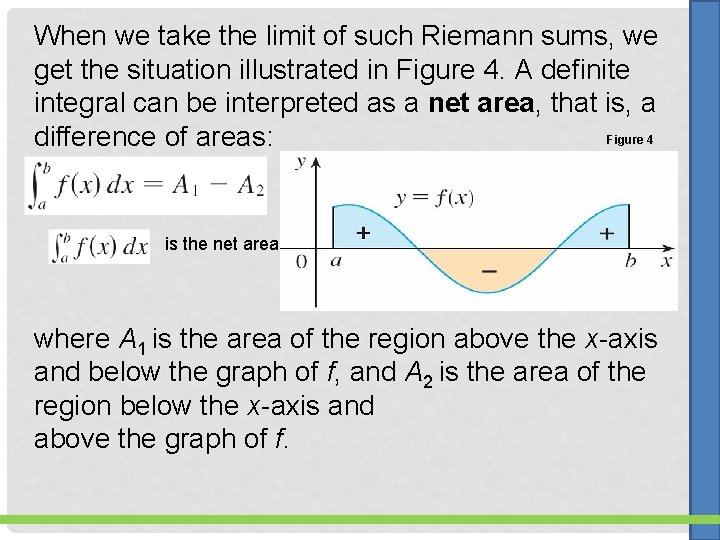
When we take the limit of such Riemann sums, we get the situation illustrated in Figure 4. A definite integral can be interpreted as a net area, that is, a Figure 4 difference of areas: is the net area. where A 1 is the area of the region above the x-axis and below the graph of f, and A 2 is the area of the region below the x-axis and above the graph of f.
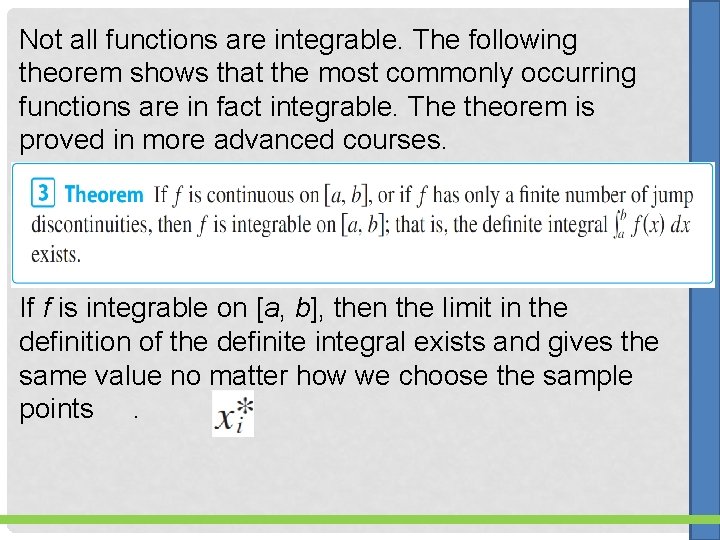
Not all functions are integrable. The following theorem shows that the most commonly occurring functions are in fact integrable. The theorem is proved in more advanced courses. If f is integrable on [a, b], then the limit in the definition of the definite integral exists and gives the same value no matter how we choose the sample points.
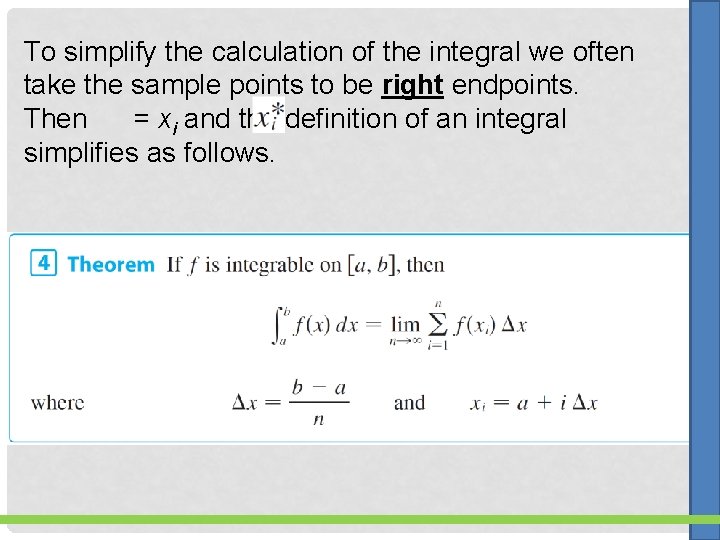
To simplify the calculation of the integral we often take the sample points to be right endpoints. Then = xi and the definition of an integral simplifies as follows.
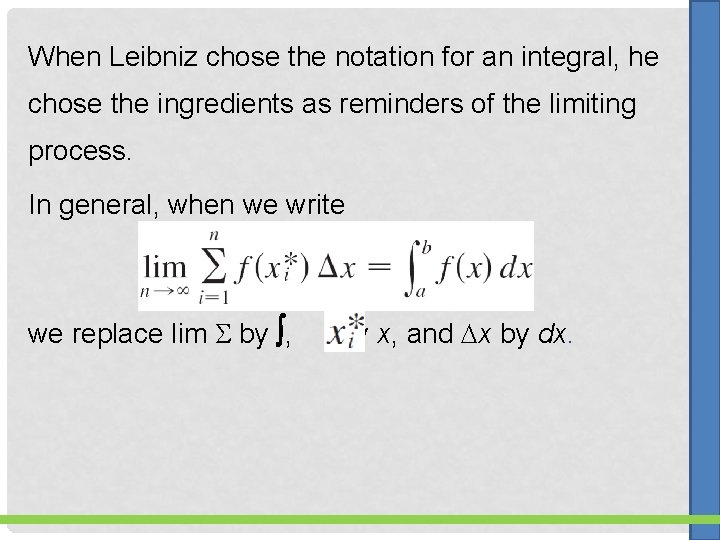
When Leibniz chose the notation for an integral, he chose the ingredients as reminders of the limiting process. In general, when we write we replace lim by , by x, and x by dx.
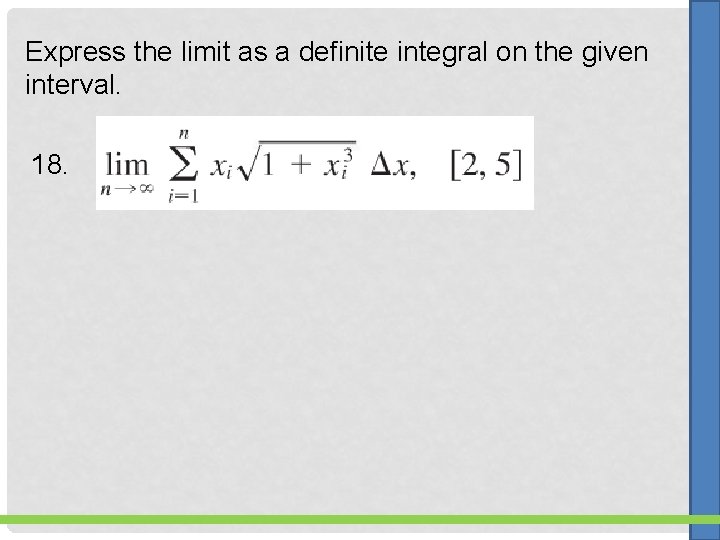
Express the limit as a definite integral on the given interval. 18.
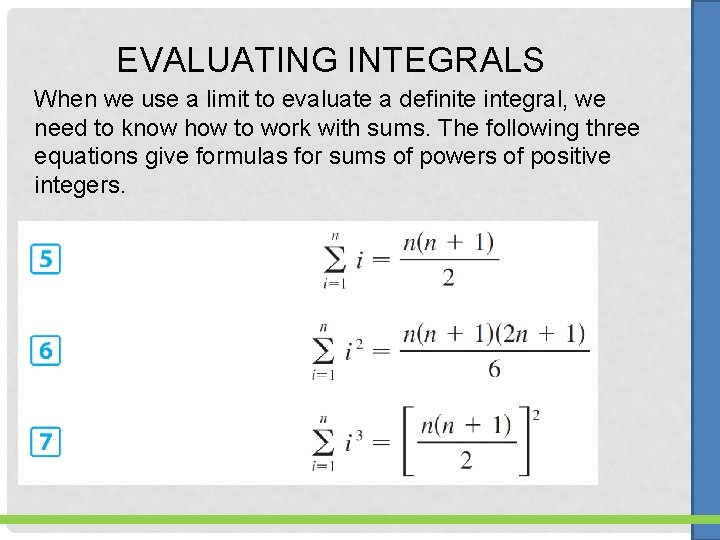
EVALUATING INTEGRALS When we use a limit to evaluate a definite integral, we need to know how to work with sums. The following three equations give formulas for sums of powers of positive integers.
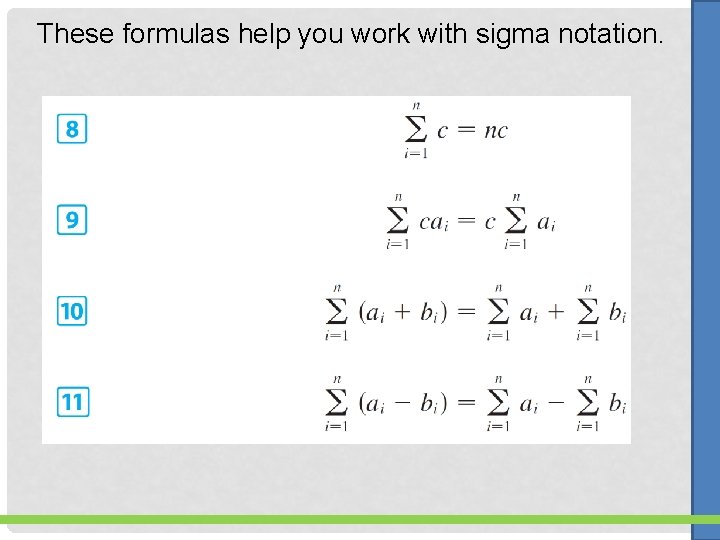
These formulas help you work with sigma notation.
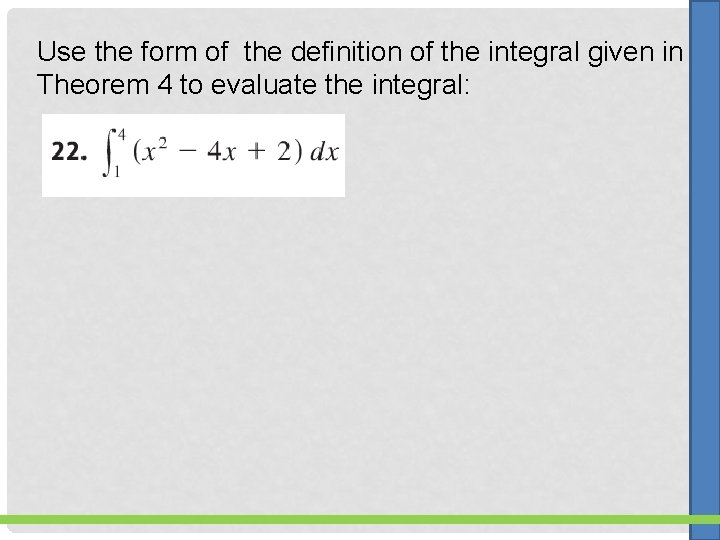
Use the form of the definition of the integral given in Theorem 4 to evaluate the integral:
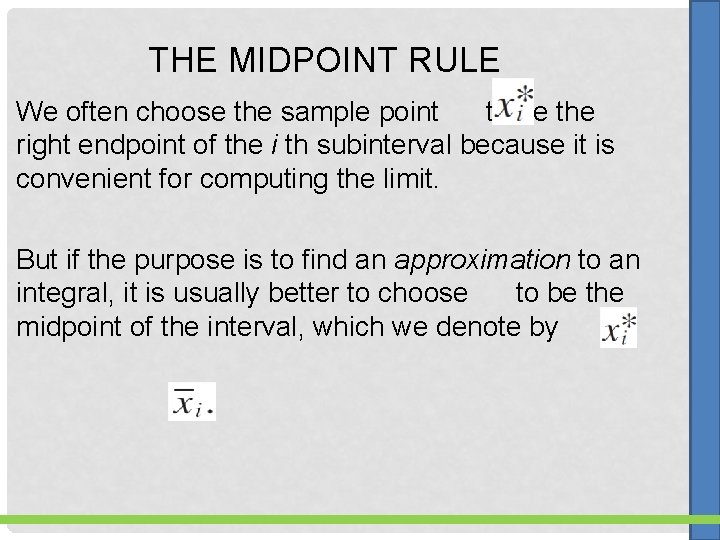
THE MIDPOINT RULE We often choose the sample point to be the right endpoint of the i th subinterval because it is convenient for computing the limit. But if the purpose is to find an approximation to an integral, it is usually better to choose to be the midpoint of the interval, which we denote by
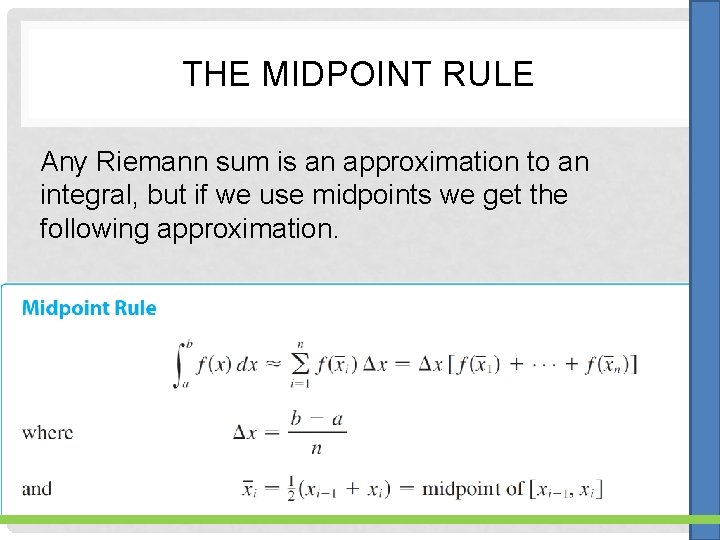
THE MIDPOINT RULE Any Riemann sum is an approximation to an integral, but if we use midpoints we get the following approximation.
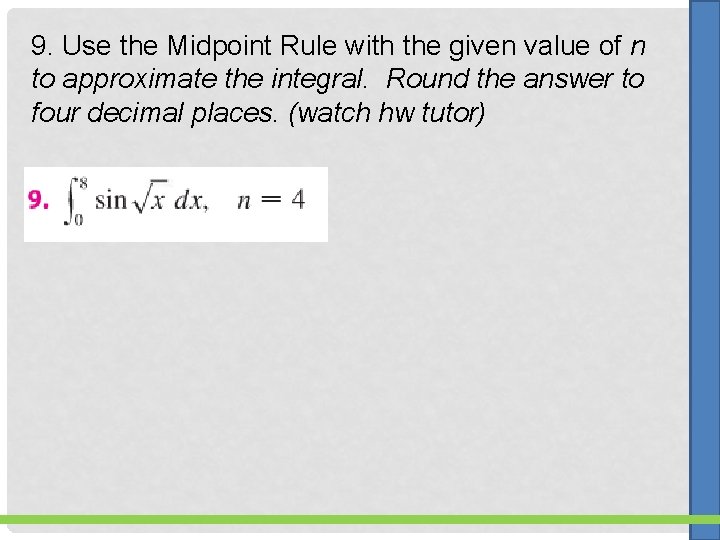
9. Use the Midpoint Rule with the given value of n to approximate the integral. Round the answer to four decimal places. (watch hw tutor)