
5 2 The Bohr and Quantum Mechanical Models

5. 2 The Bohr and Quantum Mechanical Models of the Atom Electrons in Atoms 433
Objectives 1. To understand how the emission spectrum of hydrogen demonstrates the quantized nature of energy 2. To learn about Bohr’s model of the hydrogen atom 3. To understand how the electron’s position is represented in the wave mechanical model 434
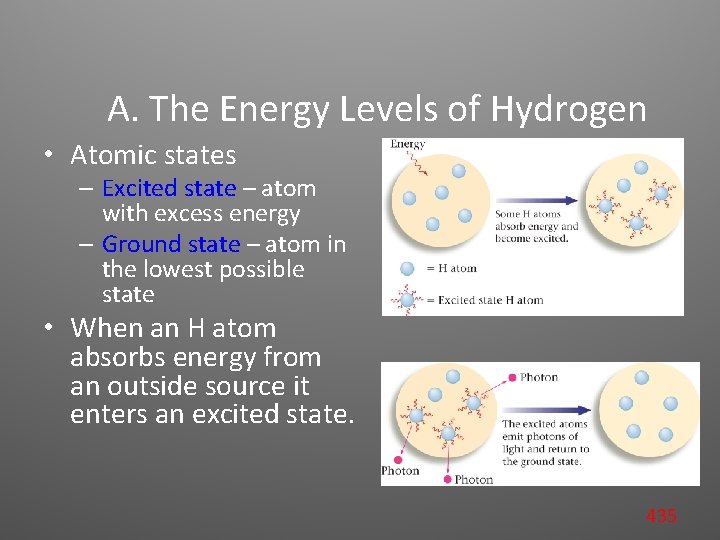
A. The Energy Levels of Hydrogen • Atomic states – Excited state – atom with excess energy – Ground state – atom in the lowest possible state • When an H atom absorbs energy from an outside source it enters an excited state. 435
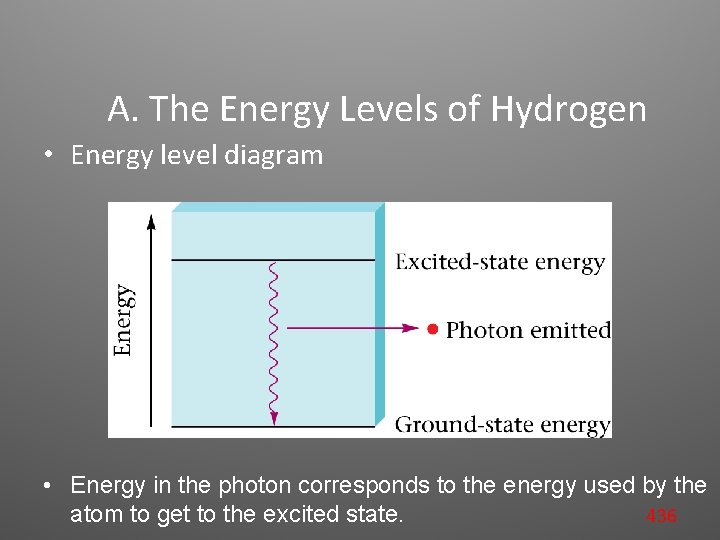
A. The Energy Levels of Hydrogen • Energy level diagram • Energy in the photon corresponds to the energy used by the 436 atom to get to the excited state.
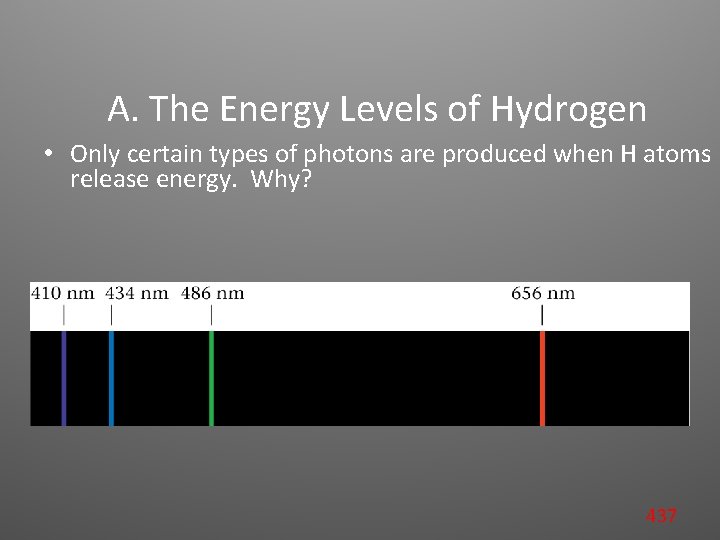
A. The Energy Levels of Hydrogen • Only certain types of photons are produced when H atoms release energy. Why? 437
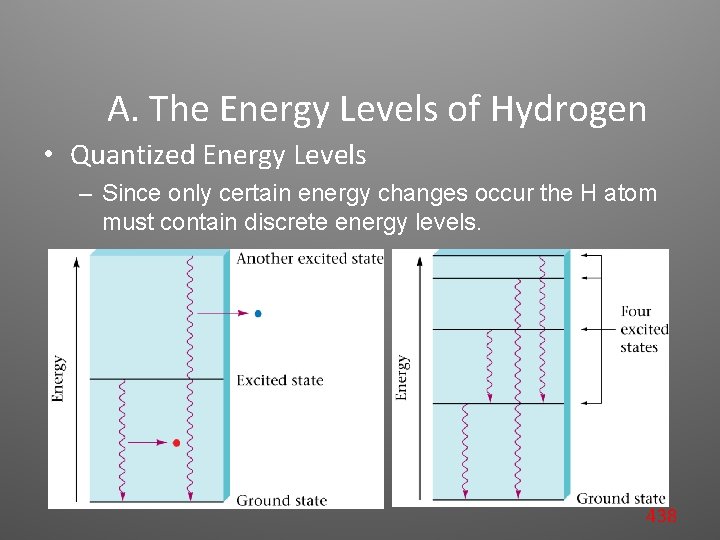
A. The Energy Levels of Hydrogen • Quantized Energy Levels – Since only certain energy changes occur the H atom must contain discrete energy levels. 438
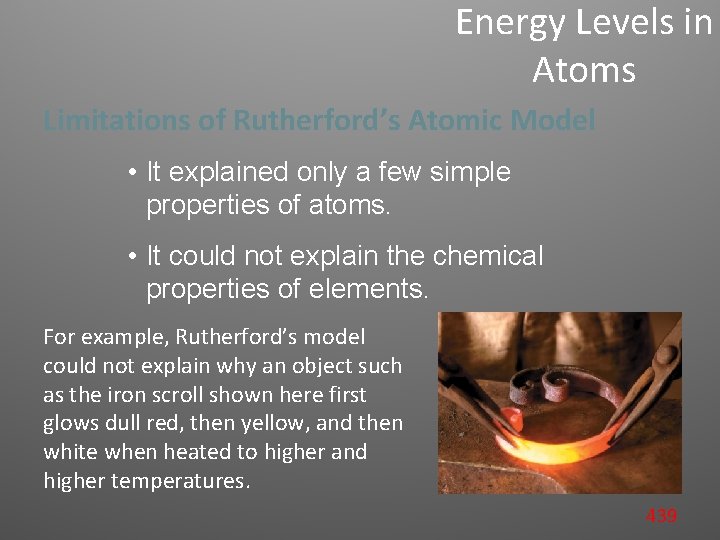
Energy Levels in Atoms Limitations of Rutherford’s Atomic Model • It explained only a few simple properties of atoms. • It could not explain the chemical properties of elements. For example, Rutherford’s model could not explain why an object such as the iron scroll shown here first glows dull red, then yellow, and then white when heated to higher and higher temperatures. 439
The Bohr Model Energy Levels in Atoms • In 1913, Niels Bohr (1885– 1962), a young Danish physicist and a student of Rutherford, developed a new atomic model. • He changed Rutherford’s model to incorporate newer discoveries about how the energy of an atom changes when the atom absorbs or emits light. 440
The Bohr Model Energy Levels in Atoms • Bohr proposed that an electron is found only in specific circular paths, or orbits, around the nucleus. 441
Energy Levels in Atoms The Bohr Model Each possible electron orbit in Bohr’s model has a fixed energy. • The fixed energies an electron can have are called energy levels. • A quantum of energy is the amount of energy required to move an electron from one energy level to another energy level. 442
B. The Bohr Model of the Atom • Bohr’s model of the atom was incorrect. – Electron does not move in a circular orbit. – Planetary model 443
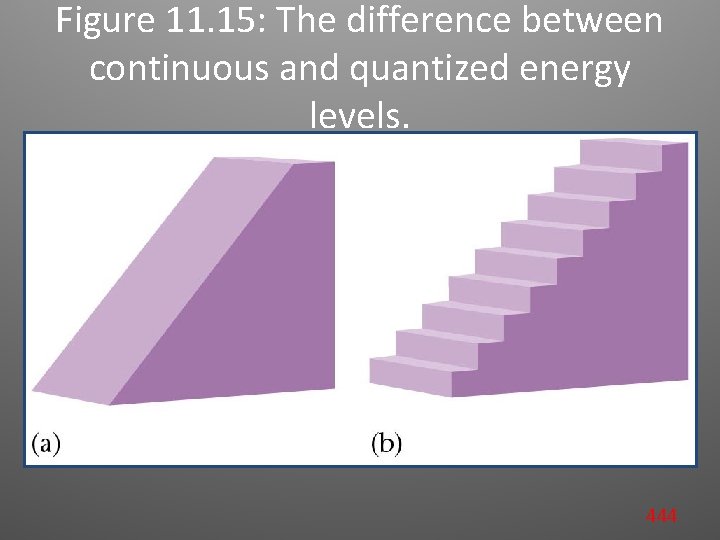
Figure 11. 15: The difference between continuous and quantized energy levels. 444
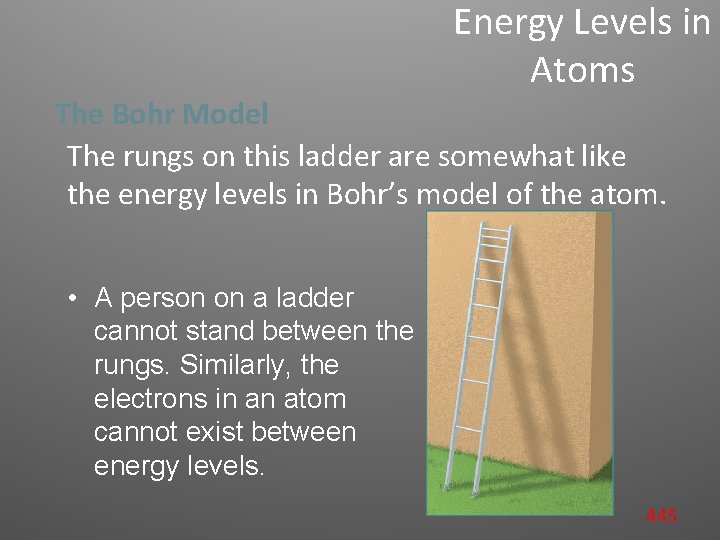
Energy Levels in Atoms The Bohr Model The rungs on this ladder are somewhat like the energy levels in Bohr’s model of the atom. • A person on a ladder cannot stand between the rungs. Similarly, the electrons in an atom cannot exist between energy levels. 445
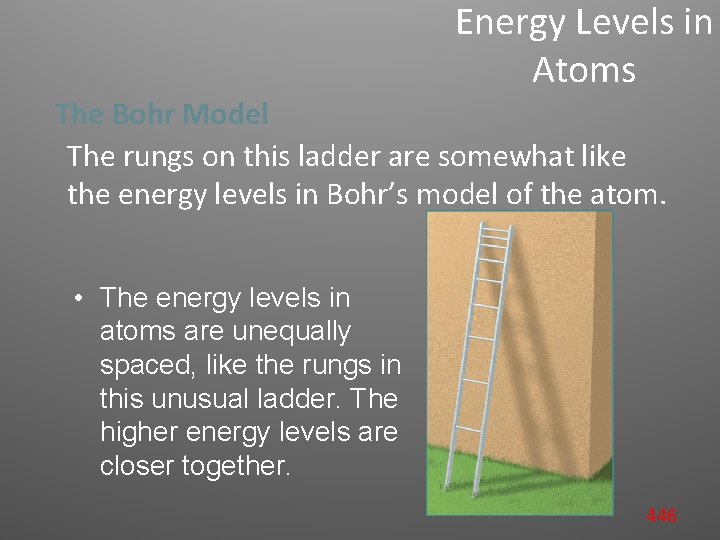
Energy Levels in Atoms The Bohr Model The rungs on this ladder are somewhat like the energy levels in Bohr’s model of the atom. • The energy levels in atoms are unequally spaced, like the rungs in this unusual ladder. The higher energy levels are closer together. 446
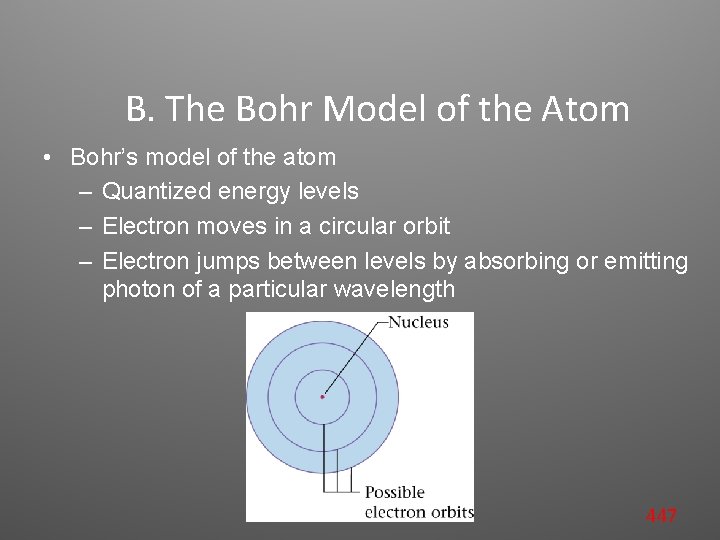
B. The Bohr Model of the Atom • Bohr’s model of the atom – Quantized energy levels – Electron moves in a circular orbit – Electron jumps between levels by absorbing or emitting photon of a particular wavelength 447
The Quantum Mechanical Model • Like the Bohr model, the quantum mechanical model of the atom restricts the energy of electrons to certain values. • Unlike the Bohr model, however, the quantum mechanical model does not specify an exact path the electron takes around the nucleus. 448
The Quantum Mechanical Model The quantum mechanical model determines the allowed energies an electron can have and how likely it is to find the electron in various locations around the nucleus of an atom. 449
The Quantum Mechanical Model Probability describes how likely it is to find an electron in a particular location around the nucleus of an atom. 450
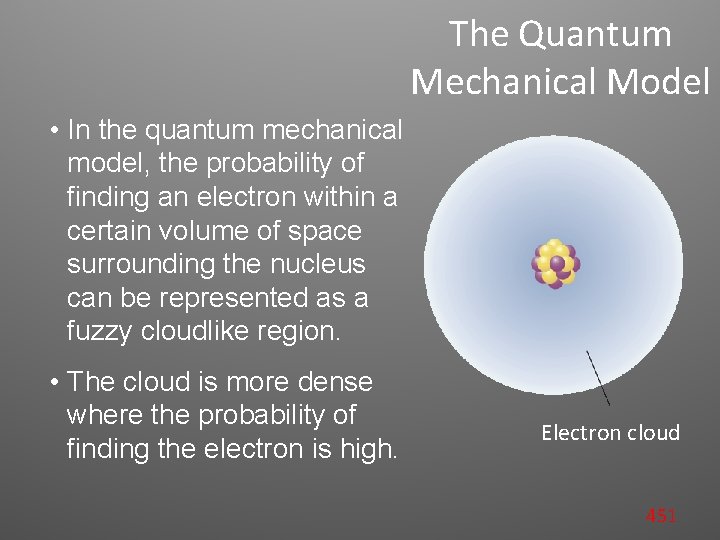
The Quantum Mechanical Model • In the quantum mechanical model, the probability of finding an electron within a certain volume of space surrounding the nucleus can be represented as a fuzzy cloudlike region. • The cloud is more dense where the probability of finding the electron is high. Electron cloud 451
Wave Mechanical Model Orbitals are the mathematical probability of where an electron can be found Firefly model 452
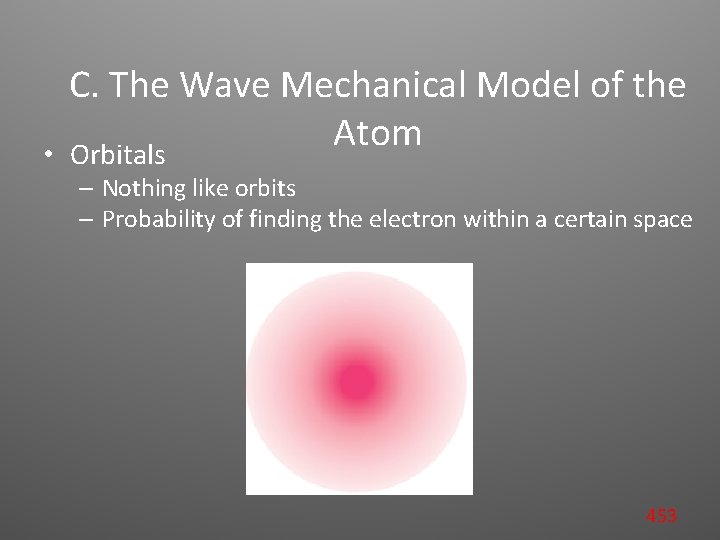
• C. The Wave Mechanical Model of the Atom Orbitals – Nothing like orbits – Probability of finding the electron within a certain space 453
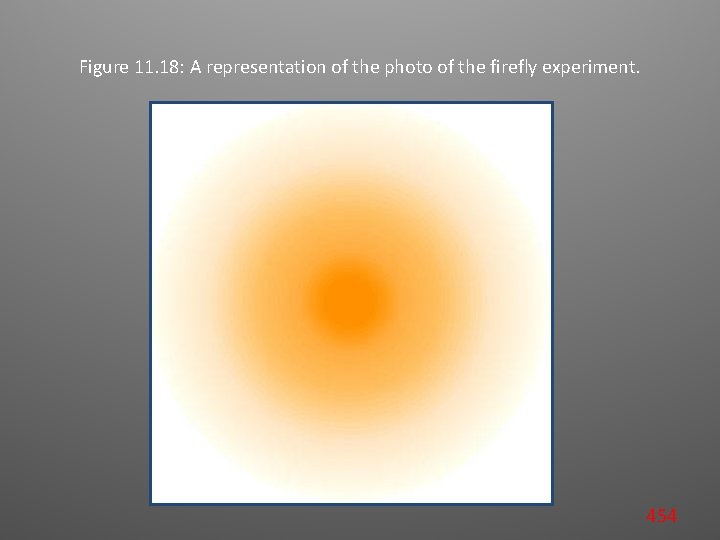
Figure 11. 18: A representation of the photo of the firefly experiment. 454
How are the quantum mechanical model and the Bohr model alike? How are they different? Like the Bohr model, the quantum mechanical model restricts the energy of electrons to certain values. Unlike the Bohr model, the quantum mechanical model does not specify an exact path the electron takes around the nucleus. 455
Atomic Orbitals How do sublevels of principal energy levels differ? 456
Atomic Orbitals • Solutions to the Schrödinger equation give the energies, or energy levels, an electron can have. • For each energy level, the Schrödinger equation also leads to a mathematical expression, called an atomic orbital. • An atomic orbital is represented pictorially as a region of space in which there is a high probability of finding an electron. 457
Atomic Orbitals • The energy levels of electrons in the quantum mechanical model are labeled by principal quantum numbers (n). • These numbers are assigned the values n = 1, 2, 3, 4, and so forth. • For each principal energy level greater than 1, there are several orbitals with different shapes and at different energy levels. • These energy levels within a principal energy level constitute energy sublevels. 458
Atomic Orbitals Each energy sublevel corresponds to one or more orbitals of different shapes. The orbitals describe where an electron is likely to be found. 459
Objectives 1. To learn about the shapes of the s, p and d orbitals 2. To review the energy levels and orbitals of the wave mechanical model of the atom 3. To learn about electron spin 460
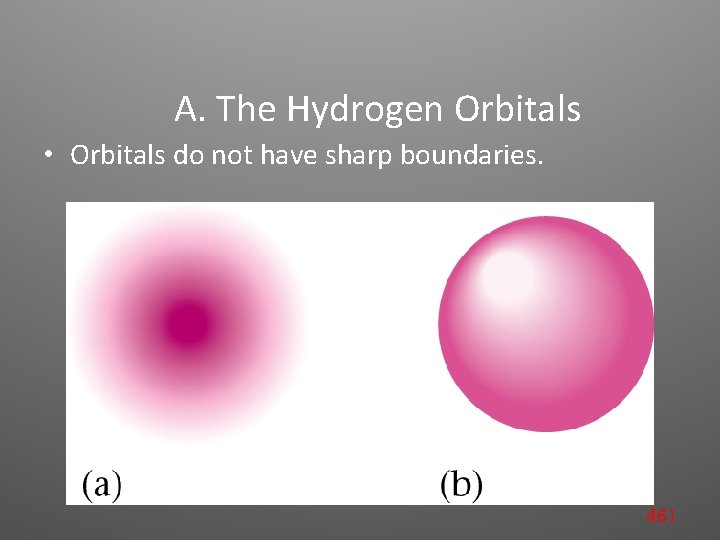
A. The Hydrogen Orbitals • Orbitals do not have sharp boundaries. 461
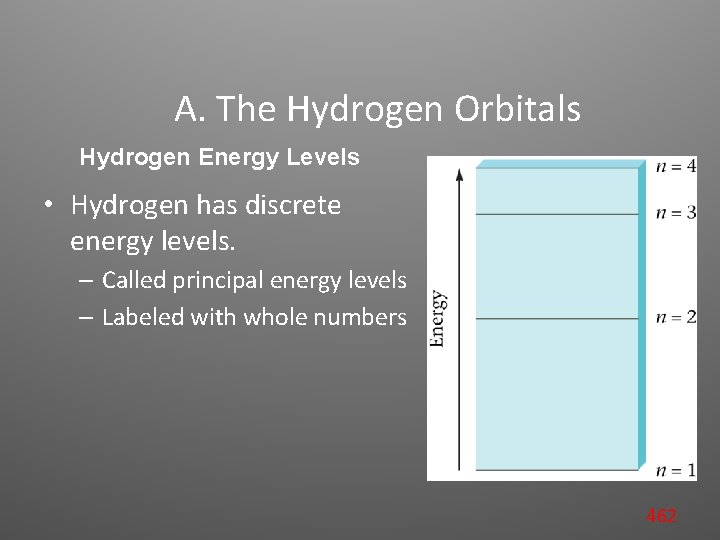
A. The Hydrogen Orbitals Hydrogen Energy Levels • Hydrogen has discrete energy levels. – Called principal energy levels – Labeled with whole numbers 462
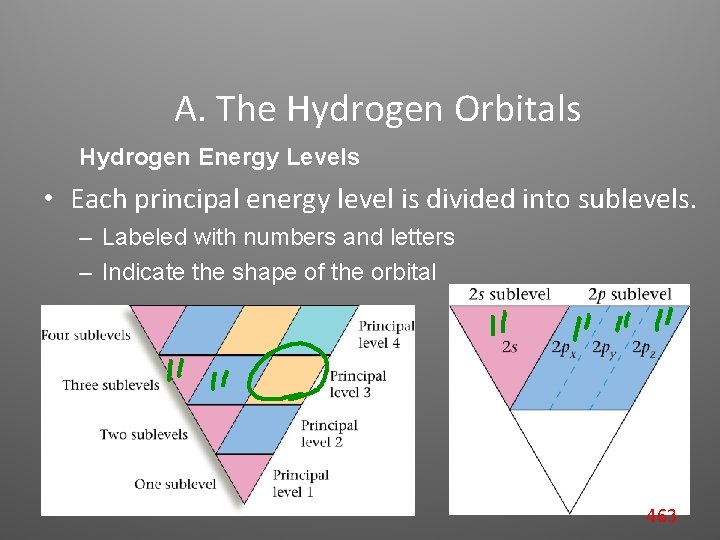
A. The Hydrogen Orbitals Hydrogen Energy Levels • Each principal energy level is divided into sublevels. – Labeled with numbers and letters – Indicate the shape of the orbital 463
A. The Hydrogen Orbitals • Why does an H atom have so many orbitals and only 1 electron? – An orbital is a potential space for an electron. – Atoms can have many potential orbitals. 464
B. The Wave Mechanical Model: Further Development Atoms Beyond Hydrogen • The Bohr model was discarded because it does not apply to all atoms. • Atoms beyond hydrogen have an equal number of protons and electrons. – Need one more property to determine how the electrons are arranged – Spin – electron spins like a top 465
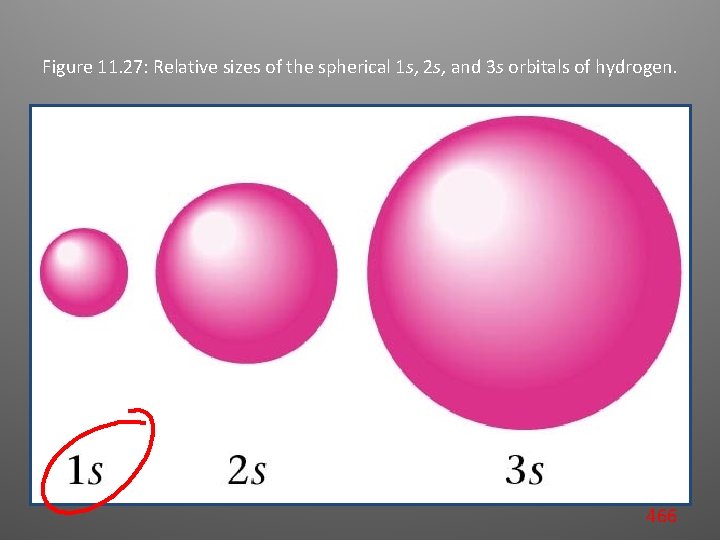
Figure 11. 27: Relative sizes of the spherical 1 s, 2 s, and 3 s orbitals of hydrogen. 466
B. The Wave Mechanical Model: Further Development Atoms Beyond Hydrogen • Pauli Exclusion Principle - an atomic orbital can hold a maximum of 2 electrons and those 2 electrons must have opposite spins 467
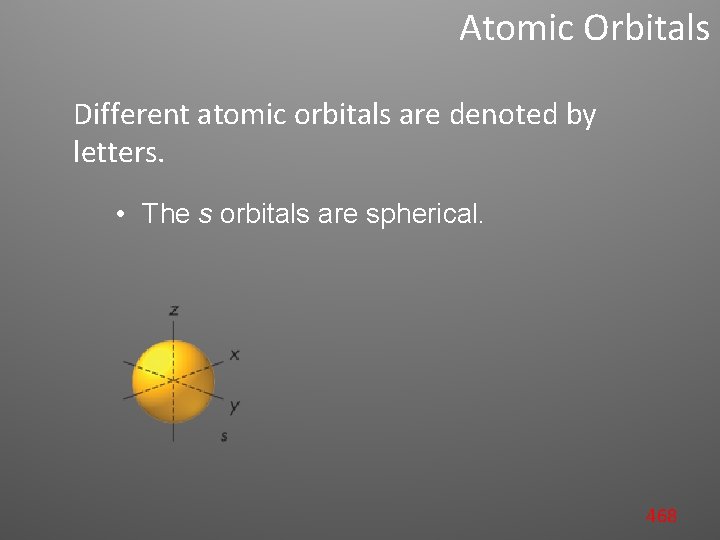
Atomic Orbitals Different atomic orbitals are denoted by letters. • The s orbitals are spherical. 468
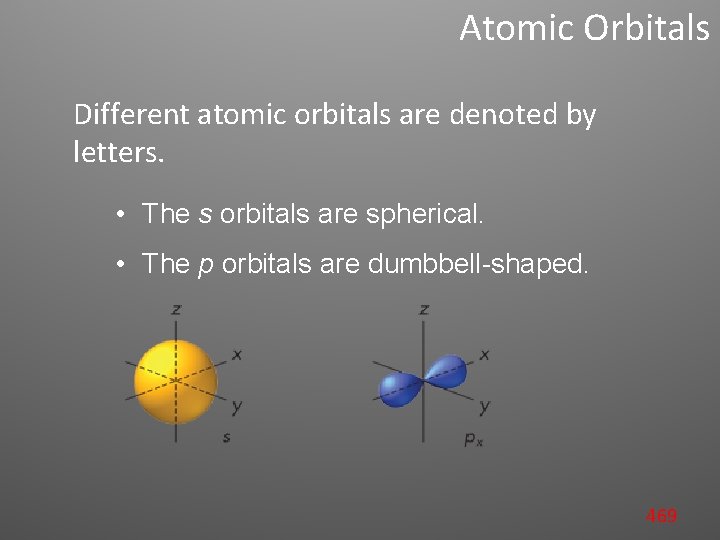
Atomic Orbitals Different atomic orbitals are denoted by letters. • The s orbitals are spherical. • The p orbitals are dumbbell-shaped. 469
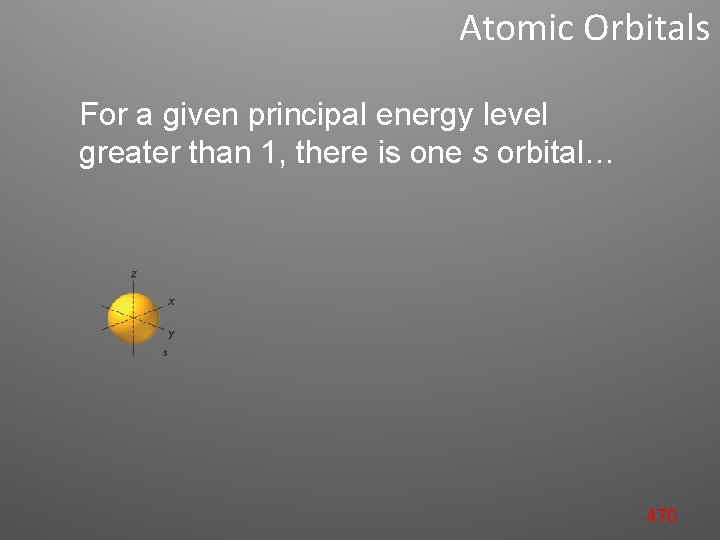
Atomic Orbitals For a given principal energy level greater than 1, there is one s orbital… 470
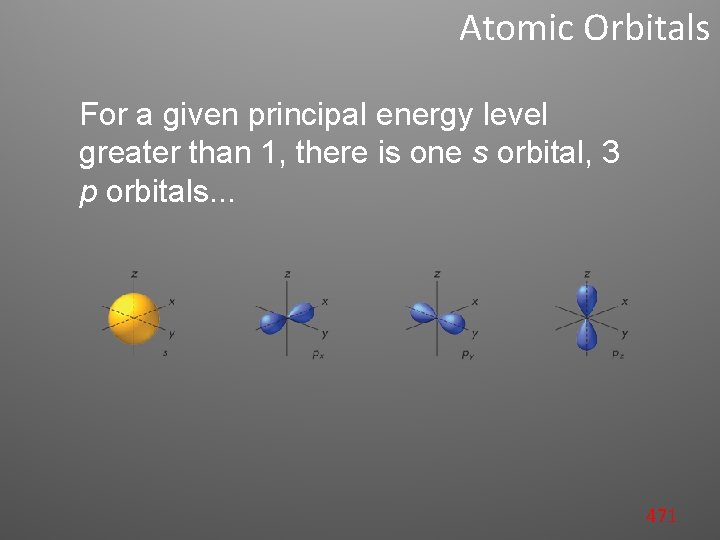
Atomic Orbitals For a given principal energy level greater than 1, there is one s orbital, 3 p orbitals. . . 471
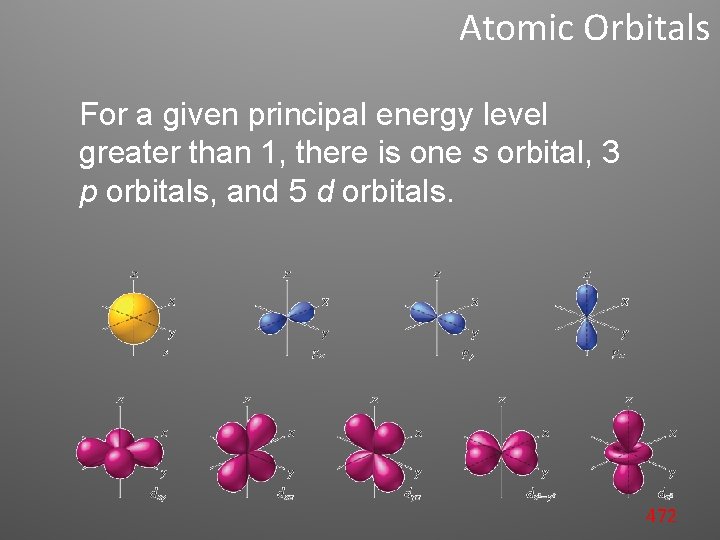
Atomic Orbitals For a given principal energy level greater than 1, there is one s orbital, 3 p orbitals, and 5 d orbitals. 472
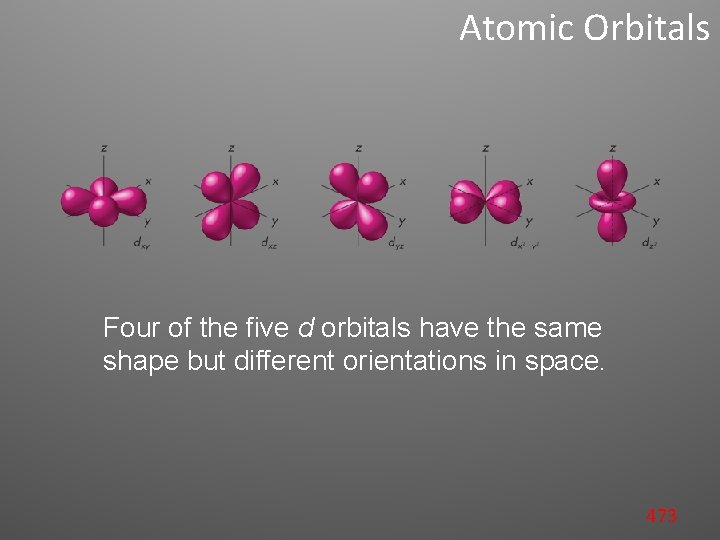
Atomic Orbitals Four of the five d orbitals have the same shape but different orientations in space. 473
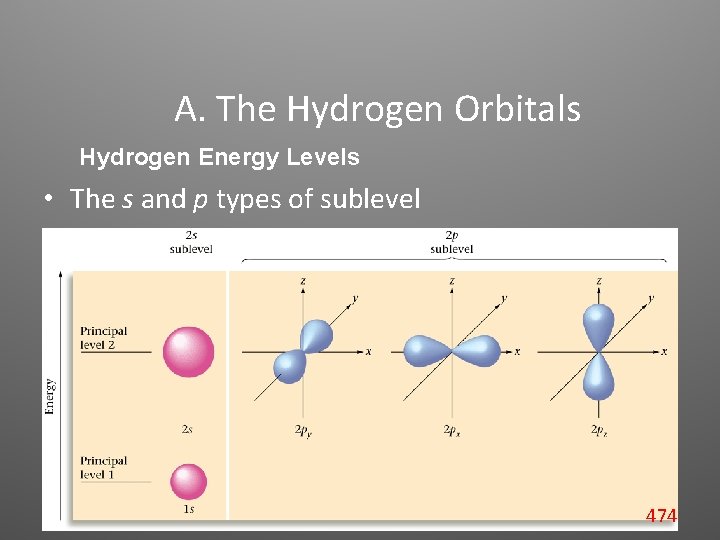
A. The Hydrogen Orbitals Hydrogen Energy Levels • The s and p types of sublevel 474
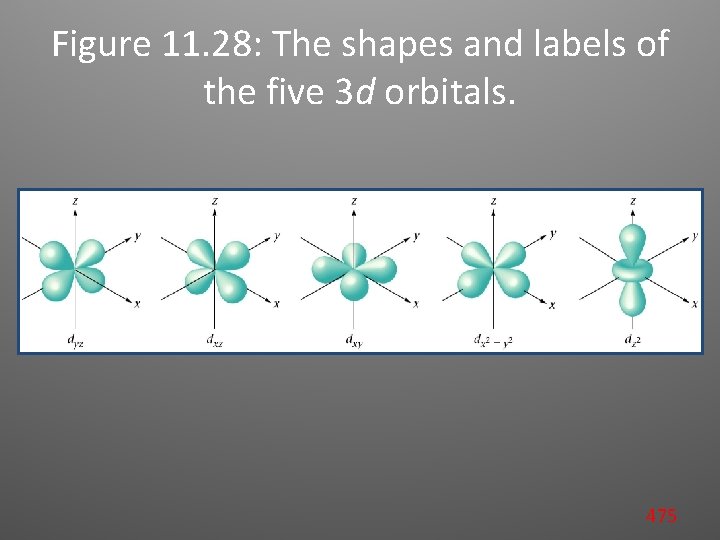
Figure 11. 28: The shapes and labels of the five 3 d orbitals. 475
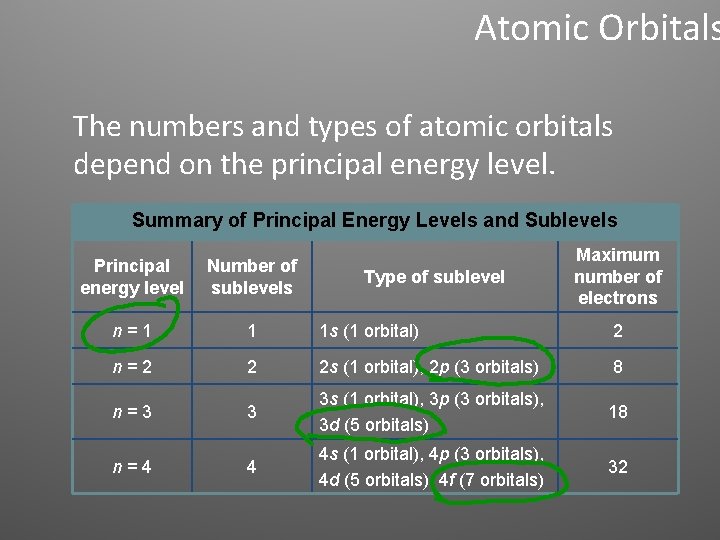
Atomic Orbitals The numbers and types of atomic orbitals depend on the principal energy level. Summary of Principal Energy Levels and Sublevels Maximum number of electrons Principal energy level Number of sublevels n=1 1 1 s (1 orbital) 2 n=2 2 2 s (1 orbital), 2 p (3 orbitals) 8 n=3 3 3 s (1 orbital), 3 p (3 orbitals), 3 d (5 orbitals) 18 4 4 s (1 orbital), 4 p (3 orbitals), 4 d (5 orbitals), 4 f (7 orbitals) 32 n=4 Type of sublevel
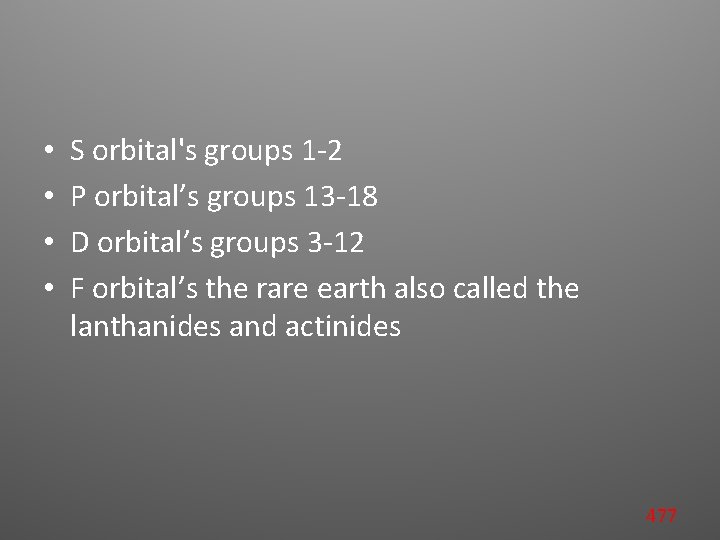
• • S orbital's groups 1 -2 P orbital’s groups 13 -18 D orbital’s groups 3 -12 F orbital’s the rare earth also called the lanthanides and actinides 477
Atomic Orbitals • The principal quantum number, n, always equals the number of sublevels within that principal energy level. 478
Atomic Orbitals • The principal quantum number, n, always equals the number of sublevels within that principal energy level. • The number of orbitals in a principal energy level is equal to n 2. 479
Atomic Orbitals • The principal quantum number, n, always equals the number of sublevels within that principal energy level. • The number of orbitals in a principal energy level is equal to n 2. • A maximum of two electrons can occupy an orbital. 480
Atomic Orbitals • The principal quantum number, n, always equals the number of sublevels within that principal energy level. • The number of orbitals in a principal energy level is equal to n 2. • A maximum of two electrons can occupy an orbital. • Therefore, the maximum number of electrons that can occupy a principal energy level is given by the formula 2 n 2. 481
Calculate the maximum number of electrons in the 5 th principal energy level (n = 5). 482
Calculate the maximum number of electrons in the 5 th principal energy level (n = 5). The maximum number of electrons that can occupy a principal energy level is given by the formula 2 n 2. If n = 5, 2 n 2 = 50. 483
CHEMISTRY & YOU Why do scientists no longer use physical models to describe the motion of electrons? 484
CHEMISTRY & YOU Why do scientists no longer use physical models to describe the motion of electrons? • Previous models of the atom were physical models based on the motion of large objects. • Theoretical calculations and experimental results showed that these models did not always correctly describe electron motion. • Schrödinger devised a mathematical equation describing the behavior of the electron in a hydrogen atom. The quantum mechanical model came from the solutions to the Schrödinger equation. 485
Key Concepts • Bohr proposed that an electron is found only in specific circular paths, or orbits, around the nucleus. • The quantum mechanical model determines the allowed energies an electron can have and how likely it is to find the electron in various locations around the nucleus of an atom. • Each energy sublevel corresponds to one or more orbitals of different shapes, which describe where the electron is likely to be found. 486
Glossary Terms • energy level: the specific energies an electron in an atom or other system can have • quantum: the amount of energy needed to move an electron from one energy level to another 487
Glossary Terms • quantum mechanical model: the modern description, primarily mathematical, of the behavior of electrons in atoms • atomic orbital: a mathematical expression describing the probability of finding an electron at various locations; usually represented by the region of space around the nucleus where there is a high probability of finding an electron 488
BIG IDEA • Electrons and the Structure of Atoms • The quantum mechanical model of the atom comes from the solutions to the Schrödinger equation. • Solutions to the Schrödinger equation give the energies an electron can have and the atomic orbitals, which describe the regions of space where an electron may be found. 489
- Slides: 57