
5 2 Multiplication and Division of Integers Models
- Slides: 24
5 -2 Multiplication and Division of Integers • • • Models for multiplication of integers. Properties of multiplication of integers. Integer division. Order of operations on integers. Inequalities with integers. ALWAYS LEARNING Copyright © 2020, 2016, 2012 Pearson Education, Inc. 1
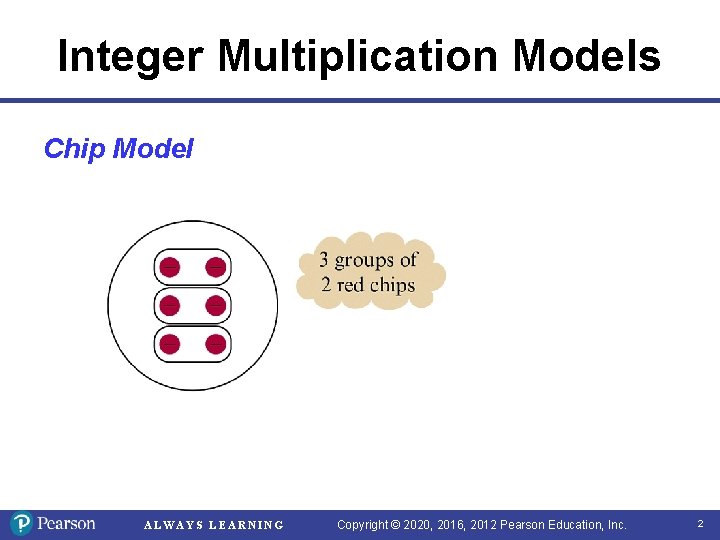
Integer Multiplication Models Chip Model ALWAYS LEARNING Copyright © 2020, 2016, 2012 Pearson Education, Inc. 2
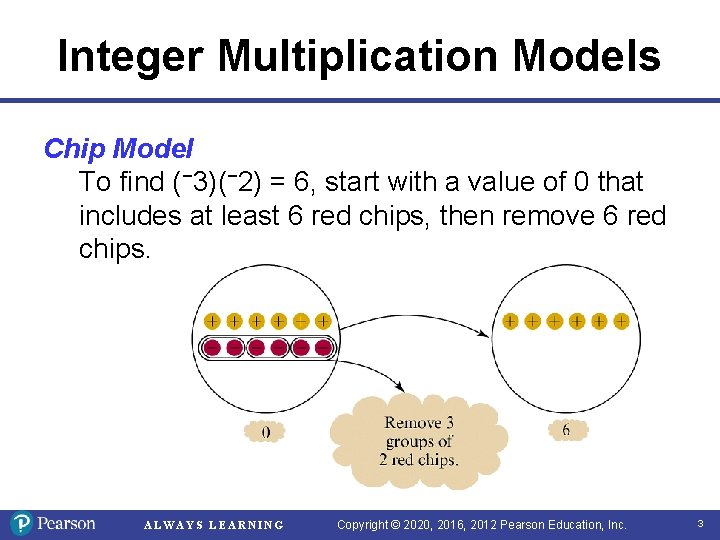
Integer Multiplication Models Chip Model To find (− 3)(− 2) = 6, start with a value of 0 that includes at least 6 red chips, then remove 6 red chips. ALWAYS LEARNING Copyright © 2020, 2016, 2012 Pearson Education, Inc. 3
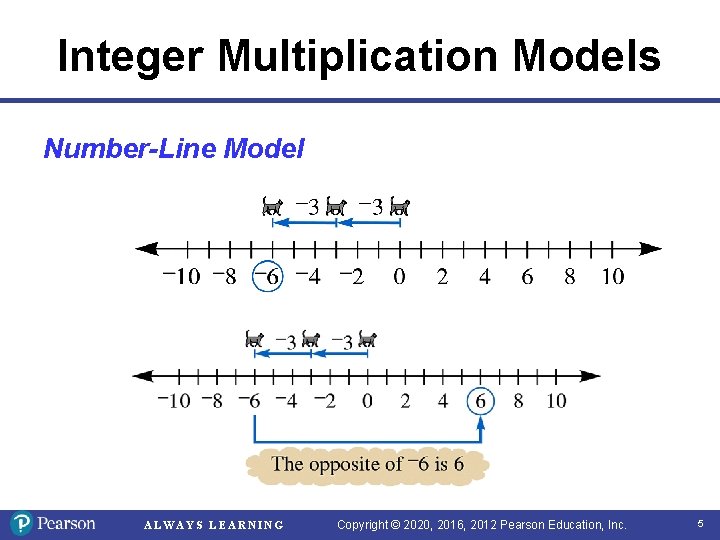
Integer Multiplication Models Number-Line Model Demonstrate multiplication by using a cat moving along a number line. Here are the rules for walking a number line: • Always start at zero, and always face the positive (right) direction. • If the number is positive, walk forward. • If the number is negative, walk backward. ALWAYS LEARNING Copyright © 2020, 2016, 2012 Pearson Education, Inc. 4
Integer Multiplication Models Number-Line Model ALWAYS LEARNING Copyright © 2020, 2016, 2012 Pearson Education, Inc. 5
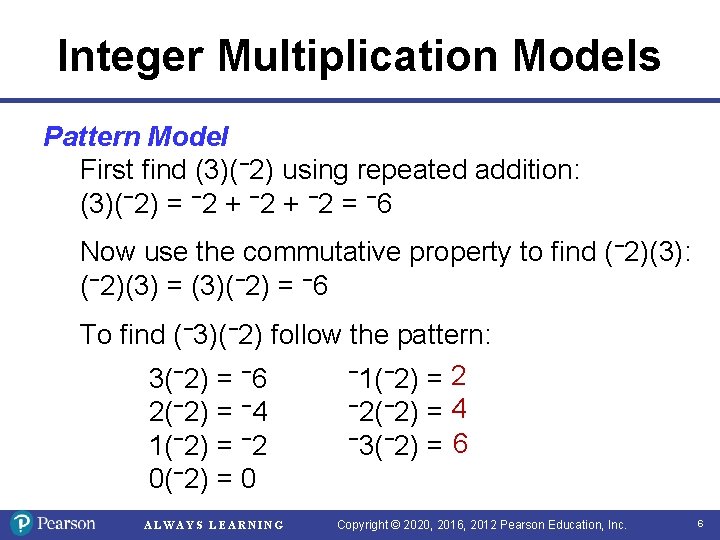
Integer Multiplication Models Pattern Model First find (3)(− 2) using repeated addition: (3)(− 2) = − 2 + − 2 = − 6 Now use the commutative property to find (− 2)(3): (− 2)(3) = (3)(− 2) = − 6 To find (− 3)(− 2) follow the pattern: − 1(− 2) = 2 3(− 2) = − 6 − 2(− 2) = 4 2(− 2) = − 4 − 3(− 2) = 6 1(− 2) = − 2 0(− 2) = 0 ALWAYS LEARNING Copyright © 2020, 2016, 2012 Pearson Education, Inc. 6
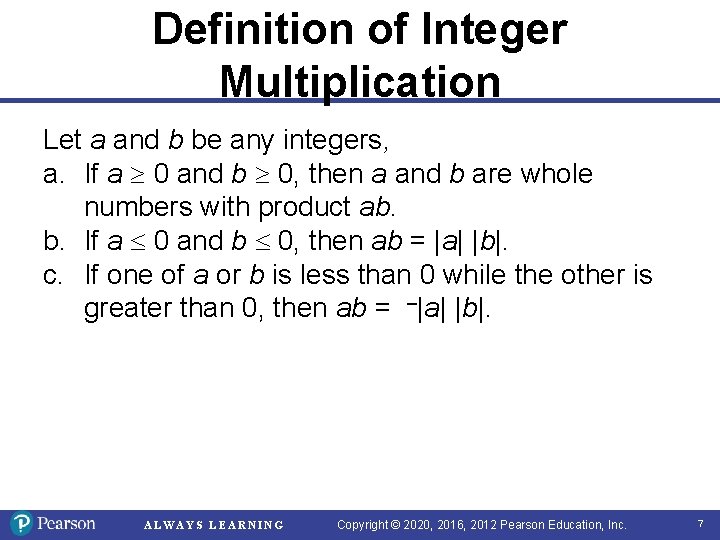
Definition of Integer Multiplication Let a and b be any integers, a. If a 0 and b 0, then a and b are whole numbers with product ab. b. If a 0 and b 0, then ab = |a| |b|. c. If one of a or b is less than 0 while the other is greater than 0, then ab = –|a| |b|. ALWAYS LEARNING Copyright © 2020, 2016, 2012 Pearson Education, Inc. 7
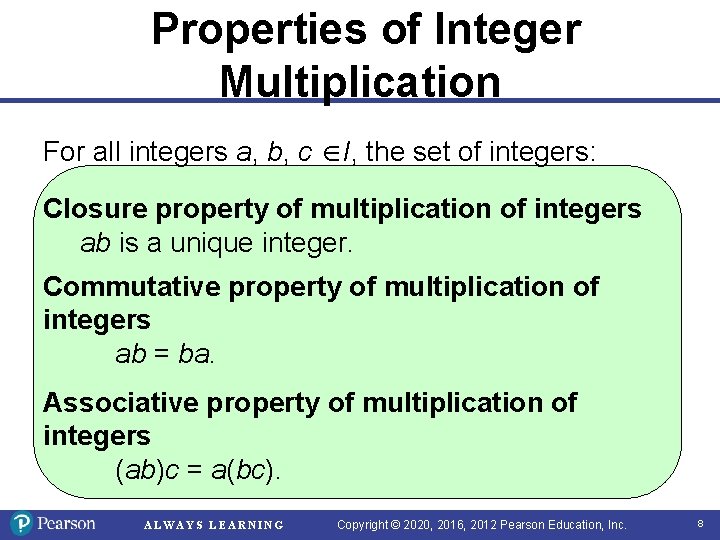
Properties of Integer Multiplication For all integers a, b, c I, the set of integers: Closure property of multiplication of integers ab is a unique integer. Commutative property of multiplication of integers ab = ba. Associative property of multiplication of integers (ab)c = a(bc). ALWAYS LEARNING Copyright © 2020, 2016, 2012 Pearson Education, Inc. 8
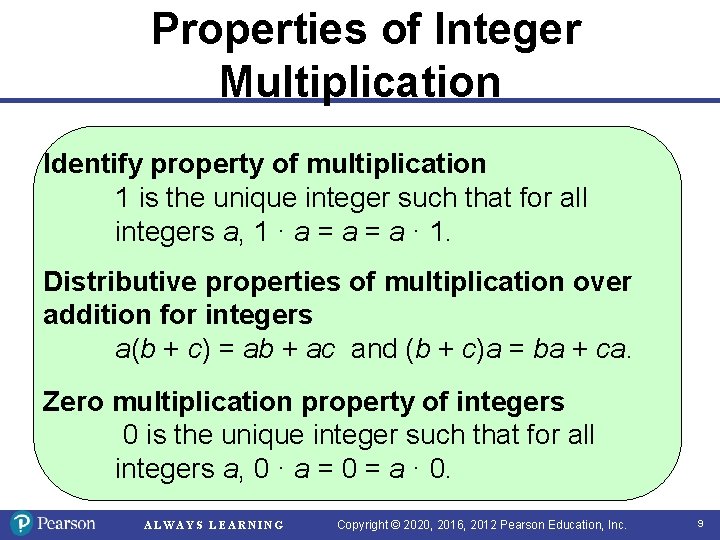
Properties of Integer Multiplication Identify property of multiplication 1 is the unique integer such that for all integers a, 1 · a = a · 1. Distributive properties of multiplication over addition for integers a(b + c) = ab + ac and (b + c)a = ba + ca. Zero multiplication property of integers 0 is the unique integer such that for all integers a, 0 · a = 0 = a · 0. ALWAYS LEARNING Copyright © 2020, 2016, 2012 Pearson Education, Inc. 9
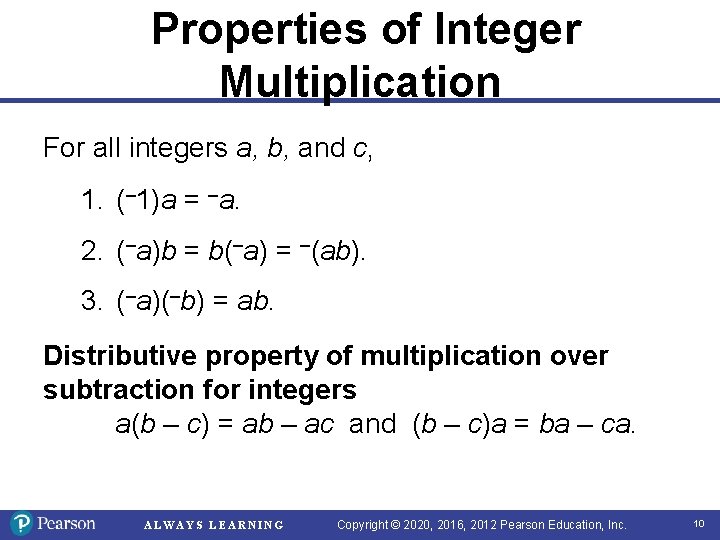
Properties of Integer Multiplication For all integers a, b, and c, 1. (– 1)a = –a. 2. (–a)b = b(–a) = –(ab). 3. (–a)(–b) = ab. Distributive property of multiplication over subtraction for integers a(b – c) = ab – ac and (b – c)a = ba – ca. ALWAYS LEARNING Copyright © 2020, 2016, 2012 Pearson Education, Inc. 10
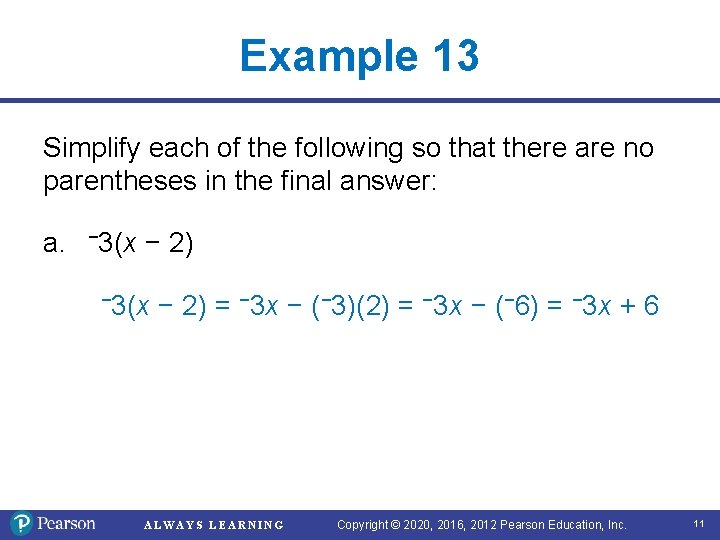
Example 13 Simplify each of the following so that there are no parentheses in the final answer: a. − 3(x − 2) = − 3 x − (− 3)(2) = − 3 x − (− 6) = − 3 x + 6 ALWAYS LEARNING Copyright © 2020, 2016, 2012 Pearson Education, Inc. 11
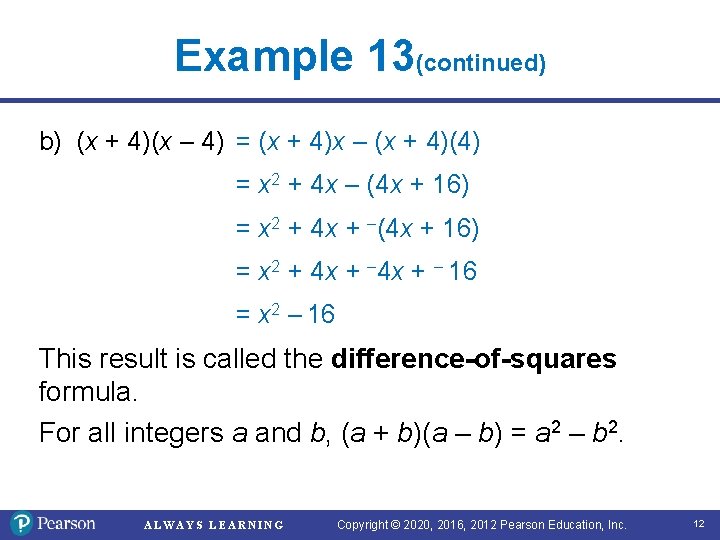
Example 13(continued) b) (x + 4)(x – 4) = (x + 4)x – (x + 4)(4) = x 2 + 4 x – (4 x + 16) = x 2 + 4 x + – 16 = x 2 – 16 This result is called the difference-of-squares formula. For all integers a and b, (a + b)(a – b) = a 2 – b 2. ALWAYS LEARNING Copyright © 2020, 2016, 2012 Pearson Education, Inc. 12
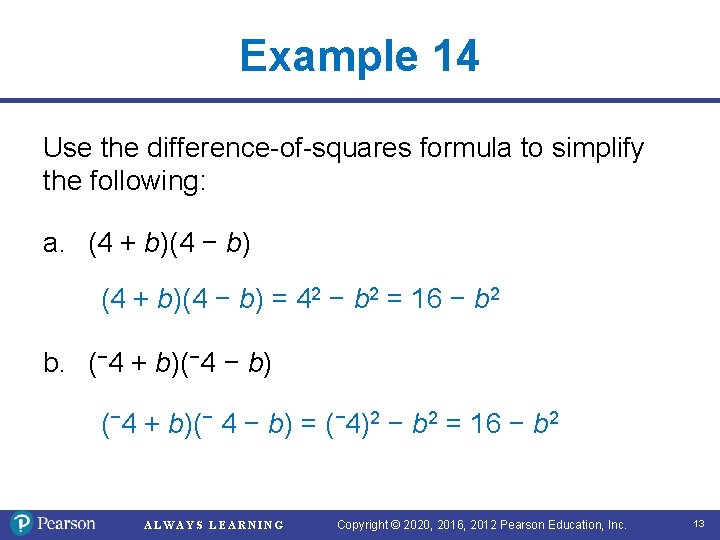
Example 14 Use the difference-of-squares formula to simplify the following: a. (4 + b)(4 − b) = 42 − b 2 = 16 − b 2 b. (− 4 + b)(− 4 − b) = (− 4)2 − b 2 = 16 − b 2 ALWAYS LEARNING Copyright © 2020, 2016, 2012 Pearson Education, Inc. 13
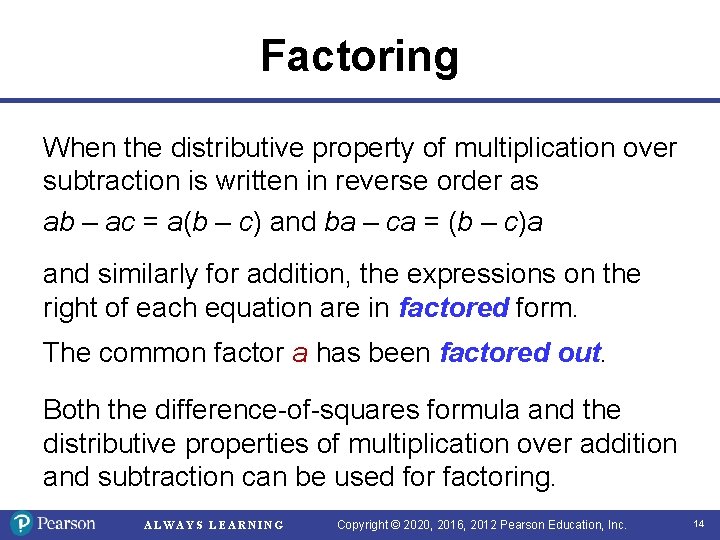
Factoring When the distributive property of multiplication over subtraction is written in reverse order as ab – ac = a(b – c) and ba – ca = (b – c)a and similarly for addition, the expressions on the right of each equation are in factored form. The common factor a has been factored out. Both the difference-of-squares formula and the distributive properties of multiplication over addition and subtraction can be used for factoring. ALWAYS LEARNING Copyright © 2020, 2016, 2012 Pearson Education, Inc. 14
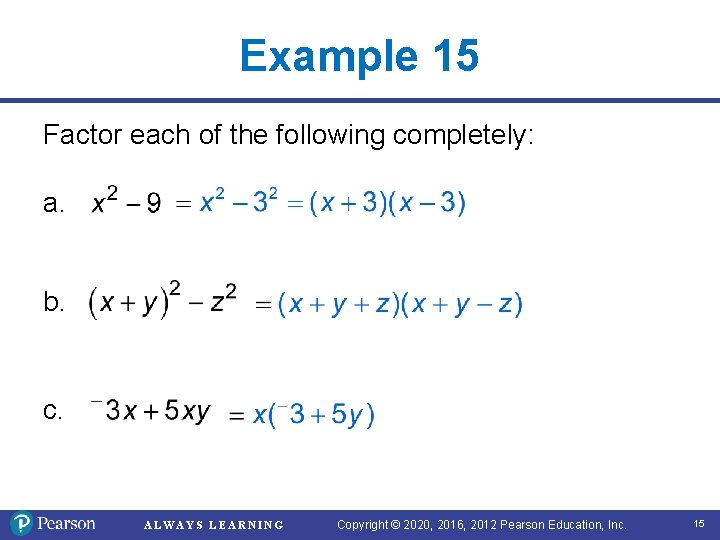
Example 15 Factor each of the following completely: a. b. c. ALWAYS LEARNING Copyright © 2020, 2016, 2012 Pearson Education, Inc. 15
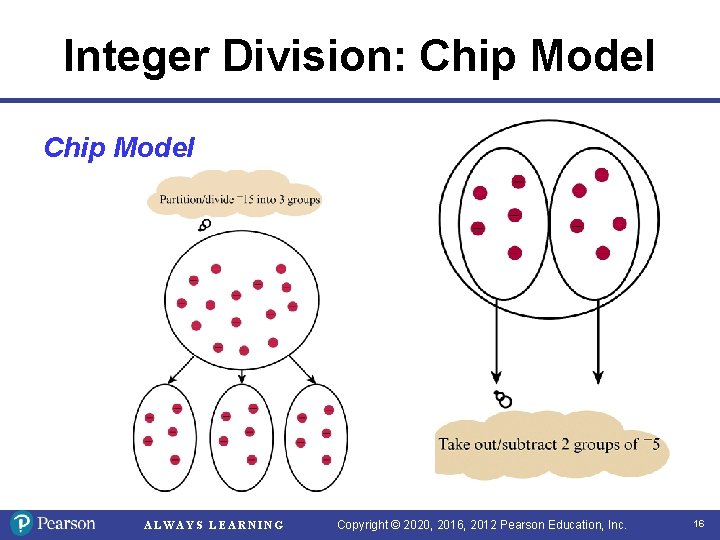
Integer Division: Chip Model ALWAYS LEARNING Copyright © 2020, 2016, 2012 Pearson Education, Inc. 16
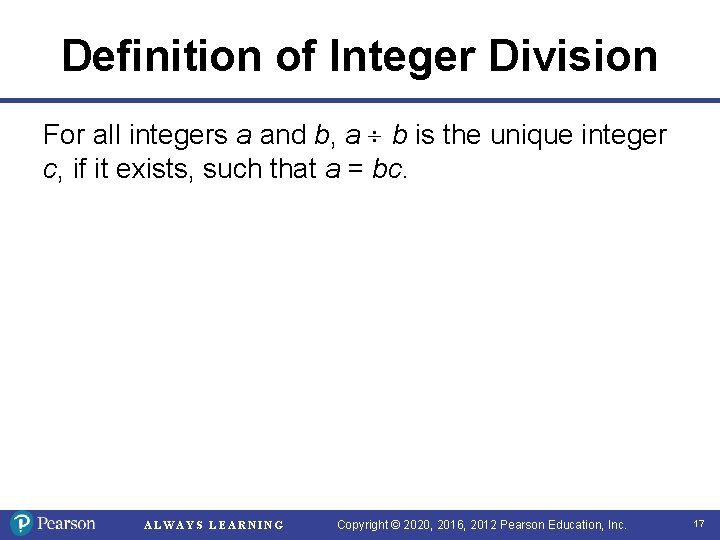
Definition of Integer Division For all integers a and b, a b is the unique integer c, if it exists, such that a = bc. ALWAYS LEARNING Copyright © 2020, 2016, 2012 Pearson Education, Inc. 17
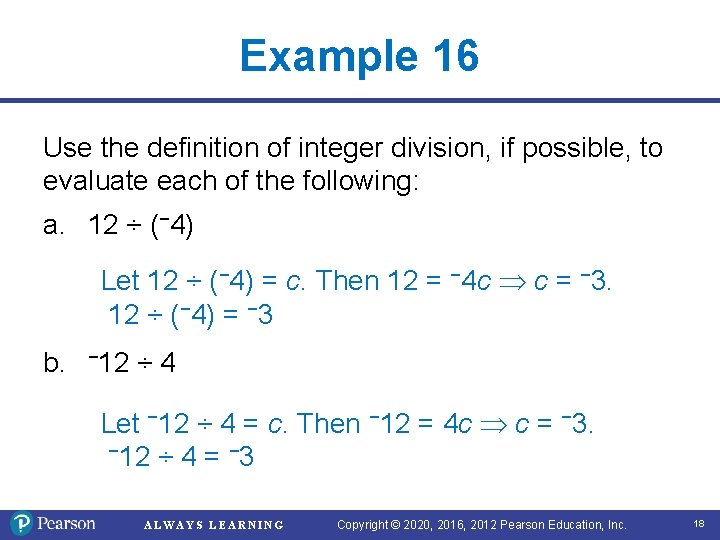
Example 16 Use the definition of integer division, if possible, to evaluate each of the following: a. 12 ÷ (− 4) Let 12 ÷ (− 4) = c. Then 12 = − 4 c c = − 3. 12 ÷ (− 4) = − 3 b. − 12 ÷ 4 Let − 12 ÷ 4 = c. Then − 12 = 4 c c = − 3. − 12 ÷ 4 = − 3 ALWAYS LEARNING Copyright © 2020, 2016, 2012 Pearson Education, Inc. 18
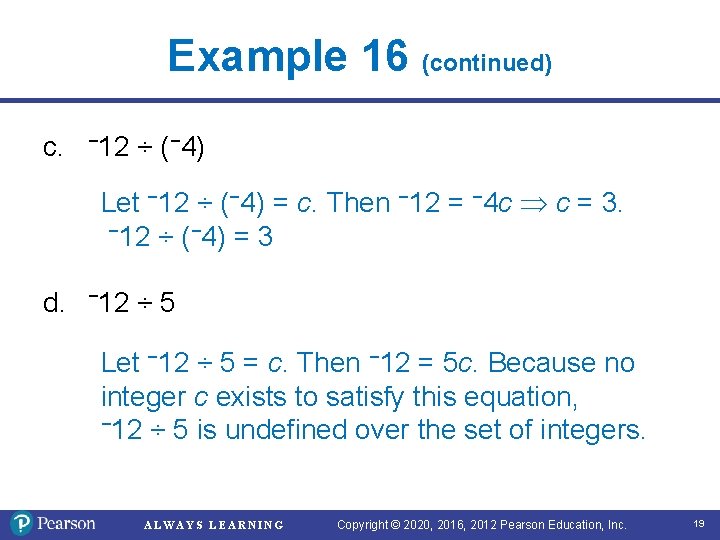
Example 16 (continued) c. − 12 ÷ (− 4) Let − 12 ÷ (− 4) = c. Then − 12 = − 4 c c = 3. − 12 ÷ (− 4) = 3 d. − 12 ÷ 5 Let − 12 ÷ 5 = c. Then − 12 = 5 c. Because no integer c exists to satisfy this equation, − 12 ÷ 5 is undefined over the set of integers. ALWAYS LEARNING Copyright © 2020, 2016, 2012 Pearson Education, Inc. 19
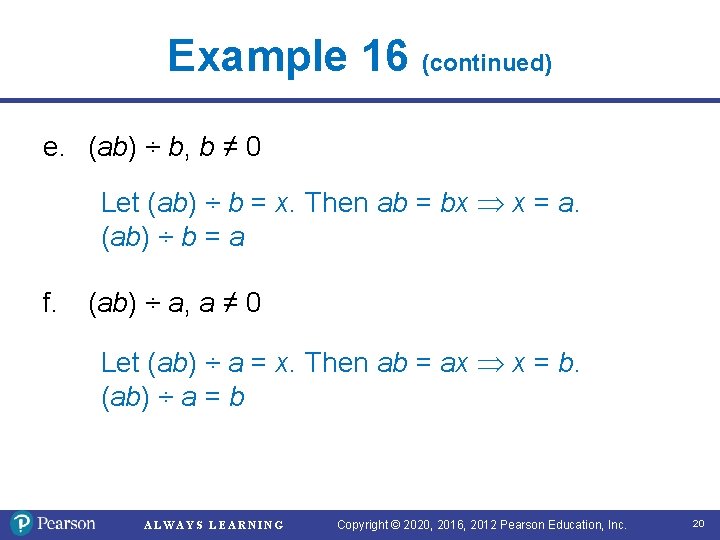
Example 16 (continued) e. (ab) ÷ b, b ≠ 0 Let (ab) ÷ b = x. Then ab = bx x = a. (ab) ÷ b = a f. (ab) ÷ a, a ≠ 0 Let (ab) ÷ a = x. Then ab = ax x = b. (ab) ÷ a = b ALWAYS LEARNING Copyright © 2020, 2016, 2012 Pearson Education, Inc. 20
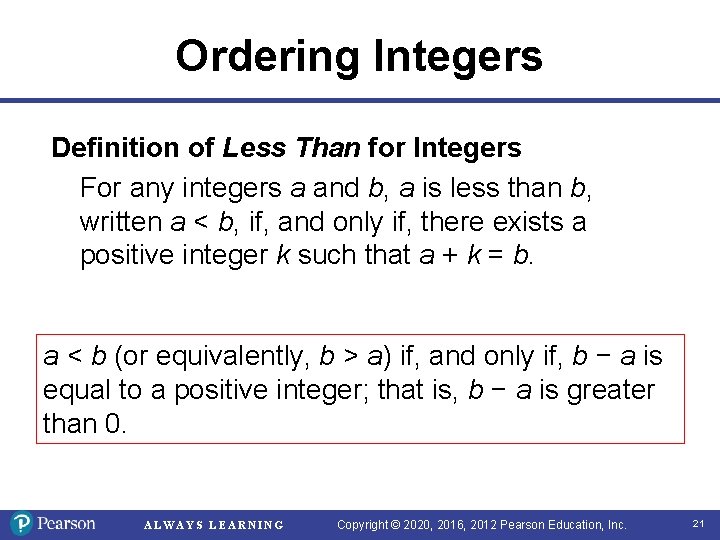
Ordering Integers Definition of Less Than for Integers For any integers a and b, a is less than b, written a < b, if, and only if, there exists a positive integer k such that a + k = b. a < b (or equivalently, b > a) if, and only if, b − a is equal to a positive integer; that is, b − a is greater than 0. ALWAYS LEARNING Copyright © 2020, 2016, 2012 Pearson Education, Inc. 21
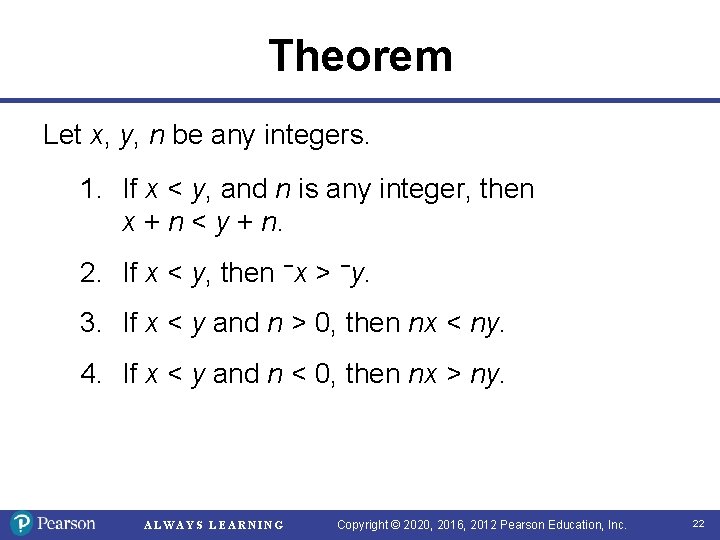
Theorem Let x, y, n be any integers. 1. If x < y, and n is any integer, then x + n < y + n. 2. If x < y, then −x > −y. 3. If x < y and n > 0, then nx < ny. 4. If x < y and n < 0, then nx > ny. ALWAYS LEARNING Copyright © 2020, 2016, 2012 Pearson Education, Inc. 22
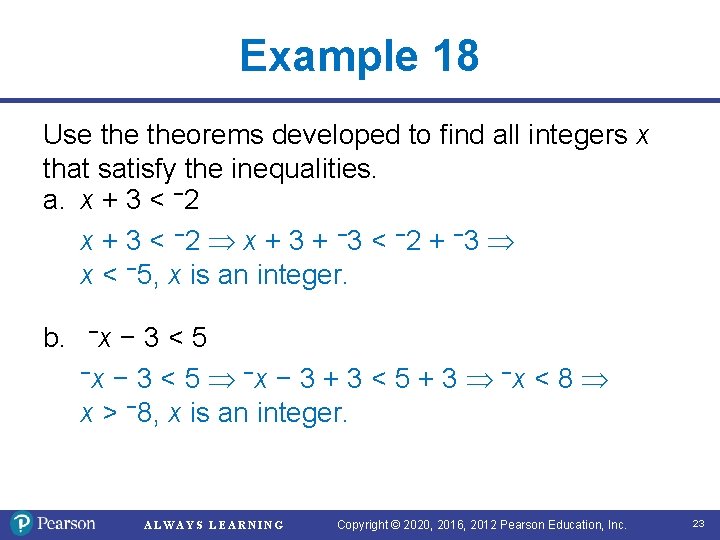
Example 18 Use theorems developed to find all integers x that satisfy the inequalities. a. x + 3 < − 2 x + 3 + − 3 < − 2 + − 3 x < − 5, x is an integer. b. −x − 3<5 −x − 3 < 5 −x − 3 + 3 < 5 + 3 −x < 8 x > − 8, x is an integer. ALWAYS LEARNING Copyright © 2020, 2016, 2012 Pearson Education, Inc. 23
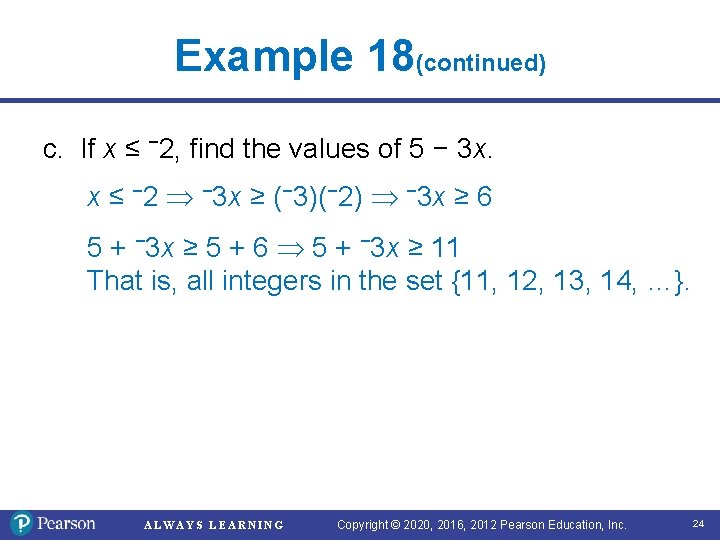
Example 18(continued) c. If x ≤ − 2, find the values of 5 − 3 x. x ≤ − 2 − 3 x ≥ (− 3)(− 2) − 3 x ≥ 6 5 + − 3 x ≥ 5 + 6 5 + − 3 x ≥ 11 That is, all integers in the set {11, 12, 13, 14, …}. ALWAYS LEARNING Copyright © 2020, 2016, 2012 Pearson Education, Inc. 24