
5 2 Direct Export Manufacturer or exporter sells
- Slides: 19
5. 2 Direct Export Manufacturer or exporter sells directly to an importer or buyer located in the foreign market area. Ø Exporter take a more direct approach to exporting may choose to transport the goods into a foreign market themselves. Ø This proactive approach gives the company greater controls on issues such as the finished product, the selling and marketing methods Ø The actual transaction flow between nations is handled directly by a dependent organization of the manufacturer or a foreign-based marketing organization or customer. Ø
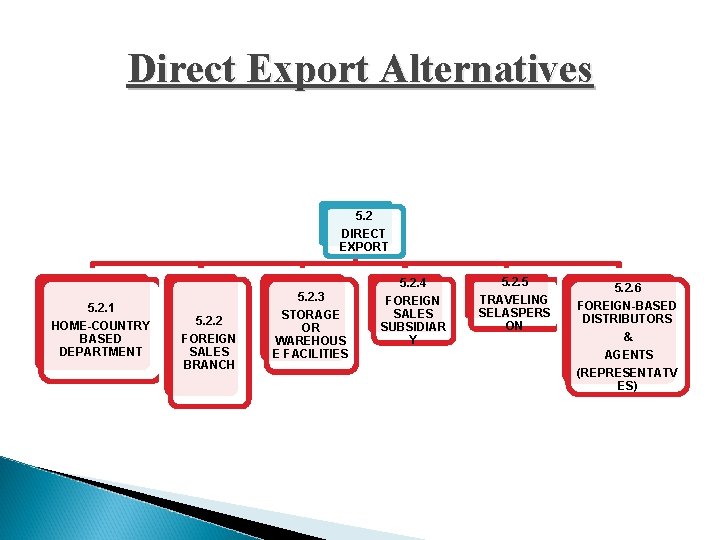
Direct Export Alternatives 5. 2 DIRECT EXPORT 5. 2. 1 HOME-COUNTRY BASED DEPARTMENT 5. 2. 3 5. 2. 2 FOREIGN SALES BRANCH STORAGE OR WAREHOUS E FACILITIES 5. 2. 4 5. 2. 5 FOREIGN SALES SUBSIDIAR Y TRAVELING SELASPERS ON 5. 2. 6 FOREIGN-BASED DISTRIBUTORS & AGENTS (REPRESENTATV ES)
5. 2. 1 Home-Country Based Department Ø Ø Export department or division in the home country. Also known as dependent organization. Involved directly in making export sales. Serve as the home-based export marketing department to coordinate and control the activities of other dependent organizations located in foreign markets.
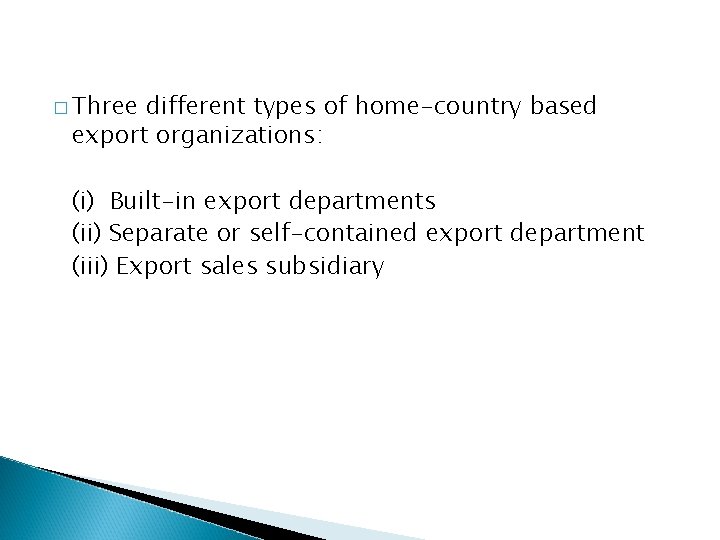
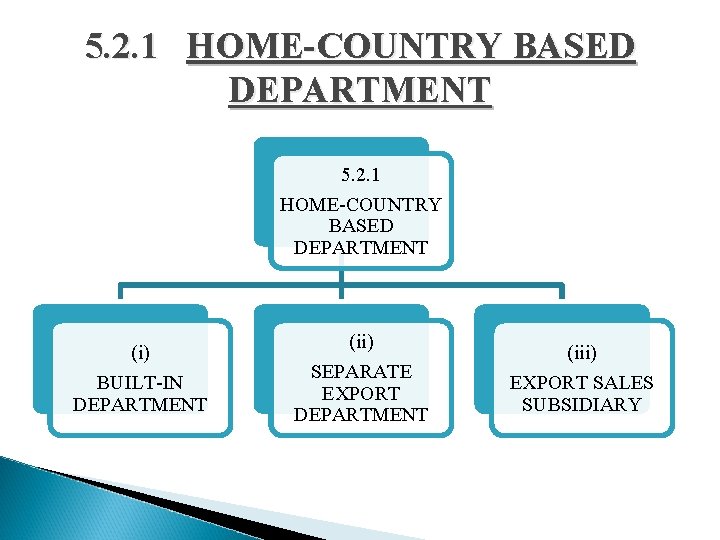
� Three different types of home-country based export organizations: (i) Built-in export departments (ii) Separate or self-contained export department (iii) Export sales subsidiary
5. 2. 1 HOME-COUNTRY BASED DEPARTMENT (i) BUILT-IN DEPARTMENT (ii) SEPARATE EXPORT DEPARTMENT (iii) EXPORT SALES SUBSIDIARY
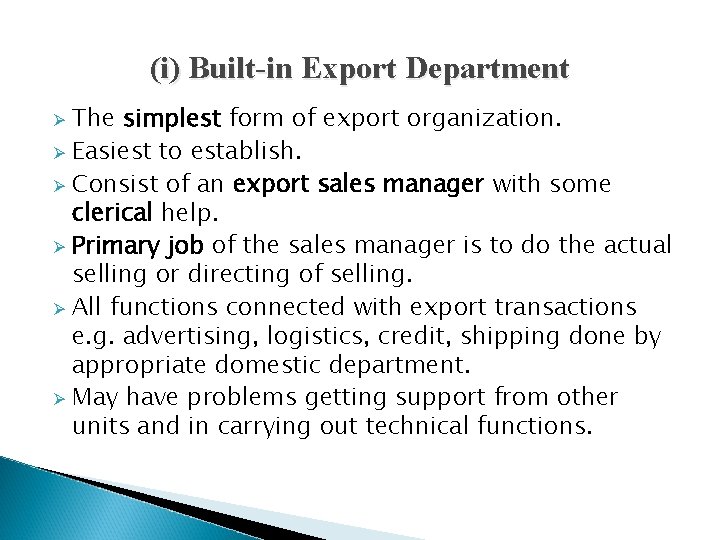
(i) Built-in Export Department The simplest form of export organization. Ø Easiest to establish. Ø Consist of an export sales manager with some clerical help. Ø Primary job of the sales manager is to do the actual selling or directing of selling. Ø All functions connected with export transactions e. g. advertising, logistics, credit, shipping done by appropriate domestic department. Ø May have problems getting support from other units and in carrying out technical functions. Ø
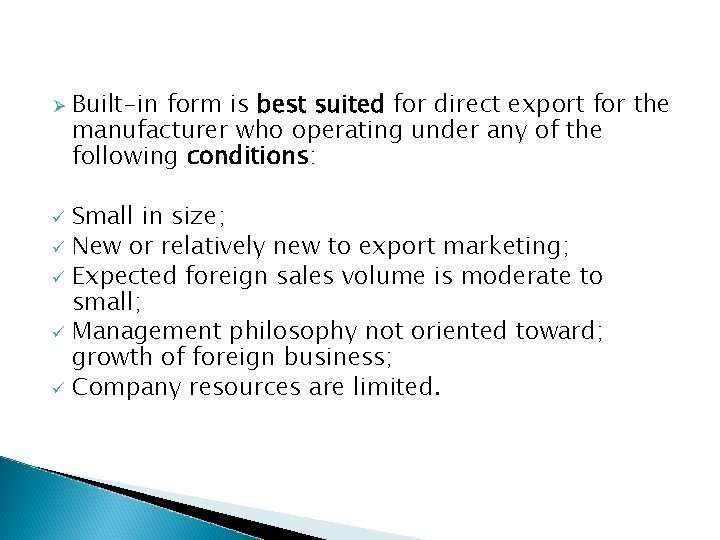
Ø Built-in form is best suited for direct export for the manufacturer who operating under any of the following conditions: Small in size; ü New or relatively new to export marketing; ü Expected foreign sales volume is moderate to small; ü Management philosophy not oriented toward; growth of foreign business; ü Company resources are limited. ü
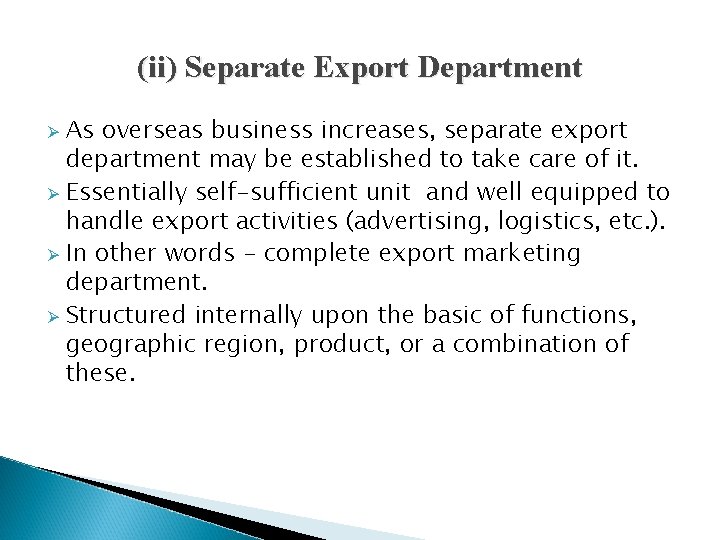
(ii) Separate Export Department As overseas business increases, separate export department may be established to take care of it. Ø Essentially self-sufficient unit and well equipped to handle export activities (advertising, logistics, etc. ). Ø In other words - complete export marketing department. Ø Structured internally upon the basic of functions, geographic region, product, or a combination of these. Ø
� Characteristics of separate export department: No inherent possibility for clash between the international and domestic sides of the firm regarding the time to be spent by domestic marketing personnel on foreign business matters. ü Export operations can be conducted on a full-time basis by personnel knowledgeable and trained; specifically committed to exporting. ü Has a fairly high degree of flexibility in terms of where it is located. ü
(iii) Export Sales Subsidiary Much more complex and almost completely independent organization. Ø Wholly owned and controlled by the parent company. Ø Functions same as SED but differs significantly in financially and organizationally. Ø ESS purchase goods from parent company and resell in foreign countries. Ø Benefit: total and independent control of their activities. Ø
� Advantages: ◦ provides unified control; ◦ profit center; ◦ can more easily allocate orders and supervise traffic management; ◦ ease of financing; ◦ wider product line; ◦ tax advantages in some countries.
5. 2. 2 Foreign Sales Branch � Serious involvement in international trade. Primary purpose: � Closer supervision of foreign sales by manufacturer in home country. Secondary purpose: � A foreign facility for manufacturer to display its product line (Display center).
� Responsibility: � Provides control, service, dedicated staff for your products; costly. � Handles all of sales distribution and promotion in a designated market area. � Storage or warehouse facilities � Used when inventory in foreign markets is necessary or profitable. � May be for one country or regional.
5. 2. 3 Storage or Warehousing Facilities � May be the complementary action to the set up of ESS and may be part of a sales branch. � Due to the exporter decisions to invest in foreign country. � Operates as a separate entity and set up to fill orders made by foreign distributors. � Reasons: ü Faster and more secure flows of goods; ü Create consumer trust and satisfaction; ü Facilitates easier trading with wholesalers and retailers. � Best set up in a free port or trade zone.
5. 2. 4 Foreign Sales Subsidiary � Similar in operation to the ESS and FSB. � Differences: greater autonomy in decision making. � Has its own organizational structure, separate financial accounts and marketing division. � They purchase goods from parent-company and resell it to foreign buyer. � Using transfer pricing. � Why establish foreign sales subsidiary? ü Potential tax advantages ü Business practices
5. 2. 5 Traveling Sales Person Functions: selling activities, customer relations, information gathering. � May act as a chain between manufacturer and end users. � Traveling export salesperson: � A person who lives in one country, often the home country of the employer, and travels abroad to perform the sales duties. Resident sales person: � A person who is sent out of the home country to live and work in a foreign market.
� Basic functions of traveling sales personnel: (i) Communication of product information to customers, and obtaining orders. (ii) Customer relations: maintaining and improving the company’s position with customers and general public. (iii) Gathering and communicating information. (iv) Arranging the delivery of products.
5. 2. 6 Foreign Based Distributors and Agents/Representatives �A distributor is a customer of the manufacturer, who purchases the goods and earns their profit through a profit margin when it’s resold. � An agent is a representative of the manufacturer who earns commission for finding foreign purchasers of the manufacturers goods. � Unfortunately, terms are often used interchanged. � In direct exporting, use of exclusive agents or distributors is easiest and least costly; also has potential for development.
� Conditions required the uses of distributors/agents: ü Little knowledge of foreign market; ü Do not wish to make greater investments; not sure the product will be successful or not; ü Do not have personnel capable of being a traveling salesperson; ü Order small in quantities or size. � More importantly, the uses of distributor/agent is less risks and less costs.