
5 1 The Cell Cycle The cell cycle
- Slides: 51
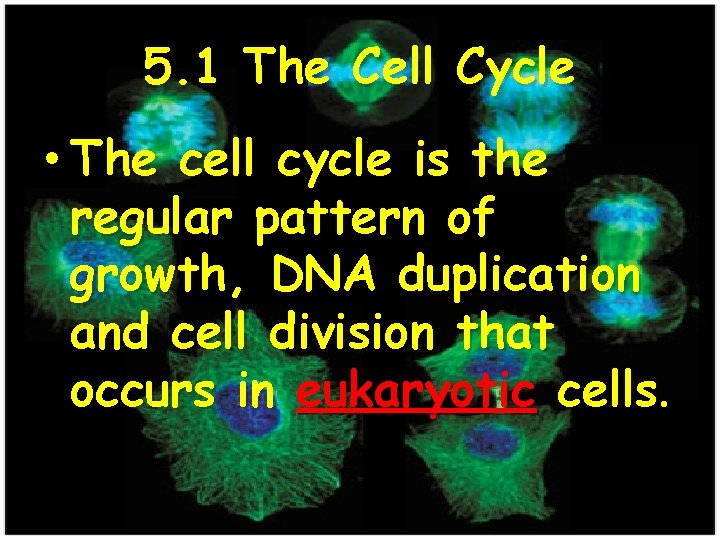
5. 1 The Cell Cycle • The cell cycle is the regular pattern of growth, DNA duplication and cell division that occurs in eukaryotic cells.
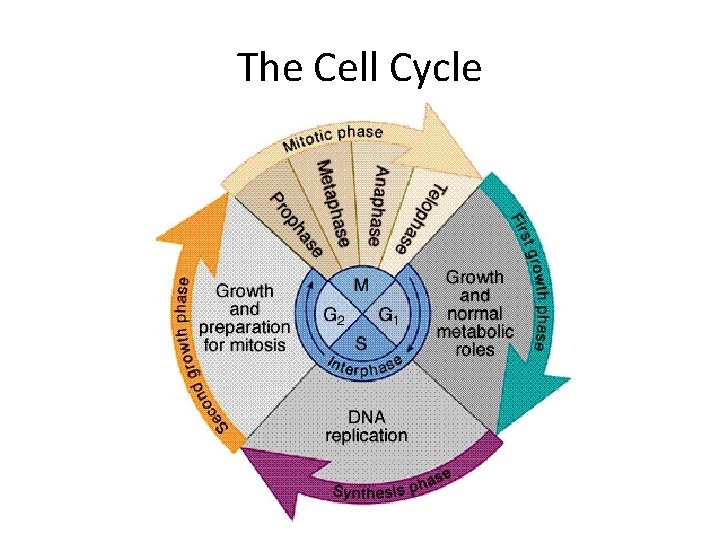
The Cell Cycle
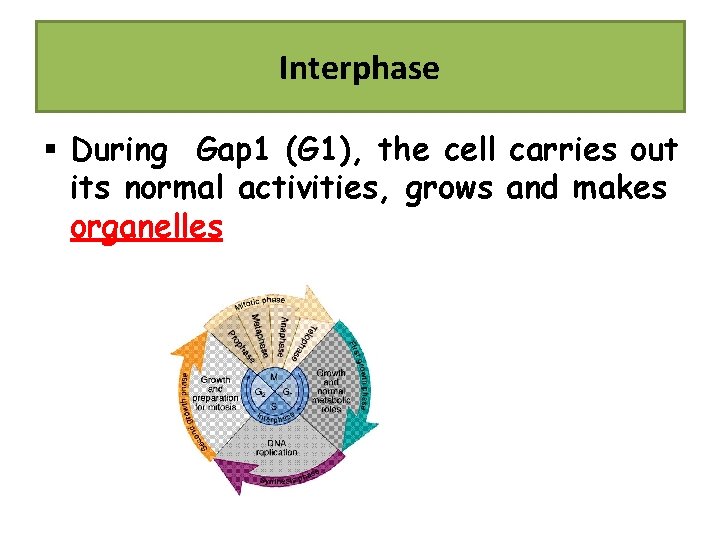
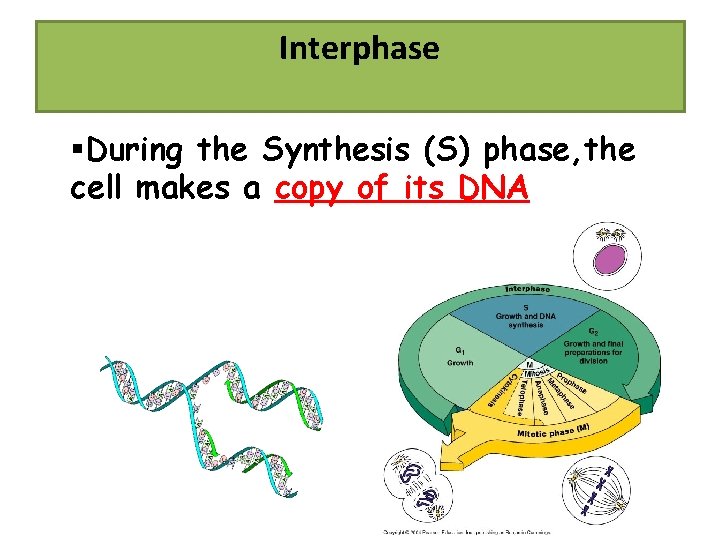
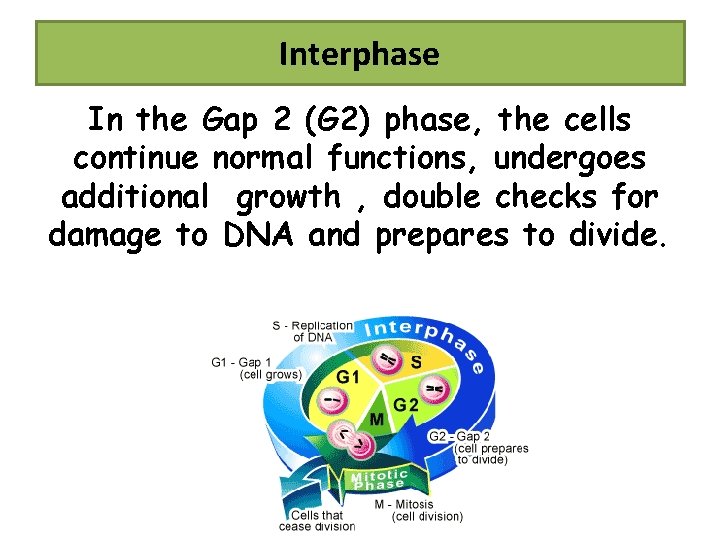
Main Idea: The cell cycle has THREE main stages and then an end action – Gap 1 (G 1) – Synthesis (S) – Gap 2 (G 2) – 2. Mitosis (M) – 3. Cytokinesis 1. Interphase Gap 1, Synthesis and Gap 2 Together make up Interphase.
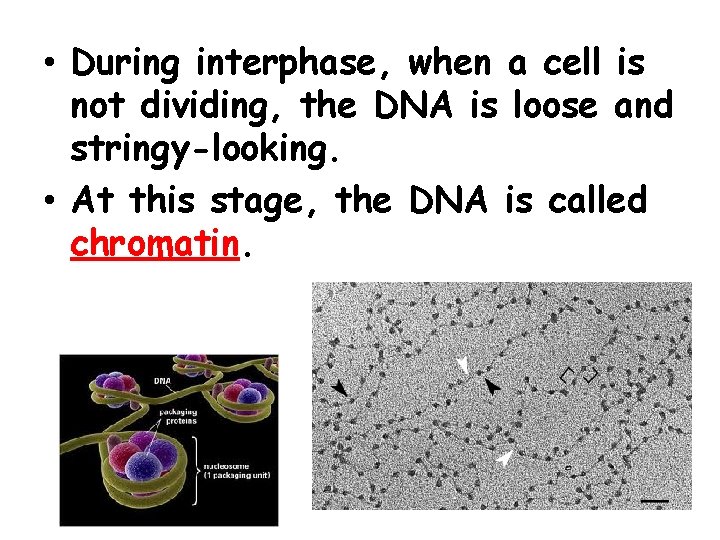
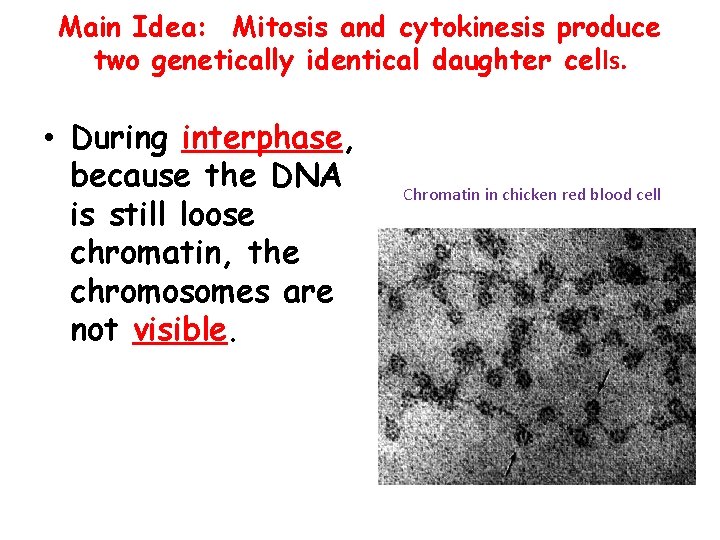
• During interphase, when a cell is not dividing, the DNA is loose and stringy-looking. • At this stage, the DNA is called chromatin.
Interphase § During Gap 1 (G 1), the cell carries out its normal activities, grows and makes organelles
Interphase §During the Synthesis (S) phase, the cell makes a copy of its DNA
Interphase In the Gap 2 (G 2) phase, the cells continue normal functions, undergoes additional growth , double checks for damage to DNA and prepares to divide.
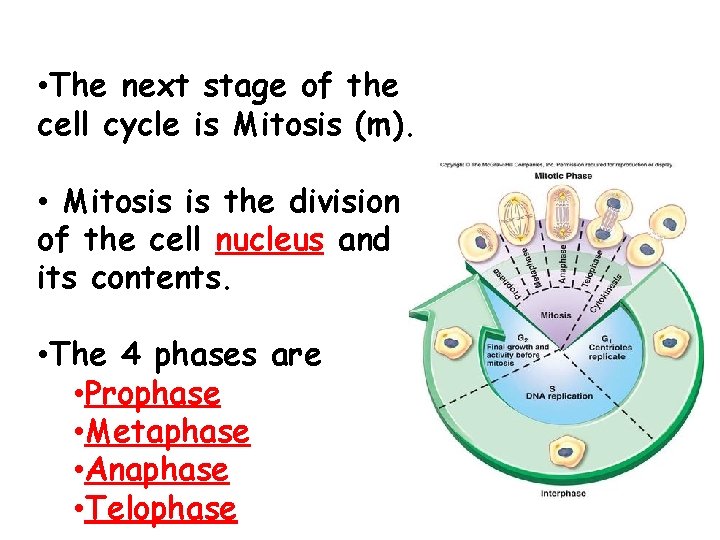
• The next stage of the cell cycle is Mitosis (m). • Mitosis is the division of the cell nucleus and its contents. • The 4 phases are • Prophase • Metaphase • Anaphase • Telophase
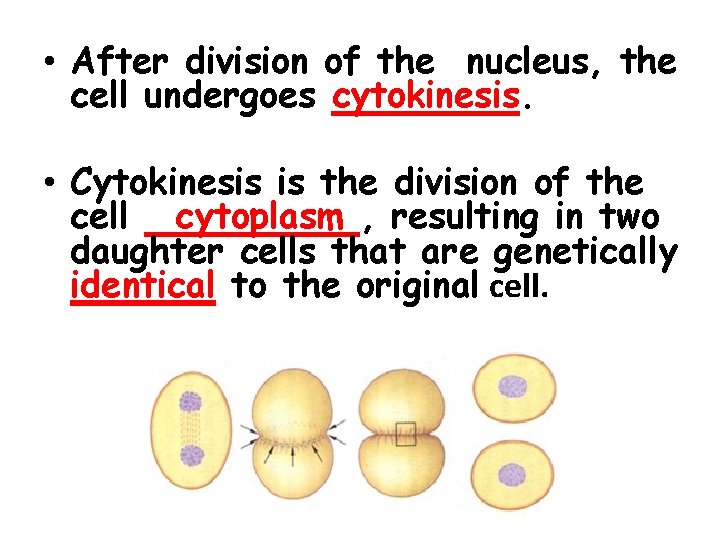
• After division of the nucleus, the cell undergoes cytokinesis. • Cytokinesis is the division of the cell cytoplasm , resulting in two daughter cells that are genetically identical to the original cell.
Main Idea: Cells divide at different rates • Prokaryotes generally divide much faster than eukaryotes. • The rate at which your cells divide depends upon your body’s need for those cells. • The rate of cell division in embryos and children is faster than that of adults. • The rate of cell division in an adult varies within the different tissues.
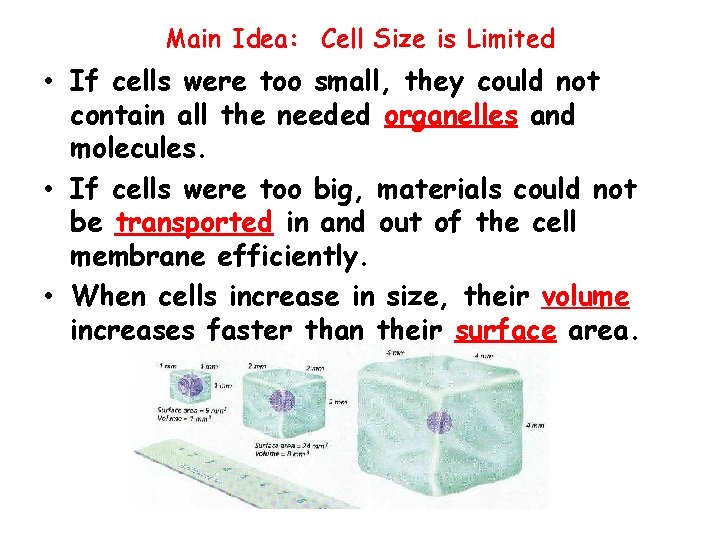
Main Idea: Cell Size is Limited • If cells were too small, they could not contain all the needed organelles and molecules. • If cells were too big, materials could not be transported in and out of the cell membrane efficiently. • When cells increase in size, their volume increases faster than their surface area.
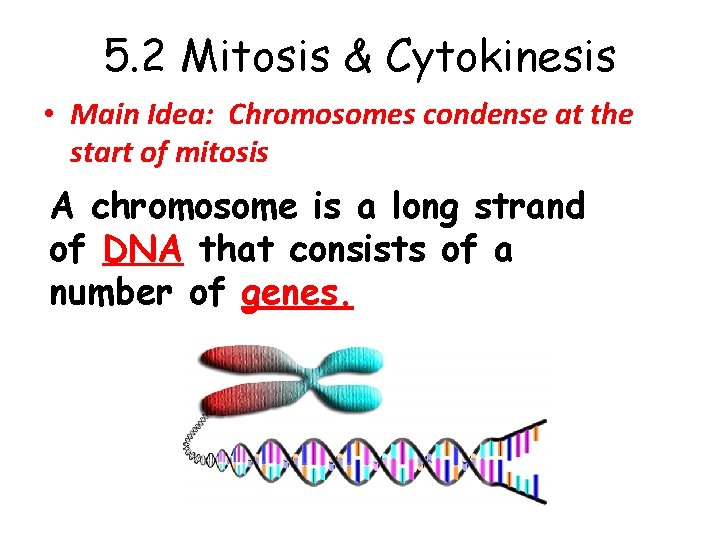
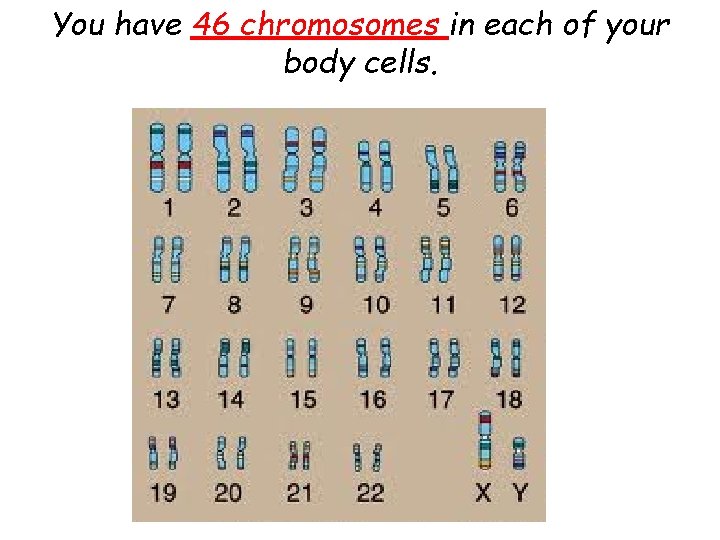
5. 2 Mitosis & Cytokinesis • Main Idea: Chromosomes condense at the start of mitosis A chromosome is a long strand of DNA that consists of a number of genes.
You have 46 chromosomes in each of your body cells.
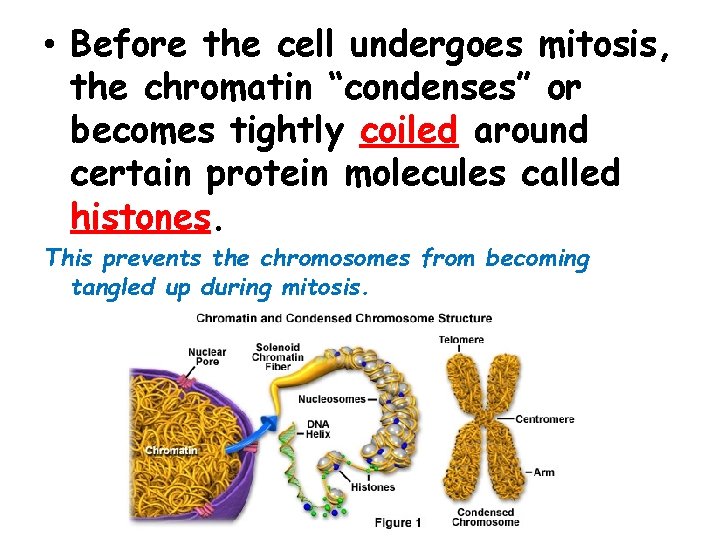
• Before the cell undergoes mitosis, the chromatin “condenses” or becomes tightly coiled around certain protein molecules called histones. This prevents the chromosomes from becoming tangled up during mitosis.
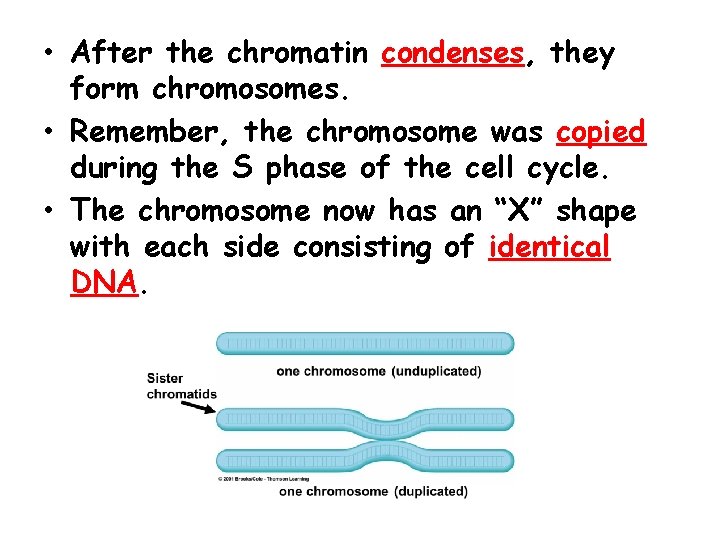
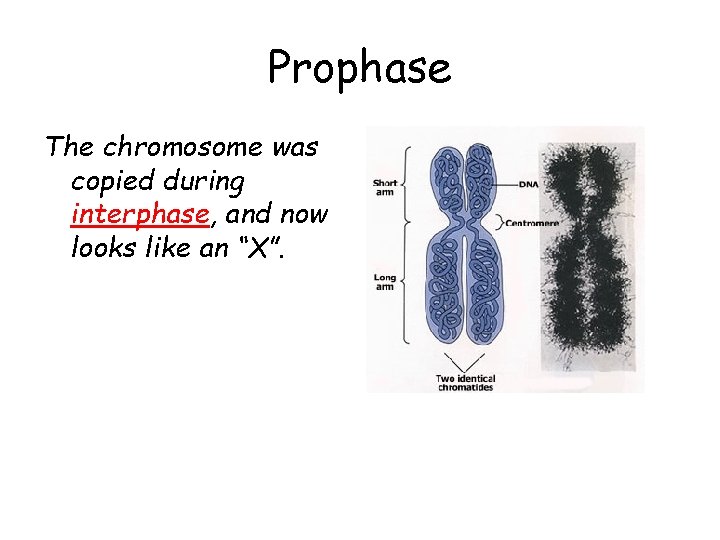
• After the chromatin condenses, they form chromosomes. • Remember, the chromosome was copied during the S phase of the cell cycle. • The chromosome now has an “X” shape with each side consisting of identical DNA.
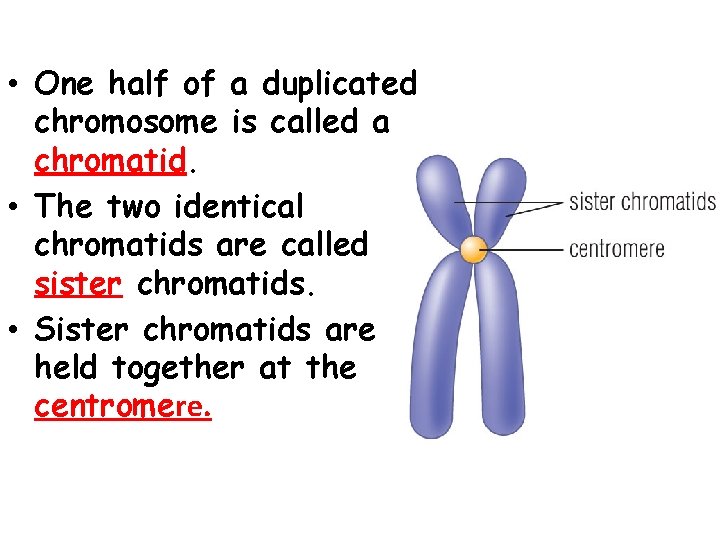
• One half of a duplicated chromosome is called a chromatid. • The two identical chromatids are called sister chromatids. • Sister chromatids are held together at the centromere.
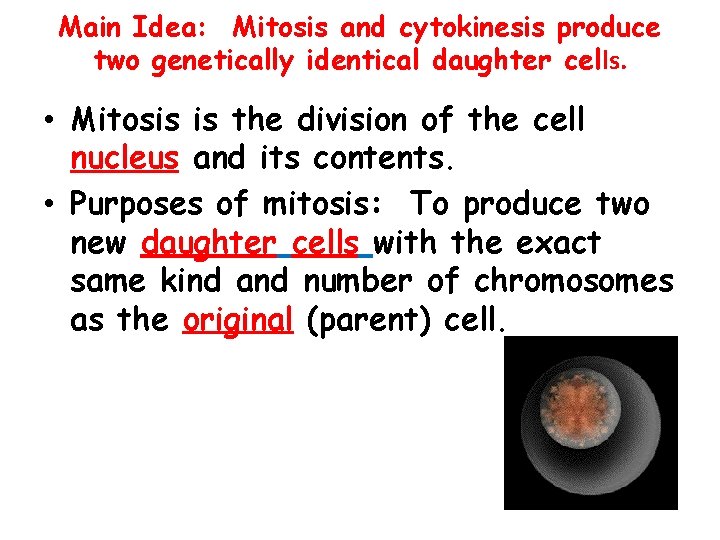
Main Idea: Mitosis and cytokinesis produce two genetically identical daughter cells. • Mitosis is the division of the cell nucleus and its contents. • Purposes of mitosis: To produce two new daughter cells with the exact same kind and number of chromosomes as the original (parent) cell.
Main Idea: Mitosis and cytokinesis produce two genetically identical daughter cells. • During interphase, because the DNA is still loose chromatin, the chromosomes are not visible. Chromatin in chicken red blood cell
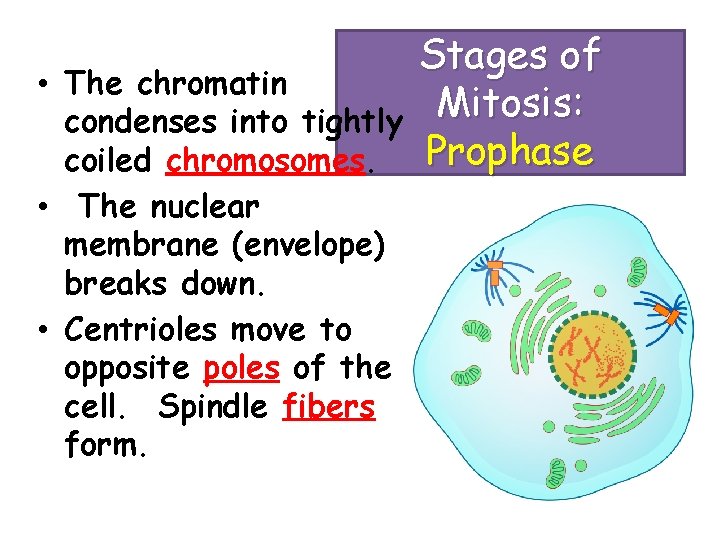
• The chromatin condenses into tightly coiled chromosomes. • The nuclear membrane (envelope) breaks down. • Centrioles move to opposite poles of the cell. Spindle fibers form. Stages of Mitosis: Prophase
Prophase The chromosome was copied during interphase, and now looks like an “X”.
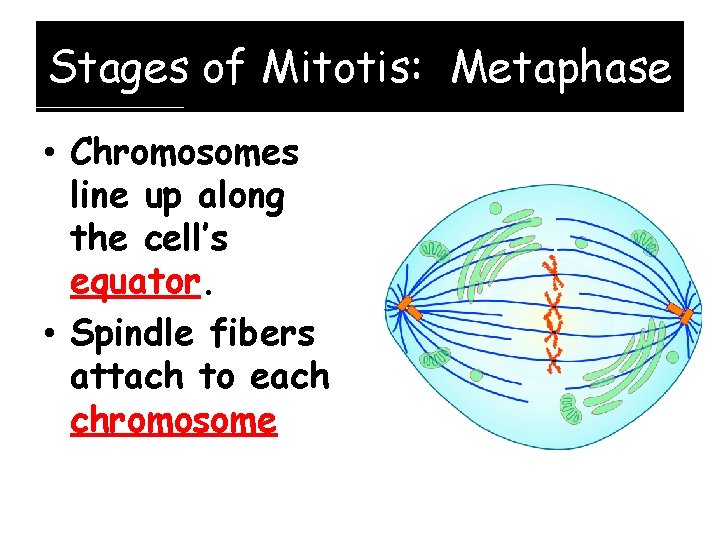
Stages of Mitotis: Metaphase • Chromosomes line up along the cell’s equator. • Spindle fibers attach to each chromosome
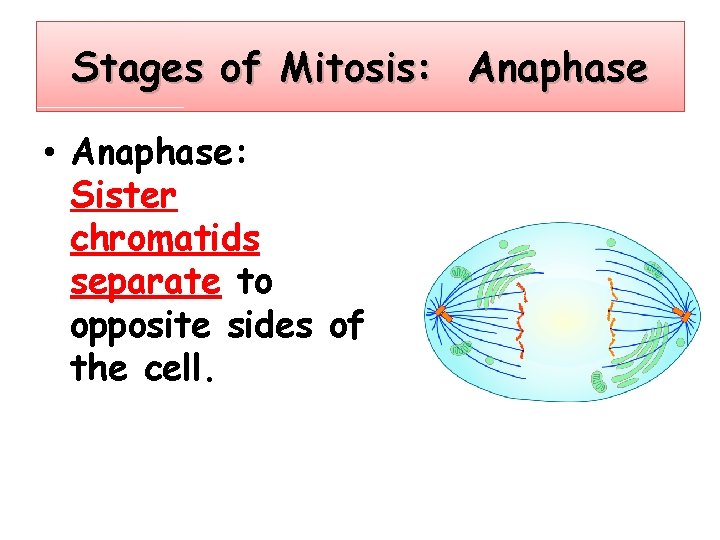
Stages of Mitosis: Anaphase • Anaphase: Sister chromatids separate to opposite sides of the cell.
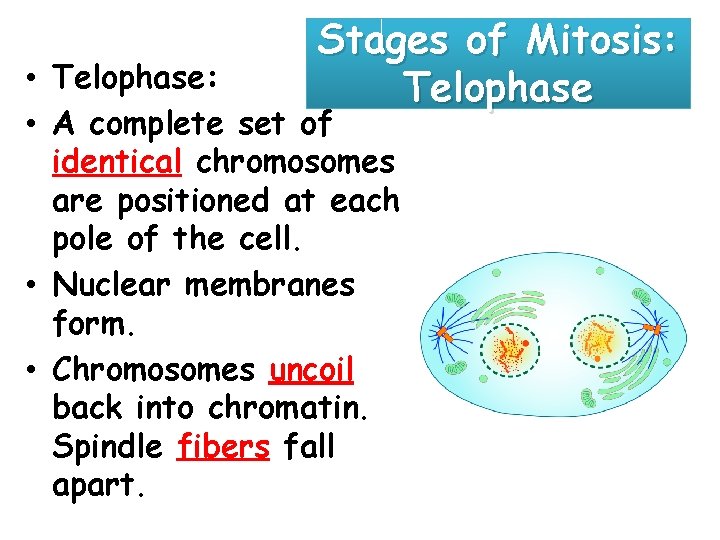
Stages of Mitosis: Telophase • Telophase: • A complete set of identical chromosomes are positioned at each pole of the cell. • Nuclear membranes form. • Chromosomes uncoil back into chromatin. Spindle fibers fall apart.
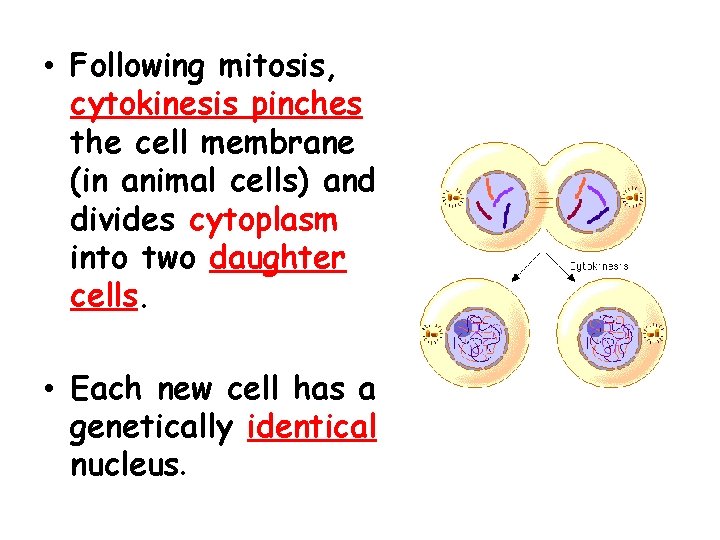
• Following mitosis, cytokinesis pinches the cell membrane (in animal cells) and divides cytoplasm into two daughter cells. • Each new cell has a genetically identical nucleus.
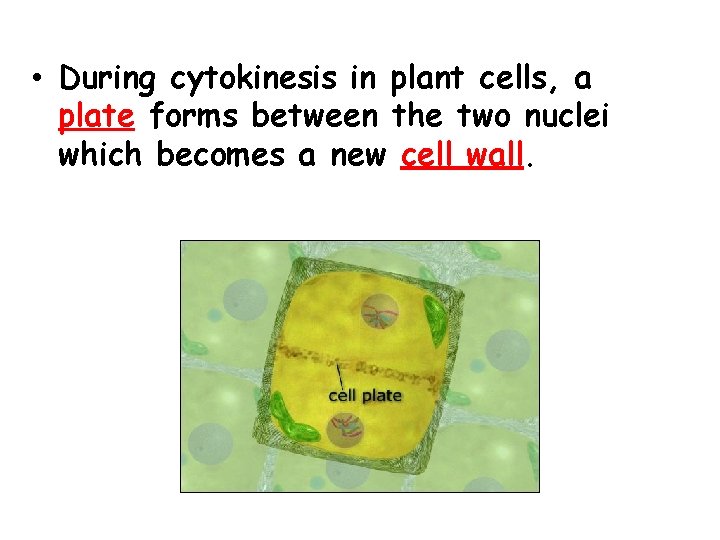
• During cytokinesis in plant cells, a plate forms between the two nuclei which becomes a new cell wall.
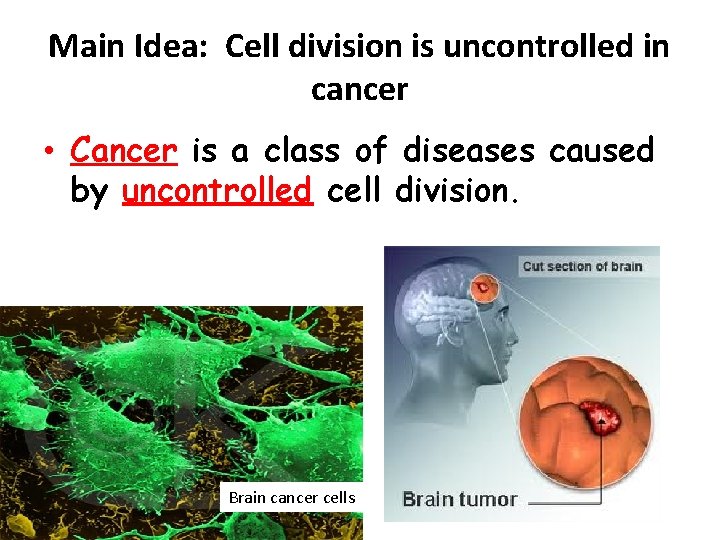
Main Idea: Cell division is uncontrolled in cancer • Cancer is a class of diseases caused by uncontrolled cell division. Brain cancer cells
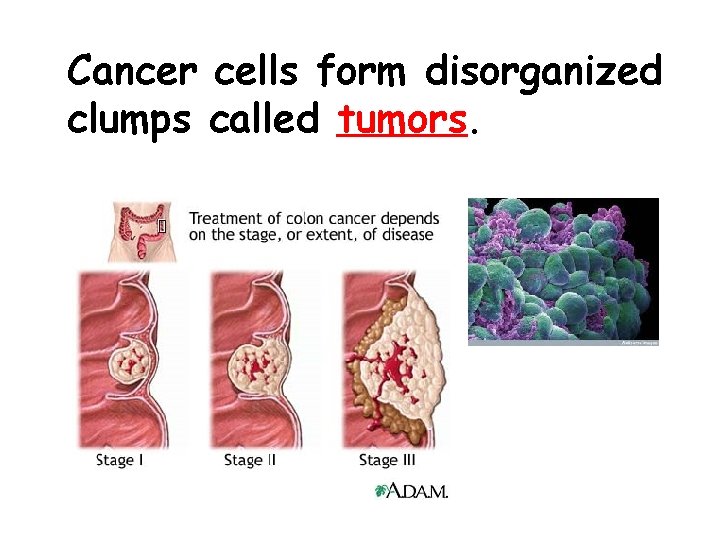
Cancer cells form disorganized clumps called tumors.
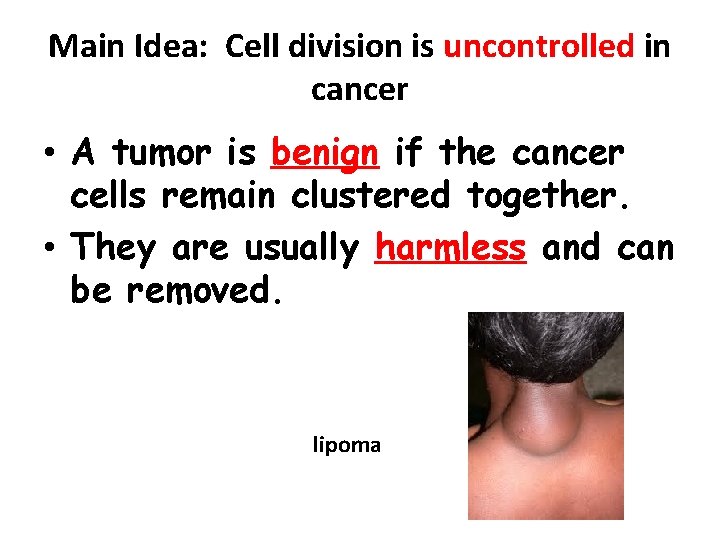
Main Idea: Cell division is uncontrolled in cancer • A tumor is benign if the cancer cells remain clustered together. • They are usually harmless and can be removed. lipoma
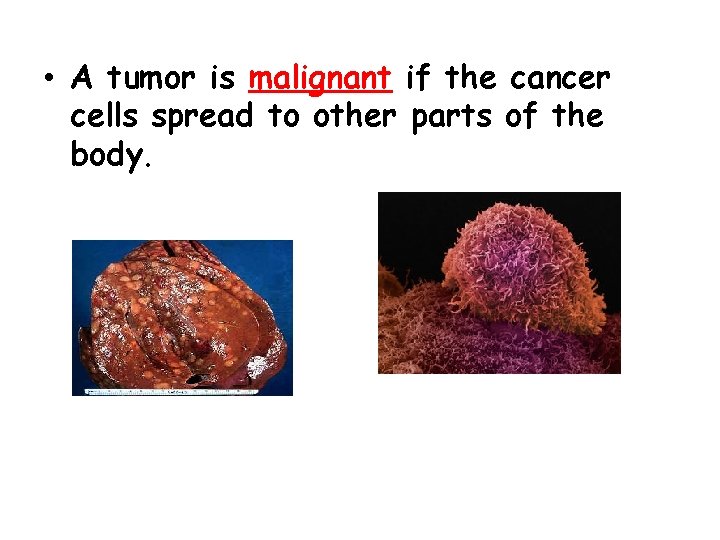
• A tumor is malignant if the cancer cells spread to other parts of the body.
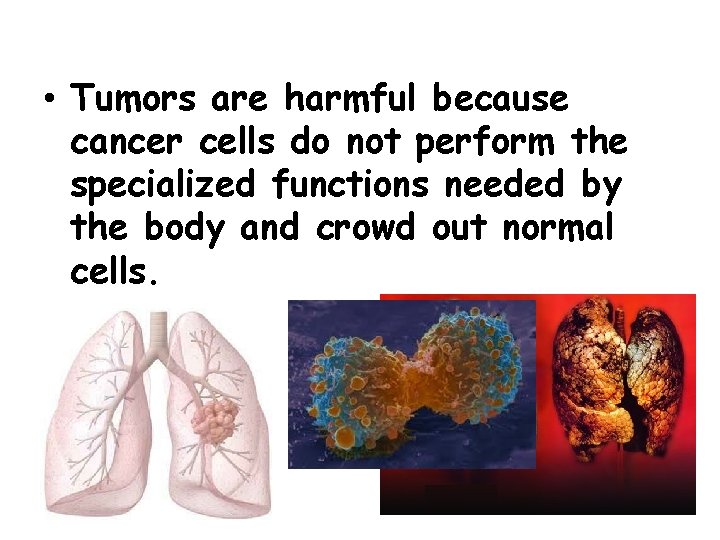
• Tumors are harmful because cancer cells do not perform the specialized functions needed by the body and crowd out normal cells.
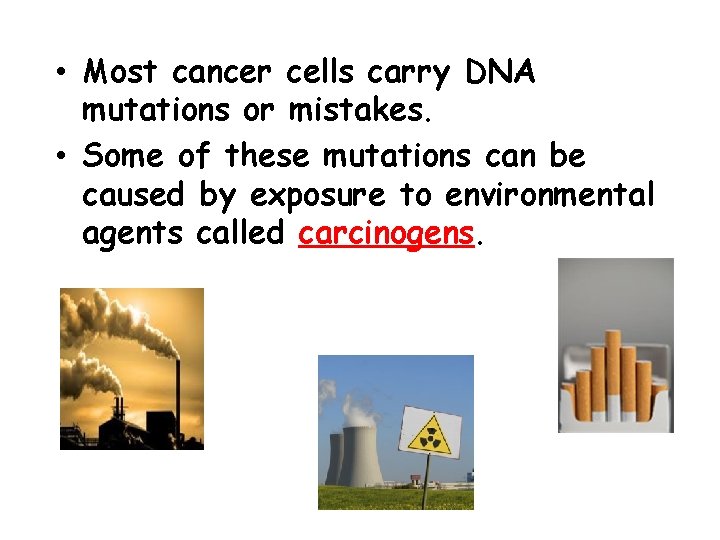
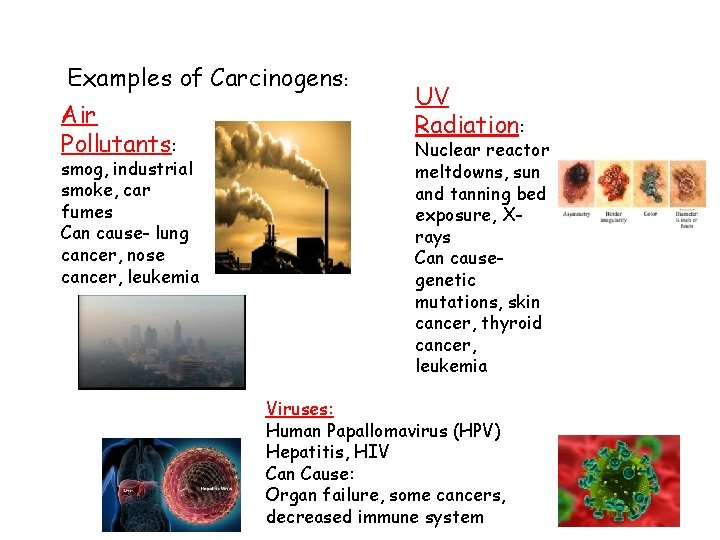
• Most cancer cells carry DNA mutations or mistakes. • Some of these mutations can be caused by exposure to environmental agents called carcinogens.
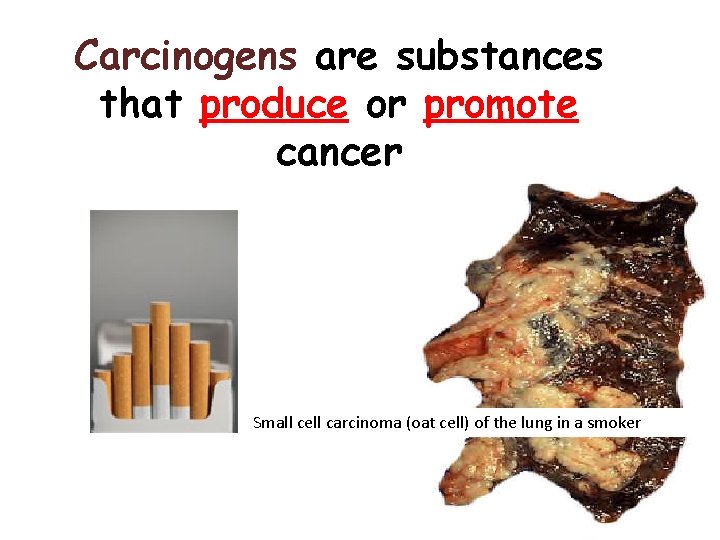
Carcinogens are substances that produce or promote cancer Small cell carcinoma (oat cell) of the lung in a smoker
Examples of Carcinogens: Air Pollutants: smog, industrial smoke, car fumes Can cause- lung cancer, nose cancer, leukemia UV Radiation: Nuclear reactor meltdowns, sun and tanning bed exposure, Xrays Can causegenetic mutations, skin cancer, thyroid cancer, leukemia Viruses: Human Papallomavirus (HPV) Hepatitis, HIV Can Cause: Organ failure, some cancers, decreased immune system
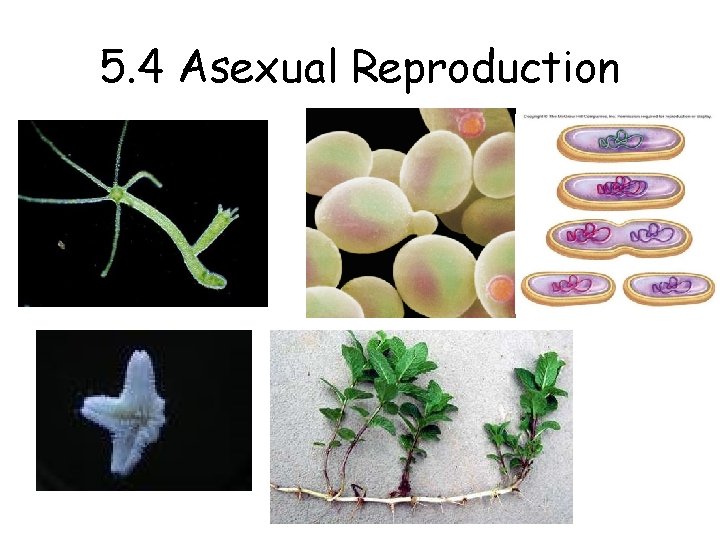
5. 4 Asexual Reproduction
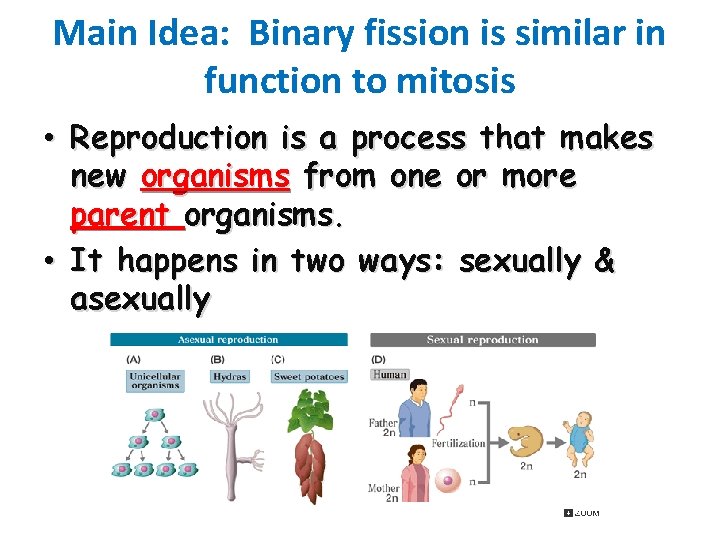
Main Idea: Binary fission is similar in function to mitosis • Reproduction is a process that makes new organisms from one or more parent organisms. • It happens in two ways: sexually & asexually
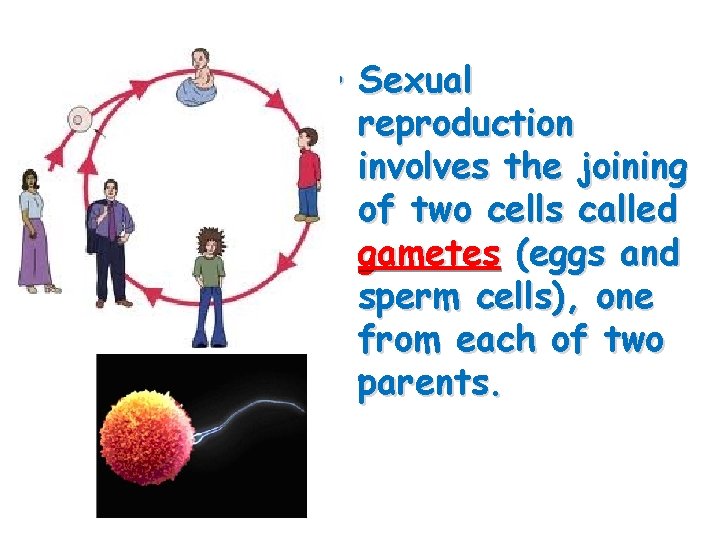
• Sexual reproduction involves the joining of two cells called gametes (eggs and sperm cells), one from each of two parents.
Asexual Reproduction • Asexual reproduction is the production of offspring from a single parent and does not involve the joining of gametes. • The offspring are genetically identical to each other and the parent.
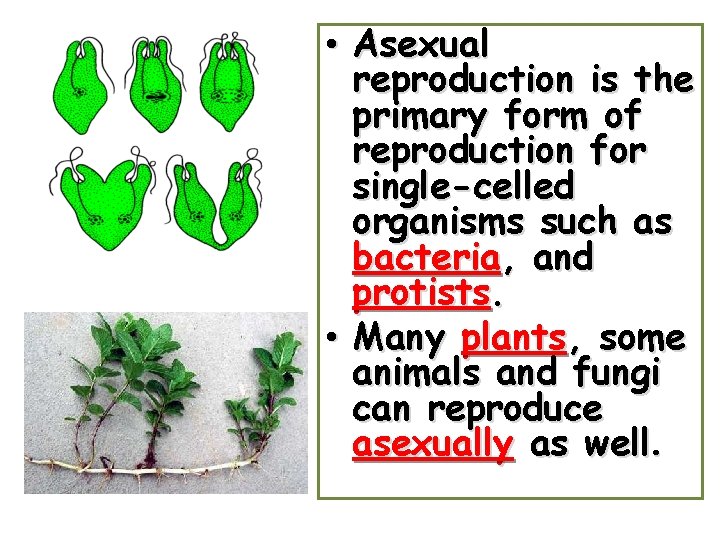
• Asexual reproduction is the primary form of reproduction for single-celled organisms such as bacteria, and protists. • Many plants, some animals and fungi can reproduce asexually as well.
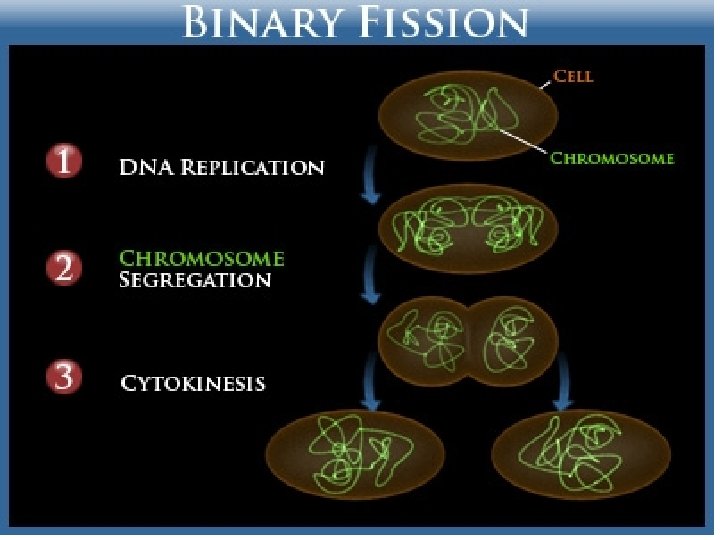
Main Idea: Binary fission is similar to mitosis • Binary fission is the asexual reproduction of a single-celled organism by division into two new organisms.
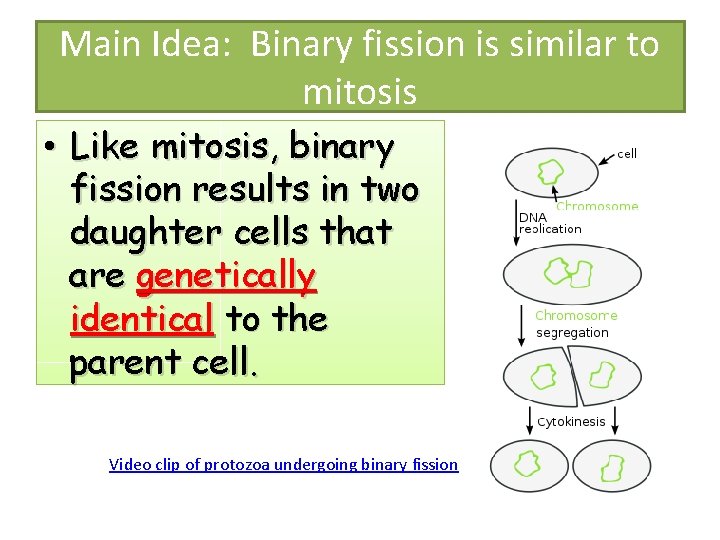
Main Idea: Binary fission is similar to mitosis • Like mitosis, binary fission results in two daughter cells that are genetically identical to the parent cell. Video clip of protozoa undergoing binary fission
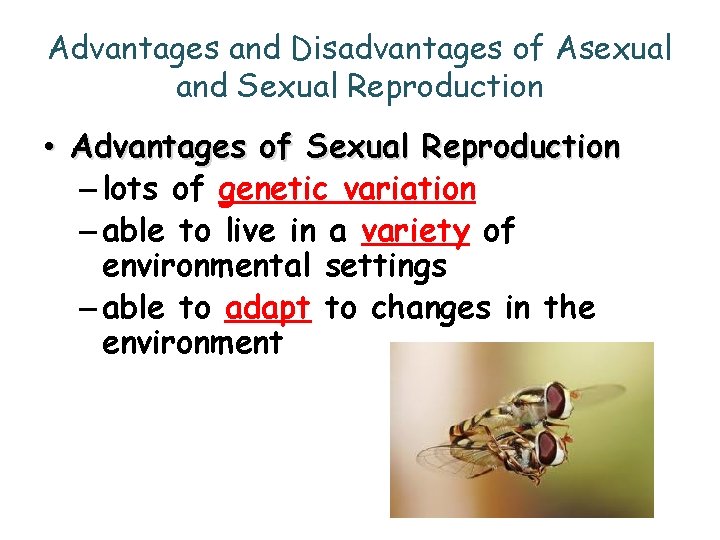
Advantages and Disadvantages of Asexual and Sexual Reproduction • Advantages of Sexual Reproduction – lots of genetic variation – able to live in a variety of environmental settings – able to adapt to changes in the environment
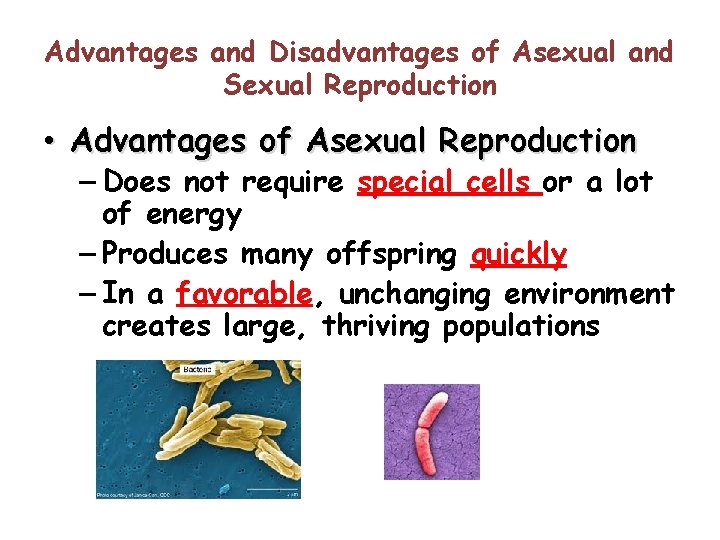
Advantages and Disadvantages of Asexual and Sexual Reproduction • Advantages of Asexual Reproduction – Does not require special cells or a lot of energy – Produces many offspring quickly – In a favorable, unchanging environment creates large, thriving populations
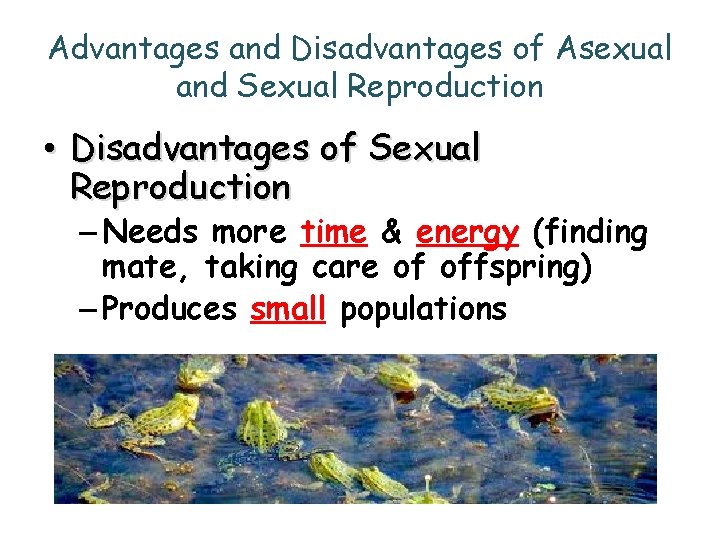
Advantages and Disadvantages of Asexual and Sexual Reproduction • Disadvantages of Sexual Reproduction – Needs more time & energy (finding mate, taking care of offspring) – Produces small populations
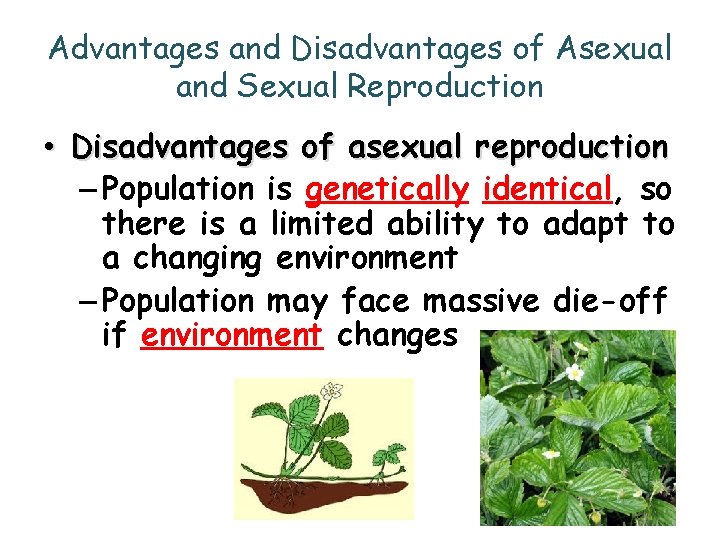
Advantages and Disadvantages of Asexual and Sexual Reproduction • Disadvantages of asexual reproduction – Population is genetically identical, so there is a limited ability to adapt to a changing environment – Population may face massive die-off if environment changes
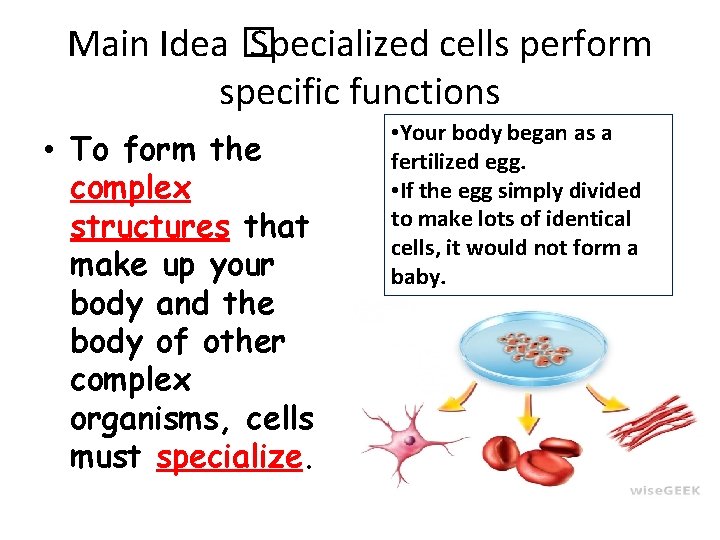
Main Idea � Specialized cells perform specific functions • To form the complex structures that make up your body and the body of other complex organisms, cells must specialize. • Your body began as a fertilized egg. • If the egg simply divided to make lots of identical cells, it would not form a baby.
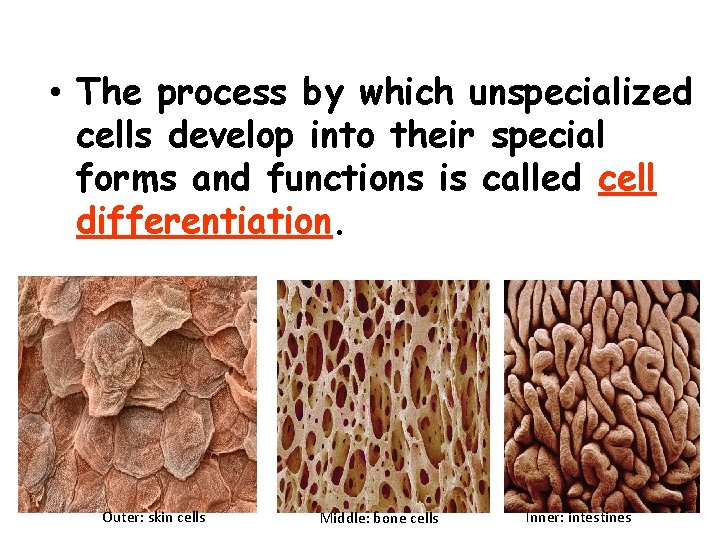
• The process by which unspecialized cells develop into their special forms and functions is called cell differentiation. Outer: skin cells Middle: bone cells Inner: intestines
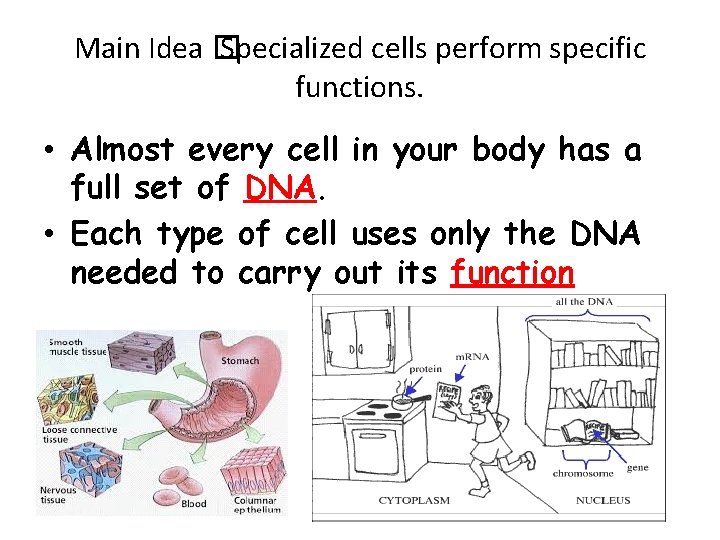
Main Idea � Specialized cells perform specific functions. • Almost every cell in your body has a full set of DNA. • Each type of cell uses only the DNA needed to carry out its function
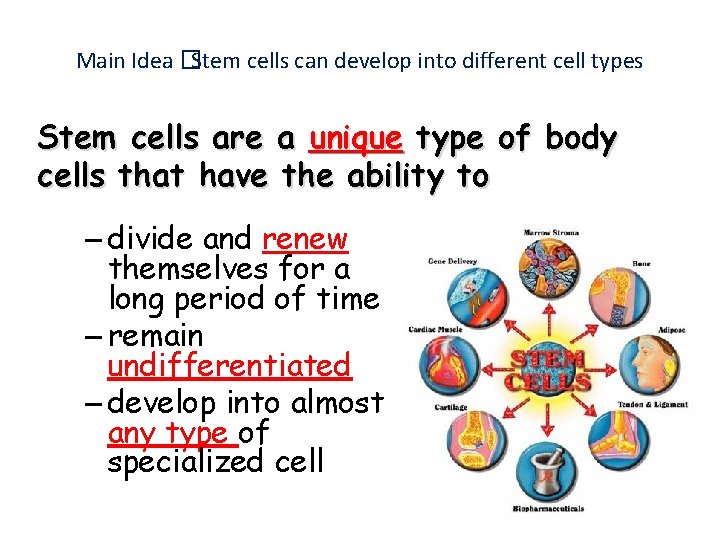
Main Idea �Stem cells can develop into different cell types Stem cells are a unique type of body cells that have the ability to – divide and renew themselves for a long period of time – remain undifferentiated – develop into almost any type of specialized cell
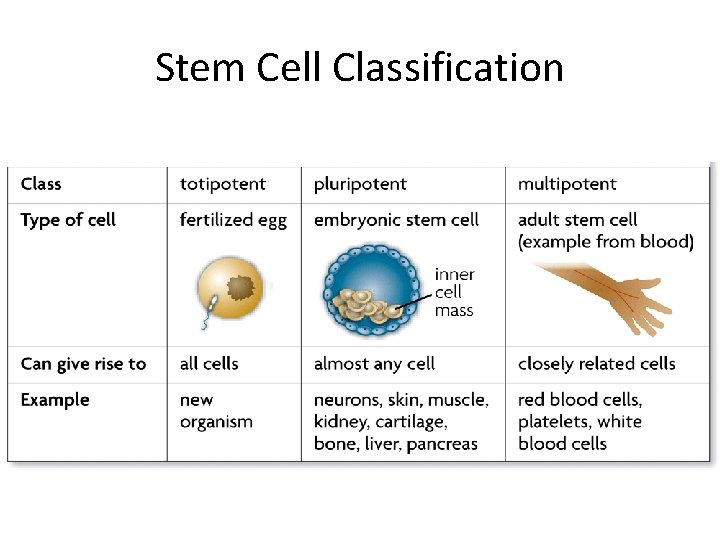
Stem Cell Classification
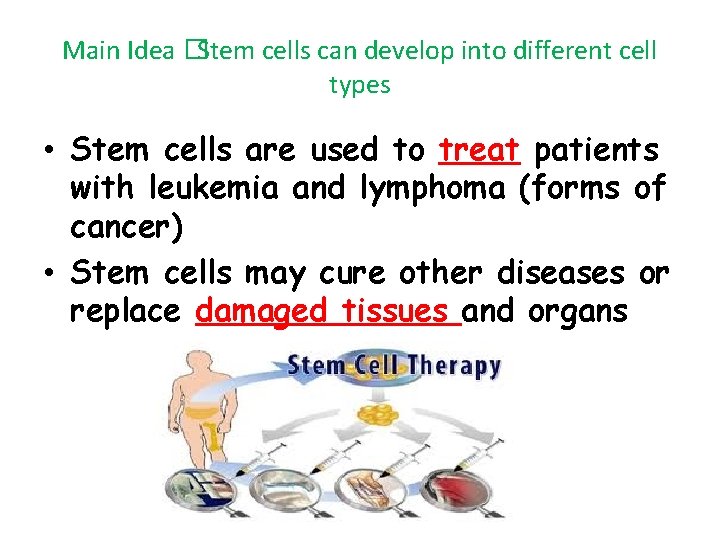
Main Idea �Stem cells can develop into different cell types • Stem cells are used to treat patients with leukemia and lymphoma (forms of cancer) • Stem cells may cure other diseases or replace damaged tissues and organs