
458 Multispecies Models Introduction to predatorprey dynamics Fish
- Slides: 22
458 Multispecies Models (Introduction to predator-prey dynamics) Fish 458, Lecture 26
Overview 458 n n All of the models examined so far ignore multispecies considerations. We can divide multispecies considerations into biological and technological interactions.
Biological and Technological Interactions 458 n n n Technological Interactions: linkage among species occurs because of their co-occurrence in catches. Biological Interactions: linkage among species occurs because one eats the other or they compete for the same prey. This lecture and the next lecture will focus on biological interactions.
Biological Interactions 458 n n We will develop our models of biological interactions using lumped differential equations (i. e. we are modelling the rate of change of population size / biomass). Multi-species / eco-system models are, however, extremely complicated and we will quickly have to resort to numerical methods to make use of them.
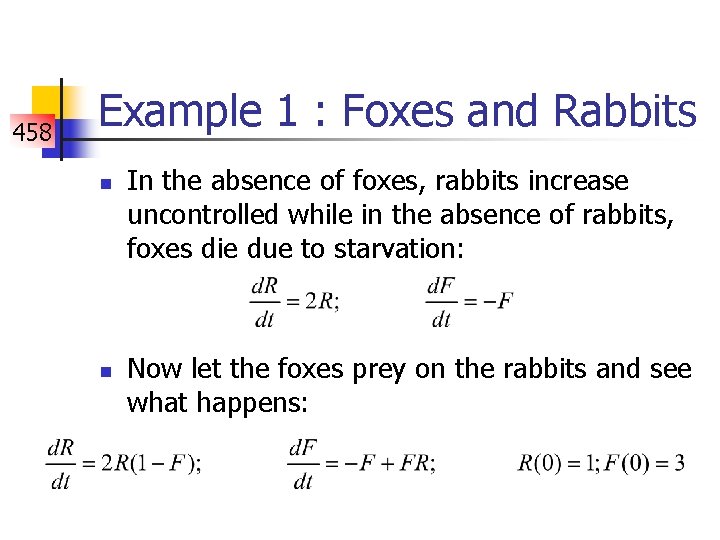
458 Example 1 : Foxes and Rabbits n n In the absence of foxes, rabbits increase uncontrolled while in the absence of rabbits, foxes die due to starvation: Now let the foxes prey on the rabbits and see what happens:
458 Example 1 : Foxes and Rabbits
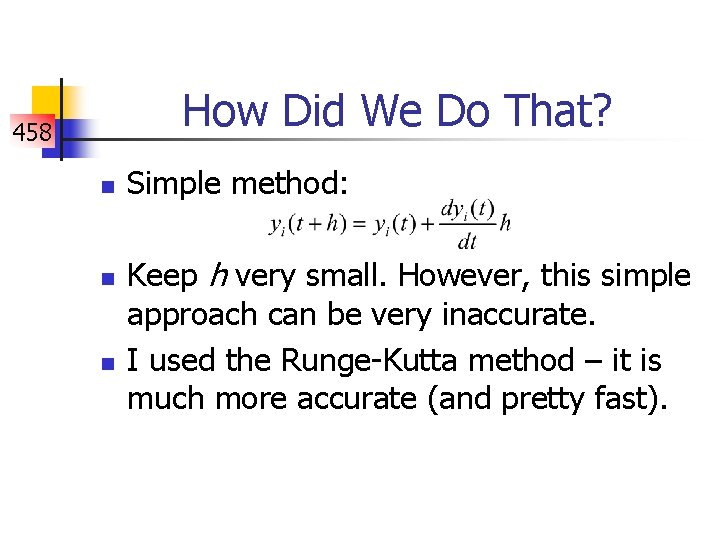
How Did We Do That? 458 n n n Simple method: Keep h very small. However, this simple approach can be very inaccurate. I used the Runge-Kutta method – it is much more accurate (and pretty fast).
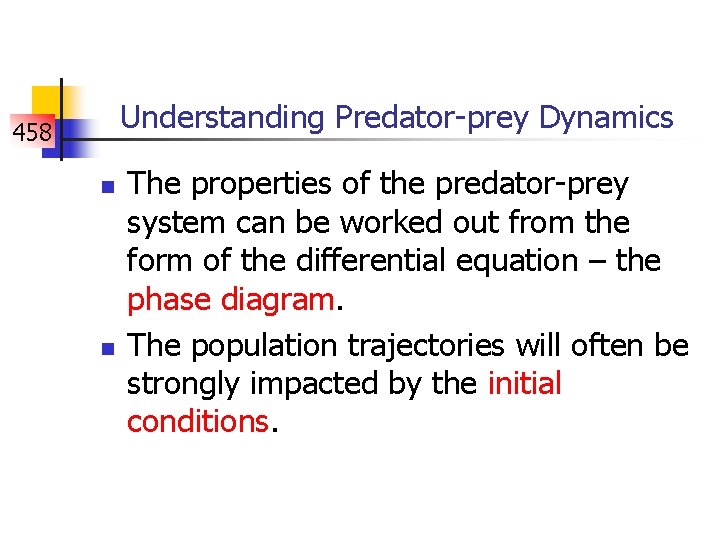
Understanding Predator-prey Dynamics 458 n n The properties of the predator-prey system can be worked out from the form of the differential equation – the phase diagram. The population trajectories will often be strongly impacted by the initial conditions.
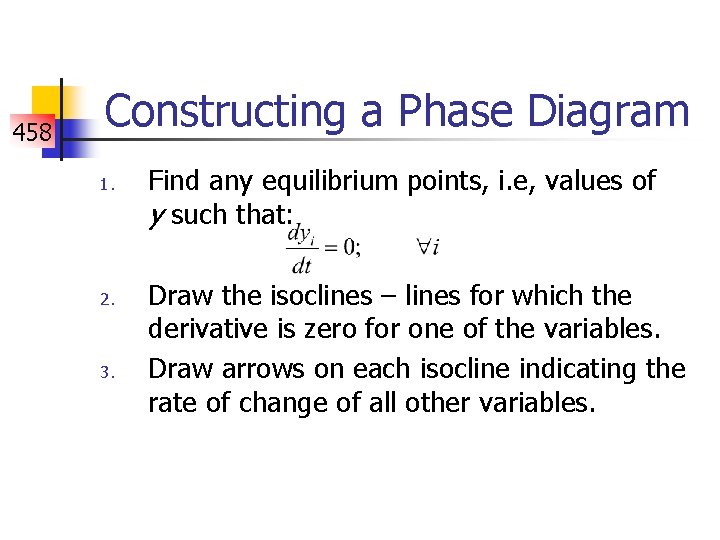
458 Constructing a Phase Diagram 1. 2. 3. Find any equilibrium points, i. e, values of y such that: Draw the isoclines – lines for which the derivative is zero for one of the variables. Draw arrows on each isocline indicating the rate of change of all other variables.
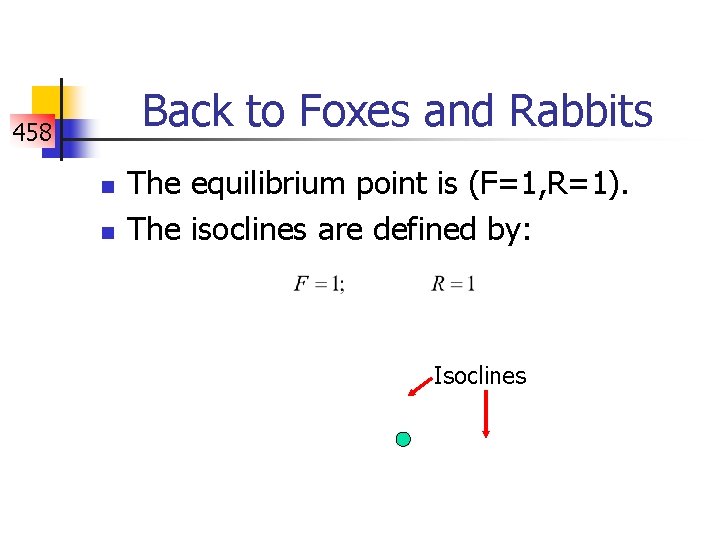
Back to Foxes and Rabbits 458 n n The equilibrium point is (F=1, R=1). The isoclines are defined by: Isoclines
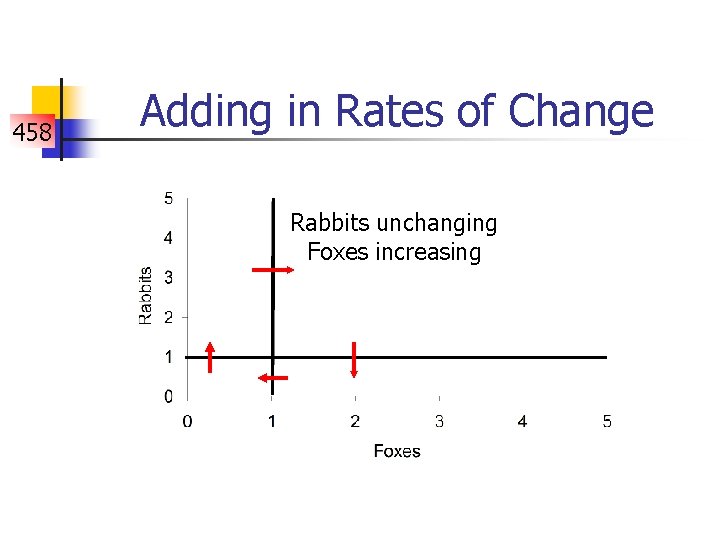
458 Adding in Rates of Change Rabbits unchanging Foxes increasing
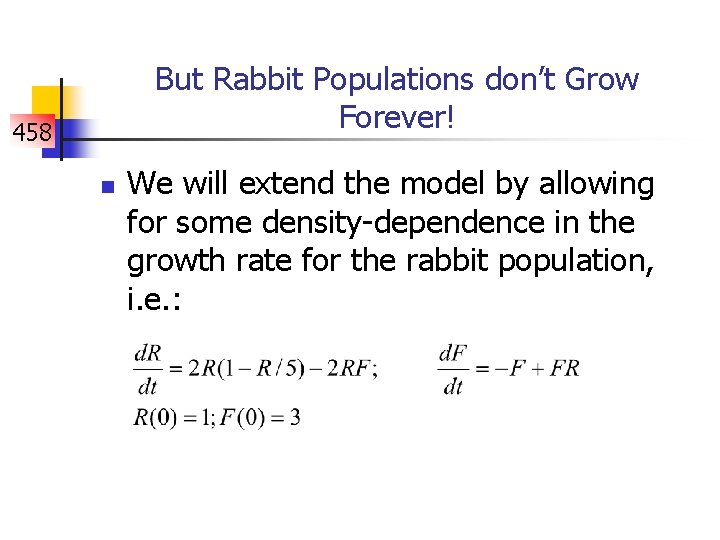
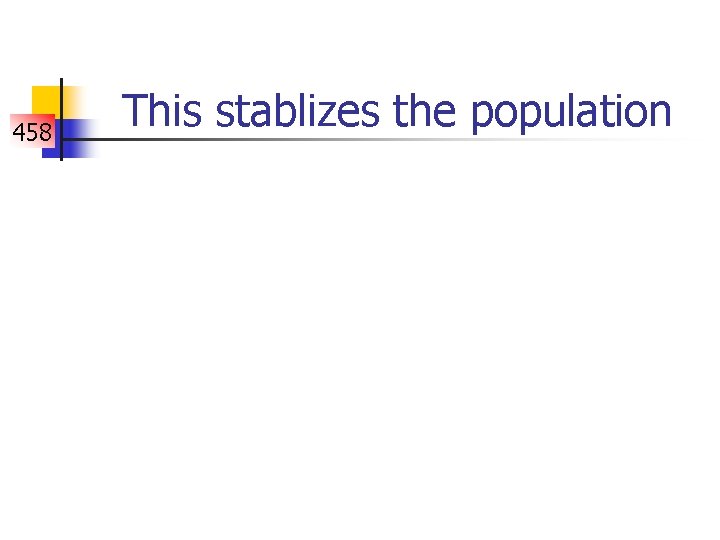
But Rabbit Populations don’t Grow Forever! 458 n We will extend the model by allowing for some density-dependence in the growth rate for the rabbit population, i. e. :
458 This stablizes the population
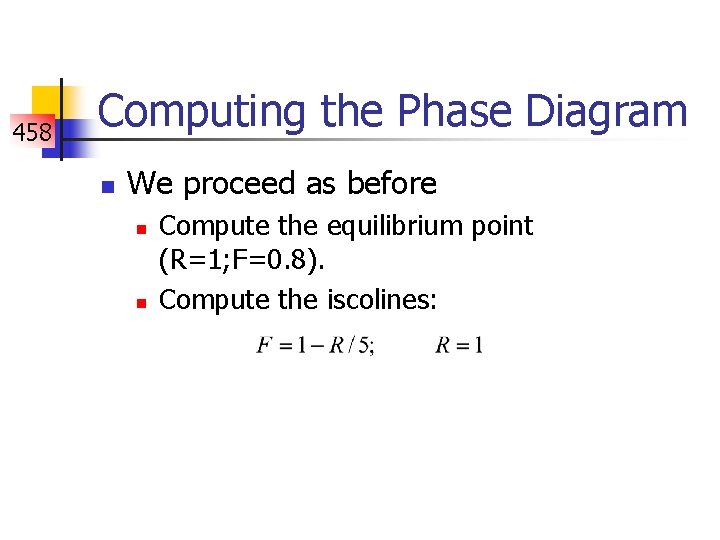
458 Computing the Phase Diagram n We proceed as before n n Compute the equilibrium point (R=1; F=0. 8). Compute the iscolines:
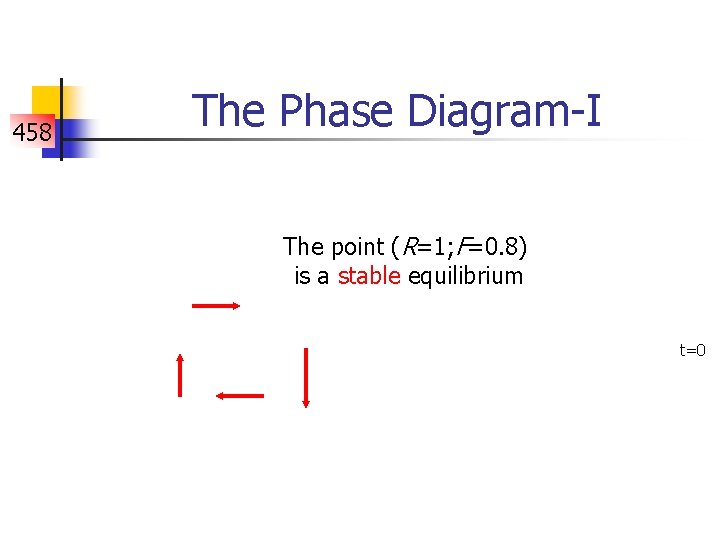
458 The Phase Diagram-I The point (R=1; F=0. 8) is a stable equilibrium t=0
458 The Phase Diagram-II
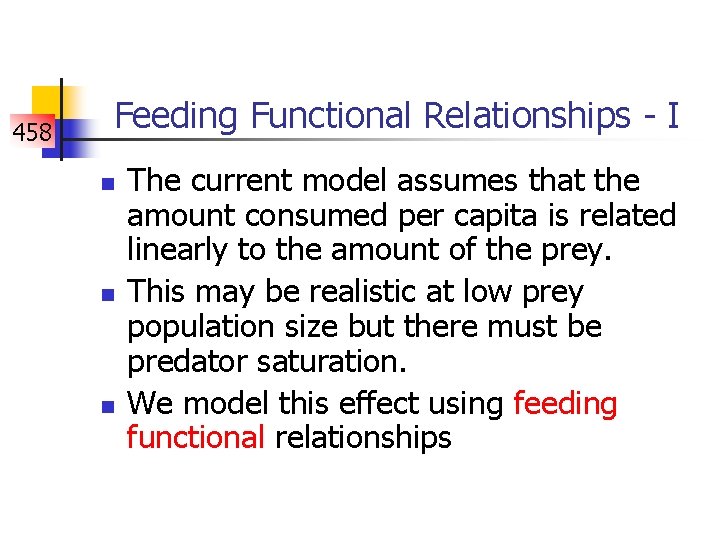
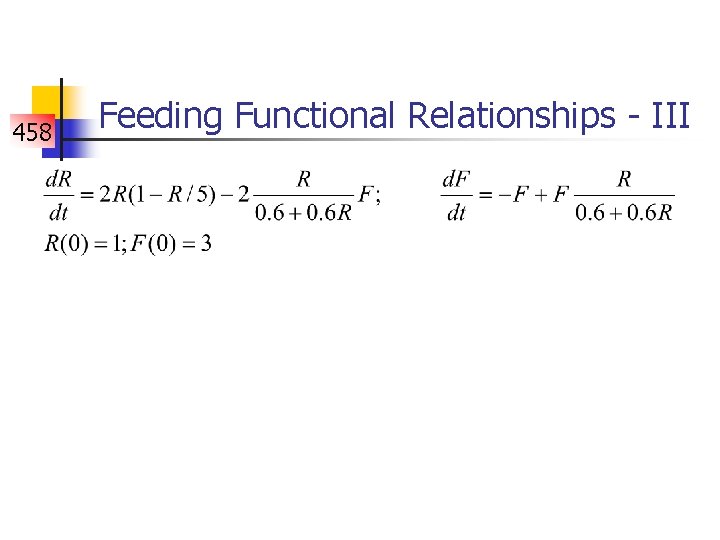
458 Feeding Functional Relationships - I n n n The current model assumes that the amount consumed per capita is related linearly to the amount of the prey. This may be realistic at low prey population size but there must be predator saturation. We model this effect using feeding functional relationships
458 Feeding Functional Relationships - II
458 Feeding Functional Relationships - III
Multispecies Models 458 n Advantages: n n Predator-prey dynamics are clearly realistic! Managers are often interested in “ecosystem considerations”.
Multispecies Models 458 n Disadvantages: n n It is very difficult to select functional forms / the number of species. The number of parameters in a multispecies model can be enormous (‘ 000 s). The results of multispecies models are often sensitive to their specifications. The methods required to conduct the numerical integrations can be complicated and, if not done correctly, numerical integration impacts the results markedly.
Readings 458 n n Press et al. (1988), Chapter 16. Starfield and Bleloch, Chapter 6.