
455 Chapter 12 BoundaryValue Problem in Rectangular Coordinates
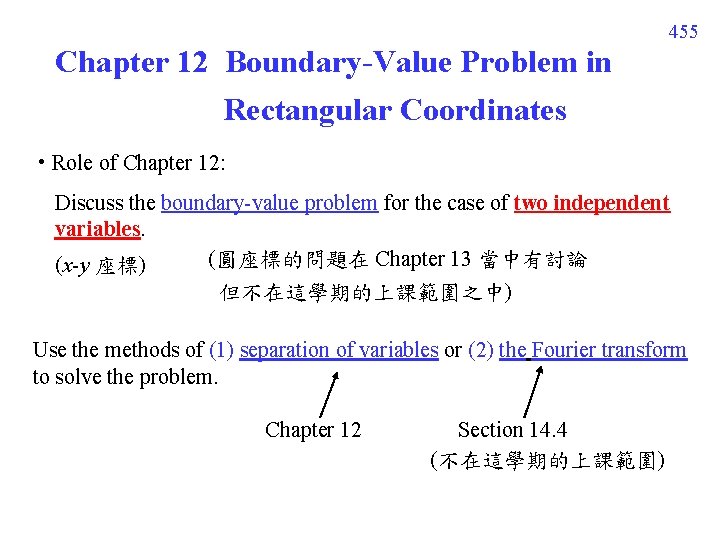
455 Chapter 12 Boundary-Value Problem in Rectangular Coordinates • Role of Chapter 12: Discuss the boundary-value problem for the case of two independent variables. (圓座標的問題在 Chapter 13 當中有討論 (x-y 座標) 但不在這學期的上課範圍之中) Use the methods of (1) separation of variables or (2) the Fourier transform to solve the problem. Chapter 12 Section 14. 4 (不在這學期的上課範圍)
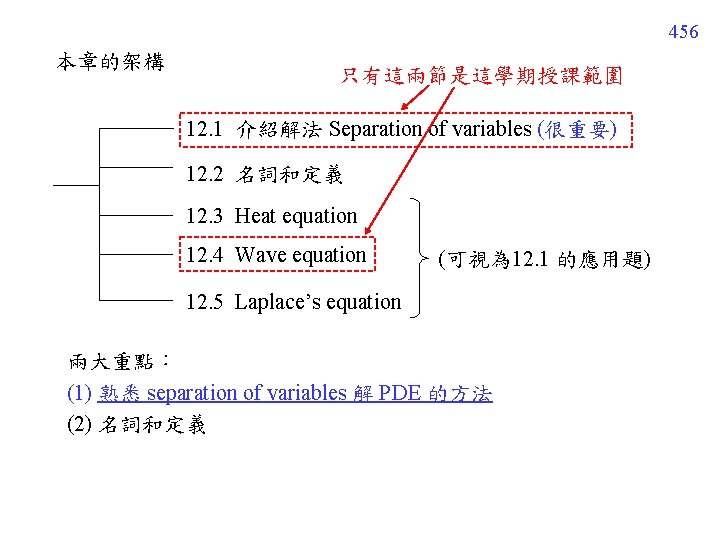
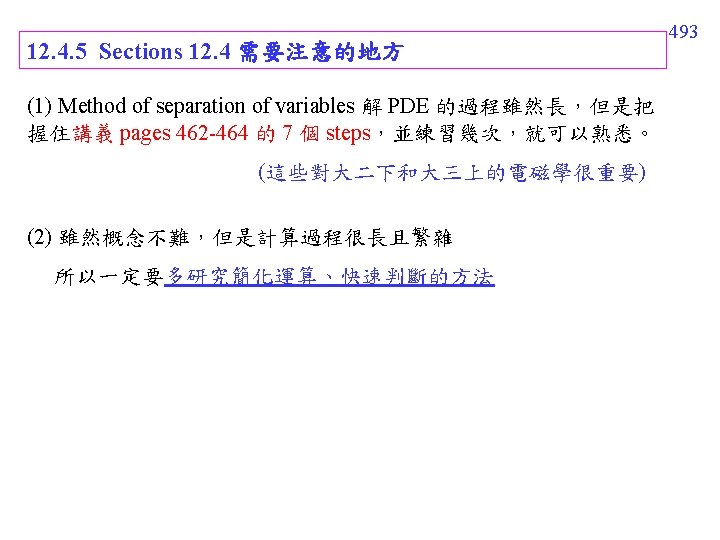
456 本章的架構 只有這兩節是這學期授課範圍 12. 1 介紹解法 Separation of variables (很重要) 12. 2 名詞和定義 12. 3 Heat equation 12. 4 Wave equation (可視為 12. 1 的應用題) 12. 5 Laplace’s equation 兩大重點: (1) 熟悉 separation of variables 解 PDE 的方法 (2) 名詞和定義
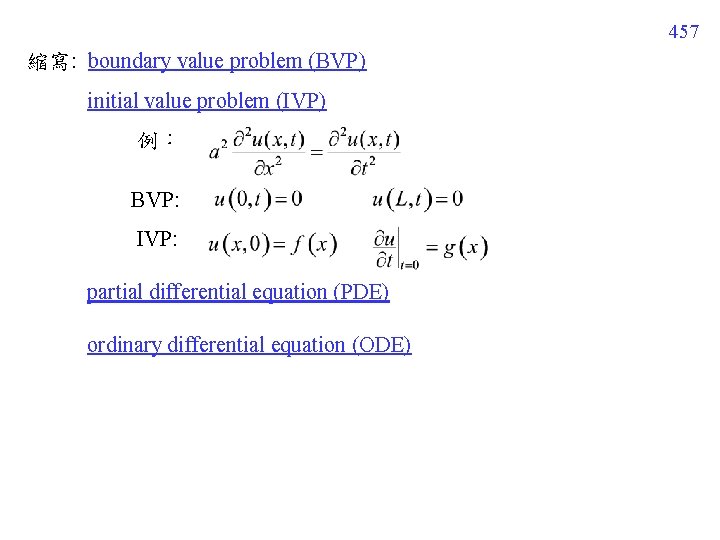
457 縮寫: boundary value problem (BVP) initial value problem (IVP) 例: BVP: IVP: partial differential equation (PDE) ordinary differential equation (ODE)
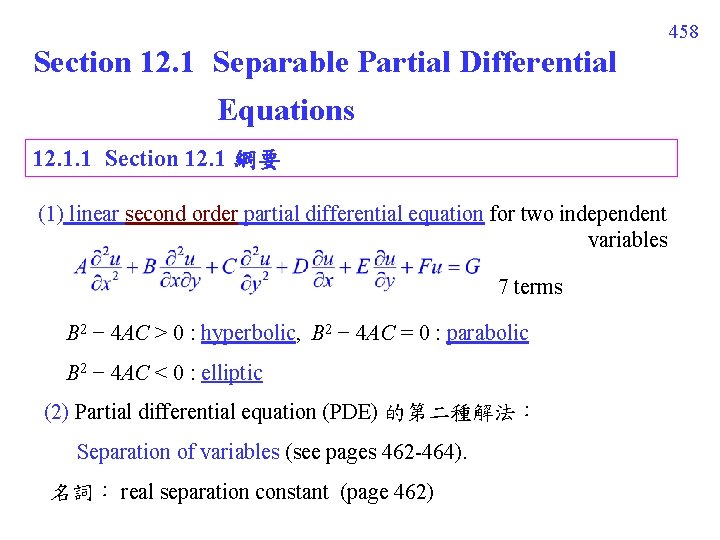
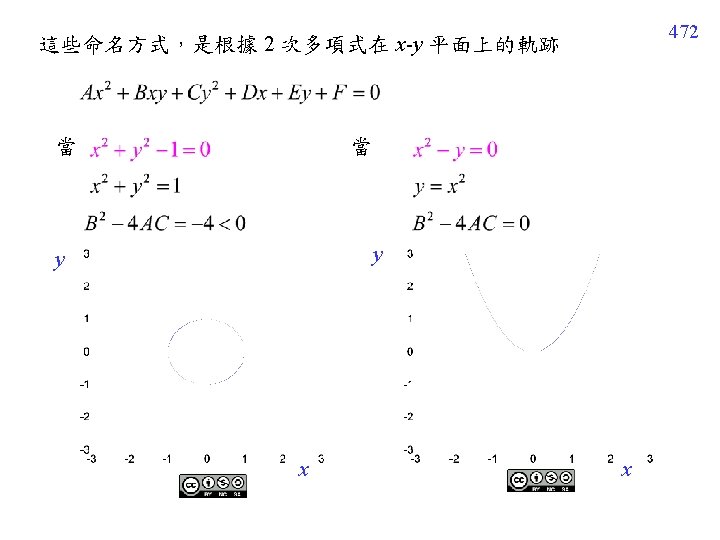
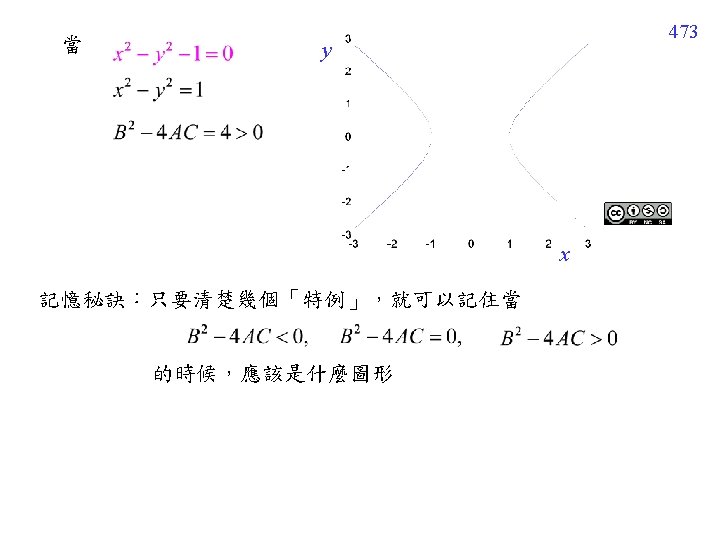
458 Section 12. 1 Separable Partial Differential Equations 12. 1. 1 Section 12. 1 綱要 (1) linear second order partial differential equation for two independent variables 7 terms B 2 − 4 AC > 0 : hyperbolic, B 2 − 4 AC = 0 : parabolic B 2 − 4 AC < 0 : elliptic (2) Partial differential equation (PDE) 的第二種解法: Separation of variables (see pages 462 -464). 名詞: real separation constant (page 462)
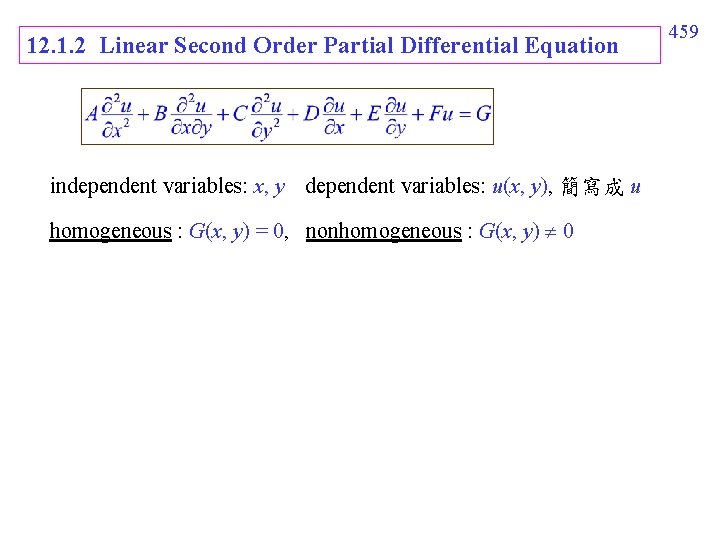
12. 1. 2 Linear Second Order Partial Differential Equation independent variables: x, y dependent variables: u(x, y), 簡寫成 u homogeneous : G(x, y) = 0, nonhomogeneous : G(x, y) 0 459
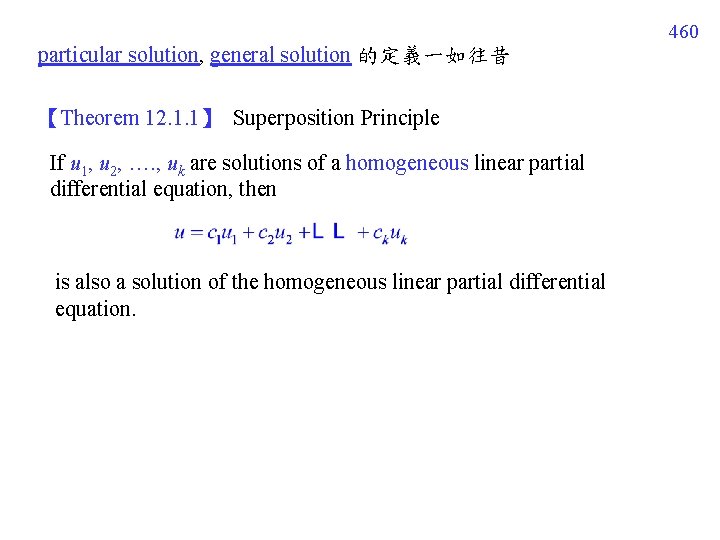
460 particular solution, general solution 的定義一如往昔 【Theorem 12. 1. 1】 Superposition Principle If u 1, u 2, …. , uk are solutions of a homogeneous linear partial differential equation, then is also a solution of the homogeneous linear partial differential equation.
12. 1. 3 Method of Separation of Variables 解 PDE with BVP (or IVP) 的方法 (1) method of separation of variables 若 PDE 當中有對 x 及對 y 的偏微分, 假設解為 u(x, y) = X(x)Y(y) (2) using the Fourier transform (or Fourier cosine transform, Fourier sine transform) (see Section 14. 4 ,期末考範圍外) 共通的精神: PDE ODE Note: Laplace transform can also be used for solving the PDE (Section 14 -2,期末考範圍外) 461
462 Method of Separation of Variables 的流程 (Step 1) 假設解為 u(x, y) = X(x)Y(y) 解法關鍵 (Step 2) 將 u(x, y) = X(x)Y(y) 代入 PDE,把 PDE 變成 “ function of X ” = “ function of Y ” = 的型態 被稱為 real separation constant
Steps 3, 4, 5 要分成不同的 Cases 來解 除了trivial 的情形外,所有可能的 cases 都要考慮 (Pre-Step) 考慮等於 0 的 initial / boundary conditions (Step 3) 將 function of X = 的解算出,即為 X(x) 註:有時,先解 Y(y) 會比較容易 (視 boundary (initial) conditions 而定) (Step 4) 將 function of Y = 的解算出,即為 Y(y) 需注意的地方和 Step 3 相同 (Step 5) u(x, y) = X(x)Y(y) 463
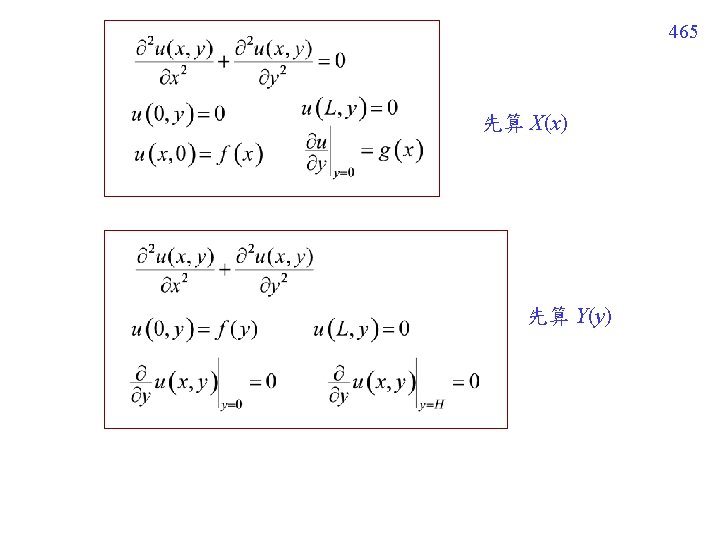
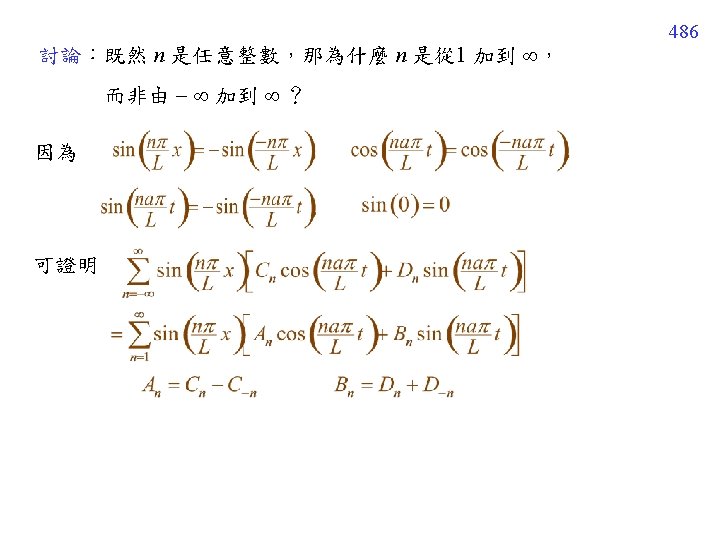
(Step 6) 將所有可能的解全部加起來 464 (Step 7) 用非零的 boundary (initial) conditions 將 coefficients 求出 註: 這一步經常會用到 Fourier series, Fourier cosine series 或 Fourier sine series ※ 若沒有 boundary (initial) conditions,Steps 6, 7 可以省略 Rules: x 的 BVP (IVP) 簡單 先算 X(x) y 的 BVP (IVP) 簡單 先算 Y(y) 沒有 BVP (IVP) 先算 X(x) 或 Y(y) 皆可
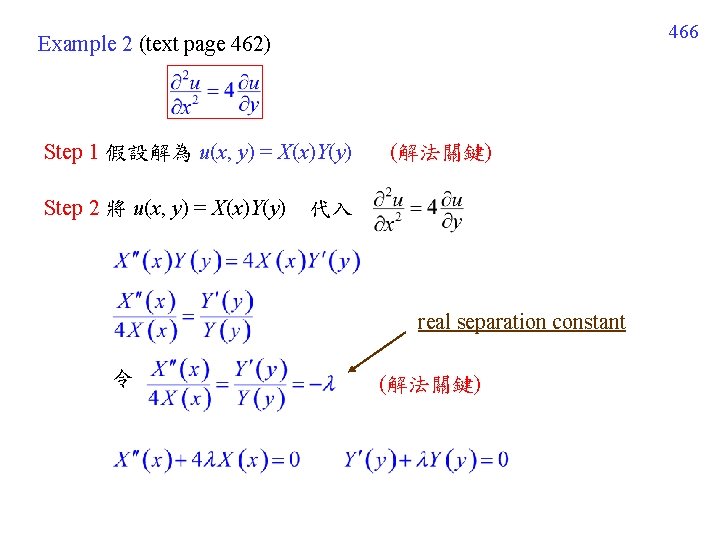
466 Example 2 (text page 462) Step 1 假設解為 u(x, y) = X(x)Y(y) Step 2 將 u(x, y) = X(x)Y(y) (解法關鍵) 代入 real separation constant 令 (解法關鍵)
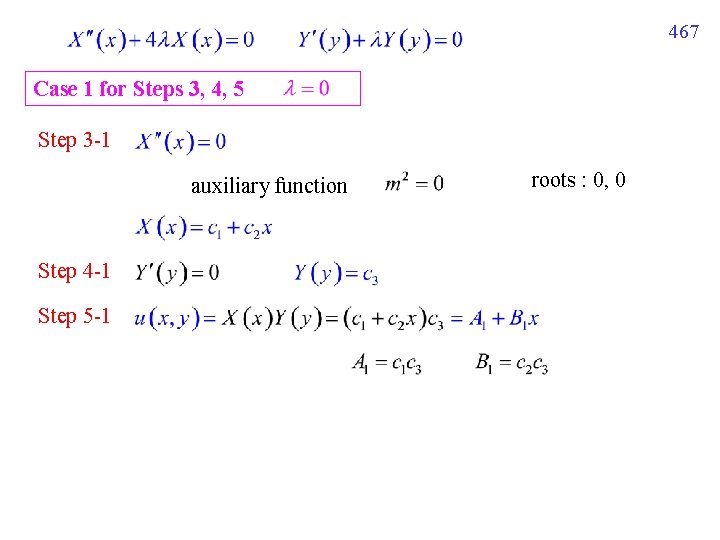
467 Case 1 for Steps 3, 4, 5 Step 3 -1 auxiliary function Step 4 -1 Step 5 -1 roots : 0, 0
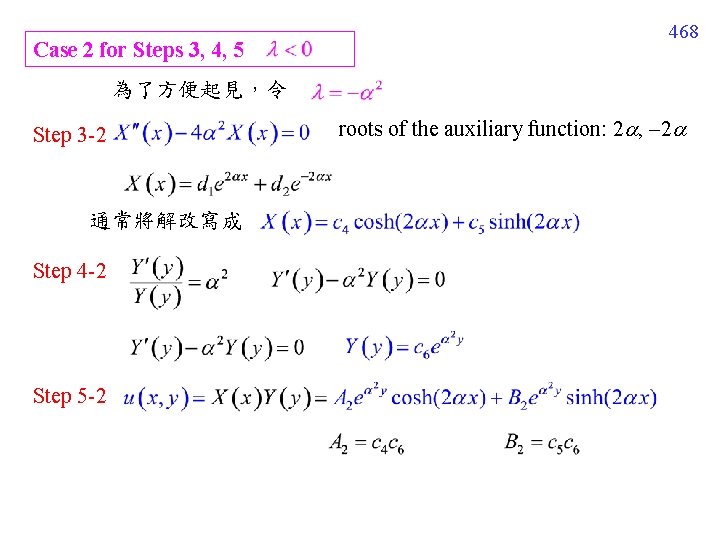
Case 2 for Steps 3, 4, 5 468 為了方便起見,令 Step 3 -2 通常將解改寫成 Step 4 -2 Step 5 -2 roots of the auxiliary function: 2 , 2
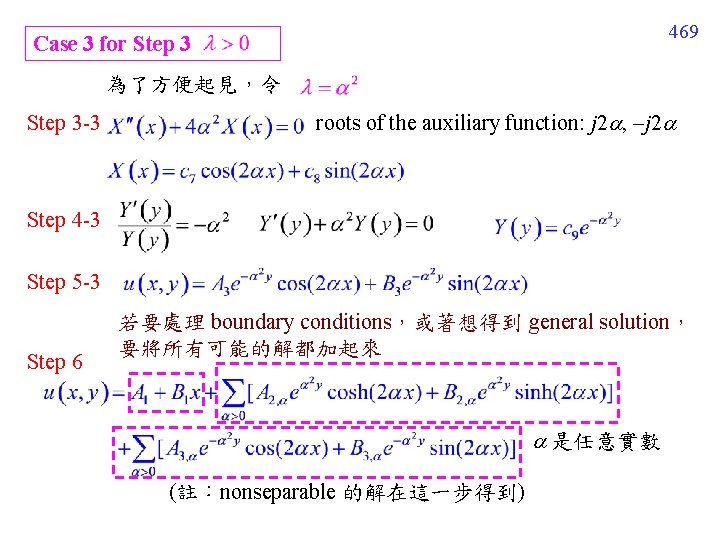
469 Case 3 for Step 3 為了方便起見,令 Step 3 -3 roots of the auxiliary function: j 2 , j 2 Step 4 -3 Step 5 -3 Step 6 若要處理 boundary conditions,或著想得到 general solution, 要將所有可能的解都加起來 是任意實數 (註:nonseparable 的解在這一步得到)
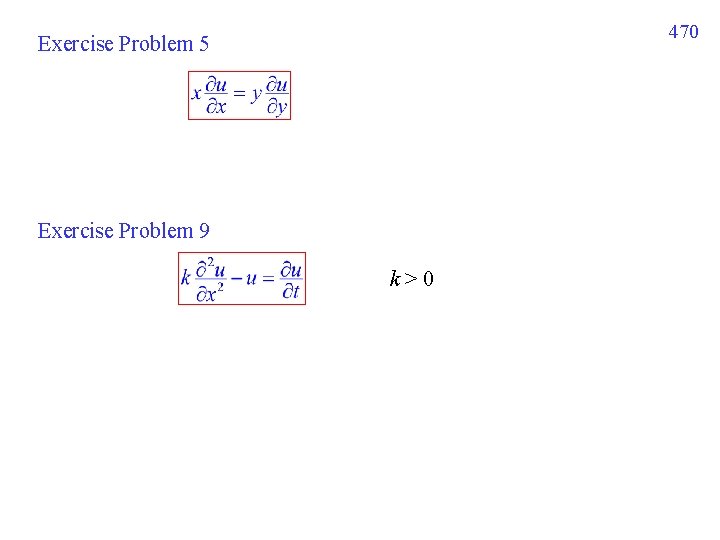
470 Exercise Problem 5 Exercise Problem 9 k>0

471 12. 1. 4 Classification The PDE is said to be hyperbolic (雙曲線) The PDE is said to be parabolic (拋物線) The PDE is said to be elliptic (橢圓形)
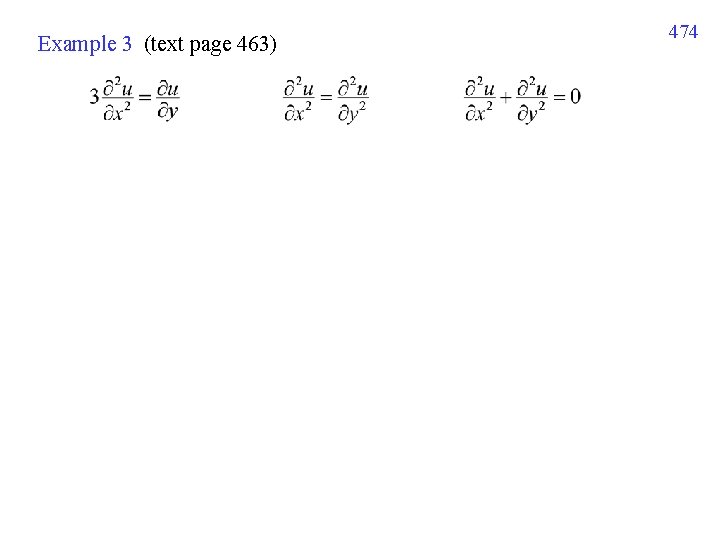
Example 3 (text page 463) 474
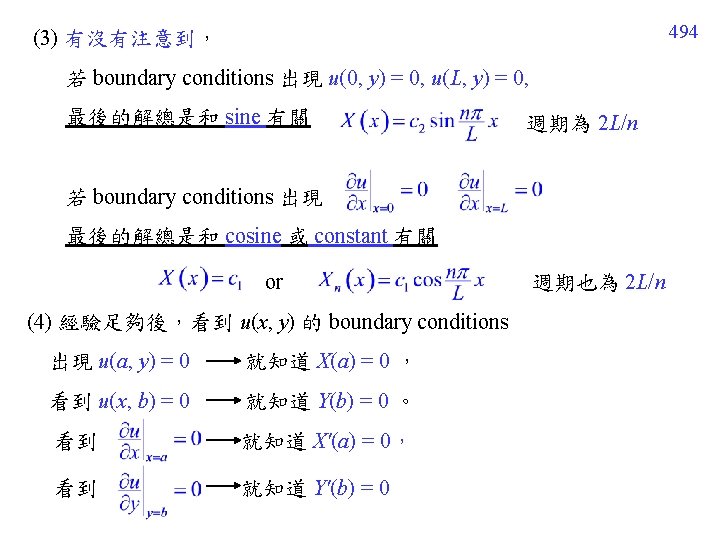
12. 1. 5 本節需要注意的地方 475 (1) 本節除了定義以外,只有兩個重點: classification of equations 以 及 method of separation of variables. (2) 然而, method of separation of variables 解法的流程,稍有些複 雜,需要熟悉 (Sections 12 -4, 12 -5 都將用這個方法) 關鍵:記住第一步 u(x, y) = X(x)Y(y) 第二步 function of X = function of Y = (3) Method of separation of variables 在計算時,會分成很多個 cases. (4) Separation of variables要解 BVP 和 IVP時,需要將每個 cases 得 出來的解都加起來 (Step 6)
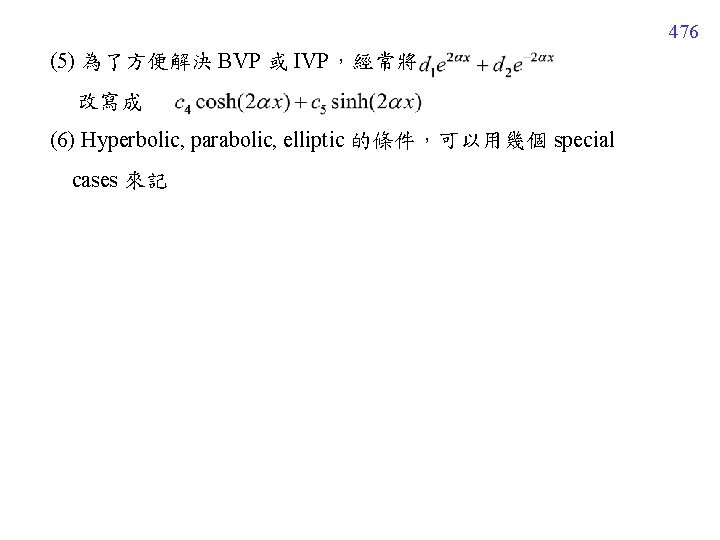
476 (5) 為了方便解決 BVP 或 IVP,經常將 改寫成 (6) Hyperbolic, parabolic, elliptic 的條件,可以用幾個 special cases 來記
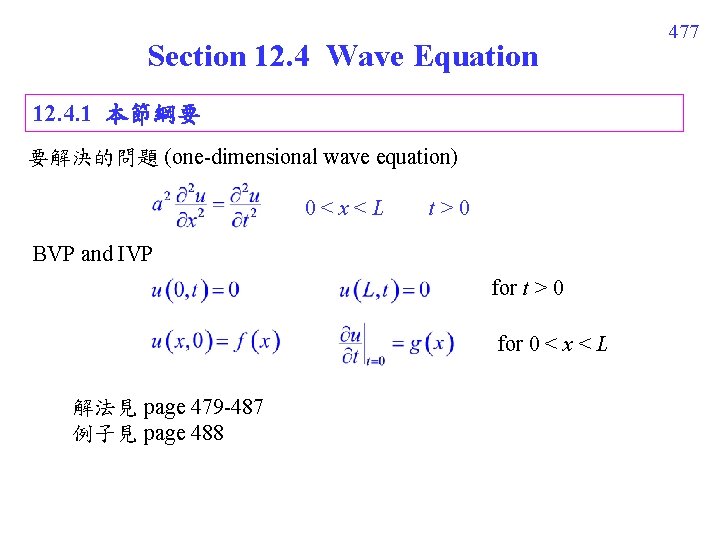
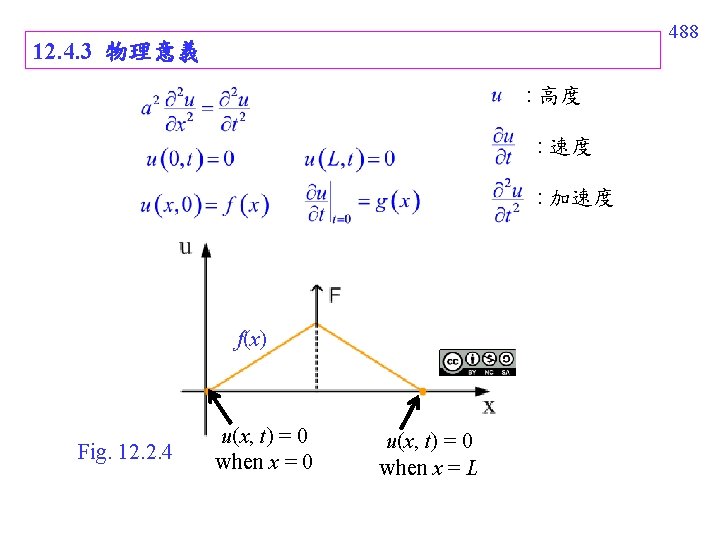
Section 12. 4 Wave Equation 12. 4. 1 本節綱要 要解決的問題 (one-dimensional wave equation) 0<x<L t>0 BVP and IVP for t > 0 for 0 < x < L 解法見 page 479 -487 例子見 page 488 477
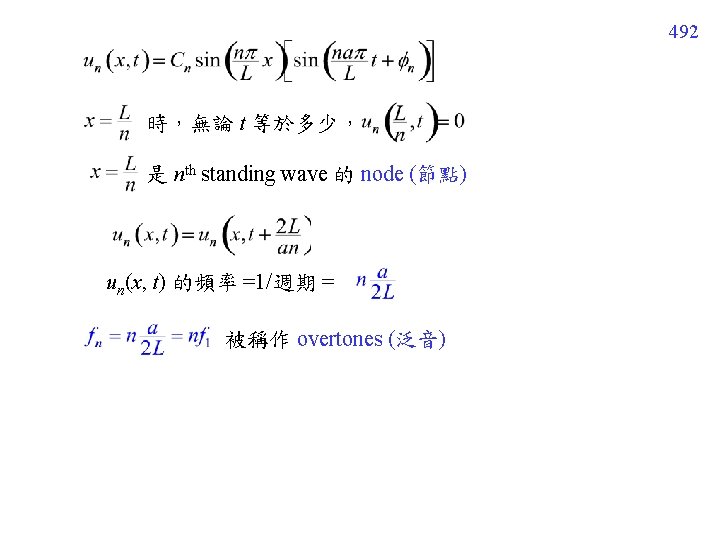
478 實際上,Sections 12. 4 可看成是 Section 12. 1 的 method of separation of variables 的練習題 (可見得 method of separation of variables 有多重要) 名詞: standing waves (page 489) normal modes (page 489) first standing wave (page 490) fundamental frequency (page 490) nodes (page 492) overtones (page 492)
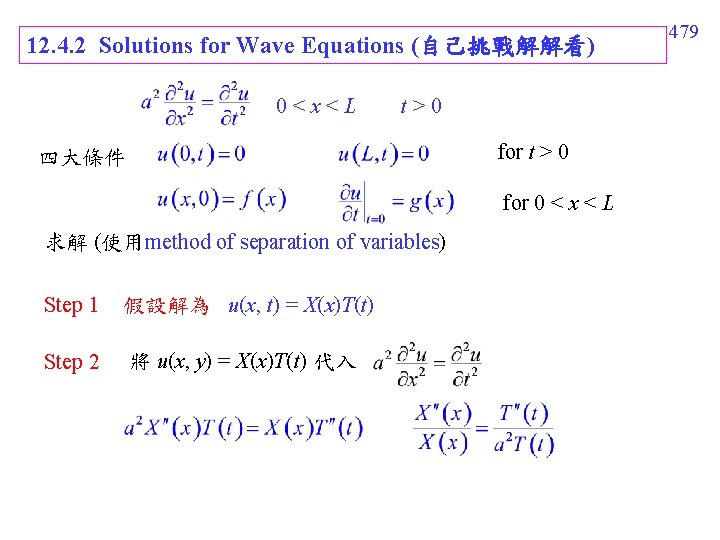
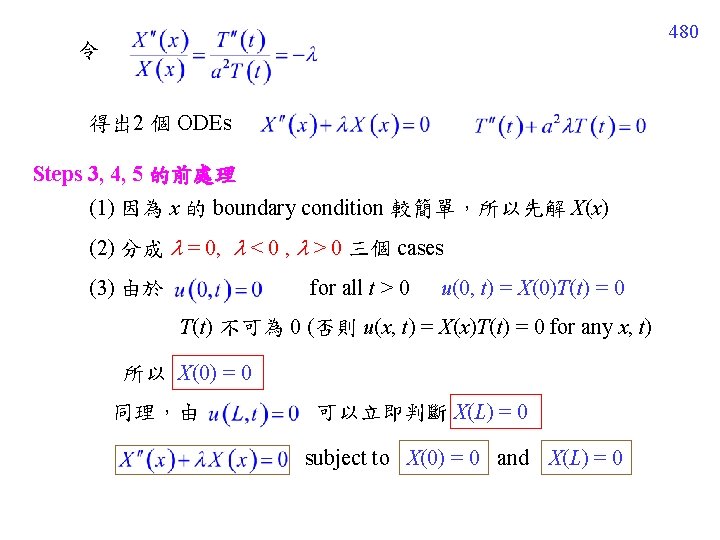
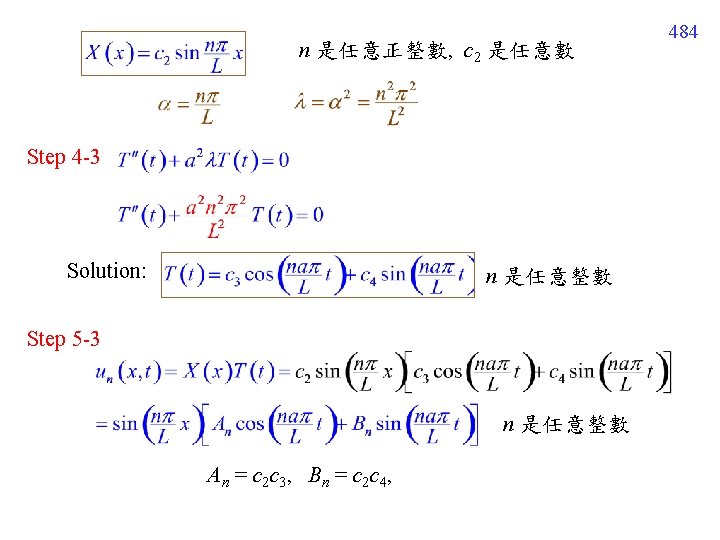
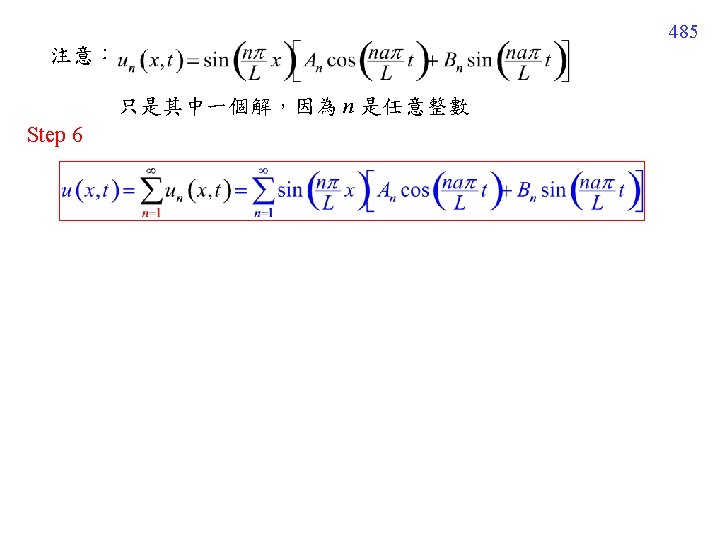
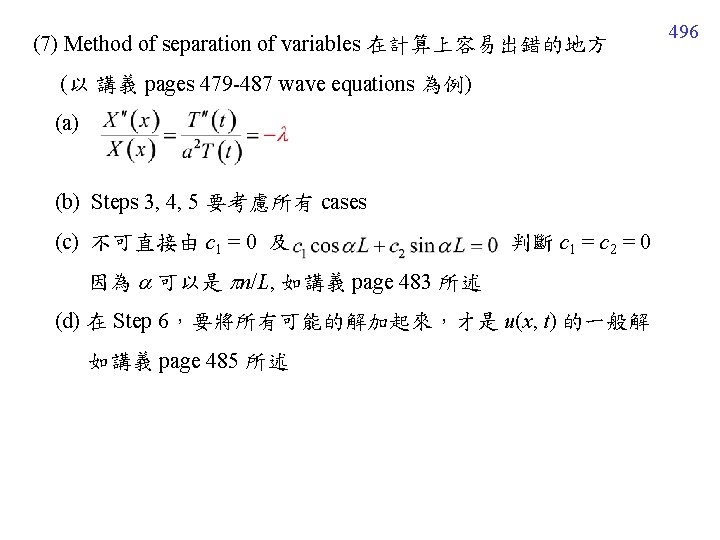
12. 4. 2 Solutions for Wave Equations (自己挑戰解解看) 0<x<L t>0 for t > 0 四大條件 for 0 < x < L 求解 (使用method of separation of variables) Step 1 假設解為 u(x, t) = X(x)T(t) Step 2 將 u(x, y) = X(x)T(t) 代入 479
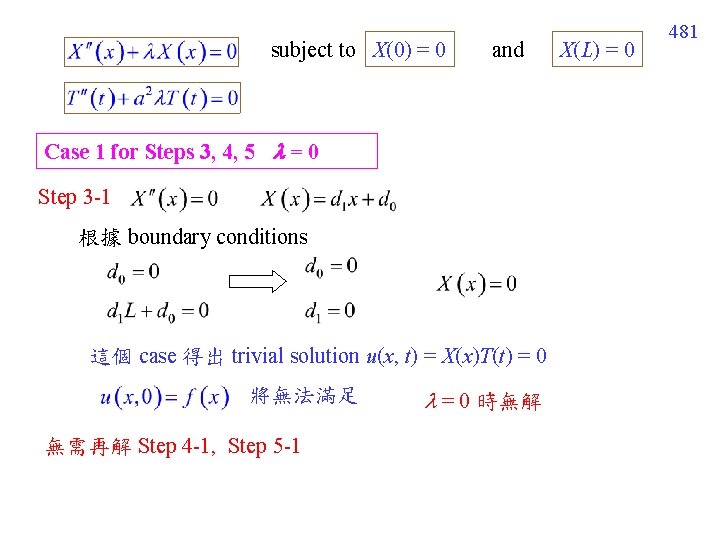
subject to X(0) = 0 and Case 1 for Steps 3, 4, 5 = 0 Step 3 -1 根據 boundary conditions 這個 case 得出 trivial solution u(x, t) = X(x)T(t) = 0 將無法滿足 無需再解 Step 4 -1, Step 5 -1 = 0 時無解 X(L) = 0 481
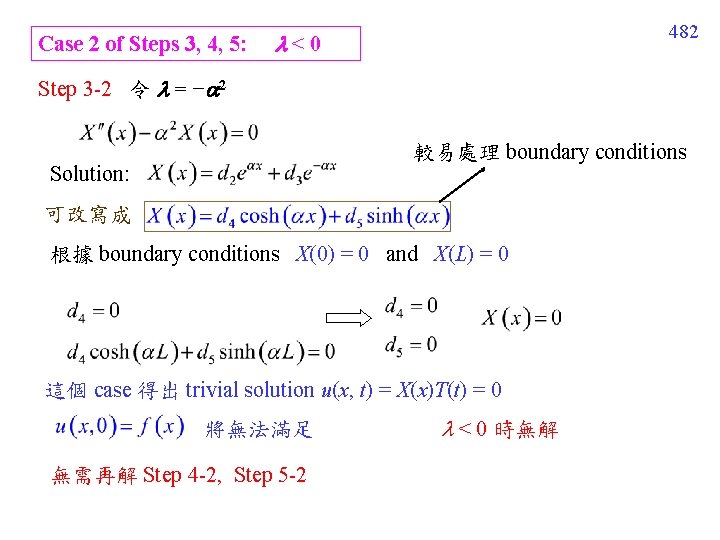
Case 2 of Steps 3, 4, 5: 482 <0 Step 3 -2 令 = − 2 較易處理 boundary conditions Solution: 可改寫成 根據 boundary conditions X(0) = 0 and X(L) = 0 這個 case 得出 trivial solution u(x, t) = X(x)T(t) = 0 將無法滿足 無需再解 Step 4 -2, Step 5 -2 < 0 時無解
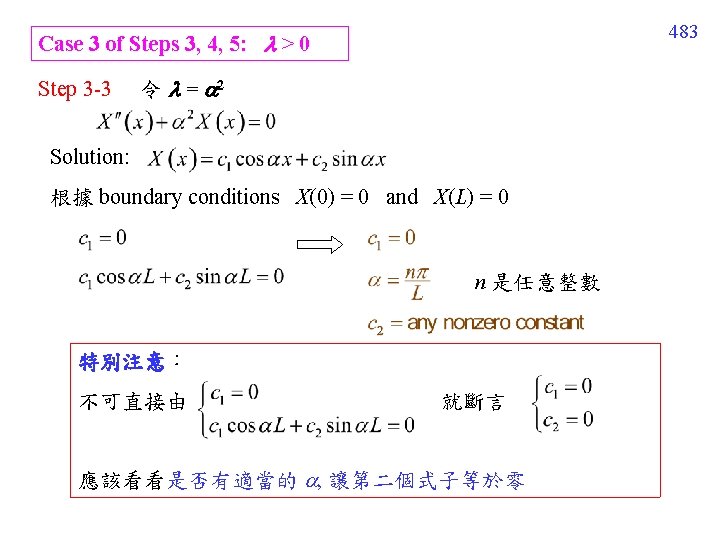
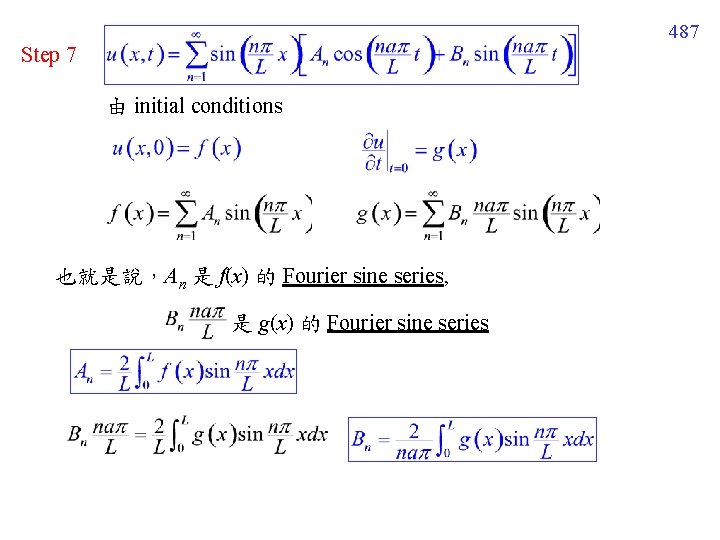
487 Step 7 由 initial conditions 也就是說,An 是 f(x) 的 Fourier sine series, 是 g(x) 的 Fourier sine series
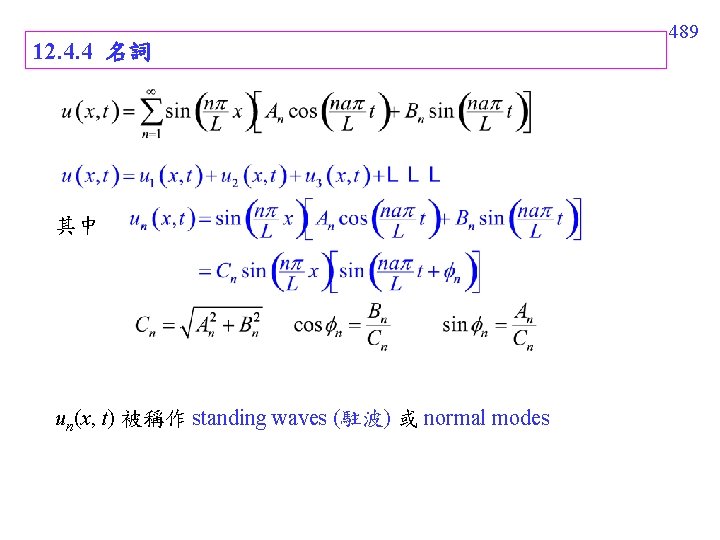
12. 4. 4 名詞 其中 un(x, t) 被稱作 standing waves (駐波) 或 normal modes 489
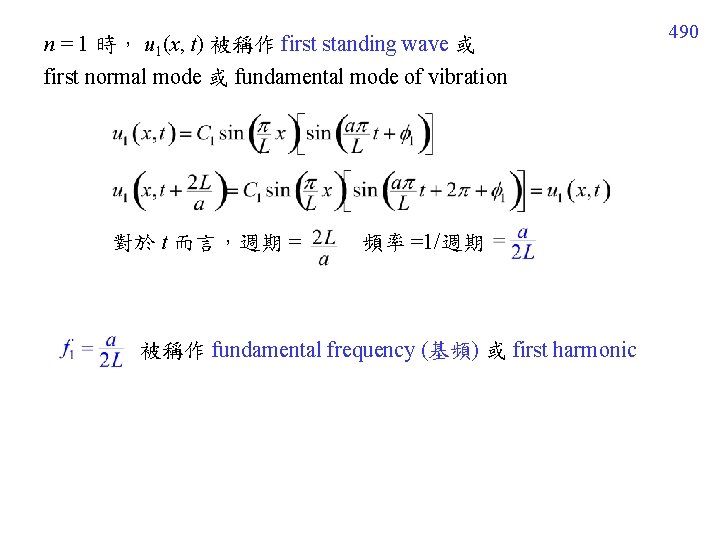
n = 1 時, u 1(x, t) 被稱作 first standing wave 或 first normal mode 或 fundamental mode of vibration 對於 t 而言,週期 = 頻率 =1/週期 被稱作 fundamental frequency (基頻) 或 first harmonic 490
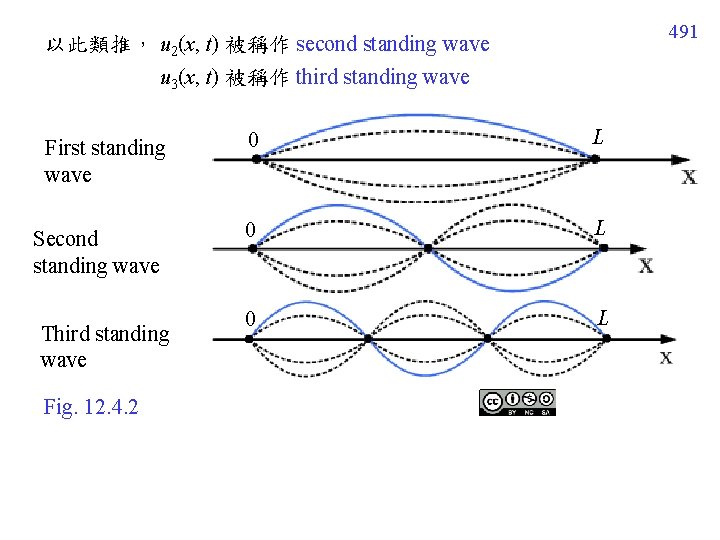
491 以此類推, u 2(x, t) 被稱作 second standing wave u 3(x, t) 被稱作 third standing wave First standing wave 0 L Second standing wave 0 L Third standing wave Fig. 12. 4. 2
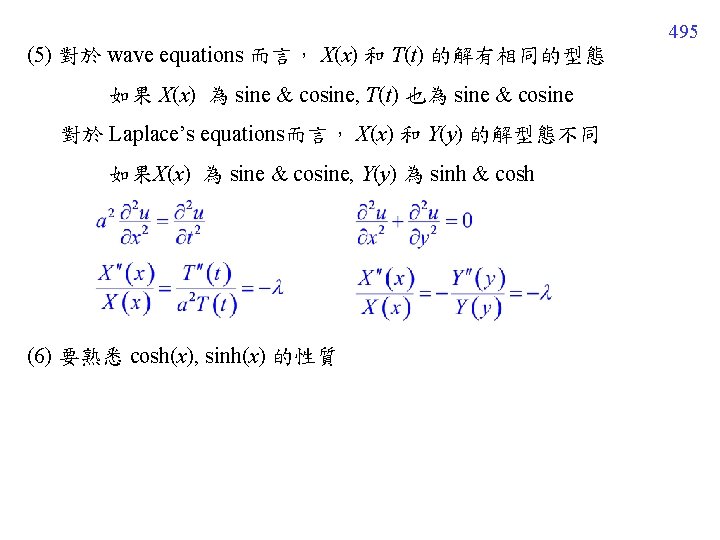
495 (5) 對於 wave equations 而言, X(x) 和 T(t) 的解有相同的型態 如果 X(x) 為 sine & cosine, T(t) 也為 sine & cosine 對於 Laplace’s equations而言, X(x) 和 Y(y) 的解型態不同 如果X(x) 為 sine & cosine, Y(y) 為 sinh & cosh (6) 要熟悉 cosh(x), sinh(x) 的性質
497 Exercise for Practice Section 12 -1 3, 6, 9, 10, 12, 14, 16, 18, 22, 23, 27, 30, 32 Section 12 -4 1, 4, 7, 10, 11, 15, 17, 21, 23 Review 12 1, 2, 5, 13

- Slides: 44