
450 101 Management Information System Decision Support System

- Slides: 99
450 -101 Management Information System Decision Support System ��. ������� Office : CS 320, Computer Science Building Email : wwettayaprasit@yahoo. com Website : http: //staff. cs. psu. ac. th/wiphada Phone : 0 -7428 -8596 Chapter 1
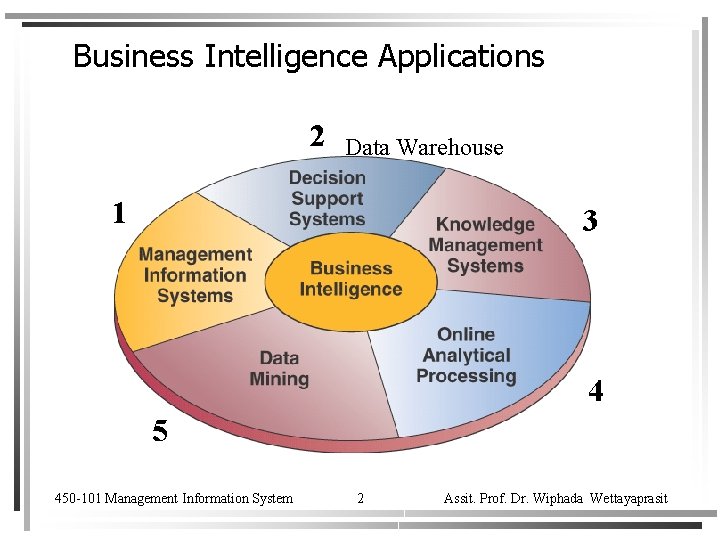
Business Intelligence Applications 2 Data Warehouse 1 3 4 5 450 -101 Management Information System 2 Assit. Prof. Dr. Wiphada Wettayaprasit
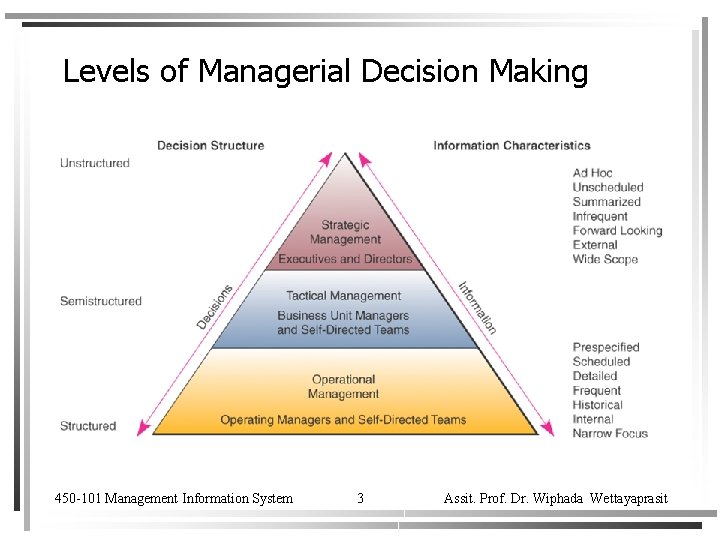
Levels of Managerial Decision Making 450 -101 Management Information System 3 Assit. Prof. Dr. Wiphada Wettayaprasit
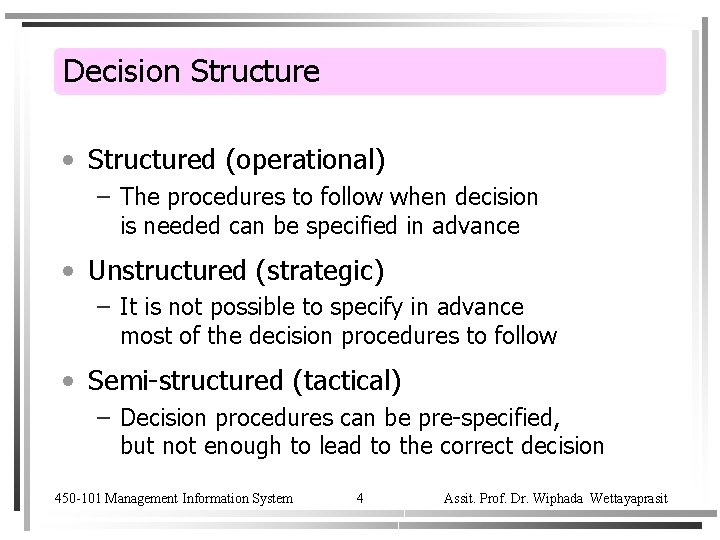
Decision Structure • Structured (operational) – The procedures to follow when decision is needed can be specified in advance • Unstructured (strategic) – It is not possible to specify in advance most of the decision procedures to follow • Semi-structured (tactical) – Decision procedures can be pre-specified, but not enough to lead to the correct decision 450 -101 Management Information System 4 Assit. Prof. Dr. Wiphada Wettayaprasit
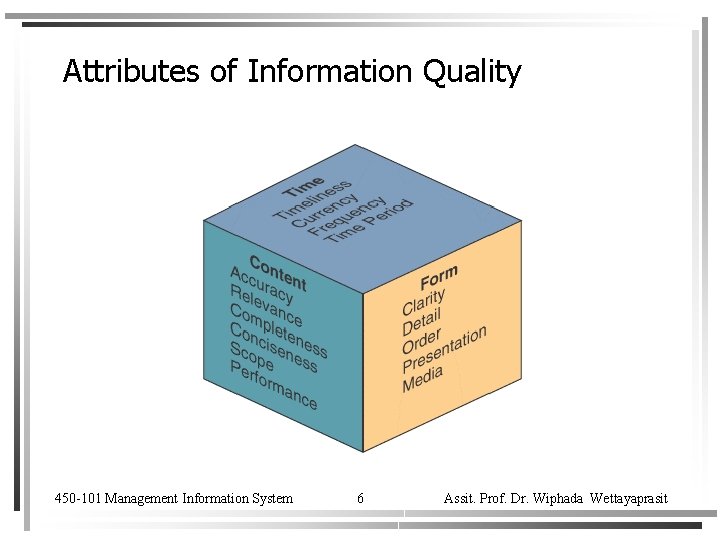
Information Quality • Information products made more valuable by their attributes, characteristics, or qualities – Information that is outdated, inaccurate, or hard to understand has much less value • Information has three dimensions – Time – Content – Form 450 -101 Management Information System 5 Assit. Prof. Dr. Wiphada Wettayaprasit
Attributes of Information Quality 450 -101 Management Information System 6 Assit. Prof. Dr. Wiphada Wettayaprasit
Decision Support in Business • Companies are investing in data-driven decision support application frameworks to help them respond to – Changing market conditions – Customer needs • This is accomplished by several types of – Management information – Decision support – Other information systems 450 -101 Management Information System 7 Assit. Prof. Dr. Wiphada Wettayaprasit
1 Management Information Systems • The original type of information system that supported managerial decision making – Produces information products that support many day-to-day decision-making needs – Produces reports, display, and responses – Satisfies needs of operational and tactical decision makers who face structured decisions 450 -101 Management Information System 8 Assit. Prof. Dr. Wiphada Wettayaprasit
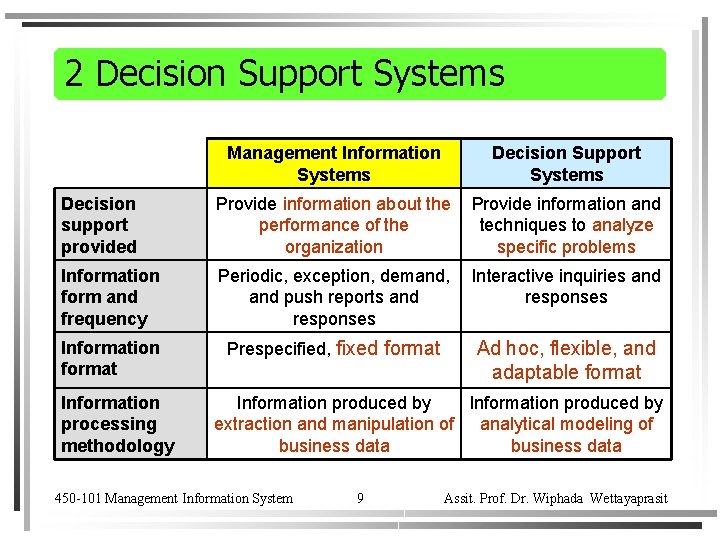
2 Decision Support Systems Management Information Systems Decision Support Systems Decision support provided Provide information about the performance of the organization Provide information and techniques to analyze specific problems Information form and frequency Periodic, exception, demand, and push reports and responses Interactive inquiries and responses Information format Prespecified, fixed format Ad hoc, flexible, and adaptable format Information processing methodology Information produced by extraction and manipulation of analytical modeling of business data 450 -101 Management Information System 9 Assit. Prof. Dr. Wiphada Wettayaprasit
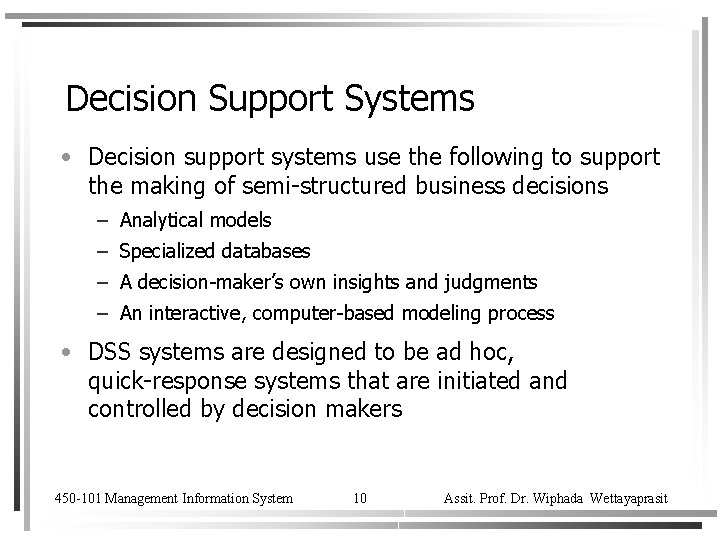
Decision Support Systems • Decision support systems use the following to support the making of semi-structured business decisions – Analytical models – Specialized databases – A decision-maker’s own insights and judgments – An interactive, computer-based modeling process • DSS systems are designed to be ad hoc, quick-response systems that are initiated and controlled by decision makers 450 -101 Management Information System 10 Assit. Prof. Dr. Wiphada Wettayaprasit
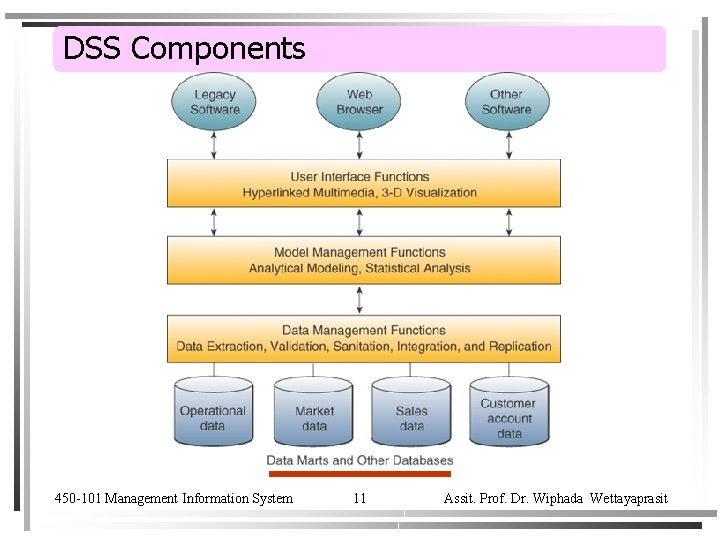
DSS Components 450 -101 Management Information System 11 Assit. Prof. Dr. Wiphada Wettayaprasit
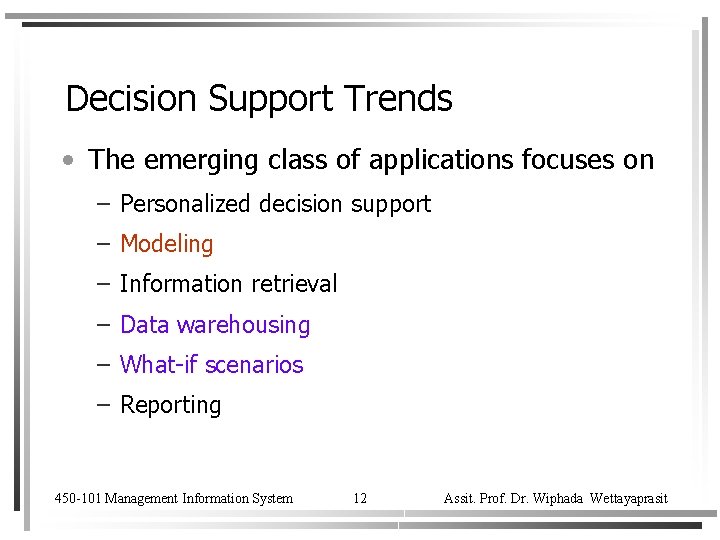
Decision Support Trends • The emerging class of applications focuses on – Personalized decision support – Modeling – Information retrieval – Data warehousing – What-if scenarios – Reporting 450 -101 Management Information System 12 Assit. Prof. Dr. Wiphada Wettayaprasit
DSS Model Base • Model Base – A software component that consists of models used in computational and analytical routines that mathematically express relations among variables • Spreadsheet Examples – Linear programming – Multiple regression forecasting – Capital budgeting present value 450 -101 Management Information System 13 Assit. Prof. Dr. Wiphada Wettayaprasit
Using Decision Support Systems • Using a decision support system involves an interactive analytical modeling process – Decision makers are not demanding pre-specified information – They are exploring possible alternatives • What-If Analysis – Observing how changes to selected variables affect other variables 450 -101 Management Information System 14 Assit. Prof. Dr. Wiphada Wettayaprasit
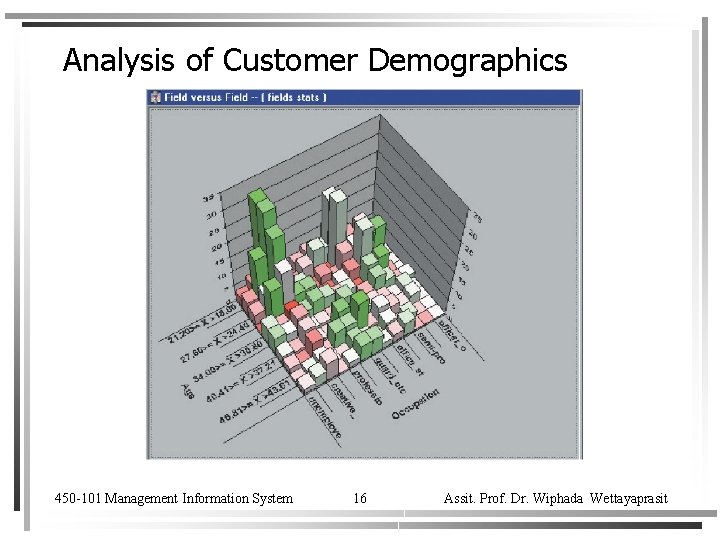
Data Visualization Systems • DVS – Represents complex data using interactive, three-dimensional graphical forms (charts, graphs, maps) – Helps users interactively sort, subdivide, combine, and organize data while it is in its graphical form 450 -101 Management Information System 15 Assit. Prof. Dr. Wiphada Wettayaprasit
Analysis of Customer Demographics 450 -101 Management Information System 16 Assit. Prof. Dr. Wiphada Wettayaprasit
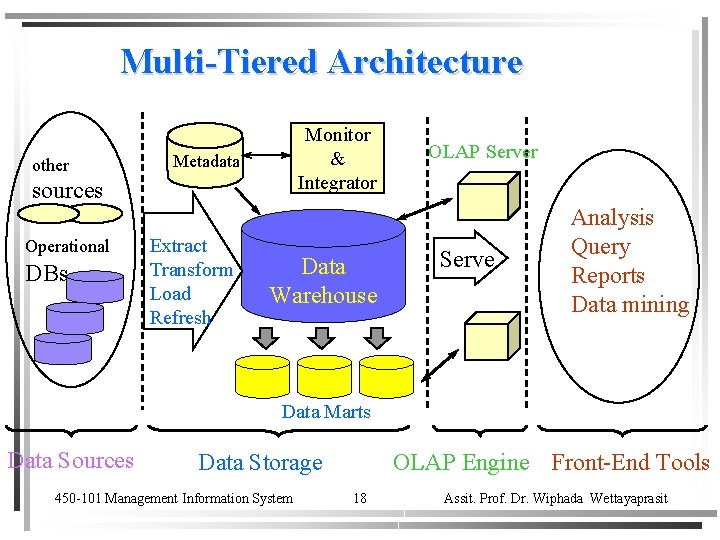
Multi-Tiered Architecture other Monitor & Integrator Metadata sources Operational DBs Extract Transform Load Refresh Data Warehouse OLAP Server Serve Analysis Query Reports Data mining Data Marts Data Sources Data Storage 450 -101 Management Information System OLAP Engine Front-End Tools 18 Assit. Prof. Dr. Wiphada Wettayaprasit
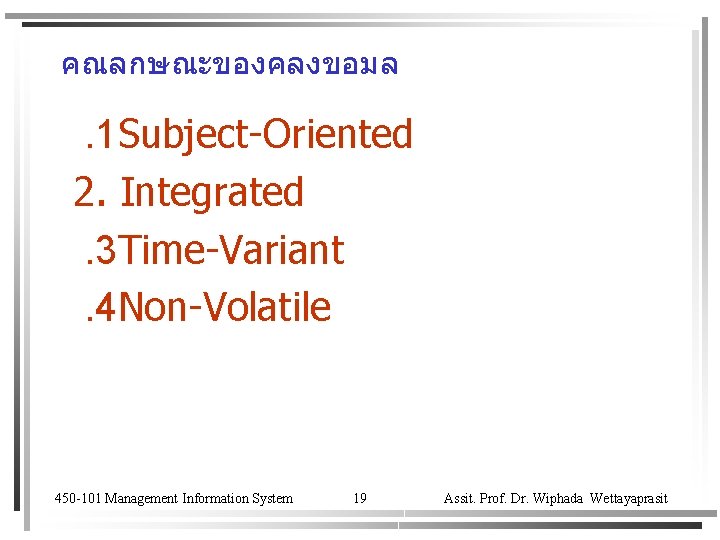
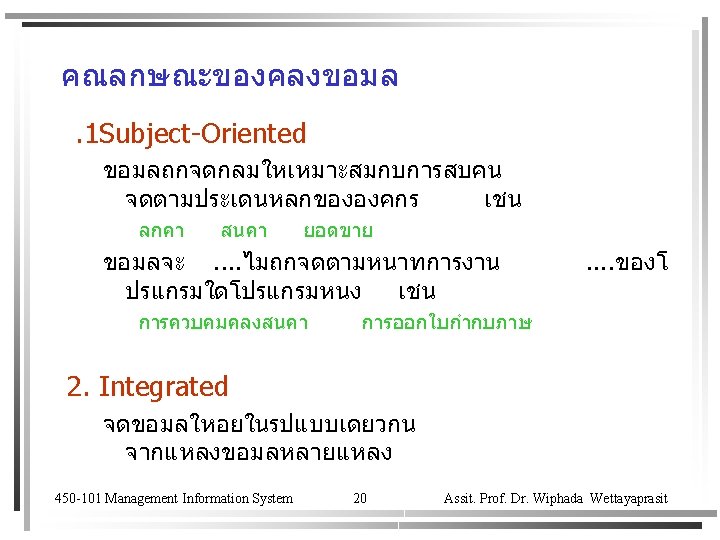
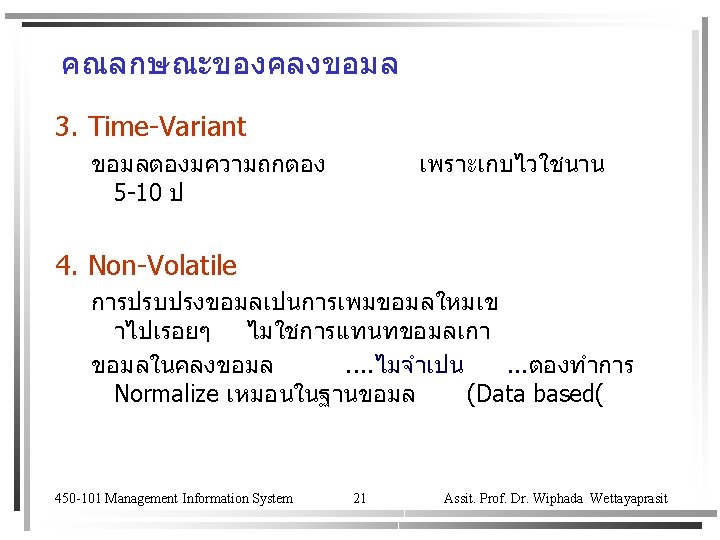
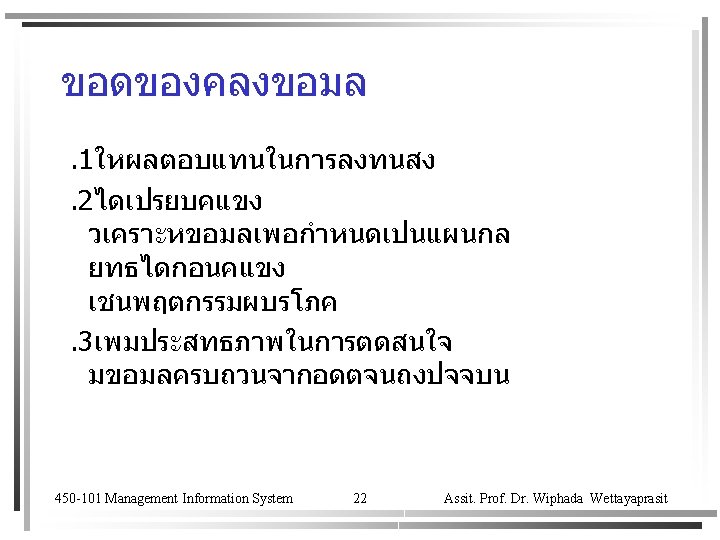
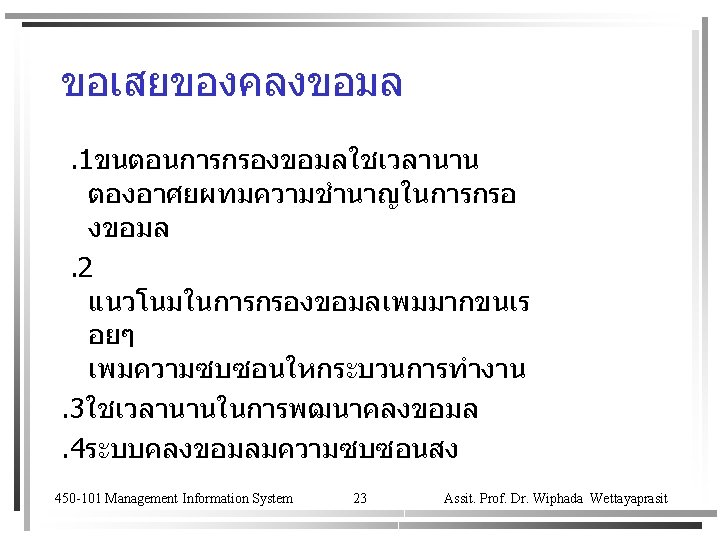
คณลกษณะของคลงขอมล . 1 Subject-Oriented 2. Integrated. 3 Time-Variant. 4 Non-Volatile 450 -101 Management Information System 19 Assit. Prof. Dr. Wiphada Wettayaprasit
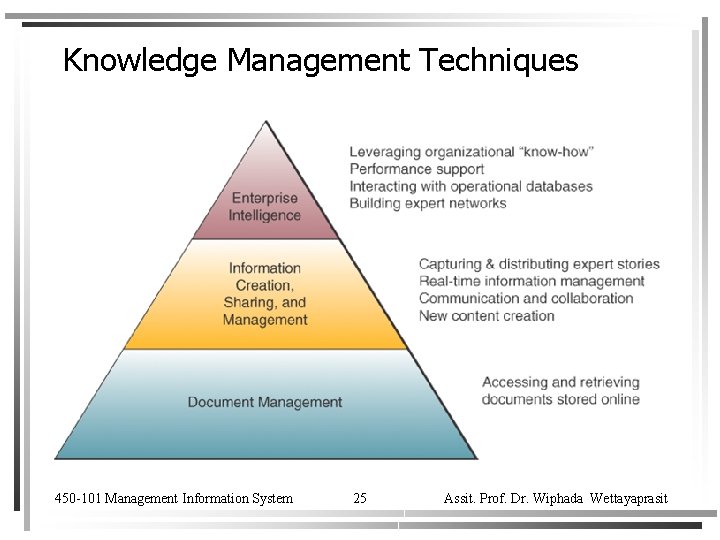
3 Knowledge Management • Successful knowledge management – Creates techniques, technologies, systems, and rewards for getting employees to share what they know – Makes better use of accumulated workplace and enterprise knowledge 450 -101 Management Information System 24 Assit. Prof. Dr. Wiphada Wettayaprasit
Knowledge Management Techniques 450 -101 Management Information System 25 Assit. Prof. Dr. Wiphada Wettayaprasit
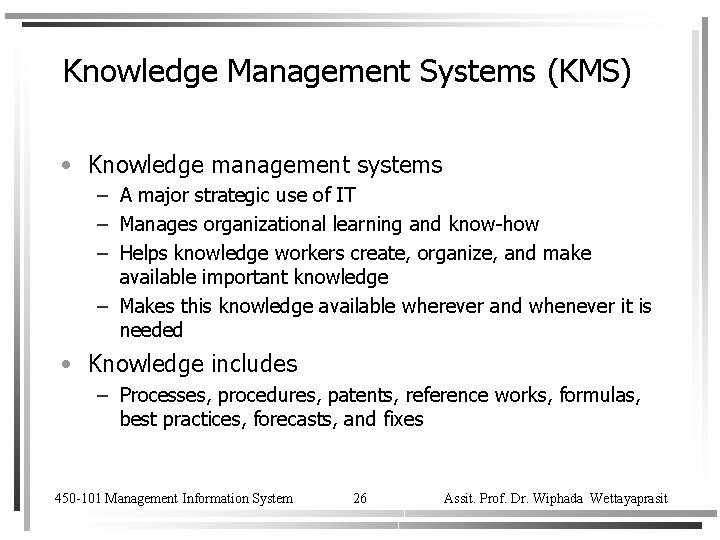
Knowledge Management Systems (KMS) • Knowledge management systems – A major strategic use of IT – Manages organizational learning and know-how – Helps knowledge workers create, organize, and make available important knowledge – Makes this knowledge available wherever and whenever it is needed • Knowledge includes – Processes, procedures, patents, reference works, formulas, best practices, forecasts, and fixes 450 -101 Management Information System 26 Assit. Prof. Dr. Wiphada Wettayaprasit
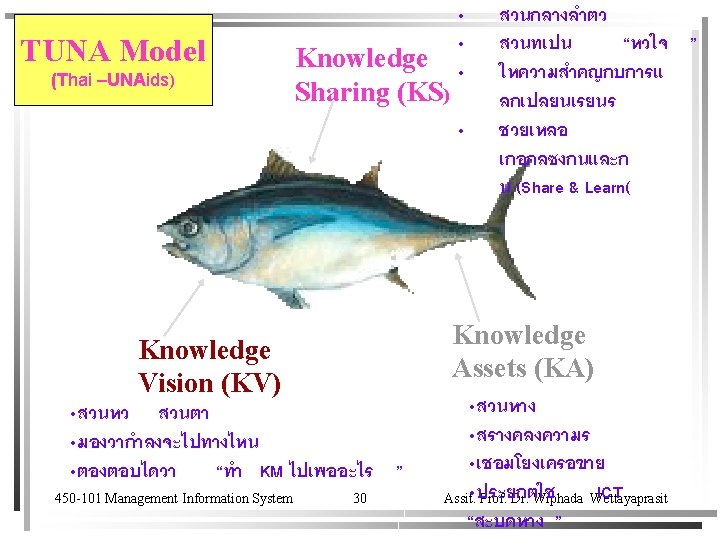
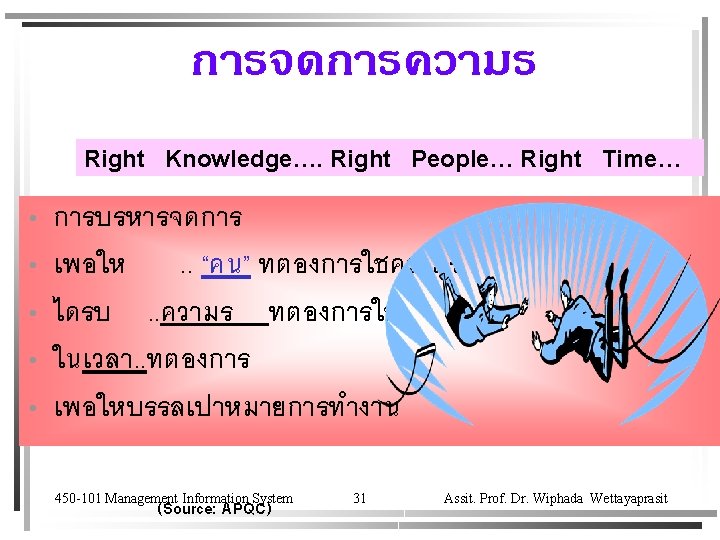
Knowledge Management ������ Chapter 1
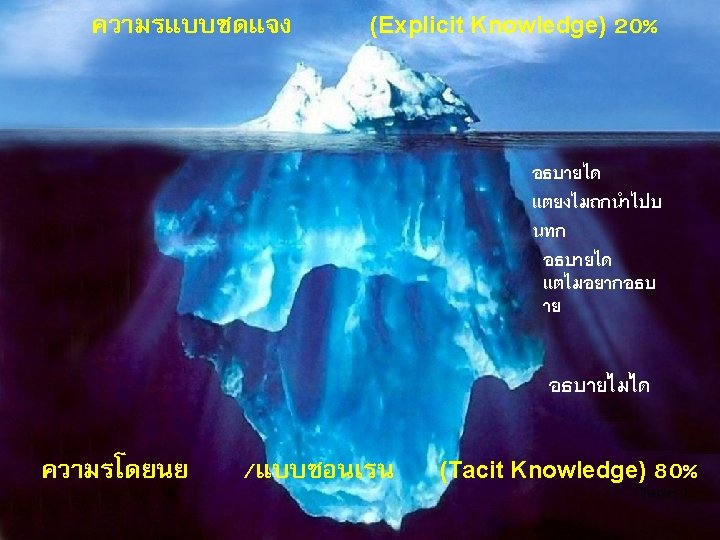
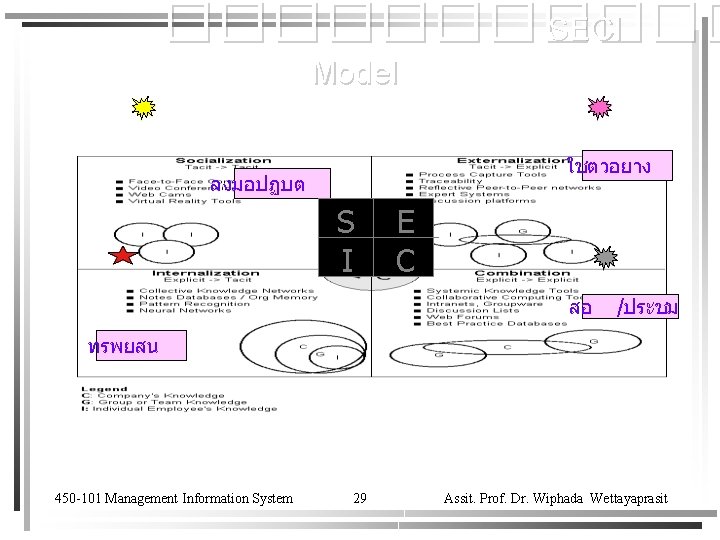
������ SECI Model ใชตวอยาง ลงมอปฏบต S I E C สอ /ประชม ทรพยสน 450 -101 Management Information System 29 Assit. Prof. Dr. Wiphada Wettayaprasit
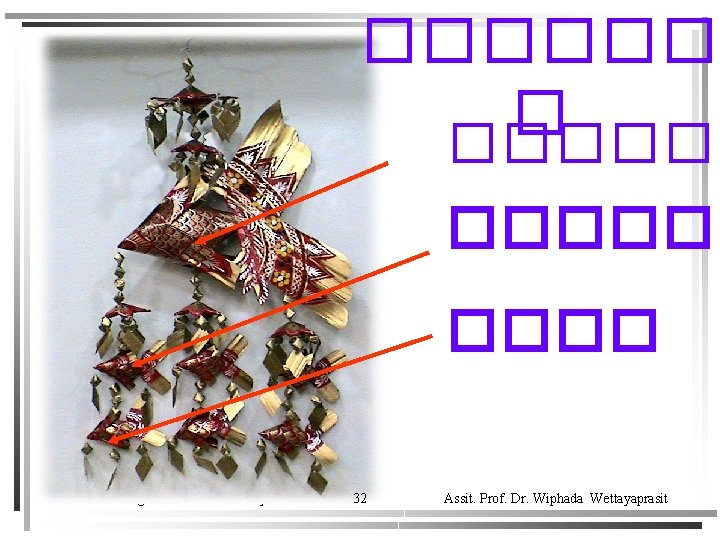
������ ���� 450 -101 Management Information System 32 Assit. Prof. Dr. Wiphada Wettayaprasit
450 -101 Management Information System 34 Assit. Prof. Dr. Wiphada Wettayaprasit
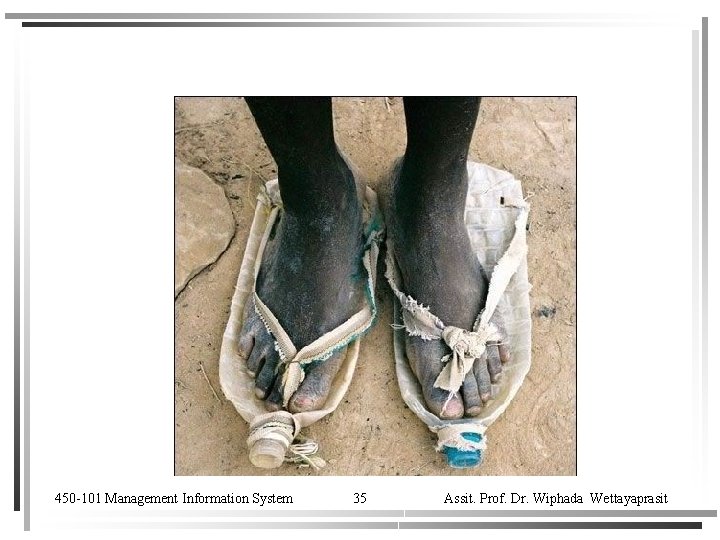
450 -101 Management Information System 35 Assit. Prof. Dr. Wiphada Wettayaprasit
4 Online Analytical Processing • OLAP – Enables managers and analysts to examine and manipulate large amounts of detailed and consolidated data from many perspectives – Done interactively, in real time, with rapid response to queries 450 -101 Management Information System 36 Assit. Prof. Dr. Wiphada Wettayaprasit
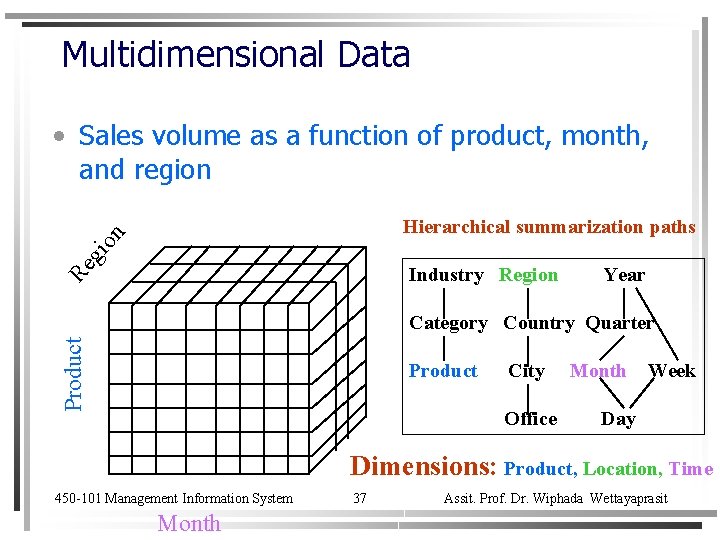
Multidimensional Data • Sales volume as a function of product, month, and region gi on Hierarchical summarization paths Re Industry Region Year Product Category Country Quarter Product City Office Month Week Day Dimensions: Product, Location, Time 450 -101 Management Information System Month 37 Assit. Prof. Dr. Wiphada Wettayaprasit
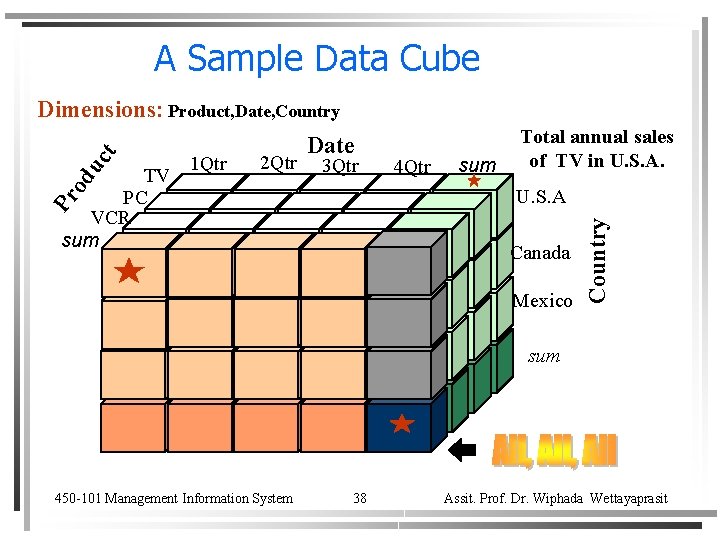
A Sample Data Cube 1 Qtr 2 Qtr 3 Qtr 4 Qtr sum U. S. A Pr od TV PC VCR sum Total annual sales of TV in U. S. A. Canada Mexico Country uc t Dimensions: Product, Date, Country Date sum 450 -101 Management Information System 38 Assit. Prof. Dr. Wiphada Wettayaprasit
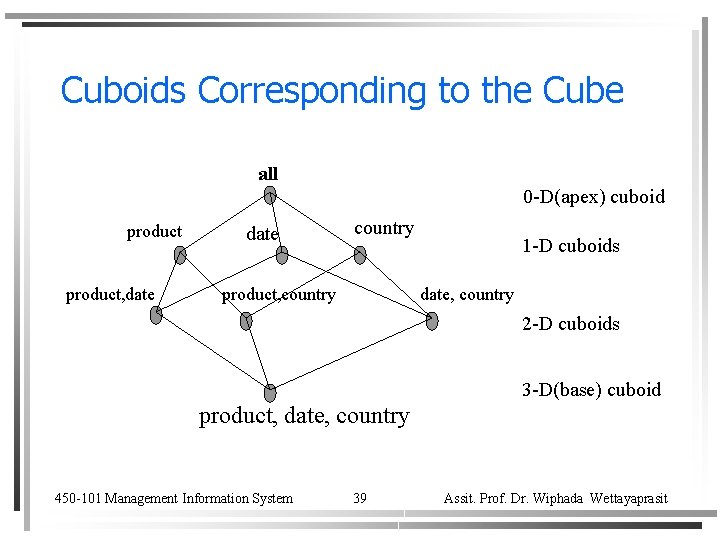
Cuboids Corresponding to the Cube all 0 -D(apex) cuboid product, date country product, country 1 -D cuboids date, country 2 -D cuboids 3 -D(base) cuboid product, date, country 450 -101 Management Information System 39 Assit. Prof. Dr. Wiphada Wettayaprasit
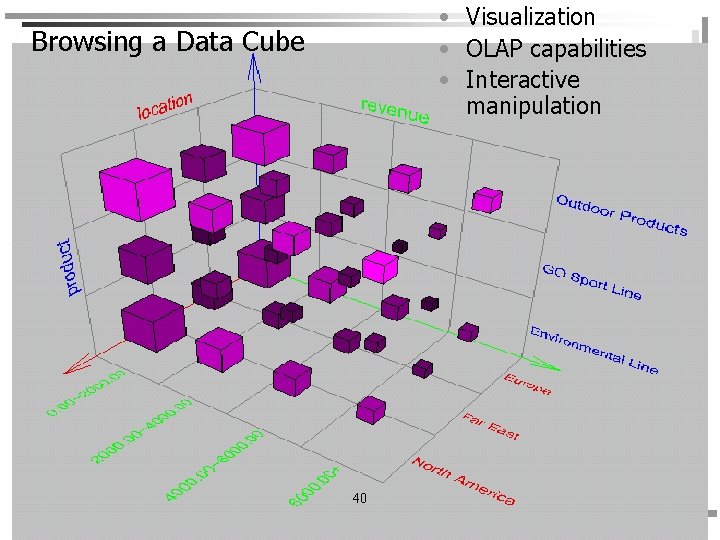
• Visualization • OLAP capabilities • Interactive manipulation Browsing a Data Cube 450 -101 Management Information System 40 Assit. Prof. Dr. Wiphada Wettayaprasit
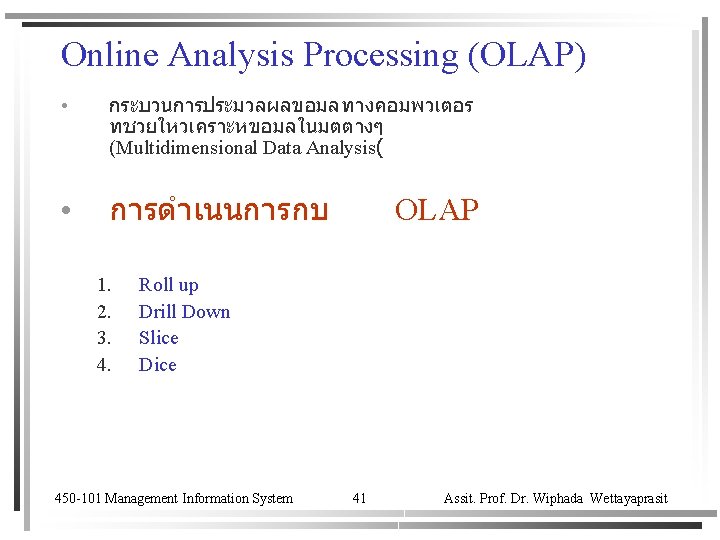
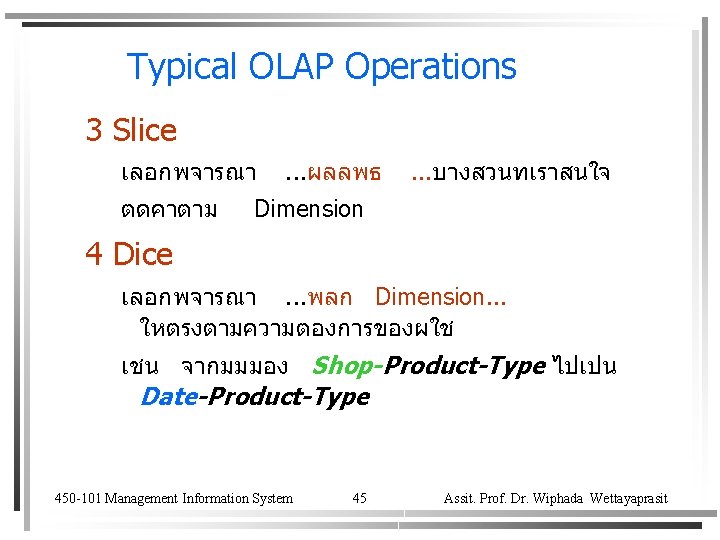
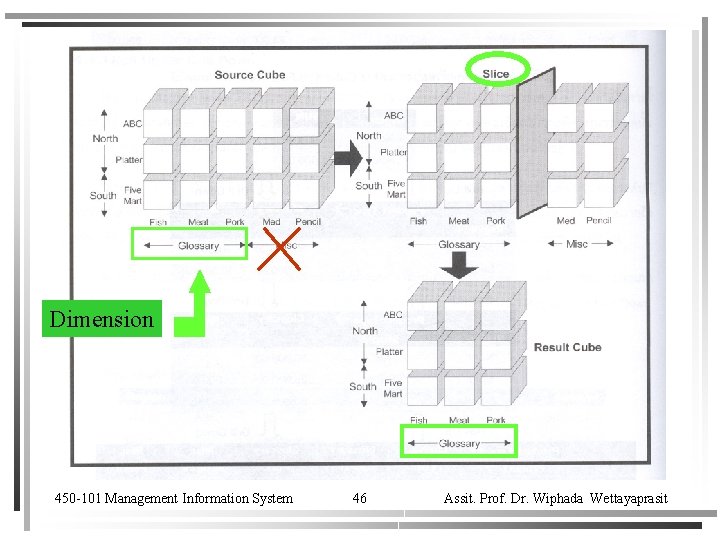
Online Analysis Processing (OLAP) • กระบวนการประมวลผลขอมลทางคอมพวเตอร ทชวยใหวเคราะหขอมลในมตตางๆ (Multidimensional Data Analysis( • การดำเนนการกบ 1. 2. 3. 4. OLAP Roll up Drill Down Slice Dice 450 -101 Management Information System 41 Assit. Prof. Dr. Wiphada Wettayaprasit
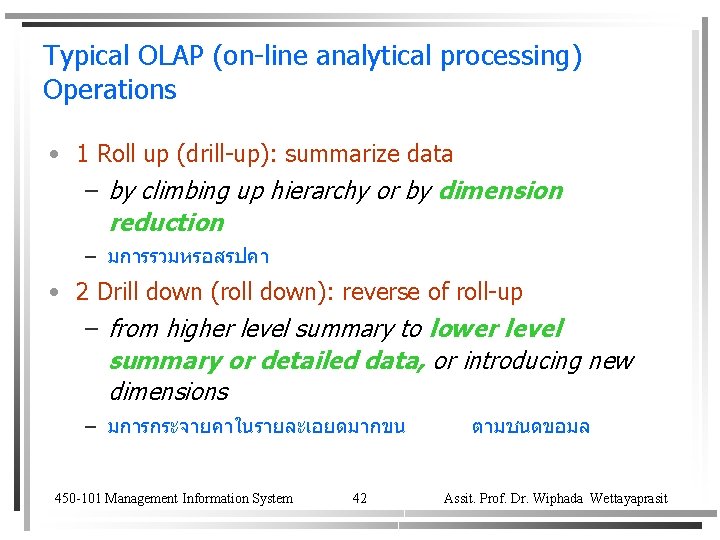
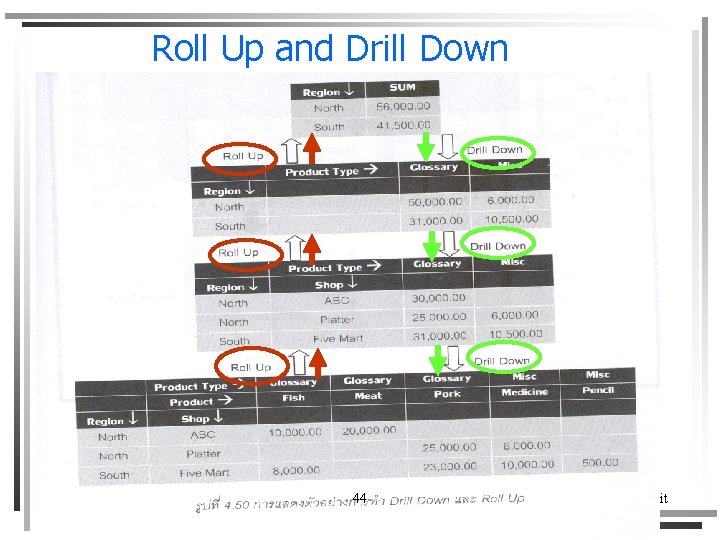
Typical OLAP (on-line analytical processing) Operations • 1 Roll up (drill-up): summarize data – by climbing up hierarchy or by dimension reduction – มการรวมหรอสรปคา • 2 Drill down (roll down): reverse of roll-up – from higher level summary to lower level summary or detailed data, or introducing new dimensions – มการกระจายคาในรายละเอยดมากขน 450 -101 Management Information System 42 ตามชนดขอมล Assit. Prof. Dr. Wiphada Wettayaprasit
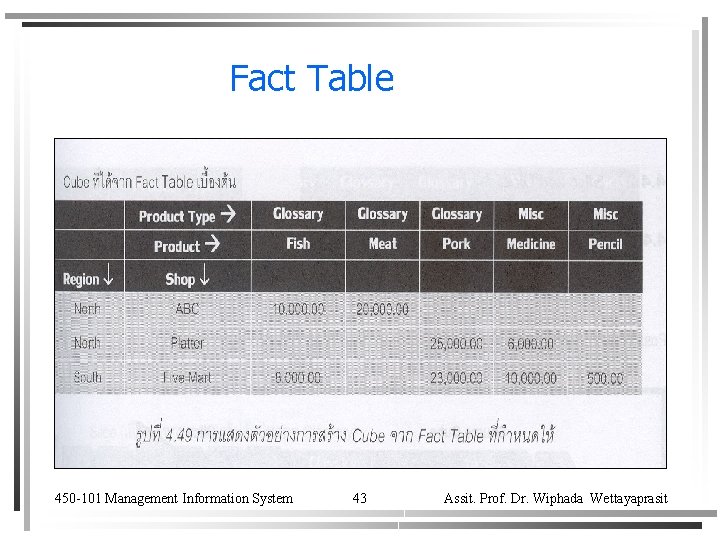
Fact Table 450 -101 Management Information System 43 Assit. Prof. Dr. Wiphada Wettayaprasit
Roll Up and Drill Down 450 -101 Management Information System 44 Assit. Prof. Dr. Wiphada Wettayaprasit
Dimension 450 -101 Management Information System 46 Assit. Prof. Dr. Wiphada Wettayaprasit
5 Data Mining • Provides decision support through knowledge discovery – Analyzes vast stores of historical business data – Looks for patterns, trends, and correlations – Goal is to improve business performance 450 -101 Management Information System 47 Assit. Prof. Dr. Wiphada Wettayaprasit
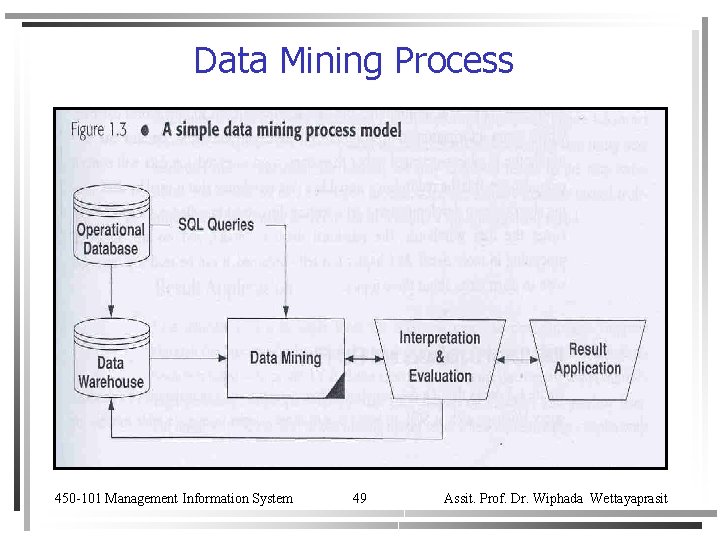
Data Mining Process 450 -101 Management Information System 49 Assit. Prof. Dr. Wiphada Wettayaprasit
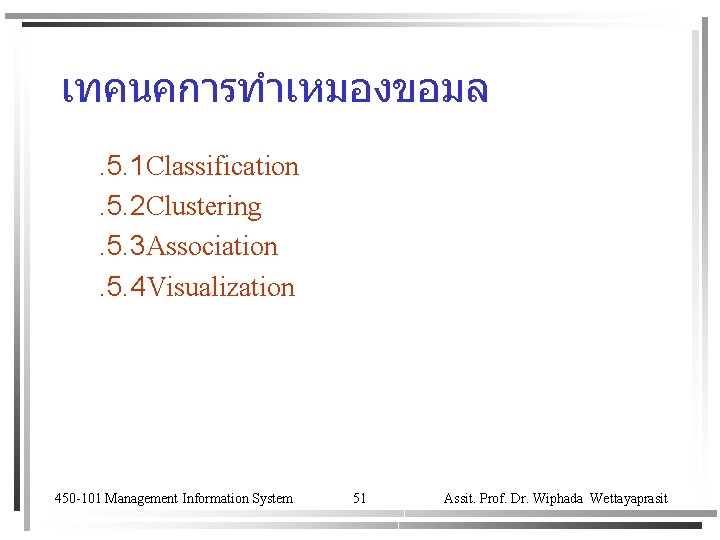
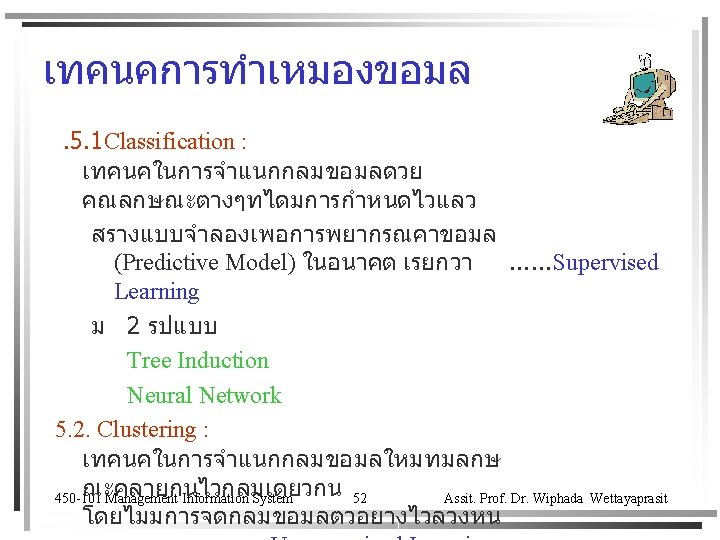
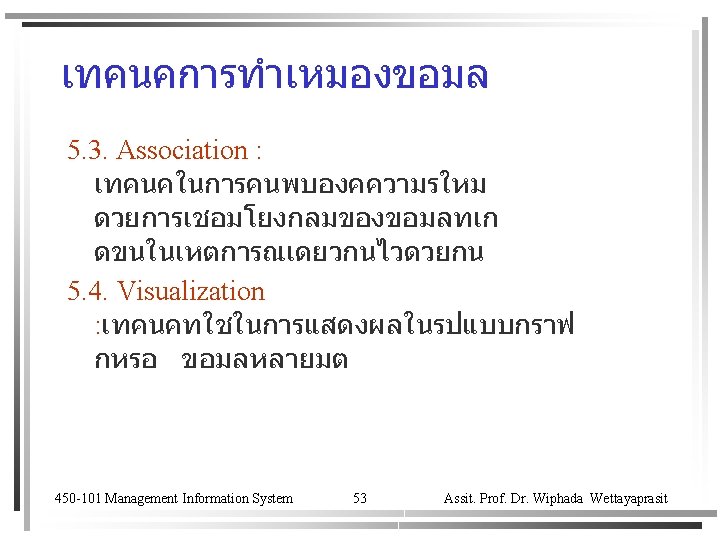
เทคนคการทำเหมองขอมล. 5. 1 Classification. 5. 2 Clustering. 5. 3 Association. 5. 4 Visualization 450 -101 Management Information System 51 Assit. Prof. Dr. Wiphada Wettayaprasit
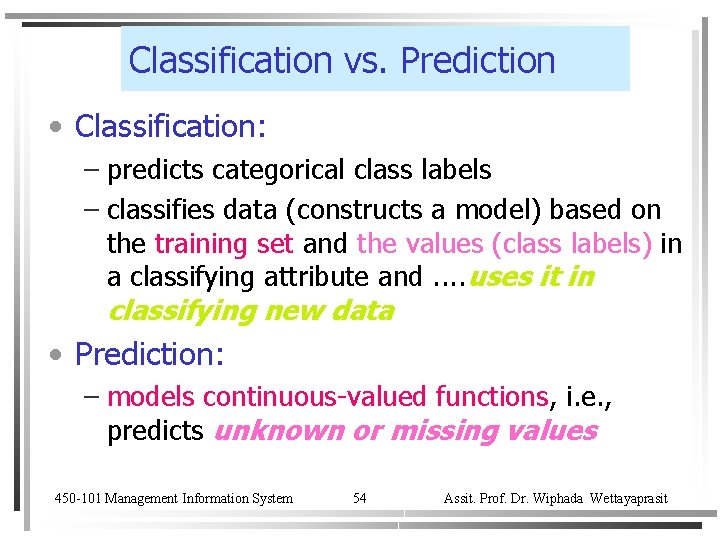
Classification vs. Prediction • Classification: – predicts categorical class labels – classifies data (constructs a model) based on the training set and the values (class labels) in a classifying attribute and. . uses it in classifying new data • Prediction: – models continuous-valued functions, i. e. , predicts unknown or missing values 450 -101 Management Information System 54 Assit. Prof. Dr. Wiphada Wettayaprasit
Classification Process 1. Model construction: 2. Model usage: 450 -101 Management Information System 55 Assit. Prof. Dr. Wiphada Wettayaprasit
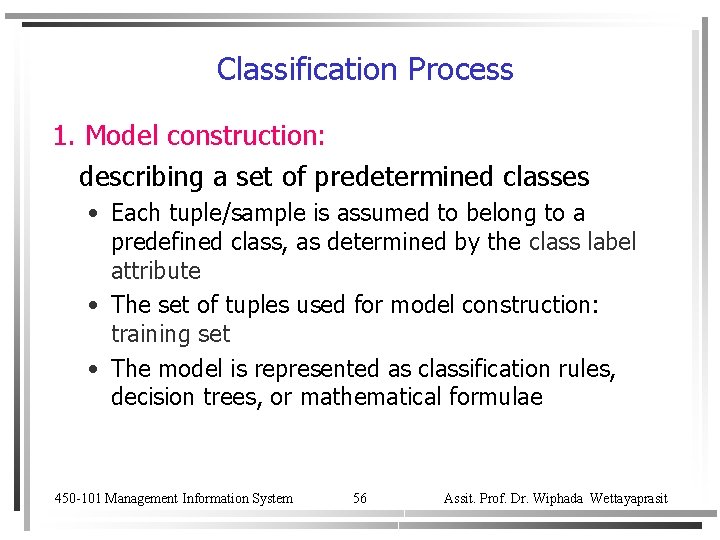
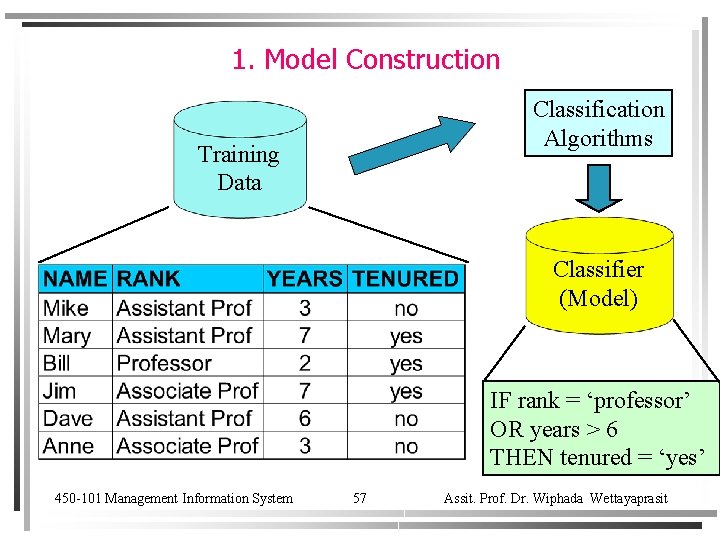
Classification Process 1. Model construction: describing a set of predetermined classes • Each tuple/sample is assumed to belong to a predefined class, as determined by the class label attribute • The set of tuples used for model construction: training set • The model is represented as classification rules, decision trees, or mathematical formulae 450 -101 Management Information System 56 Assit. Prof. Dr. Wiphada Wettayaprasit
1. Model Construction Classification Algorithms Training Data Classifier (Model) IF rank = ‘professor’ OR years > 6 THEN tenured = ‘yes’ 450 -101 Management Information System 57 Assit. Prof. Dr. Wiphada Wettayaprasit
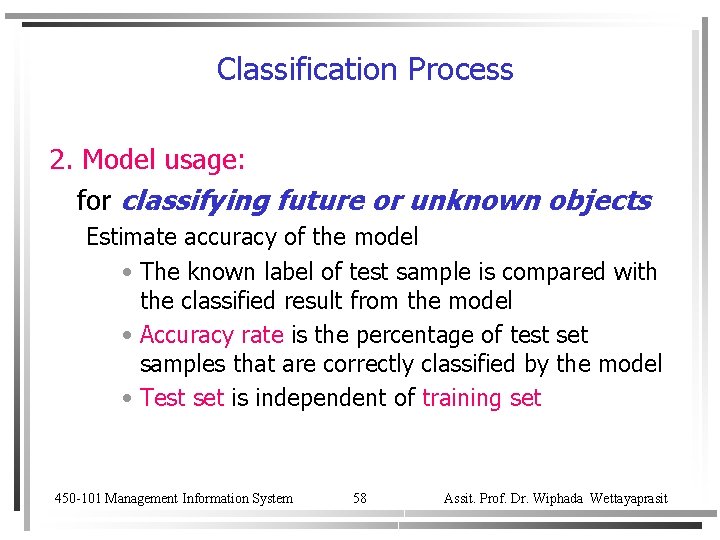
Classification Process 2. Model usage: for classifying future or unknown objects Estimate accuracy of the model • The known label of test sample is compared with the classified result from the model • Accuracy rate is the percentage of test set samples that are correctly classified by the model • Test set is independent of training set 450 -101 Management Information System 58 Assit. Prof. Dr. Wiphada Wettayaprasit
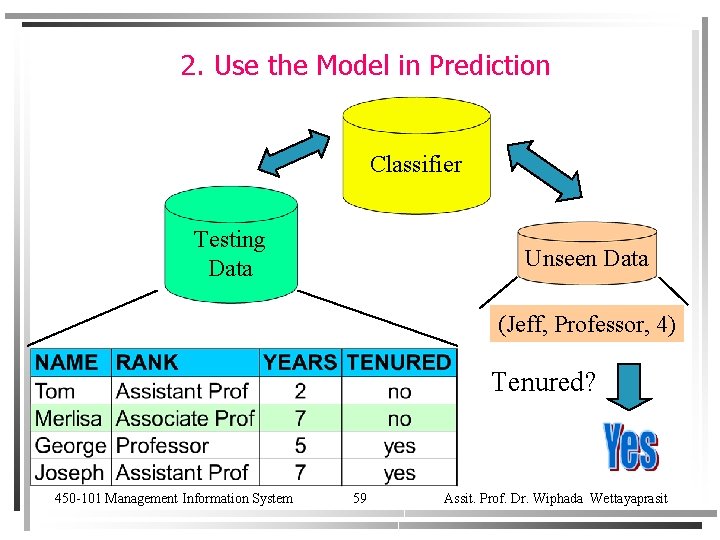
2. Use the Model in Prediction Classifier Testing Data Unseen Data (Jeff, Professor, 4) Tenured? 450 -101 Management Information System 59 Assit. Prof. Dr. Wiphada Wettayaprasit
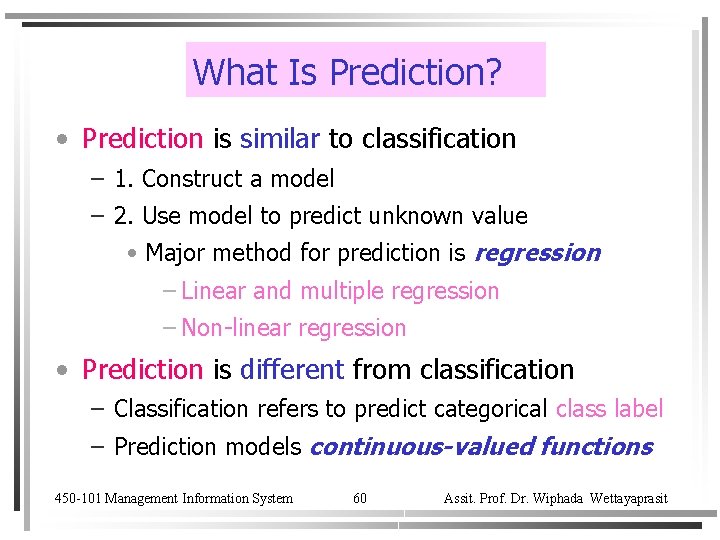
What Is Prediction? • Prediction is similar to classification – 1. Construct a model – 2. Use model to predict unknown value • Major method for prediction is regression – Linear and multiple regression – Non-linear regression • Prediction is different from classification – Classification refers to predict categorical class label – Prediction models continuous-valued functions 450 -101 Management Information System 60 Assit. Prof. Dr. Wiphada Wettayaprasit
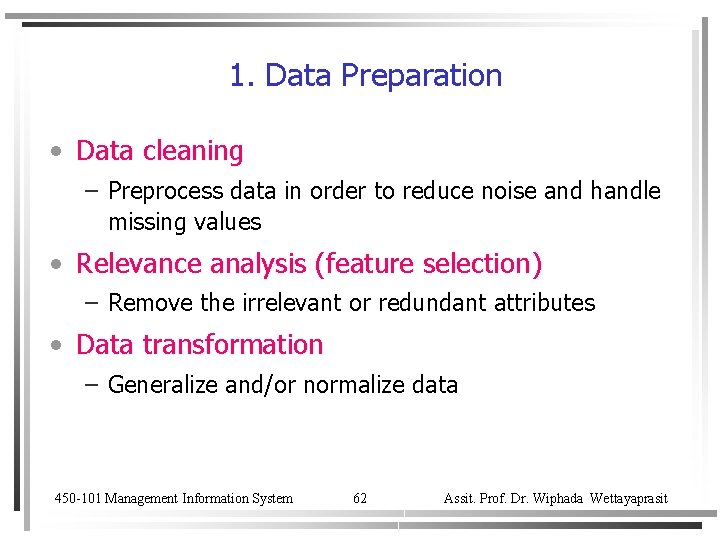
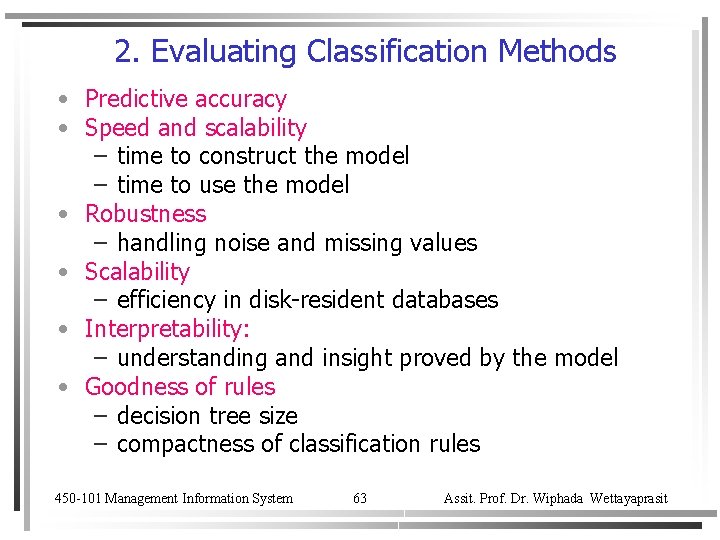
Data Mining Process 1. Data Preparation 2. Evaluating Classification Methods 450 -101 Management Information System 61 Assit. Prof. Dr. Wiphada Wettayaprasit
1. Data Preparation • Data cleaning – Preprocess data in order to reduce noise and handle missing values • Relevance analysis (feature selection) – Remove the irrelevant or redundant attributes • Data transformation – Generalize and/or normalize data 450 -101 Management Information System 62 Assit. Prof. Dr. Wiphada Wettayaprasit
2. Evaluating Classification Methods • Predictive accuracy • Speed and scalability – time to construct the model – time to use the model • Robustness – handling noise and missing values • Scalability – efficiency in disk-resident databases • Interpretability: – understanding and insight proved by the model • Goodness of rules – decision tree size – compactness of classification rules 450 -101 Management Information System 63 Assit. Prof. Dr. Wiphada Wettayaprasit
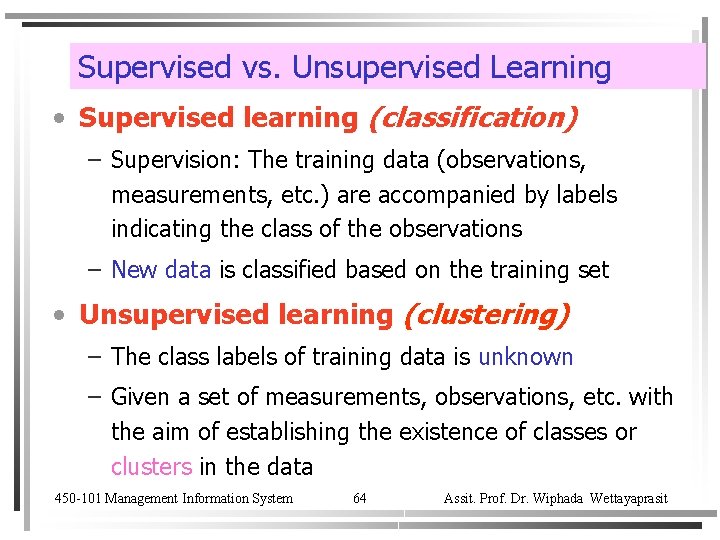
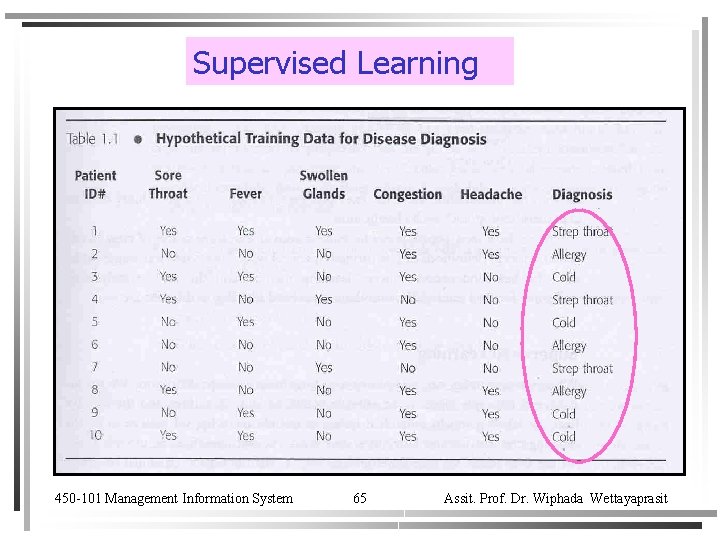
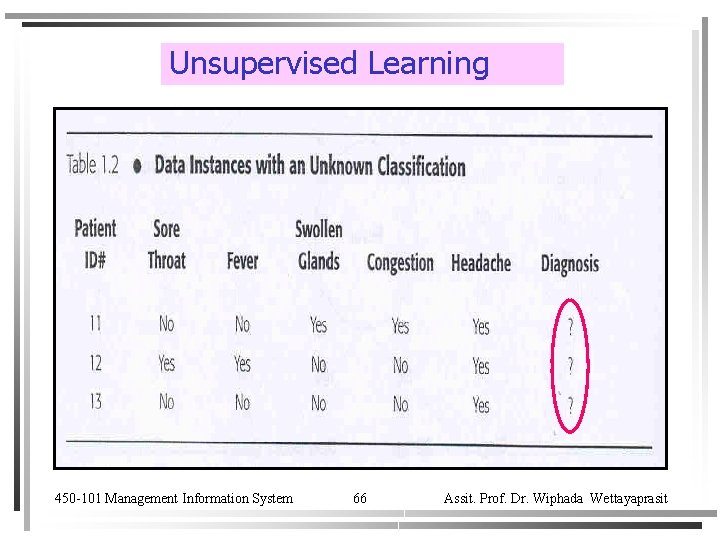
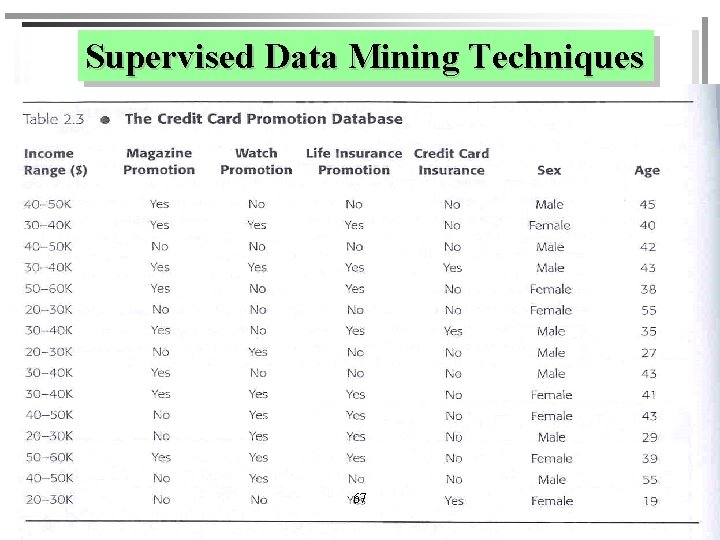
Supervised vs. Unsupervised Learning • Supervised learning (classification) – Supervision: The training data (observations, measurements, etc. ) are accompanied by labels indicating the class of the observations – New data is classified based on the training set • Unsupervised learning (clustering) – The class labels of training data is unknown – Given a set of measurements, observations, etc. with the aim of establishing the existence of classes or clusters in the data 450 -101 Management Information System 64 Assit. Prof. Dr. Wiphada Wettayaprasit
Supervised Learning 450 -101 Management Information System 65 Assit. Prof. Dr. Wiphada Wettayaprasit
Unsupervised Learning 450 -101 Management Information System 66 Assit. Prof. Dr. Wiphada Wettayaprasit
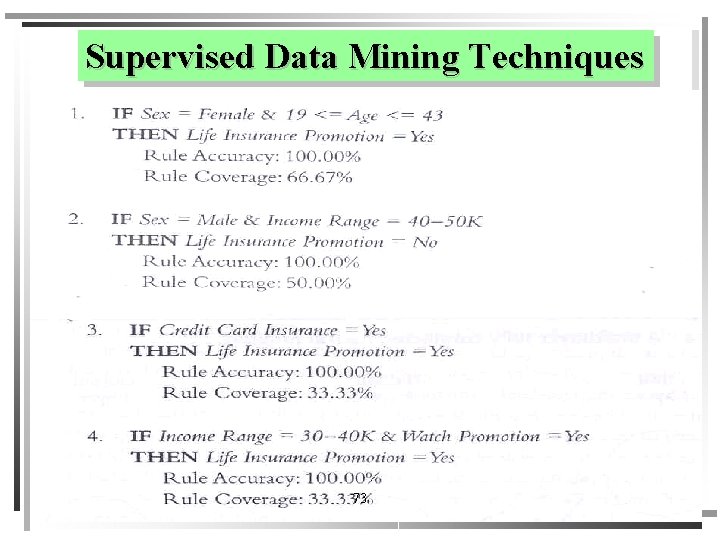
Supervised Data Mining Techniques 450 -101 Management Information System 67 Assit. Prof. Dr. Wiphada Wettayaprasit
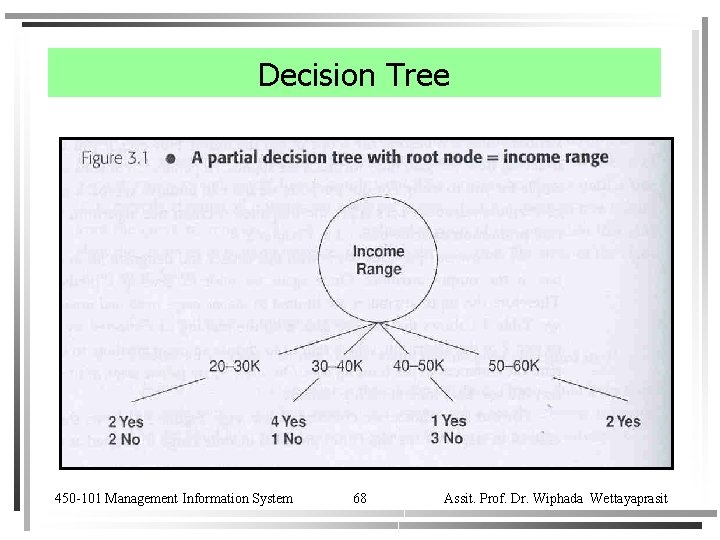
Decision Tree 450 -101 Management Information System 68 Assit. Prof. Dr. Wiphada Wettayaprasit
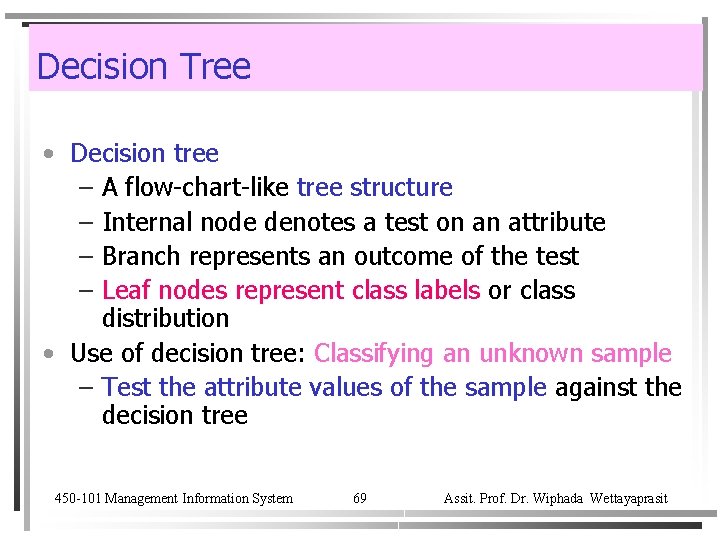
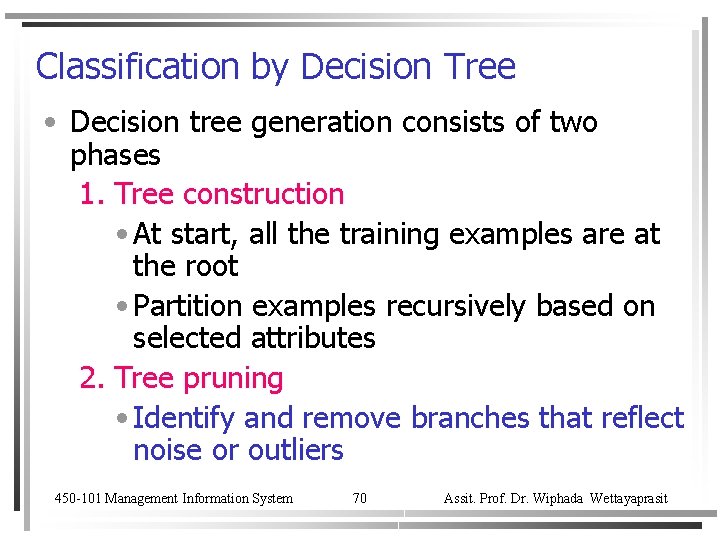
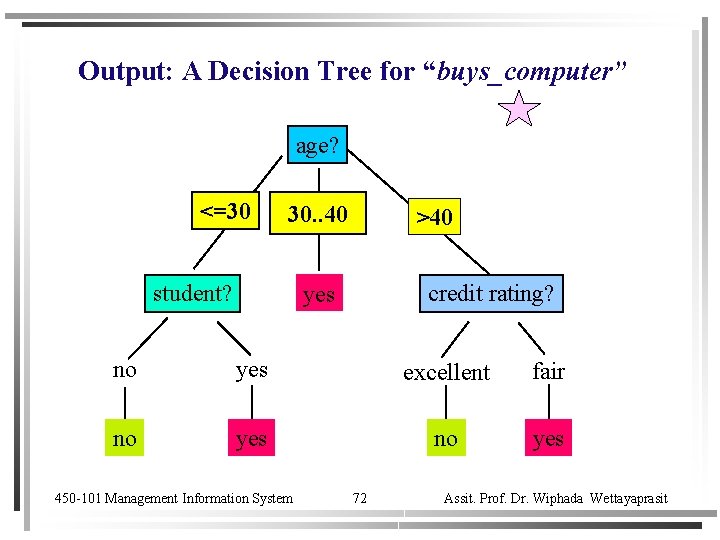
Decision Tree • Decision tree – A flow-chart-like tree structure – Internal node denotes a test on an attribute – Branch represents an outcome of the test – Leaf nodes represent class labels or class distribution • Use of decision tree: Classifying an unknown sample – Test the attribute values of the sample against the decision tree 450 -101 Management Information System 69 Assit. Prof. Dr. Wiphada Wettayaprasit
Classification by Decision Tree • Decision tree generation consists of two phases 1. Tree construction • At start, all the training examples are at the root • Partition examples recursively based on selected attributes 2. Tree pruning • Identify and remove branches that reflect noise or outliers 450 -101 Management Information System 70 Assit. Prof. Dr. Wiphada Wettayaprasit
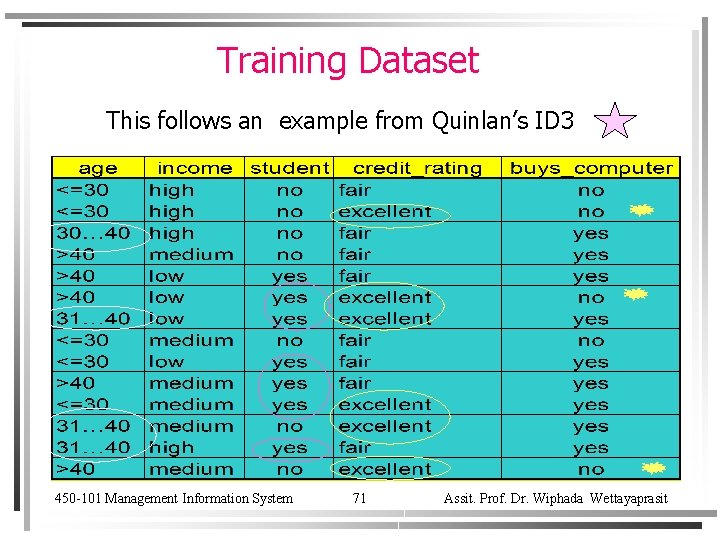
Training Dataset This follows an example from Quinlan’s ID 3 450 -101 Management Information System 71 Assit. Prof. Dr. Wiphada Wettayaprasit
Output: A Decision Tree for “buys_computer” age? <=30 30. . 40 overcast student? >40 credit rating? yes no yes excellent fair no yes 450 -101 Management Information System 72 Assit. Prof. Dr. Wiphada Wettayaprasit
Supervised Data Mining Techniques 450 -101 Management Information System 73 Assit. Prof. Dr. Wiphada Wettayaprasit
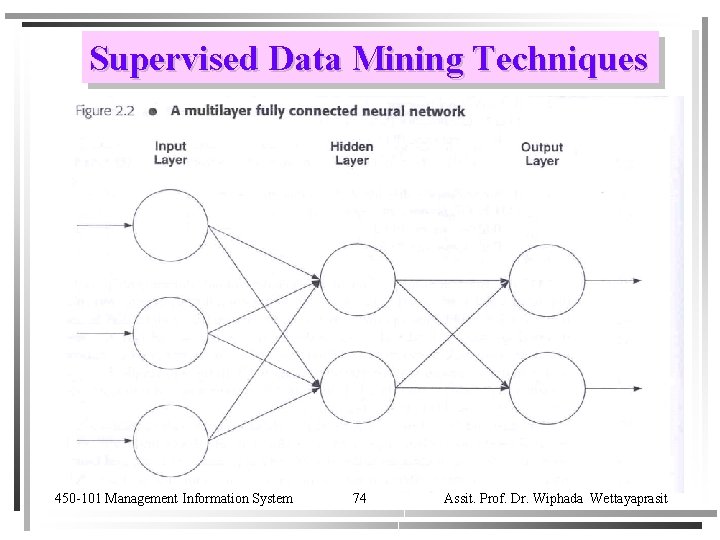
Supervised Data Mining Techniques 450 -101 Management Information System 74 Assit. Prof. Dr. Wiphada Wettayaprasit
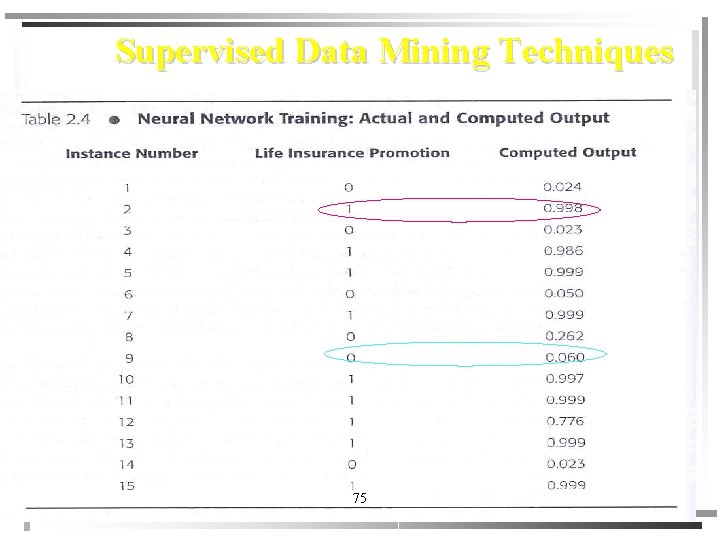
Supervised Data Mining Techniques 450 -101 Management Information System 75 Assit. Prof. Dr. Wiphada Wettayaprasit
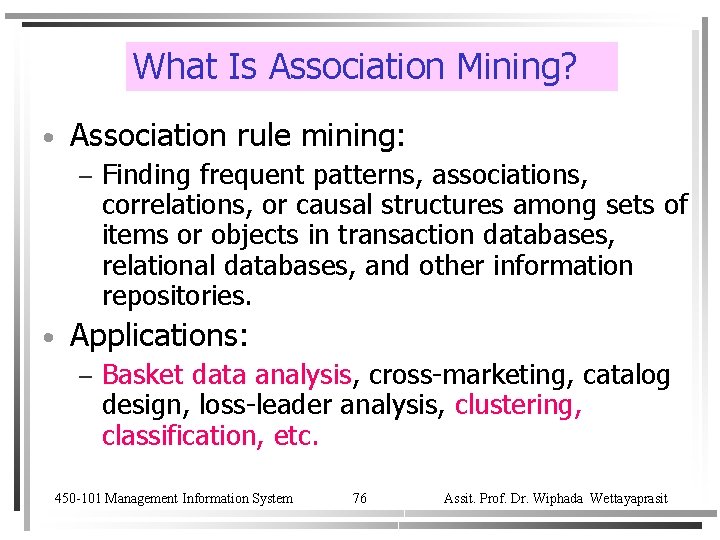
What Is Association Mining? • Association rule mining: – • Finding frequent patterns, associations, correlations, or causal structures among sets of items or objects in transaction databases, relational databases, and other information repositories. Applications: – Basket data analysis, cross-marketing, catalog design, loss-leader analysis, clustering, classification, etc. 450 -101 Management Information System 76 Assit. Prof. Dr. Wiphada Wettayaprasit
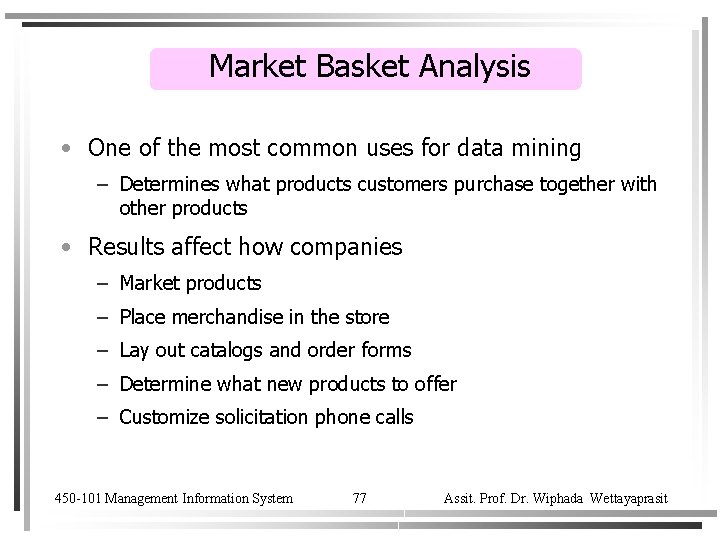
Market Basket Analysis • One of the most common uses for data mining – Determines what products customers purchase together with other products • Results affect how companies – Market products – Place merchandise in the store – Lay out catalogs and order forms – Determine what new products to offer – Customize solicitation phone calls 450 -101 Management Information System 77 Assit. Prof. Dr. Wiphada Wettayaprasit
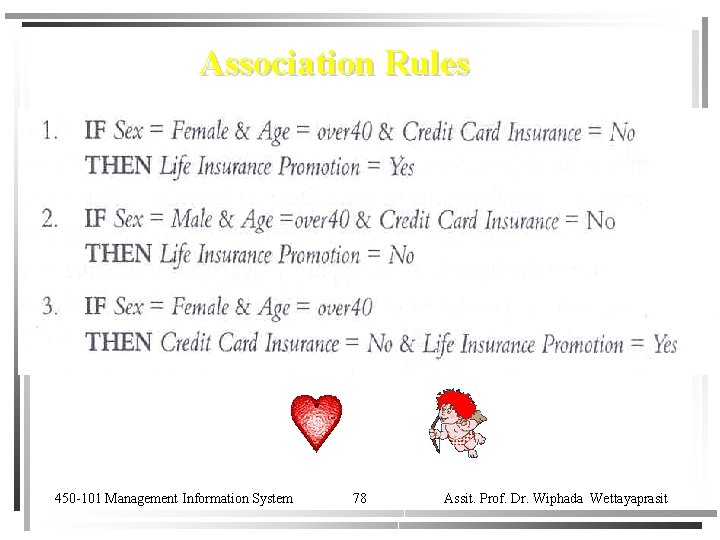
Association Rules 450 -101 Management Information System 78 Assit. Prof. Dr. Wiphada Wettayaprasit
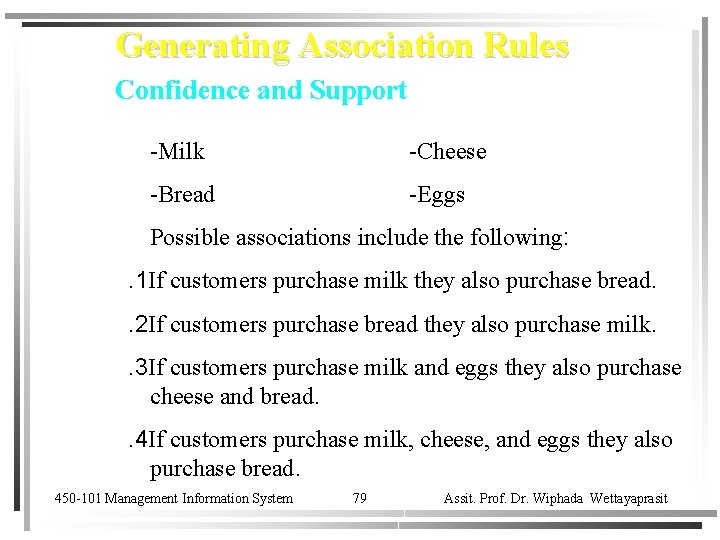
Generating Association Rules Confidence and Support -Milk -Cheese -Bread -Eggs Possible associations include the following: . 1 If customers purchase milk they also purchase bread. . 2 If customers purchase bread they also purchase milk. . 3 If customers purchase milk and eggs they also purchase cheese and bread. . 4 If customers purchase milk, cheese, and eggs they also purchase bread. 450 -101 Management Information System 79 Assit. Prof. Dr. Wiphada Wettayaprasit
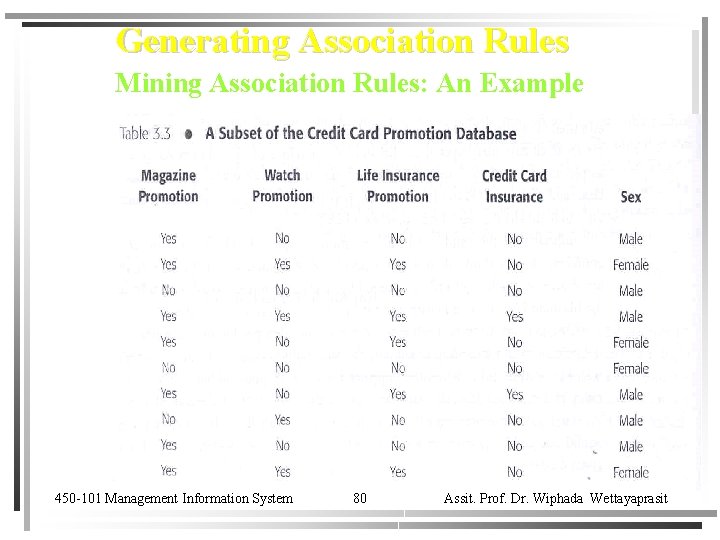
Generating Association Rules Mining Association Rules: An Example 450 -101 Management Information System 80 Assit. Prof. Dr. Wiphada Wettayaprasit
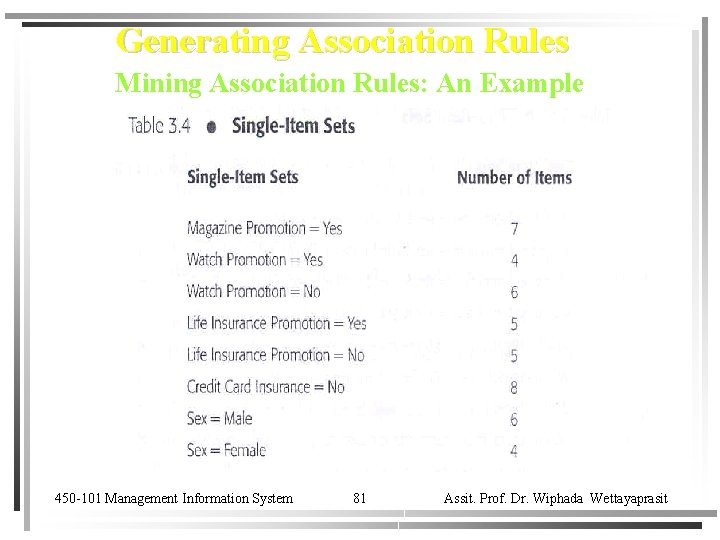
Generating Association Rules Mining Association Rules: An Example 450 -101 Management Information System 81 Assit. Prof. Dr. Wiphada Wettayaprasit
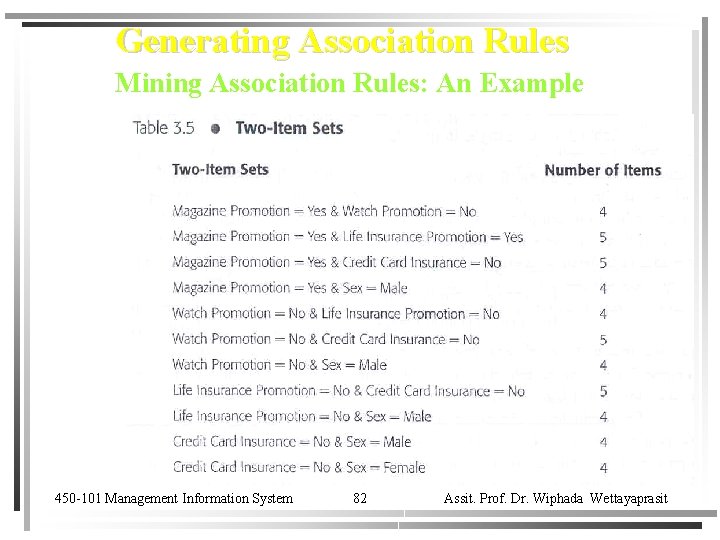
Generating Association Rules Mining Association Rules: An Example 450 -101 Management Information System 82 Assit. Prof. Dr. Wiphada Wettayaprasit
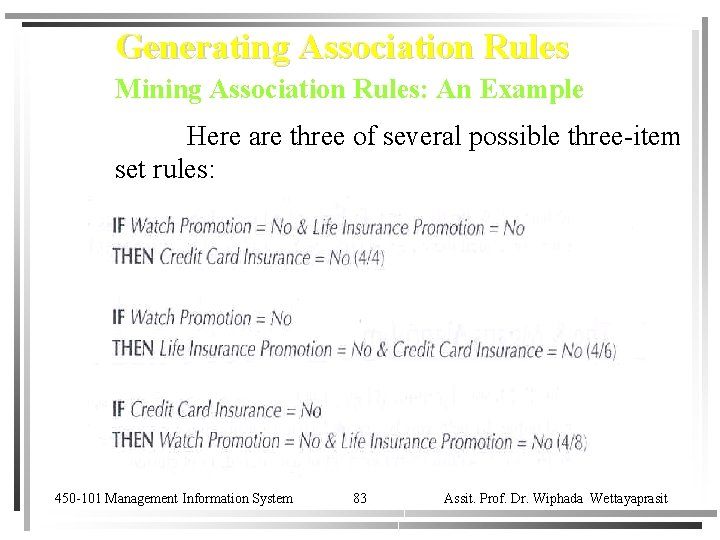
Generating Association Rules Mining Association Rules: An Example Here are three of several possible three-item set rules: 450 -101 Management Information System 83 Assit. Prof. Dr. Wiphada Wettayaprasit
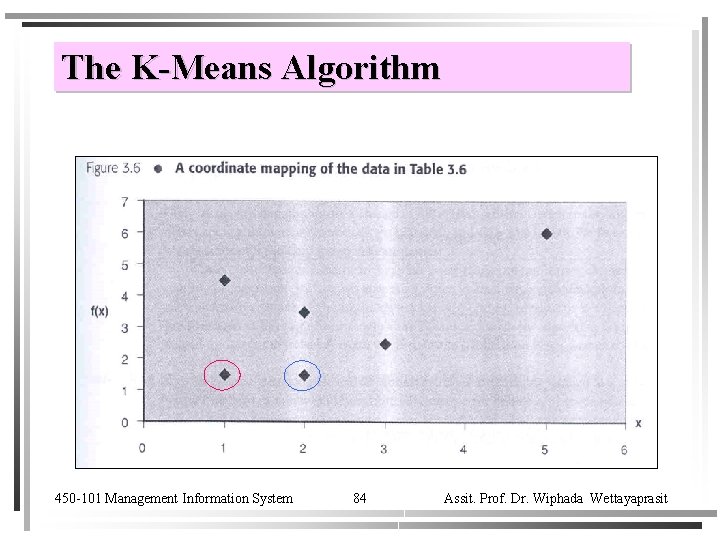
The K-Means Algorithm 450 -101 Management Information System 84 Assit. Prof. Dr. Wiphada Wettayaprasit
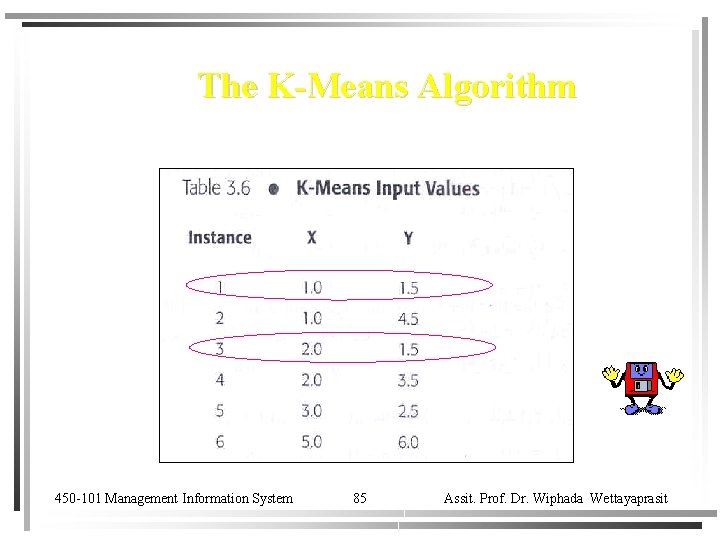
The K-Means Algorithm 450 -101 Management Information System 85 Assit. Prof. Dr. Wiphada Wettayaprasit
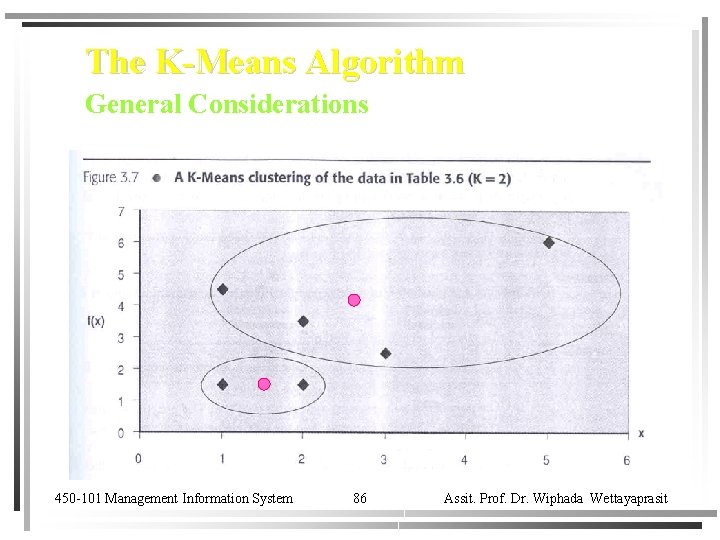
The K-Means Algorithm General Considerations 450 -101 Management Information System 86 Assit. Prof. Dr. Wiphada Wettayaprasit
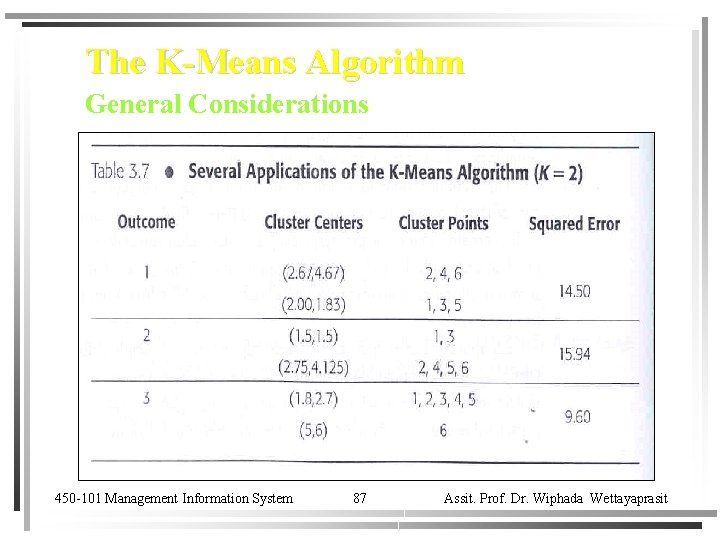
The K-Means Algorithm General Considerations 450 -101 Management Information System 87 Assit. Prof. Dr. Wiphada Wettayaprasit
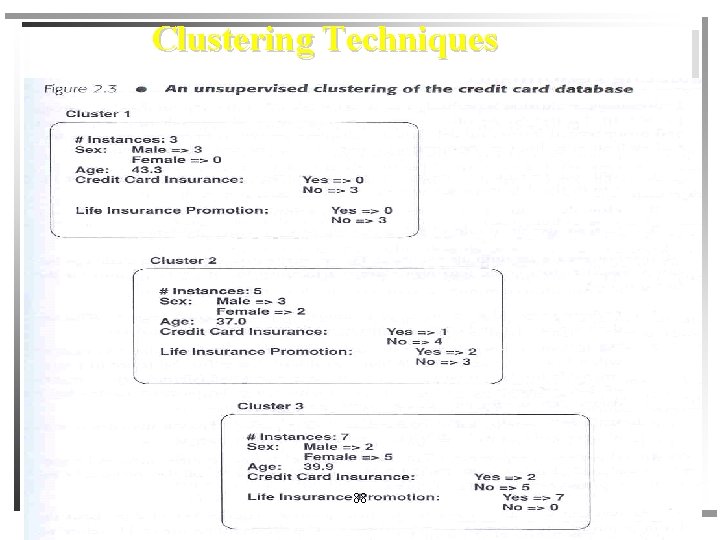
Clustering Techniques 450 -101 Management Information System 88 Assit. Prof. Dr. Wiphada Wettayaprasit
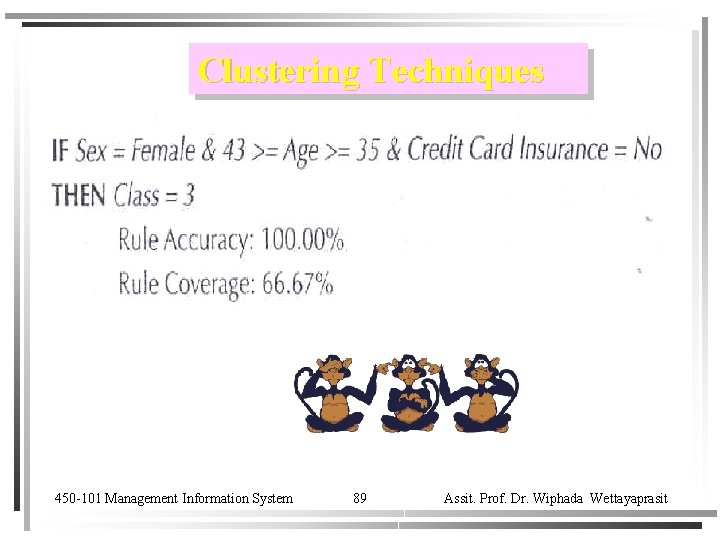
Clustering Techniques 450 -101 Management Information System 89 Assit. Prof. Dr. Wiphada Wettayaprasit
Geographic Information Systems • GIS – DSS uses geographic databases to construct and display maps and other graphic displays – Supports decisions affecting the geographic distribution of people and other resources – Often used with Global Positioning Systems (GPS) devices 450 -101 Management Information System 92 Assit. Prof. Dr. Wiphada Wettayaprasit
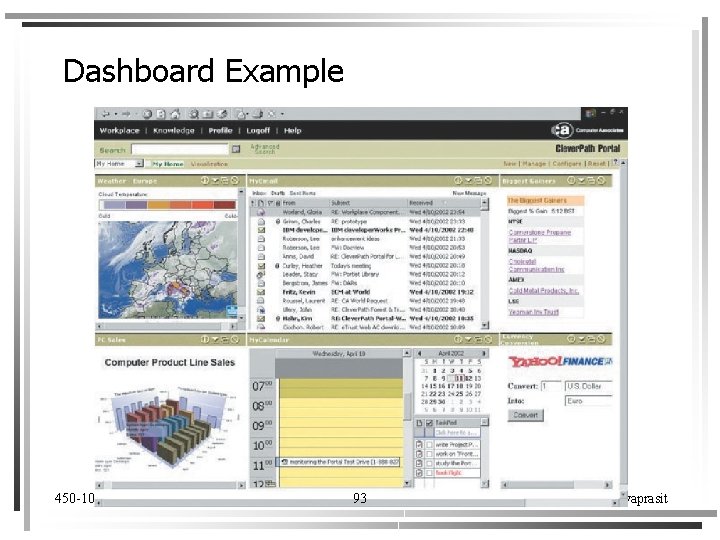
Dashboard Example 450 -101 Management Information System 93 Assit. Prof. Dr. Wiphada Wettayaprasit
Executive Information Systems • EIS – Combines many features of MIS and DSS – Provide top executives with immediate and easy access to information – Identify factors that are critical to accomplishing strategic objectives (critical success factors) – So popular that it has been expanded to managers, analysis, and other knowledge workers 450 -101 Management Information System 94 Assit. Prof. Dr. Wiphada Wettayaprasit
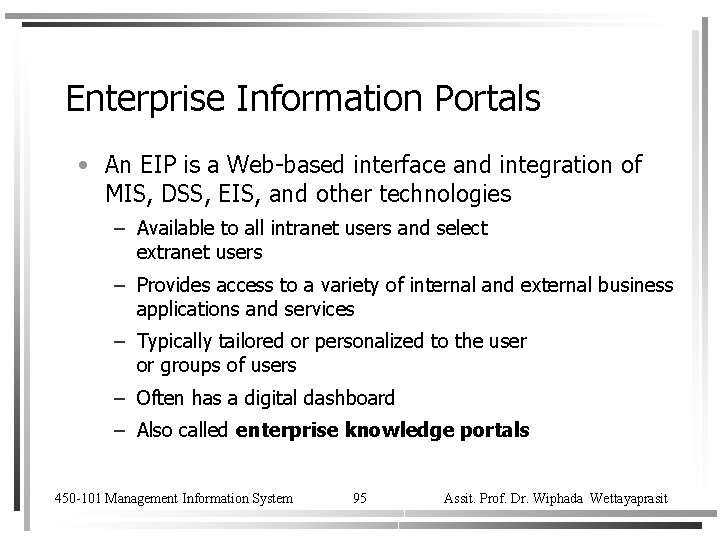
Enterprise Information Portals • An EIP is a Web-based interface and integration of MIS, DSS, EIS, and other technologies – Available to all intranet users and select extranet users – Provides access to a variety of internal and external business applications and services – Typically tailored or personalized to the user or groups of users – Often has a digital dashboard – Also called enterprise knowledge portals 450 -101 Management Information System 95 Assit. Prof. Dr. Wiphada Wettayaprasit
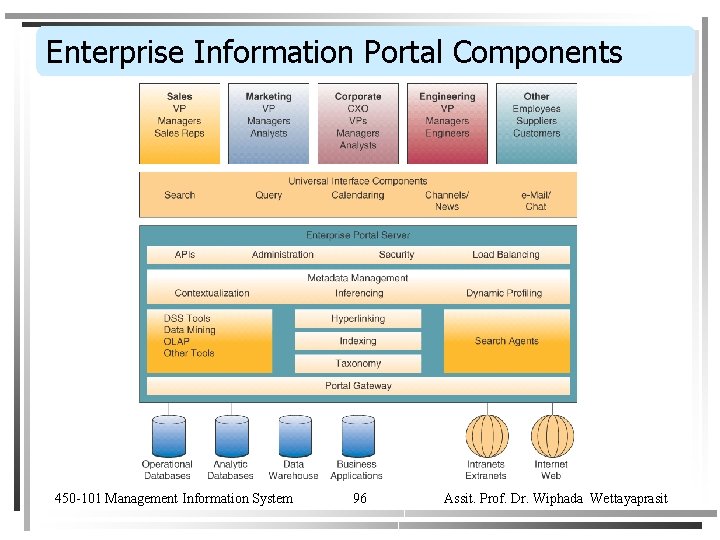
Enterprise Information Portal Components 450 -101 Management Information System 96 Assit. Prof. Dr. Wiphada Wettayaprasit
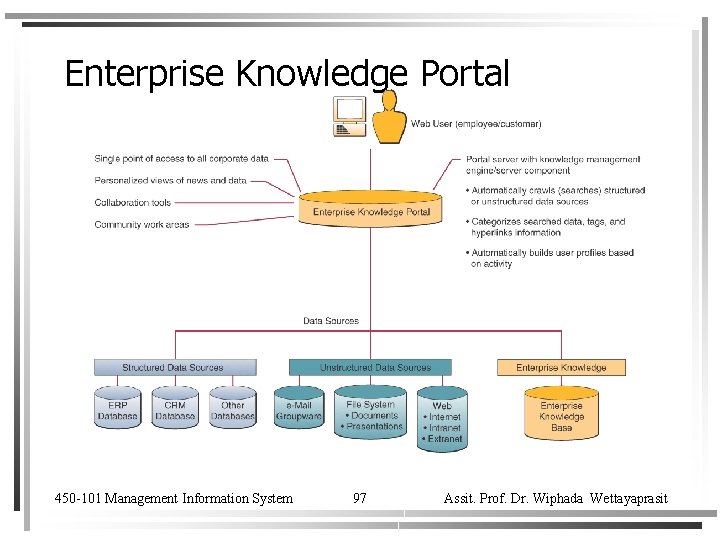
Enterprise Knowledge Portal 450 -101 Management Information System 97 Assit. Prof. Dr. Wiphada Wettayaprasit
Reference Data Mining: Concepts and Techniques (Chapter 6 Slide for textbook), Jiawei Han and Micheline Kamber, Intelligent Database Systems Research Lab, School of Computing Science, Simon Fraser University, Canada Data Mining A tutorial-Based Primer, Richard J. Roiger and Michael W. Geatz, Pearson Education Inc. , 2003 James A. O’Brien and George M. Marakas, Management Information Systems, 8 th edition, Mc. Graw-Hill /Irwin, 2008 450 -101 Management Information System 98 Assit. Prof. Dr. Wiphada Wettayaprasit
Q&A 450 -101 Management Information System 99 Assit. Prof. Dr. Wiphada Wettayaprasit