
447 CS Management of Programming Projects Lecture 13
- Slides: 7
447 CS – Management of Programming Projects Lecture 13 The limitations of projects k. albasheir@psau. edu. sa
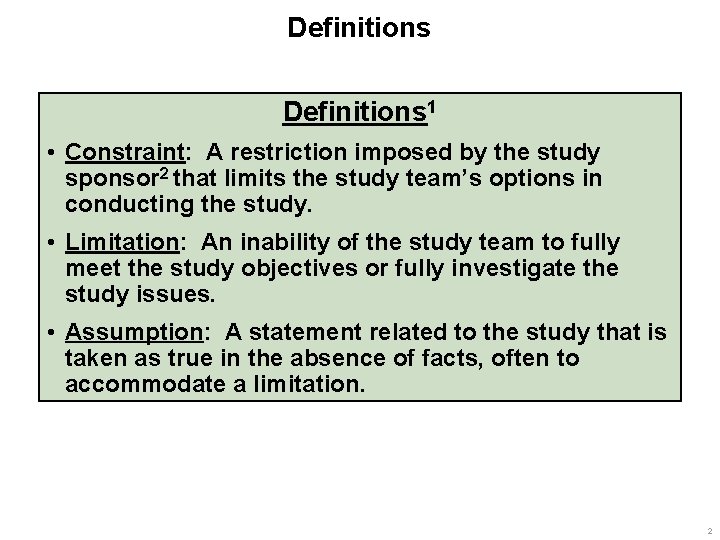
Definitions 1 • Constraint: A restriction imposed by the study sponsor 2 that limits the study team’s options in conducting the study. • Limitation: An inability of the study team to fully meet the study objectives or fully investigate the study issues. • Assumption: A statement related to the study that is taken as true in the absence of facts, often to accommodate a limitation. 2
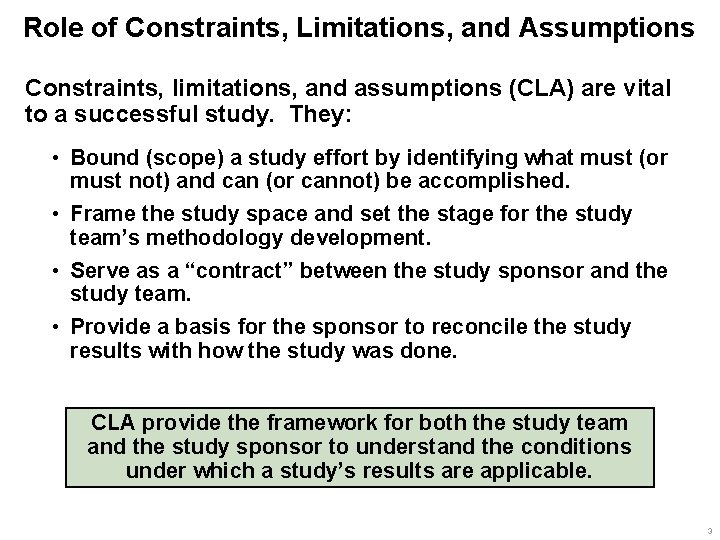
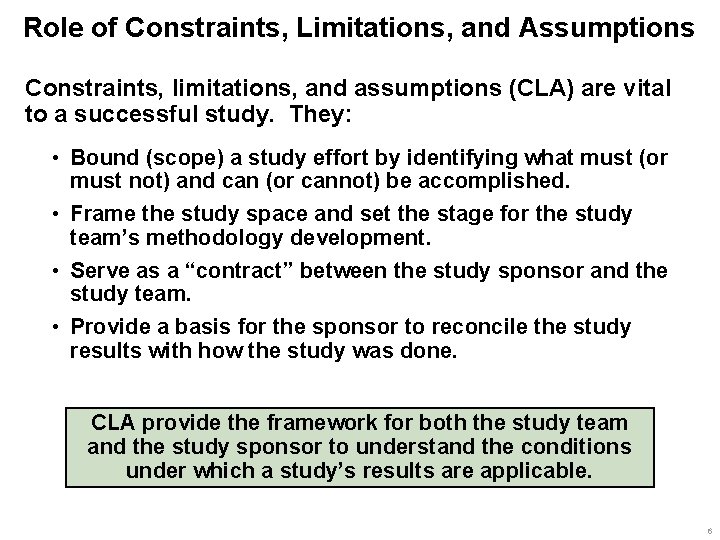
Role of Constraints, Limitations, and Assumptions Constraints, limitations, and assumptions (CLA) are vital to a successful study. They: • Bound (scope) a study effort by identifying what must (or must not) and can (or cannot) be accomplished. • Frame the study space and set the stage for the study team’s methodology development. • Serve as a “contract” between the study sponsor and the study team. • Provide a basis for the sponsor to reconcile the study results with how the study was done. CLA provide the framework for both the study team and the study sponsor to understand the conditions under which a study’s results are applicable. 3
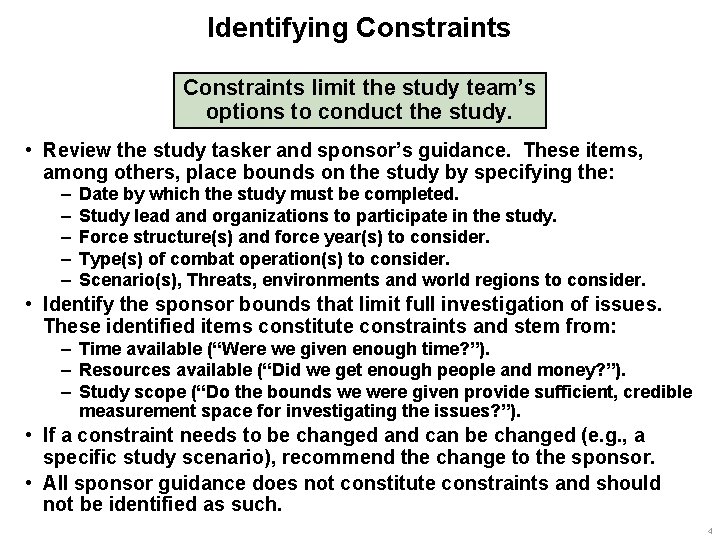
Identifying Constraints limit the study team’s options to conduct the study. • Review the study tasker and sponsor’s guidance. These items, among others, place bounds on the study by specifying the: – – – Date by which the study must be completed. Study lead and organizations to participate in the study. Force structure(s) and force year(s) to consider. Type(s) of combat operation(s) to consider. Scenario(s), Threats, environments and world regions to consider. • Identify the sponsor bounds that limit full investigation of issues. These identified items constitute constraints and stem from: – Time available (“Were we given enough time? ”). – Resources available (“Did we get enough people and money? ”). – Study scope (“Do the bounds we were given provide sufficient, credible measurement space for investigating the issues? ”). • If a constraint needs to be changed and can be changed (e. g. , a specific study scenario), recommend the change to the sponsor. • All sponsor guidance does not constitute constraints and should not be identified as such. 4
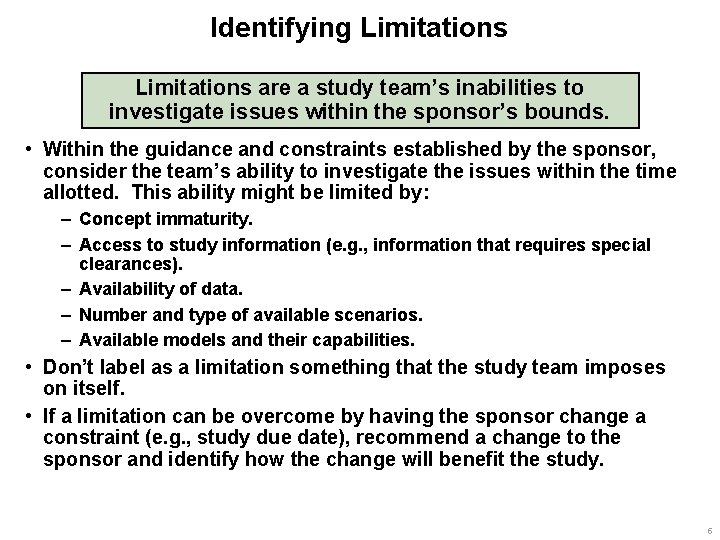
Identifying Limitations are a study team’s inabilities to investigate issues within the sponsor’s bounds. • Within the guidance and constraints established by the sponsor, consider the team’s ability to investigate the issues within the time allotted. This ability might be limited by: – Concept immaturity. – Access to study information (e. g. , information that requires special clearances). – Availability of data. – Number and type of available scenarios. – Available models and their capabilities. • Don’t label as a limitation something that the study team imposes on itself. • If a limitation can be overcome by having the sponsor change a constraint (e. g. , study due date), recommend a change to the sponsor and identify how the change will benefit the study. 5
Role of Constraints, Limitations, and Assumptions Constraints, limitations, and assumptions (CLA) are vital to a successful study. They: • Bound (scope) a study effort by identifying what must (or must not) and can (or cannot) be accomplished. • Frame the study space and set the stage for the study team’s methodology development. • Serve as a “contract” between the study sponsor and the study team. • Provide a basis for the sponsor to reconcile the study results with how the study was done. CLA provide the framework for both the study team and the study sponsor to understand the conditions under which a study’s results are applicable. 6
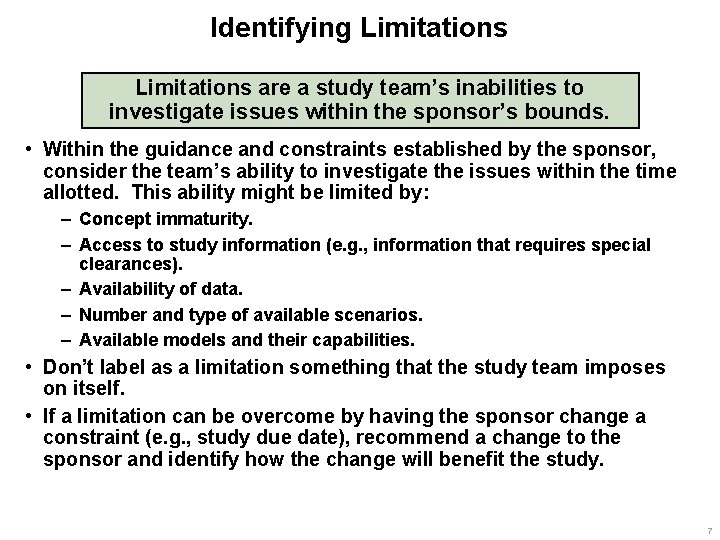
Identifying Limitations are a study team’s inabilities to investigate issues within the sponsor’s bounds. • Within the guidance and constraints established by the sponsor, consider the team’s ability to investigate the issues within the time allotted. This ability might be limited by: – Concept immaturity. – Access to study information (e. g. , information that requires special clearances). – Availability of data. – Number and type of available scenarios. – Available models and their capabilities. • Don’t label as a limitation something that the study team imposes on itself. • If a limitation can be overcome by having the sponsor change a constraint (e. g. , study due date), recommend a change to the sponsor and identify how the change will benefit the study. 7