
441 Chem CH2 Ultraviolet and Visible Spectroscopy 1
441 Chem CH-2 Ultraviolet and Visible Spectroscopy 1
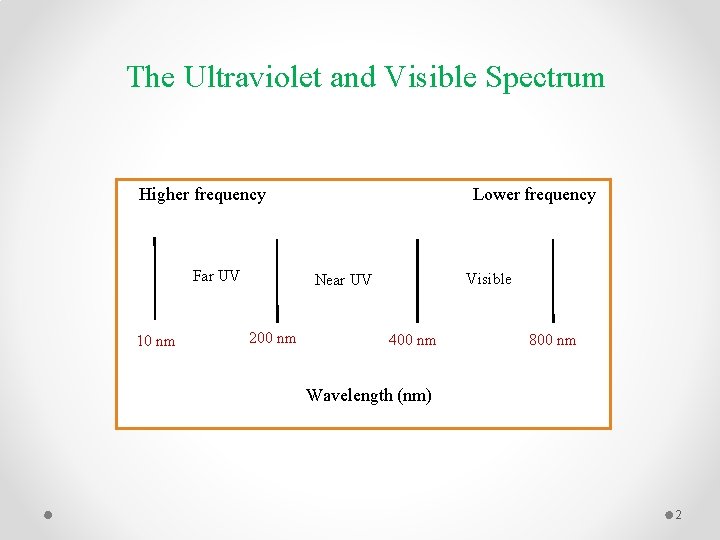
The Ultraviolet and Visible Spectrum Lower frequency Higher frequency Far UV 10 nm Visible Near UV 200 nm 400 nm 800 nm Wavelength (nm) 2
Ultraviolet and Visible Spectroscopy q The absorption of ultraviolet and visible radiation by molecules is dependent upon the electronic structure of the molecule. q So the ultraviolet and visible spectrum is called: Electronic Spectrum q The absorption of light energy by organic compounds in the visible and ultraviolet region involves the promotion of electrons in , , and n-orbitals from the ground state to higher energy states. This is also called Energy Transition 3
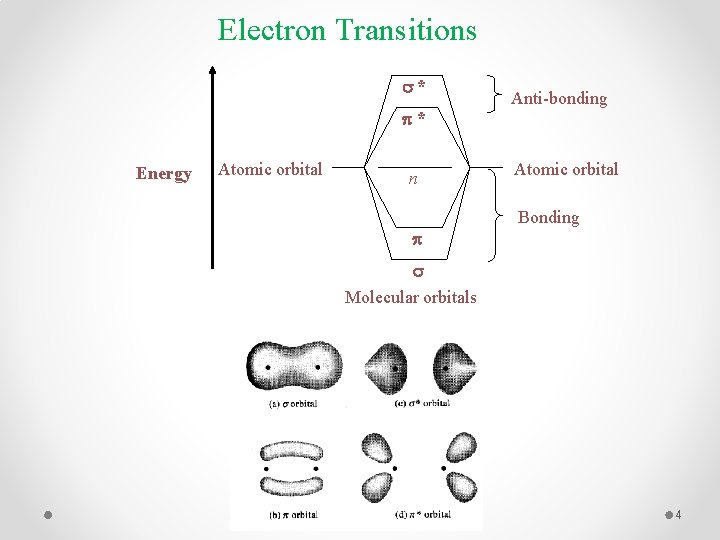
Electron Transitions s* p* Energy Atomic orbital n p Anti-bonding Atomic orbital Bonding s Molecular orbitals 4
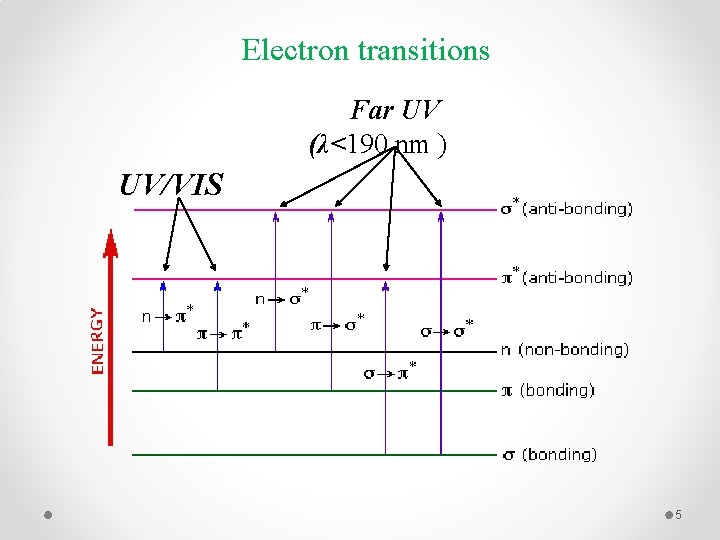
Electron transitions Far UV (λ<190 nm ) UV/VIS 5
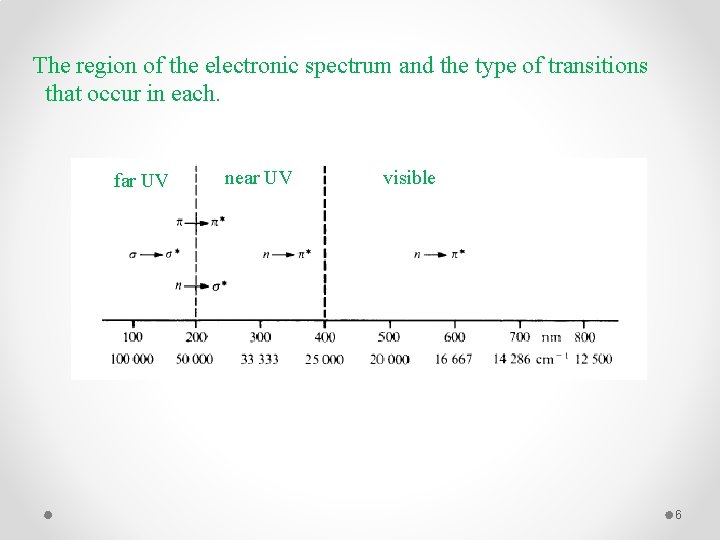
The region of the electronic spectrum and the type of transitions that occur in each. far UV near UV visible 6
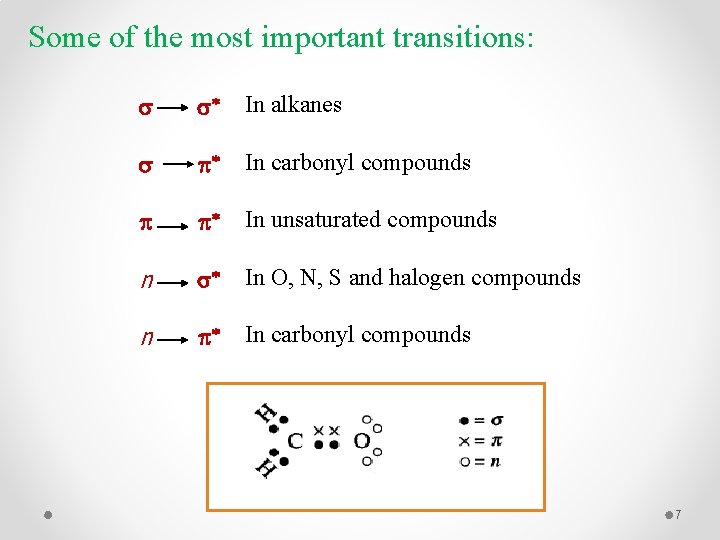
Some of the most important transitions: s s* In alkanes s p* In carbonyl compounds p p* In unsaturated compounds n s* In O, N, S and halogen compounds n p* In carbonyl compounds 7
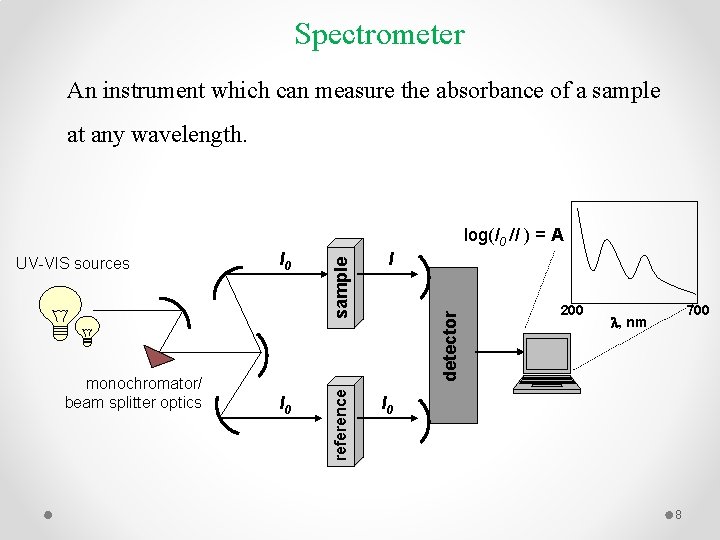
Spectrometer An instrument which can measure the absorbance of a sample at any wavelength. I 0 I detector monochromator/ beam splitter optics I 0 reference UV-VIS sources sample log(I 0 /I ) = A 200 700 l, nm I 0 8
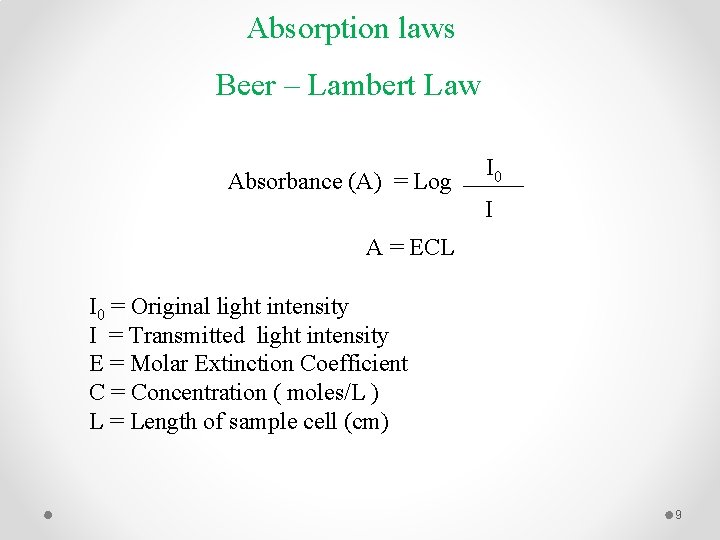
Absorption laws Beer – Lambert Law Absorbance (A) = Log I 0 I A = ECL I 0 = Original light intensity I = Transmitted light intensity E = Molar Extinction Coefficient C = Concentration ( moles/L ) L = Length of sample cell (cm) 9
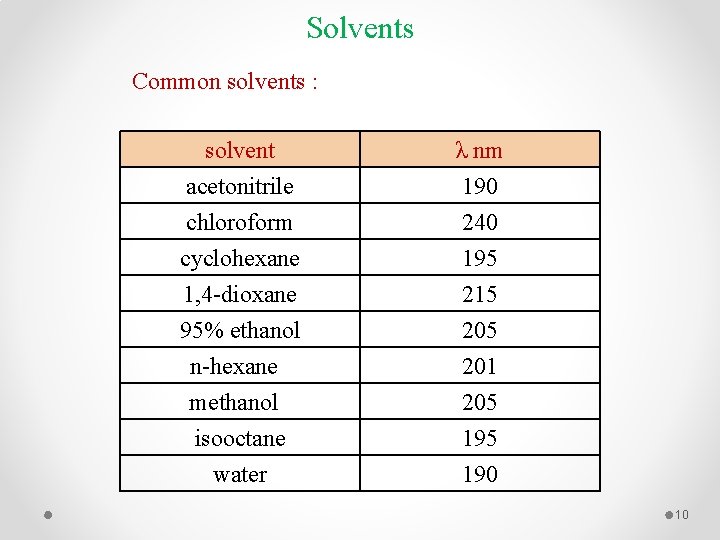
Solvents Common solvents : solvent acetonitrile chloroform cyclohexane λ nm 190 240 195 1, 4 -dioxane 95% ethanol n-hexane methanol isooctane water 215 201 205 190 10
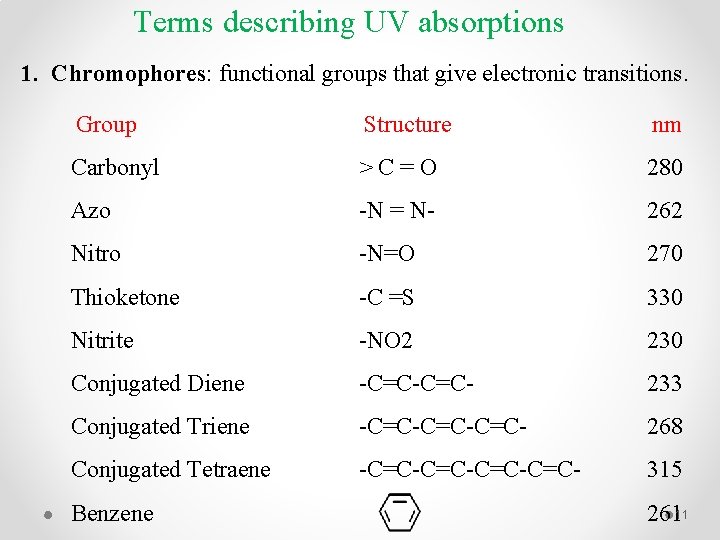
Terms describing UV absorptions 1. Chromophores: functional groups that give electronic transitions. Group Structure nm Carbonyl > C = O 280 Azo -N = N- 262 Nitro -N=O 270 Thioketone -C =S 330 Nitrite -NO 2 230 Conjugated Diene -C=C- 233 Conjugated Triene -C=C-C=C- 268 Conjugated Tetraene -C=C-C=C- 315 Benzene 26111
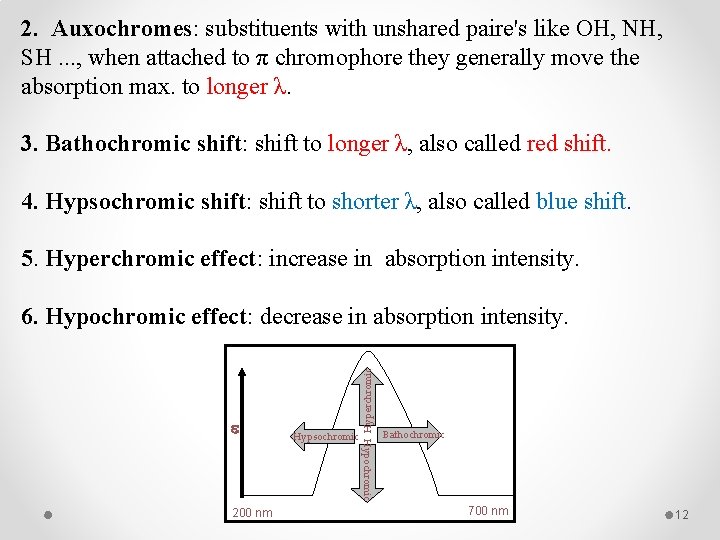
2. Auxochromes: substituents with unshared paire's like OH, NH, SH. . . , when attached to π chromophore they generally move the absorption max. to longer λ. 3. Bathochromic shift: shift to longer λ, also called red shift. 4. Hypsochromic shift: shift to shorter λ, also called blue shift. 5. Hyperchromic effect: increase in absorption intensity. e Hypochromic 200 nm Hypsochromic Hyperchromic 6. Hypochromic effect: decrease in absorption intensity. Bathochromic 700 nm 12
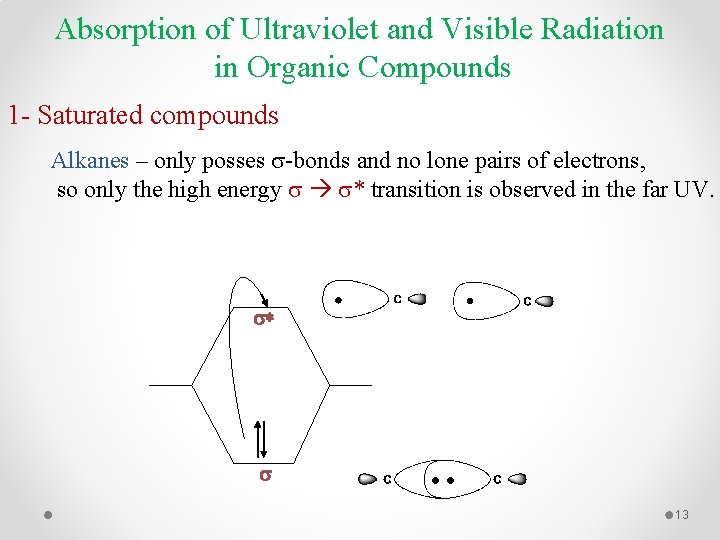
Absorption of Ultraviolet and Visible Radiation in Organic Compounds 1 - Saturated compounds Alkanes – only posses -bonds and no lone pairs of electrons, so only the high energy * transition is observed in the far UV. s* s 13
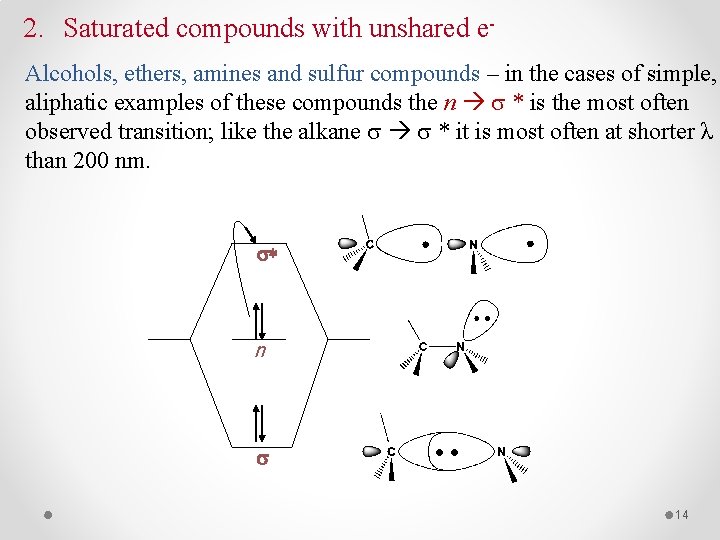
2. Saturated compounds with unshared e- Alcohols, ethers, amines and sulfur compounds – in the cases of simple, aliphatic examples of these compounds the n * is the most often observed transition; like the alkane * it is most often at shorter λ than 200 nm. s* n s 14
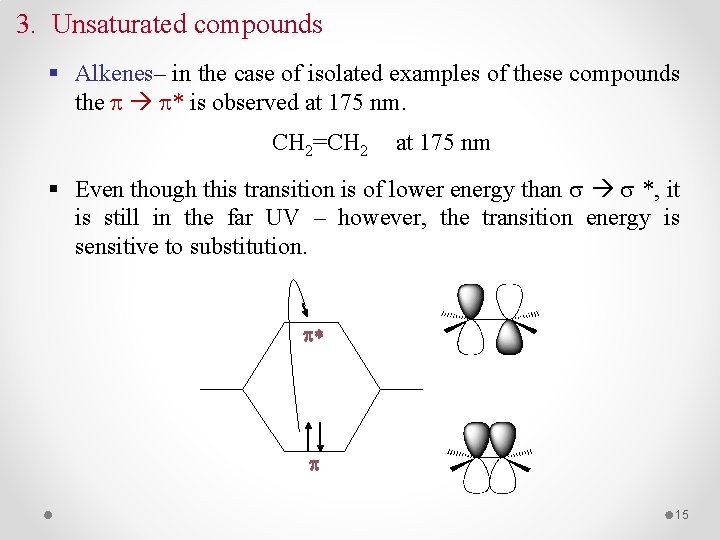
3. Unsaturated compounds § Alkenes– in the case of isolated examples of these compounds the * is observed at 175 nm. CH 2=CH 2 at 175 nm § Even though this transition is of lower energy than *, it is still in the far UV – however, the transition energy is sensitive to substitution. p* p 15
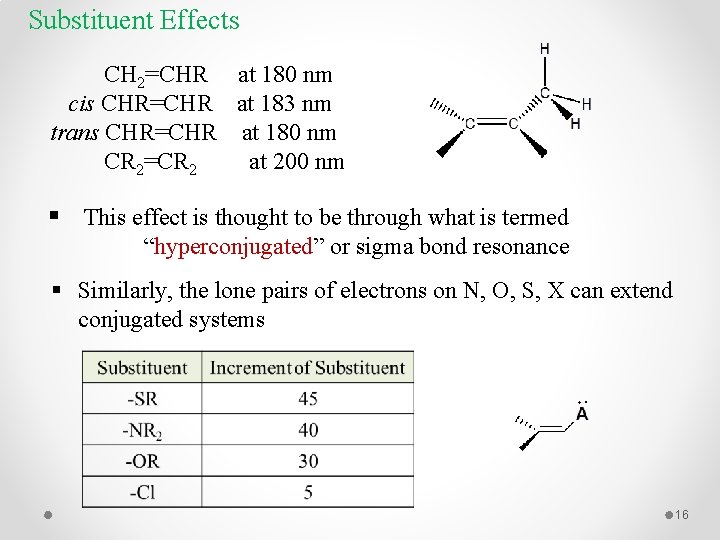
Substituent Effects CH 2=CHR at 180 nm cis CHR=CHR at 183 nm trans CHR=CHR at 180 nm CR 2=CR 2 at 200 nm § This effect is thought to be through what is termed “hyperconjugated” or sigma bond resonance § Similarly, the lone pairs of electrons on N, O, S, X can extend conjugated systems 16
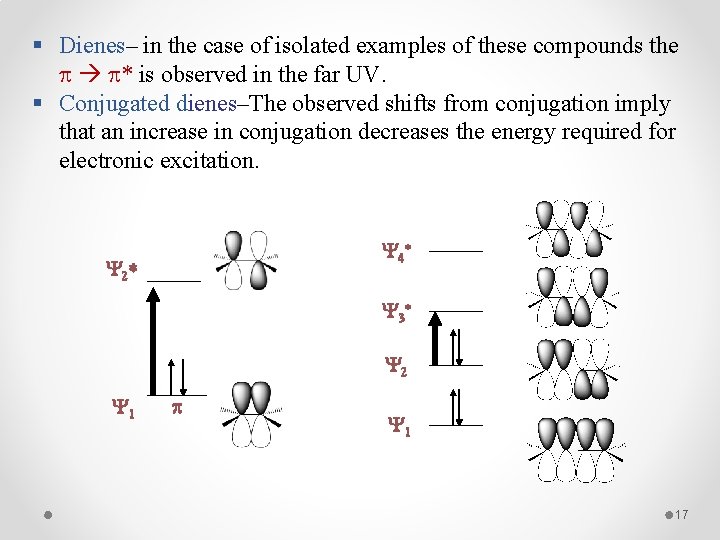
§ Dienes– in the case of isolated examples of these compounds the * is observed in the far UV. § Conjugated dienes–The observed shifts from conjugation imply that an increase in conjugation decreases the energy required for electronic excitation. Y 4 * Y 2 * Y 3 * Y 2 Y 1 p Y 1 17
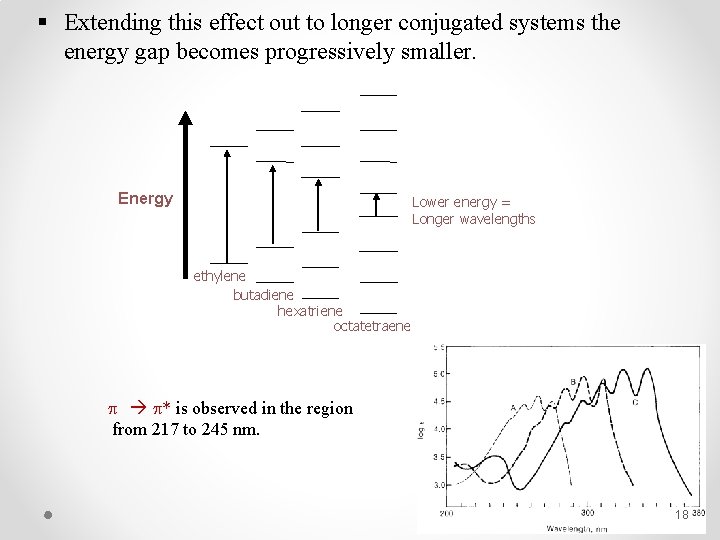
§ Extending this effect out to longer conjugated systems the energy gap becomes progressively smaller. Energy Lower energy = Longer wavelengths ethylene butadiene hexatriene octatetraene * is observed in the region from 217 to 245 nm. 18
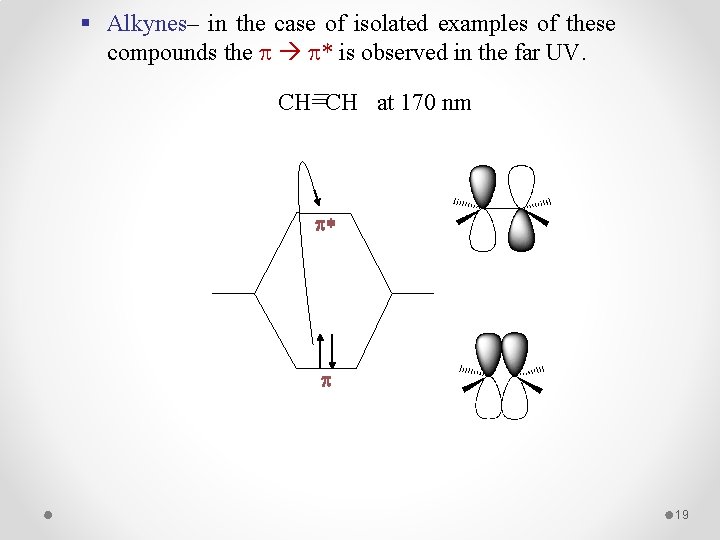
§ Alkynes– in the case of isolated examples of these compounds the * is observed in the far UV. CH=CH at 170 nm p* p 19
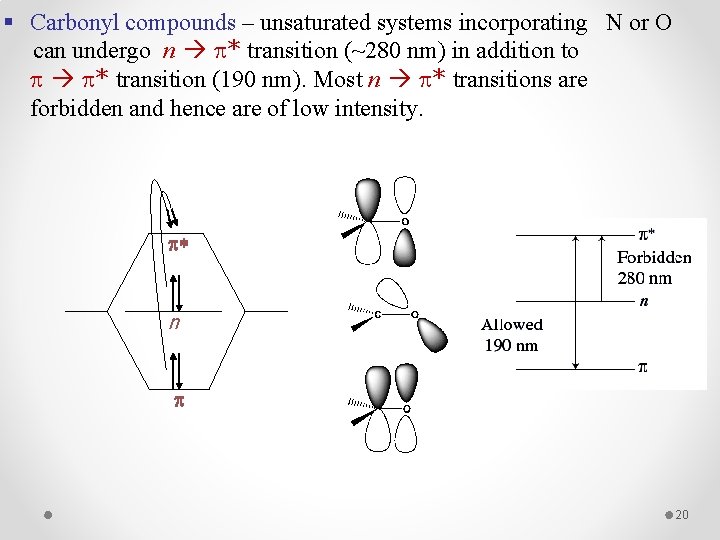
§ Carbonyl compounds – unsaturated systems incorporating N or O can undergo n * transition (~280 nm) in addition to * transition (190 nm). Most n * transitions are forbidden and hence are of low intensity. p* n p 20
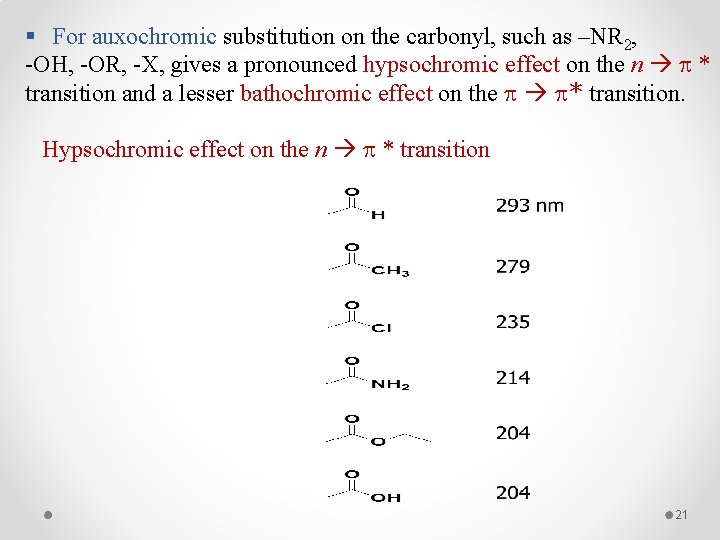
§ For auxochromic substitution on the carbonyl, such as –NR 2, -OH, -OR, -X, gives a pronounced hypsochromic effect on the n * transition and a lesser bathochromic effect on the * transition. Hypsochromic effect on the n * transition 21
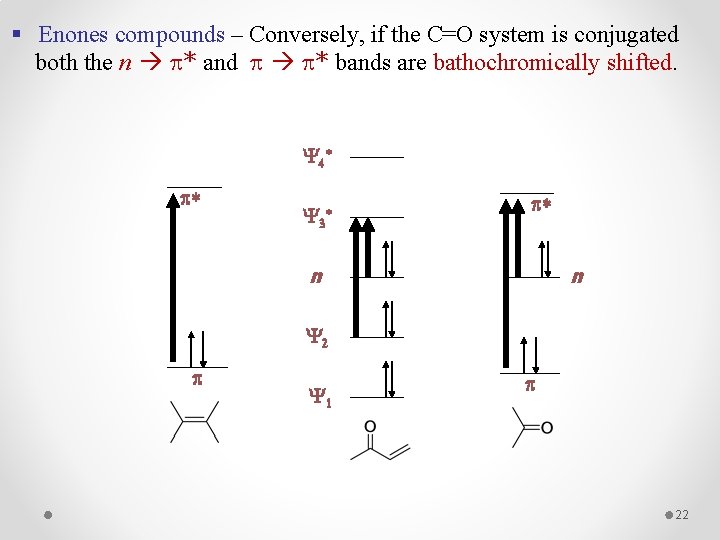
§ Enones compounds – Conversely, if the C=O system is conjugated both the n * and * bands are bathochromically shifted. Y 4 * p* Y 3 * p* n n Y 2 p Y 1 p 22
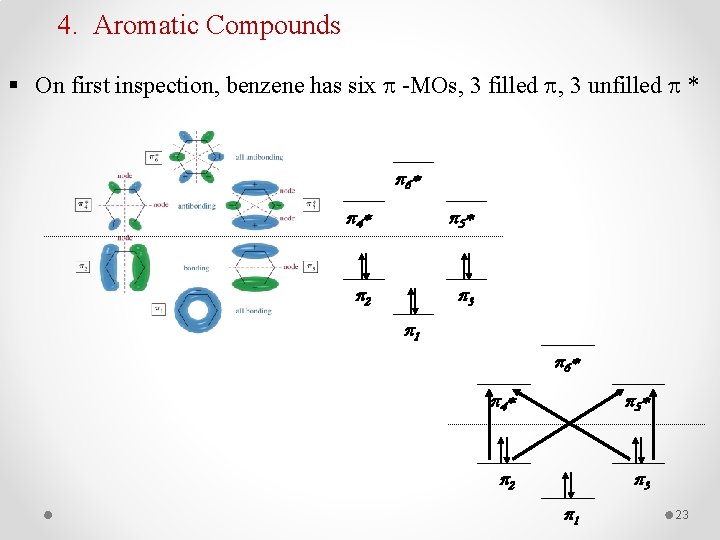
4. Aromatic Compounds § On first inspection, benzene has six -MOs, 3 filled , 3 unfilled * p 6 * p 4 * p 5 * p 2 p 3 p 1 23
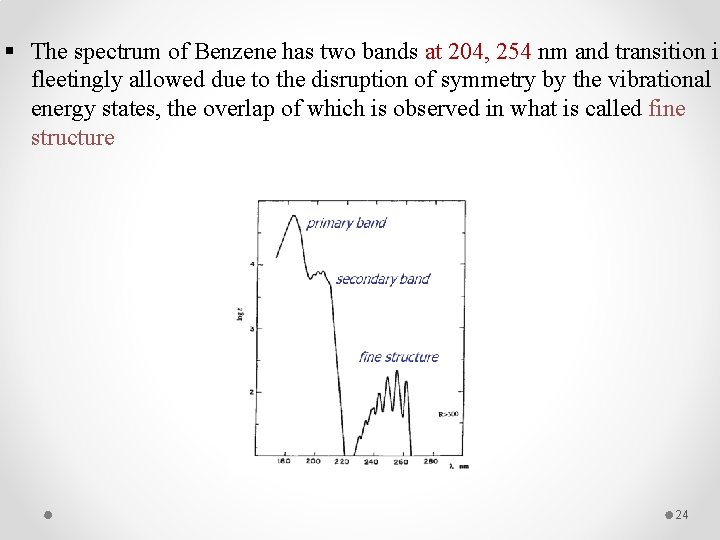
§ The spectrum of Benzene has two bands at 204, 254 nm and transition is fleetingly allowed due to the disruption of symmetry by the vibrational energy states, the overlap of which is observed in what is called fine structure 24
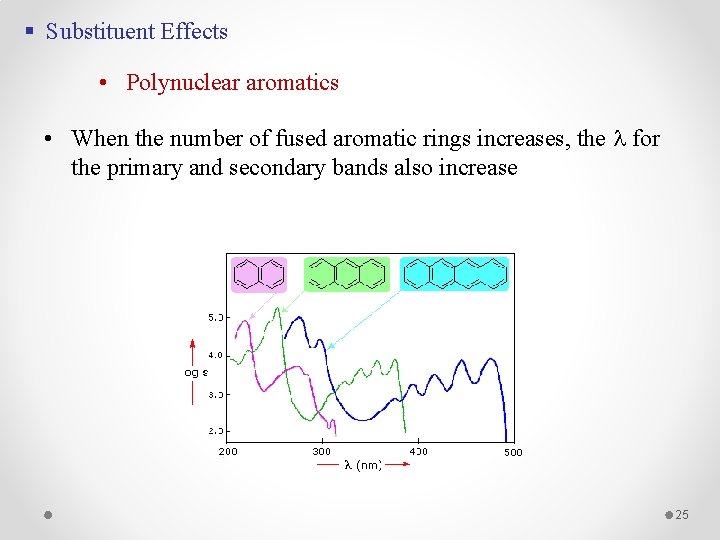
§ Substituent Effects • Polynuclear aromatics • When the number of fused aromatic rings increases, the l for the primary and secondary bands also increase 25
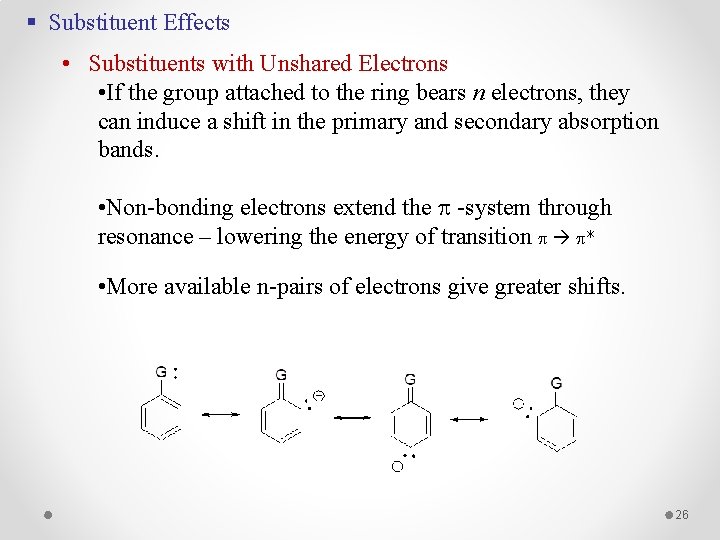
§ Substituent Effects • Substituents with Unshared Electrons • If the group attached to the ring bears n electrons, they can induce a shift in the primary and secondary absorption bands. • Non-bonding electrons extend the -system through resonance – lowering the energy of transition * • More available n-pairs of electrons give greater shifts. 26
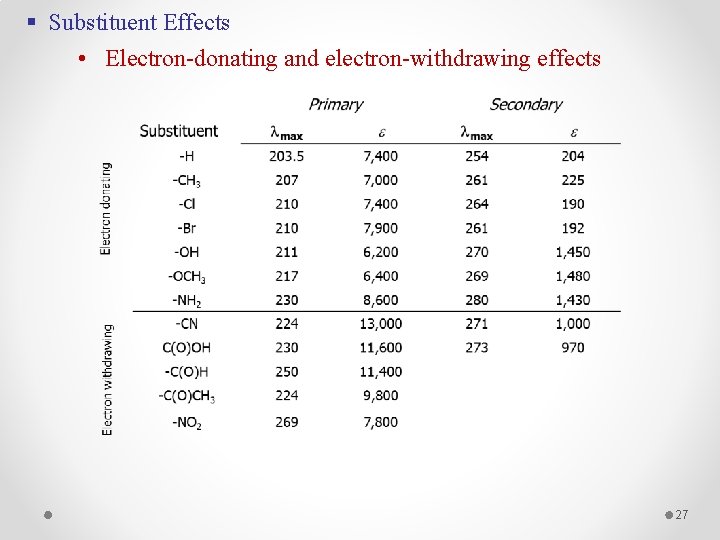
§ Substituent Effects • Electron-donating and electron-withdrawing effects 27
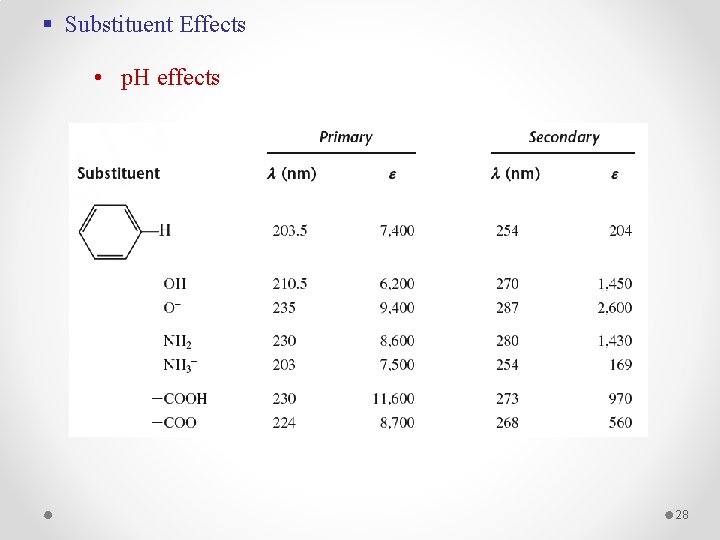
§ Substituent Effects • p. H effects 28
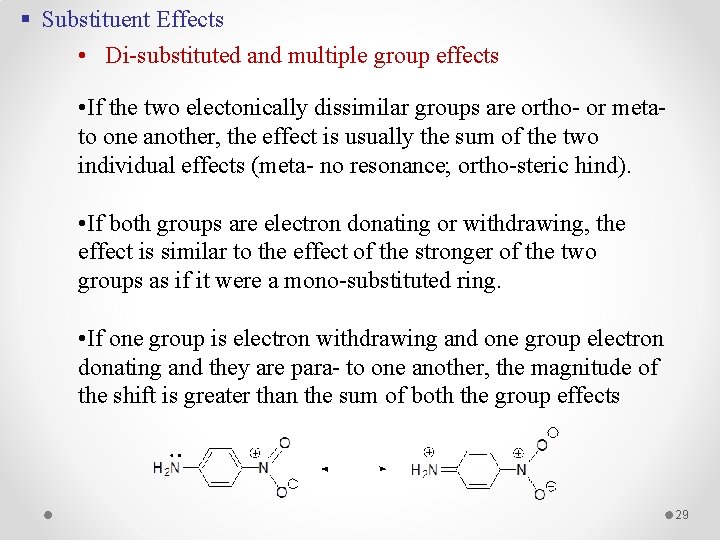
§ Substituent Effects • Di-substituted and multiple group effects • If the two electonically dissimilar groups are ortho- or meta- to one another, the effect is usually the sum of the two individual effects (meta- no resonance; ortho-steric hind). • If both groups are electron donating or withdrawing, the effect is similar to the effect of the stronger of the two groups as if it were a mono-substituted ring. • If one group is electron withdrawing and one group electron donating and they are para- to one another, the magnitude of the shift is greater than the sum of both the group effects 29
- Slides: 29