
4 TH WORKSHOP PROMOTING OPEN SCIENCE Research Data

- Slides: 30
4 TH WORKSHOP: PROMOTING OPEN SCIENCE Research Data Management Funder Policies in the United States and a University's Call to Action – February 28, 2017 – Kyoto University Michael Witt Head, Distributed Data Curation Center Associate Professor of Library Science http: //www. lib. purdue. edu/research/witt E-mail: mwitt@purdue. edu
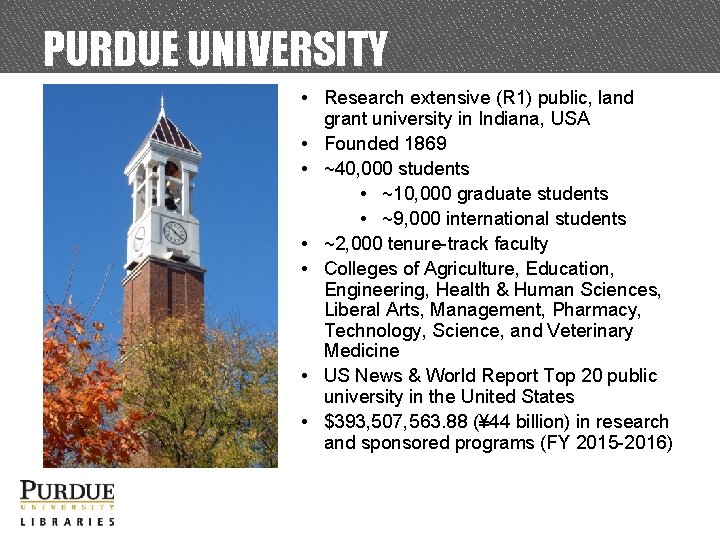
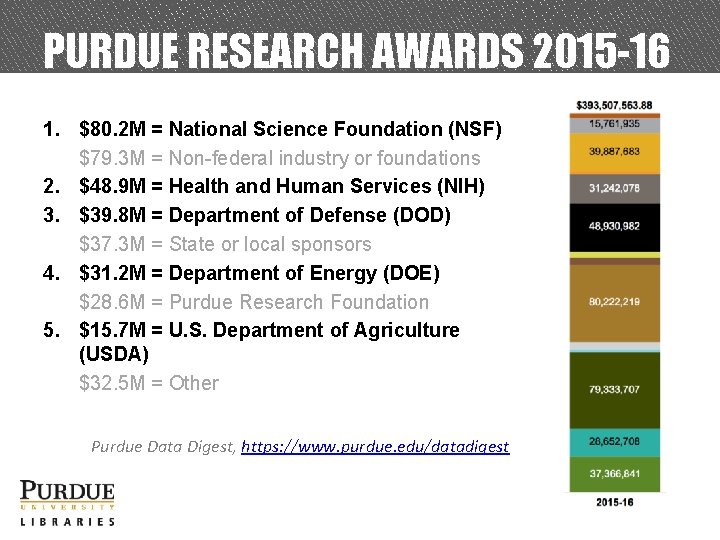
PURDUE UNIVERSITY • Research extensive (R 1) public, land grant university in Indiana, USA • Founded 1869 • ~40, 000 students • ~10, 000 graduate students • ~9, 000 international students • ~2, 000 tenure-track faculty • Colleges of Agriculture, Education, Engineering, Health & Human Sciences, Liberal Arts, Management, Pharmacy, Technology, Science, and Veterinary Medicine • US News & World Report Top 20 public university in the United States • $393, 507, 563. 88 (¥ 44 billion) in research and sponsored programs (FY 2015 -2016)
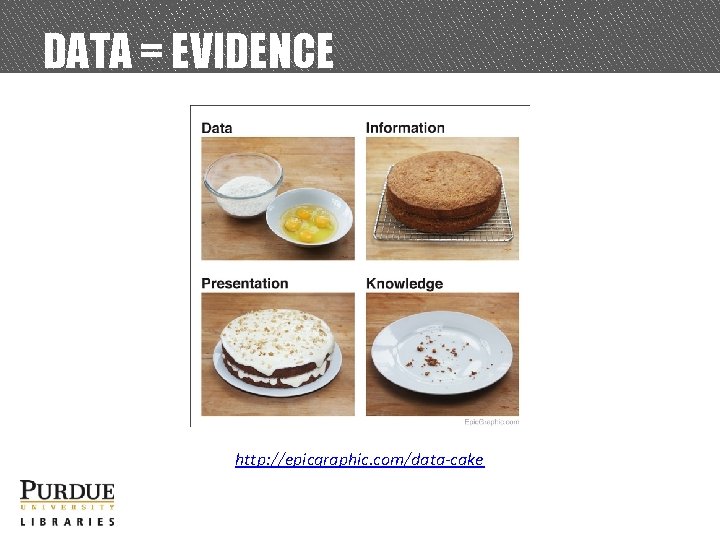
DATA = EVIDENCE http: //epicgraphic. com/data-cake
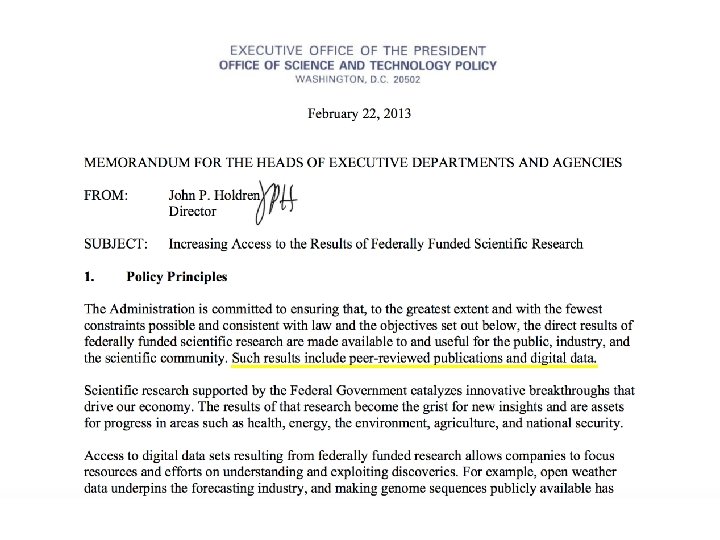
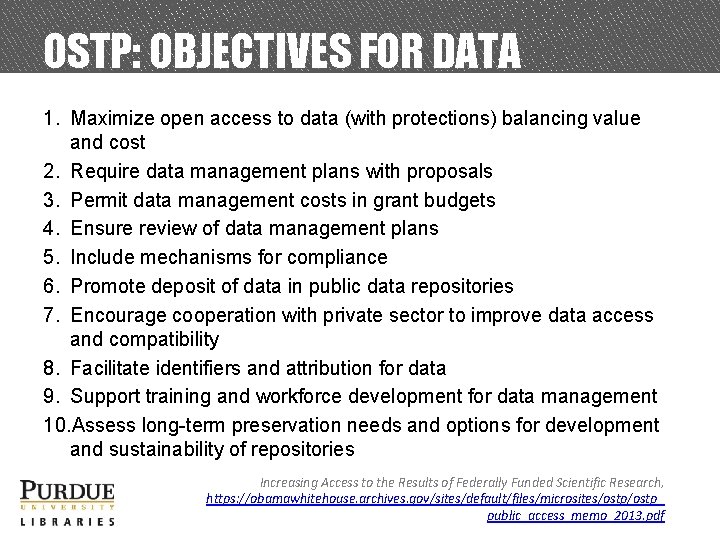
OSTP: OBJECTIVES FOR DATA 1. Maximize open access to data (with protections) balancing value and cost 2. Require data management plans with proposals 3. Permit data management costs in grant budgets 4. Ensure review of data management plans 5. Include mechanisms for compliance 6. Promote deposit of data in public data repositories 7. Encourage cooperation with private sector to improve data access and compatibility 8. Facilitate identifiers and attribution for data 9. Support training and workforce development for data management 10. Assess long-term preservation needs and options for development and sustainability of repositories Increasing Access to the Results of Federally Funded Scientific Research, https: //obamawhitehouse. archives. gov/sites/default/files/microsites/ostp_ public_access_memo_2013. pdf
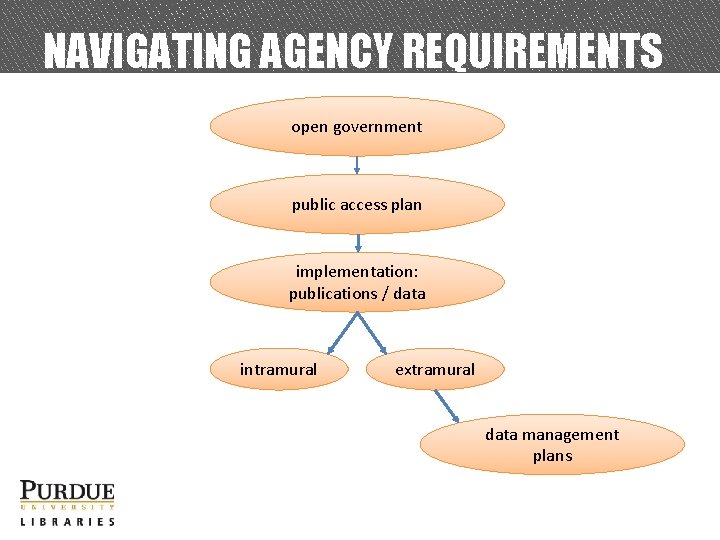
NAVIGATING AGENCY REQUIREMENTS open government public access plan implementation: publications / data intramural extramural data management plans
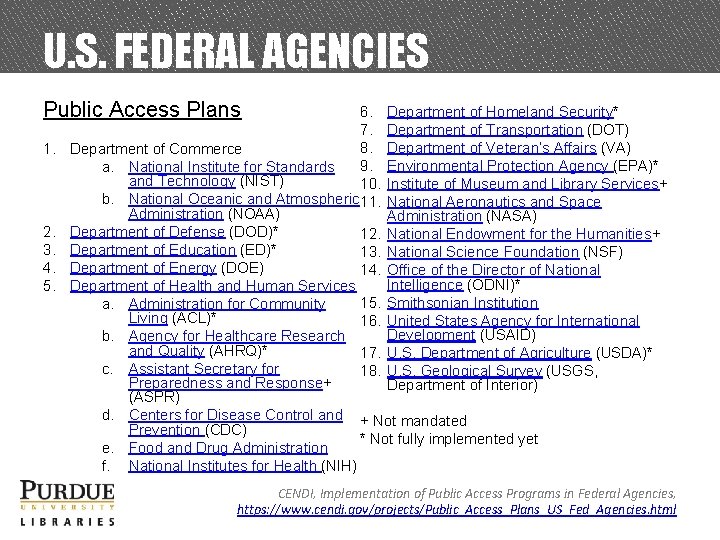
U. S. FEDERAL AGENCIES Public Access Plans 1. 2. 3. 4. 5. 6. Department of Homeland Security* 7. Department of Transportation (DOT) 8. Department of Veteran’s Affairs (VA) Department of Commerce 9. Environmental Protection Agency (EPA)* a. National Institute for Standards and Technology (NIST) 10. Institute of Museum and Library Services+ b. National Oceanic and Atmospheric 11. National Aeronautics and Space Administration (NOAA) Administration (NASA) Department of Defense (DOD)* 12. National Endowment for the Humanities+ Department of Education (ED)* 13. National Science Foundation (NSF) Department of Energy (DOE) 14. Office of the Director of National Intelligence (ODNI)* Department of Health and Human Services 15. Smithsonian Institution a. Administration for Community Living (ACL)* 16. United States Agency for International Development (USAID) b. Agency for Healthcare Research and Quality (AHRQ)* 17. U. S. Department of Agriculture (USDA)* c. Assistant Secretary for 18. U. S. Geological Survey (USGS, Preparedness and Response+ Department of Interior) (ASPR) d. Centers for Disease Control and + Not mandated Prevention (CDC) * Not fully implemented yet e. Food and Drug Administration f. National Institutes for Health (NIH) CENDI, Implementation of Public Access Programs in Federal Agencies, https: //www. cendi. gov/projects/Public_Access_Plans_US_Fed_Agencies. html
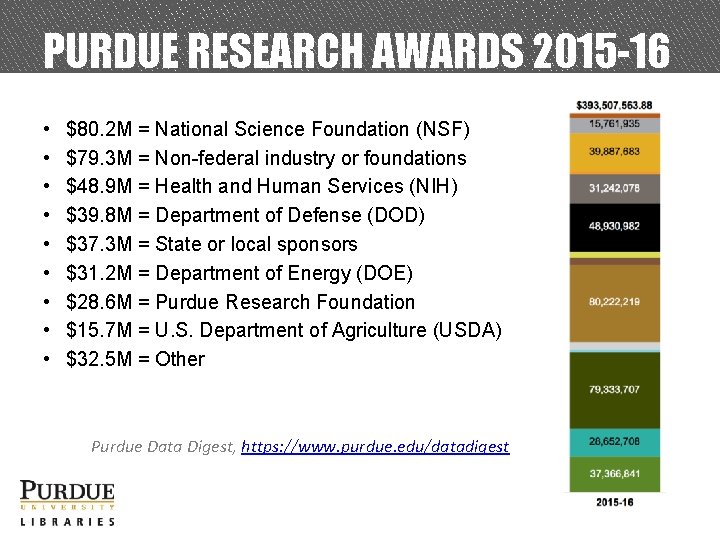
PURDUE RESEARCH AWARDS 2015 -16 • • • $80. 2 M = National Science Foundation (NSF) $79. 3 M = Non-federal industry or foundations $48. 9 M = Health and Human Services (NIH) $39. 8 M = Department of Defense (DOD) $37. 3 M = State or local sponsors $31. 2 M = Department of Energy (DOE) $28. 6 M = Purdue Research Foundation $15. 7 M = U. S. Department of Agriculture (USDA) $32. 5 M = Other Purdue Data Digest, https: //www. purdue. edu/datadigest
PURDUE RESEARCH AWARDS 2015 -16 1. $80. 2 M = National Science Foundation (NSF) $79. 3 M = Non-federal industry or foundations 2. $48. 9 M = Health and Human Services (NIH) 3. $39. 8 M = Department of Defense (DOD) $37. 3 M = State or local sponsors 4. $31. 2 M = Department of Energy (DOE) $28. 6 M = Purdue Research Foundation 5. $15. 7 M = U. S. Department of Agriculture (USDA) $32. 5 M = Other Purdue Data Digest, https: //www. purdue. edu/datadigest
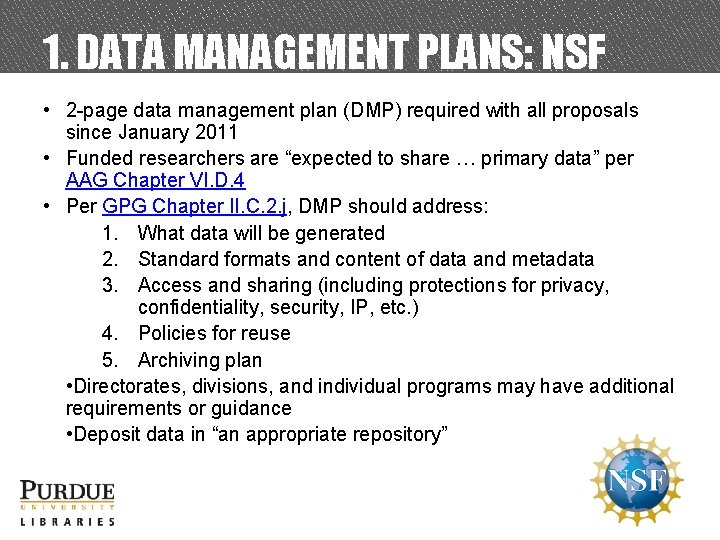
1. DATA MANAGEMENT PLANS: NSF • 2 -page data management plan (DMP) required with all proposals since January 2011 • Funded researchers are “expected to share … primary data” per AAG Chapter VI. D. 4 • Per GPG Chapter II. C. 2. j, DMP should address: 1. What data will be generated 2. Standard formats and content of data and metadata 3. Access and sharing (including protections for privacy, confidentiality, security, IP, etc. ) 4. Policies for reuse 5. Archiving plan • Directorates, divisions, and individual programs may have additional requirements or guidance • Deposit data in “an appropriate repository”
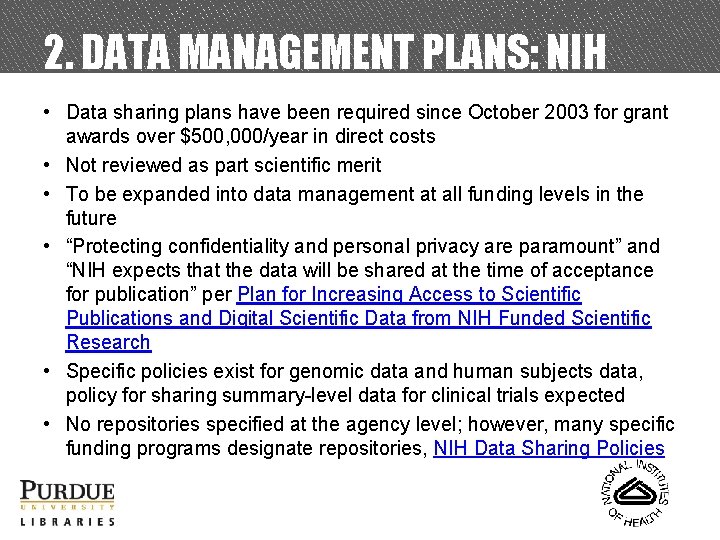
2. DATA MANAGEMENT PLANS: NIH • Data sharing plans have been required since October 2003 for grant awards over $500, 000/year in direct costs • Not reviewed as part scientific merit • To be expanded into data management at all funding levels in the future • “Protecting confidentiality and personal privacy are paramount” and “NIH expects that the data will be shared at the time of acceptance for publication” per Plan for Increasing Access to Scientific Publications and Digital Scientific Data from NIH Funded Scientific Research • Specific policies exist for genomic data and human subjects data, policy for sharing summary-level data for clinical trials expected • No repositories specified at the agency level; however, many specific funding programs designate repositories, NIH Data Sharing Policies
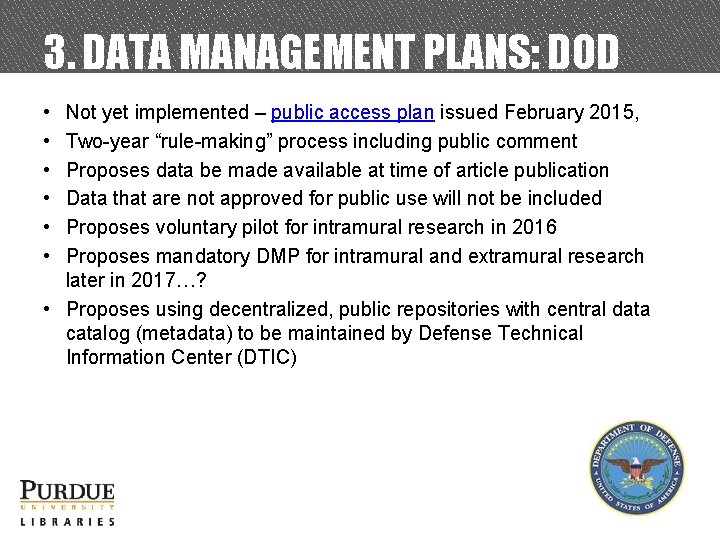
3. DATA MANAGEMENT PLANS: DOD • • • Not yet implemented – public access plan issued February 2015, Two-year “rule-making” process including public comment Proposes data be made available at time of article publication Data that are not approved for public use will not be included Proposes voluntary pilot for intramural research in 2016 Proposes mandatory DMP for intramural and extramural research later in 2017…? • Proposes using decentralized, public repositories with central data catalog (metadata) to be maintained by Defense Technical Information Center (DTIC)
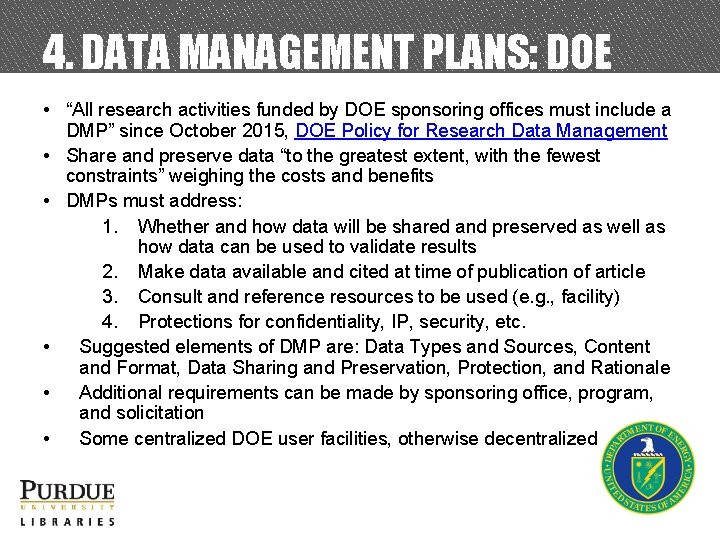
4. DATA MANAGEMENT PLANS: DOE • “All research activities funded by DOE sponsoring offices must include a DMP” since October 2015, DOE Policy for Research Data Management • Share and preserve data “to the greatest extent, with the fewest constraints” weighing the costs and benefits • DMPs must address: 1. Whether and how data will be shared and preserved as well as how data can be used to validate results 2. Make data available and cited at time of publication of article 3. Consult and reference resources to be used (e. g. , facility) 4. Protections for confidentiality, IP, security, etc. • Suggested elements of DMP are: Data Types and Sources, Content and Format, Data Sharing and Preservation, Protection, and Rationale • Additional requirements can be made by sponsoring office, program, and solicitation • Some centralized DOE user facilities, otherwise decentralized
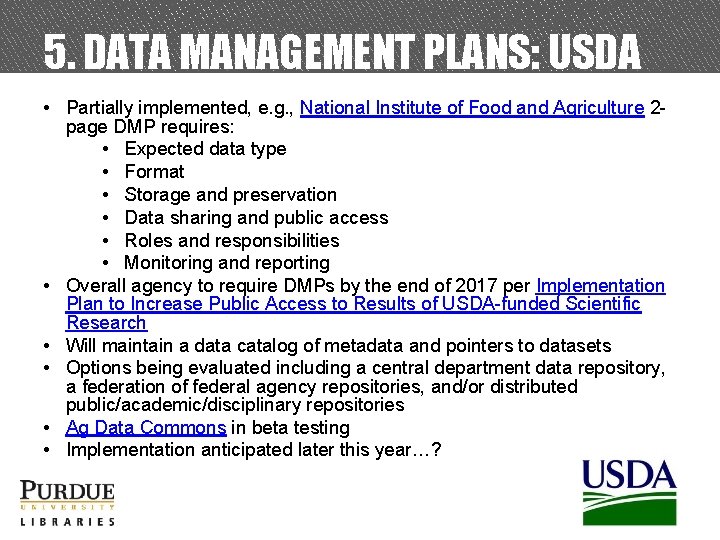
5. DATA MANAGEMENT PLANS: USDA • Partially implemented, e. g. , National Institute of Food and Agriculture 2 page DMP requires: • Expected data type • Format • Storage and preservation • Data sharing and public access • Roles and responsibilities • Monitoring and reporting • Overall agency to require DMPs by the end of 2017 per Implementation Plan to Increase Public Access to Results of USDA-funded Scientific Research • Will maintain a data catalog of metadata and pointers to datasets • Options being evaluated including a central department data repository, a federation of federal agency repositories, and/or distributed public/academic/disciplinary repositories • Ag Data Commons in beta testing • Implementation anticipated later this year…?
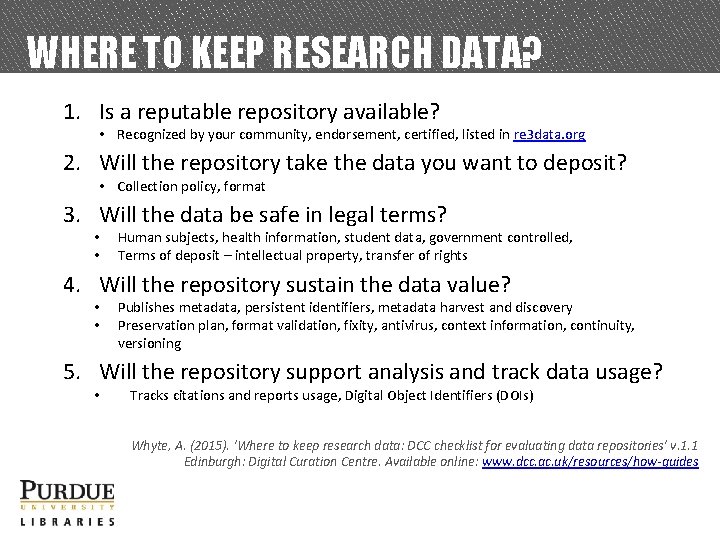
WHERE TO KEEP RESEARCH DATA? 1. Is a reputable repository available? • Recognized by your community, endorsement, certified, listed in re 3 data. org 2. Will the repository take the data you want to deposit? • Collection policy, format 3. Will the data be safe in legal terms? • • Human subjects, health information, student data, government controlled, Terms of deposit – intellectual property, transfer of rights 4. Will the repository sustain the data value? • • Publishes metadata, persistent identifiers, metadata harvest and discovery Preservation plan, format validation, fixity, antivirus, context information, continuity, versioning 5. Will the repository support analysis and track data usage? • Tracks citations and reports usage, Digital Object Identifiers (DOIs) Whyte, A. (2015). ‘Where to keep research data: DCC checklist for evaluating data repositories’ v. 1. 1 Edinburgh: Digital Curation Centre. Available online: www. dcc. ac. uk/resources/how-guides
CAMPUS COLLABORATION Purdue University Research Repository (PURR) The PURR service is a collaborative effort of the Purdue University Libraries, Executive Vice President for Research and Partnerships, and Information Technology at Purdue. PURR is a designated university core research facility. Designated community: Purdue University faculty, staff, and graduate student researchers; their collaborators; and the current and future consumers of their research data. Based on the HUBzero Platform for Scientific Collaboration software
http: //purr. purdue. edu
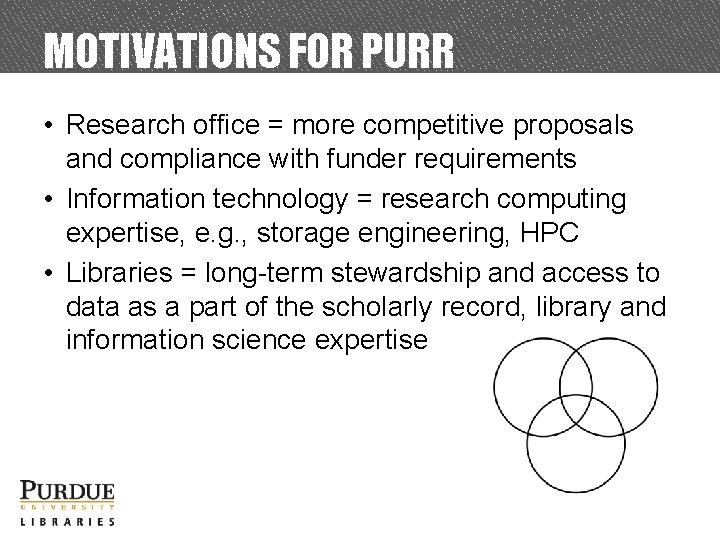
MOTIVATIONS FOR PURR • Research office = more competitive proposals and compliance with funder requirements • Information technology = research computing expertise, e. g. , storage engineering, HPC • Libraries = long-term stewardship and access to data as a part of the scholarly record, library and information science expertise
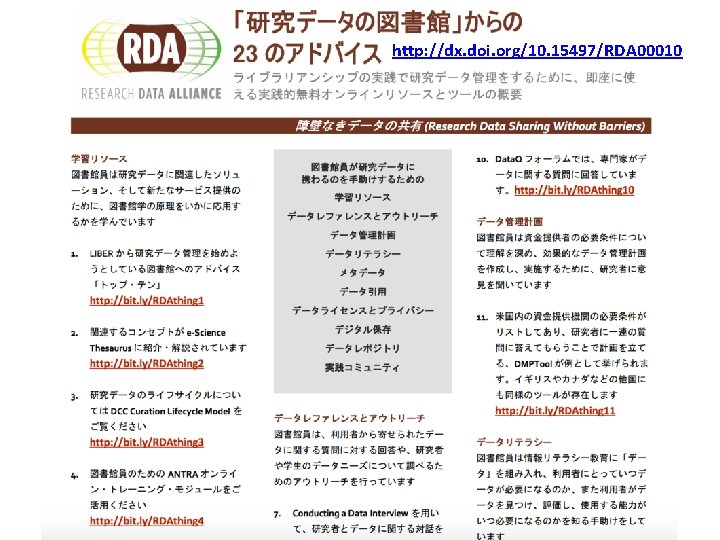
http: //dx. doi. org/10. 15497/RDA 00010
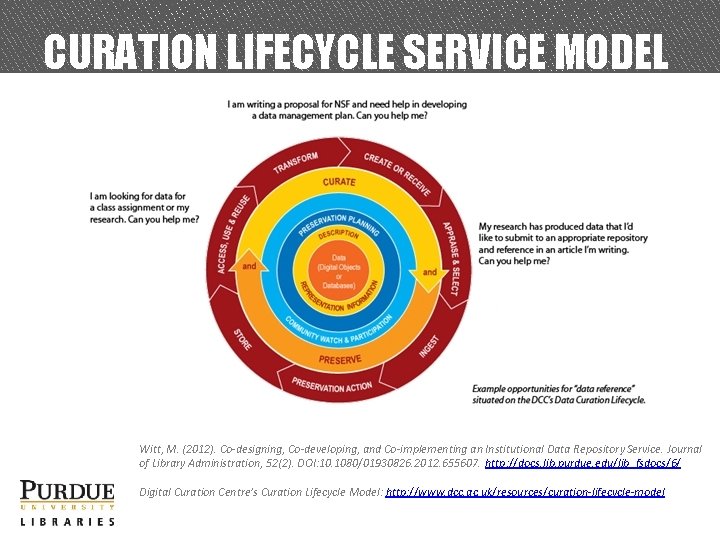
CURATION LIFECYCLE SERVICE MODEL Witt, M. (2012). Co-designing, Co-developing, and Co-implementing an Institutional Data Repository Service. Journal of Library Administration, 52(2). DOI: 10. 1080/01930826. 2012. 655607. http: //docs. lib. purdue. edu/lib_fsdocs/6/ Digital Curation Centre’s Curation Lifecycle Model: http: //www. dcc. ac. uk/resources/curation-lifecycle-model
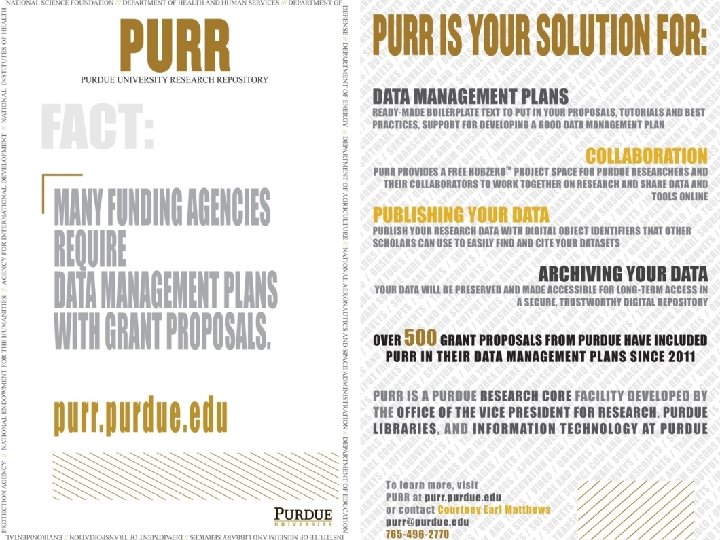
PURR POSTCARD AND POSTER 21 21
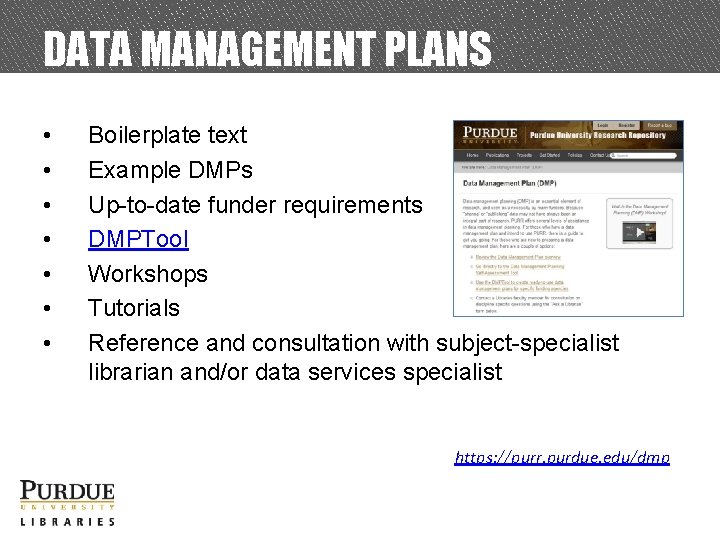
DATA MANAGEMENT PLANS • • Boilerplate text Example DMPs Up-to-date funder requirements DMPTool Workshops Tutorials Reference and consultation with subject-specialist librarian and/or data services specialist https: //purr. purdue. edu/dmp
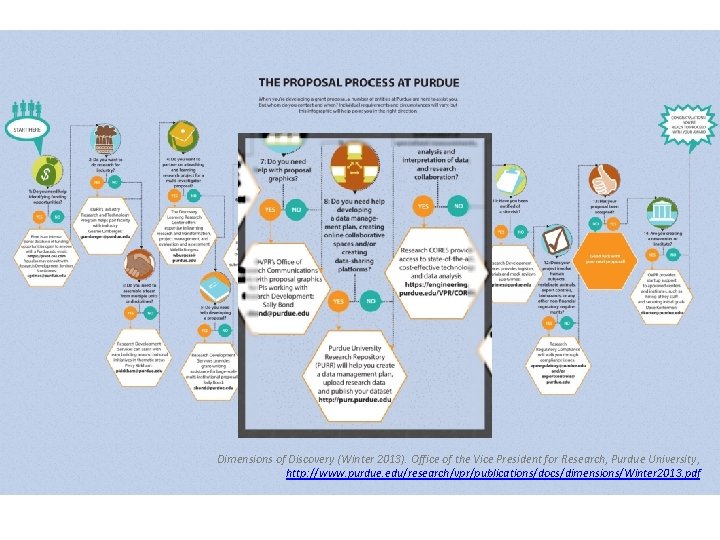
Dimensions of Discovery (Winter 2013). Office of the Vice President for Research, Purdue University, http: //www. purdue. edu/research/vpr/publications/docs/dimensions/Winter 2013. pdf
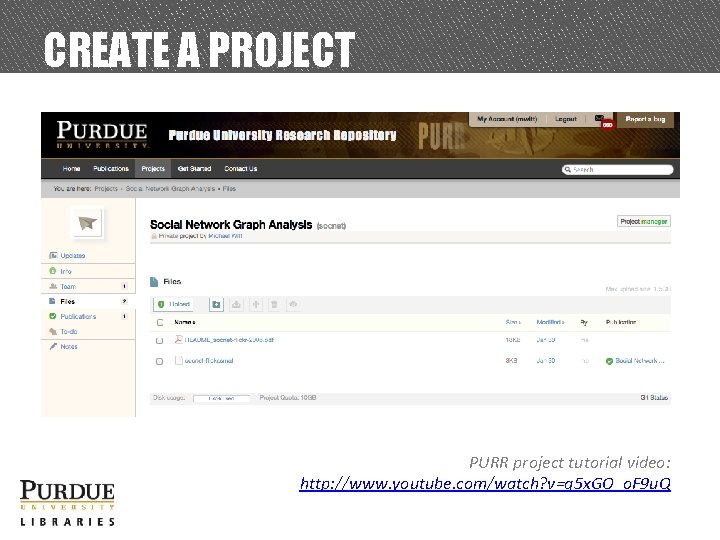
CREATE A PROJECT PURR project tutorial video: http: //www. youtube. com/watch? v=q 5 x. GO_o. F 9 u. Q
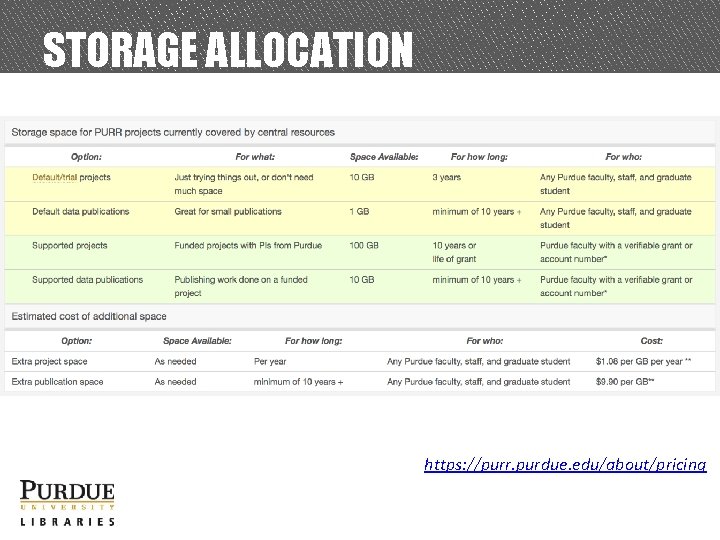
USE PROJECT TO COLLABORATE Create: • any Purdue faculty, staff, or graduate student researcher can create private projects • describe the project • disclaim use of sensitive or restricted data • receive a default allocation of storage • register a grant award to increase allocation • invite collaborators from other institutions to join project Collaborate: • git repository to share and version files (sftp & Google Drive integration) • virtual machine/s • wiki • blog • to-do list management and project notes • newsfeed • stage data publications
STORAGE ALLOCATION https: //purr. purdue. edu/about/pricing
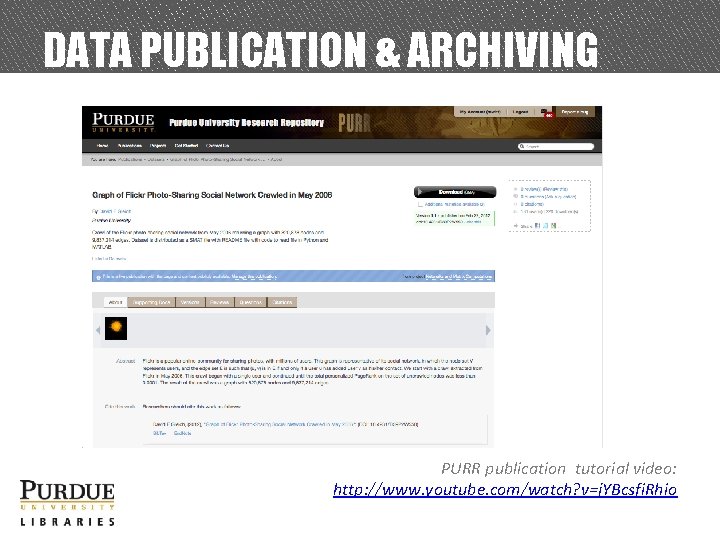
DATA PUBLICATION & ARCHIVING PURR publication tutorial video: http: //www. youtube. com/watch? v=j. YBcsfi. Rhio
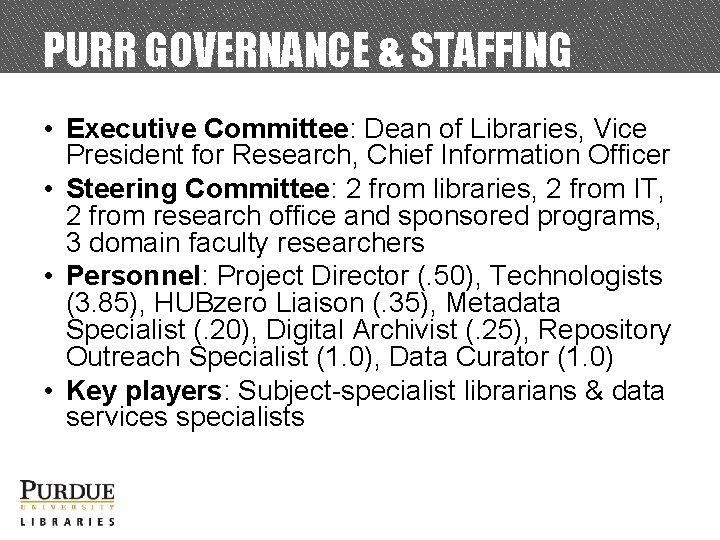
PURR GOVERNANCE & STAFFING • Executive Committee: Dean of Libraries, Vice President for Research, Chief Information Officer • Steering Committee: 2 from libraries, 2 from IT, 2 from research office and sponsored programs, 3 domain faculty researchers • Personnel: Project Director (. 50), Technologists (3. 85), HUBzero Liaison (. 35), Metadata Specialist (. 20), Digital Archivist (. 25), Repository Outreach Specialist (1. 0), Data Curator (1. 0) • Key players: Subject-specialist librarians & data services specialists
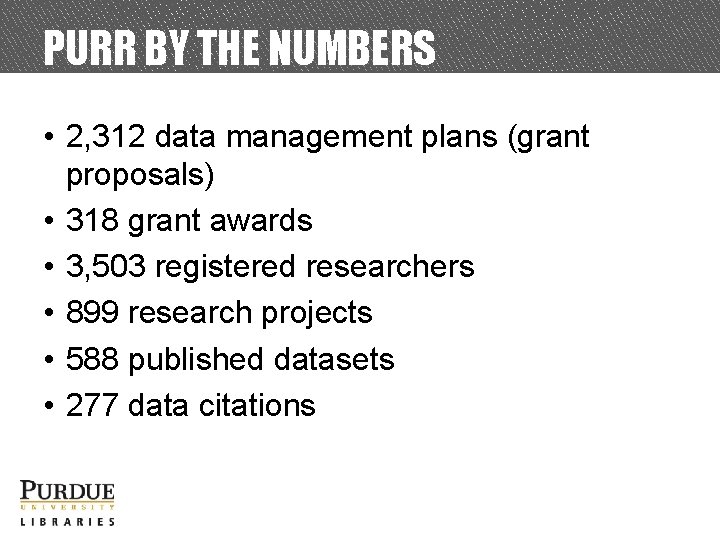
PURR BY THE NUMBERS • 2, 312 data management plans (grant proposals) • 318 grant awards • 3, 503 registered researchers • 899 research projects • 588 published datasets • 277 data citations
ありがとうございます Michael Witt Head, Distributed Data Curation Center Associate Professor of Library Science http: //www. lib. purdue. edu/research/witt E-mail: mwitt@purdue. edu