
4 th Edition Power Point Presentations developed by
4 th Edition Power. Point® Presentations developed by Darrell Bailey Indiana University School of Informatics Indianapolis Chapter 9 Renaissance Music Copyright © 2010 by Schirmer Cengage Learning
The Renaissance Outlook § § § Rebirth of interest in ancient civilizations Humanism Many great works of art Gutenberg’s invention of movable type Age of exploration The “Renaissance man” – Leonardo da Vinci
The Renaissance Mass § § § Ordinary set to music Based on phrase of Gregorian chant Addition of bass voice part Points of imitation Josquin: Kyrie from Pange lingua Mass © Schirmer, Cengage Learning Copyright © 2010 by Schirmer Cengage Learning
The Renaissance Motet § § Sacred polyphonic work for voices All parts sing same text Sung in Latin Sung by small groups of men and boys
The Renaissance Motet § § New lines of text introduced in imitation No strong feeling of chord progressions Limited feeling of meter Sung without accompaniment (a cappella)
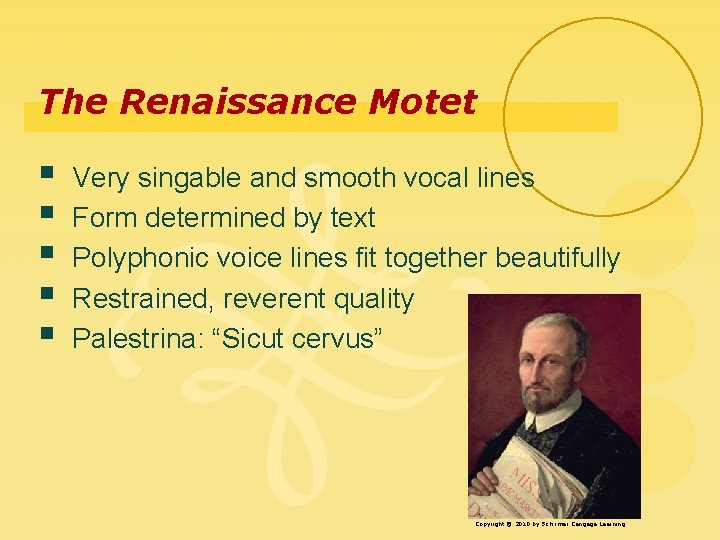
The Renaissance Motet § § § Very singable and smooth vocal lines Form determined by text Polyphonic voice lines fit together beautifully Restrained, reverent quality Palestrina: “Sicut cervus” Copyright © 2010 by Schirmer Cengage Learning
The Madrigal § § Secular work, often polyphonic, for small vocal group Differs from a motet Vernacular languages ► Texts often deal with love ► Tend to be more rhythmic ► Sung at social gatherings ►
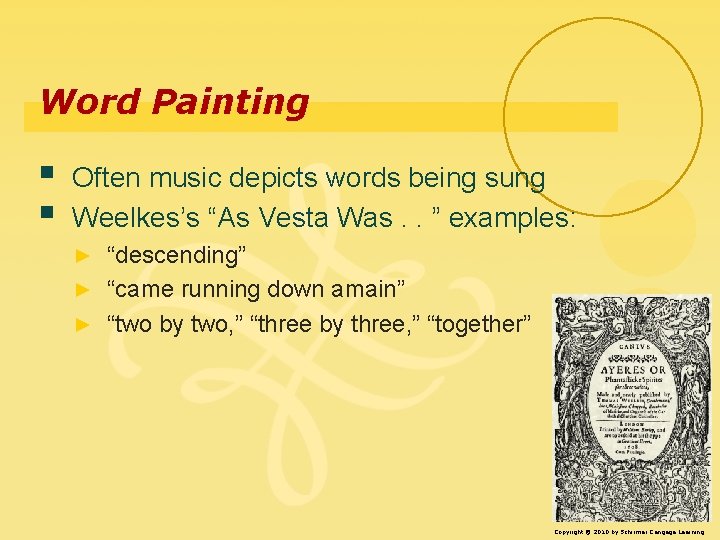
Word Painting § § Often music depicts words being sung Weelkes’s “As Vesta Was. . ” examples: “descending” ► “came running down amain” ► “two by two, ” “three by three, ” “together” ► Copyright © 2010 by Schirmer Cengage Learning
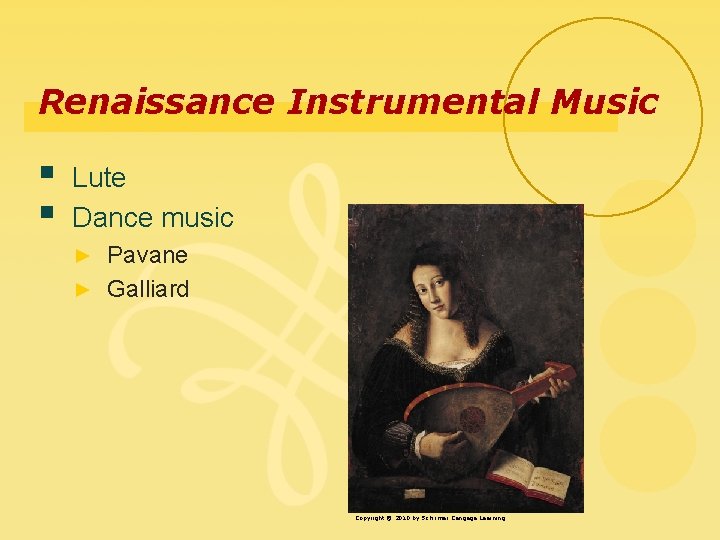
Renaissance Instrumental Music § § Lute Dance music Pavane ► Galliard ► Copyright © 2010 by Schirmer Cengage Learning
Summary § § The Renaissance outlook The Renaissance Mass ► The Renaissance motet ► Palestrina: “Sicut cervus” The Madrigal ► § Josquin: Kyrie Weelkes: “As Vesta Was from Latmos Hill Descending” Renaissance instrumental music
- Slides: 10