
4 Skin and Body Membranes Power Point Lecture
4 Skin and Body Membranes Power. Point® Lecture Slide Presentation by Jerry L. Cook, Sam Houston University ESSENTIALS OF HUMAN ANATOMY & PHYSIOLOGY EIGHTH EDITION ELAINE N. MARIEB Copyright © 2006 Pearson Education, Inc. , publishing as Benjamin Cummings
Skin and Body Membranes § Function of body membranes § Line or cover body surfaces § __________ body surfaces Copyright © 2006 Pearson Education, Inc. , publishing as Benjamin Cummings
Classification of Body Membranes § Epithelial membranes § __________ membrane § Connective tissue membranes Copyright © 2006 Pearson Education, Inc. , publishing as Benjamin Cummings
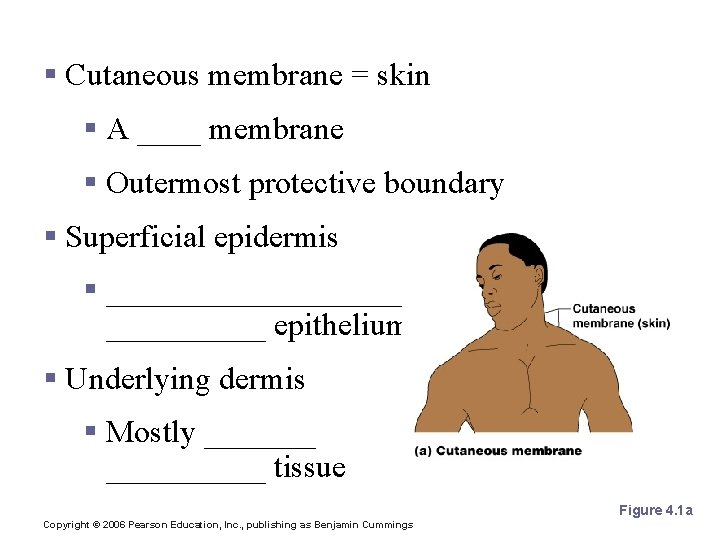
Cutaneous Membrane § Cutaneous membrane = skin § A ____ membrane § Outermost protective boundary § Superficial epidermis § ___________ epithelium § Underlying dermis § Mostly __________ tissue Figure 4. 1 a Copyright © 2006 Pearson Education, Inc. , publishing as Benjamin Cummings
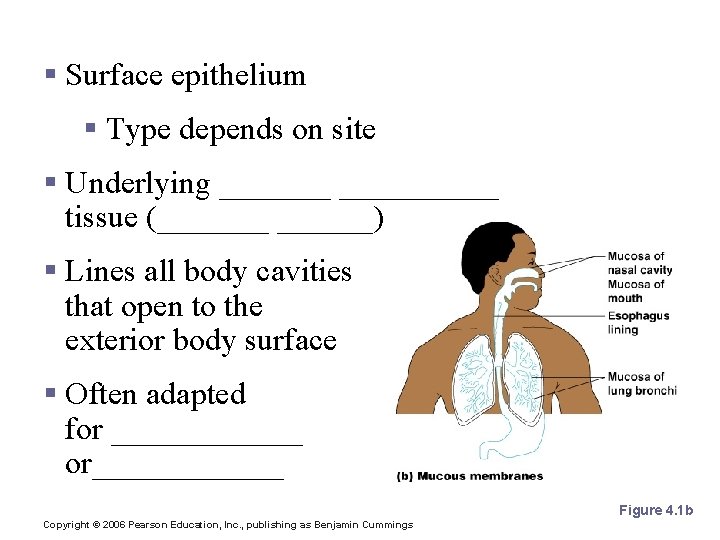
Mucous Membranes § Surface epithelium § Type depends on site § Underlying __________ tissue (_______) § Lines all body cavities that open to the exterior body surface § Often adapted for ______ or______ Figure 4. 1 b Copyright © 2006 Pearson Education, Inc. , publishing as Benjamin Cummings
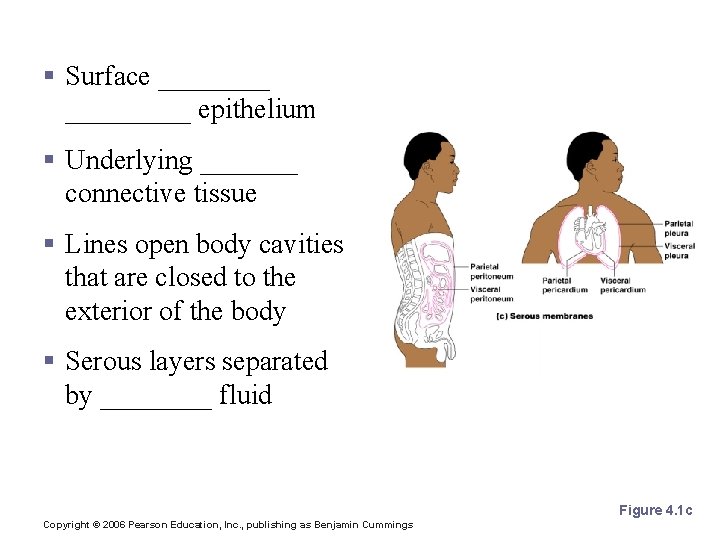
Serous Membranes § Surface _________ epithelium § Underlying _______ connective tissue § Lines open body cavities that are closed to the exterior of the body § Serous layers separated by ____ fluid Figure 4. 1 c Copyright © 2006 Pearson Education, Inc. , publishing as Benjamin Cummings
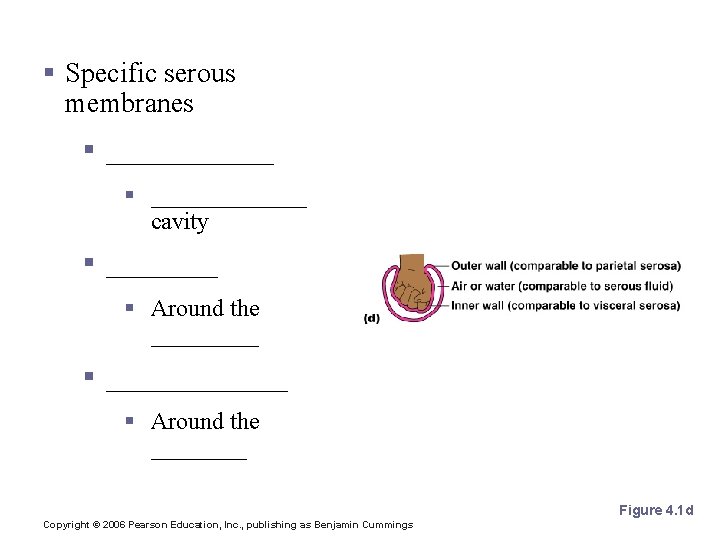
Serous Membranes § Specific serous membranes § _____________ cavity § ____ § Around the _____ § _______ § Around the ____ Figure 4. 1 d Copyright © 2006 Pearson Education, Inc. , publishing as Benjamin Cummings
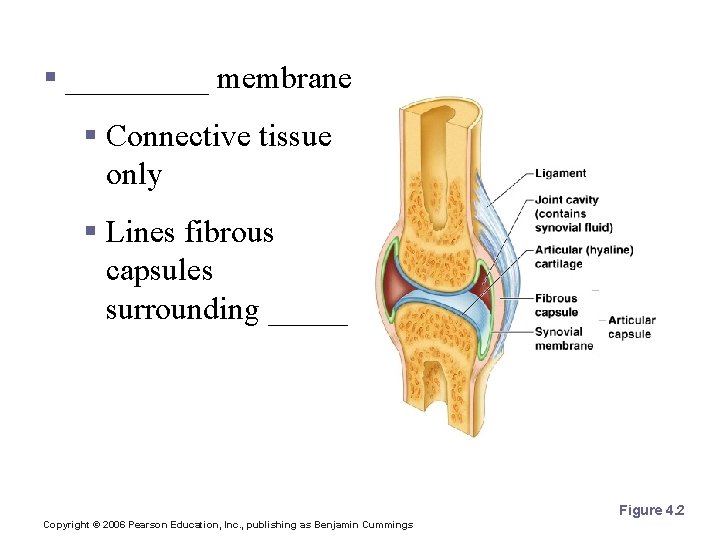
Connective Tissue Membrane § _____ membrane § Connective tissue only § Lines fibrous capsules surrounding _____ Figure 4. 2 Copyright © 2006 Pearson Education, Inc. , publishing as Benjamin Cummings
Integumentary System § Skin (______ membrane) § Skin derivatives § ____ glands § _______ Copyright © 2006 Pearson Education, Inc. , publishing as Benjamin Cummings
Skin Functions § Protects deeper tissues from: § ___________ damage § ______ § _______ Copyright © 2006 Pearson Education, Inc. , publishing as Benjamin Cummings
Skin Functions § Aids in heat regulation § Aids in excretion of ____ and ____ acid § Synthesizes _____ ___ Copyright © 2006 Pearson Education, Inc. , publishing as Benjamin Cummings
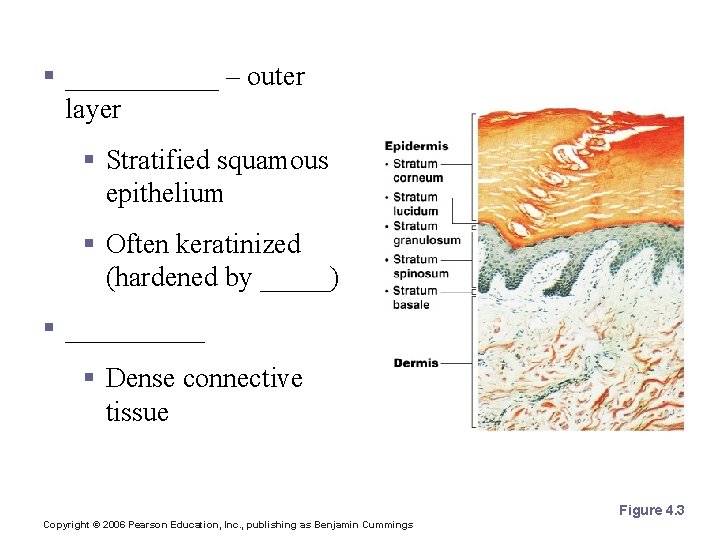
Skin Structure § ______ – outer layer § Stratified squamous epithelium § Often keratinized (hardened by _____) § _____ § Dense connective tissue Figure 4. 3 Copyright © 2006 Pearson Education, Inc. , publishing as Benjamin Cummings
Skin Structure § Deep to dermis is the ______ § Not part of the skin § Anchors skin to underlying organs § Composed mostly of _____ tissue Copyright © 2006 Pearson Education, Inc. , publishing as Benjamin Cummings
Layer of Epidermis § _______ § Cells undergoing ____ § Lies next to dermis § __________ Copyright © 2006 Pearson Education, Inc. , publishing as Benjamin Cummings
Layer of Epidermis § ______ § Occurs only in _______ § Located- _____________ § _____ § Shingle-like _______ Copyright © 2006 Pearson Education, Inc. , publishing as Benjamin Cummings
Melanin § Pigment (melanin) produced by ______ § Color is _______ to ______ § Melanocytes are mostly in the stratum ______ § Amount of melanin produced depends upon ______ and ________ Copyright © 2006 Pearson Education, Inc. , publishing as Benjamin Cummings
Dermis § Two layers § _____ layer § Projections called _____ § _____________ § Capillary loops § _____ layer § Blood vessels § __________ Copyright © 2006 Pearson Education, Inc. , publishing as Benjamin Cummings
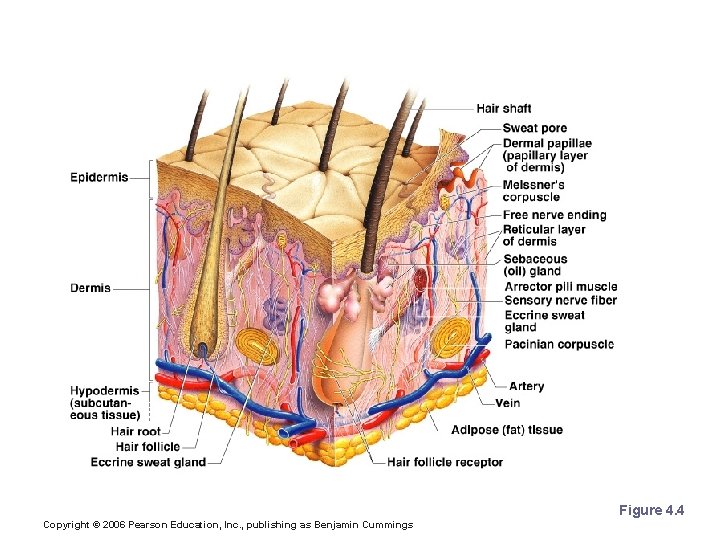
Skin Structure Figure 4. 4 Copyright © 2006 Pearson Education, Inc. , publishing as Benjamin Cummings
Normal Skin Color Determinants § ______ § Yellow, brown or black pigments § ______________ pigment from some vegetables § ________ § _____ coloring from blood cells in dermis capillaries § _____ content determines the extent of red coloring Copyright © 2006 Pearson Education, Inc. , publishing as Benjamin Cummings
Appendages of the Skin § _____ glands § Produce ____ § Lubricant for skin § Kills ______ § Most with ducts that empty into ______ follicles § Glands are activated at ____ Copyright © 2006 Pearson Education, Inc. , publishing as Benjamin Cummings
Appendages of the Skin § Sweat glands § Widely distributed in skin § Two types § ______ § Open via duct to pore on skin surface § _____ § Ducts empty into hair follicles Copyright © 2006 Pearson Education, Inc. , publishing as Benjamin Cummings
Sweat and Its Function § Composition § Mostly water § Some metabolic waste § Fatty acids and proteins (_____ only) § Function § Helps _____ ______ § Excretes waste products § _____ nature inhibits bacteria growth § Odor is from associated ______ Copyright © 2006 Pearson Education, Inc. , publishing as Benjamin Cummings
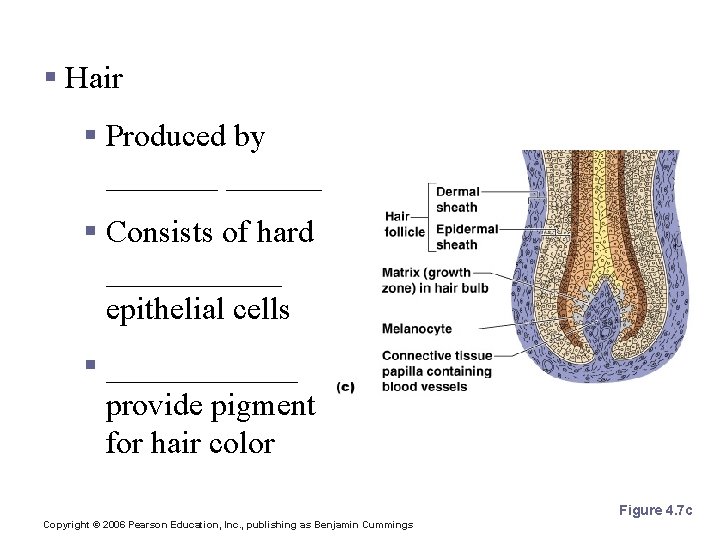
Appendages of the Skin § Hair § Produced by _______ § Consists of hard ______ epithelial cells § ______ provide pigment for hair color Figure 4. 7 c Copyright © 2006 Pearson Education, Inc. , publishing as Benjamin Cummings
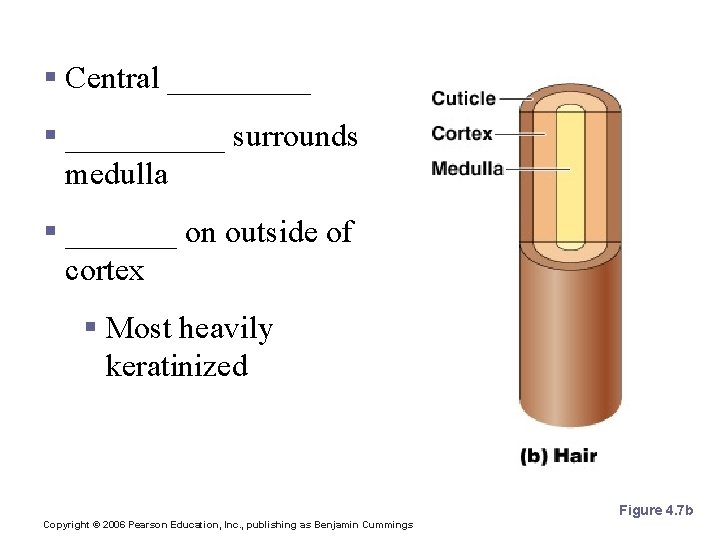
Hair Anatomy § Central _____ § _____ surrounds medulla § _______ on outside of cortex § Most heavily keratinized Figure 4. 7 b Copyright © 2006 Pearson Education, Inc. , publishing as Benjamin Cummings
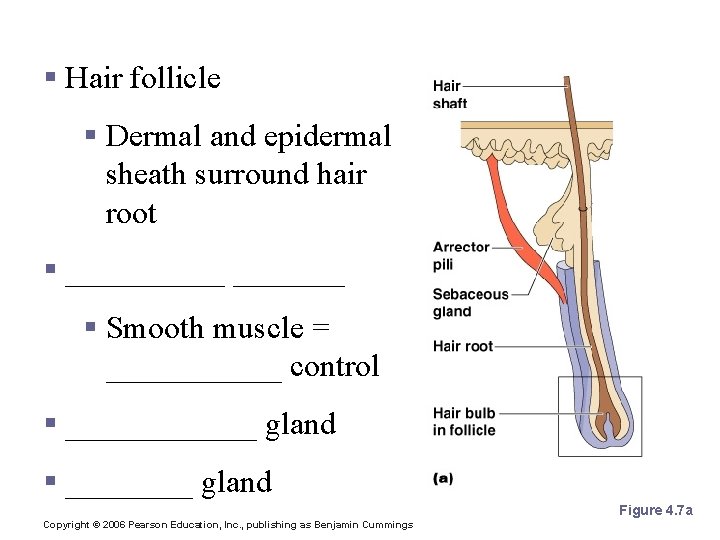
Associated Hair Structures § Hair follicle § Dermal and epidermal sheath surround hair root § _______ § Smooth muscle = ______ control § ______ gland § ____ gland Figure 4. 7 a Copyright © 2006 Pearson Education, Inc. , publishing as Benjamin Cummings
Appendages of the Skin § Nails § Scale-like modifications of the ____ § Heavily keratinized § Stratum ____ extends beneath the nail bed § Responsible for growth § Lack of _____ makes them colorless Copyright © 2006 Pearson Education, Inc. , publishing as Benjamin Cummings
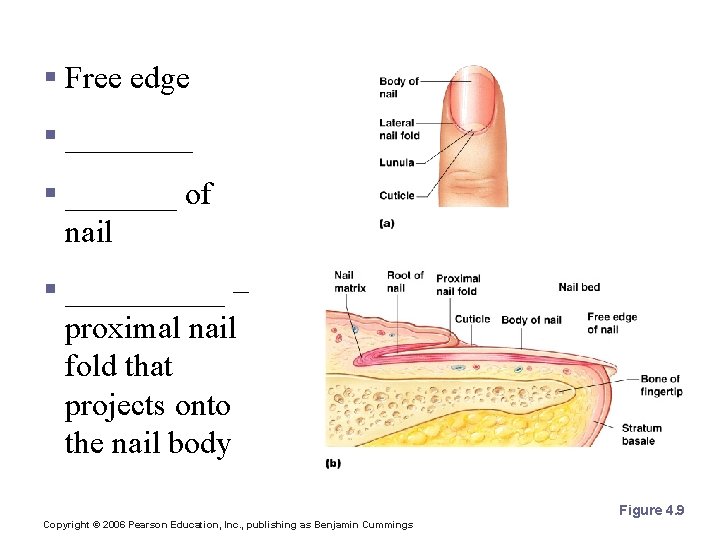
Nail Structures § Free edge § _______ of nail § _____ – proximal nail fold that projects onto the nail body Figure 4. 9 Copyright © 2006 Pearson Education, Inc. , publishing as Benjamin Cummings
Skin Homeostatic Imbalances § Infections § ______ = TINEA PEDIS § Caused by _____ infection § Boils and carbuncles § Caused by _____ infection § _____ § Caused by ____ Copyright © 2006 Pearson Education, Inc. , publishing as Benjamin Cummings
Skin Homeostatic Imbalances § Infections and allergies § _________ § Exposures cause allergic reaction § ______ § Caused by _____ infection § ______ § Cause is unknown § Triggered by ________, and ____ Copyright © 2006 Pearson Education, Inc. , publishing as Benjamin Cummings
Skin Homeostatic Imbalances § Burns § Tissue damage and cell death caused by ______, UV radiation, or chemicals § Associated dangers § _______ § ______ § _______ Copyright © 2006 Pearson Education, Inc. , publishing as Benjamin Cummings
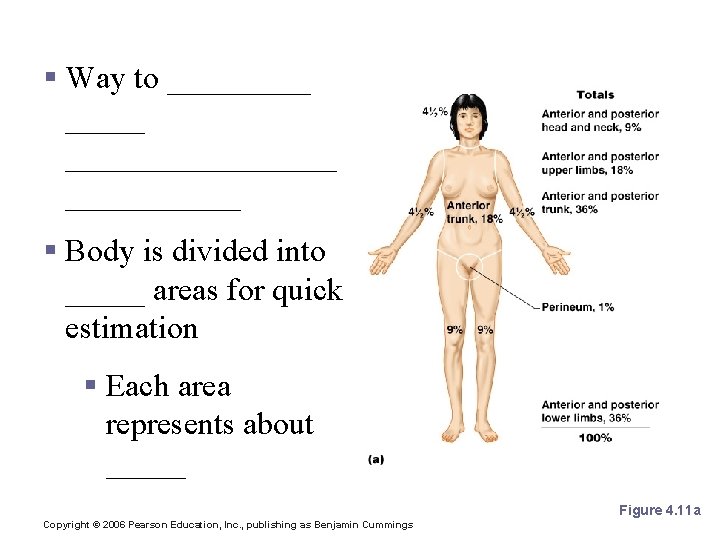
Rule of Nines § Way to ___________ § Body is divided into _____ areas for quick estimation § Each area represents about _____ Figure 4. 11 a Copyright © 2006 Pearson Education, Inc. , publishing as Benjamin Cummings
Severity of Burns § First-degree burns § Only ______ is damaged § Skin is ____ and _____ § Second degree burns § _____ and _______ are damaged § Skin is red with _____ § Third-degree burns § Destroys entire skin layer § Burn is _______ or _______ Copyright © 2006 Pearson Education, Inc. , publishing as Benjamin Cummings
Critical Burns § Burns are considered critical if: § Over ______ of body has second degree burns § Over ______ of the body has third degree burns § There are third degree burns of the _____, or _______ Copyright © 2006 Pearson Education, Inc. , publishing as Benjamin Cummings
Skin Cancer § Cancer – ________ § Two types § ______ § Does not spread (encapsulated) § ____________ (moves) to other parts of the body § ______is the most common type of cancer Copyright © 2006 Pearson Education, Inc. , publishing as Benjamin Cummings
Skin Cancer Types § ____ cell carcinoma § Least ______ § Most common type § Arises from ______ § ____ cell carcinoma § Arises from _____ § Metastasizes to _______ § Early removal allows a good chance of cure Copyright © 2006 Pearson Education, Inc. , publishing as Benjamin Cummings
Skin Cancer Types § Malignant melanoma § Most deadly of skin cancers § Cancer of _______ § Metastasizes rapidly to lymph and blood vessels § Detection uses ____ rule Copyright © 2006 Pearson Education, Inc. , publishing as Benjamin Cummings
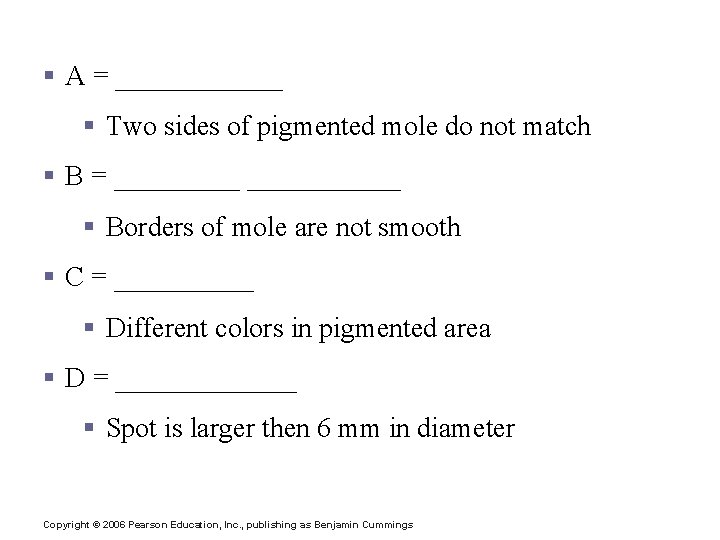
ABCD Rule § A = ______ § Two sides of pigmented mole do not match § B = ___________ § Borders of mole are not smooth § C = _____ § Different colors in pigmented area § D = _______ § Spot is larger then 6 mm in diameter Copyright © 2006 Pearson Education, Inc. , publishing as Benjamin Cummings
- Slides: 37