
4 Select and Implementing the appropriate RM control


- Slides: 19
4. Select and Implementing the appropriate RM control procedure. (4. Techniques for Treating Risk) Dr. Asmaa Mohamed Wahba
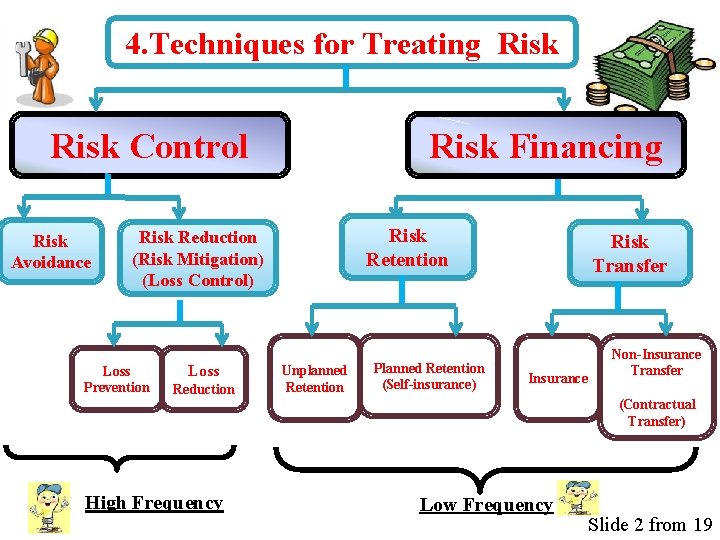
4. Techniques for Treating Risk Control Risk Avoidance Risk Financing Risk Retention Risk Reduction (Risk Mitigation) (Loss Control) Loss Prevention Loss Reduction High Frequency Unplanned Retention Planned Retention (Self-insurance) Risk Transfer Insurance Non-Insurance Transfer (Contractual Transfer) Low Frequency Slide 2 from 19
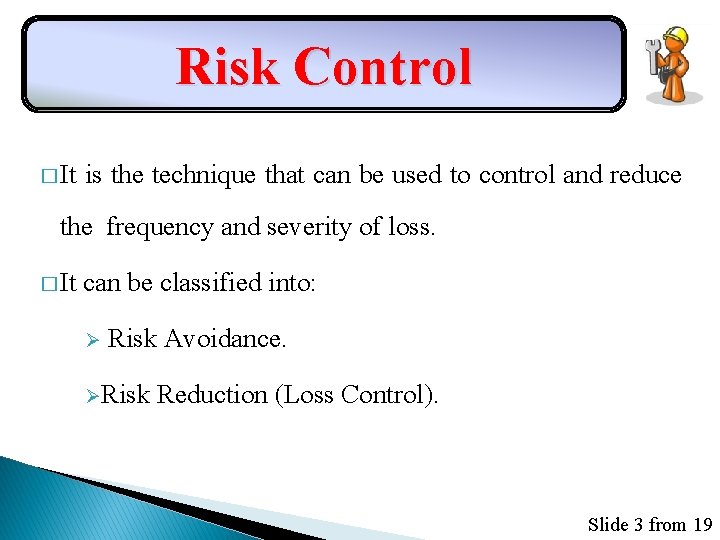
Risk Control � It is the technique that can be used to control and reduce the frequency and severity of loss. � It can be classified into: Ø Risk Avoidance. ØRisk Reduction (Loss Control). Slide 3 from 19
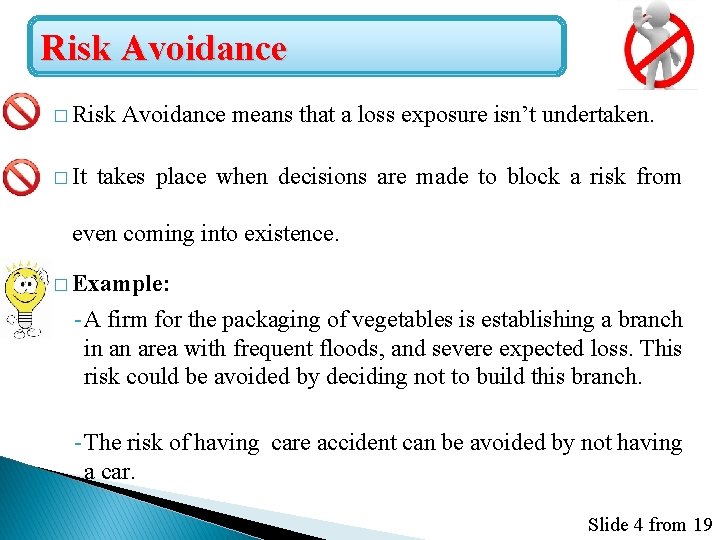
Risk Avoidance � Risk � It Avoidance means that a loss exposure isn’t undertaken. takes place when decisions are made to block a risk from even coming into existence. � Example: - A firm for the packaging of vegetables is establishing a branch in an area with frequent floods, and severe expected loss. This risk could be avoided by deciding not to build this branch. - The risk of having care accident can be avoided by not having a car. Slide 4 from 19
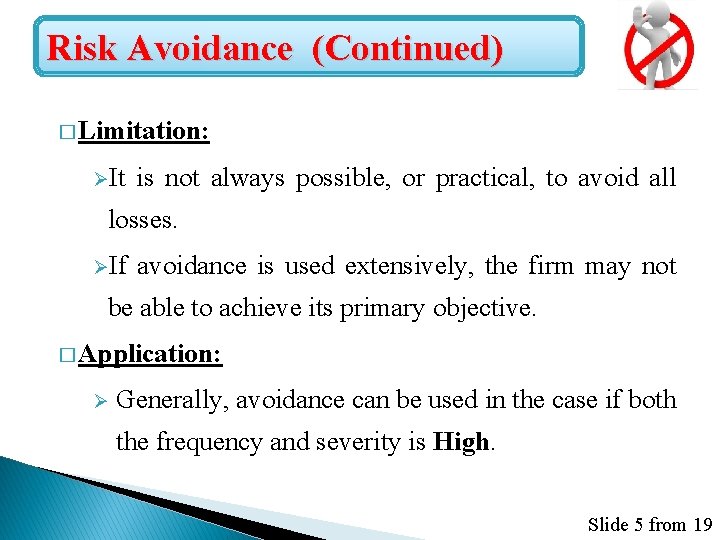
Risk Avoidance (Continued) � Limitation: ØIt is not always possible, or practical, to avoid all losses. ØIf avoidance is used extensively, the firm may not be able to achieve its primary objective. � Application: Ø Generally, avoidance can be used in the case if both the frequency and severity is High. Slide 5 from 19
Risk Reduction (Risk Mitigation) (Loss Control) � The term risk reduction is used to define a set of efforts aimed to minimize risk. � The term “risk reduction” includes both loss prevention and loss Reduction. . o “loss prevention” efforts are aimed to reduce the frequency of the loss. o“Loss reduction” efforts are aimed to reduce the severity of the loss. Slide 6 from 19
Risk Reduction (continued) � Example: - Installing a fire alarm systems. - Installing a monitoring cameras and guard system. - Supply the factory with first aid unit. - Preparing training courses for workers on how to behave in case of fire. - Preparing training courses for students on how to behave in the event of an earthquake. Slide 7 from 19
Risk Financing � Risk financing consists of those techniques designed to guarantee the availability of funds to meet loss. � Risk Financing includes: o Risk Retention. o Risk Transfer. Slide 8 from 19
Risk Retention �It is a technique in which the organization decides to bear the impact of loss itself. �Risk retention technique can be classified into: o Unplanned Retention. o Planned Retention (Self-insurance). Slide 9 from 19
Unplanned Retention � Unplanned Retention is a technique in which the organization decides to bear the impact of loss without any presetting funding plan or arrangement. Planned Retention (Self-insurance) � Self-insurance is a method in which an organization decides to bear the effect of loss by assigning a set of funds to pay the loss if it occurs. Slide 10 from 19
Risk Retention (continued) Ø Reasons for Risk Retention : § Commercial insurance coverage is not available (uninsurable Risk). § Commercial insurance is too expensive. Ø Limitations of Risk Retention : § The severity of loss is low. § The financial position of a company is enough to face the potential loss. Ø Advantage: § Sometimes, it is less cost than other techniques. § Encourages the organization to set up the loss prevention devices. Ø Disadvantage: § A loss can occur higher than the company's expectations, in such case the company may not be able to bear the impact of loss. Slide 11 from 19
Risk Transfer �A risk transfer is a technique by which a risk is transferred to a professional risk bearer (i. e. , an insurance company) or to another party throw a contract (e. g. , a hold harmless clause). � Thus, Risk Transfer technique can be classified into: o Insurance o Non-Insurance Transfer. (Contractual Transfer) Slide 12 from 19
Insurance � Insurance is a contractual agreement, in which the party exposed to the risk (insured) pays the premium to the insurer (insurance company). and the insurer promise to pay loss as stated in contract. � It is used in case if the frequency of loss is Low and the Severity of loss is High. Slide 13 from 19
Non-Insurance Transfer (Contractual Transfer) � Non-Insurance Transfer is the technique in which the risk is transferred from one party to another party other than an insurance company. This risk management technique usually involves risk transfers by way of hold harmless, indemnity, in contracts. � Non-Insurance Transfer is covered by contracts rather than insurance. Slide 14 from 19
Non-Insurance Transfer (continued) �Example: - A machine owner rent the machine to a second party. The contract determined that the second party not the machine owner would be responsible for any liability arising out of the usage of the machine. Slide 15 from 19
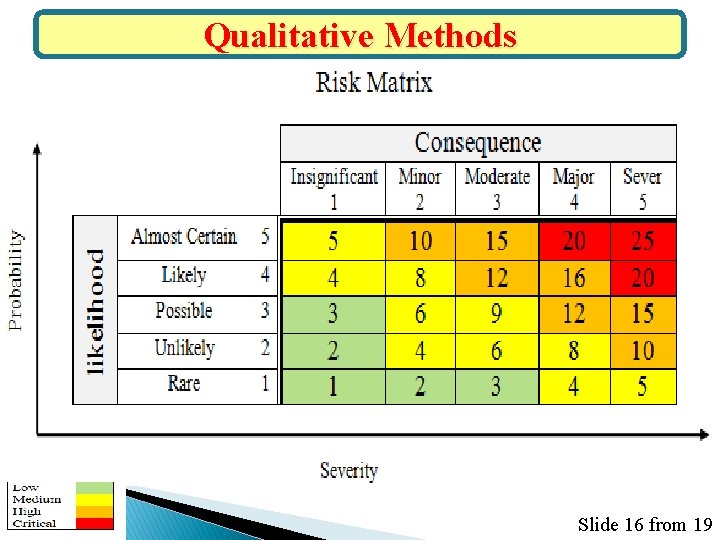
Qualitative Methods Slide 16 from 19
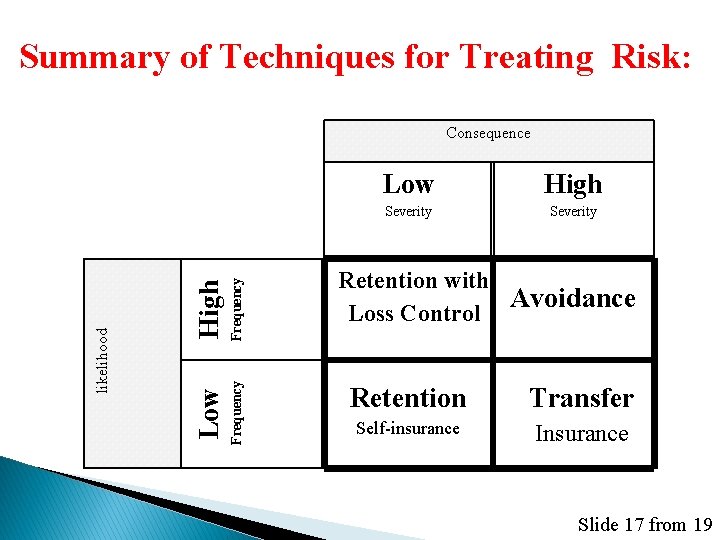
Summary of Techniques for Treating Risk: High Frequency Low Frequency likelihood Consequence Low High Severity Retention with Avoidance Loss Control Retention Transfer Self-insurance Insurance Slide 17 from 19
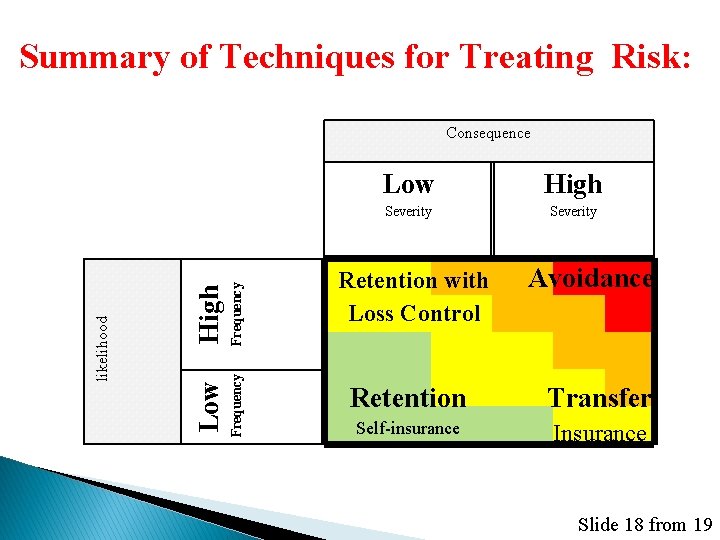
Summary of Techniques for Treating Risk: High Frequency Low Frequency likelihood Consequence Low High Severity Retention with Loss Control Avoidance Retention Transfer Self-insurance Insurance Slide 18 from 19
Note that: Risk sharing � Risk sharing is sometimes cited as an additional way of dealing with risk. � Risk sharing is a technique in which the cost of the consequences of a risk is distributed among several participants. � Risk sharing may be viewed as a special case of risk transfer and risk retention. ◦ Part of the risk of the individual is transferred to the group. ◦ The risks of a number of individuals are retained collectively. Slide 19 from 19