
4 Pronouns MARY ELLEN GUFFEY AND CAROLYN M
- Slides: 54
4 Pronouns MARY ELLEN GUFFEY AND CAROLYN M. SEEFER BUSINESS ENGLISH 12 e © 2017 Cengage Learning®. May not be scanned, copied or duplicated, or posted to a publicly accessible website, in whole or in part, except for use as permitted in a license distributed with a certain product or service or otherwise on a password-protected website or school-approved learning management system for classroom use. © Larysa Ray/Shutterstock. © Valeri Potapova/Shutterstock.
LEARNING OUTCOMES Level 1 ▶ Use subjective, objective, and possessive pronouns correctly. ▶ Choose the correct pronoun in compound constructions, comparatives, appositives, reflexives, and following linking verbs. © 2017 Cengage Learning®. May not be scanned, copied or duplicated, or posted to a publicly accessible website, in whole or in part, except for use as permitted in a license distributed with a certain product or service or otherwise on a password-protected website or school-approved learning management system for classroom use. © Larysa Ray/Shutterstock 2
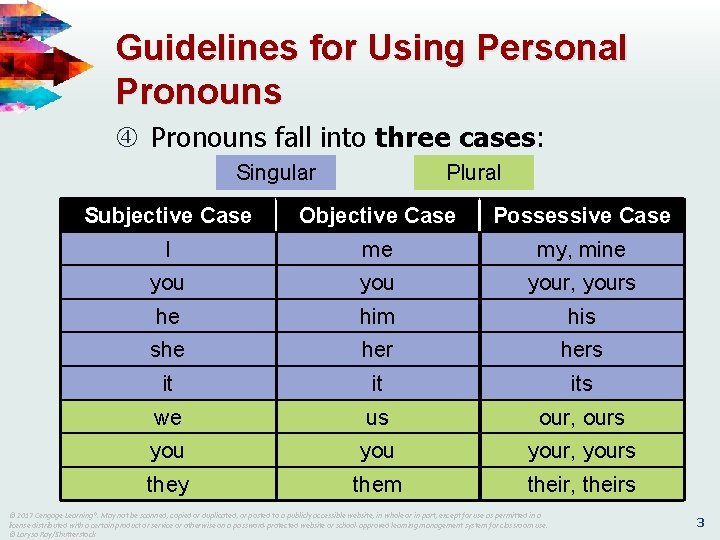
Guidelines for Using Personal Pronouns fall into three cases: Singular Plural Subjective Case Objective Case Possessive Case I me my, mine you your, yours he him his she hers it it its we us our, ours you your, yours they them their, theirs © © 2017 Cengage Learning®. May not be be scanned, copied or or duplicated, or or posted to to a a publicly accessible website, in in whole or or in in part, except for use as as permitted in in a a license distributed with a license with a certain product service or otherwise on a password-protected website or school-approved learning management for Ray/Shutterstock classroom use. certain distributed product or service or otherwise onor a password-protected website or school-approved learning management system for classroom use. system © Larysa Ray/Shutterstock 3
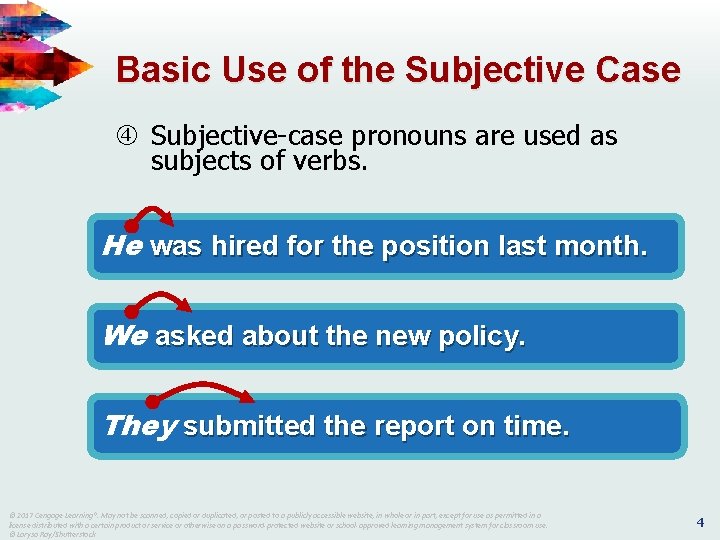
Basic Use of the Subjective Case Subjective-case pronouns are used as subjects of verbs. He was hired for the position last month. We asked about the new policy. They submitted the report on time. © © 2017 Cengage Learning®. May not be be scanned, copied or or duplicated, or or posted to to a a publicly accessible website, in in whole or or in in part, except for use as as permitted in in a a license distributed with a license with a certain product service or otherwise on a password-protected website or school-approved learning management for Ray/Shutterstock classroom use. certain distributed product or service or otherwise onor a password-protected website or school-approved learning management system for classroom use. system © Larysa Ray/Shutterstock 4
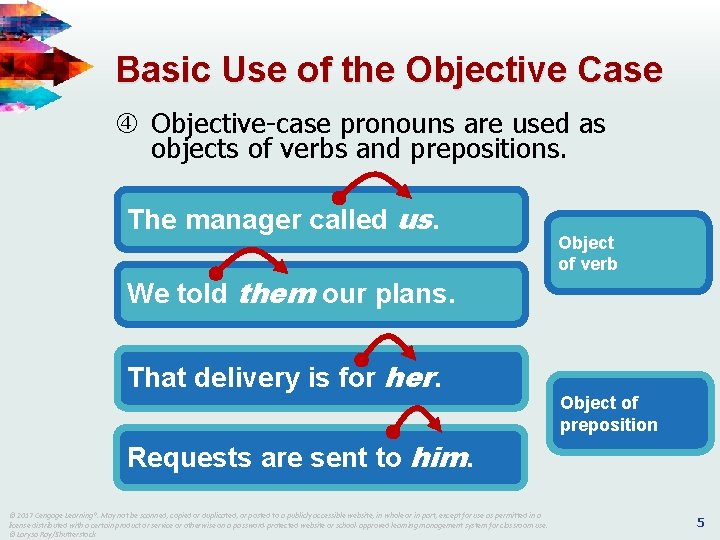
Basic Use of the Objective Case Objective-case pronouns are used as objects of verbs and prepositions. The manager called us. We told them our plans. That delivery is for her. Object of verb Object of preposition Requests are sent to him. © © 2017 Cengage Learning®. May not be be scanned, copied or or duplicated, or or posted to to a a publicly accessible website, in in whole or or in in part, except for use as as permitted in in a a license distributed with a license with a certain product service or otherwise on a password-protected website or school-approved learning management for Ray/Shutterstock classroom use. certain distributed product or service or otherwise onor a password-protected website or school-approved learning management system for classroom use. system © Larysa Ray/Shutterstock 5
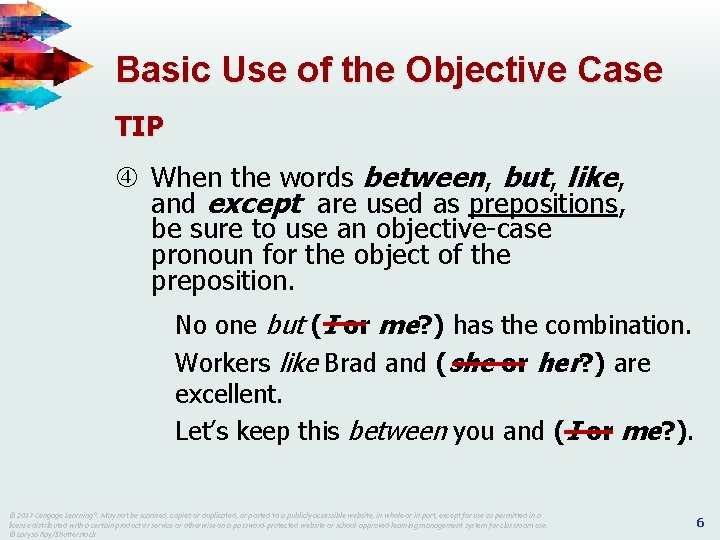
Basic Use of the Objective Case TIP When the words between, but, like, and except are used as prepositions, be sure to use an objective-case pronoun for the object of the preposition. No one but (I or me? ) has the combination. Workers like Brad and (she or her? ) are excellent. Let’s keep this between you and (I or me? ). © © 2017 Cengage Learning®. May not be be scanned, copied or or duplicated, or or posted to to a a publicly accessible website, in in whole or or in in part, except for use as as permitted in in a a license distributed with a license with a certain product service or otherwise on a password-protected website or school-approved learning management for Ray/Shutterstock classroom use. certain distributed product or service or otherwise onor a password-protected website or school-approved learning management system for classroom use. system © Larysa Ray/Shutterstock 6
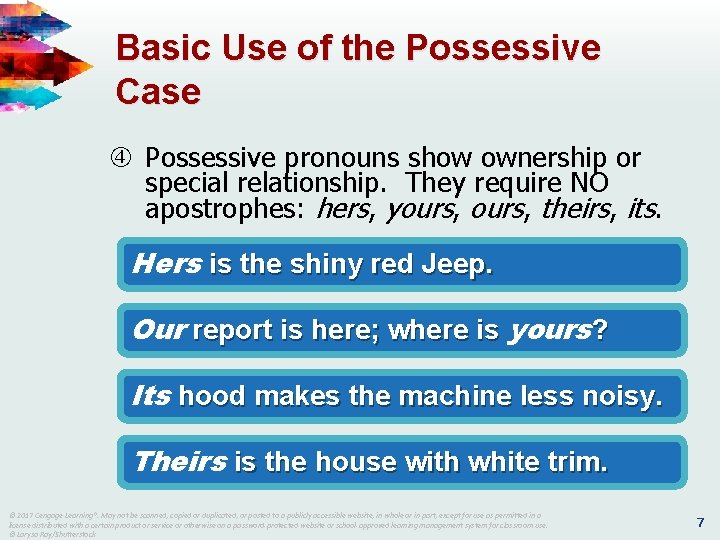
Basic Use of the Possessive Case Possessive pronouns show ownership or special relationship. They require NO apostrophes: hers, yours, theirs, its. Hers is the shiny red Jeep. Our report is here; where is yours? Its hood makes the machine less noisy. Theirs is the house with white trim. © © 2017 Cengage Learning®. May not be be scanned, copied or or duplicated, or or posted to to a a publicly accessible website, in in whole or or in in part, except for use as as permitted in in a a license distributed with a license with a certain product service or otherwise on a password-protected website or school-approved learning management for Ray/Shutterstock classroom use. certain distributed product or service or otherwise onor a password-protected website or school-approved learning management system for classroom use. system © Larysa Ray/Shutterstock 7
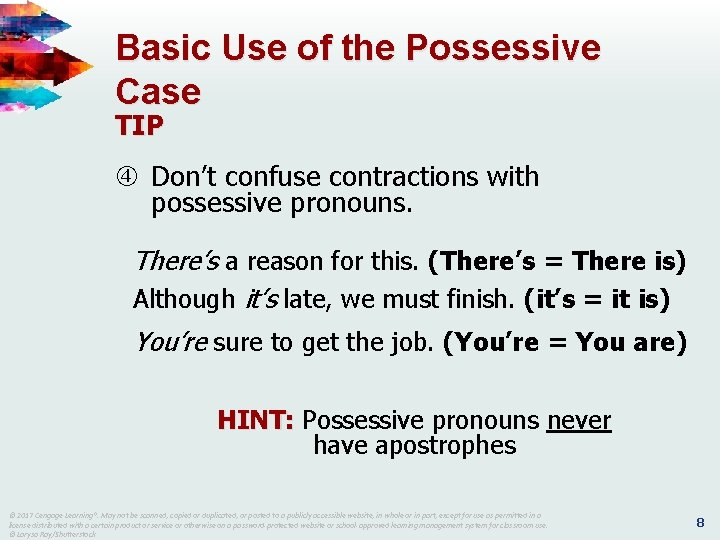
Basic Use of the Possessive Case TIP Don’t confuse contractions with possessive pronouns. There’s a reason for this. (There’s = There is) Although it’s late, we must finish. (it’s = it is) You’re sure to get the job. (You’re = You are) HINT: Possessive pronouns never have apostrophes © © 2017 Cengage Learning®. May not be be scanned, copied or or duplicated, or or posted to to a a publicly accessible website, in in whole or or in in part, except for use as as permitted in in a a license distributed with a license with a certain product service or otherwise on a password-protected website or school-approved learning management for Ray/Shutterstock classroom use. certain distributed product or service or otherwise onor a password-protected website or school-approved learning management system for classroom use. system © Larysa Ray/Shutterstock 8
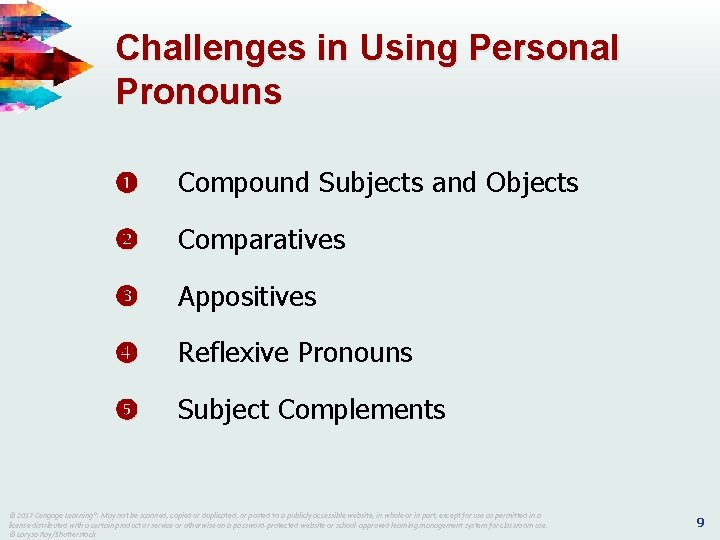
Challenges in Using Personal Pronouns Compound Subjects and Objects Comparatives Appositives Reflexive Pronouns Subject Complements © © 2017 Cengage Learning®. May not be be scanned, copied or or duplicated, or or posted to to a a publicly accessible website, in in whole or or in in part, except for use as as permitted in in a a license distributed with a license with a certain product service or otherwise on a password-protected website or school-approved learning management for Ray/Shutterstock classroom use. certain distributed product or service or otherwise onor a password-protected website or school-approved learning management system for classroom use. system © Larysa Ray/Shutterstock 9
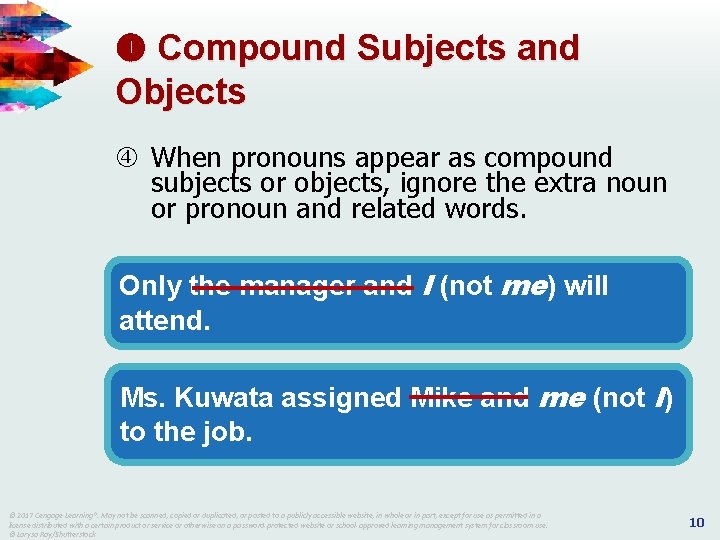
Compound Subjects and Objects When pronouns appear as compound subjects or objects, ignore the extra noun or pronoun and related words. Only the manager and I (not me) will attend. Ms. Kuwata assigned Mike and me (not I) to the job. © © 2017 Cengage Learning®. May not be be scanned, copied or or duplicated, or or posted to to a a publicly accessible website, in in whole or or in in part, except for use as as permitted in in a a license distributed with a license with a certain product service or otherwise on a password-protected website or school-approved learning management for Ray/Shutterstock classroom use. certain distributed product or service or otherwise onor a password-protected website or school-approved learning management system for classroom use. system © Larysa Ray/Shutterstock 10
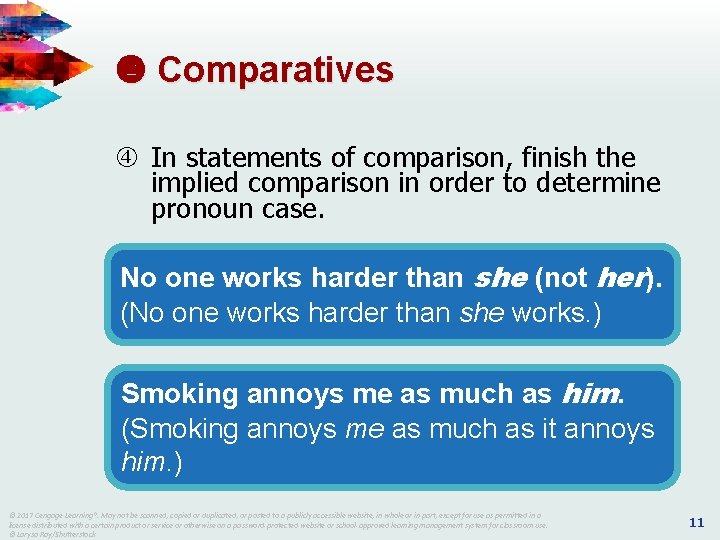
Comparatives In statements of comparison, finish the implied comparison in order to determine pronoun case. No one works harder than she (not her). (No one works harder than she works. ) Smoking annoys me as much as him. (Smoking annoys me as much as it annoys him. ) © © 2017 Cengage Learning®. May not be be scanned, copied or or duplicated, or or posted to to a a publicly accessible website, in in whole or or in in part, except for use as as permitted in in a a license distributed with a license with a certain product service or otherwise on a password-protected website or school-approved learning management for Ray/Shutterstock classroom use. certain distributed product or service or otherwise onor a password-protected website or school-approved learning management system for classroom use. system © Larysa Ray/Shutterstock 11
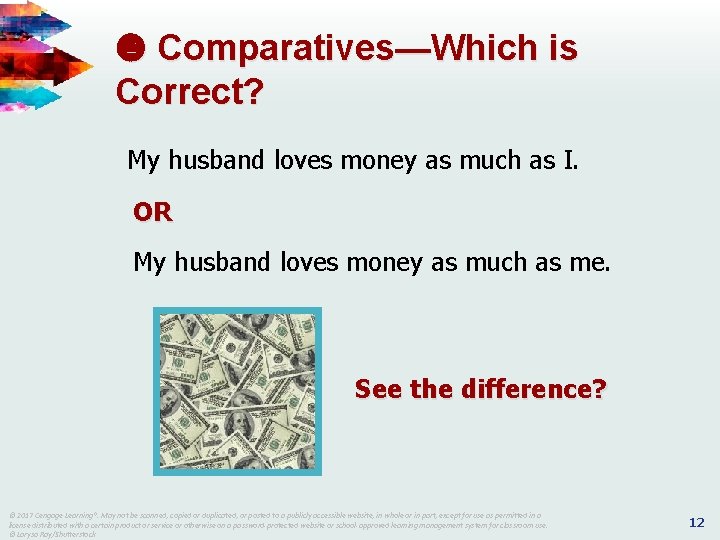
Comparatives—Which is Correct? My husband loves money as much as I. OR My husband loves money as much as me. See the difference? © © 2017 Cengage Learning®. May not be be scanned, copied or or duplicated, or or posted to to a a publicly accessible website, in in whole or or in in part, except for use as as permitted in in a a license distributed with a license with a certain product service or otherwise on a password-protected website or school-approved learning management for Ray/Shutterstock classroom use. certain distributed product or service or otherwise onor a password-protected website or school-approved learning management system for classroom use. system © Larysa Ray/Shutterstock 12
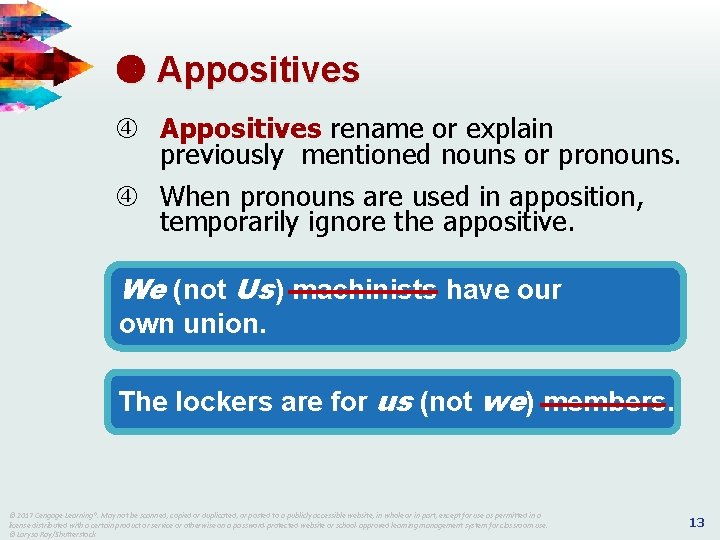
Appositives rename or explain previously mentioned nouns or pronouns. When pronouns are used in apposition, temporarily ignore the appositive. We (not Us) machinists have our own union. The lockers are for us (not we) members. © © 2017 Cengage Learning®. May not be be scanned, copied or or duplicated, or or posted to to a a publicly accessible website, in in whole or or in in part, except for use as as permitted in in a a license distributed with a license with a certain product service or otherwise on a password-protected website or school-approved learning management for Ray/Shutterstock classroom use. certain distributed product or service or otherwise onor a password-protected website or school-approved learning management system for classroom use. system © Larysa Ray/Shutterstock 13
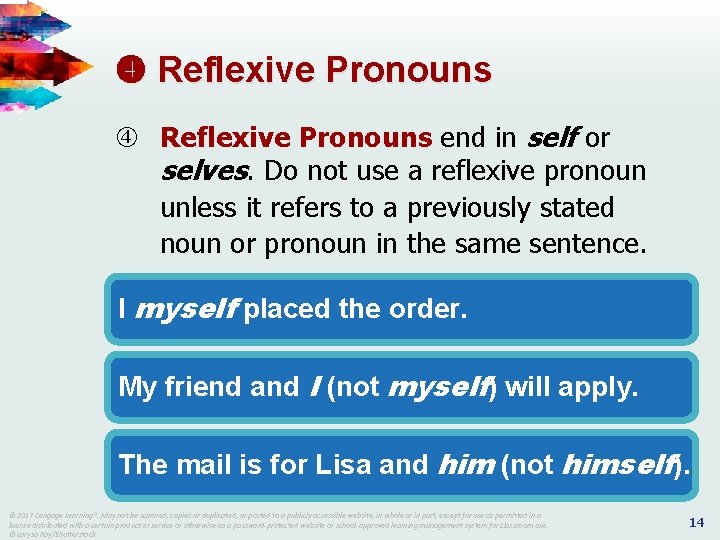
Reflexive Pronouns end in self or selves. Do not use a reflexive pronoun unless it refers to a previously stated noun or pronoun in the same sentence. I myself placed the order. My friend and I (not myself) will apply. The mail is for Lisa and him (not himself). © © 2017 Cengage Learning®. May not be be scanned, copied or or duplicated, or or posted to to a a publicly accessible website, in in whole or or in in part, except for use as as permitted in in a a license distributed with a license with a certain product service or otherwise on a password-protected website or school-approved learning management for Ray/Shutterstock classroom use. certain distributed product or service or otherwise onor a password-protected website or school-approved learning management system for classroom use. system © Larysa Ray/Shutterstock 14
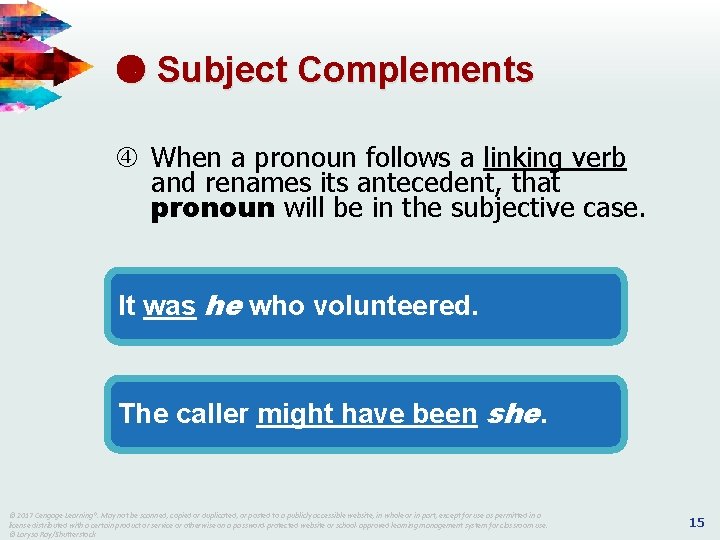
Subject Complements When a pronoun follows a linking verb and renames its antecedent, that pronoun will be in the subjective case. It was he who volunteered. The caller might have been she. © © 2017 Cengage Learning®. May not be be scanned, copied or or duplicated, or or posted to to a a publicly accessible website, in in whole or or in in part, except for use as as permitted in in a a license distributed with a license with a certain product service or otherwise on a password-protected website or school-approved learning management for Ray/Shutterstock classroom use. certain distributed product or service or otherwise onor a password-protected website or school-approved learning management system for classroom use. system © Larysa Ray/Shutterstock 15
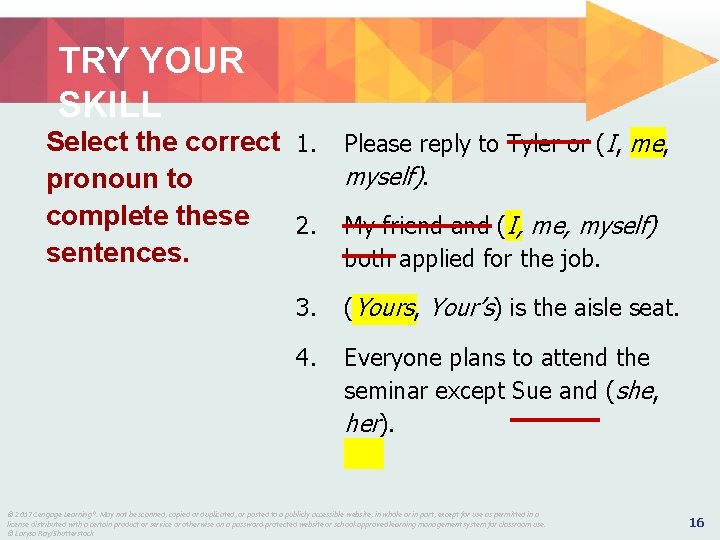
TRY YOUR SKILL Select the correct 1. Please reply to Tyler or (I, me, myself). pronoun to complete these 2. My friend and (I, me, myself) sentences. both applied for the job. 3. (Yours, Your’s) is the aisle seat. 4. Everyone plans to attend the seminar except Sue and (she, her). © 2017 Cengage Learning®. May not be scanned, copied or duplicated, or posted to a publicly accessible website, in whole or in part, except for use as permitted in a license distributed with a certain product or service or otherwise on a password-protected website or school-approved learning management system for classroom use. © Larysa Ray/Shutterstock 16
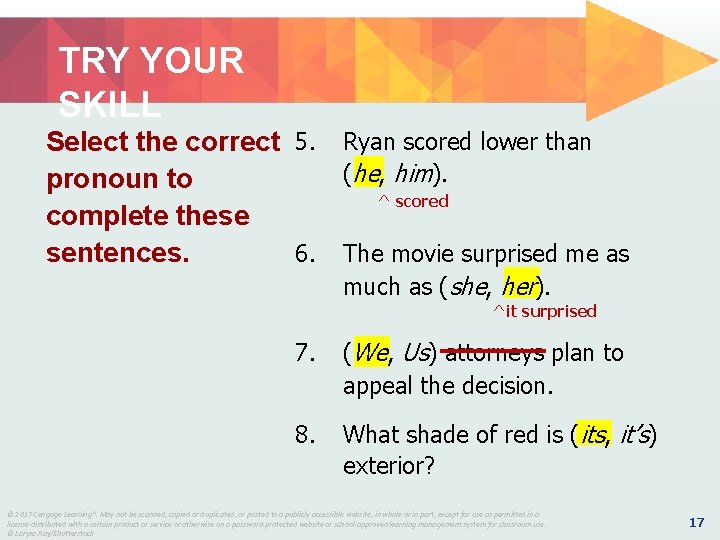
TRY YOUR SKILL Select the correct 5. Ryan scored lower than (he, him). pronoun to ^ scored complete these sentences. 6. The movie surprised me as much as (she, her). ^it surprised 7. (We, Us) attorneys plan to appeal the decision. 8. What shade of red is (its, it’s) exterior? © 2017 Cengage Learning®. May not be scanned, copied or duplicated, or posted to a publicly accessible website, in whole or in part, except for use as permitted in a license distributed with a certain product or service or otherwise on a password-protected website or school-approved learning management system for classroom use. © Larysa Ray/Shutterstock 17
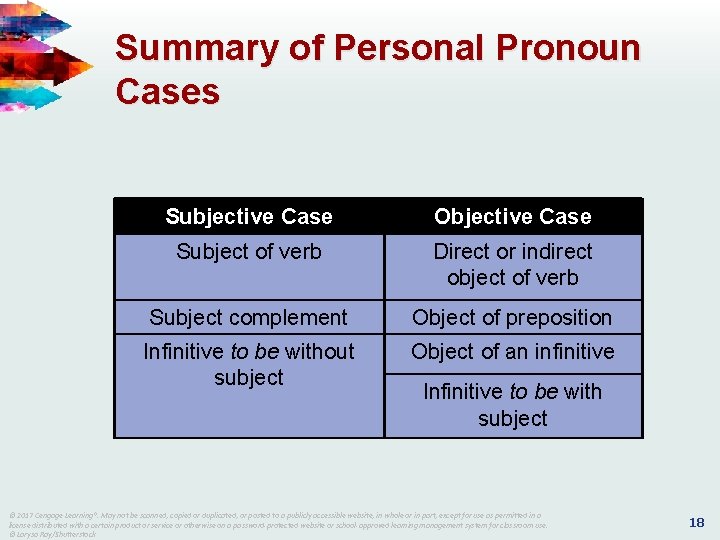
Summary of Personal Pronoun Cases Subjective Case Objective Case Subject of verb Direct or indirect object of verb Subject complement Object of preposition Infinitive to be without subject Object of an infinitive Infinitive to be with subject © © 2017 Cengage Learning®. May not be be scanned, copied or or duplicated, or or posted to to a a publicly accessible website, in in whole or or in in part, except for use as as permitted in in a a license distributed with a license with a certain product service or otherwise on a password-protected website or school-approved learning management for Ray/Shutterstock classroom use. certain distributed product or service or otherwise onor a password-protected website or school-approved learning management system for classroom use. system © Larysa Ray/Shutterstock 18
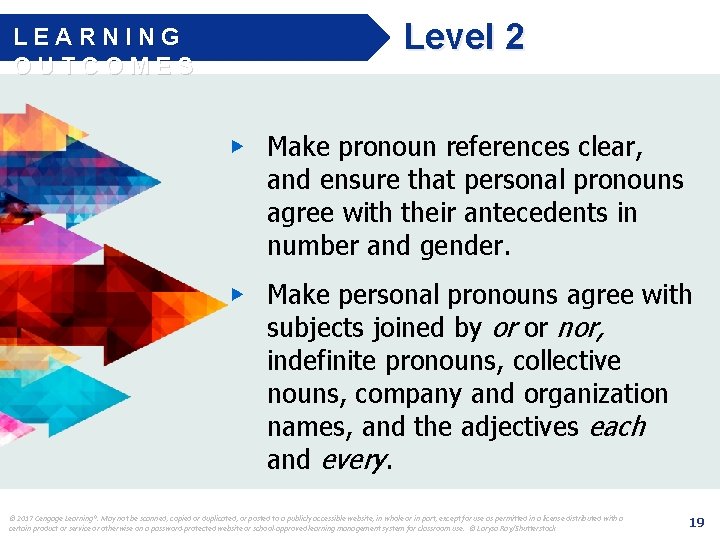
LEARNING OUTCOMES Level 2 ▶ Make pronoun references clear, and ensure that personal pronouns agree with their antecedents in number and gender. ▶ Make personal pronouns agree with subjects joined by or or nor, indefinite pronouns, collective nouns, company and organization names, and the adjectives each and every. © 2017 Cengage Learning®. May not be scanned, copied or duplicated, or posted to a publicly accessible website, in whole or in part, except for use as permitted in a license distributed with a certain product or service or otherwise on a password-protected website or school-approved learning management system for classroom use. © Larysa Ray/Shutterstock 19
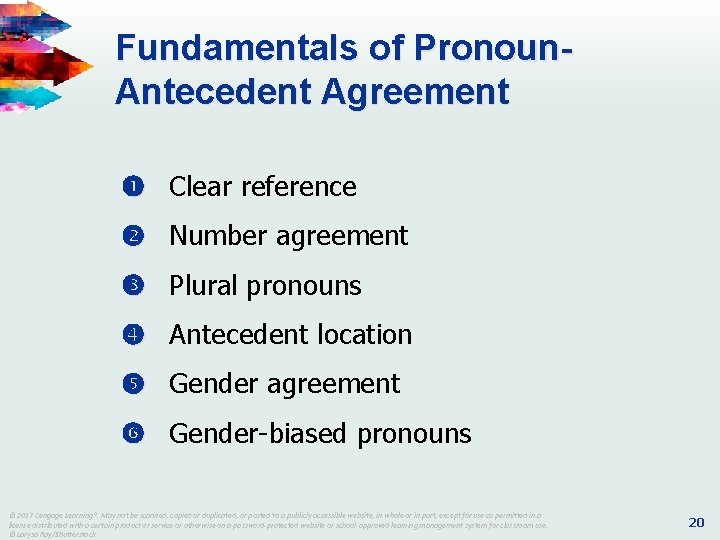
Fundamentals of Pronoun. Antecedent Agreement Clear reference Number agreement Plural pronouns Antecedent location Gender agreement Gender-biased pronouns © © 2017 Cengage Learning®. May not be be scanned, copied or or duplicated, or or posted to to a a publicly accessible website, in in whole or or in in part, except for use as as permitted in in a a license distributed with a license with a certain product service or otherwise on a password-protected website or school-approved learning management for Ray/Shutterstock classroom use. certain distributed product or service or otherwise onor a password-protected website or school-approved learning management system for classroom use. system © Larysa Ray/Shutterstock 20
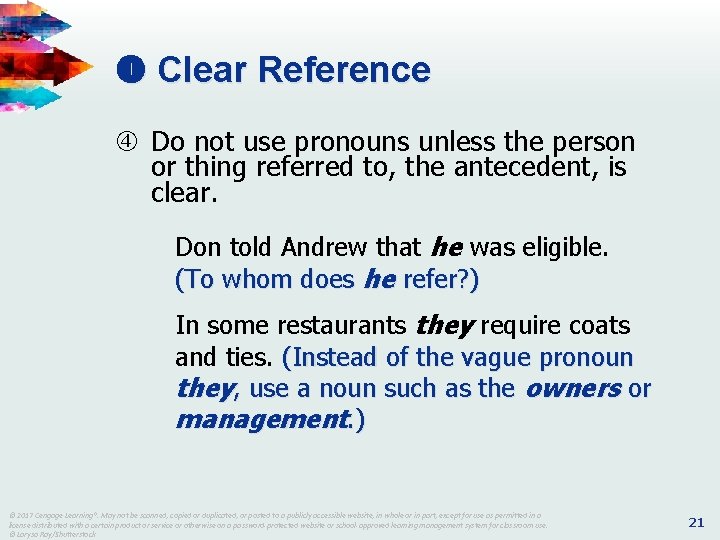
Clear Reference Do not use pronouns unless the person or thing referred to, the antecedent, is clear. Don told Andrew that he was eligible. (To whom does he refer? ) In some restaurants they require coats and ties. (Instead of the vague pronoun they, use a noun such as the owners or management. ) © © 2017 Cengage Learning®. May not be be scanned, copied or or duplicated, or or posted to to a a publicly accessible website, in in whole or or in in part, except for use as as permitted in in a a license distributed with a license with a certain product service or otherwise on a password-protected website or school-approved learning management for Ray/Shutterstock classroom use. certain distributed product or service or otherwise onor a password-protected website or school-approved learning management system for classroom use. system © Larysa Ray/Shutterstock 21
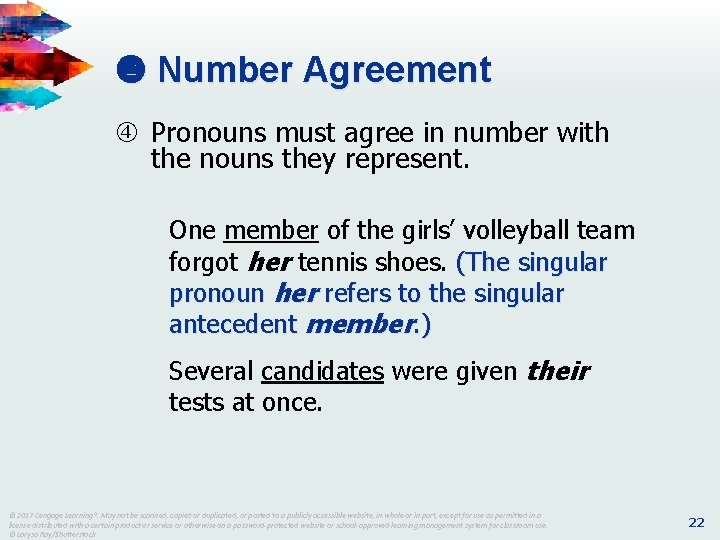
Number Agreement Pronouns must agree in number with the nouns they represent. One member of the girls’ volleyball team forgot her tennis shoes. (The singular pronoun her refers to the singular antecedent member. ) Several candidates were given their tests at once. © © 2017 Cengage Learning®. May not be be scanned, copied or or duplicated, or or posted to to a a publicly accessible website, in in whole or or in in part, except for use as as permitted in in a a license distributed with a license with a certain product service or otherwise on a password-protected website or school-approved learning management for Ray/Shutterstock classroom use. certain distributed product or service or otherwise onor a password-protected website or school-approved learning management system for classroom use. system © Larysa Ray/Shutterstock 22
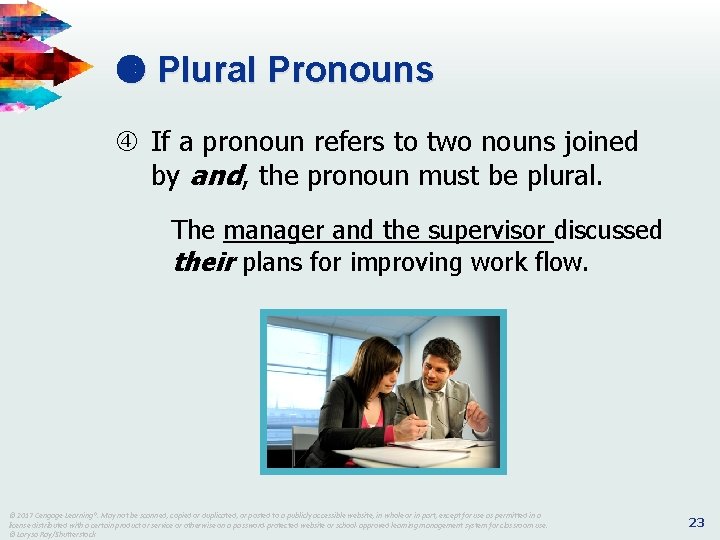
Plural Pronouns If a pronoun refers to two nouns joined by and, the pronoun must be plural. The manager and the supervisor discussed their plans for improving work flow. © © 2017 Cengage Learning®. May not be be scanned, copied or or duplicated, or or posted to to a a publicly accessible website, in in whole or or in in part, except for use as as permitted in in a a license distributed with a license with a certain product service or otherwise on a password-protected website or school-approved learning management for Ray/Shutterstock classroom use. certain distributed product or service or otherwise onor a password-protected website or school-approved learning management system for classroom use. system © Larysa Ray/Shutterstock 23
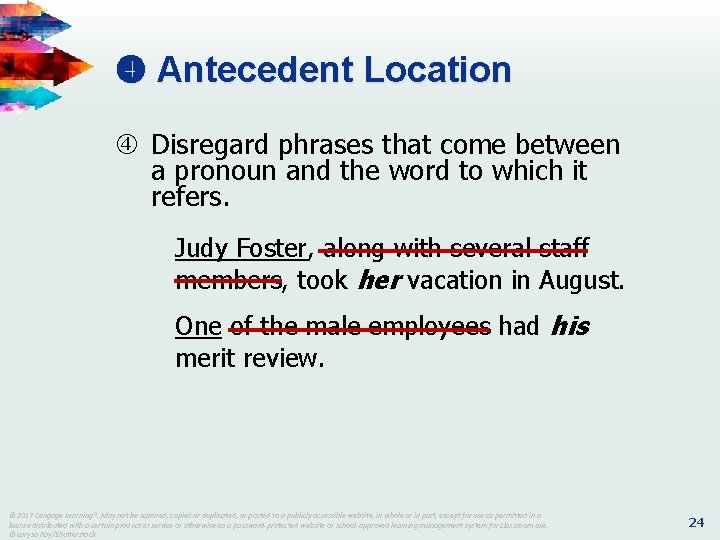
Antecedent Location Disregard phrases that come between a pronoun and the word to which it refers. Judy Foster, along with several staff members, took her vacation in August. One of the male employees had his merit review. © © 2017 Cengage Learning®. May not be be scanned, copied or or duplicated, or or posted to to a a publicly accessible website, in in whole or or in in part, except for use as as permitted in in a a license distributed with a license with a certain product service or otherwise on a password-protected website or school-approved learning management for Ray/Shutterstock classroom use. certain distributed product or service or otherwise onor a password-protected website or school-approved learning management system for classroom use. system © Larysa Ray/Shutterstock 24
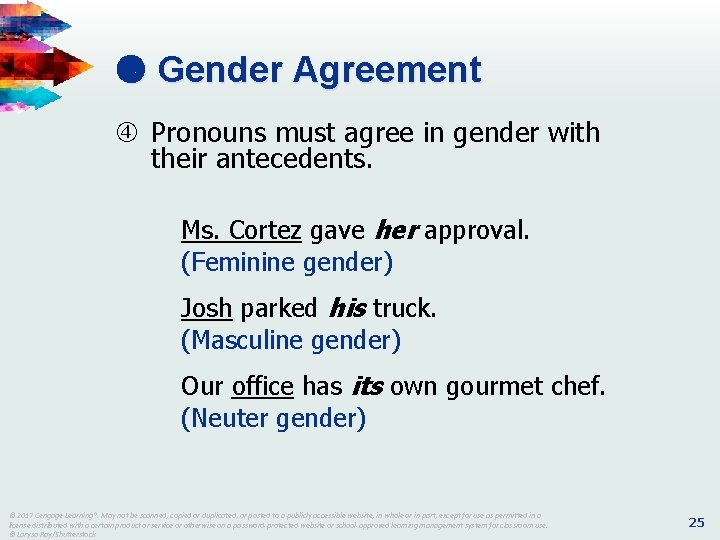
Gender Agreement Pronouns must agree in gender with their antecedents. Ms. Cortez gave her approval. (Feminine gender) Josh parked his truck. (Masculine gender) Our office has its own gourmet chef. (Neuter gender) © © 2017 Cengage Learning®. May not be be scanned, copied or or duplicated, or or posted to to a a publicly accessible website, in in whole or or in in part, except for use as as permitted in in a a license distributed with a license with a certain product service or otherwise on a password-protected website or school-approved learning management for Ray/Shutterstock classroom use. certain distributed product or service or otherwise onor a password-protected website or school-approved learning management system for classroom use. system © Larysa Ray/Shutterstock 25
Gender-Biased Pronouns When the gender of the antecedent is unknown, the use of common-gender, or masculine pronouns, was accepted in the past. Sensitive writers today should avoid common-gender pronouns, which can sound sexist. © © 2017 Cengage Learning®. May not be be scanned, copied or or duplicated, or or posted to to a a publicly accessible website, in in whole or or in in part, except for use as as permitted in in a a license distributed with a license with a certain product service or otherwise on a password-protected website or school-approved learning management for Ray/Shutterstock classroom use. certain distributed product or service or otherwise onor a password-protected website or school-approved learning management system for classroom use. system © Larysa Ray/Shutterstock 26
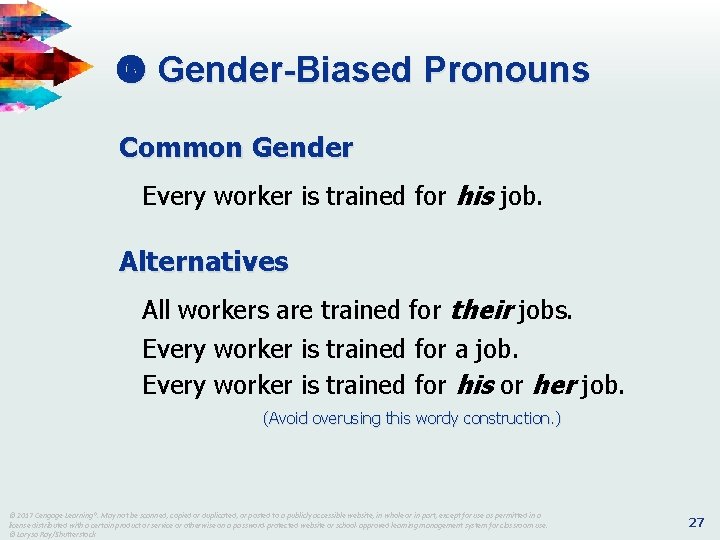
Gender-Biased Pronouns Common Gender Every worker is trained for his job. Alternatives All workers are trained for their jobs. Every worker is trained for a job. Every worker is trained for his or her job. (Avoid overusing this wordy construction. ) © © 2017 Cengage Learning®. May not be be scanned, copied or or duplicated, or or posted to to a a publicly accessible website, in in whole or or in in part, except for use as as permitted in in a a license distributed with a license with a certain product service or otherwise on a password-protected website or school-approved learning management for Ray/Shutterstock classroom use. certain distributed product or service or otherwise onor a password-protected website or school-approved learning management system for classroom use. system © Larysa Ray/Shutterstock 27
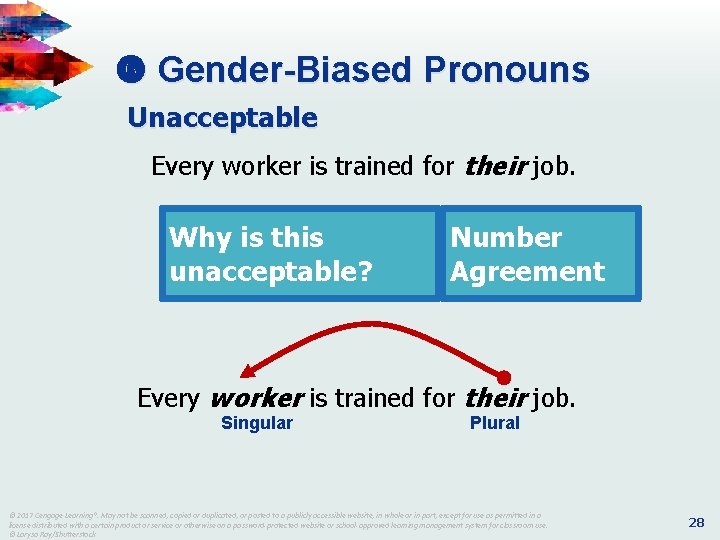
Gender-Biased Pronouns Unacceptable Every worker is trained for their job. Why is this unacceptable? Number Agreement Every worker is trained for their job. Singular Plural © © 2017 Cengage Learning®. May not be be scanned, copied or or duplicated, or or posted to to a a publicly accessible website, in in whole or or in in part, except for use as as permitted in in a a license distributed with a license with a certain product service or otherwise on a password-protected website or school-approved learning management for Ray/Shutterstock classroom use. certain distributed product or service or otherwise onor a password-protected website or school-approved learning management system for classroom use. system © Larysa Ray/Shutterstock 28
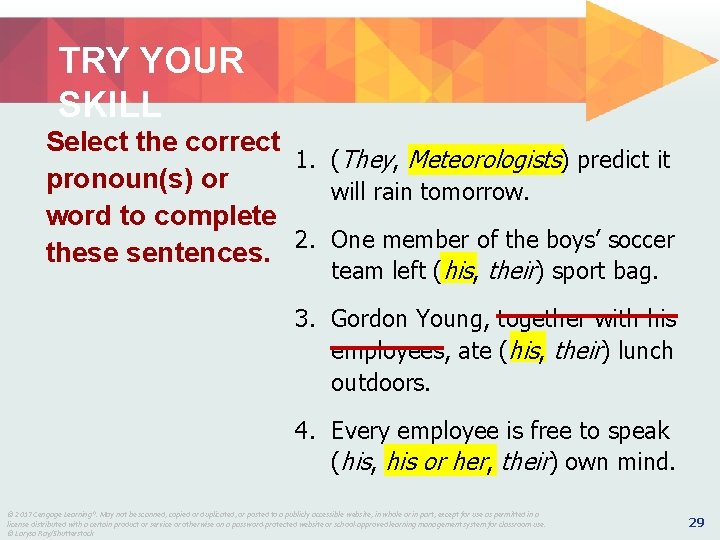
TRY YOUR SKILL Select the correct 1. (They, Meteorologists) predict it pronoun(s) or will rain tomorrow. word to complete 2. One member of the boys’ soccer these sentences. team left (his, their) sport bag. 3. Gordon Young, together with his employees, ate (his, their) lunch outdoors. 4. Every employee is free to speak (his, his or her, their) own mind. © 2017 Cengage Learning®. May not be scanned, copied or duplicated, or posted to a publicly accessible website, in whole or in part, except for use as permitted in a license distributed with a certain product or service or otherwise on a password-protected website or school-approved learning management system for classroom use. © Larysa Ray/Shutterstock 29
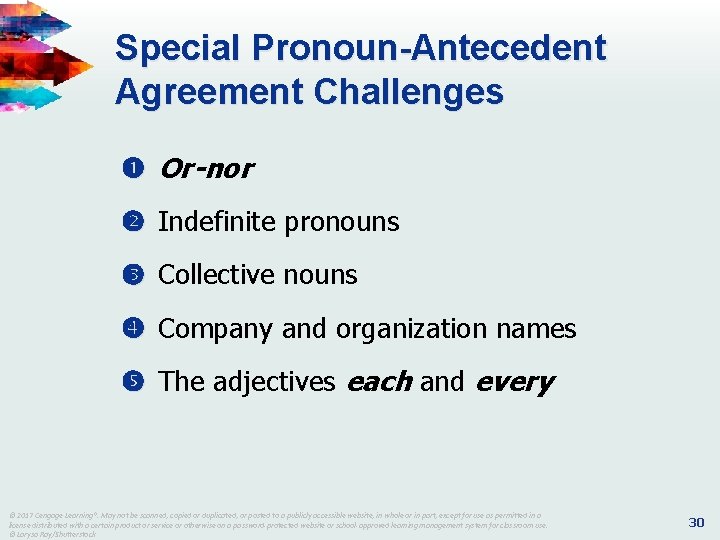
Special Pronoun-Antecedent Agreement Challenges Or-nor Indefinite pronouns Collective nouns Company and organization names The adjectives each and every © © 2017 Cengage Learning®. May not be be scanned, copied or or duplicated, or or posted to to a a publicly accessible website, in in whole or or in in part, except for use as as permitted in in a a license distributed with a license with a certain product service or otherwise on a password-protected website or school-approved learning management for Ray/Shutterstock classroom use. certain distributed product or service or otherwise onor a password-protected website or school-approved learning management system for classroom use. system © Larysa Ray/Shutterstock 30
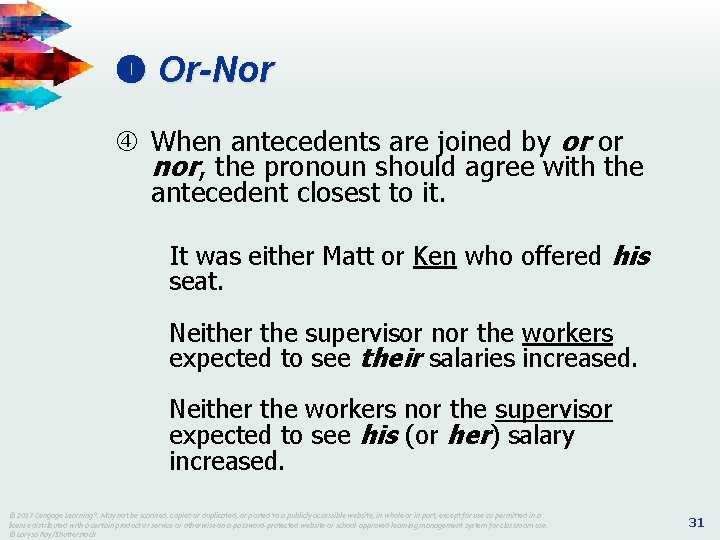
Or-Nor When antecedents are joined by or or nor, the pronoun should agree with the antecedent closest to it. It was either Matt or Ken who offered his seat. Neither the supervisor nor the workers expected to see their salaries increased. Neither the workers nor the supervisor expected to see his (or her) salary increased. © © 2017 Cengage Learning®. May not be be scanned, copied or or duplicated, or or posted to to a a publicly accessible website, in in whole or or in in part, except for use as as permitted in in a a license distributed with a license with a certain product service or otherwise on a password-protected website or school-approved learning management for Ray/Shutterstock classroom use. certain distributed product or service or otherwise onor a password-protected website or school-approved learning management system for classroom use. system © Larysa Ray/Shutterstock 31
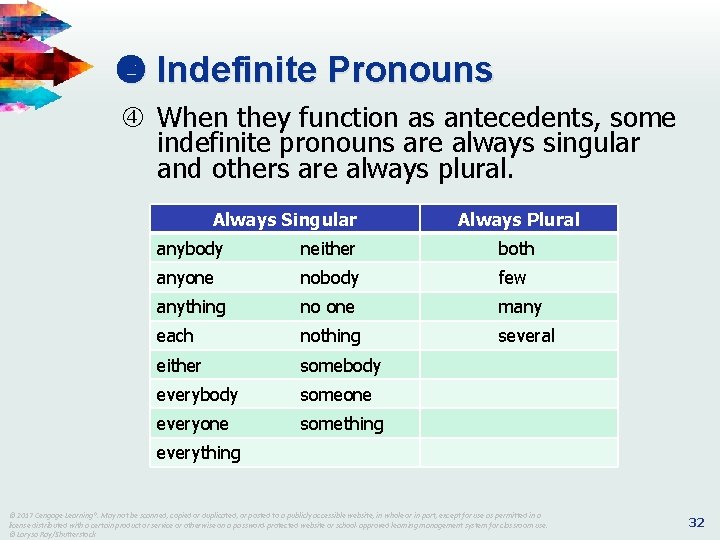
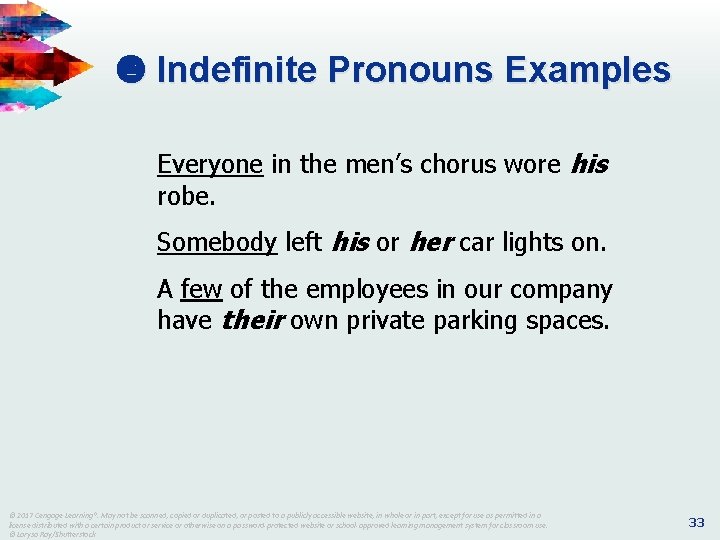
Indefinite Pronouns When they function as antecedents, some indefinite pronouns are always singular and others are always plural. Always Singular Always Plural anybody neither both anyone nobody few anything no one many each nothing several either somebody everybody someone everyone something everything © © 2017 Cengage Learning®. May not be be scanned, copied or or duplicated, or or posted to to a a publicly accessible website, in in whole or or in in part, except for use as as permitted in in a a license distributed with a license with a certain product service or otherwise on a password-protected website or school-approved learning management for Ray/Shutterstock classroom use. certain distributed product or service or otherwise onor a password-protected website or school-approved learning management system for classroom use. system © Larysa Ray/Shutterstock 32
Indefinite Pronouns Examples Everyone in the men’s chorus wore his robe. Somebody left his or her car lights on. A few of the employees in our company have their own private parking spaces. © © 2017 Cengage Learning®. May not be be scanned, copied or or duplicated, or or posted to to a a publicly accessible website, in in whole or or in in part, except for use as as permitted in in a a license distributed with a license with a certain product service or otherwise on a password-protected website or school-approved learning management for Ray/Shutterstock classroom use. certain distributed product or service or otherwise onor a password-protected website or school-approved learning management system for classroom use. system © Larysa Ray/Shutterstock 33
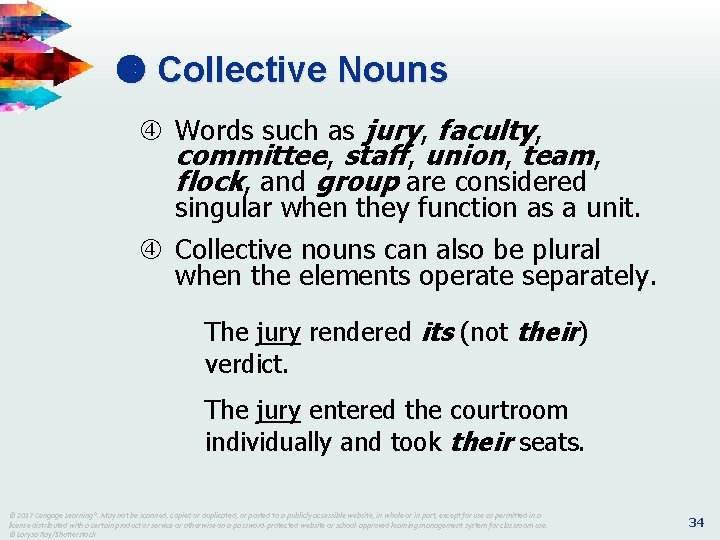
Collective Nouns Words such as jury, faculty, committee, staff, union, team, flock, and group are considered singular when they function as a unit. Collective nouns can also be plural when the elements operate separately. The jury rendered its (not their) verdict. The jury entered the courtroom individually and took their seats. © © 2017 Cengage Learning®. May not be be scanned, copied or or duplicated, or or posted to to a a publicly accessible website, in in whole or or in in part, except for use as as permitted in in a a license distributed with a license with a certain product service or otherwise on a password-protected website or school-approved learning management for Ray/Shutterstock classroom use. certain distributed product or service or otherwise onor a password-protected website or school-approved learning management system for classroom use. system © Larysa Ray/Shutterstock 34
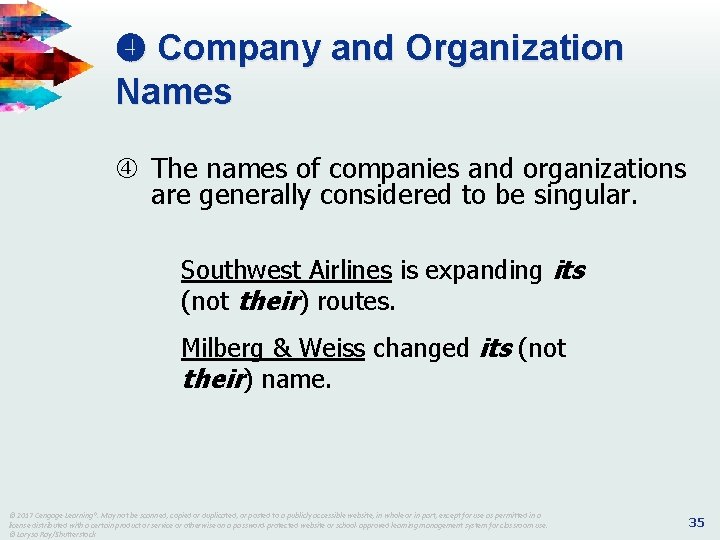
Company and Organization Names The names of companies and organizations are generally considered to be singular. Southwest Airlines is expanding its (not their) routes. Milberg & Weiss changed its (not their) name. © © 2017 Cengage Learning®. May not be be scanned, copied or or duplicated, or or posted to to a a publicly accessible website, in in whole or or in in part, except for use as as permitted in in a a license distributed with a license with a certain product service or otherwise on a password-protected website or school-approved learning management for Ray/Shutterstock classroom use. certain distributed product or service or otherwise onor a password-protected website or school-approved learning management system for classroom use. system © Larysa Ray/Shutterstock 35
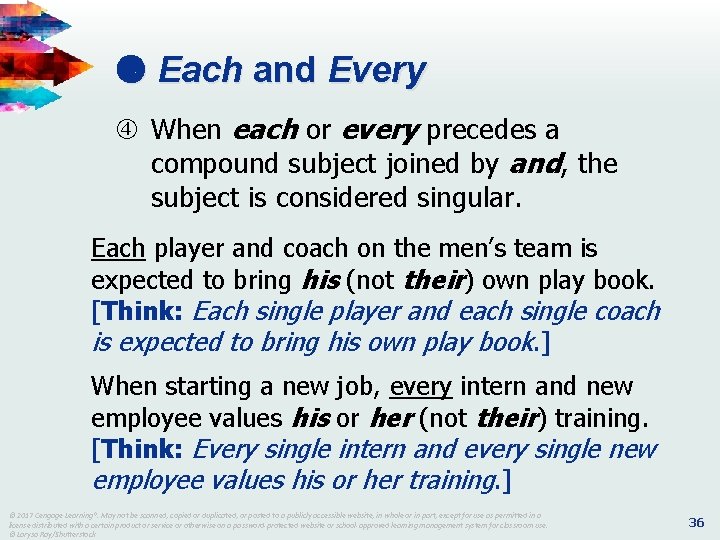
Each and Every When each or every precedes a compound subject joined by and, the subject is considered singular. Each player and coach on the men’s team is expected to bring his (not their) own play book. [Think: Each single player and each single coach is expected to bring his own play book. ] When starting a new job, every intern and new employee values his or her (not their) training. [Think: Every single intern and every single new employee values his or her training. ] © © 2017 Cengage Learning®. May not be be scanned, copied or or duplicated, or or posted to to a a publicly accessible website, in in whole or or in in part, except for use as as permitted in in a a license distributed with a license with a certain product service or otherwise on a password-protected website or school-approved learning management for Ray/Shutterstock classroom use. certain distributed product or service or otherwise onor a password-protected website or school-approved learning management system for classroom use. system © Larysa Ray/Shutterstock 36
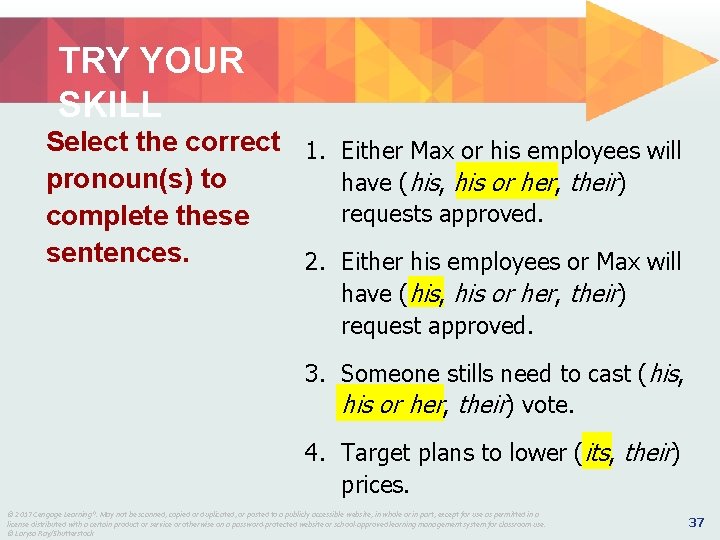
TRY YOUR SKILL Select the correct 1. Either Max or his employees will pronoun(s) to have (his, his or her, their) requests approved. complete these sentences. 2. Either his employees or Max will have (his, his or her, their) request approved. 3. Someone stills need to cast (his, his or her, their) vote. 4. Target plans to lower (its, their) prices. © 2017 Cengage Learning®. May not be scanned, copied or duplicated, or posted to a publicly accessible website, in whole or in part, except for use as permitted in a license distributed with a certain product or service or otherwise on a password-protected website or school-approved learning management system for classroom use. © Larysa Ray/Shutterstock 37
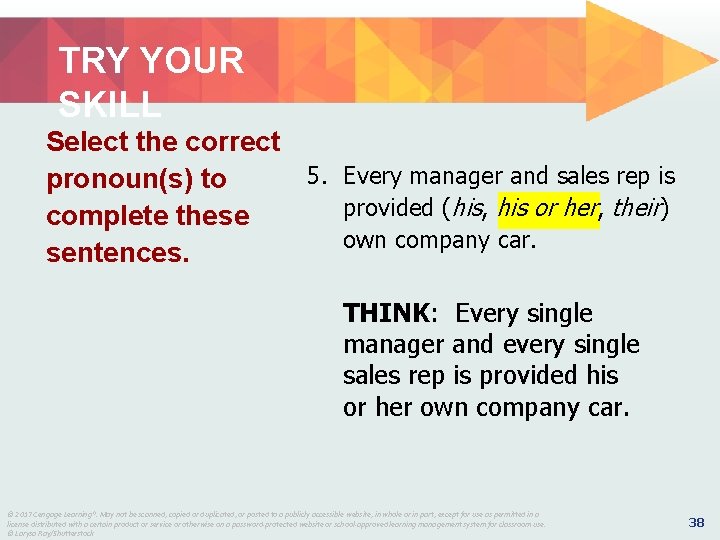
TRY YOUR SKILL Select the correct 5. Every manager and sales rep is pronoun(s) to provided (his, his or her, their) complete these own company car. sentences. THINK: Every single manager and every single sales rep is provided his or her own company car. © 2017 Cengage Learning®. May not be scanned, copied or duplicated, or posted to a publicly accessible website, in whole or in part, except for use as permitted in a license distributed with a certain product or service or otherwise on a password-protected website or school-approved learning management system for classroom use. © Larysa Ray/Shutterstock 38
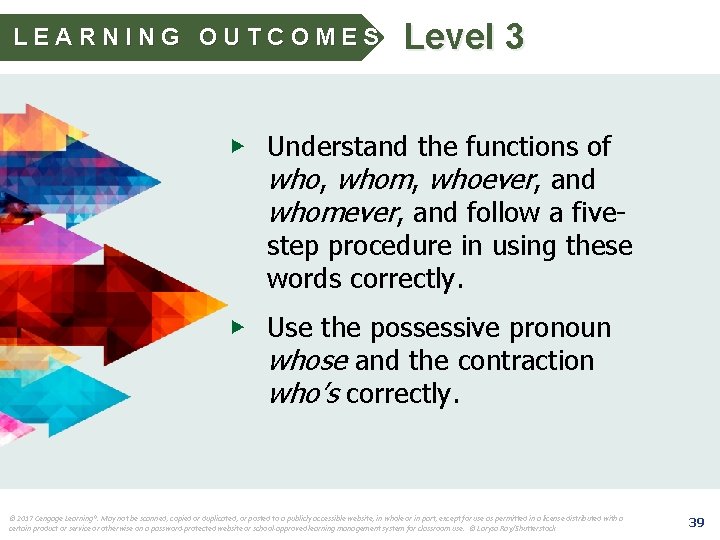
LEARNING OUTCOMES Level 3 ▶ Understand the functions of who, whom, whoever, and whomever, and follow a fivestep procedure in using these words correctly. ▶ Use the possessive pronoun whose and the contraction who’s correctly. © 2017 Cengage Learning®. May not be scanned, copied or duplicated, or posted to a publicly accessible website, in whole or in part, except for use as permitted in a license distributed with a certain product or service or otherwise on a password-protected website or school-approved learning management system for classroom use. © Larysa Ray/Shutterstock 39
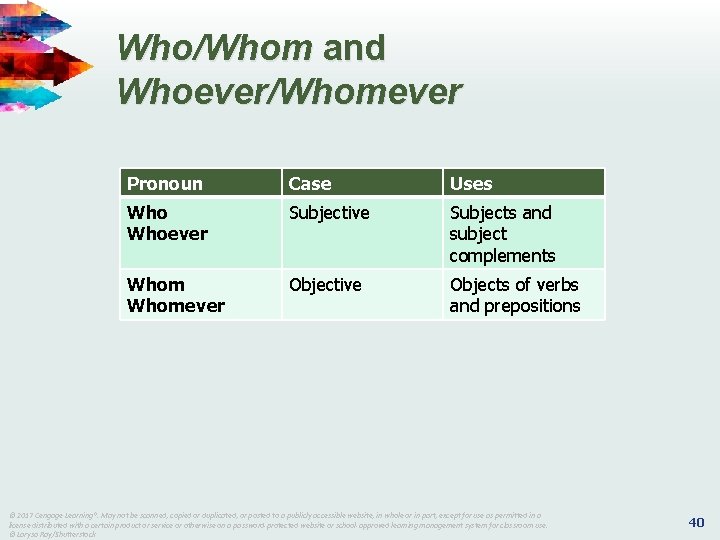
Who/Whom and Whoever/Whomever Pronoun Case Uses Whoever Subjective Subjects and subject complements Whomever Objective Objects of verbs and prepositions © © 2017 Cengage Learning®. May not be be scanned, copied or or duplicated, or or posted to to a a publicly accessible website, in in whole or or in in part, except for use as as permitted in in a a license distributed with a license with a certain product service or otherwise on a password-protected website or school-approved learning management for Ray/Shutterstock classroom use. certain distributed product or service or otherwise onor a password-protected website or school-approved learning management system for classroom use. system © Larysa Ray/Shutterstock 40
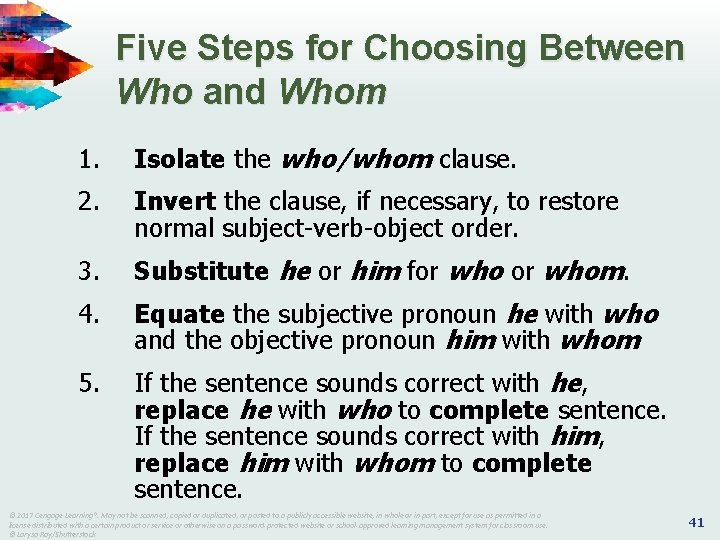
Five Steps for Choosing Between Who and Whom 1. Isolate the who/whom clause. 2. Invert the clause, if necessary, to restore normal subject-verb-object order. 3. Substitute he or him for whom. 4. Equate the subjective pronoun he with who and the objective pronoun him with whom 5. If the sentence sounds correct with he, replace he with who to complete sentence. If the sentence sounds correct with him, replace him with whom to complete sentence. © © 2017 Cengage Learning®. May not be be scanned, copied or or duplicated, or or posted to to a a publicly accessible website, in in whole or or in in part, except for use as as permitted in in a a license distributed with a license with a certain product service or otherwise on a password-protected website or school-approved learning management for Ray/Shutterstock classroom use. certain distributed product or service or otherwise onor a password-protected website or school-approved learning management system for classroom use. system © Larysa Ray/Shutterstock 41
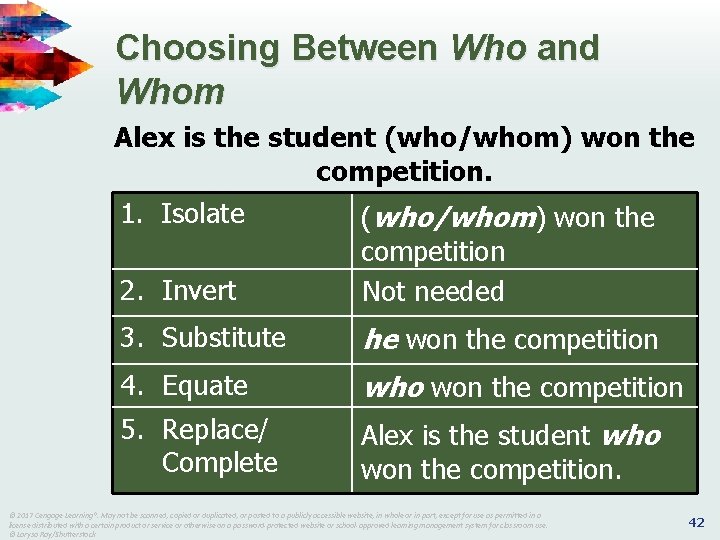
Choosing Between Who and Whom Alex is the student (who/whom) won the competition. 1. Isolate 2. Invert (who/whom) won the competition Not needed 3. Substitute he won the competition 4. Equate who won the competition 5. Replace/ Complete Alex is the student who won the competition. © © 2017 Cengage Learning®. May not be be scanned, copied or or duplicated, or or posted to to a a publicly accessible website, in in whole or or in in part, except for use as as permitted in in a a license distributed with a license with a certain product service or otherwise on a password-protected website or school-approved learning management for Ray/Shutterstock classroom use. certain distributed product or service or otherwise onor a password-protected website or school-approved learning management system for classroom use. system © Larysa Ray/Shutterstock 42
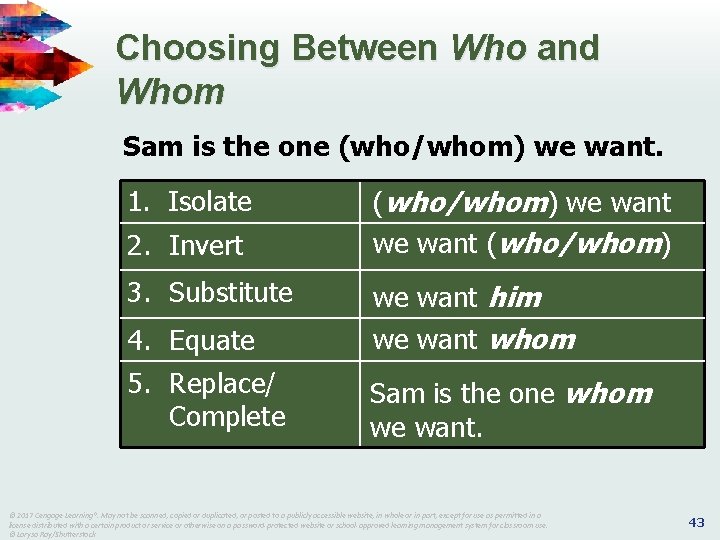
Choosing Between Who and Whom Sam is the one (who/whom) we want. 1. Isolate 2. Invert 3. Substitute (who/whom) we want (who/whom) 4. Equate we want him we want whom 5. Replace/ Complete Sam is the one whom we want. © © 2017 Cengage Learning®. May not be be scanned, copied or or duplicated, or or posted to to a a publicly accessible website, in in whole or or in in part, except for use as as permitted in in a a license distributed with a license with a certain product service or otherwise on a password-protected website or school-approved learning management for Ray/Shutterstock classroom use. certain distributed product or service or otherwise onor a password-protected website or school-approved learning management system for classroom use. system © Larysa Ray/Shutterstock 43
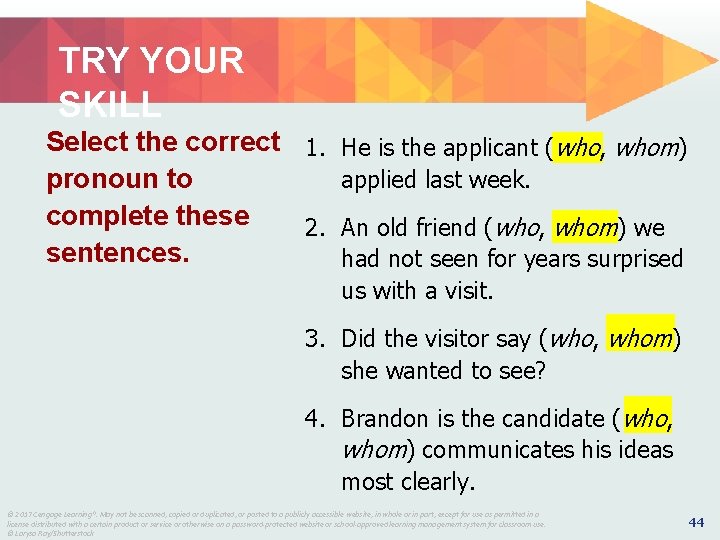
TRY YOUR SKILL Select the correct 1. He is the applicant (who, whom) applied last week. pronoun to complete these 2. An old friend (who, whom) we sentences. had not seen for years surprised us with a visit. 3. Did the visitor say (who, whom) she wanted to see? 4. Brandon is the candidate (who, whom) communicates his ideas most clearly. © 2017 Cengage Learning®. May not be scanned, copied or duplicated, or posted to a publicly accessible website, in whole or in part, except for use as permitted in a license distributed with a certain product or service or otherwise on a password-protected website or school-approved learning management system for classroom use. © Larysa Ray/Shutterstock 44
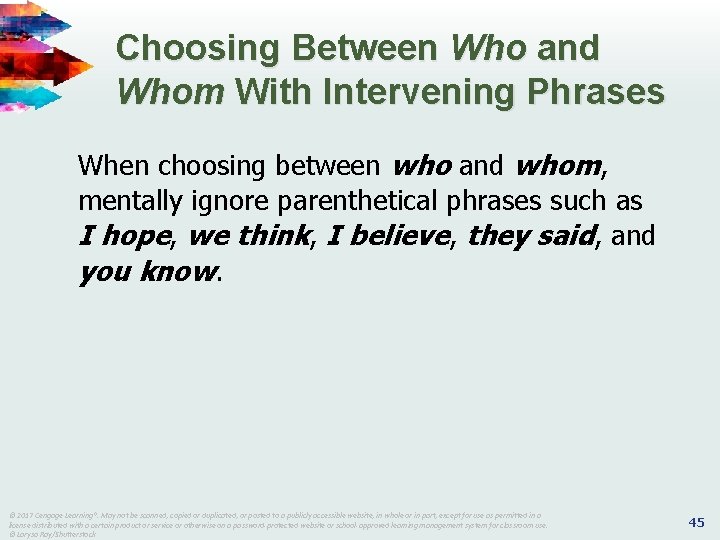
Choosing Between Who and Whom With Intervening Phrases When choosing between who and whom, mentally ignore parenthetical phrases such as I hope, we think, I believe, they said, and you know. © © 2017 Cengage Learning®. May not be be scanned, copied or or duplicated, or or posted to to a a publicly accessible website, in in whole or or in in part, except for use as as permitted in in a a license distributed with a license with a certain product service or otherwise on a password-protected website or school-approved learning management for Ray/Shutterstock classroom use. certain distributed product or service or otherwise onor a password-protected website or school-approved learning management system for classroom use. system © Larysa Ray/Shutterstock 45
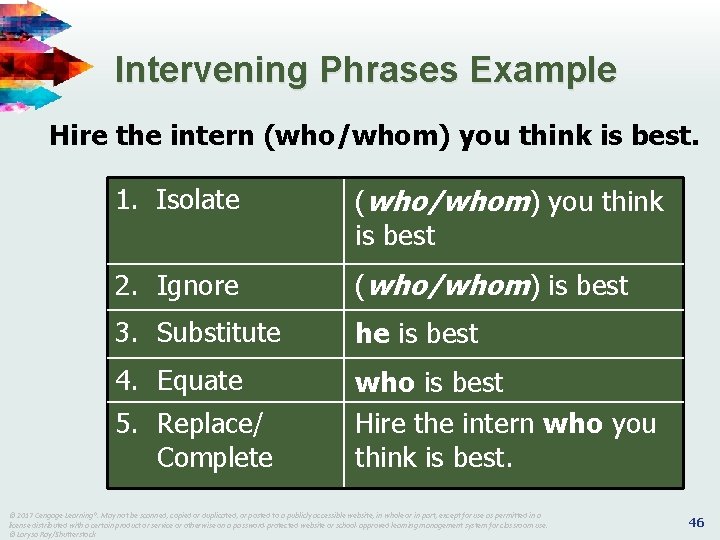
Intervening Phrases Example Hire the intern (who/whom) you think is best. 1. Isolate (who/whom) you think is best 2. Ignore (who/whom) is best 3. Substitute he is best 4. Equate who is best Hire the intern who you think is best. 5. Replace/ Complete © © 2017 Cengage Learning®. May not be be scanned, copied or or duplicated, or or posted to to a a publicly accessible website, in in whole or or in in part, except for use as as permitted in in a a license distributed with a license with a certain product service or otherwise on a password-protected website or school-approved learning management for Ray/Shutterstock classroom use. certain distributed product or service or otherwise onor a password-protected website or school-approved learning management system for classroom use. system © Larysa Ray/Shutterstock 46
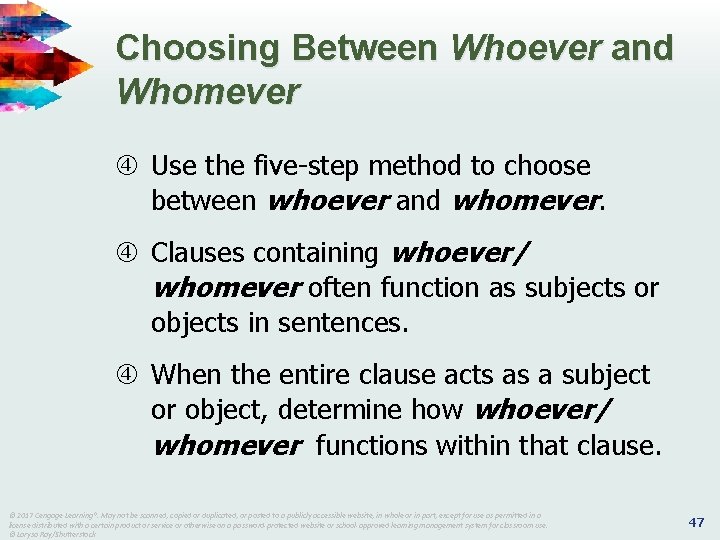
Choosing Between Whoever and Whomever Use the five-step method to choose between whoever and whomever. Clauses containing whoever/ whomever often function as subjects or objects in sentences. When the entire clause acts as a subject or object, determine how whoever/ whomever functions within that clause. © © 2017 Cengage Learning®. May not be be scanned, copied or or duplicated, or or posted to to a a publicly accessible website, in in whole or or in in part, except for use as as permitted in in a a license distributed with a license with a certain product service or otherwise on a password-protected website or school-approved learning management for Ray/Shutterstock classroom use. certain distributed product or service or otherwise onor a password-protected website or school-approved learning management system for classroom use. system © Larysa Ray/Shutterstock 47
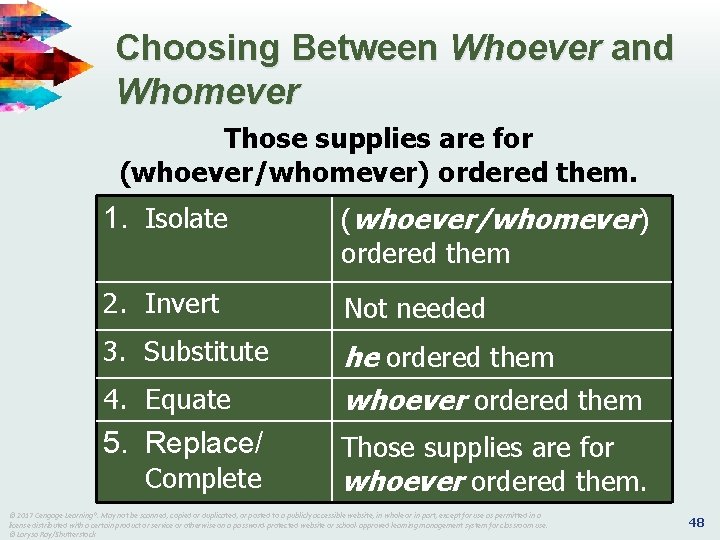
Choosing Between Whoever and Whomever Those supplies are for (whoever/whomever) ordered them. 1. Isolate (whoever/whomever) ordered them 2. Invert Not needed 3. Substitute he ordered them whoever ordered them 4. Equate 5. Replace/ Complete Those supplies are for whoever ordered them. © © 2017 Cengage Learning®. May not be be scanned, copied or or duplicated, or or posted to to a a publicly accessible website, in in whole or or in in part, except for use as as permitted in in a a license distributed with a license with a certain product service or otherwise on a password-protected website or school-approved learning management for Ray/Shutterstock classroom use. certain distributed product or service or otherwise onor a password-protected website or school-approved learning management system for classroom use. system © Larysa Ray/Shutterstock 48
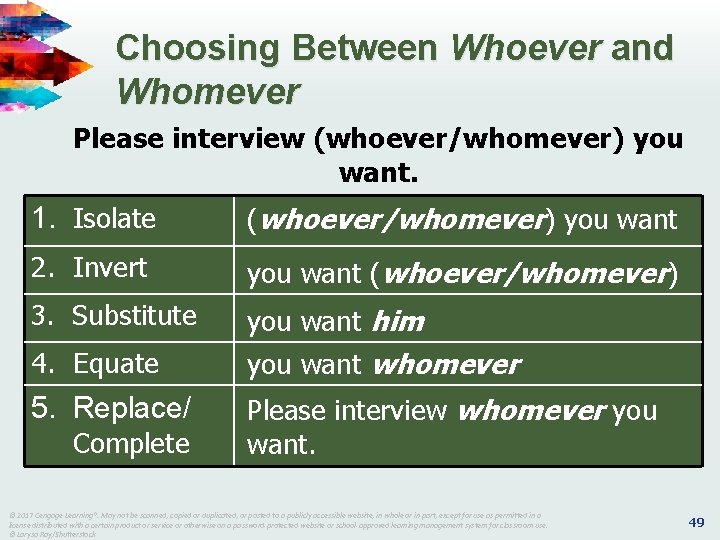
Choosing Between Whoever and Whomever Please interview (whoever/whomever) you want. 1. Isolate (whoever/whomever) you want 2. Invert you want (whoever/whomever) 3. Substitute you want him 4. Equate you want whomever 5. Replace/ Please interview whomever you want. Complete © © 2017 Cengage Learning®. May not be be scanned, copied or or duplicated, or or posted to to a a publicly accessible website, in in whole or or in in part, except for use as as permitted in in a a license distributed with a license with a certain product service or otherwise on a password-protected website or school-approved learning management for Ray/Shutterstock classroom use. certain distributed product or service or otherwise onor a password-protected website or school-approved learning management system for classroom use. system © Larysa Ray/Shutterstock 49
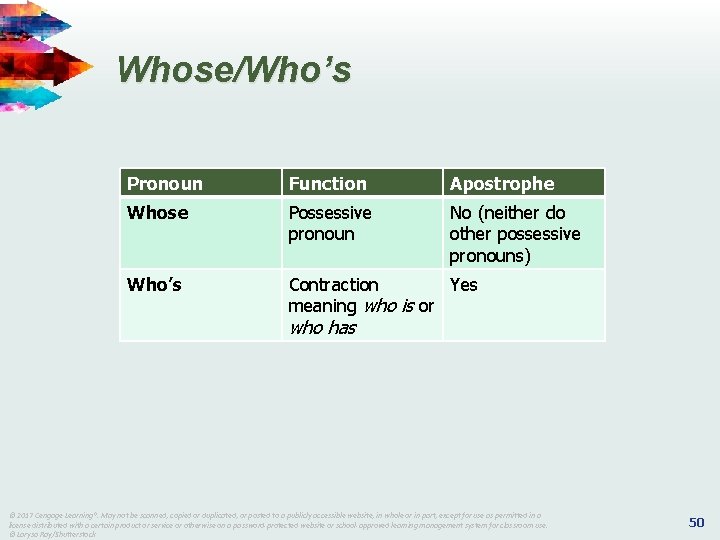
Whose/Who’s Pronoun Function Apostrophe Whose Possessive pronoun No (neither do other possessive pronouns) Who’s Contraction Yes meaning who is or who has © © 2017 Cengage Learning®. May not be be scanned, copied or or duplicated, or or posted to to a a publicly accessible website, in in whole or or in in part, except for use as as permitted in in a a license distributed with a license with a certain product service or otherwise on a password-protected website or school-approved learning management for Ray/Shutterstock classroom use. certain distributed product or service or otherwise onor a password-protected website or school-approved learning management system for classroom use. system © Larysa Ray/Shutterstock 50
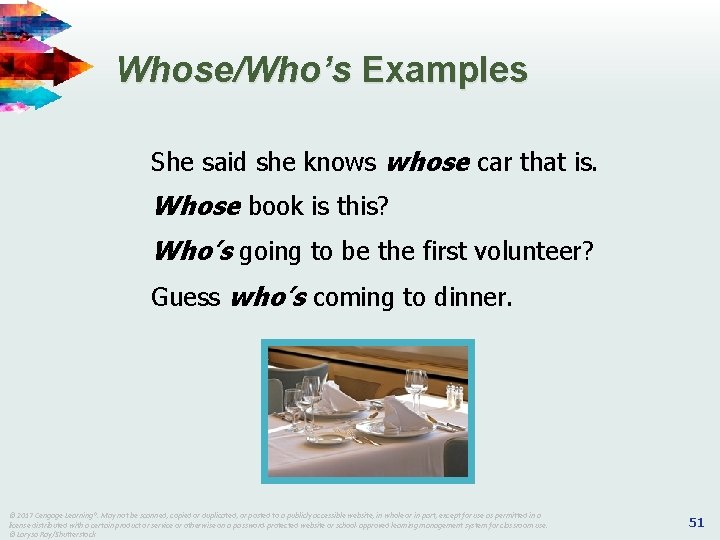
Whose/Who’s Examples She said she knows whose car that is. Whose book is this? Who’s going to be the first volunteer? Guess who’s coming to dinner. © © 2017 Cengage Learning®. May not be be scanned, copied or or duplicated, or or posted to to a a publicly accessible website, in in whole or or in in part, except for use as as permitted in in a a license distributed with a license with a certain product service or otherwise on a password-protected website or school-approved learning management for Ray/Shutterstock classroom use. certain distributed product or service or otherwise onor a password-protected website or school-approved learning management system for classroom use. system © Larysa Ray/Shutterstock 51
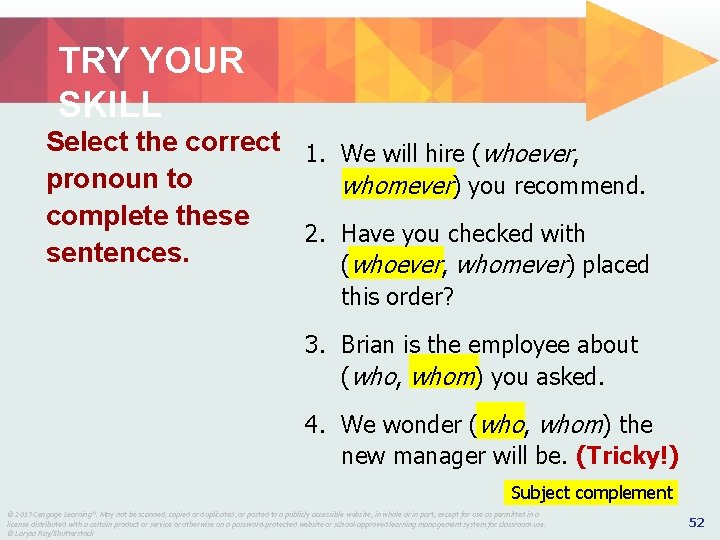
TRY YOUR SKILL Select the correct 1. We will hire (whoever, pronoun to whomever) you recommend. complete these 2. Have you checked with sentences. (whoever, whomever) placed this order? 3. Brian is the employee about (who, whom) you asked. 4. We wonder (who, whom) the new manager will be. (Tricky!) Subject complement © 2017 Cengage Learning®. May not be scanned, copied or duplicated, or posted to a publicly accessible website, in whole or in part, except for use as permitted in a license distributed with a certain product or service or otherwise on a password-protected website or school-approved learning management system for classroom use. © Larysa Ray/Shutterstock 52
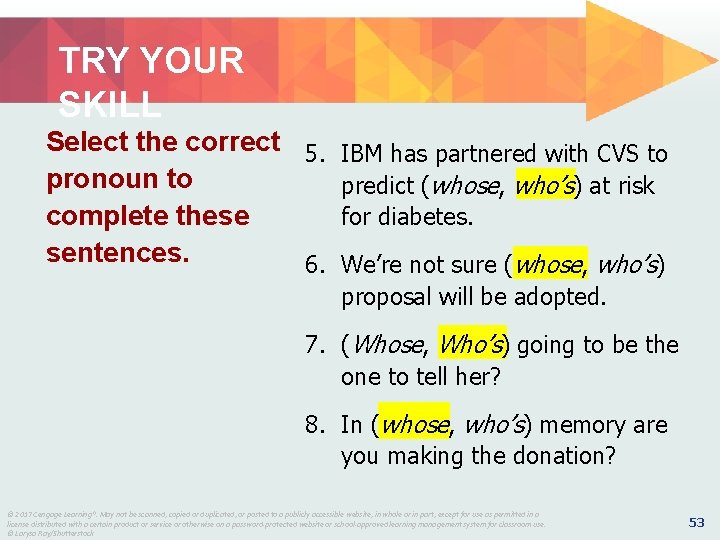
TRY YOUR SKILL Select the correct 5. IBM has partnered with CVS to pronoun to predict (whose, who’s) at risk complete these for diabetes. sentences. 6. We’re not sure (whose, who’s) proposal will be adopted. 7. (Whose, Who’s) going to be the one to tell her? 8. In (whose, who’s) memory are you making the donation? © 2017 Cengage Learning®. May not be scanned, copied or duplicated, or posted to a publicly accessible website, in whole or in part, except for use as permitted in a license distributed with a certain product or service or otherwise on a password-protected website or school-approved learning management system for classroom use. © Larysa Ray/Shutterstock 53
“What is written without effort is in general read without pleasure. ” – Samuel Johnson, English writer/critic/editor (17091784) © 2017 Cengage Learning®. May not be scanned, copied or duplicated, or posted to a publicly accessible website, in whole or in part, except for use as permitted in a © 2017 Cengagewith Learning®. May not be or duplicated, or posted to a publicly website, in learning whole ormanagement in part, except for useforasclassroom permitteduse. in a license distributed with a license distributed a certain product orscanned, service orcopied otherwise on a password-protected websiteaccessible or school-approved system © certain product or service or otherwise on a password-protected website or school-approved learning management system for classroom use. © Larysa Ray/Shutterstock 54