
4 Project Integration Management PMP Prep Course Based
4. Project Integration Management PMP Prep Course Based on the PMBOK® Guide 3 rd Edition v. 2. © Copyright and all rights reserved – 2005 PMI Mile Hi Chapter Integration -
4. Project Integration Management – Includes the processes and activities to identify, define, combine, unify, and coordinate the various processes and project management activities within the Project Management Process Groups. *Source: PMBOK® p. 77 12/07/05 v. 2. © Copyright and all rights reserved – 2005 PMI Mile Hi Chapter 2
4. Project Integration Management Integration – Is primarily concerned with effectively integrating the processes among the Project Management Process Groups that are required to accomplish project objective within an organization's defined procedures. Not all processes may be required, but they all must be addressed. *Source: PMBOK® p. 78 12/07/05 v. 2. © Copyright and all rights reserved – 2005 PMI Mile Hi Chapter 3
4. Project Integration Management A significant role of the Project Manager is to perform Integration. To put all the pieces of the Project together into a cohesive whole that gets the project done faster, on Scope with defined Quality, for less costs and resources. *Source: PMBOK® p. 78 12/07/05 v. 2. © Copyright and all rights reserved – 2005 PMI Mile Hi Chapter 4
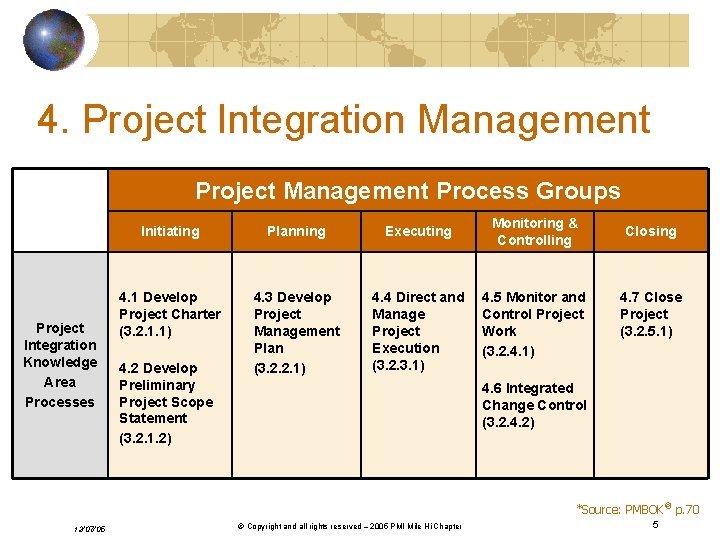
4. Project Integration Management Project Management Process Groups Project Integration Knowledge Area Processes Initiating Planning Executing Monitoring & Controlling 4. 1 Develop Project Charter (3. 2. 1. 1) 4. 3 Develop Project Management Plan (3. 2. 2. 1) 4. 4 Direct and Manage Project Execution (3. 2. 3. 1) 4. 5 Monitor and Control Project Work (3. 2. 4. 1) 4. 2 Develop Preliminary Project Scope Statement (3. 2. 1. 2) Closing 4. 7 Close Project (3. 2. 5. 1) 4. 6 Integrated Change Control (3. 2. 4. 2) *Source: PMBOK® p. 70 12/07/05 v. 2. © Copyright and all rights reserved – 2005 PMI Mile Hi Chapter 5
4. 1 Develop Project Charter – The document that formally authorizes a project. Provides the project manager the authority to apply organizational resources. The project manager should be assigned prior to the start of planning, and preferably while the project charter is being developed. *Source: PMBOK® p. 81 12/07/05 v. 2. © Copyright and all rights reserved – 2005 PMI Mile Hi Chapter 6
4. 1 Develop Project Charter The Charter – documents business needs, project justification, current understanding of the customer's requirements, and the new product, service, or result that is intended to satisfy those requirements. *Source: PMBOK® p. 81 12/07/05 v. 2. © Copyright and all rights reserved – 2005 PMI Mile Hi Chapter 7
4. 1 Develop Project Charter The charter addresses: Stakeholder requirements, expectations Business needs Project purpose or justification Assigned Project Manager and authorities Assumptions; Constraints Summary milestone schedule Stakeholder influences Functional organization responsibilities Business case justification Summary budget *Source: PMBOK® p. 82 12/07/05 v. 2. © Copyright and all rights reserved – 2005 PMI Mile Hi Chapter 8
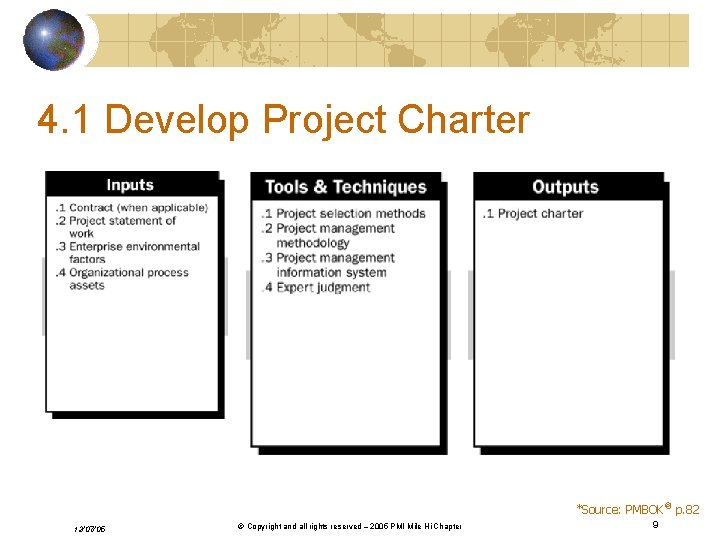
4. 1 Develop Project Charter *Source: PMBOK® p. 82 12/07/05 v. 2. © Copyright and all rights reserved – 2005 PMI Mile Hi Chapter 9
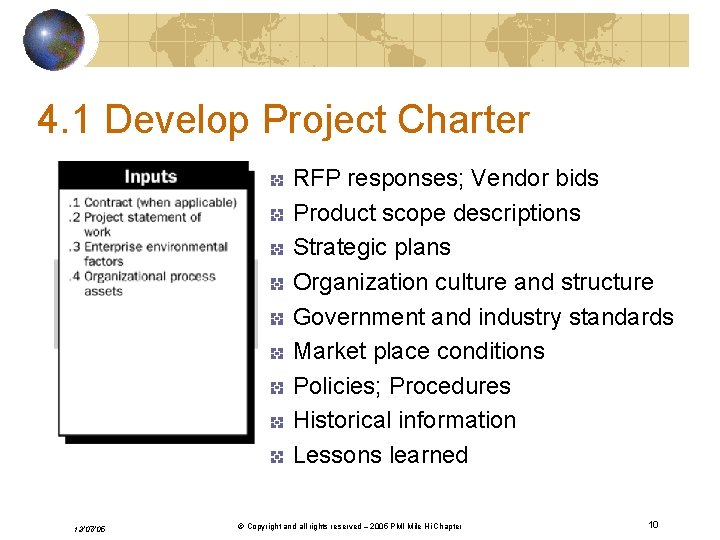
4. 1 Develop Project Charter RFP responses; Vendor bids Product scope descriptions Strategic plans Organization culture and structure Government and industry standards Market place conditions Policies; Procedures Historical information Lessons learned 12/07/05 v. 2. © Copyright and all rights reserved – 2005 PMI Mile Hi Chapter 10
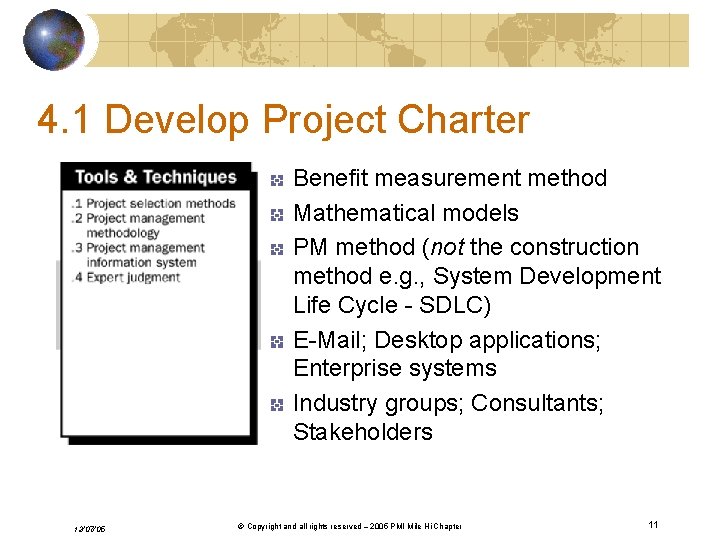
4. 1 Develop Project Charter Benefit measurement method Mathematical models PM method (not the construction method e. g. , System Development Life Cycle - SDLC) E-Mail; Desktop applications; Enterprise systems Industry groups; Consultants; Stakeholders 12/07/05 v. 2. © Copyright and all rights reserved – 2005 PMI Mile Hi Chapter 11
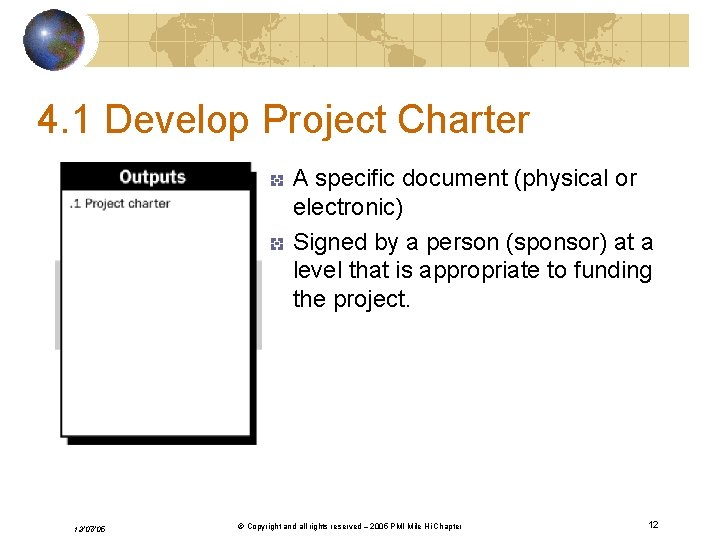
4. 1 Develop Project Charter A specific document (physical or electronic) Signed by a person (sponsor) at a level that is appropriate to funding the project. 12/07/05 v. 2. © Copyright and all rights reserved – 2005 PMI Mile Hi Chapter 12
4. 2 Develop Preliminary Project Scope Statement – The definition of the project – what needs to be accomplished. The process addresses and documents the characteristics and boundaries of the project and its associated products and services, as well as the methods of acceptance and scope control. *Source: PMBOK® p. 86 12/07/05 v. 2. © Copyright and all rights reserved – 2005 PMI Mile Hi Chapter 13
4. 2 Develop Preliminary Project Scope Statement A scope statement includes: Project, product objectives Product/service requirements and characteristics Acceptance criteria Project boundaries Project requirements and deliverables Project constraints, assumptions 12/07/05 Initial project organization Initial defined risks Schedule milestones Initial WBS Order of magnitude cost estimate Project configuration management requirements Approval requirements *Source: PMBOK p. 86 v. 2. © Copyright and all rights reserved – 2005 PMI Mile Hi Chapter ® 14
4. 2 Develop Preliminary Project Scope Statement Constraints – Factors that will limit the project team’s options: Budget Schedule Scope Staff 12/07/05 Legal/Contractual Political Cultural v. 2. © Copyright and all rights reserved – 2005 PMI Mile Hi Chapter 15
4. 2 Develop Preliminary Project Scope Statement 12/07/05 v. 2. © Copyright and all rights reserved – 2005 PMI Mile Hi Chapter 16
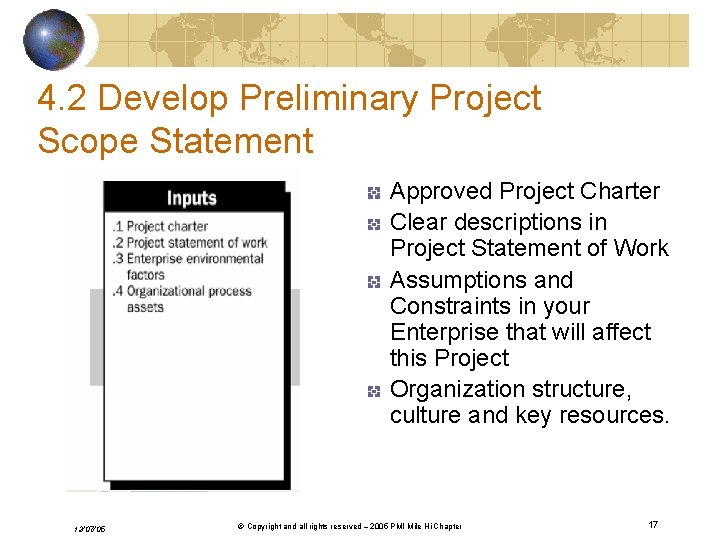
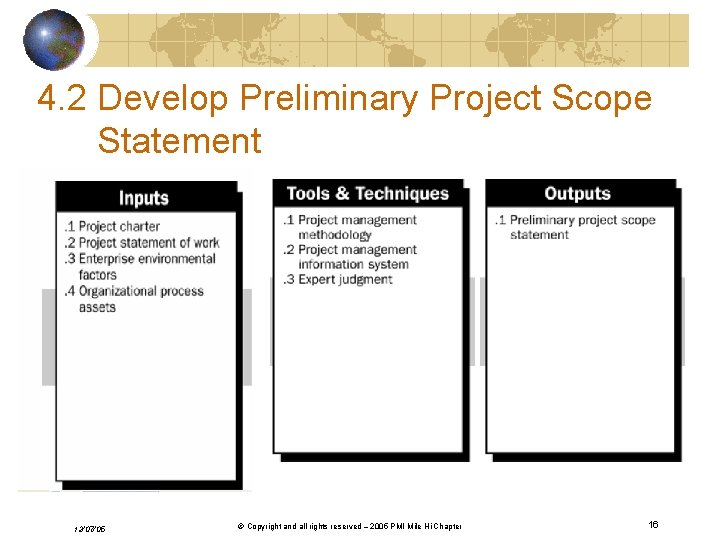
4. 2 Develop Preliminary Project Scope Statement Approved Project Charter Clear descriptions in Project Statement of Work Assumptions and Constraints in your Enterprise that will affect this Project Organization structure, culture and key resources. 12/07/05 v. 2. © Copyright and all rights reserved – 2005 PMI Mile Hi Chapter 17
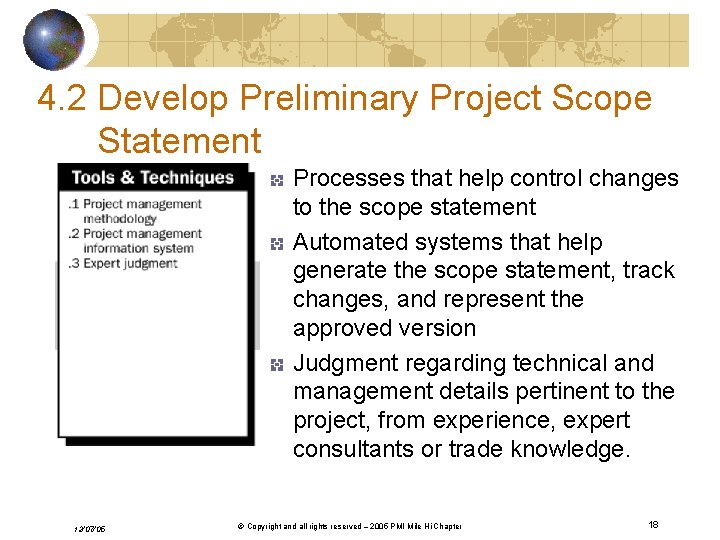
4. 2 Develop Preliminary Project Scope Statement Processes that help control changes to the scope statement Automated systems that help generate the scope statement, track changes, and represent the approved version Judgment regarding technical and management details pertinent to the project, from experience, expert consultants or trade knowledge. 12/07/05 v. 2. © Copyright and all rights reserved – 2005 PMI Mile Hi Chapter 18
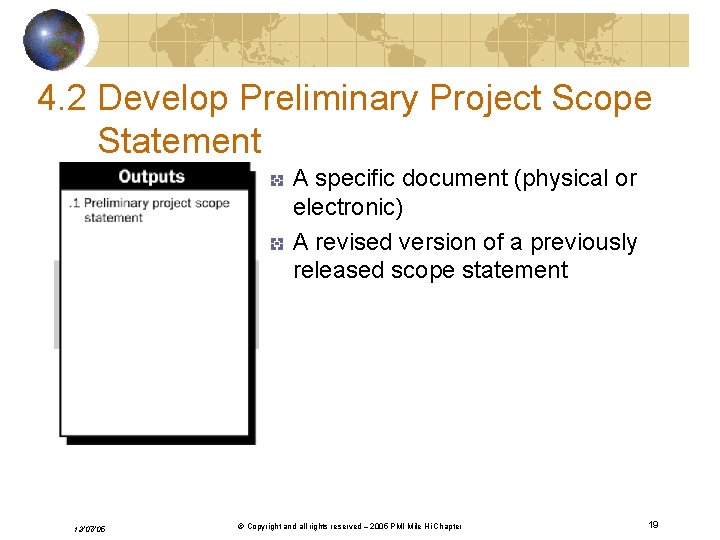
4. 2 Develop Preliminary Project Scope Statement A specific document (physical or electronic) A revised version of a previously released scope statement 12/07/05 v. 2. © Copyright and all rights reserved – 2005 PMI Mile Hi Chapter 19
4. 3 Develop Project Management Plan Developing the plan – Includes the actions necessary to define, integrate, and coordinate all subsidiary plans into a project management plan – a plan that defines how the project is executed, monitored and controlled, and closed. The plan documents the outputs of the processes of the Planning Process Group. (see PMBOK, page 70) 12/07/05 v. 2. © Copyright and all rights reserved – 2005 PMI Mile Hi Chapter *Source: PMBOK® p. 88 20
4. 3 Develop Project Management Plan Sample plan content: (not limited to) PM processes How work will be executed How changes will be controlled What tools will be used Key management review processes Communication channels Subsidiary plans / baselines: Scope management plan Cost management plan Quality management plan Staffing management plan Risk management plan Schedule, cost, quality baselines *Source: PMBOK® p. 88/89 12/07/05 v. 2. © Copyright and all rights reserved – 2005 PMI Mile Hi Chapter 21
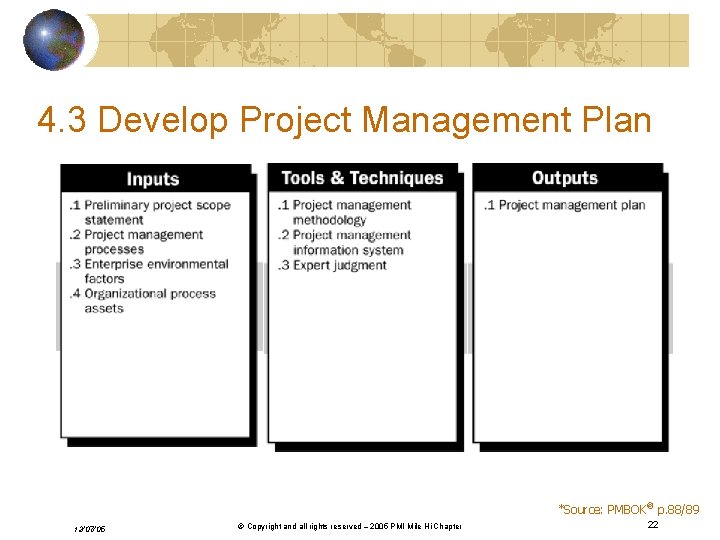
4. 3 Develop Project Management Plan *Source: PMBOK® p. 88/89 12/07/05 v. 2. © Copyright and all rights reserved – 2005 PMI Mile Hi Chapter 22
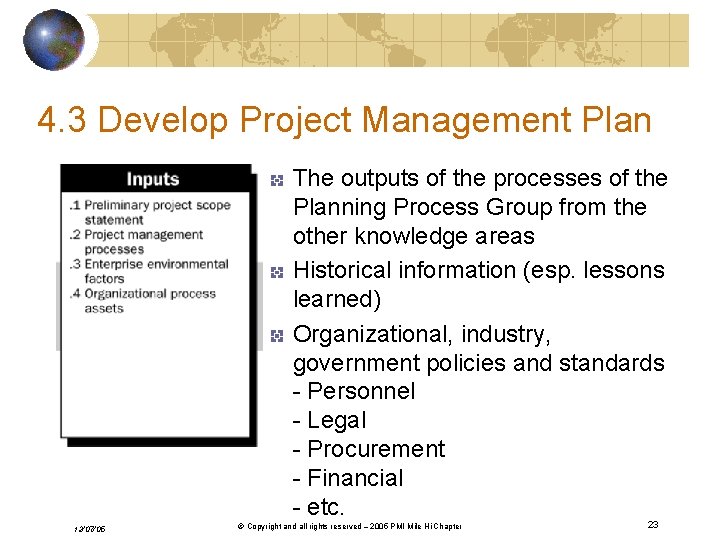
4. 3 Develop Project Management Plan The outputs of the processes of the Planning Process Group from the other knowledge areas Historical information (esp. lessons learned) Organizational, industry, government policies and standards - Personnel - Legal - Procurement - Financial - etc. 12/07/05 v. 2. © Copyright and all rights reserved – 2005 PMI Mile Hi Chapter 23
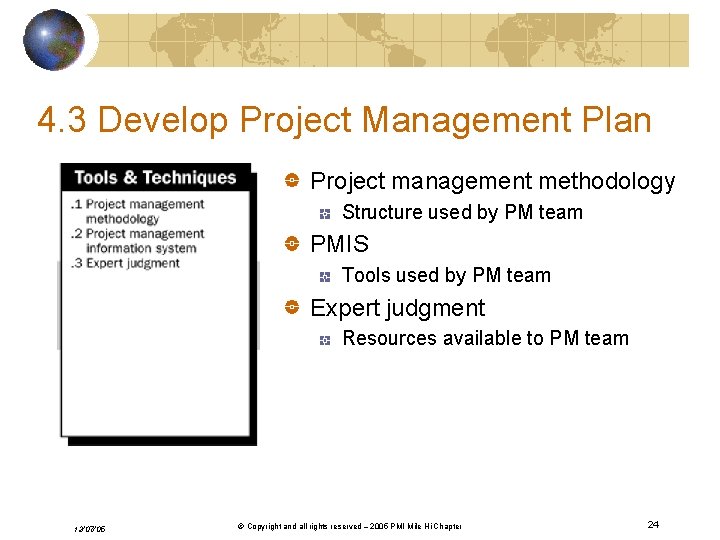
4. 3 Develop Project Management Plan Project management methodology Structure used by PM team PMIS Tools used by PM team Expert judgment Resources available to PM team 12/07/05 v. 2. © Copyright and all rights reserved – 2005 PMI Mile Hi Chapter 24
4. 3 Develop Project Management Plan – Tools and Techniques Project Management Methodology – A structured approach which aids a project management team in developing and controlling changes. Simple – uses standard forms and/or templates Complex – Requiring simulation Manual or Electronic Formal or Informal 12/07/05 v. 2. © Copyright and all rights reserved – 2005 PMI Mile Hi Chapter 25
4. 3 Develop Project Management Plan – Tools and Techniques Project Management Information System (PMIS) – Tools and techniques used to: Gather Integrate Disseminate the outputs of the other project management processes. Support all aspects of the project from initiation to closing. Includes both manual and automated systems. 12/07/05 v. 2. © Copyright and all rights reserved – 2005 PMI Mile Hi Chapter 26
4. 3 Develop Project Management Plan – Tools and Techniques Expert Judgment (Stakeholder Skills & Knowledge) – The project team must develop an environment in which the stakeholders can contribute their expertise to the project. Valuable Sources of Information PM Must Be Open to Input In-House Advisors Involved Stakeholders are Less Disruptive 12/07/05 v. 2. © Copyright and all rights reserved – 2005 PMI Mile Hi Chapter 27
4. 3 Develop Project Management Plan Project management plan Formal, approved document Used to manage and control the project Integrated supporting organization input Will change over time!!! 12/07/05 v. 2. © Copyright and all rights reserved – 2005 PMI Mile Hi Chapter 28
4. 3 Develop Project Management Plan – Typical Content Project Charter Strategy Scope Statement including deliverable and objectives WBS Cost Estimates Schedule Performance Measurement Baselines 12/07/05 Major milestones Key or required staff Organization structure Subsidiary plans Risk assessment, including constraints, and assumptions Open issues v. 2. © Copyright and all rights reserved – 2005 PMI Mile Hi Chapter 29
4. 3 Develop Project Management Plan Supporting Detail Outputs from other plans Additional information Technical documentation (e. g. requirements, design and specifications) Documentation of relevant standards Organized to facilitate use in executing the plan 12/07/05 v. 2. © Copyright and all rights reserved – 2005 PMI Mile Hi Chapter 30
4. 4 Direct and Manage Project Plan Execution The project manager & team perform multiple actions to accomplish the work defined. – The primary process for carrying out the project plan. The vast majority of the project’s budget will be expended in performing this process. 12/07/05 v. 2. © Copyright and all rights reserved – 2005 PMI Mile Hi Chapter 31
4. 4 Direct and Manage Project Plan Execution 12/07/05 v. 2. © Copyright and all rights reserved – 2005 PMI Mile Hi Chapter 32
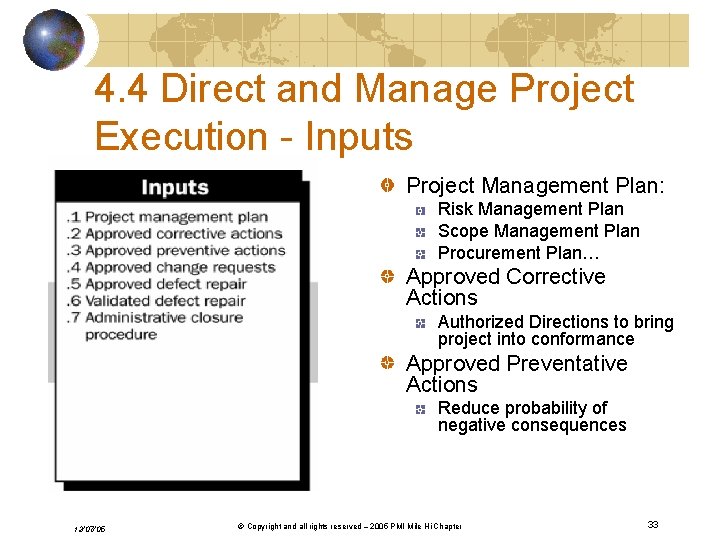
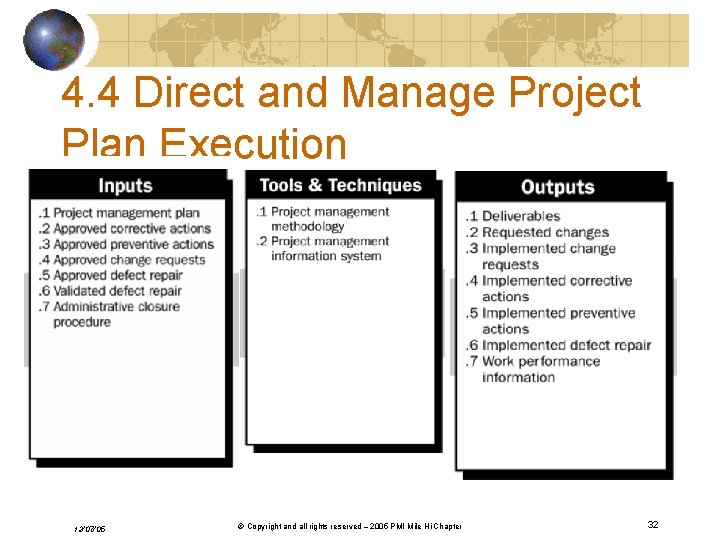
4. 4 Direct and Manage Project Execution - Inputs Project Management Plan: Risk Management Plan Scope Management Plan Procurement Plan… Approved Corrective Actions Authorized Directions to bring project into conformance Approved Preventative Actions Reduce probability of negative consequences 12/07/05 v. 2. © Copyright and all rights reserved – 2005 PMI Mile Hi Chapter 33
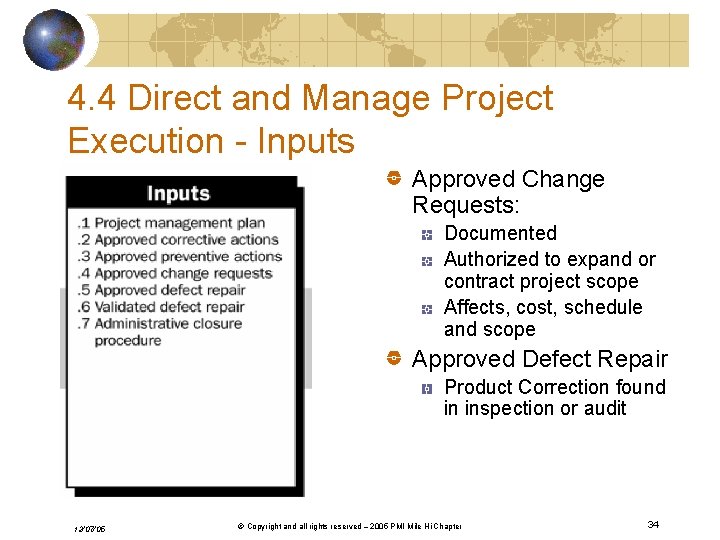
4. 4 Direct and Manage Project Execution - Inputs Approved Change Requests: Documented Authorized to expand or contract project scope Affects, cost, schedule and scope Approved Defect Repair Product Correction found in inspection or audit 12/07/05 v. 2. © Copyright and all rights reserved – 2005 PMI Mile Hi Chapter 34
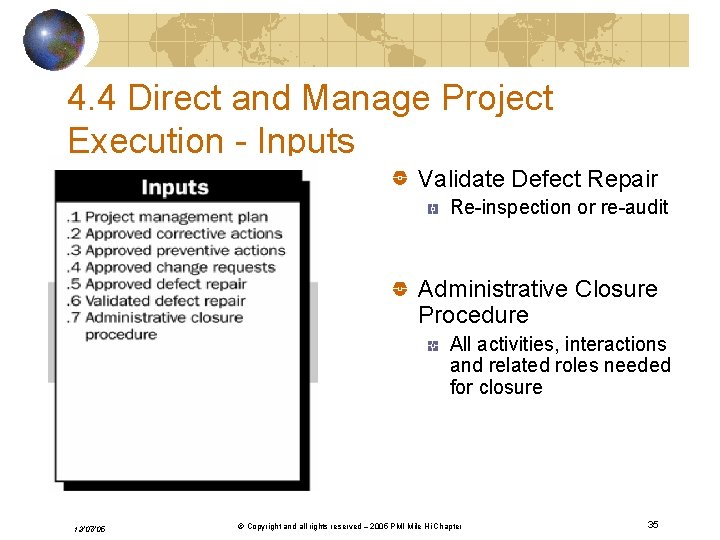
4. 4 Direct and Manage Project Execution - Inputs Validate Defect Repair Re-inspection or re-audit Administrative Closure Procedure All activities, interactions and related roles needed for closure 12/07/05 v. 2. © Copyright and all rights reserved – 2005 PMI Mile Hi Chapter 35
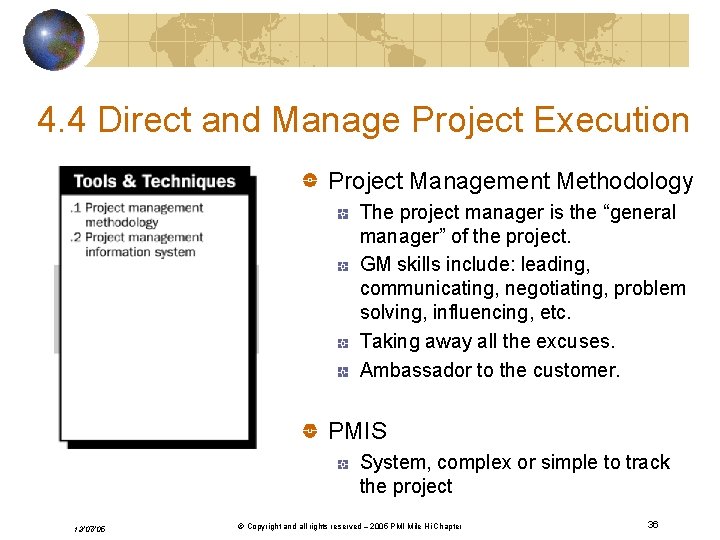
4. 4 Direct and Manage Project Execution Project Management Methodology The project manager is the “general manager” of the project. GM skills include: leading, communicating, negotiating, problem solving, influencing, etc. Taking away all the excuses. Ambassador to the customer. PMIS System, complex or simple to track the project 12/07/05 v. 2. © Copyright and all rights reserved – 2005 PMI Mile Hi Chapter 36
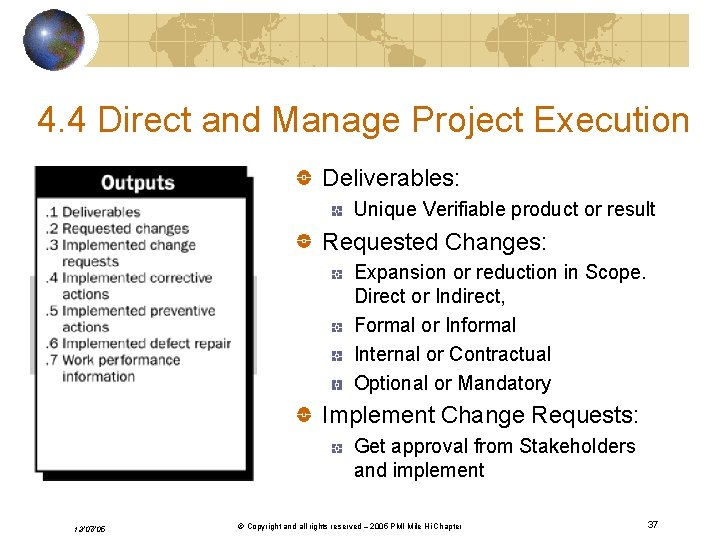
4. 4 Direct and Manage Project Execution Deliverables: Unique Verifiable product or result Requested Changes: Expansion or reduction in Scope. Direct or Indirect, Formal or Informal Internal or Contractual Optional or Mandatory Implement Change Requests: Get approval from Stakeholders and implement 12/07/05 v. 2. © Copyright and all rights reserved – 2005 PMI Mile Hi Chapter 37
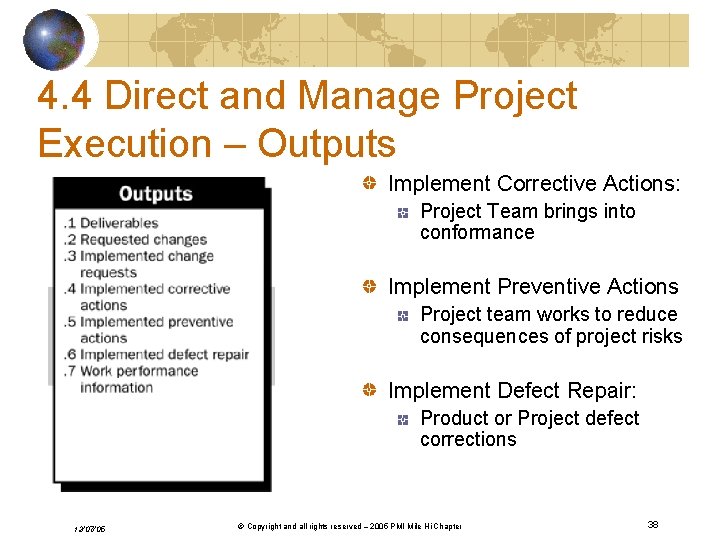
4. 4 Direct and Manage Project Execution – Outputs Implement Corrective Actions: Project Team brings into conformance Implement Preventive Actions Project team works to reduce consequences of project risks Implement Defect Repair: Product or Project defect corrections 12/07/05 v. 2. © Copyright and all rights reserved – 2005 PMI Mile Hi Chapter 38
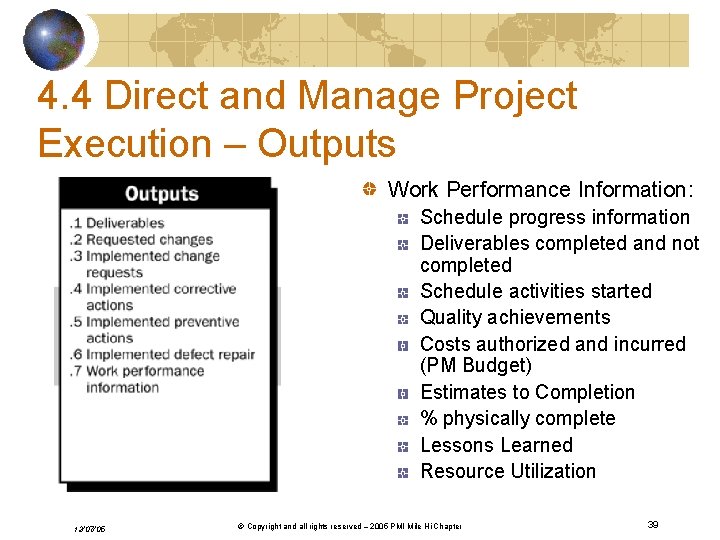
4. 4 Direct and Manage Project Execution – Outputs Work Performance Information: Schedule progress information Deliverables completed and not completed Schedule activities started Quality achievements Costs authorized and incurred (PM Budget) Estimates to Completion % physically complete Lessons Learned Resource Utilization 12/07/05 v. 2. © Copyright and all rights reserved – 2005 PMI Mile Hi Chapter 39
4. 5 Monitor and Control Project Work This process is performed to monitor project processes associated with initiating, planning, executing and closing. Continuous monitoring gives the project team insight into the health of the project and identifies areas needing attention. *Source: PMBOK® p. 94 12/07/05 v. 2. © Copyright and all rights reserved – 2005 PMI Mile Hi Chapter 40
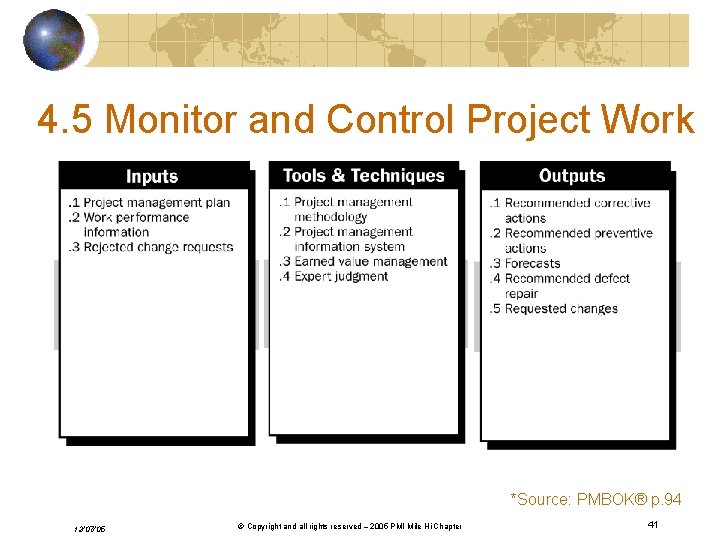
4. 5 Monitor and Control Project Work *Source: PMBOK® p. 94 12/07/05 v. 2. © Copyright and all rights reserved – 2005 PMI Mile Hi Chapter 41
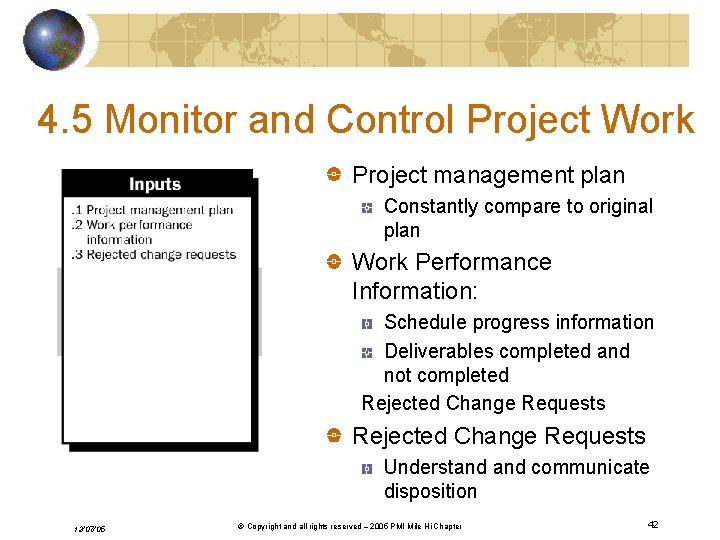
4. 5 Monitor and Control Project Work Project management plan Constantly compare to original plan Work Performance Information: Schedule progress information Deliverables completed and not completed Rejected Change Requests Understand communicate disposition 12/07/05 v. 2. © Copyright and all rights reserved – 2005 PMI Mile Hi Chapter 42
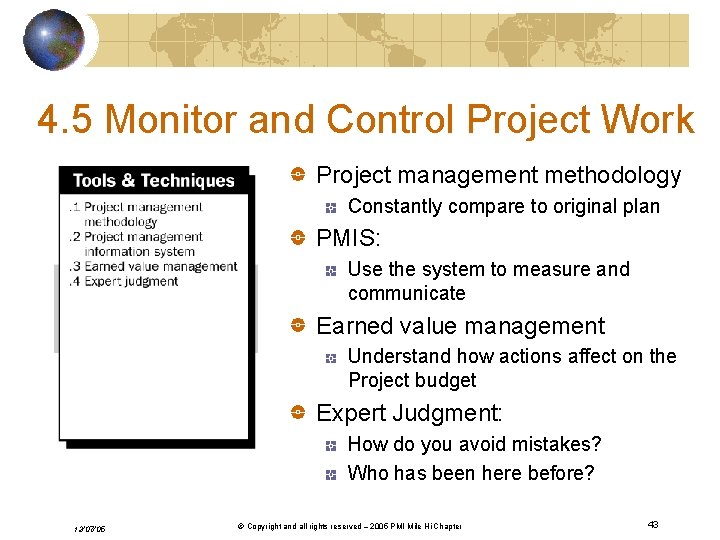
4. 5 Monitor and Control Project Work Project management methodology Constantly compare to original plan PMIS: Use the system to measure and communicate Earned value management Understand how actions affect on the Project budget Expert Judgment: How do you avoid mistakes? Who has been here before? 12/07/05 v. 2. © Copyright and all rights reserved – 2005 PMI Mile Hi Chapter 43
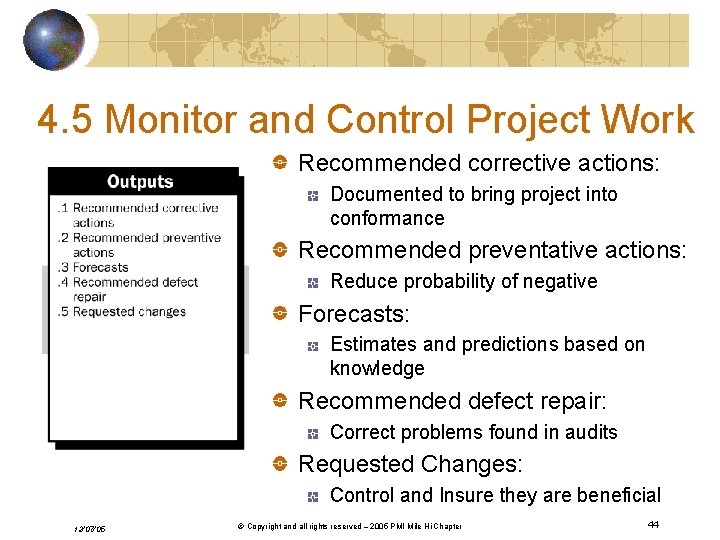
4. 5 Monitor and Control Project Work Recommended corrective actions: Documented to bring project into conformance Recommended preventative actions: Reduce probability of negative Forecasts: Estimates and predictions based on knowledge Recommended defect repair: Correct problems found in audits Requested Changes: Control and Insure they are beneficial 12/07/05 v. 2. © Copyright and all rights reserved – 2005 PMI Mile Hi Chapter 44
4. 6 Integrated Change Control Process begins at project inception through completions. Projects rarely run exactly according to the plan. Identify if change is really needed Get needed changes approved Implement approved changes Maintain integrity of baselines Insure Scope, Cost, Schedule & Quality are integrated into change process, understand Risk 12/07/05 v. 2. © Copyright and all rights reserved – 2005 PMI Mile Hi Chapter 45
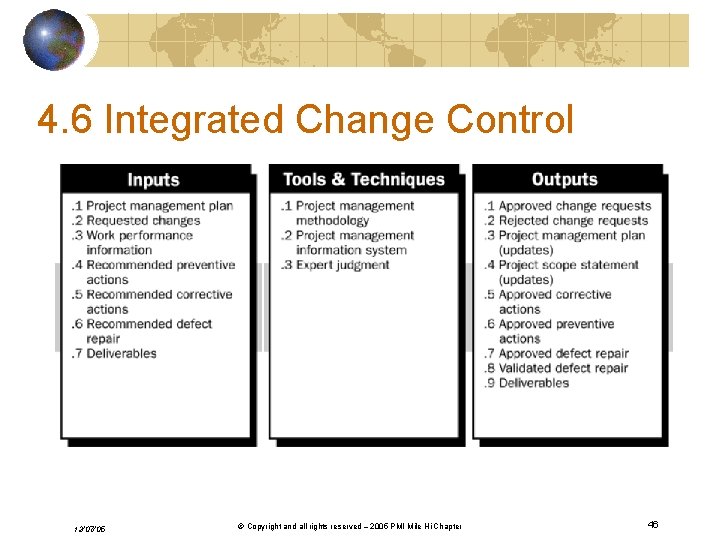
4. 6 Integrated Change Control 12/07/05 v. 2. © Copyright and all rights reserved – 2005 PMI Mile Hi Chapter 46
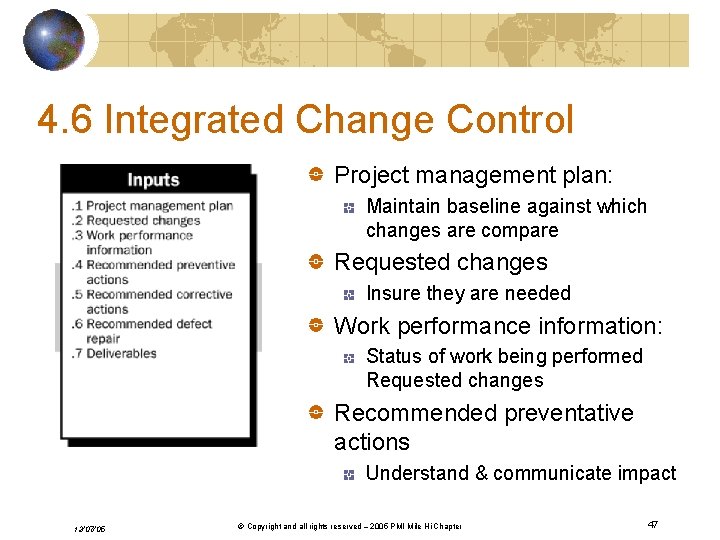
4. 6 Integrated Change Control Project management plan: Maintain baseline against which changes are compare Requested changes Insure they are needed Work performance information: Status of work being performed Requested changes Recommended preventative actions Understand & communicate impact 12/07/05 v. 2. © Copyright and all rights reserved – 2005 PMI Mile Hi Chapter 47
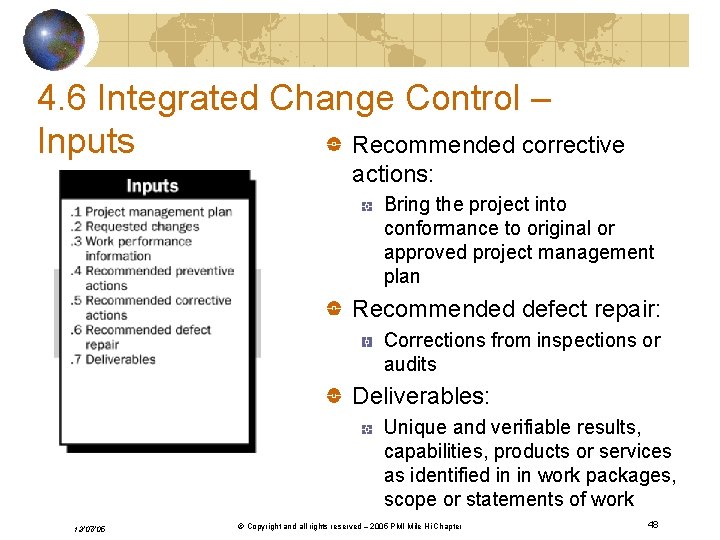
4. 6 Integrated Change Control – Recommended corrective Inputs actions: Bring the project into conformance to original or approved project management plan Recommended defect repair: Corrections from inspections or audits Deliverables: Unique and verifiable results, capabilities, products or services as identified in in work packages, scope or statements of work 12/07/05 v. 2. © Copyright and all rights reserved – 2005 PMI Mile Hi Chapter 48
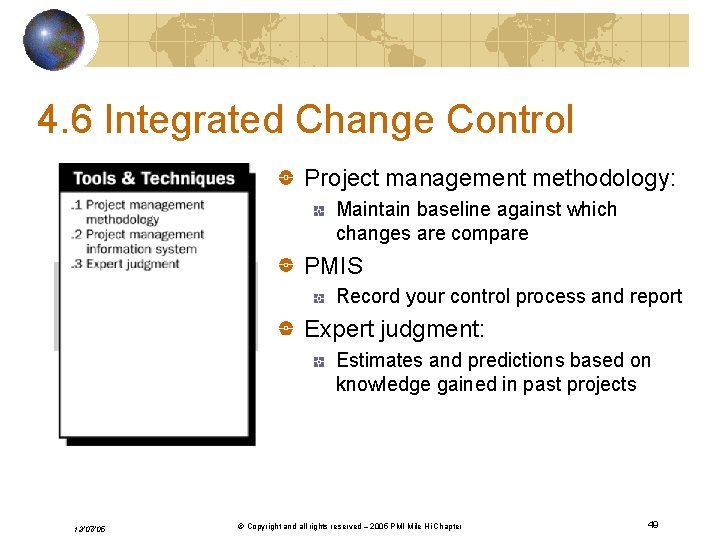
4. 6 Integrated Change Control Project management methodology: Maintain baseline against which changes are compare PMIS Record your control process and report Expert judgment: Estimates and predictions based on knowledge gained in past projects 12/07/05 v. 2. © Copyright and all rights reserved – 2005 PMI Mile Hi Chapter 49
4. 6 Integrated Change Control System – A collection of formal, documented procedures that define the steps by which official project documents may be changed. Defines levels of change Includes: • A logging mechanism • A tracking system • An approval process with various types of changes 12/07/05 v. 2. © Copyright and all rights reserved – 2005 PMI Mile Hi Chapter 50
4. 6 Integrated Change Control System (PMIS) Change Control Board (CCB) • Reviews all changes • Approves or reject all change requests • Chaired by the project manager • Well defined responsibilities • Approved by major stakeholders 12/07/05 v. 2. © Copyright and all rights reserved – 2005 PMI Mile Hi Chapter 51
4. 6 Integrated Change Control Configuration Management – A documented procedure to apply technical and administrative direction to: Identify and document the functional and physical characteristics of an item or system. Control any changes to characteristics. Record and report the change and status. Audit to verify conformance to requirements 12/07/05 v. 2. © Copyright and all rights reserved – 2005 PMI Mile Hi Chapter 52
4. 6 Integrated Change Control Configuration Management A subset of Change Control Used to ensure that the product or service description is correct and complete. Manages the product or service configuration and any changes to it. 12/07/05 v. 2. © Copyright and all rights reserved – 2005 PMI Mile Hi Chapter 53
4. 6 Integrated Change Control Performance Reporting Processes Techniques such as Earned Value Analysis Used to measure variances to the plan Identifies areas to apply corrective action 12/07/05 v. 2. © Copyright and all rights reserved – 2005 PMI Mile Hi Chapter 54
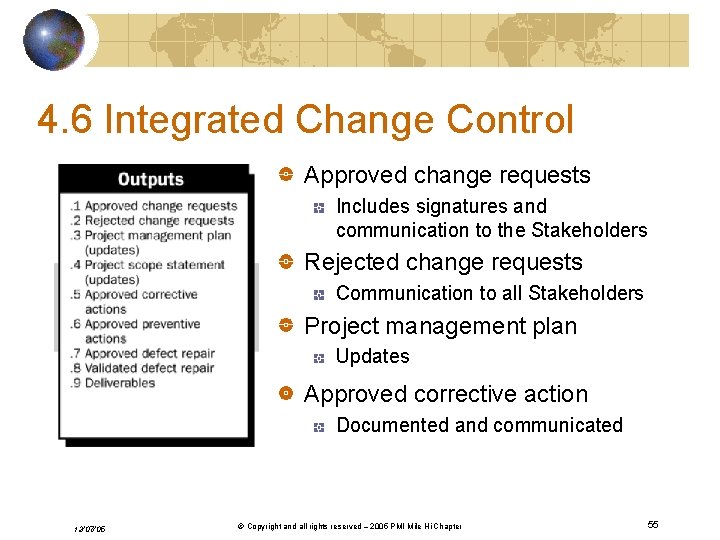
4. 6 Integrated Change Control Approved change requests Includes signatures and communication to the Stakeholders Rejected change requests Communication to all Stakeholders Project management plan Updates Approved corrective action Documented and communicated 12/07/05 v. 2. © Copyright and all rights reserved – 2005 PMI Mile Hi Chapter 55
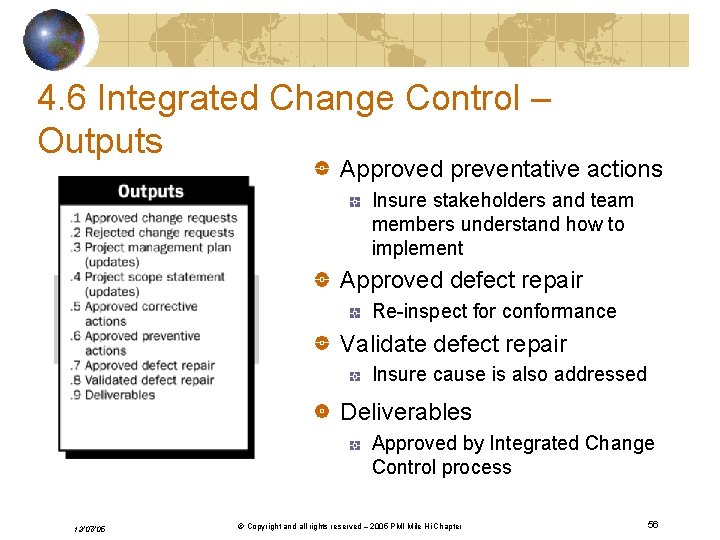
4. 6 Integrated Change Control – Outputs Approved preventative actions Insure stakeholders and team members understand how to implement Approved defect repair Re-inspect for conformance Validate defect repair Insure cause is also addressed Deliverables Approved by Integrated Change Control process 12/07/05 v. 2. © Copyright and all rights reserved – 2005 PMI Mile Hi Chapter 56
4. 6 Integrated Change Control Lessons Learned – Items to be documented so that they become part of the historical database for project within the organization, to include: The causes of variances The reasoning behind the corrective action Other types of lessons learned to insure it is not repeated 12/07/05 v. 2. © Copyright and all rights reserved – 2005 PMI Mile Hi Chapter 57
4. 7 Close Project Involves performing the project closure portion of the project management plan. In multi-phase projects, this process closes out the portion of the project scope and associated activities completed in this phase. 12/07/05 v. 2. © Copyright and all rights reserved – 2005 PMI Mile Hi Chapter 58
4. 7 Close Project Administrative Closure Details performing the project closure portion of the project management plan Includes analysis, lessons learned and archiving of project information Contract Closure Formal, written, product and project verification including all signatures and payment records. Identifies final results and supporting details Can be repeated for each phase of large contracts 12/07/05 v. 2. © Copyright and all rights reserved – 2005 PMI Mile Hi Chapter 59
4. 7 Close Project 12/07/05 v. 2. © Copyright and all rights reserved – 2005 PMI Mile Hi Chapter 60
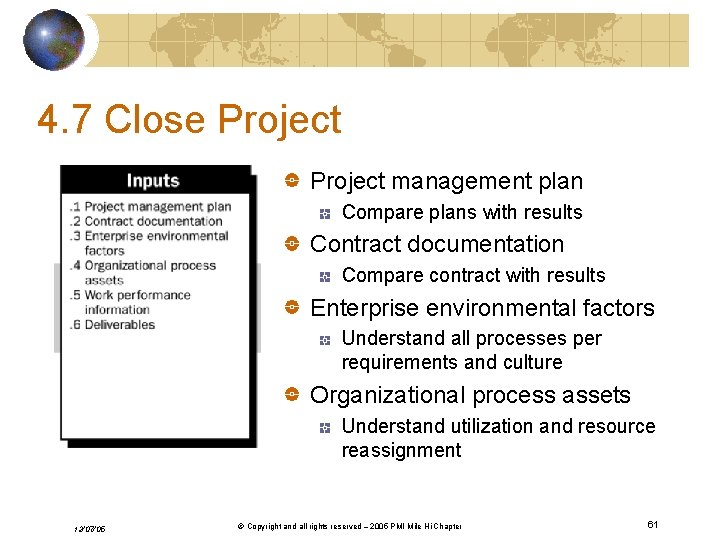
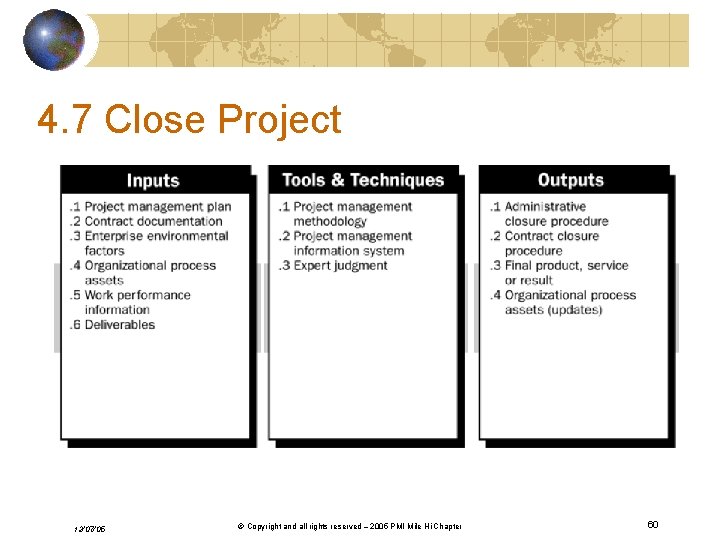
4. 7 Close Project management plan Compare plans with results Contract documentation Compare contract with results Enterprise environmental factors Understand all processes per requirements and culture Organizational process assets Understand utilization and resource reassignment 12/07/05 v. 2. © Copyright and all rights reserved – 2005 PMI Mile Hi Chapter 61
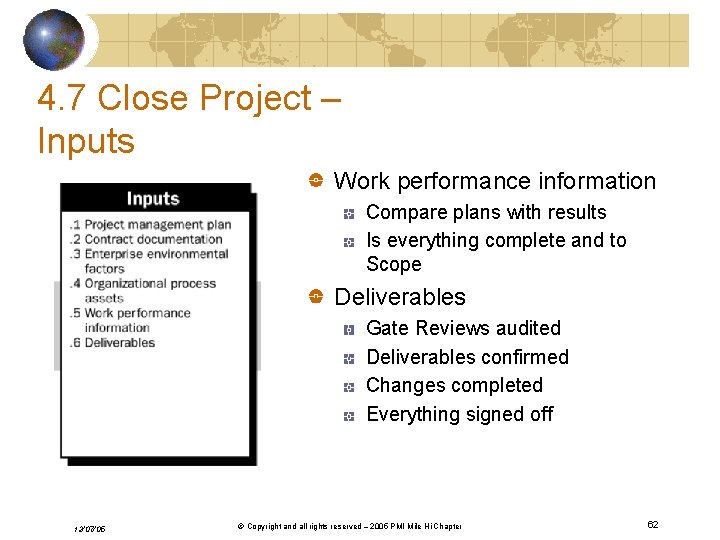
4. 7 Close Project – Inputs Work performance information Compare plans with results Is everything complete and to Scope Deliverables Gate Reviews audited Deliverables confirmed Changes completed Everything signed off 12/07/05 v. 2. © Copyright and all rights reserved – 2005 PMI Mile Hi Chapter 62
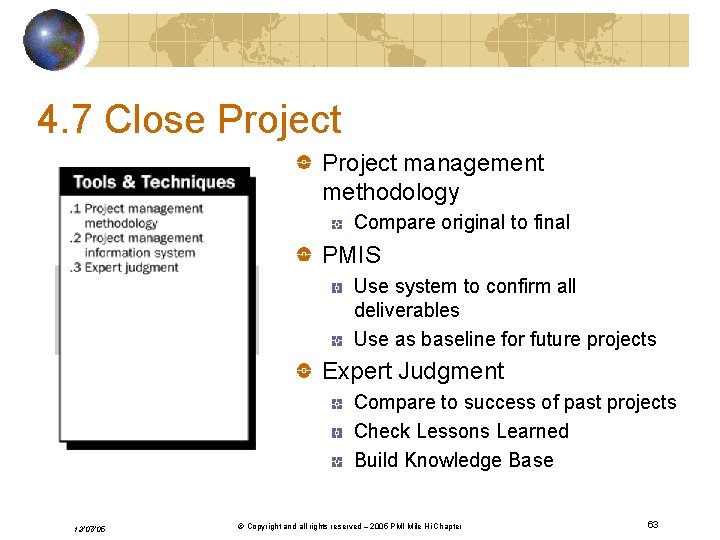
4. 7 Close Project management methodology Compare original to final PMIS Use system to confirm all deliverables Use as baseline for future projects Expert Judgment Compare to success of past projects Check Lessons Learned Build Knowledge Base 12/07/05 v. 2. © Copyright and all rights reserved – 2005 PMI Mile Hi Chapter 63
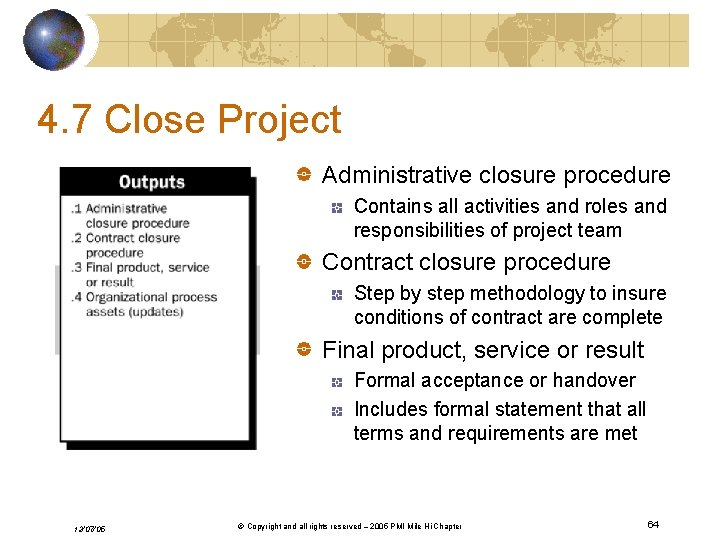
4. 7 Close Project Administrative closure procedure Contains all activities and roles and responsibilities of project team Contract closure procedure Step by step methodology to insure conditions of contract are complete Final product, service or result Formal acceptance or handover Includes formal statement that all terms and requirements are met 12/07/05 v. 2. © Copyright and all rights reserved – 2005 PMI Mile Hi Chapter 64
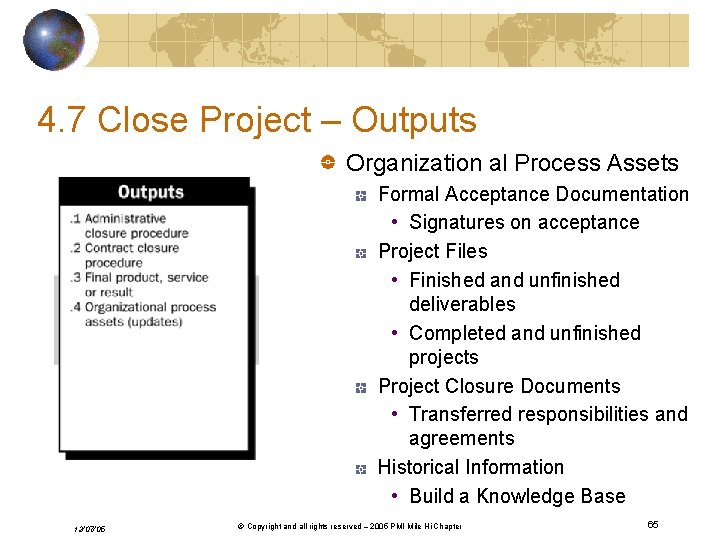
4. 7 Close Project – Outputs Organization al Process Assets Formal Acceptance Documentation • Signatures on acceptance Project Files • Finished and unfinished deliverables • Completed and unfinished projects Project Closure Documents • Transferred responsibilities and agreements Historical Information • Build a Knowledge Base 12/07/05 v. 2. © Copyright and all rights reserved – 2005 PMI Mile Hi Chapter 65

Integration Management Successful integration management provides the framework for the Project Manager to take the correct action to keep the project on track when unexpected problems arise. 12/07/05 v. 2. © Copyright and all rights reserved – 2005 PMI Mile Hi Chapter 66
Integration Management Characteristics of effective integration: Overlapping processes Effective change control and communications Reduced development time and cost Early and on-going involvement of all stakeholders Early visibility of results Early problem identification and resolution Use all relevant expertise at earliest meaningful time 12/07/05 v. 2. © Copyright and all rights reserved – 2005 PMI Mile Hi Chapter 67
Integration Management Summary Know what components are included in integration management. Know the integration management processes and to which process group they belong. Understand the inputs, tools and techniques, and outputs for each of the integration management processes 12/07/05 v. 2. © Copyright and all rights reserved – 2005 PMI Mile Hi Chapter 68
Integration Management Summary Recognize that the project plan includes many components and these document the basis for all project decisions Use the information about integration management to understand the authority and limits to authority for the project manager, especially regarding project scope 12/07/05 v. 2. © Copyright and all rights reserved – 2005 PMI Mile Hi Chapter 69
Integration Management Summary Recognize that all changes to the project should be guided by a documented process in the project plan. Know Rita Mulcahy’s “QUICKTEST TOPICS” in the Integration Management, chapter 4 in the PMP EXAM PREP. 12/07/05 v. 2. © Copyright and all rights reserved – 2005 PMI Mile Hi Chapter 70
4. Project Integration Management Questions ? Thank you v. 2. © Copyright and all rights reserved – 2005 PMI Mile Hi Chapter Integration -
- Slides: 71