
4 Probability Lesson 4 6 The Multiplication Rule

4 Probability Lesson 4. 6 The Multiplication Rule for Independent Events Statistics and Probability with Applications, 3 rd Edition Starnes & Tabor Bedford Freeman Worth Publishers
The Multiplication Rule for Independent Events Learning Targets After this lesson, you should be able to: ü Use the multiplication rule for independent events to calculate probabilities. ü Calculate P(at least one) using the complement rule and the multiplication rule for independent events. ü Determine if it is appropriate to use the multiplication rule for independent events in a given setting. Statistics and Probability with Applications, 3 rd Edition 2
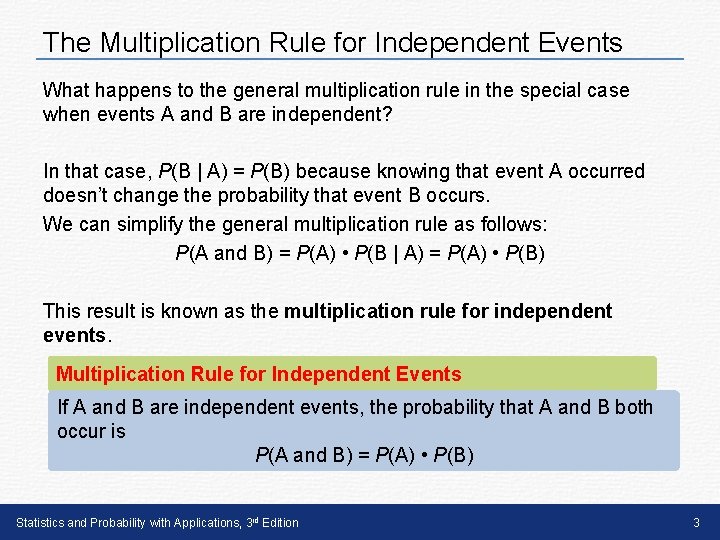
The Multiplication Rule for Independent Events What happens to the general multiplication rule in the special case when events A and B are independent? In that case, P(B | A) = P(B) because knowing that event A occurred doesn’t change the probability that event B occurs. We can simplify the general multiplication rule as follows: P(A and B) = P(A) • P(B | A) = P(A) • P(B) This result is known as the multiplication rule for independent events. Multiplication Rule for Independent Events If A and B are independent events, the probability that A and B both occur is P(A and B) = P(A) • P(B) Statistics and Probability with Applications, 3 rd Edition 3
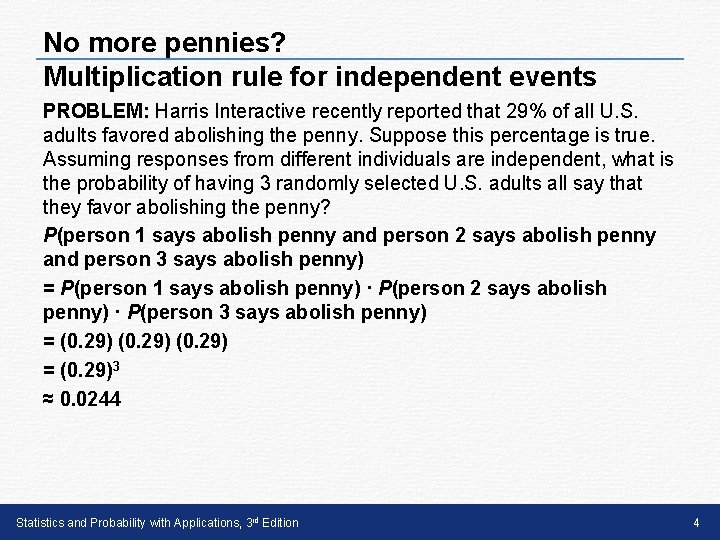
No more pennies? Multiplication rule for independent events PROBLEM: Harris Interactive recently reported that 29% of all U. S. adults favored abolishing the penny. Suppose this percentage is true. Assuming responses from different individuals are independent, what is the probability of having 3 randomly selected U. S. adults all say that they favor abolishing the penny? P(person 1 says abolish penny and person 2 says abolish penny and person 3 says abolish penny) = P(person 1 says abolish penny) · P(person 2 says abolish penny) · P(person 3 says abolish penny) = (0. 29) = (0. 29)3 ≈ 0. 0244 Statistics and Probability with Applications, 3 rd Edition 4
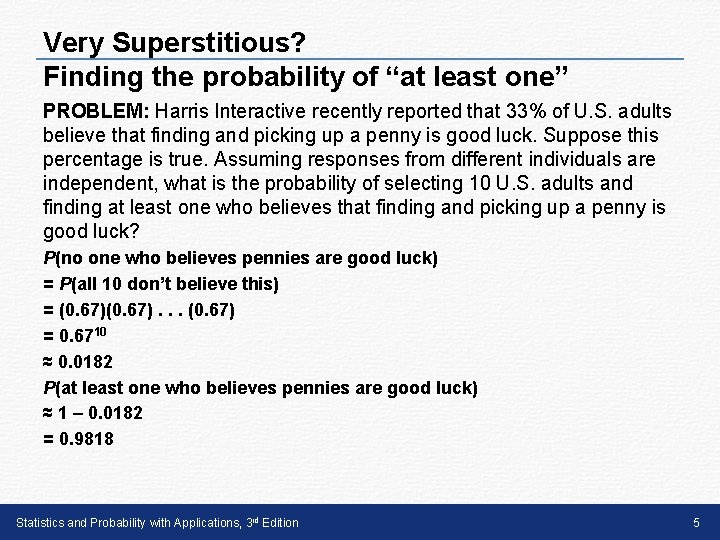
Very Superstitious? Finding the probability of “at least one” PROBLEM: Harris Interactive recently reported that 33% of U. S. adults believe that finding and picking up a penny is good luck. Suppose this percentage is true. Assuming responses from different individuals are independent, what is the probability of selecting 10 U. S. adults and finding at least one who believes that finding and picking up a penny is good luck? P(no one who believes pennies are good luck) = P(all 10 don’t believe this) = (0. 67). . . (0. 67) = 0. 6710 ≈ 0. 0182 P(at least one who believes pennies are good luck) ≈ 1 – 0. 0182 = 0. 9818 Statistics and Probability with Applications, 3 rd Edition 5
The Multiplication Rule for Independent Events The multiplication rule P(A and B) = P(A) · P(B) holds if A and B are independent but not otherwise. The addition rule P(A or B) = P(A) + P(B) holds if A and B are mutually exclusive but not otherwise. Resist the temptation to use these simple rules when the conditions that justify them are not met. Statistics and Probability with Applications, 3 rd Edition 6
Getting pregnant after age 55? Beware lack of independence! PROBLEM: According to the Current Population Survey (CPS), 27% of U. S. females are older than 55. The Centers for Disease Control and Prevention (CDC) report that 6% of all U. S. females are pregnant. Suppose that these results are accurate. If we randomly select a U. S. female, is P(pregnant and over 55) = (0. 06)(0. 27) = 0. 0162? Why or why not? No, because being older than 55 and being pregnant are not independent events. Knowing that the chosen female is older than 55 makes it much less likely that she is pregnant. Statistics and Probability with Applications, 3 rd Edition 7
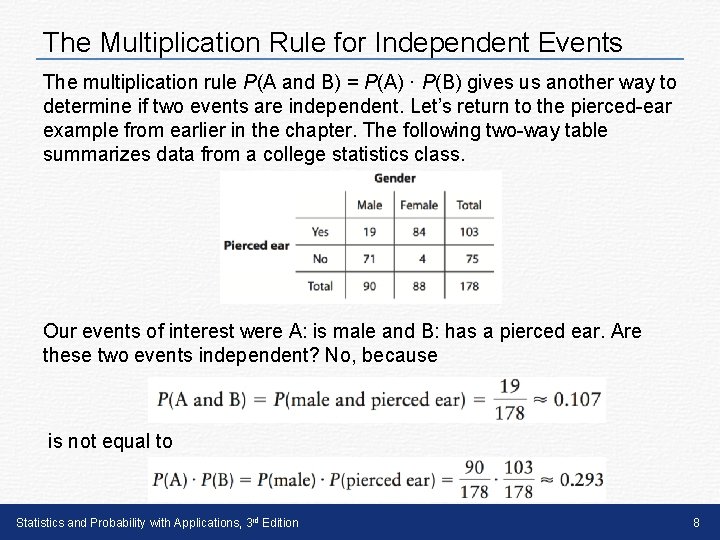
The Multiplication Rule for Independent Events The multiplication rule P(A and B) = P(A) · P(B) gives us another way to determine if two events are independent. Let’s return to the pierced-ear example from earlier in the chapter. The following two-way table summarizes data from a college statistics class. Our events of interest were A: is male and B: has a pierced ear. Are these two events independent? No, because is not equal to Statistics and Probability with Applications, 3 rd Edition 8
LESSON APP 4. 6 How should we interpret genetic screening? The First Trimester Screen is a test given during the first trimester of pregnancy to determine if there are specific chromosomal abnormalities in the fetus. According to a study published in the New England Journal of Medicine, approximately 5% of normal pregnancies will receive a positive result. Assume that test results for individual women are independent. 1. Suppose that two unrelated women who are having normal pregnancies, Devondra and Miranda, are given the First Trimester Screen. What is the probability that Devondra gets a positive result and Miranda gets a negative result? 2. If 100 unrelated women with normal pregnancies are tested with the First Trimester Screen, what is the probability that at least 1 woman will receive a positive result? Statistics and Probability with Applications, 3 rd Edition 9
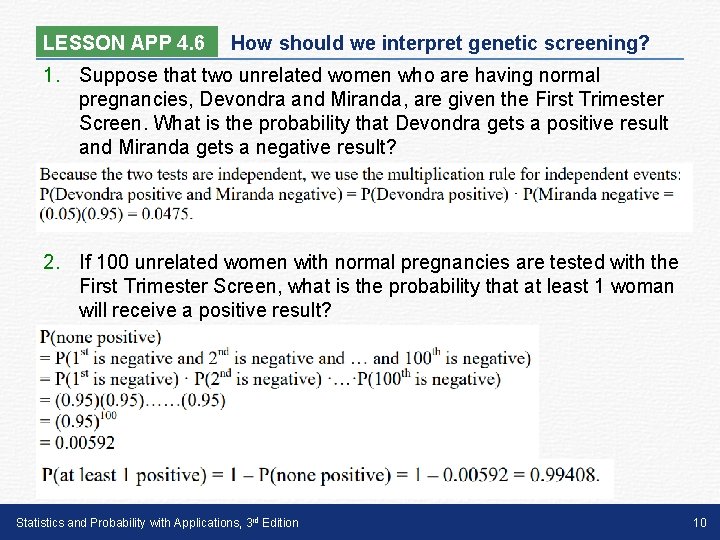
LESSON APP 4. 6 How should we interpret genetic screening? 1. Suppose that two unrelated women who are having normal pregnancies, Devondra and Miranda, are given the First Trimester Screen. What is the probability that Devondra gets a positive result and Miranda gets a negative result? 2. If 100 unrelated women with normal pregnancies are tested with the First Trimester Screen, what is the probability that at least 1 woman will receive a positive result? Statistics and Probability with Applications, 3 rd Edition 10
The Multiplication Rule for Independent Events Learning Targets After this lesson, you should be able to: ü Use the multiplication rule for independent events to calculate probabilities. ü Calculate P(at least one) using the complement rule and the multiplication rule for independent events. ü Determine if it is appropriate to use the multiplication rule for independent events in a given setting. Statistics and Probability with Applications, 3 rd Edition 11
- Slides: 11