
4 Probability Lesson 4 1 Randomness Probability and
4 Probability Lesson 4. 1 Randomness, Probability, and Simulation Statistics and Probability with Applications, 3 rd Edition Starnes & Tabor Bedford Freeman Worth Publishers
Randomness, Probability, and Simulation Learning Targets After this lesson, you should be able to: ü Interpret probability as a long-run relative frequency. ü Dispel common myths about randomness. ü Use simulation to model chance behavior. Statistics and Probability with Applications, 3 rd Edition 2
Randomness, Probability, and Simulation Chance is all around us. The mathematics of chance behavior is called probability. Chance behavior is unpredictable in the short run, but has a regular and predictable pattern in the long run. Probability The probability of any outcome of a chance process is a number between 0 and 1 that describes the proportion of times the outcome would occur in a very large number of repetitions. Statistics and Probability with Applications, 3 rd Edition 3
Randomness, Probability, and Simulation Outcomes that never occur have probability 0. An outcome that happens on every repetition has probability 1. An outcome that happens half the time in a very long series of trials has probability 0. 5. The fact that the proportion of heads in many tosses of a coin eventually closes in on 0. 5 is guaranteed by the law of large numbers. Law of Large Numbers The law of large numbers says that if we observe more and more repetitions of any chance process, the proportion of times that a specific outcome occurs approaches its probability. Statistics and Probability with Applications, 3 rd Edition 4
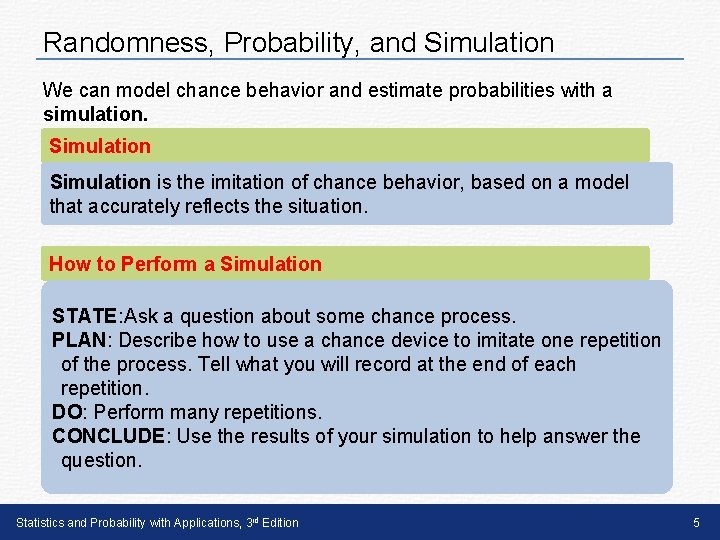
Randomness, Probability, and Simulation We can model chance behavior and estimate probabilities with a simulation. Simulation is the imitation of chance behavior, based on a model that accurately reflects the situation. How to Perform a Simulation STATE: Ask a question about some chance process. PLAN: Describe how to use a chance device to imitate one repetition of the process. Tell what you will record at the end of each repetition. DO: Perform many repetitions. CONCLUDE: Use the results of your simulation to help answer the question. Statistics and Probability with Applications, 3 rd Edition 5
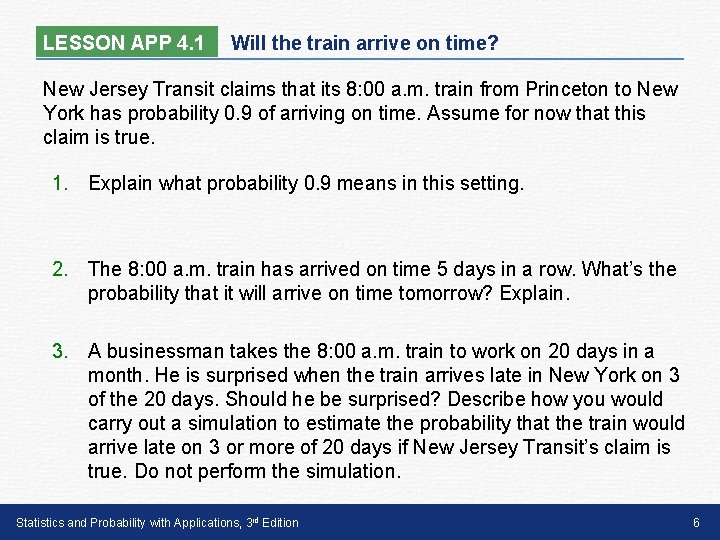
LESSON APP 4. 1 Will the train arrive on time? New Jersey Transit claims that its 8: 00 a. m. train from Princeton to New York has probability 0. 9 of arriving on time. Assume for now that this claim is true. 1. Explain what probability 0. 9 means in this setting. 2. The 8: 00 a. m. train has arrived on time 5 days in a row. What’s the probability that it will arrive on time tomorrow? Explain. 3. A businessman takes the 8: 00 a. m. train to work on 20 days in a month. He is surprised when the train arrives late in New York on 3 of the 20 days. Should he be surprised? Describe how you would carry out a simulation to estimate the probability that the train would arrive late on 3 or more of 20 days if New Jersey Transit’s claim is true. Do not perform the simulation. Statistics and Probability with Applications, 3 rd Edition 6
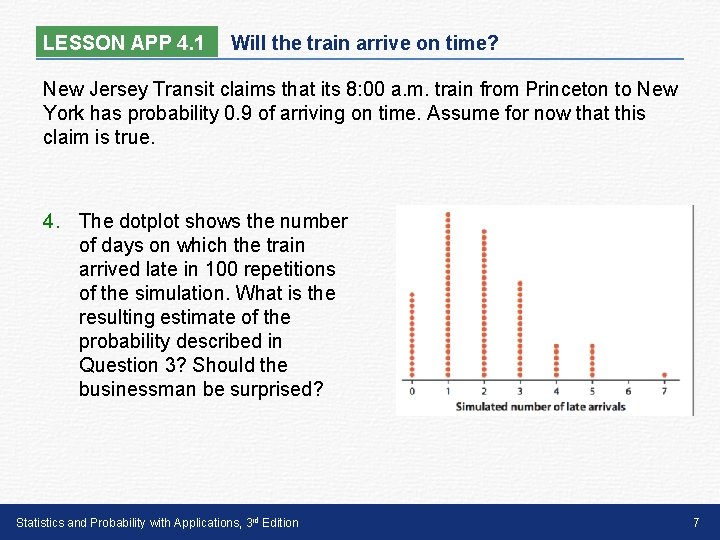
LESSON APP 4. 1 Will the train arrive on time? New Jersey Transit claims that its 8: 00 a. m. train from Princeton to New York has probability 0. 9 of arriving on time. Assume for now that this claim is true. 4. The dotplot shows the number of days on which the train arrived late in 100 repetitions of the simulation. What is the resulting estimate of the probability described in Question 3? Should the businessman be surprised? Statistics and Probability with Applications, 3 rd Edition 7
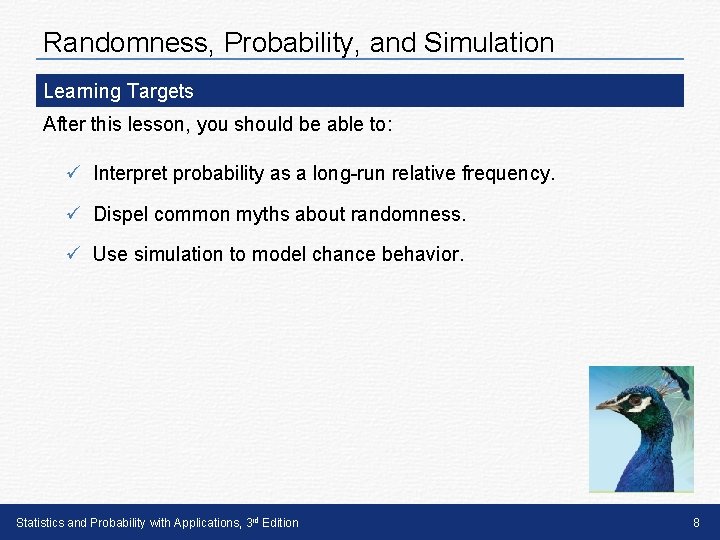
Randomness, Probability, and Simulation Learning Targets After this lesson, you should be able to: ü Interpret probability as a long-run relative frequency. ü Dispel common myths about randomness. ü Use simulation to model chance behavior. Statistics and Probability with Applications, 3 rd Edition 8
- Slides: 8